
Key Takeaways
1. The Afghan Jihad: A Cold War Proxy That Bred New Enemies
"It is essential that Afghanistan’s resistance continues,” he wrote. “This means more money as well as arms shipments to the rebels, and some technical advice."
Proxy war's genesis. The Soviet invasion of Afghanistan in 1979, driven by fears of losing a client state and perceived CIA intrigues, prompted the U.S. to covertly arm Afghan rebels. National Security Adviser Zbigniew Brzezinski saw an opportunity to bleed the Soviets, leading President Carter to authorize initial "non-lethal" aid, quickly escalating to weapons under President Reagan. This strategy, while effective against the Soviets, inadvertently laid the groundwork for future threats.
Unforeseen consequences. Both superpowers initially underestimated the power of Islamic fundamentalism, viewing the Afghan rebels as mere "bandits." The CIA's mission was to "harass" Soviet forces, not to win outright, leading to a hands-off approach to Afghan politics. This created a fertile ground for radical ideologies to take root, as the focus remained solely on expelling the Soviets, with little thought given to the long-term political landscape.
A new enemy emerges. The jihad attracted thousands of foreign volunteers, including Osama bin Laden, who would later turn their focus on the U.S. The CIA's success in driving out the Soviets, celebrated as one of its proudest achievements, masked the unintended consequence of empowering a new, transnational enemy that would eventually strike the American homeland.
2. Pakistan's Double Game: Fueling Extremism While Partnering the U.S.
"The self-perpetuating secret routines of these official liaisons, and their unexamined assumptions, helped create the Afghanistan that became Osama bin Laden’s sanctuary."
Strategic imperative. Pakistan, under General Zia-ul-Haq, became the indispensable conduit for U.S. and Saudi aid to the Afghan mujahideen. Zia, a devout Muslim and shrewd politician, leveraged this alliance to secure billions in aid and advanced weaponry, while simultaneously pursuing his own agenda: strengthening Islamist factions in Afghanistan to create a pro-Pakistan buffer state and using jihadists in Kashmir against India.
ISI's unchecked power. Pakistan's Inter-Services Intelligence (ISI) gained immense power and resources, becoming a "shadow government" within Pakistan. ISI systematically favored radical Islamist commanders like Gulbuddin Hekmatyar, often at the expense of more moderate or royalist Afghan leaders, and controlled the distribution of weapons and funds. This manipulation, often concealed from the CIA, ensured that Pakistan's Islamist agenda shaped the Afghan resistance.
A dangerous legacy. Despite CIA awareness of ISI's duplicity and its support for anti-American elements, the U.S. largely acquiesced, prioritizing the anti-Soviet fight. This reliance on ISI, driven by bureaucratic convenience and a desire to avoid direct involvement, allowed extremist networks to flourish, providing sanctuary and training for a new generation of jihadists who would later target the U.S.
3. Saudi Arabia's Ambiguous Role: Funding Piety and Peril
"Prince Turki embodied Saudi Arabia’s cascading contradictions."
A complex alliance. Saudi Arabia, fearing Soviet expansion and sharing an ideological opposition to communism, became a crucial financial partner in the Afghan jihad, matching U.S. aid dollar-for-dollar. Prince Turki al-Faisal, the Saudi intelligence chief, played a pivotal role, building GID into a powerful agency and fostering alliances with Pakistan and various Islamist groups.
Appeasing domestic radicals. The Saudi royal family, facing internal challenges from puritanical Wahhabi clerics and dissidents like Osama bin Laden, often appeased its Islamist critics by allowing them to fund and proselytize abroad. This led to a massive flow of Saudi charity and private funds to extremist groups in Afghanistan and Pakistan, often outside the control of official intelligence channels.
Bin Laden's early patron. Osama bin Laden, initially seen as a wealthy philanthropist, benefited from Saudi intelligence connections and charity networks. While never a formal agent, he was "our man" in Afghanistan, building roads and supporting Arab volunteers. This early patronage, combined with Saudi reluctance to confront bin Laden directly even after his anti-royal pronouncements, allowed his network to grow unchecked.
4. U.S. Disengagement: A Costly Vacuum After Soviet Withdrawal
"The United States government decided it had no further interests in Afghanistan."
Abandonment after victory. Following the Soviet withdrawal in 1989 and the USSR's collapse in 1991, the U.S. rapidly disengaged from Afghanistan. Despite warnings from diplomats like Peter Tomsen about the dangers of instability and rising extremism, the Clinton administration adopted a "hands-off" policy, viewing Afghanistan as a "dying issue" and a "black hole."
Ignoring the brewing storm. This disengagement meant the U.S. largely ignored the escalating civil war between Afghan factions, the growing influence of Pakistani and Saudi-backed Islamists, and the proliferation of jihadist training camps. Resources for intelligence collection in Afghanistan dwindled, leaving the U.S. blind to the evolving threats.
A missed opportunity. The decision to withdraw, driven by post-Cold War priorities and budget cuts, squandered years of investment and influence. It allowed Afghanistan to become a haven for transnational terrorists, drug traffickers, and extremist ideologies, setting the stage for future attacks against American interests.
5. The Taliban's Rise: A Misunderstood Force for Order and Extremism
"The Taliban assembled their story so that Pashtuns could recognize it as a revival of old glory."
Emergence from chaos. The Taliban, a militia of religious students, rose in Kandahar in 1994, capitalizing on popular revulsion against corrupt warlords and promising to restore order through strict Islamic law. Their narrative, blending traditional Pashtun values with austere Deobandi theology, resonated with many war-weary Afghans.
Pakistani and Saudi backing. The Taliban received significant covert support from Pakistan's ISI, which saw them as a means to achieve strategic depth against India and install a friendly government in Kabul. Saudi Arabia also provided substantial financial and ideological aid, viewing the Taliban as a Sunni bulwark against Iran and a reflection of their own Wahhabi principles.
U.S. miscalculation. The Clinton administration initially viewed the Taliban with a mix of indifference and cautious optimism, hoping they could stabilize Afghanistan and facilitate energy pipelines. Despite growing evidence of their extremism and human rights abuses, U.S. diplomats engaged with them, often underestimating their rigid ideology and their deepening alliance with Osama bin Laden.
6. Osama bin Laden's Evolution: From Financier to Global Terrorist Leader
"The judgment to kill and fight Americans and their allies, whether civilians or military, is an obligation for every Muslim who is able to do so in any country."
From patron to pariah. After his expulsion from Saudi Arabia and Sudan, Osama bin Laden found sanctuary in Afghanistan, where he deepened his ties with the Taliban. His initial role as a financier and organizer of Arab volunteers evolved into a more direct leadership of a transnational terrorist network, al Qaeda.
Declaration of war. In 1998, bin Laden, alongside Ayman al-Zawahiri, issued a fatwa declaring jihad against "Jews and Crusaders," explicitly calling for attacks on American civilians and military worldwide. This marked a significant escalation, transforming him from a regional agitator into a declared global enemy of the United States.
Operational expansion. From his Afghan base, bin Laden orchestrated the 1998 embassy bombings in Africa and the 2000 USS Cole attack, demonstrating al Qaeda's growing operational capability and ambition for mass casualties. He also cultivated a sophisticated media strategy, using interviews and videos to spread his message and recruit new followers.
7. Legal Constraints and Operational Paralysis: The CIA's Struggle Against Al Qaeda
"You are to capture him alive."
The assassination ban. The CIA's efforts to counter bin Laden were heavily constrained by a presidential ban on assassination, requiring agents to attempt capture even in high-risk situations. This legal nuance, while intended to uphold American values, created operational dilemmas in Afghanistan's lawless environment.
"The Afghan ambush." CIA officers, planning snatch operations with Afghan tribal agents, understood the practical reality: any attempt to capture bin Laden would likely result in a firefight. Despite clear instructions to take him alive, the expectation was often "the Afghan ambush," where lethal force would be used, creating a complex legal and ethical tightrope for the agency.
White House caution. The Clinton administration, wary of "collateral damage" and political fallout, often hesitated to approve risky operations, even when intelligence suggested bin Laden's location. This caution, combined with the legal ambiguities, led to missed opportunities to neutralize bin Laden, fueling frustration within the CIA's Counterterrorist Center.
8. Missed Opportunities: The Failure to Embrace Ahmed Shah Massoud
"Massoud believed that the Taliban were seeking to destroy him or force him into exile."
A vital but neglected ally. Ahmed Shah Massoud, the charismatic Tajik commander, was the most formidable military opponent of the Taliban and al Qaeda in Afghanistan. He consistently warned the U.S. about the growing threat posed by bin Laden and his allies, offering to cooperate in intelligence and counterterrorism efforts.
U.S. skepticism and neutrality. Despite Massoud's strategic importance and his willingness to fight, the U.S. largely maintained a policy of neutrality in the Afghan civil war, refusing to provide significant military aid. This stance was driven by:
- Skepticism about Massoud's ability to defeat the Taliban.
- Concerns about his human rights record and alleged drug trafficking.
- A desire not to alienate Pakistan, which actively opposed Massoud.
A tragic end. Massoud's pleas for substantial American support went largely unheeded. He was assassinated by al Qaeda operatives on September 9, 2001, just two days before the 9/11 attacks, eliminating a crucial potential ally on the ground.
9. The "Blinking Red" Warnings: Intelligence Overload Before 9/11
"We are going to be struck soon,” Cofer Black told the Pentagon’s classified annual conference on counterterrorism nine days later. “Many Americans are going to die, and it could be in the U.S.”
A surge of threats. In the months leading up to 9/11, the U.S. intelligence community, particularly the CIA's Counterterrorist Center, experienced an unprecedented surge in threat reporting from al Qaeda. Intercepts and human sources indicated multiple, spectacular attacks were imminent, some possibly targeting the U.S. homeland.
Vague but ominous. Despite the high volume, much of the intelligence remained maddeningly vague, lacking specific details about targets, timing, or methods. This created a dilemma for policymakers: how to act decisively on generalized warnings without risking false alarms or misdirected retaliation.
The challenge of actionable intelligence. The sheer volume of threats, combined with the difficulty of verifying them, led to an "overload" in the warning system. While the "system was blinking red," the ability to translate these warnings into precise, actionable intelligence for preemptive strikes or defensive measures proved elusive.
10. Bureaucratic Inertia: Competing Priorities and Lack of Urgency
"Is there any policy?"
Divided attention. The Bush administration, upon taking office, prioritized missile defense, military reform, China, and Iraq, with terrorism and Afghanistan ranking lower on the agenda. This shift in focus, combined with a perception that terrorism was a manageable, episodic threat, delayed a comprehensive response to al Qaeda.
Interagency friction. Internal divisions and rivalries among the CIA, FBI, State Department, and Pentagon hampered a unified approach. Debates over legal authorities, resource allocation, and the efficacy of different counterterrorism tactics often led to paralysis and missed opportunities.
A lack of political will. Despite dire warnings from intelligence officials like George Tenet, the political will to undertake a costly and risky war in Afghanistan, or to fundamentally alter alliances with Pakistan and Saudi Arabia, was absent. The prevailing sentiment was that Afghanistan was a problem to be managed, not solved, and that bin Laden was a criminal, not an existential threat.
11. The Human Cost: Afghanistan's Unending Cycle of War and Neglect
"What an unlucky country."
A land of suffering. Two decades of continuous conflict, fueled by superpower proxy wars and regional rivalries, left Afghanistan devastated. Millions died, millions more became refugees, and the country's infrastructure crumbled, leading to widespread poverty, disease, and illiteracy.
The cycle of violence. The U.S. disengagement after the Soviet withdrawal, coupled with continued foreign interference, perpetuated a cycle of civil war and instability. The rise of the Taliban and al Qaeda was a direct consequence of this prolonged conflict and neglect, transforming Afghanistan into a sanctuary for global terrorism.
A tragic irony. The very country that helped the U.S. win the Cold War became the source of its greatest terrorist attack. The indifference and competing priorities of successive U.S. administrations, combined with the complex web of regional alliances and internal bureaucratic struggles, ultimately contributed to a catastrophic failure to address the brewing threat in Afghanistan.
Review Summary
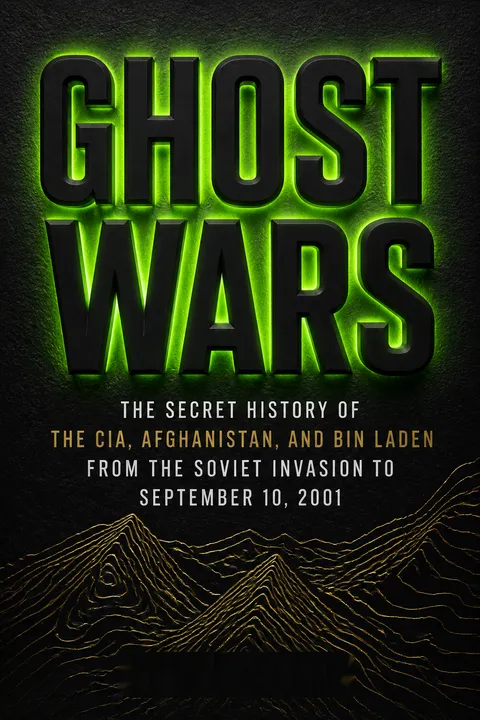
Reviewers widely praise Ghost Wars as a masterful, exhaustively researched account of CIA involvement in Afghanistan from 1979 to 9/11, with most awarding it four or five stars. Readers highlight Coll's balanced, non-partisan approach and vivid characterizations of key figures like Ahmed Shah Massoud and Osama bin Laden. Many describe it as essential reading for understanding modern geopolitics, though some note its density and length make it challenging. A few critics view it as an establishment narrative that glosses over deeper causes of terrorism.
People Also Read




Download PDF
Download EPUB
.epub digital book format is ideal for reading ebooks on phones, tablets, and e-readers.








































