

Key Takeaways
Stop waiting for fate; engineer your own luck in love
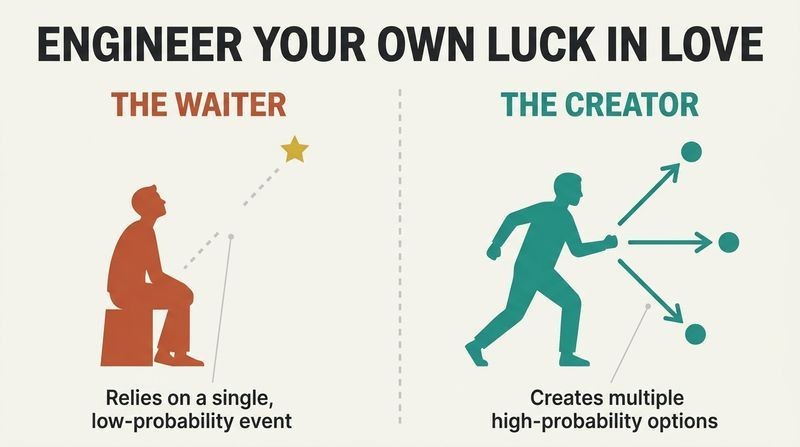
Love is created, not stumbled upon. Hussey opens with a blunt reframe: most people leave romance to chance, blaming Hollywood and fairy tales for the belief that The One will materialize at a stoplight. He tells the story of Jane, who met her boyfriend randomly at eighteen, then found herself at twenty-five heartbroken and clueless, because she had won love like a lottery and had no formula to replicate it.
Waiters get the wrong thing or nothing. The remedy is to become a creator. Ask yourself constantly: am I waiting or creating? Waiting has one method (do nothing); creating has thousands. Hussey argues the deep satisfaction of taking action itself makes people happy, even before results arrive.
The lottery-winner analogy is sharper than it first appears. Behavioral economists note that windfall recipients often go broke because they never built the skill of generating wealth, only the luck of receiving it. The same holds for relationships. What's valuable here is the agency reframe, echoing psychologist Julian Rotter's concept of internal versus external locus of control. People who believe outcomes are within their influence take more action and report higher well-being. The nuance worth flagging: agency can tip into anxious over-effort. The healthiest stance treats proactivity as a game to enjoy, not a desperate campaign, which Hussey does emphasize.
Pour every non-creepy man into your funnel, then filter ruthlessly
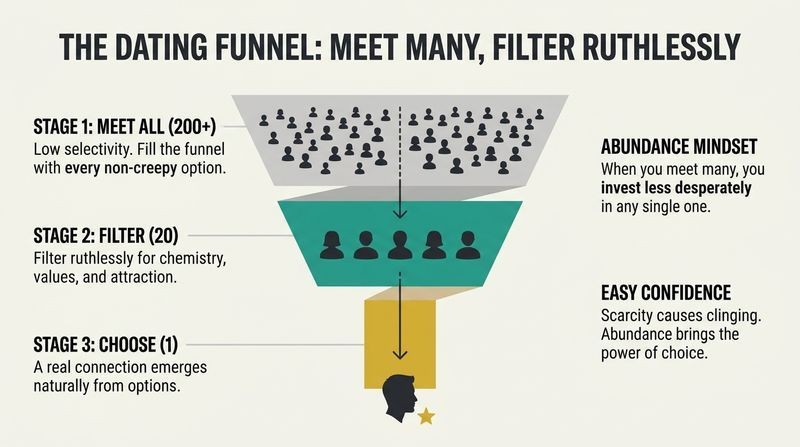
Meet many to choose well. Hussey's core system is the funnel: the first and widest funnel catches every new man you meet, with zero selectivity. Later funnels filter for attraction, chemistry, and relationship potential. If you meet only one man every three years, you have nothing to compare him to and risk settling. Imagine 200 men at a party: maybe 20 attract you, 10 warrant a date, 5 a second date, 1 a real connection.
Abundance beats scarcity. Meeting many men shifts your psychology. When you believe good men are plentiful (they are 50% of the population), you invest less desperately in any single one, become choosier, and radiate an easy-come, easy-go confidence. Scarcity thinking makes you cling to the first decent option.
The funnel is essentially a sales pipeline applied to dating, and the abundance-versus-scarcity distinction maps neatly onto negotiation theory, where the party with the best alternative (a strong BATNA) holds the power. Someone with many prospects negotiates from strength. There is real psychological research backing this: perceived abundance reduces anxious attachment behaviors. A fair critique is that framing humans as funnel inputs can feel transactional, and Hussey concedes this, arguing that systematizing the meeting phase does not cheapen the love that results. The deeper point stands: emotional desperation is often just a math problem disguised as a feeling.
Build tiny conversation rituals until sociability becomes automatic
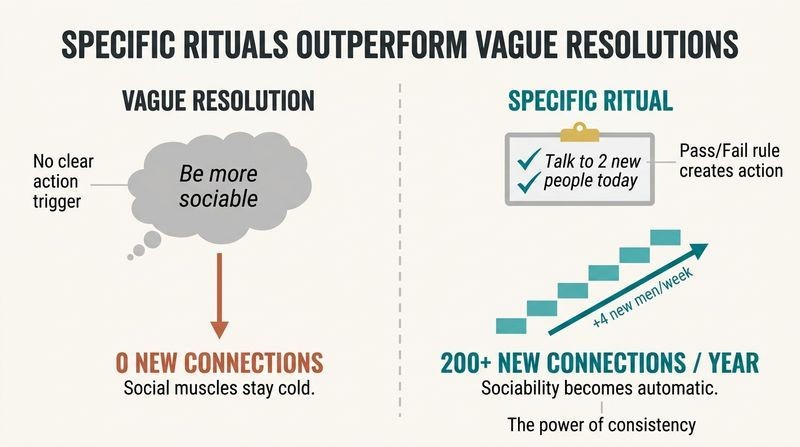
Ordinary actions, done consistently, transform love lives. Hussey borrows Keith Cunningham's line that consistent ordinary things produce extraordinary results. Rather than a dramatic makeover, he prescribes small repeatable rituals: talk to all service staff, learn one new person's name daily, compliment three people, perform one random act of kindness, and never leave the gym without three conversations. Four new men a week equals 200 a year.
Specificity makes rituals stick. A vague resolution like be more sociable fails because you cannot measure it. A concrete rule (talk to two new men on the way to work) gives you a pass-fail criterion. The point is not that each stranger is a candidate but that practicing on everyone keeps your social muscles warm for the moment that matters.
This is habit science applied to charisma. James Clear and BJ Fogg both stress that specificity and small scale are what make behaviors durable, and Hussey intuited the same. The insistence on practicing with everyone, not just attractive targets, is the sleeper insight. It reflects the psychological principle of desensitization: repeated low-stakes exposure erodes fear. Salespeople and improv actors train identically. One caveat: not all cultures or contexts welcome unsolicited chat from strangers, and the rituals assume a fairly extroverted, urban Western environment. Still, the underlying mechanism, converting a scary skill into an unremarkable habit through volume, is robust and widely transferable.
Become a high-value woman by living an extraordinary life first
Extraordinary attracts extraordinary. Hussey's thesis is that to get an exceptional partner you must embody the qualities you seek. He names four traits of high value: self-confidence (certainty about your own worth), independence (a full life you love with or without a man), integrity (sticking to your principles), and femininity (comfort letting a man feel needed).
Certainty is the sexiest quality. He illustrates with a cab driver who quipped someone must think highly of him, because they sent him. That relaxed self-assuredness, not arrogance, is magnetic. A woman with a brimming life does not seek a man to fill a void, which frees her to be selective. As he puts it, before you get the guy, get a life. Passionate lives are inherently attractive.
The title concept rests on a self-development premise that predates dating advice: Aristotle's idea that we become what we repeatedly do. The independence argument has strong empirical support, as self-expansion theory in relationship psychology shows people are drawn to partners who bring novelty and growth, which requires having a rich life to share. The femininity section is the most dated and contestable, leaning on essentialist claims about men needing to feel needed. Readers can extract the durable kernel (interdependence beats both neediness and cold self-sufficiency) while questioning the gendered packaging. The strongest, least controversial claim is simply this: build a life so good that a partner is a bonus, not a rescue.
The hottest men rarely approach; make the first move invisibly
Attraction paralyzes men, not emboldens them. After coaching over 10,000 men, Hussey debunks the myth that if he liked you, he would come over. The more attracted a man is, the less likely he approaches, because rejection threatens his status among friends, which he fears more than women realize. The confident approachers are often the 1% of players worth avoiding.
Use the modern white handkerchief. In Victorian times a woman dropped her handkerchief so a man could return it and start talking, letting him feel he acted on fate. Hussey updates this: give two looks (one glance, then a lingering smile), physically move closer, wave him over, or ask a small favor. A University of Wisconsin study found a smile made men 70% more likely to approach than eye contact alone.
This reframe dissolves a painful misattribution. Women often read male inaction as personal rejection when it is usually male fear, an error psychologists call the fundamental attribution error applied to romance. The handkerchief technique is clever social engineering: it lowers the man's perceived risk while preserving his sense of initiative, satisfying the ego without deception. There is a subtle feminist tension worth naming: the approach still requires the man to feel he chose, which some readers find like managing fragility rather than transcending it. Yet Hussey's underlying data point, that most men are far more insecure than they appear, is a genuinely liberating corrective to decades of wait-to-be-chased advice.
Ditch the resume interview; hunt values, not facts
Small talk kills chemistry. Trading where-do-you-work questions guarantees a forgettable exchange because neither person reveals personality. Hussey urges seeking values over facts. Instead of asking a man's job, ask what he would do if every career paid the same, then follow with why. Emotion-based questions expose what someone truly cares about; logical questions are mere placeholders.
Create sexual tension through playful testing. He teaches manufacturing a false debt: tell a man he passed a test (You have good taste, you passed) or failed one (Lemon muffin? This would never work between us). His emotional brain wants to prove himself even though he knows it is a game. Flirting is spontaneity and letting go of self-consciousness, not smooth martini-glass sophistication.
The values-not-facts principle aligns with research by Arthur Aron, whose famous 36 questions accelerated intimacy precisely by skipping surface data for meaningful self-disclosure. Hussey independently arrives at the same insight: emotional revelation bonds people faster than biographical exchange. The false-debt technique is essentially a micro-application of the Zeigarnik effect and commitment consistency, where people work to resolve an incomplete challenge. A reasonable critique is that scripted teasing can feel manipulative or land awkwardly without genuine warmth. The technique works only when playfulness is authentic. Used mechanically, it reads as a line. The transferable core, replacing interrogation with curiosity about what someone values, improves any conversation, romantic or not.
Perceived beauty from behavior beats objective beauty every time
Attraction has a formula. Hussey's equation: Visual Chemistry plus Perceived Challenge plus Perceived Value plus Connection equals deep, lasting attraction. Visual chemistry comes not from objective beauty (which shifts by era, from Marilyn Monroe's curves to today's toned abs) but from perceived beauty, the attractiveness created through charisma, confidence, and playful energy.
Beauty alone is a liability. He compares a stunning but hollow woman to a Ferrari with a weak engine. Objectively beautiful women who rely on looks often leave their personalities underdeveloped, making them harder to stay attracted to. Perceived challenge means having standards a man must rise to; perceived value means having a life he wants to join; connection means genuine emotional intimacy. All four must work in concert.
The perceived-versus-objective beauty distinction has solid grounding in the psychology of attraction. Studies on the mere-exposure effect and the halo of warmth show that likability and animation measurably raise perceived physical attractiveness over time, while static beauty ratings drop as personality disappoints. Evolutionary psychologist Geoffrey Miller argues charisma, humor, and social intelligence are themselves fitness signals, which supports Hussey's claim that behavior generates desire. The Ferrari metaphor is memorable but slightly overstates the beauty-as-curse case. Attractive people do accrue real advantages. The honest reframe is that looks open a door which personality must walk through, and the door is far wider than most anxious people believe.
Sex bonds men only after the emotional hook point
Timing sex by date-count misses the point. Hussey rejects the wait-three-dates rule as arbitrary game-playing. What matters is the emotional hook point: the moment a man becomes emotionally attached, thinking of you when watching a film with friends, detouring to your neighborhood, wondering what you are doing at night. Sex should deepen an existing connection, not attempt to manufacture one.
Men value physical contact they have earned. He argues men suffer anxiety at having had a woman anyone could have had; unearned sex tanks your perceived value. Sexual validation comes not from the act but from feeling chosen, that no other man could have won you. He advises never punishing a man for wanting sex, but watching how he reacts to a graceful no. A man who reacts angrily was never planning to stay.
The emotional hook point is Hussey's most useful coinage because it replaces a rule with a diagnostic. It aligns loosely with attachment research showing emotional bonding and sexual bonding operate on partly separate systems, and that oxytocin release from sex does not reliably create commitment absent emotional investment. The claim that men uniquely need to feel a partner was hard-won is more contested; the desire to feel chosen and special is well-documented across genders, not male-specific. The genuinely practical takeaway is the reaction test: how someone handles a boundary reveals character faster than any amount of stated intention. That principle generalizes well beyond sex.
Escape the friend zone by injecting sexuality early
Connection without sexual tension traps you. Hussey's equation for the friend zone: Playfulness plus Spontaneity plus Connection, minus Sexuality, equals friend trap. Women who become a man's confidante, coaching him through his other romances, cement themselves as buddies. He cites When Harry Met Sally: Harry only sees Sally sexually when she fakes an orgasm at the deli, suddenly revealing a side he never imagined.
Establish desire from the start. Escape tactics: refuse the relationship-coach role, be willing to disagree (breaking rapport creates more attraction than constant agreement), make clear certain perks are reserved for a partner, and voice sexual thoughts obliquely (That jacket is sexy, take it off). Become physically tactile with everyone so touch feels natural, not loaded. The early stage previews the relationship; show the sexual side now or lose it.
The friend-zone equation crystallizes a real dynamic that social psychology recognizes as the distinction between liking and desire, which can decouple. The advice to break rapport by disagreeing is counterintuitive but supported by research on attraction and challenge; consistent agreement signals low value and reduces intrigue, while measured difference signals a self that must be won. The When Harry Met Sally reference is apt cultural shorthand. One limitation: the framework treats the friend zone as always a failure of technique, when sometimes a person simply is not attracted, and no amount of tactical sexuality changes that. Reading persistent non-interest as a puzzle to solve can shade into disrespecting a clear answer.
Judge a man by how he treats you, not his resume
Beware premature obligation. Hussey warns against committing emotionally before a man has earned it. Women often fall for a man's potential or for how impressively he moves through the world, then mold him into an imagined Mr. Right and over-invest. A man may be a wonder in his own life yet have done nothing for you specifically.
Reciprocity and the investment bank. Picture a bank account: a man builds credit by making effort to see you, showing generosity, and looking out for your interests. Reward what he deposits, and he learns that investing earns him more. His summary of the mating instinct: give a man ten women and he plays; give a woman ten men and she chooses. So slow down, keep meeting others, and let his actions, not his charisma, determine his value.
The investment-bank metaphor operationalizes the principle of reciprocity documented by Robert Cialdini, but with a twist rooted in the Ben Franklin effect Hussey cites elsewhere: people value what they work for and grow fonder of those they invest in, a phenomenon known as effort justification. So making a man invest is not manipulation but a way of deepening his genuine attachment. The evolutionary framing (women choose, men play) is a broad generalization that oversimplifies real variation and modern dynamics, and should be held loosely. The durable, gender-neutral insight is to evaluate anyone by their behavior toward you specifically, discounting both their reputation and your own projected fantasy.
Commitment fear is emotional association, not a fixed male trait
Two men, same needs, opposite feelings. Hussey distinguishes Mr. Bachelor from Mr. Relationship. Both crave sex, adventure, and excitement equally. The only difference is what they associate with commitment. Mr. Bachelor links being single to those pleasures and relationships to lost freedom, fueled by media fantasies of James Bond and The Hangover that never match his actually boring, lonely single reality.
Flip the script through action, not argument. You cannot logically debate a man into wanting commitment; he must sell himself on it. Hussey confesses he once told a woman he wanted nothing serious. She calmly replied she was not proposing, dropped him down her priority list, yet stayed her best self when they met. Given nothing to rebel against and shown a life he did not want to lose, he asked for commitment within weeks.
Reframing commitment phobia as a learned emotional association rather than an innate defect is genuinely useful and aligns with cognitive-behavioral principles: associations can be reconditioned through new experiences even when they resist verbal persuasion. His personal anecdote demonstrates a sophisticated grasp of reactance theory, the finding that people push back against perceived threats to their autonomy. By removing pressure, the woman removed the thing to resist. The parenting analogy (nothing to rebel against) is astute. The limitation is that some avoidance is rooted in deeper attachment wounds that no partner's technique can resolve, and the strategy risks keeping someone waiting on a person who is genuinely unavailable rather than merely uncertain.
Keep the guy by never ending the courtship
Getting him is the beginning, not the ending. Hussey pushes back on the Hollywood credits-roll fantasy. High value is not a short-term lure but a permanent practice, relevant on date one and after ten years. He identifies five things that keep a man devoted: sexual validation, recognition of his uniqueness, loyal teamwork, the chance to protect and provide, and being nurtured and supported.
Guard your standards and your life. He uses a train metaphor: your life is a train pulling into the station briefly. A man can climb aboard, but it will not sit waiting. Keep building the vibrant lifestyle that attracted him, maintain the standards you had at the start (do not tolerate at month six what you allowed on day one), and never stop having sex. His 83-year-old client, building a boat to sail away with her new love, proves it works at any age.
The continuity thesis, that courtship behaviors must persist, is well supported by relationship research on the corrosive power of complacency and the protective power of ongoing novelty and appreciation, as studied by John Gottman and Arthur Aron. Gottman's work in particular shows that small consistent bids for connection, not grand gestures, predict lasting marriages, which echoes Hussey's ritual-based philosophy. The five male needs framework is intuitive though gendered; most map onto universal human needs for esteem, autonomy, and belonging identified in self-determination theory. The train metaphor and the elderly boat-builder close the book on its truest note: these skills build not just a relationship but a self-respecting life that remains attractive precisely because it does not stop for anyone.
Analysis
Get the Guy is a framework-driven self-help book that repackages a male dating coach's insider knowledge for a female audience. Its structural cleverness lies in three acts (find, get, keep) that mirror the actual arc of relationship formation, and in Hussey's willingness to translate male psychology honestly, including the parts women find unflattering or implausible. The book's central, genuinely valuable move is the relentless reframe from passive to active: love as engineered outcome rather than fated accident. This agency thesis is philosophically sound and empirically supported by locus-of-control research.
What distinguishes the book from generic dating advice is its diagnostic vocabulary. The funnel, the emotional hook point, perceived versus objective beauty, and the friend-trap equation give readers mental models rather than rules, which is a more durable form of teaching. Hussey's attraction formula is reductive but memorable, and its insistence that behavior generates desire more than static appearance is both encouraging and consistent with attraction science.
The book's weaknesses are its era and its gender essentialism. Published in 2013, it leans on media references and on hardwired claims about masculine and feminine nature that read as dated and occasionally as managing male fragility rather than transcending it. The femininity chapter and the choose-versus-play mating generalizations are its softest ground, more folk psychology than evidence.
Yet Hussey largely inoculates himself by repeating that the deepest goal is a life worth living independent of any man. That framing rescues the transactional funnel logic from cynicism. The strongest through-line, evaluate people by their behavior toward you, keep courting after commitment, and build a self so full that a partner is addition not rescue, transcends dating entirely. Read charitably, it is a confidence and agency manual wearing a dating book's cover, and its best insights apply to friendship, career, and self-worth as readily as to romance.
Review Summary
Get the Guy receives mixed reviews. Many praise its empowering message and practical advice on self-improvement and dating. Readers appreciate Hussey's optimistic tone and insights into male psychology. However, some criticize the book for promoting unrealistic standards and reinforcing gender stereotypes. Critics argue that it oversimplifies relationships and places too much emphasis on changing oneself to attract a partner. Despite the polarized opinions, many readers found valuable takeaways about building confidence and creating opportunities for meaningful connections.
People Also Read




FAQ
What's Get the Guy about?
- Focus on Love Life: Get the Guy by Matthew Hussey is a guide for women to enhance their love lives by understanding male psychology and attraction.
- Three-Part Structure: The book is divided into "Find the Guy," "Get the Guy," and "Keep the Guy," each addressing different dating stages.
- Empowerment and Proactivity: Hussey encourages women to be proactive in their dating lives and develop a high-value lifestyle.
Why should I read Get the Guy?
- Insights into Male Mind: The book provides unique insights into male psychology, helping women understand what men desire in relationships.
- Practical Techniques: It offers actionable advice and techniques that can be immediately implemented to improve dating experiences.
- Boosts Confidence: Following Hussey's advice can help women build confidence and self-worth, making them more attractive to potential partners.
What are the key takeaways of Get the Guy?
- Be a High-Value Woman: Hussey emphasizes traits like self-confidence, independence, and integrity as key to attracting the right men.
- Proactive Approach: Women are encouraged to actively seek opportunities to meet men rather than waiting for them to approach.
- Create Attraction: The book outlines a formula for attraction, including visual chemistry, perceived challenge, and connection.
What is the "White Handkerchief Approach" in Get the Guy?
- Subtle Initiation: This approach allows women to signal interest in a man subtly, encouraging him to make the first move.
- Eye Contact and Smiles: Making eye contact and smiling are key components, showing interest and prompting engagement.
- Creating Opportunities: It helps women create opportunities for conversation without appearing desperate, balancing assertiveness with playfulness.
How can I be a high-value woman according to Get the Guy?
- Know Your Worth: A high-value woman is confident in her worth and knows what she deserves in a relationship.
- Set Standards: Having clear standards for a partner helps attract men who respect and meet those expectations.
- Maintain Independence: Engaging in meaningful activities and having a fulfilling life outside of a relationship is crucial.
What is the attraction formula mentioned in Get the Guy?
- Visual Chemistry: Initial physical attraction is important but just the starting point.
- Perceived Challenge: Presenting oneself as a challenge keeps the excitement alive and motivates pursuit.
- Connection: Establishing a genuine emotional connection is crucial for deep and lasting attraction.
How should I approach texting after meeting someone according to Get the Guy?
- Use Texts for Fun: Texts should be light, cheeky, and flirty, used for entertainment and logistics.
- Avoid Boring Texts: Mundane texts can kill attraction; instead, ask intriguing questions or make playful statements.
- Create Intrigue: Texts should create excitement and encourage responses, maintaining engagement.
What are some common myths about men and dating discussed in Get the Guy?
- "All Men Want Casual Flings": Hussey debunks this myth, stating many men desire meaningful connections.
- "There Are No Good Men": Good men are everywhere; women need to create opportunities to meet them.
- "Men Only Want Hotter Women": While physical attraction matters, men value personality and character more.
What is the emotional hook point in Get the Guy?
- Definition: It's the moment when a man becomes emotionally invested in a woman, crucial for deeper connection.
- Creating the Hook Point: Shared experiences and meaningful conversations help establish this emotional connection.
- Importance for Relationships: Recognizing and nurturing this connection is vital for long-term attraction.
How can I create a great date experience as per Get the Guy?
- Avoid Traditional Dates: Opt for interactive activities like hiking or visiting a museum instead of typical dinner dates.
- Be Playful and Engaging: Create a fun and spontaneous atmosphere to foster relaxation and openness.
- Focus on Connection: Aim to connect through engaging questions that reveal personal values and encourage meaningful conversation.
How can I tell if a guy is worth my time according to Get the Guy?
- Observe His Actions: Assess his commitment by how he treats you and invests in the relationship.
- Shared Values: Ensure alignment in core values for long-term compatibility.
- Growth Mindset: Look for signs of personal growth and teamwork, indicating a partner worth investing in.
What are the best quotes from Get the Guy and what do they mean?
- “A guy wants a girl he feels no one else can get, not one he feels he can’t get.”: Highlights the importance of perceived value in attraction.
- “When we own even our imperfections, our insecurities lose their power over us.”: Emphasizes self-acceptance and confidence.
- “The moment you start focusing on the future while he’s still thinking of where you’re going to eat tonight, he begins to wonder how the two of you are so out of sync.”: Stresses the importance of being present in the relationship.
About the Author
Other books by Matthew Hussey

Download PDF
Download EPUB
.epub digital book format is ideal for reading ebooks on phones, tablets, and e-readers.








































