

Key Takeaways
Your moment-to-moment energy state, not willpower, shapes your whole life
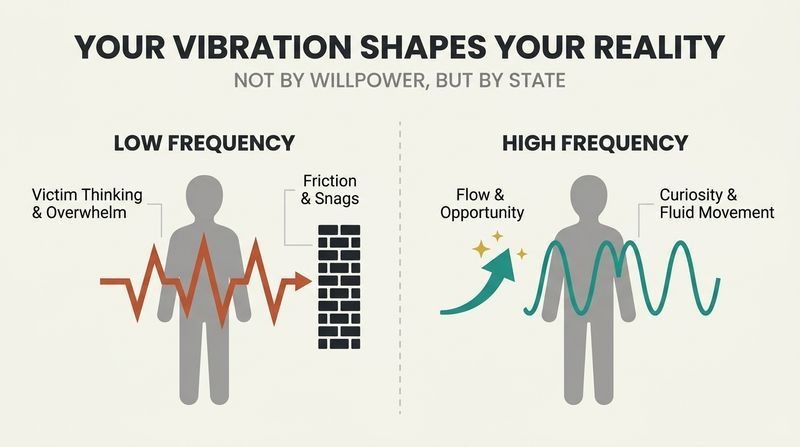
Personal vibration is the master tool. Peirce's core claim is that you are not a solid object separated from others by empty space but an oscillating field of energy. The frequency you hold in your body, emotions, and mind at any given moment (your personal vibration) determines what unfolds. Hold a high, fast, clear frequency and life flows with luck and ease; hold a slow, distorted one and you meet snags, disappointment, and drained relationships.
It fluctuates and it is yours to steer. Physical pain, victim thinking, or mental overwhelm drag it down; fluid movement, generosity, and curiosity lift it up. Improving any one channel (moving your body, softening a thought) pulls the others along. Other people and places can knock you off, but the choice of where you vibrate is ultimately internal.
The insight that emotional-physiological state precedes outcome echoes findings in affective science: mood priming shifts attention, risk appetite, and social signaling in measurable ways. Barbara Fredrickson's broaden-and-build research shows positive states literally widen perceptual scope. Where Peirce overreaches is treating vibration as a literal physical frequency that rearranges external events. A skeptic would separate two claims: that inner state changes how you perceive and act (well supported) and that it changes physical reality directly (unsupported). The pragmatic reader can adopt the first without swallowing the second, and still gain most of the book's value: treat your state as an instrument you tune, not a fixed condition you suffer.
Find your home frequency: the soul's tone you return to when lost
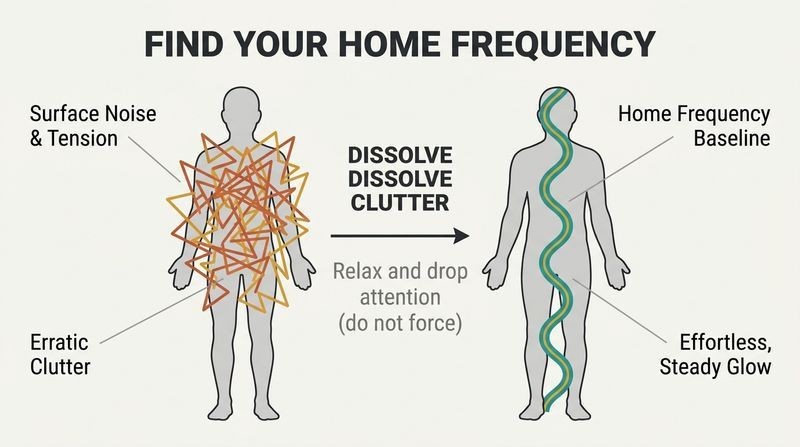
Home frequency is your baseline. Peirce names the naturally high, consistent vibration of your soul expressing through your body the home frequency. It feels like the effortless joy babies radiate: bliss, cheerfulness, generosity, a texture like silk or running water. A cancer patient named Lisa discovered hers one night when her body hummed with unprompted bliss, and she found she could summon it at will.
Reach it by being real, not by forcing. You do not crank your vibration up; you relax, drop attention into your body, calm it, and let clutter dissolve so the tone shines through. Peirce suggests contrasting your worst-case-scenario tension against a best-case glow, then rocking between them until you can pinpoint the home-frequency sensation and recenter there whenever agitated people or old fears pull you off.
The home frequency functions like a somatic anchor, and here the book aligns neatly with evidence-based practice. Trauma therapists teach clients to identify a felt sense of safety in the body and return to it, and interoception research links body awareness to emotional regulation. Reframing the target as real rather than high is genuinely useful: striving to feel high often produces brittle, performative positivity that collapses, whereas returning to an authentic baseline is sustainable. The weaker move is equating this state with the soul or an objective heaven. Stripped of metaphysics, the technique resembles a portable self-regulation cue, closer to a personalized version of meditation's home base than anything supernatural.
Feeling shaken and hypersensitive is the phoenix midway through rebirth
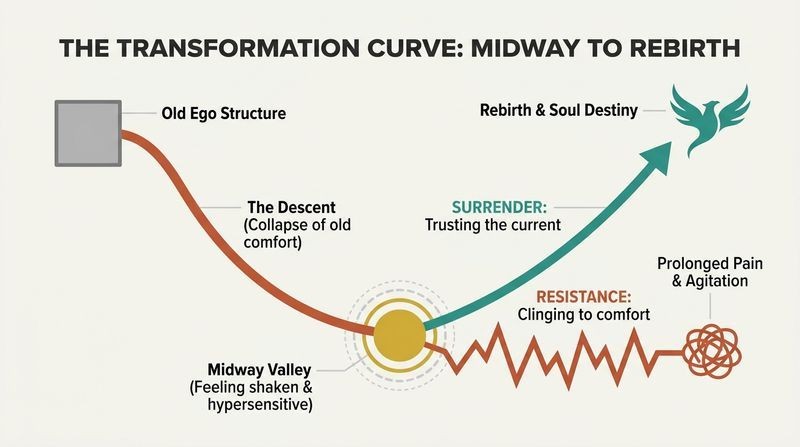
Transformation runs in nine stages. Peirce maps a phoenix-like process from spirit merging with body, through the subconscious emptying its fears, through ego resistance and the collapse of old structures, to a turning point where you stop, surrender, and rediscover your soul, then reemerge to live your destiny. The unpleasant early stages (insomnia, anxiety, buried memories surfacing, relationships breaking) are not malfunctions but the fever of change.
Resistance prolongs the pain. At each stage you can fight the current or trust it. Clinging to old comfort stalls progress and manufactures agitation; surrendering lets your frequency rise. She frames the whole era, the shift from Information Age to Intuition Age, as a collective version of this, so personal disorientation mirrors a world in volatile transition.
Stage models of transformation have a long lineage: Kubler-Ross on grief, Prochaska on behavior change, the hero's journey in myth. Their appeal is that they reframe distress as a phase rather than a verdict, which can be therapeutic in itself. The risk is unfalsifiability: any experience, good or bad, can be slotted somewhere on the ladder, so the map explains everything and predicts nothing. Peirce's tethering of individual psychology to a planetary awakening and 2012-style prophecy dates the work and strains credibility. The durable kernel is gentler and testable: normalize the discomfort of growth, expect nonlinear progress, and stop pathologizing the messy middle of any deep change.
As infants we learned to fight or flee feeling; those habits now cage us
Feeling habits form in the sonar years. Peirce argues we are born empathic, sending out love like sonar. Where it met a parent's open heart, we felt validated; where it hit fear or rigidity, it bounced back as pain, teaching us to contract. To keep the crumbs of love available, we copied our parents' beliefs and postures and shut down parts of ourselves. These crystallized into unhealthy feeling habits.
Two flavors: flight and fight. Flight habits flee and numb (dissociation, addiction, living in others' lives, victimhood). Fight habits control and attack (blame, fixing everyone, workaholism, stubbornness). Megan, abandoned by her father, grew hyper-vigilant and pushed away boyfriends preemptively. Underneath each habit sits a baby-mind misperception ("my loved ones leave me") that, once found and reversed, lets the habit fade.
This is essentially attachment theory rendered in energetic language. Bowlby and Ainsworth documented how early caregiver responsiveness shapes internal working models that persist into adult relationships, and the fight-flight framing maps onto anxious versus avoidant styles. Peirce's contribution is practical: catch the habit mid-action, sit with the discomfort thirty seconds longer than usual, then substitute a healthier response, which resembles exposure plus cognitive reappraisal. One caution: her claim that adults can rewrite these patterns quickly, almost instantly, undersells how entrenched trauma responses are. Real reconsolidation of attachment wounds usually takes repeated, relationally safe experience over time, not a single insight, however illuminating.
Stop forcing outcomes; use willpower to choose, not to shove
Getting stuck is a low-frequency spiral. Claudia's story shows the mechanism: a subtle snub at a meeting dropped her vibration, which drew more negative experiences (firing, illness, dwindling money), which dropped it further. Peirce identifies stuckness as low vibration plus misused will plus resisting life's natural wave motion.
Redefine willpower as choosing. Old-style will resists, controls, and dams the river, which exhausts you. The right use of will is simply choosing: choose a higher vibration, choose to go with the wave you are in, choose to be with what is. When stuck, do not strategize a ten-step escape; suspend the contracted pattern, let your mind go slack, and notice what the wave wants. Recognize that troughs (boredom, endings, empty space) are as necessary and useful as crests.
The distinction between forcing and allowing has strong parallels in psychology. Acceptance and Commitment Therapy shows that struggling against unwanted internal states amplifies them, whereas acceptance frees energy for valued action. Taoist wu wei (effortless action) and flow research both suggest that peak functioning comes from working with, not against, momentum. Peirce's insistence that endings and fallow periods are not failures is a valuable corrective to a culture that pathologizes rest. The debatable part is the implied cosmology in which a benevolent current always knows best. Sometimes stuckness signals a real external obstacle requiring strategic force, and pure surrender can shade into passivity or spiritual bypassing of problems that need direct action.
Know anything by feeling into it: merge, become it, then step back
Feeling into is direct knowing. Rather than analyzing from a distance, Peirce teaches extending your awareness 360 degrees, noticing something, then merging with it briefly so its inner nature transmits into your body. Feel into a plant and you sense it needs water because you feel thirsty; feel into a person and you know their tension is fear, not hostility. Your body works like a tuning fork, matching whatever it touches.
Home frequency is the reference point. Because your body copies surrounding vibrations, you need a stable baseline to interpret what you pick up and to snap back afterward. Practice on small choices first (eggs or oatmeal, which call to make first) before big ones. Ask constantly: what am I noticing, what do I already know about this, is this information useful to me now?
Stripped of mysticism, feeling into resembles embodied simulation, and neuroscience gives it partial backing. Mirror neuron systems and interoceptive inference let us model others' states by covertly reproducing them, and expert intuition (Gary Klein's naturalistic decision-making) shows specialists reach accurate conclusions through pattern recognition felt as a hunch before it is articulated. The reframe of intuition as a trainable bodily skill rather than a mystical gift is empowering and consistent with deliberate-practice research. The honest caveat, which Peirce partly acknowledges, is projection: a body flooded with your own anxiety can misread it as data about a house, a stock, or a stranger. Reliable intuition requires calibration and disconfirmation, not blind trust.
The people who irritate you frequency-match a fear you haven't cleared
Relationships are mutual creations. Peirce claims people appear in your life because their frequency pattern matches yours; those with wildly different vibrations simply do not show up. Admirable people mirror your strengths; irritating or threatening ones mirror suppressed fears or the opposite pole of a polarity you are stuck in. Whatever theme surfaces addresses both partners, so telling your partner something "about them" is always about both of you.
Endings are frequency shifts, not betrayals. When one person's field rises (say after a breakthrough), the old resonance breaks and the relationship changes form or dissolves. Her parents' marriage ended in year forty-nine when her mother's field finally shifted. Because both souls co-author the timing, she argues, there is no need for the devastation and blame we usually attach to breakups.
The mirror principle overlaps with Jungian projection and with the systems view in couples therapy, where a presenting complaint is treated as a property of the dyad rather than one partner. That reframe genuinely defuses blame and invites self-inquiry. Homogamy research also confirms we pair with people similar in values, background, and attachment patterns more than opposites-attract folklore suggests. But the claim risks a cruel corollary: if everyone in your world matches your vibration, victims of genuine abuse may be told they attracted or co-created it. Peirce partly guards against this, yet the framework can slide into blaming the harmed. The insight works best as a tool for self-reflection, not as a theory of moral causation.
Treat every problem as a question your soul is asking you
Problems point to an experience you need. In Peirce's vibrational problem solving, a problem is not an obstacle to eliminate but a signal that you have stopped your own flow, usually to avoid an experience. Reframe the problem as one or more questions. Instead of "I need a car but cannot afford one," ask what experience (freedom, safety, mobility) the car represents, then supply that experience internally first through vivid imagination. Often the external situation then resolves in surprising ways.
Seek upscale solutions. These resonate at a higher frequency and are win-win-win, benefiting every person, plus community and environment, rather than relieving one tension by creating damage elsewhere. They often jump a level, use unexpected parts of your personality, solve several problems at once, and arrive feeling like relief rather than grind.
Reframing problems as questions is sound cognitive technique: question framing shifts the brain from threat-defense toward exploratory, solution-oriented processing, and design thinking formalizes the same move ("how might we"). The insistence on solutions that serve the whole system anticipates stakeholder and regenerative thinking now common in sustainability and business ethics, a genuinely forward-looking stance for 2009. Solving internally first through mental rehearsal has support too: visualization primes motivation and reduces the felt scarcity that narrows thinking. The overpromise is the implied magic, that supplying an experience in imagination reliably materializes the external result. More defensibly, resolving the emotional charge frees you to notice real opportunities and act, which is often enough to explain the wins.
You don't attract what you want; you notice it already in your field
Beyond the law of attraction. Peirce argues the popular "like attracts like" model is a linear, separation-based first draft applied mostly out of fear (chasing money and status to soothe insecurity). Attraction implies the thing is "over there" and must be dragged to you by will, which reinstates the ego and severs the felt experience of being provided for.
Materializing is noticing plus attention. In a unified field, what you want already exists in your moment. You notice an idea, invest attention, imagine it in full sensory detail until your body accepts it as normal, and it condenses into form. You never create alone; other souls and even particles cooperate. Things fail to materialize when you force with willpower, when fear (not desire) drives you, when your body cannot feel the result as real, or when it simply is not on your soul's path.
This is a shrewd critique of the manifestation industry from inside its own worldview, and the psychological reading is respectable. Detailed sensory rehearsal boosts the motivation and self-efficacy that drive real action, while fear-based striving triggers the stress physiology that narrows cognition and impairs performance, a robust finding from Yerkes-Dodson onward. The reframe from grabbing to noticing also tracks with research on attentional bias: what you prime yourself to see, you find. Where it strays is the literal claim that attention condenses matter and that particles volunteer to become your new laptop. The useful residue is disciplined: clarify what you want, rehearse it vividly, drop the desperation, act, and stay alert to openings you would otherwise miss.
Your body votes yes or no before your mind knows: read the signal
Truth and anxiety signals are your discernment system. Peirce says the reptile brain registers information as expansion (yes) or contraction (no). Truth signals feel like warmth spreading across the chest, energy bubbling up, prickly chills, or something clicking into place. Anxiety signals feel like a sinking stomach, cold, tightness, or a knot in the solar plexus. These are not idiosyncrasies to dismiss; they are data.
The body is a barometer, and early is better. Philip's body learned to feel his volatile wife's rage building hours before it erupted. Ignored, subtle signals escalate: a whisper becomes tension, then pain, then chronic illness. A corporate recruiter, David, filled positions by making ten intuition-guided calls instead of fifty cold ones. Catch the faint expansion or contraction early and you save yourself the louder message later.
This lands closest to hard science. Antonio Damasio's somatic marker hypothesis proposes that bodily signals guide decisions before conscious reasoning, and his Iowa Gambling Task showed players' skin conductance flagged bad decks before they could explain why. Interoceptive accuracy correlates with better intuitive judgment in several studies. So the core claim, that the body registers relevant information ahead of deliberation, is defensible. The practical discipline of scanning for early, subtle cues is genuinely valuable in a culture that overrides bodily signals until they become symptoms. The honest limit is reliability: bodily signals also encode bias, trauma, and digestion. They are a vote worth counting, not an infallible oracle, and they improve with feedback and calibration.
Heal others by healing yourself, because your fields overlap
Empathy is sensitivity filtered through the heart. In the later stages, Peirce says refined empathy becomes your default mode of knowing, letting you feel the soul inside anything. She cites HeartMath research that the heart's electromagnetic field is far larger than the brain's and that one person's brain waves can synchronize to another's heartbeat. Compassion, a broader knowing of love as the core of all beings, becomes, in her vision, the next evolutionary force replacing survival of the fittest.
You cannot fix another's wound for them. Sam kept rescuing abandoned women to heal his own buried abandonment, which only drove them off. Because people share overlapping fields, healing your own wound raises the shared vibration and offers others a template, but they must choose it. You offer your healed state; they take it or leave it.
The relational claim is wise and widely echoed: you model regulation rather than impose it, a principle central to therapy, parenting, and leadership. Emotional contagion is real and measurable, and co-regulation research shows nervous systems do sync in close contact. The refusal to rescue, respecting others' agency, is a healthy boundary that counters codependency. The scientific packaging is shakier. HeartMath's interpretations are contested, and the leap from a detectable cardiac field to telepathic healing or DNA-reshaping compassion outruns the evidence. Framing compassion as the coming evolutionary mechanism is inspiring aspiration, not biology; evolution has no such directional intent. The takeaway survives the overreach: tend your own state first, then offer rather than force.
Analysis
Frequency is a synthesis text, weaving intuition development, energy healing, transpersonal psychology, and popular physics into a single vocabulary organized around one metaphor: everything, including you, is vibration. Its genre is New Age self-help, and its structure is a hybrid, half staged transformation narrative (the nine phases), half practical manual (dozens of Try This exercises and Just to Recap summaries). Peirce's real innovation is packaging: coining home frequency, personal vibration, feeling into, and feeling habits gives fuzzy experiences memorable handles, and the home frequency messages closing each chapter attempt to induce, not just describe, the state she teaches.
The book's persistent liability is its scientific borrowing. Quantum superposition, the many-worlds interpretation, the Schumann resonance, E=mc2, and phantom DNA are recruited as evidence for consciousness claims they do not support. This is the quantum-mysticism move critiqued by physicists since What the Bleep, and it will alienate empirically minded readers. Yet a charitable reading finds that most of the actionable content does not actually depend on the physics. The techniques are defensible on psychological grounds: somatic anchoring, interoceptive discernment, cognitive reframing, acceptance over resistance, embodied simulation, and mental rehearsal all have research support under other names.
The deeper tension is agency versus surrender. Peirce simultaneously insists you author your reality and that you should stop forcing and trust the flow. Held loosely this is a mature both-and; held rigidly it risks spiritual bypassing and, in the relationship material, victim-blaming. The most valuable stance for a modern reader is instrumental: treat vibration as a metaphor for state, use the exercises as self-regulation and attention-training tools, and decline the literal cosmology. Read that way, the book delivers a coherent practice for noticing your inner state, clearing reactive patterns, and acting from calm rather than fear, which is genuinely useful regardless of whether energy fields rearrange matter.
Review Summary
Frequency by Penney Peirce receives mostly positive reviews, with readers praising its insights on personal vibration and energy. Many find the book transformative, offering practical exercises for self-improvement. Some appreciate its scientific approach, while others view it as more spiritual. Critics argue that certain concepts lack scientific backing. The book is seen as a bridge between science and spirituality, exploring themes of consciousness, intuition, and personal growth. Readers often report multiple readings to fully grasp the concepts presented.
People Also Read







FAQ
What's Frequency: The Power of Personal Vibration about?
- Exploring Personal Vibration: The book explores the concept of personal vibration, which is the frequency of energy you hold in your body, emotions, and mind. It suggests that understanding and raising this frequency can lead to a more fulfilling life.
- Transformation Process: Penney Peirce outlines a nine-phase transformation process that individuals undergo as they become more aware of their vibrations and learn to navigate life with greater sensitivity and intuition.
- Connection to the Universe: It posits that everything in the universe is interconnected through energy and vibration, and by tuning into your personal frequency, you can align with your true self and the cosmos.
Why should I read Frequency: The Power of Personal Vibration?
- Practical Tools for Growth: The book provides practical exercises and insights to help readers recognize and develop their sensitivity to vibrations, which can accelerate personal growth and transformation.
- Understanding Energy Dynamics: It offers a comprehensive understanding of how energy dynamics work in our lives, helping readers to navigate challenges and enhance their well-being.
- Empowerment through Awareness: By reading Frequency, you empower yourself to take charge of your emotional and energetic states, leading to a more harmonious and fulfilling existence.
What are the key takeaways of Frequency: The Power of Personal Vibration?
- Home Frequency Concept: One of the central ideas is the concept of "home frequency," which is the vibration of your soul expressing through your body. This frequency serves as a compass for living authentically and joyfully.
- Nine Phases of Transformation: The book outlines nine phases of transformation that individuals experience as they raise their personal vibration and become more attuned to their true selves.
- Conscious Sensitivity Development: Readers learn how to develop conscious sensitivity, which allows them to perceive subtle energies and vibrations in themselves and their environment, enhancing their intuitive abilities.
What are the best quotes from Frequency: The Power of Personal Vibration and what do they mean?
- “The truth cuts deeper—a lot deeper—than what is visible to your physical eyes.” This quote emphasizes the importance of looking beyond the surface to understand the deeper truths of existence and personal experience.
- “You are a limitless being made of consciousness and energy.” This statement serves as a reminder of our inherent potential and the interconnectedness of all life, encouraging readers to embrace their true nature.
- “When you let go and experience trust or faith, you become more transparent.” This quote highlights the idea that surrendering to the flow of life and trusting in the process allows for greater clarity and connection to one’s true self.
What is the transformation process outlined in Frequency: The Power of Personal Vibration?
- Nine Phases Explained: The transformation process consists of nine phases that guide individuals from a state of fear and limitation to one of love and empowerment. Each phase represents a step in the journey of raising personal vibration.
- Clearing Blocks: The early phases focus on identifying and clearing subconscious blocks that hinder personal growth, while later phases emphasize embracing one’s true identity and purpose.
- Integration of Experiences: Throughout the process, individuals learn to integrate their experiences, allowing for a more fluid and harmonious existence as they align with their home frequency.
How can I find my home frequency according to Frequency: The Power of Personal Vibration?
- Centering in the Body: To find your home frequency, you must bring your attention fully into your body and calm your mind. This involves relaxing and being present in the moment.
- Activating Heart Awareness: Engaging with your heart’s electromagnetic field is crucial; it helps you connect with your soul’s vibration and recognize your home frequency.
- Practicing Lovingkindness: By applying loving attention to yourself and your experiences, you can more easily access your home frequency and allow it to guide your actions and decisions.
What is conscious sensitivity in Frequency: The Power of Personal Vibration and how can I develop it?
- Definition of Conscious Sensitivity: Conscious sensitivity is the ability to perceive subtle energies and nonverbal information from both physical and nonphysical sources. It allows individuals to navigate life with greater awareness and intuition.
- Feeling Into Experiences: Developing this sensitivity involves practicing "feeling into" various aspects of life, such as people, objects, and situations, to gain deeper insights and understanding.
- Regular Practice: Engaging in exercises that enhance your sensitivity, such as meditation and mindfulness, can help you become more attuned to the vibrations around you and within you.
How do negative vibrations affect my life according to Frequency: The Power of Personal Vibration?
- Impact on Personal Vibration: Negative vibrations can lower your personal vibration, leading to feelings of anxiety, depression, and disconnection from your true self. This creates a cycle of negativity that can be hard to break.
- Stuckness and Resistance: When you are caught in negative vibrations, you may feel stuck and resistant to change, which can hinder your personal growth and transformation.
- Awareness and Release: Recognizing when you are in a negative state allows you to take steps to release those vibrations and return to your home frequency, promoting healing and well-being.
What exercises are recommended in Frequency: The Power of Personal Vibration to raise my vibration?
- Breathing Techniques: The book suggests deep, slow breathing exercises to calm the body and raise your personal vibration. This helps to clear away negative energy and promote relaxation.
- Journaling Practices: Keeping a journal to track your feelings and experiences can help you identify patterns in your personal vibration and facilitate conscious sensitivity development.
- Visualization and Meditation: Engaging in visualization exercises, such as imagining your diamond light body merging with your physical body, can help you connect with your home frequency and enhance your overall energy state.
How does Frequency: The Power of Personal Vibration relate to the concept of energy and consciousness?
- Interconnectedness of All Life: The book emphasizes that everything in the universe is interconnected through energy and consciousness, and understanding this relationship is key to personal transformation.
- Energy as a Tool for Growth: By recognizing and harnessing the power of energy, individuals can raise their personal vibration and align with their true selves, leading to greater fulfillment and purpose.
- Consciousness Expansion: As personal vibration increases, so does consciousness, allowing individuals to access higher states of awareness and deeper insights into their lives and the world around them.
How does Frequency: The Power of Personal Vibration define home frequency?
- Home Frequency Explained: Home frequency is described as the vibration of one’s soul as it expresses through the body, emotions, and mind. It represents the most authentic state of being for an individual.
- Guidance for Life Choices: The book emphasizes that maintaining one’s home frequency is crucial for making decisions that resonate with personal truth. It serves as a compass for navigating life’s challenges and opportunities.
- Connection to Personal Vibration: Home frequency is closely linked to personal vibration, which fluctuates based on thoughts, emotions, and experiences. Understanding this connection allows individuals to align their actions with their true selves.
What role does empathy play in Frequency: The Power of Personal Vibration?
- Empathy as a Tool: The book highlights empathy as a vital skill for understanding and connecting with others. It allows individuals to feel into another’s experience, fostering compassion and deeper relationships.
- Development of Compassion: Through empathy, readers can cultivate compassion, which is essential for personal and collective healing. The author suggests that empathy can transform negative emotions and promote unity.
- Practical Applications: The book provides exercises to enhance empathic abilities, encouraging readers to practice feeling into others’ experiences. This practice can lead to greater emotional intelligence and connection.
What is the significance of materialization and dematerialization in Frequency: The Power of Personal Vibration?
- Understanding Materialization: Materialization refers to the process of bringing ideas into physical form through attention and energy. The book explains that this process is influenced by one’s personal vibration and home frequency.
- Dematerialization Explained: Dematerialization is the reverse process, where physical forms dissolve back into the unified field. This concept emphasizes the fluidity of existence and the importance of letting go of what no longer serves you.
- Practical Implications: The author encourages readers to practice both materialization and dematerialization in their lives. By doing so, individuals can create a high-frequency life that aligns with their soul’s purpose.
About the Author
Other books by Penney Peirce
Download PDF
Download EPUB
.epub digital book format is ideal for reading ebooks on phones, tablets, and e-readers.








































