

Key Takeaways
Your voice is blocked by tension, not lacking in talent
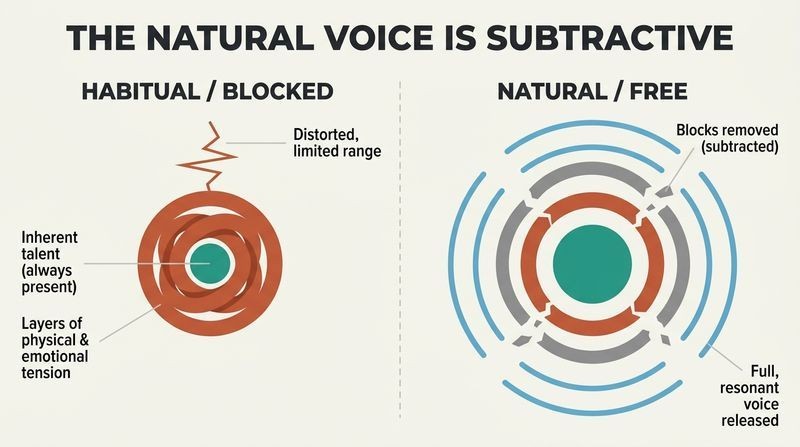
Everyone is born with a full instrument. Linklater's foundational claim is that every person possesses a voice capable of a two-to four-octave range able to express any emotion, mood, or thought. The problem is not that voices are weak or ordinary. It is that living in the world layers on tensions, defenses, and inhibitions that choke the natural instrument until communication comes out distorted.
Removal, not addition. The work is therefore subtractive. Rather than building a beautiful musical instrument through elocution and technique, the goal is to dissolve physical, emotional, intellectual, and psychological blocks so the voice already inside can emerge. She draws a crucial distinction: what feels natural to you and what feels familiar are not the same thing. Your habitual voice is familiar, but your natural voice may feel strange at first.
What's striking is how this inverts the conventional model of voice training. Where mid-century British schools chased the pear-shaped vowel and the voice beautiful, Linklater treats the trained voice with suspicion, arguing polish often masks a hidden self. This resonates with somatic therapies like the Alexander Technique and Feldenkrais, which also work by removing habitual interference rather than adding effort. The insight parallels Michelangelo's apocryphal claim that the sculpture already exists in the marble. One caveat: the strong nature-versus-conditioning framing risks underplaying that some vocal limits are anatomical, and that skilled addition (breath capacity, articulation) genuinely matters too, as her own later exercises concede.
Blocked emotions choke the voice; muddy thinking blurs speech
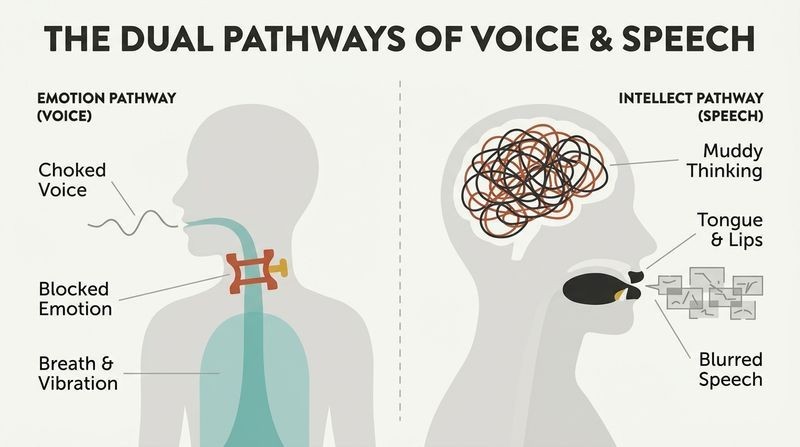
Two maxims govern everything. Linklater distills her entire method into a pair of laws: blocked emotions are the fundamental obstacle to a free voice, and muddy thinking is the fundamental obstacle to clear articulation. The voice divides its labor. Breath and vibration serve emotion; the tongue and lips serve intellect. When either channel is jammed, communication fails in a predictable way.
The mind-body cannot be split. Because physical processes generate sound, the inner muscles must be free to receive delicate impulses from the brain. She cites neuroscientist Antonio Damasio, who notes the Greek word psyche originally meant breath and blood. To free the voice is to free the person, and person is indivisibly mind and body. Unlock one, you unlock the other.
The claim that emotional suppression physically constricts the throat has gained empirical support since 1976. Research on the polyvagal system and vocal biomarkers shows stress measurably alters pitch, jitter, and laryngeal tension. Damasio's somatic marker hypothesis, which Linklater invokes, argues emotion is not opposed to reason but foundational to it, dovetailing neatly with her refusal to separate feeling from sound. The division of labor (breath for emotion, tongue for intellect) is a useful heuristic, though somewhat schematic. Prosody research suggests emotional and semantic content are woven together neurologically rather than routed through separate anatomical channels, so the clean split is pedagogically handy more than literally true.
The chocolate-chip cookie moment rerouted your voice away from truth
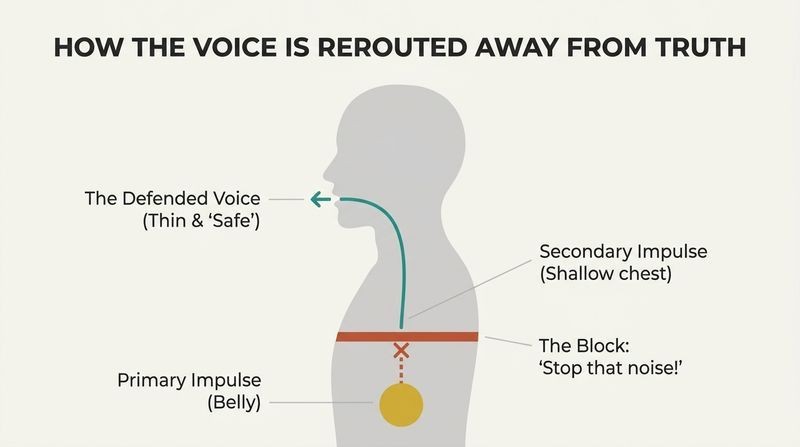
A parable of every voice. Linklater explains why voices stop working through a story she calls the Chocolate-Chip Cookie tale. A newborn wails from the belly, a primary impulse driven by the Pang of hunger, and it works: milk arrives, survival is secured. But at two or three, the child who screams for a cookie from that same deep place gets scolded: stop that noise, ask nicely. The child learns the Pang is dangerous.
Secondary impulses take over. The next day the child bypasses the belly entirely, finding shallow breath high in the chest and a beguiling, sweetened voice from the face and head. It earns two cookies. That rerouting, from primary reflexive impulse to protective secondary impulse, becomes lifelong habit. It is why adults speak from a thin, defended place rather than a connected one.
This developmental narrative anticipates attachment theory and Gabor Mate's work on how socialization trades authenticity for acceptance. The mechanism, replacing spontaneous reflex with defended control, mirrors what Wilhelm Reich called character armor: chronic muscular patterns that encode emotional history. What Linklater adds is specificity about where the armor sits: throat, jaw, tongue, chest. The story is deliberately allegorical, so it should not be mistaken for literal developmental science. Yet its explanatory power is real. Most people genuinely do breathe shallowly and speak from the mask. The tale reframes vocal tension not as a flaw to fix but as an old survival strategy that outlived its usefulness.
Let breath replace itself; never actively inhale
Breathing is reflexive, not willed. The single hardest reprogramming Linklater asks for is to stop breathing on purpose. Natural breath, like a baby's, is involuntary: you release the outgoing breath, wait without holding, and the incoming breath drops back in on its own when the body needs it. Consciously pulling air in recruits large clumsy external muscles that destroy sensitivity to changing emotional states.
Language shapes behavior. She insists you change your vocabulary. Not inhale and exhale but incoming breath and outgoing breath. Not breathe in but allow the breath in. The engine is the sigh of relief, an easy feeling that draws breath deep without effort. She distinguishes this sharply from a big breath, which is mechanical muscle work with no feeling content. Relaxed adults breathe in a roughly universal rhythm, about four seconds per cycle.
The insistence that vocabulary reshapes physiology is more than poetry. Framing effects are well documented in motor learning: internal cues (contract this muscle) often produce worse performance than external or passive cues (let it happen), a finding replicated across sports science and rehabilitation. Linklater intuited this decades before the research consolidated. The sigh-of-relief device is elegant because it smuggles in emotional content, ensuring breath stays coupled to feeling. One tension worth flagging: singers and swimmers deliberately control breath, and she concedes their methods simply serve different purposes. Her claim is not that breath control is wrong, only that actors need spontaneity above capacity.
Picture sound starting eighteen inches below your throat
Anatomical fiction, better function. The voice actually originates at the larynx. But Linklater argues that if you focus there, you produce a forced, monochromatic, personality-free sound. Paradoxically, an inaccurate picture yields the best result. She has students imagine sound welling up from a pool of vibrations deep in the pelvis and diaphragm, escaping as a formless neutral sigh she spells huh. This is the touch of sound.
Cause over effect. The principle is that you never make the sound. You supply the cause (a thought-feeling impulse plus free breath) and let sound happen as a by-product, the way flipping a switch produces light without you generating the light. She anchors the impulse in the solar plexus, the nerve center where humans palpably register grief, joy, shock, and anger, so that voice stays married to feeling.
This is a sophisticated bit of embodied cognition. The deliberate use of an anatomically false image to bypass conscious interference echoes how expert performers use imagery: a pianist thinking of tone color, not finger mechanics. Neurologically, gross laryngeal focus tends to invite hyperfunction (pressed phonation), whereas distal imagery relaxes the vocal folds and lets aerodynamics do the work. The solar plexus anchoring aligns with interoception research showing the gut and diaphragm are dense with emotional signaling. The move is pragmatic rather than scientific, and Linklater is refreshingly honest that it would make a voice scientist quail. It works because the mind performs better when misdirected away from the mechanism.
Vibrations die in tension and multiply in relaxation
Sound wants sounding boards. Once vibration exists, it re-sounds off resistant surfaces. Bone is the best resonator, cartilage very good, toned muscle adequate, and flabby tissue simply muffles sound like heavy velvet. Linklater's three laws of vibration: tension murders them, relaxation lets them thrive, and they love having attention paid to them. She has students literally feel the buzz with their hands on the lips, skull, chest, and body, becoming connoisseurs who taste vibration like a favorite sandwich filling.
Free the channel. Between the deep source and the outside world sits the channel: jaw, tongue, soft palate, and throat. Each is a habitual site of clamping. The jaw becomes an iron gate slammed against emotion. The tongue, which she likens to the trickster god Hermes, secretly tenses to support weak breath. Freeing each one clears the passageway.
The bone-conducts-best claim is acoustically sound: denser materials transmit vibration with less damping. The jaw-as-emotional-gate observation is validated by dentistry and psychology alike; bruxism and TMJ tension correlate strongly with suppressed anger and stress. Linklater's mythological framing (the lying tongue of Hermes versus the rainbow-truth of Iris) is charming pedagogy that makes an abstract motor pattern memorable. The tongue insight is genuinely counterintuitive: most people never suspect their tongue tenses to compensate for lazy breathing. One connection worth drawing: her channel-freeing sequence resembles progressive muscular relaxation protocols, but with a communicative purpose rather than mere calm. The aim is not relaxation for its own sake, which she warns produces a wet rag.
Climb the resonating ladder from chest to skull
A map of the range. Linklater organizes the body's resonators as a ladder of cavities, broad at the bottom and narrowing toward the top: chest, mouth, teeth, sinuses, nose, and skull. Each rung amplifies a different part of your three-to four-octave range and carries a distinct quality. Lower sounds rumble in the chest, the middle blooms in the mask of the face, and high-intensity sounds ring in the dome of the skull.
Fill the gaps, isolate then blend. Weak rungs can be strengthened and gaps filled through targeted exercises: warming the chest with a lazy haa, pinging vibrations into the nose, releasing falsetto into the skull. The middle register, richest in tiny resonating chambers, is the most revealing and therefore the most defended. A well-modulated but single-quality voice signals a person controlling how they are perceived, hiding many things. Nuance requires access to every rung.
The ladder is a useful mental model even if physiologically the resonators are more interconnected than a discrete-rung metaphor implies. Acoustically, resonance is governed by formants, the amplified frequency bands shaped by the vocal tract, and Linklater's rungs roughly correspond to shifting those formants. Her claim that a consistently pleasant voice is a hiding place is provocative and psychologically astute: broadcasters and politicians cultivate exactly such controlled sameness. The distrust of the well-trained voice is a recurring theme that separates her from classical elocution. Modern voice science would add that skull resonance is partly proprioceptive sensation rather than actual acoustic amplification, but the training effect on fold function is real.
Meet higher demand with more sigh, never more push
Reverse the instinct to strain. As pitch rises, most people reach, brace, and push, or simply refuse to go higher. Linklater's counterintuitive rule: the higher you go, the more you sigh from deeper inside with more relief. A genuine sigh of pleasurable relief cannot coexist with tension, delivers a gust of supporting breath, and dissolves the I can't reflex by substituting palpable pleasure for effort.
Strength without tension. She builds breath power through vivid imagination rather than brute force: vacuuming the lungs against a pinched nose to create a vacuum, or panting like an excited puppy to restore reflexive diaphragm action. The reconditioning goal is to develop mental intensity without physical tension, so that a big emotion or a large theatre triggers greater release rather than greater clenching. Muscles that hold onto feeling kill it; muscles that conduct feeling generate more.
This is perhaps the most practically transferable insight, extending far beyond acting. The principle that intensity should produce release rather than contraction maps onto performance psychology broadly: clutch athletes and musicians describe letting go under pressure, not gripping harder. The physiological logic is sound: laryngeal and breathing muscles perform better when antagonistic tension is minimized, and pushing tends to create the pressed phonation that damages folds. The puppy-panting image cleverly restores involuntary reflex by hijacking an emotional state. Her observation that held feeling dies while conducted feeling multiplies anticipates findings in emotion regulation research, where suppression dampens affect while expression sustains it. The reframe of high notes as relief rather than effort is quietly radical.
Clear diction flows from clear thinking, not mouth gymnastics
Articulation means jointedness. The word articulate literally means having joints, and Linklater treats consonants and vowels as the joints that cut flowing vibration into words. She refuses to teach correct speech, dismissing Standard English and Transatlantic accents as class-consciousness dressed as aesthetics. The only criterion is comprehension: anything that distorts the message must yield, but individuality and regional richness should be celebrated.
Free the articulators, then trust thought. The lips and tongue must be limbered and made independent of the jaw, which should stay still. She condemns the elocution bone prop (biting an object to force the mouth open) as a guarantee of unnatural mouthing. She has seen actors with flawless diction who remain unintelligible, and actors who barely seem to move their mouths yet are perfectly clear. The difference is specificity of intention. Overdeveloped articulation muscles destroy the balance between voice and speech.
Linklater's rejection of prescriptive pronunciation was ahead of its curve and now aligns with sociolinguistics, which treats all dialects as rule-governed and equally valid. Her clarity-from-thought claim finds support in speech production models: intelligibility depends heavily on prosodic and semantic coherence, not just crisp phonemes, which is why a mumbler with clear intention can outperform a precise but disconnected speaker. The critique of the bone prop is a jab at the Elsie Fogerty lineage of mechanical training. One friendly caution: some speakers genuinely need targeted articulatory work for specific defects, and clear thinking alone will not remap a lateral lisp. Linklater acknowledges this, pointing such cases to specialist resources.
Read a text vertically into the body, not horizontally for plot
Break the linear habit. Ninety-nine percent of readers skim a text straight to the end to extract meaning, so they can control it and decide how to speak it. Linklater calls this reading with the head, and it traps the actor in the safe, inventive forebrain. Instead she prescribes vertical reading: letting each word drop down into the psyche to mingle with unconscious rivers of image, memory, and feeling before it becomes speech.
Words as seeds. She has actors literally tear a poem into individual words, lie on the floor, and let each scrap sink in on the breath, turning to image and emotion before being spoken. Learn lines by heart, not by memorize, which imprints mechanical inflection like an internal teleprompter. Her mnemonic: nurture Mind, Middle, and Mouth; banish Muscling, Manipulation, and Mastication. Truth of result depends on depth of planting.
The head-versus-stomach distinction Linklater borrows from poet Gwyneth Lewis resonates with dual-process theory: the fast, verbal, controlling system versus the slower, embodied, intuitive one. Her practice of physically dismembering a text to defeat premature interpretation is a genuine creativity technique, forcing fresh encounter over habituated response, akin to how visual artists turn a drawing upside down to see it anew. The distinction between memorize and learn by heart is supported by memory research: rote visual encoding produces brittle, context-dependent recall and fossilized delivery, while deep semantic and emotional encoding produces flexible, generative retrieval. The floor-work-with-torn-paper method is unusual but principled, targeting the exact failure mode of actorly line-learning: locking in an interpretation before understanding arrives.
Celebrate what's fresh; refuse the inner litany of failure
Articulate the new, however small. When Linklater asks students how an exercise felt, they deflect: fine, good, or I felt dizzy and nauseous. These are the mind's diversionary tactics to avoid admitting change, because change threatens a hard-won status quo. Her rule is to name anything fresh, new, or interesting first, and only afterward discuss problems. Verbalizing a new experience brings it to consciousness and cements the imprint; leave it unnamed and old habits creep back.
Celebrate, don't flagellate. She identifies a silent negative litany many carry, phrases like you'll never make it or you're not clever enough, planted long ago by a parent or teacher and reinforced by every small failure. Cultivating the habit of noticing and speaking the fresh replaces that litany with a positive one. Transformation comes in small incremental steps, each of which must be positively acknowledged to stick.
This is essentially a learning-science and clinical-psychology insight embedded in a voice class. Naming an experience to consolidate it parallels affect labeling research, where putting feelings into words measurably dampens amygdala activity and aids integration. The celebrate-don't-flagellate stance prefigures self-compassion research, which shows harsh self-criticism impairs skill acquisition while kind, specific acknowledgment accelerates it. The negative litany is a lay description of what cognitive therapists call automatic negative thoughts or maladaptive schemas. What Linklater contributes is the tight coupling: because voice work exposes the vulnerable self, the same defenses that block the throat block learning. Fixing the pedagogy of attention becomes inseparable from freeing the instrument itself.
Analysis
Freeing the Natural Voice is a training manual disguised as a philosophy of the self, and that dual identity is what makes it both influential and hard to summarize. On the surface it is a rigorously sequenced twenty-plus-day curriculum, moving from spine and breath through resonance, range, articulation, and finally text. Beneath that scaffolding runs a single insistent thesis inherited from Linklater's teacher Iris Warren: the voice is not a skill to be built but a self to be liberated, and the barrier is always tension born of emotional defense.
What distinguishes the book within its genre is its refusal of the aesthetic. Where the British elocution tradition prized the voice beautiful, Linklater treats vocal polish as a symptom of concealment, arguing that a consistently pleasant tone signals a person managing perception rather than revealing truth. This anti-perfectionism, radical in 1963 when she brought the method to America, now looks prescient, aligning with sociolinguistic respect for dialect and with therapeutic models of authenticity.
The method's intellectual spine is psychophysical monism: mind and body are indivisible, so unlocking one unlocks the other. Linklater reaches for Damasio's neuroscience to legitimize what she teaches by instinct, and the reach is mostly justified, though the book leans on evocative imagery (pools, marionettists, hummingbirds) more than mechanism. That imagery is not decoration; it is the technology. She deliberately deploys anatomically false pictures because they bypass the conscious interference that ruins vocal function, a strategy modern motor-learning research validates.
The limitations are honest ones. The work resists the page, as she repeatedly warns, because it depends on a trusted external observer and on slow somatic feedback no book can supply. Its emotional excavations blur the line between training and therapy, which she acknowledges is risky without a skilled guide. And its near-total subordination of technique to feeling, while corrective, occasionally undersells the sheer craft her own exercises demand. Still, the achievement endures: a system that treats speaking as an act of courage.
Review Summary
Freeing the Natural Voice receives mixed reviews, with many praising its comprehensive approach to voice training for actors and singers. Readers appreciate the detailed exercises and potential for personal growth, noting improved communication skills and emotional connection. However, some find it overly complex, time-consuming, and difficult to follow without guidance. Critics argue it's less suitable for casual readers seeking quick improvements. Overall, reviewers acknowledge its value for serious performers but caution about the significant time investment required to see results.
People Also Read









FAQ
What's Freeing the Natural Voice about?
- Vocal Freedom Focus: Freeing the Natural Voice by Kristin Linklater emphasizes liberating the natural voice through exercises that combine physical awareness, relaxation, and vocal techniques.
- Psycho-Physical Approach: The book integrates psychological understanding with physiological knowledge, exploring the connection between mind and body in vocal expression.
- Structured Exercises: It provides a detailed framework of exercises to develop and strengthen the voice, focusing on breathing, resonance, and articulation.
Why should I read Freeing the Natural Voice?
- Enhance Communication Skills: The book is beneficial for improving vocal communication in acting, singing, or everyday interactions, teaching authentic and powerful self-expression.
- Comprehensive Techniques: Linklater offers a wealth of exercises tested over decades, making it a practical guide for both beginners and experienced performers.
- Mind-Body Connection: It emphasizes understanding the relationship between physical tension and vocal expression, leading to greater emotional freedom and creativity.
What are the key takeaways of Freeing the Natural Voice?
- Vocal Freedom: The primary goal is to free the natural voice from physical and emotional tensions for authentic expression.
- Understanding Voice Mechanics: Readers gain insight into how the voice works, including breath, resonance, and articulation, to overcome vocal limitations.
- Emotion and Intellect Integration: Effective communication requires balancing emotional expression and intellectual clarity, ensuring genuine vocal conveyance.
How does Freeing the Natural Voice address tension in the voice?
- Identifying Tension Sources: The book teaches recognizing tension in the body, particularly in the jaw, tongue, and throat, crucial for freeing the voice.
- Exercises for Relaxation: Linklater provides specific exercises aimed at releasing tension, creating a more open channel for sound.
- Connection to Emotion: Emotional blocks often manifest as physical tension, and addressing these tensions unlocks deeper emotional expression.
What is the significance of the "sigh of relief" in Freeing the Natural Voice?
- Foundation for Vocal Release: The "sigh of relief" serves as a starting point for vocal exercises, helping to release tension and allow breath to flow freely.
- Emotional Connection: It connects the physical act of breathing with emotional expression, encouraging spontaneous and genuine responses.
- Practical Application: Linklater encourages incorporating the sigh into various exercises, reinforcing its importance in developing a natural voice.
What specific exercises are included in Freeing the Natural Voice?
- Physical Awareness Exercises: Exercises like "Workday One" focus on developing physical awareness, crucial for vocal development.
- Breathing Techniques: "Workday Two" emphasizes freeing the breath, essential for sound production, with breath as the source of vocal sound.
- Vibration and Resonance Work: Exercises explore sound vibrations and body resonance, such as "Workday Three" and "Workday Four," using the body as a resonating chamber.
What is the "resonating ladder" in Freeing the Natural Voice?
- Concept of Resonance: The "resonating ladder" refers to various resonating cavities in the body that amplify sound, contributing to voice richness.
- Development of Vocal Range: Exercises help explore and develop vocal range, allowing for greater flexibility and strength in the voice.
- Integration of Breath and Sound: Emphasizes integrating breath support with resonating chambers for a full and vibrant sound.
How does Freeing the Natural Voice help with articulation?
- Focus on Tongue and Jaw: The book provides exercises aimed at freeing the tongue and jaw, crucial for clear articulation.
- Connection to Breath: Articulation exercises ensure breath supports the process, allowing for clearer and more expressive speech.
- Practice Techniques: Readers practice articulation through exercises combining relaxation and vocal techniques, ensuring harmonious tongue and jaw work.
How does Freeing the Natural Voice address emotional expression?
- Connection to Emotion: Vocal expression is deeply connected to emotional expression, encouraging exploration of emotional landscapes for enhanced delivery.
- Imagery and Visualization: Using imagery and visualization techniques helps tap into emotions, creating a more authentic vocal experience.
- Physical Response to Emotion: Physical sensations reflect emotional states, with the body playing a crucial role in genuine vocal expression.
What role does breath play in Freeing the Natural Voice?
- Breath as Foundation: Breath is essential in voice production, with proper breath control fundamental for achieving a free and powerful voice.
- Breathing Exercises: Various exercises enhance lung capacity and strengthen breathing muscles, developing a steady and controlled breath.
- Connection to Emotion: Breath is linked to emotional expression, carrying emotional energy crucial for authentic performances.
How can I apply the techniques from Freeing the Natural Voice in my daily life?
- Daily Vocal Warm-ups: Incorporating exercises into daily routines maintains vocal health and flexibility, enhancing speaking and singing abilities.
- Mindfulness and Awareness: Techniques encourage mindfulness and physical awareness, beneficial in public speaking and interpersonal communication.
- Emotional Expression: Applying principles of emotional expression enhances communication skills, leading to more impactful interactions.
What are the best quotes from Freeing the Natural Voice and what do they mean?
- "To free the voice is to free the person.": Vocal freedom is linked to personal expression and emotional authenticity.
- "Breath becomes vibration.": Highlights the fundamental role of breath in voice production, essential for vocal expression.
- "The body is all ears.": Suggests the physical body's crucial role in vocal expression and listening, emphasizing attunement to body and emotions.
Download PDF
Download EPUB
.epub digital book format is ideal for reading ebooks on phones, tablets, and e-readers.








































