

Plot Summary
Cancer Takes Everything But Spite
Lily1 knew the diagnosis was a death sentence when her battered Corolla wouldn't start in the hospital parking lot. Metastasized cancer, everywhere, and she couldn't afford the first round of chemo — let alone a battle her doctor already considered lost.
She'd spent her whole working life in customer service without benefits, careful with money but never careful enough for this. She drove two hours to her parents' house and told them in the kitchen. Her father raged. Her mother sobbed and begged her not to go.
Over the months that followed, Lily1 wrote letters for her brothers, marathoned old movies with her dad, and tried to leave behind memories instead of bitterness. When death finally came one evening, she hugged her parents a little tighter. Nothing hurt anymore.
A Hobbit Door in Paradise
The Afterlife's lobby operated like a cosmic bank — attendants at desks, files in hand, souls waiting in chairs. Siedah,8 a warm woman in a pink hijab, guided Lily1 through Universal Judgment, a gray arch that replayed her entire existence in a torrent of moments: stealing chocolate chips, first tattoo, self-harm, babysitting children, cancer diagnosis, dying.
She emerged into rolling green hills and a house with a round purple door straight out of Tolkien. Her childhood cat Max trotted from the strawberry patch.
A two-story library waited inside with sliding ladders. Her tattoos reappeared on her skin at a thought. But when she pressed her palm to her chest, searching for a heartbeat, she found only silence — a hollow reminder that she'd lost the fight she'd never been equipped to win.
Customer Service Goes to Hell
Spite carried her through the obsidian arch. She'd spent a lifetime being told she was going to Hell; now she'd prove them right, with wine in hand. What she found instead was demon customer service — overwhelmed gate workers frog-marching screaming souls toward their assigned punishment and healing levels.
Captain Moura13 and the red-skinned Crocell15 were drowning in complaints. Lily,1 fluent in the language of entitled idiots after twenty years of retail, asked for a folding chair, a sign reading "Hellp Desk," and a baseball bat.
She set up between the gate and the tunnels and went to work: reading soul files by touch, matching energy with bullies, offering blunt comfort to the lost. She smashed a child molester's jaw with the bat. A wire file basket appeared on her desk — cosmic approval, granted.
FruitBat and Nearamir
Weeks into her Afterlife, Lily1 joined a demon-hosted lobby of Invaders, the multiplayer game she'd loved when alive. She chose the username Nearamir — a nerdy riff on Tolkien's Faramir. Then a new player spoke, and the entire lobby went quiet. FruitBat's voice was a low, growling rumble that stroked along her skin like a phantom heartbeat.
She blurted that it was the sexiest voice she'd ever heard; half the lobby agreed. They fell into an easy rhythm of dad jokes and flirtation between murder rounds. He called her nerd wife after finding her character's body during a trial. She kissed at his avatar and felt a fuzzy warmth she hadn't earned in life. She liked this faceless, nameless man. She craved the connection more than she'd expected.
The Voice Has a Face
Lucifer4 was never subtle about matchmaking. The sword he'd supposedly left in the gate's weapons closet required a general to identify — a lie so thin it was practically transparent. Bel,2 a seven-foot demon with purple-gray skin, bat-like wings, and silver eyes, stalked into the cavernous gate area and stopped dead.
A tall, auburn-haired mortal was kicking a genocidal soul in the stomach with gorgeous form. She looked up, blood spattered on her cheek. Recognition hit simultaneously — she knew that voice.
He was FruitBat; she was Nearamir. He lifted her off the ground in a hug that felt like something clicking into place. Over coffee in the Universal Hallway, they talked for hours, discovering they were fellow Tolkien nerds with matching senses of humor. He gave her the sword.
Battle Nuggets Take Second
Bel's2 trivia team at Luckyleaf pub included Lucifer,4 his cousin Asmodeus,6 Asmodeus's6 pregnant wife Sariah,7 and Thanatos17 — the Greek god of peaceful death. Lily1 threatened Asmodeus6 with a chicken wing over a Monopoly question and earned the death god's17 approval in the form of extra wings.
Their team, the Battle Nuggets, took second place. She met Greg5 — Bel's2 oldest friend and master of Level Nine, Hell's most extreme punishment level — smooth-voiced and quietly terrifying, without flinching. Bel's2 arm stayed around her all night.
When she flopped her head back against it, his breath caught. They walked home buzzing with Fuzzy Navels and unspoken want, trading bat puns. That night, Greg5 called to warn Bel:2 she's a soul, and souls reincarnate. Bel2 knew. He didn't care.
Pinkie Promise to Hell
The girl appeared at the Front Desk in a shark hoodie, swaying and terrified, too small for her age. Her name was Zoe, but she'd choose Sharkie3 — for the love of sharks that her abusive foster mother and pastor had tried to beat out of her.
She believed she belonged in Hell because they'd told her so, over and over, until a drunk driver's truck made it permanent. Lily1 crouched and offered her pinkie. In the elevator, Sharkie3 sobbed that she didn't want to go to Hell but didn't want to get in trouble either.
Lily1 held her and promised safety. Lucifer4 spoke with Sharkie3 privately, then confirmed what Lily1 already knew: this child had a Paradise waiting. Sharkie3 asked to stay with Lily1 instead. A guest room in a hobbit-hole became a sanctuary.
Being Birds in the Rain
Something was brewing in Sharkie3 for days after a sleepover — quiet stares into firelight, extra-long silences petting the cat. One rainy afternoon, she leaned over the couch watching puddle-birds splash and asked if they were having fun.
Lily1 said there was only one way to find out. On three, they ran barefoot into the downpour. Sharkie3 stomped into a puddle and shrieked. Lily1 took a flying leap, messed up the landing, and crashed flat on her back in the mud. Sharkie3 howled with laughter — the most unburdened sound she'd ever made.
They lay side by side making shapes against the gray sky with their fingers. Later, wrapped in blankets with cocoa, Sharkie3 rested her head on Lily's1 arm and said she liked them. Neither had been allowed that feeling without punishment before.
Mutually Assured Seduction
Persephone10 — the Greek goddess Lily1 had befriended over pastries — and Aphrodite18 recruited her for an orchestrated assault: every partner would dress to demolish their significant other's focus during trivia. Lily1 wore a scrap of black silk that barely qualified as a dress.
Bel,2 in sleek dark finery, forgot how to finish a sentence. They operated on a rotating schedule — one minute of looking, then back to questions — but the system collapsed when Lily1 caught a drip on her glass with her tongue. She walked toward the bathrooms. He followed.
Behind a locked door, he pressed her against the vanity and brought her to her first orgasm with skilled fingers, growling for her to watch them in the mirror. She tried to reciprocate; he refused. Not here — not on her knees in some bathroom. That was for somewhere worthy of her.
Why No One Loved Me
Sharkie3 crept into Lily's1 room at midnight, clutching a stuffed shark, shaking. At the sleepover, every other child had parents who came for them without question. Sharkie3 had known Lily1 would come, but she wasn't sure why — because Lily1 wasn't her mom. The question that broke Lily1 into dust: Why am I so easy to leave behind? Why does no one love me?
Lily1 held her and rocked her and pinkie-promised what she'd been building toward since the elevator. She would love Sharkie3 as her own child, always pick her up, always hold her when she cried. She'd set boundaries sometimes but would never hurt her on purpose. Sharkie3 asked if they could be a family. Lily1 said they already were — and Bel2 and Lucifer4 were part of it too.
Prince and Princess
Lily1 walked into Bel's2 office white-knuckled and trembling, clutching her soul file. He panicked, certain she was breaking up with him. She told him she loved him. Bel2 froze, then pulled her into his lap and said it back — nothing in that file would change how he felt. She'd known it for weeks, she explained, ever since flying over Hell in his arms, and had been too scared to own it.
She wanted them equal in vulnerability. He took the file gently, set it aside, and said his piece too. Then they came together on his desk for the first time — slow, fierce, transformative — her legs wrapped around him, his wings enclosing them both. Afterward, she rested her hand over his thundering heart and called it her real Paradise.
The Prince Who Watched
His father Samael20 had been one of the oldest beings in the Afterlife, a founding prince of Hell. When Bel2 was the equivalent of his early twenties, Samael20 came to dinner happier and more peaceful than Bel2 had ever seen him.
Then he handed over an envelope, said it was time, and walked to the Void — the place where souls and beings go to stop existing. Bel2 accompanied him to the threshold and watched him disappear. He'd spent centuries believing he wasn't enough to make his father stay.
The inherited prince title became a wound, not an honor. He'd avoided romantic permanence ever since, certain anyone he loved would leave. He told Lily1 everything, then admitted that after her, there would be no one else. If she left, he'd eventually follow his father.
Stolen Socks Across Universes
While alive, Lily1 had promised her brothers she'd steal their socks from the Afterlife — a joke meant to comfort them, one more lie to ease their grief. She'd never expected to keep it.
After reading her soul file and weeping over its contents, Bel2 confessed: he'd been organizing teenage demons to sneak into the mortal world and swipe her brothers' socks, one at a time, smuggled through a crack near an obscure Polynesian realm. The mysterious teenagers Lily1 had noticed near the gate for weeks — that was his doing.
Months later, while Bel2 was away at war, a young demon bashfully presented her with one of Ryan's running socks, explaining that Bel2 had arranged everything before he'd marched. She held a mortal sock in the Afterlife, and sobbed, and meant every tear.
General Stuff and Pinkie Promises
The other Universe widened its rift and sent an army through. Bel2 gathered all his legions on the lowest training field, armor gleaming, hair braided by Lily's1 hands. He crouched to hug Sharkie,3 who held out her pinkie finger with total solemnity.
Lily1 told him to be safe, to come home, knowing she would never ask him to be less than who he was. She gave him one last kiss, and he pressed his nieces' glittery bracelets into her palm to wear until he returned. Sharkie3 told him to go do general stuff.
Then he was gone, marching into ancient tunnels with tens of thousands of warriors. For more than two months, Lily1 held everything together — the Hellp Desk, Sharkie's3 schooling, her own terror — with coffee, margaritas, and cake eaten straight from the pan.
Sword Meets Heaven's Gate
A creature with a vertical mouth screeching like tortured infants crashed through the Universal Hallway while Lily1 was getting coffee. She evacuated panicking souls, shoving them toward realm arches, and ended up sheltering inside Heaven's gateway — the place she'd avoided her entire Afterlife.
A smaller creature pressed its nightmare face against the invisible barrier, chattering anglerfish teeth at her. She thought of Bel,2 of Sharkie,3 drew the sword he'd given her, and took its head off in one swing. Then God19 appeared beside her, glowing and shapeshifting.
She demanded to know which of his three supposed traits — all-knowing, all-powerful, all-good — was a lie. He admitted his power to intervene was limited. He bowed and apologized for the harm caused in his name. She accepted the apology. Forgiveness would take longer.
Nine Dead, and Almost Him
A gegony — a towering beast from the other Universe — crushed Bel2 in its jaws during the final battle. His soldiers pulled him free, more dead than alive: shredded wings, broken bones, lacerations covering most of his body. Four healers drained themselves completely to save him.
Lily1 sat beside his bed all night, their fingers barely touching across the sheets. When something warm tightened around her calf in the dark — his tail, reaching for her even in unconsciousness — she knew he'd made it back.
He woke the next morning, saw her auburn hair on his black silk pillows, and broke. She held him while he wept for the nine soldiers he'd named, for the ones before them, for horrors that would never fully leave his dreams. He wasn't all the way home yet, he told her. But he was here.
Lilies on the Battlefield
The letter Samael20 had left two centuries ago said what Bel2 had always been too afraid to read: that Bel2 was the best thing in his father's life, that going to the Void had never been about inadequacy. His father had been ancient and tired in ways Bel2 couldn't yet understand, but his love had been absolute.
Bel2 asked Lily1 to place the crown on his head before the funeral pyres. Thousands of warriors sang the fallen home as embers rose like inverse rain. Afterward, they walked the silent battlefield together, laying white lilies on the bodies of baby gegony that had been tortured and used as bait to force their parents into battle. By each creature curled protectively around its young, they left a flower. Someone else had placed yellow chrysanthemums beside theirs.
The Heartbeat Returns
Lev,9 Hell's most fastidious prince — a demon obsessed with reports and double-spacing — delivered a research document on the Hellp Desk's long-term success. Buried inside was an obscure process called deification: a soul who permanently yielded reincarnation could, if the Universe approved, become a true denizen of the Afterlife.
Including the ability to have children. Lily1 sprinted to the Reincarnation Office. She'd already decided to stay forever; the chance at a full life with Bel2 was beyond anything she'd dared hope.
She said goodbye to the reincarnation gate, applied, and was approved. When she raced to Bel's2 office and pressed his hand to her chest, a heartbeat thudded under his palm for the first time since she'd died. She was alive. She was home. Nothing about her felt temporary anymore.
Epilogue
A few years later, Sharkie3 — now a young adult — spins in her bedazzled-bat-equipped chair at the expanded Hellp Desk, bored by the lack of difficult souls. Bel2 stops by in an AC/DC shirt, kisses Lily,1 and calls them Hell's Belles. They plan marriage and children.
Sharkie3 has her own aquarium Paradise complete with a pet Megalodon named Bruce, courtesy of Lucifer.4 Bel2 attends therapy for his war trauma and trains his warriors again. When a timid woman named Penny wanders up to the desk, believing she belongs in Hell just as Sharkie3 once did, Lily1 smiles and offers her a job. The desk grows. The family holds.
Analysis
This novel reframes damnation as a customer service problem. At its core, it argues that the systems humans build to manage morality — churches, doctrines, hierarchies of sin — fail not because justice is flawed, but because the people administering it confuse control with care. Lily's1 Hellp Desk succeeds precisely because she treats each soul as an individual rather than a case number, the same dignity her evangelical upbringing denied her.
The book's most subversive move is making Hell the site of healing rather than Heaven. Lily1 cannot approach Heaven's arch without being paralyzed by conditioned shame, yet she strides into Hell with a baseball bat and finds community. This inversion isn't anti-religious — God19 himself appears and apologizes — but it insists that institutions claiming divine authority bear responsibility for the damage they inflict while hiding behind that claim.
The romance operates on a principle rarely explored in fantasy: that two people can be intensely attracted and still choose patience. Their sexual tension escalates across hundreds of pages not because of contrived obstacles but because both characters have learned that physical intimacy without emotional safety is hollow. Lily's1 hookup history and Bel's2 century of romantic avoidance give their eventual consummation genuine weight — it arrives not when desire peaks, but when trust does.
Sharkie's3 arc functions as the story's moral proof-of-concept. If Hell is truly just, then a child raised to believe she deserves damnation must be redirected. Her healing — through pinkie promises, puddle-stomping, and the slow accumulation of kept promises — demonstrates the book's thesis: that love is not a feeling but a pattern of reliable action performed by imperfect people.
The deification resolution could read as convenient, but it earns its payoff through Lev,9 the bureaucrat whose obsessive report-writing uncovers a loophole that passion alone could never find. The message is quietly radical: love may be the motivation, but it takes someone willing to do the paperwork to make the impossible real.
Review Summary
For Whom the Belle Tolls received mostly positive reviews, with readers praising its unique premise, character development, and emotional depth. Many appreciated the exploration of trauma, healing, and healthy relationships. The book's humor, world-building, and romance were also highlighted. Some readers found it too long and repetitive, while others felt the plot lacked conflict. Critics noted issues with pacing and writing quality. Overall, the book resonated strongly with fans of the author's TikTok series but divided opinions among other readers.
Characters
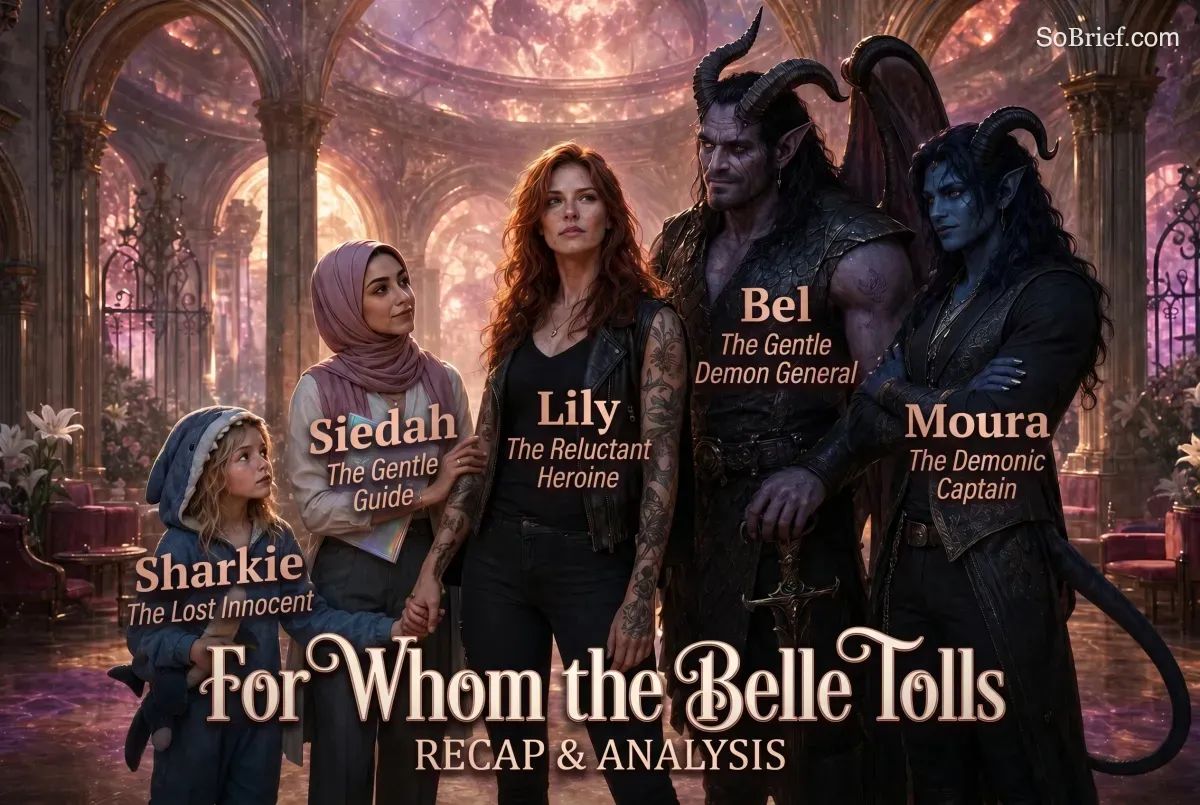
Lily
Dead woman running Hell's deskA thirty-four-year-old mortal soul who died of cancer, arriving in the Afterlife with two decades of customer service rage, a love of fantasy novels, and a silent chest where her heartbeat should be. Raised in an evangelical community that weaponized shame, she left the church after being blamed for her own assault at fourteen, then spent years rebuilding herself through therapy, tattoos, and sheer stubbornness. Six feet tall with auburn hair and a sleeve of literary tattoos, she masks vulnerability with sarcasm and competence. Her deepest wound is the belief that she requires too much effort to love—too sharp, too sarcastic, too much. She craves permanence: a partner, children, a home. The Afterlife gives her everything except the heartbeat she mourns.
Bel
Demon prince with a nerd's heartA demon prince and general commanding eighty-five legions of Hell, with purple-gray skin, bat-like wings, and a voice that makes online gaming lobbies go silent. The son of Lady Lilith11 and the late Samael20, he inherited a title he never wanted from a father who departed under painful circumstances. That loss left him believing he wasn't enough to keep anyone permanent. He compensates with relentless devotion—to his soldiers, his nieces and nephews, his friends. Behind the warrior's physique and combat scars lives a nerd who loves Tolkien, fruit, and terrible puns. He gives affection freely but guards his need for it, terrified that anyone he truly loves will eventually choose to leave. His pet name for Lily1—princess—reveals what he sees when others see only sharpness.
Sharkie
Shark-obsessed child of HellA mortal soul who died at eight, killed by a drunk driver while sneaking out to visit an aquarium. Her short life was a catalog of abuse: neglectful foster homes, a pastor who beat her, adults who told her she was wicked and destined for Hell. She arrives in the Afterlife in a shark onesie, hunched and terrified, insisting she belongs in damnation. Beneath the conditioned fear lives a fiercely curious mind and an irrepressible spirit that sharks, school, and combat classes gradually coax into the open. She communicates trust through pinkie promises and tests safety by observing whether adults keep their word. Her central question—why am I so easy to leave behind?—echoes through Lily's1 and Bel's2 own histories of abandonment and unworthiness.
Lucifer
Hell's weary, mischievous rulerRuler of Hell, devastatingly handsome with copper skin and black feathered wings, ancient beyond measure. Far from the monster of mortal mythology, he presides over a realm of justice and rehabilitation with weary devotion. He orchestrates Lily1 and Bel's2 meeting through transparent mischief. Beneath his charm lies profound exhaustion—he's spent eternity watching his name weaponized as a tool of fear. He takes a particular interest in Sharkie's3 wellbeing, and serves as a last line of defense during wartime rather than marching with his armies, a constraint that visibly frustrates him.
Greg
Hell's quietest predatorBel's2 oldest friend and master of Level Nine, Hell's most extreme punishment level. Burgundy-skinned, impeccably dressed, and lethally still, he radiates predatory calm that unnerves even other demons. His work isolating the worst souls has made him reserved and lonely, though he shows fierce loyalty through actions rather than words. He warns Bel2 that Lily1 will break his heart but supports the relationship anyway. His rare displays of vulnerability—sitting alone on stairs when Bel2 is injured, accepting a cat in his lap—reveal the depth he keeps armored beneath tailored black clothing.
Asmodeus
Bel's exuberant warrior cousinBel's2 cousin and fellow general, slate-gray skinned with spiked horns. Brash, affectionate, and shamelessly devoted to his wife Sariah7. Where Bel2 is steady, Asmodeus is exuberant—the kind of warrior who names pregnancy milestones by fruit size and drags friends through baby clothing shops. His joking exterior masks genuine emotional depth and fierce protectiveness of those he loves.
Sariah
Asmodeus's sharp-tongued wifeAsmodeus's6 terracotta-skinned wife with golden eyes, sharp-tongued and fiery. Pregnant throughout much of the story, she manages her enthusiastic husband with dry wit and steel will. She serves as one of Lily's1 frank confidantes, directly addressing sensitive topics like Lily's1 desire for children with empathy rather than pity.
Siedah
Lily's first Afterlife friendThe first person Lily1 befriends in the Afterlife—a Front Desk attendant in a pink hijab who guides souls through their post-death options. Warm but firm, she refuses to let Lily1 deflect compliments or diminish her own accomplishments, holding her hostage from pastries until she gives herself credit.
Lev
Hell's fastidious bureaucrat princeA prince of Hell obsessed with procedure, reports, and double-spacing. Olive-green skinned with burnt-orange eyes and impeccable tailoring. He sends memos about not having sex in offices. His awkward attempts at kindness—a sympathy card reading only three words—conceal genuine care for both the institution of Hell and the people within it. He finds comfort in knowledge and expresses affection through research.
Persephone
Goddess with wicked humorGreek goddess of spring, met over pastries at a coffee shop. Beautiful, wicked-humored, and surprisingly down-to-earth. She becomes Lily's1 friend, helps organize the seduction trivia night, and introduces Lily1 to the social world of deities. Married to Hades, she enjoys making the occasional filthy joke about their relationship.
Lilith
Bel's regal, cunning motherBel's2 mother, one of Hell's most powerful and ancient beings. Elegant, sharp-eyed, and warmly loving, she manages the Healers Guild and maintains a sprawling family with effortless authority. She tests Lily1 by handing her a notoriously fussy baby without warning, reading the results with a mother's precision.
Angel
Bubbly succubus friendA pink-skinned succubus demon who is Bel2 and Greg's5 friend. Sweet, curvy, and enthusiastic, she hugs with her whole being and provides warmth in a social circle that can skew toward intensity.
Moura
Gate demon captainNavy-blue-skinned captain of one of Hell's gate shifts. The first demon to invite Lily1 for wine, setting in motion her integration into Hell's community.
Krun
Gentle veteran gate warriorMassive olive-green gate demon with a broken horn, a scarred tail, and a daughter's glitter-encrusted bravery bead braided into his hair. A retired warrior whose gentleness belies his formidable build.
Crocell
Cheerful red gate demonRed-skinned gate demon who first recognizes Lily1 after her Judgment. Cheerful, loyal, and the first to celebrate her return visits.
Zagan
Artistic blue gate demonSlender midnight-blue gate demon with gorgeous penmanship who creates the original Hellp Desk sign. Blushes easily and loses a brother in the war.
Thanatos
Quiet god of peaceful deathGreek god of peaceful death, reserved and kind. His presence triggers a primal avoidance instinct in mortals, but Lily1 shakes his hand anyway and earns his quiet respect.
Aphrodite
Goddess of beauty and schemesGreek goddess of beauty who helps plan the seduction trivia night. Grounded and warm beneath her unearthly beauty, she advises Lily1 on hair, makeup, and strategic devastation.
God
Apologetic deity of lightAppears as a human-shaped being of shifting light with no fixed features. Admits his power to change the mortal world is limited and bows in apology to Lily1 for harm done in his name.
Samael
Bel's absent fatherOne of the Afterlife's most ancient beings and a founding prince of Hell. Bel's2 father, whose absence shapes his son's deepest wound and his fear of abandonment. He left behind a sealed letter and a crown.
Plot Devices
Soul Files
Reveal a soul's entire lifePaper files that project a soul's complete life history—memories, motivations, context—directly into the mind of anyone touching the pages. They appear automatically at the Hellp Desk when a soul approaches. Lily1 uses them to understand why each soul was sent to Hell, to calibrate her approach between compassion and brutality. The files show her children being abused, spouses being cheated on, employees being terrorized. The emotional weight fades after the soul moves on, but impressions linger. The files also serve as Lily's1 moral compass: she never beats a soul without seeing what they've done first, and she never mistakes fear for cruelty. When she reads Sharkie's3 file in the elevator, it confirms what she already suspects and galvanizes her protective instinct.
The Hellp Desk
Lily's purpose made physicalWhat begins as a folding table with a punny sign and a baseball bat becomes a permanent stone fixture grown directly from Hell's walls, complete with a computer, weapon rack, and an invisible protective barrier. The desk represents Lily's1 transformation from a lost soul into someone with genuine purpose. It starts as an improvised act of empathy for overwhelmed demons and evolves into an official institution that streamlines Hell's entire intake process. The desk is where Lily1 processes the worst of humanity, comforts the lost, and discovers that her lifetime of customer service rage was actually preparation for something meaningful. Its expansion to accommodate a second worker mirrors the growth of Lily's1 family and community.
Lily's Silent Chest
Tracks life, loss, and belongingAs a mortal soul, Lily1 has no heartbeat. She discovers this upon arriving in the Afterlife and it becomes a persistent, aching absence—a physical reminder of the life she lost, the fight she couldn't win. She'd savored each beat after her cancer diagnosis, so the silence is its own grief. The missing heartbeat haunts intimate moments: when Bel2 holds her against his thundering chest, when she wishes her heart would race at his heated looks, when she fears he'll notice the emptiness where life should be. It represents every dream that died with her mortal body—motherhood, growing old, the simple involuntary proof that she exists. The silent chest transforms from wound to symbol across the story's arc.
Bel's Crown
Inherited wound turned identityA gunmetal-gray crown studded with black opals, inherited from Bel's2 father Samael20 when he departed for the Void. Bel2 shoved it on the highest shelf of his office behind unread books and refused to look at it for over two centuries. The crown represents everything the prince title means to him: a reminder that his father left, that the title was given rather than earned, that love wasn't enough to keep someone. It sits alongside an unopened letter from his father. Together, the crown and letter form a sealed chamber of grief that Bel2 carries through every battle and relationship, afraid to open because the contents might confirm his worst belief about himself.
Deification
Loophole for permanent belongingAn obscure, millennia-unused process discovered by the bureaucratically obsessive Prince Leviathan9 during research on the Hellp Desk's future. A mortal soul who permanently yields their ability to reincarnate may petition the Universe for deification—transformation into a true denizen of the Afterlife. Approval is exceptionally rare, historically under ten percent, and the soul must never return to the mortal world. In exchange, they gain genuine life: aging, mortality through violence or the Void, and the ability to reproduce with other denizens. The device resolves the story's central impossible tension—Lily's1 desire to stay with Bel2 versus her dream of biological motherhood—through the most unlikely source: a prince whose idea of comfort is a double-spaced report.
FAQ
Synopsis & Basic Details
What is For Whom the Belle Tolls about?
- A Journey Beyond Life: For Whom the Belle Tolls follows Lily, a woman who dies from terminal cancer and finds herself in a bureaucratic yet fantastical Afterlife. She navigates a system of judgment, discovers her personal Paradise, and, driven by a need for purpose, volunteers at the "Hellp Desk" in Hell.
- Found Family & Healing: In Hell, Lily forms unexpected friendships with demons and deities, and takes a traumatized child soul named Sharkie under her wing. Her journey intertwines with Bel, a demon general, as their friendship blossoms into a deep, transformative love amidst personal healing and cosmic conflict.
- Choosing Eternity: The narrative explores themes of trauma and healing, self-acceptance, and the nature of existence, culminating in Lily's profound decision to yield her mortality and embrace a permanent life in the Afterlife, finding true home and family.
Why should I read For Whom the Belle Tolls?
- Unique Afterlife Reimagining: Readers seeking a fresh, humorous, and deeply empathetic take on death and the afterlife will find a rich world that subverts traditional religious dogma, offering a nuanced view of judgment, Hell, and even God. The novel challenges perceptions of good and evil, making it a compelling read for those interested in philosophical fantasy.
- Emotional Depth & Relatable Characters: Beyond the fantastical setting, the story excels in its psychological exploration of trauma and healing, grief, and healing. Lily's journey of self-discovery, Bel's struggle with past wounds, and Sharkie's path to trust offer powerful, relatable emotional arcs that resonate long after the final page.
- Witty Dialogue & Heartfelt Romance: Jaysea Lynn's writing style blends sharp wit and irreverent humor with moments of profound tenderness and passionate romance. The banter between characters, particularly Lily and Bel, is a highlight, creating a dynamic and engaging narrative that balances laughter with genuine emotional stakes.
What is the background of For Whom the Belle Tolls?
- Author's Personal Inspiration: Jaysea Lynn, born in the Pacific Northwest, drew on her love for fantasy and her experiences living aboard a sailboat. The book originated from her TikTok comedy/drama skit series "Hell's Belles," which gave her the confidence to share her writing, infusing the Afterlife setting with a unique blend of humor and personal reflection.
- Subversion of Religious Trauma: The narrative directly addresses and recontextualizes common religious fears and concepts, particularly around Hell and divine judgment. Lily's past experiences with religious trauma inform her initial apprehension and later defiance, offering a critical yet hopeful perspective on faith and spirituality.
- Cosmic Scale & Diverse Mythology: The Afterlife is presented as a vast, interconnected universe where deities from various mythologies (Greek, Norse, Mesopotamian, etc.) coexist alongside demons and mortal souls. This rich tapestry provides a backdrop for exploring universal constants of kindness and cruelty, and sets the stage for inter-universal conflicts that challenge the established peace.
What are the most memorable quotes in For Whom the Belle Tolls?
- "I didn't want to die. But we don't always get what we want, do we?" (Lily, Chapter 7): This quote encapsulates Lily's defiant pragmatism and her journey of accepting the uncontrollable. It highlights her resilience and the underlying bitterness of her mortal experience, setting the stage for her transformation in the Afterlife.
- "You are lovable. You always have been, and you always will be inherently—that means 'naturally'—easy to love." (Lily to Sharkie, Chapter 33): A pivotal moment in Sharkie's healing, this quote also reflects Lily's own hard-won self-acceptance. It underscores the novel's theme of inherent worth and the power of unconditional love to counteract deep-seated trauma.
- "Forever is never guaranteed, not even here, princess." (Bel to Lily, Chapter 25): This profound statement from Bel challenges the very concept of eternity in the Afterlife, emphasizing the preciousness of present moments and the courage required to love despite potential loss. It's central to understanding Bel's philosophy and his willingness to embrace a relationship with a mortal soul.
What writing style, narrative choices, and literary techniques does Jaysea Lynn use?
- First-Person Introspection & Humor: The narrative is primarily told from Lily's first-person perspective, offering intimate access to her sharp wit, internal struggles, and emotional growth. Jaysea Lynn masterfully uses Lily's sarcastic inner monologue and irreverent dialogue to inject humor into heavy themes, making the story both entertaining and thought-provoking.
- Subversion of Tropes & World-Building: The author skillfully subverts traditional fantasy and religious tropes, particularly in her portrayal of Hell, demons, and deities. The detailed world-building of the Afterlife, from its bureaucratic "Front Desk" to its diverse realms and cultures, is presented with a blend of the mundane and the magical, creating a unique and immersive setting.
- Emotional Resonance & Foreshadowing: Jaysea Lynn employs vivid emotional language and subtle foreshadowing to deepen the reader's connection to the characters and plot. Recurring motifs like Lily's tattoos, Bel's scars, and the house's sentience serve as symbolic anchors, while seemingly casual remarks often hint at future developments or reveal deeper character motivations.
Hidden Details & Subtle Connections
What are some minor details that add significant meaning?
- Lily's Corolla Analogy: In Chapter 1, Lily's self-deprecating joke about being a "Corolla at best" when told her tattoos were "bumper stickers on a Bentley" subtly foreshadows her deep-seated feelings of unworthiness and financial struggles that impact her life-or-death decisions. This seemingly throwaway line highlights her self-perception as ordinary and disposable, a core wound she must heal.
- The House's Sentience (Carlton): Lily's Paradise house, initially just a perfect home, gradually reveals a distinct personality, groaning happily or pouting (Chapter 22, 56). This subtle detail symbolizes the Afterlife's responsiveness to its inhabitants' emotional states and desires, acting as a supportive, almost parental, entity that reflects Lily's journey towards self-acceptance and belonging.
- Bel's Nieces' Bracelets: The aggressively glittery beaded bracelets Bel wears (Chapter 14) are a small, endearing detail that immediately humanizes him, revealing his deep love for his family and his role as a doting uncle. This contrasts with his formidable general persona, subtly foreshadowing his capacity for tenderness and his eventual role as a father figure to Sharkie.
What are some subtle foreshadowing and callbacks?
- The Old Man Waiting for His Wife: In Chapter 4, Lily observes an elderly man patiently waiting for his wife at the Front Desk, having lived "three lifetimes together." This subtly foreshadows the depth of love and permanence possible in the Afterlife, contrasting sharply with Lily's past romantic disappointments and setting a high bar for the kind of enduring connection she eventually finds with Bel.
- Bel's "Not Fond of Sharing" Comment: During trivia night (Chapter 31), Bel mentions he's "not fond of sharing" in the context of orgies. This seemingly casual remark subtly foreshadows his deeper emotional wound related to his father's departure and his fear of being "left behind" again, hinting at his desire for exclusive, lasting love.
- The "Weird Feeling" Before Invasion: Lily experiences a "weird feeling" (Chapter 48) before the enemy invasion, a sensation shared by denizens but not all souls. This foreshadows her eventual deification and deeper connection to the Afterlife's fabric, suggesting she possesses an innate sensitivity akin to its native inhabitants, hinting at her destiny to become a denizen.
What are some unexpected character connections?
- Lily's Camaraderie with Demons: Despite traditional portrayals, Lily finds immediate and deep camaraderie with the demons of Hell, particularly Moura, Crocell, and Krun (Chapter 7, 8). This connection is unexpected because it subverts mortal expectations of demons as purely evil, revealing them as complex, often weary, service workers who appreciate Lily's wit and empathy, highlighting the theme of finding connection in unlikely places.
- Lucifer as a Compassionate Matchmaker: Lucifer, the ruler of Hell, is unexpectedly portrayed as a caring, almost paternal figure who subtly orchestrates Lily and Bel's meeting (Chapter 11, 19). This challenges the traditional image of Satan, revealing a nuanced character who values justice, healing, and the happiness of his people, including playing a role in fostering love.
- God's Apology and Vulnerability: Lily's confrontation with God (Chapter 49) reveals an unexpected vulnerability in the divine being, who apologizes for the harm caused in his name and admits limitations. This connection is surprising because it humanizes God, transforming him from an all-powerful, distant figure into one capable of remorse and seeking to make amends, profoundly impacting Lily's religious trauma.
Who are the most significant supporting characters?
- Carlton (The House): More than just a setting, Lily's sentient Paradise house, affectionately nicknamed "Carlton" by Sharkie (Chapter 21, 35), acts as a silent, supportive character. It anticipates needs, offers comfort, and even expresses opinions, symbolizing the Afterlife's nurturing aspect and Lily's growing sense of belonging and safety.
- Gregorith (Greg): Bel's oldest friend and Master of Level Nine, Greg (Chapter 15, 28, 52) is a stoic, intimidating figure whose quiet loyalty and deep emotional capacity are gradually revealed. His role as a confidant to Bel and his unexpected tenderness towards Lily and Sharkie highlight the complex emotional landscape of Hell's denizens and the power of enduring friendship.
- Lev (Leviathan): As a Prince of Hell and a stickler for rules, Lev (Chapter 17, 29, 43) initially appears as a bureaucratic obstacle. However, his meticulous nature leads him to discover the deification loophole, making him an unlikely hero in Lily's journey. His awkward attempts at comfort and genuine care for the systems and people of Hell reveal a surprisingly endearing character.
Psychological, Emotional, & Relational Analysis
What are some unspoken motivations of the characters?
- Lily's Drive for Purpose: Beyond her initial defiance, Lily's volunteering at the Hellp Desk is driven by an unspoken need to prove her worth and make an impact (Chapter 7). Having felt "inconsequential" in life and grappling with survivor's guilt, her fierce dedication to justice for others is a way to find meaning and validate her own existence in the Afterlife.
- Bel's Fear of Being "Left Behind": Bel's reluctance to fully embrace romantic relationships stems from the deep trauma of his father's departure to the Void (Chapter 15, 20, 52). His unspoken motivation is a profound fear of abandonment, leading him to initially guard his heart and question his worthiness for lasting love, despite his outward confidence.
- Lucifer's Desire for Connection: Lucifer's subtle matchmaking and compassionate interactions, particularly with Sharkie and Lily, hint at an unspoken loneliness or desire for genuine connection (Chapter 11, 19, 44). As the ruler of Hell, he carries immense responsibility, and his efforts to foster happiness in others may reflect his own need for warmth and belonging in his eternal existence.
What psychological complexities do the characters exhibit?
- Lily's Paradoxical Self-Perception: Lily grapples with the psychological complexity of viewing herself as "too much" (Chapter 4) while simultaneously possessing immense inner strength and a fierce capacity for love and justice. Her journey involves deconstructing years of conditioned self-doubt and religious trauma, learning to reconcile her perceived flaws with her inherent worth, and embracing her authentic self.
- Bel's Burden of Leadership & Grief: Bel exhibits the psychological complexities of a warrior leader burdened by immense responsibility and survivor's guilt (Chapter 34, 52). His stoic exterior often masks deep grief and a profound sense of duty, leading to internal struggles with vulnerability and the emotional toll of war, even in the Afterlife.
- Sharkie's Healing from Conditioned Fear: Sharkie's psychological journey is marked by overcoming deeply ingrained conditioned fear and religious trauma (Chapter 18, 19, 23). Her initial belief that she belongs in Hell, despite her innocence, highlights the lasting impact of abuse. Her gradual blossoming into a curious, confident child demonstrates the power of consistent love, safety, and positive reinforcement in healing profound psychological wounds.
What are the major emotional turning points?
- Lily's Acceptance of Her Past: A major emotional turning point for Lily occurs when she shares her soul file with Bel (Chapter 42) and he responds with unwavering love and pride, validating her struggles and choices. This moment allows her to shed the shame and guilt she carried from her mortal life, transforming her self-perception and deepening her capacity for intimacy.
- Bel's Confrontation of His Father's Departure: Bel's emotional turning point comes when he reads his father's letter (Chapter 59), finally understanding the reasons behind his father's choice to enter the Void. This allows him to release centuries of pain, anger, and perceived inadequacy, leading to a profound sense of peace and a renewed belief in his own worthiness for love and permanence.
- Sharkie's Embrace of "Mom" and "Dad": Sharkie's decision to call Lily "Mom" and Bel "Dad" (Chapter 46, 53) marks a significant emotional turning point, symbolizing her full acceptance of her found family and her healing from past trauma. This act of trust and belonging solidifies their familial bonds and provides a powerful affirmation of love's transformative power.
How do relationship dynamics evolve?
- Lily and Bel: From Banter to Deep Intimacy: Their relationship evolves from playful, nerdy banter and mutual attraction (Chapter 9, 13) to a profound emotional and physical intimacy built on trust, vulnerability, and shared healing. Their journey involves confronting individual traumas and fears, culminating in a commitment to a permanent, loving partnership that redefines their understanding of family and belonging.
- Lily and Sharkie: From Guardian to Mother-Daughter: The dynamic between Lily and Sharkie transforms from a compassionate guardian-child relationship (Chapter 18) into a deeply loving mother-daughter bond (Chapter 33, 46). Lily's unwavering patience, protection, and belief in Sharkie's worth help the child heal, while Sharkie's trust and affection fill a void in Lily's own heart, creating a powerful found family unit.
- Lucifer's Role: From Ruler to Family Patriarch: Lucifer's relationship with Lily and Sharkie evolves from a formal ruler-subject dynamic to that of a supportive family patriarch (Chapter 19, 53). His initial role in guiding Lily and his later, tender interactions with Sharkie, culminating in being called "Papa," showcase his growth beyond his traditional image, highlighting the Afterlife's capacity for unexpected familial bonds.
Interpretation & Debate
Which parts of the story remain ambiguous or open-ended?
- The Nature of the House's Sentience: While Carlton, Lily's house, clearly has a personality and responds to her and Sharkie (Chapter 21, 22, 56), the exact nature and limits of its sentience remain ambiguous. Readers might debate whether it's a literal consciousness, a magical reflection of its inhabitants' desires, or a metaphorical representation of the Afterlife's inherent support system.
- The Future of the Inter-Universal Conflict: Although the immediate invasion is repelled and the rift sealed (Chapter 50), the long-term threat from the other Universe remains open-ended. The story concludes with a fragile peace, leaving readers to ponder whether future conflicts will arise and how the Afterlife will continue to adapt and defend itself.
- The Specifics of Deification & Powers: While Lily's deification grants her a heartbeat and the ability to reproduce (Chapter 62), the full extent of her new "denizen status" and any potential powers remains largely unexplored. The narrative hints at subtle changes but leaves the specifics open, allowing readers to imagine the ongoing evolution of her existence in the Afterlife.
What are some debatable, controversial scenes or moments in For Whom the Belle Tolls?
- Lily's Violent Justice at the Hellp Desk: Lily's use of a baseball bat and physical violence against certain souls at the Hellp Desk (Chapter 8, 13) could be a controversial point. While framed as "justice" for heinous acts and a cathartic release for Lily, some readers might debate the morality of such actions, even against truly evil characters, and whether it aligns with the Afterlife's stated goal of "growth."
- The Portrayal of God and Religious Trauma: The direct confrontation between Lily and God (Chapter 49), where God apologizes for the harm caused in his name, could be controversial for readers with strong religious beliefs. The narrative challenges traditional theological concepts, portraying God as fallible and limited, which might spark debate about the story's theological implications and its handling of religious trauma.
- Bel's "Sexile" and Blackmail: Bel's playful "blackmail" of Lily into bed rest through "sexile" (Chapter 53) is a moment that could be debated. While presented as consensual and humorous within their established dynamic, some readers might find the power dynamic or the concept of withholding sex as a tool for compliance problematic, even in a lighthearted context.
For Whom the Belle Tolls Ending Explained: How It Ends & What It Means
- Lily's Deification and Restored Heartbeat Explained: The ending of For Whom the Belle Tolls sees Lily successfully apply for deification, a rare process that transforms her from a mortal soul into a permanent denizen of the Afterlife. The most significant outcome is the restoration of her heartbeat (Chapter 62), symbolizing her full integration into life and existence within this new realm. This means she is no longer "temporary" but truly alive in the Afterlife, capable of experiencing all its joys and challenges, including the ability to have children with Bel.
- Embracing a Chosen Forever: Lily's decision to stay permanently in the Afterlife, giving up the option of reincarnation, signifies her complete acceptance of her found family and her new purpose. It means she has healed from her past traumas, overcome her fears of inadequacy and abandonment, and chosen a future defined by love, belonging, and fulfillment with Bel and Sharkie. This choice is a powerful statement on agency and the idea that "home" is where the heart is, regardless of its physical location or traditional expectations.
- A Future of Love, Family, and Continued Growth: The epilogue, set a few years later, confirms Lily's enduring happiness and the continued growth of her family. She and Bel are still deeply in love, Sharkie has blossomed into a confident young adult with her own Paradise and internship at the Hellp Desk, and they plan for more children. The ending means a hard-won peace, not just from external conflicts but from internal struggles, emphasizing that true happiness lies in embracing life's imperfections and continually choosing love and connection.
Download PDF
Download EPUB
.epub digital book format is ideal for reading ebooks on phones, tablets, and e-readers.








































