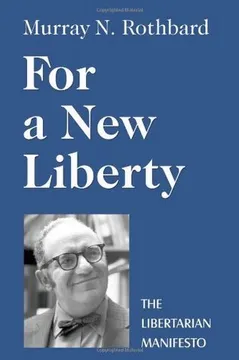
Key Takeaways
1. The Nonaggression Axiom is the absolute moral foundation of liberty.
The libertarian creed rests upon one central axiom: that no man or group of men may aggress against the person or property of anyone else.
The nonaggression principle. The libertarian creed rests upon a single, uncompromising moral axiom: no individual or group may initiate physical violence against another's person or property. This principle establishes a universal standard of justice, outlawing not only private crimes like assault and theft, but also state-sanctioned actions that would be deemed criminal if committed by private citizens.
Universal moral consistency. Unlike modern liberals or conservatives, who apply moral principles selectively, the libertarian demands absolute consistency. Leftists often oppose the violence of war while championing the violence of taxation, while rightists trumpet free enterprise while supporting militarism and the outlawing of victimless behaviors.
Defining criminal acts. Under this framework, a crime is strictly defined as a violent invasion of another's self-ownership or legitimate property. Consequently, activities that do not involve physical invasion—such as drug use, gambling, and prostitution—are not considered crimes at all.
- Aggression is defined as the initiation of the use or threat of physical violence.
- The nonaggression axiom applies equally to private citizens and government officials.
- Victimless crimes are completely decriminalized under a libertarian legal framework.
2. Private property rights are the indispensable basis of all human rights.
Whatsoever, then, he removes out of the state that nature hath provided and left it in, he hath mixed his labour with it, and joined it to something that is his own, and thereby makes it his property.
Self-ownership and homesteading. The right to self-ownership asserts that every human being has an absolute, natural right to control their own body. To survive, humans must interact with the material world, acquiring property rights in land and resources through the Lockean process of "homesteading"—mixing one's labor with previously unused natural resources.
Property is human. The common political division between "human rights" and "property rights" is a dangerous fallacy. Human rights cannot be exercised without the material means to sustain them; for example, freedom of the press is meaningless without the private ownership of newsprint, ink, and printing presses.
The market network. From the right to private property stems the absolute right to free contract and voluntary exchange. The free-market economy is simply a vast, complex network of mutually beneficial, two-person exchanges that maximizes both individual liberty and economic productivity.
- Every individual has an absolute property right in their own body and person.
- Homesteading is the only just method of acquiring ownership of natural resources.
- Property rights are the physical manifestation of human rights.
3. The State is an inherently aggressive, parasitic, and illegitimate monopoly.
The State claims and exercises the monopoly of crime…. It forbids private murder, but itself organizes murder on a colossal scale.
Organized systemic predation. While society condemns private theft and murder, it exempts the State from the general moral law under the guise of "sovereignty." In reality, the State is a parasitic institution that acquires its revenue through coercive violence (taxation) and maintains a compulsory monopoly on protection and ultimate decision-making.
The court intellectuals. Throughout history, the State has maintained its illegitimate rule by forming an alliance with "court intellectuals." These opinion-moulders—historians, economists, and technocrats—are rewarded with power and prestige in exchange for fabricating sophisticated ideologies that convince the public of the State's necessity.
Taxpayers versus tax-consumers. As John C. Calhoun demonstrated, the fiscal actions of the State inherently divide society into two conflicting classes. The "tax-payers" bear the burden of supporting the government, while the "tax-consumers" live off the coerced disbursements, creating an antagonistic relationship that expands with the size of the State.
- Taxation is legalized theft, and conscription is state-sanctioned slavery.
- The State is the supreme, best-organized aggressor against person and property.
- Written constitutions fail because the State's own Supreme Court holds the monopoly on interpretation.
4. Conscription, taxation, and compulsory services are forms of involuntary servitude.
What else is involuntary servitude if not the draft?
The draft as slavery. Conscription is the most blatant form of state-imposed slavery, forcing young men to surrender their bodies and risk their lives at below-market wages. The state's claim that the draft is necessary for national defense is economically absurd; a free market can easily hire voluntary defenders by paying competitive market wages.
Compulsory legal duties. Involuntary servitude also permeates the democratic judicial system through compulsory jury duty and the subpoena power. Forcing innocent citizens to serve on juries or testify under threat of imprisonment is a coercive extraction of labor that violates the Thirteenth Amendment.
Taxation as forced labor. The income tax system is a form of forced labor, requiring citizens to work a large portion of the year for the government without compensation. Furthermore, the withholding system forces employers to act as unpaid, coerced tax collectors, imposing heavy administrative costs on businesses.
- Conscription is a violent invasion of self-ownership and a form of state-sanctioned slavery.
- Compulsory jury duty and subpoena powers coerce labor from innocent citizens.
- The income tax forces individuals to surrender the fruits of their labor under threat of violence.
5. True personal liberty requires the decriminalization of all victimless activities.
The most dangerous man, to any government, is the man who is able to think things out for himself, without regard to the prevailing superstitions and taboos.
Victimless crime laws. Laws prohibiting gambling, prostitution, drug use, and pornography are illegitimate because they regulate actions where there is no victim. By criminalizing voluntary transactions, the State violates individual self-ownership, breeds police corruption, and creates highly lucrative black-market monopolies.
The futility of paternalism. The paternalistic argument that the State must protect individuals from themselves is a slippery slope toward totalitarianism. If the State can outlaw drugs or gambling "for our own good," it can logically dictate our diets, exercise habits, and reading materials, reducing citizens to dependent children.
The right to self-defense. True personal liberty also includes the absolute right to own and carry weapons for self-defense. Gun control laws do not disarm criminals, who routinely bypass the law; instead, they systematically disarm peaceful victims, stripping them of their primary means of protection.
- A legitimate crime requires an actual victim whose person or property has been invaded.
- Paternalistic laws reduce individuals to a subhuman level by depriving them of free choice.
- Gun control laws disarm peaceful citizens while leaving criminals free to acquire weapons.
6. Public education is an instrument of State indoctrination that must be privatized.
A tax-supported, compulsory educational system is the complete model of the totalitarian state.
Compulsory mass dragooning. Compulsory school attendance laws act as a system of state-enforced incarceration for the nation's youth. Forcing unwilling and unadaptable children into uniform classrooms warps their minds, breeds deep-seated alienation, and is a primary driver of juvenile delinquency.
Indoctrination and uniformity. Historically, the public school system was established by ruling elites to enforce obedience to the State and stamp out cultural and religious diversity. Because public schools are bureaucratic monopolies, they must impose a single, uniform curriculum, which inevitably generates intense social conflict over values.
The free market alternative. The only solution to the educational crisis is to completely separate education from the State. A free market in education would allow a diverse array of private schools to emerge, catering to the unique needs, values, and aptitudes of every child.
- Compulsory attendance laws violate the liberty of children and parents alike.
- Public schools are used by the State to inculcate obedience and uniformity.
- Higher education subsidies systematically redistribute wealth from poorer taxpayers to wealthier students.
7. The welfare state creates a destructive cycle of dependency and economic distortion.
The country can have, there is no doubt of it, exactly as many paupers as it chooses to pay for.
Incentivizing dependency. The welfare system has a positive supply function: as benefits rise and the social stigma of receiving aid is removed, the welfare rolls inevitably expand. When welfare payments and associated benefits outstrip low-wage employment, idleness becomes a rational economic choice, trapping families in permanent dependency.
The failure of the welfare state. The modern welfare state does not redistribute wealth from the rich to the poor; instead, it taxes the working poor heavily in order to subsidize the welfare poor. This system penalizes productivity and creates a permanent class of dependents who are managed by a self-perpetuating bureaucracy of social workers.
The voluntary alternative. Abolishing government welfare would pave the way for highly efficient, voluntary private charities. Programs like the Mormon Church's welfare plan demonstrate that private charity, by focusing on temporary aid and rapid rehabilitation toward self-help, successfully preserves the recipient's dignity and independence.
- High welfare benefits compete with low-wage jobs, actively discouraging productive work.
- The welfare state is a regressive system that often burdens the working poor.
- Private, voluntary charity is far more effective at fostering independence and self-respect.
8. Inflation and business cycles are caused by government manipulation of money and credit.
The government has acquired the monopoly power to counterfeit and calls it increasing the supply of dollars...
The monetary cause of inflation. Chronic inflation is not caused by greedy businessmen or demanding labor unions, but solely by the rapid expansion of the money supply. Because the government holds a coercive monopoly over the creation of money, it acts as a legalized counterfeiter, printing money to finance its own deficits.
Fractional reserve banking. The modern inflationary engine is driven by the Federal Reserve System, which cartelizes the commercial banking system. The Fed permits banks to create "checkbook money" out of thin air by pyramiding loans on top of fractional reserves, silently diluting the purchasing power of the dollar.
Austrian business cycle theory. When the central bank artificially expands credit, it lowers the rate of interest below its free-market level. This misleads businessmen into making unsustainable "malinvestments" in capital goods, sowing the seeds of an inevitable economic crash and subsequent corrective depression.
- Inflation is always and everywhere a monetary phenomenon controlled by the State.
- The Federal Reserve System is a government-sponsored cartel that inflates the currency.
- Depressions are the market's natural way of liquidating the distortions of an inflationary boom.
9. Police, courts, and national defense can be efficiently provided by the free market.
There is no reason to assume a 'natural monopoly' of judicial wisdom.
Private police protection. In a purely free society, police protection would be supplied by competing private security firms hired by landowners, merchants, and insurance companies. Because these firms would depend on voluntary consumer payments, they would have a powerful economic incentive to be highly efficient, courteous, and non-brutal.
Private courts and arbitration. Disputes would be resolved by competing private courts and voluntary arbitrators, operating under a generally accepted libertarian legal code. The historical success of the law merchant and common law demonstrates that a systematic, objective legal system can develop entirely independent of the State.
National defense without the State. A stateless society would be far less vulnerable to foreign invasion because it would not possess a threatening, centralized State apparatus. Defense would be financed voluntarily, and any invading force would face the insurmountable obstacle of a highly armed population engaged in relentless guerrilla warfare.
- Private street owners have a direct economic interest in maintaining safe, crime-free neighborhoods.
- Competing private courts would rely on reputation and voluntary arbitration to resolve disputes.
- A stateless society avoids the catastrophic inter-state wars generated by rival governments.
10. A successful strategy for liberty requires uncompromising adherence to the ultimate goal.
Gradualism in theory is perpetuity in practice.
The danger of opportunism. Libertarians must avoid the trap of right-wing opportunism, which sacrifices ultimate principles for short-run, "practical" political gains. By advocating only minor, gradual reforms, opportunists hide the ultimate goal of liberty from the public and inadvertently validate the legitimacy of the State.
The danger of sectarianism. Conversely, libertarians must also avoid left-wing sectarianism, which rejects any transitional steps or partial victories that fall short of the ultimate goal. Sectarians isolate themselves from the real world, rendering their pure theory sterile and making the achievement of liberty impossible.
The abolitionist perspective. The correct strategic path is an "abolitionist" perspective: demanding the immediate attainment of liberty while accepting any and all short-run reductions of State power. The libertarian's concern should not be to use the State to plan a gradual transition, but rather to hack away at any and all manifestations of statism whenever and wherever possible.
- Libertarians must always hold the ultimate goal of pure liberty aloft to inspire public enthusiasm.
- Any transitional demand must be consistent with, and never contradict, the final goal of liberty.
- The collapse of Keynesianism and the desanctification of the State have created a permanent crisis ripe for liberty.
Review Summary
For a New Liberty receives strong praise from most readers, who admire Rothbard's consistent, logical framework for libertarian philosophy and its applications to economics, governance, and society. Many find it transformative and prophetic. Critics, however, point to selective historical reasoning, oversimplified arguments, questionable omissions from cited sources, and weak solutions to practical governance challenges. Some dismiss it as utopian or morally troubling. Despite ideological divides, even skeptical readers acknowledge its intellectual significance as a foundational libertarian text.
About the Author
Other books by Murray N. Rothbard
Download PDF
Download EPUB
.epub digital book format is ideal for reading ebooks on phones, tablets, and e-readers.








































