

Key Takeaways
One housewife under hypnosis relived five lives across six centuries
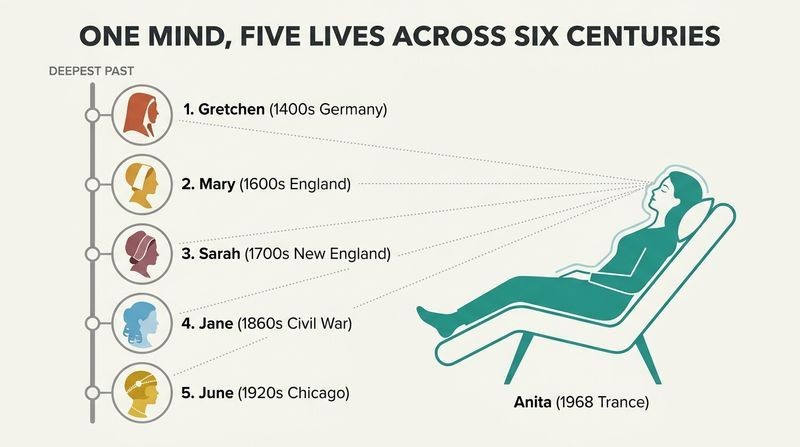
A 1968 accident of curiosity. In hot, arid Beeville, Texas, Navy hypnotist Johnny Cannon was helping a Catholic Navy wife (pseudonym Anita) lose weight and lower her blood pressure through relaxation suggestions. Anita was a somnambulist, meaning she dropped instantly into the deepest trance and remembered nothing on waking. On a whim, they tried regressing her past childhood, past birth.
The floodgates opened. Over spring to autumn 1968, Anita became five distinct women: June/Carol (a 1920s Chicago gangster's mistress), Jane (a Civil War Southern belle), Sarah (colonial New England), Mary (a meek English cobbler's wife), and Gretchen (a fierce medieval German). Each had a different voice, dialect, handwriting, and temperament. Dolores Cannon, Johnny's wife, held the microphone and took notes, launching a 40-year career.
What's striking is the humility of the setup. The Cannons had almost no prior literature (only Bridey Murphy and a couple of others) and invented their method as they went. This positions the book as a primary-source artifact rather than a polished theory. Skeptics will note that somnambulistic subjects are precisely those most suggestible and prone to confabulation, and that a hypnotist's leading questions can seed rich narratives. The book's value lies less in proving reincarnation than in documenting how vividly the human mind can generate coherent, emotionally consistent alternate personalities, a phenomenon that fascinates psychologists studying dissociation, cryptomnesia, and the constructive nature of memory.
Deep trance subjects fully become the past personality, not perform it
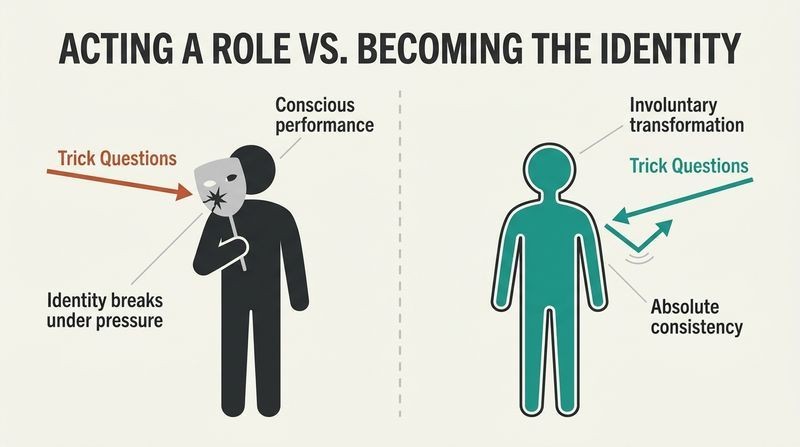
Somnambulists disappear into the role. Cannon defines a somnambulist as a person who enters the deepest hypnotic level effortlessly and literally becomes the past-life personality in every detail, retaining no conscious memory afterward. Anita did not act out a character; her mannerisms, vocabulary, and emotional reactions shifted completely and involuntarily.
Consistency under pressure. Johnny deliberately tried to confuse her across sessions weeks apart. He asked trick questions (Was the farm in Chicago? Is Al's last name Capone?), planted false facts, and jumped her between eras. She never broke character. As blonde, fair Anita, she insisted her hair was brunette when she was June. She screamed in genuine distress when returned to the hated Illinois farm as Carol. She didn't recognize everyday words like dictionary or school when regressed to eras before those terms were common.
This is the book's most testable claim, and it cuts both ways. The linguistic anachronism detail (not knowing modern words) is genuinely hard to fake deliberately and suggests deep immersion rather than conscious playacting. Yet cognitive science offers alternatives: state-dependent memory and role absorption can produce remarkable internal consistency without any paranormal source. Actors using method techniques and patients with dissociative identity disorder show similar stability. The handwriting analysis (a graphoanalyst judged three signatures as three different personalities, one introvert, one extrovert) adds intrigue, but graphology itself lacks scientific validation. The consistency is real and remarkable; its cause remains the open question.
Verify what you can, but accept most proof stays elusive
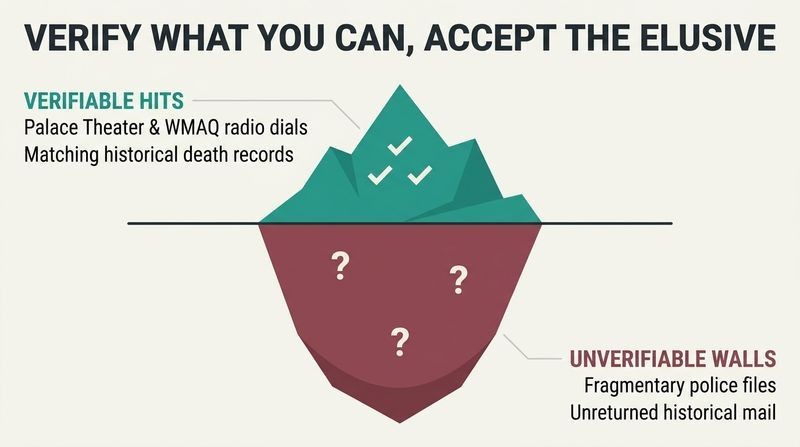
Diligent detective work. Dolores tried to corroborate Anita's statements through letters, libraries, and archives. Some hits were uncanny: Chicago radio station WMAQ really sat near 67 on the dial (June set hers to 65); the Palace Theater existed on Randolph Street; Dr. James Lipscomb died in Chicago in 1936, matching a doctor June named; Frank Nitti was indeed Capone's enforcer; Atchison, Kansas sits on the Missouri River; Tennessee really seceded in June 1861, matching Jane's odd claim the war started then.
But walls everywhere. The Chicago Tribune and police had only fragmentary crime-era records. Boston historical societies wouldn't answer mail. Weather bureaus lacked 1810 data. As Johnny put it, believers need no proof and skeptics accept none.
The pattern of verification deserves scrutiny. Many confirmed details (a theater, a radio frequency, that Tennessee seceded in June) are publicly available facts a mid-century American could have absorbed unconsciously, a phenomenon called cryptomnesia where forgotten information resurfaces as apparent memory. The truly evidential cases would be obscure, private facts, and those (Gerald Allby, the exact address on Lake Road) consistently failed to check out. Dolores is refreshingly honest about this asymmetry. Her comparison of research to genealogy (any hit feels like finding a diamond in sand) captures confirmation bias precisely: hits are memorable, misses forgotten. Still, her willingness to document failures lends the account credibility rare in the genre.
Phobias with no cause may trace to another life's trauma
Fear without a source. Anita had a lifelong, unexplained aversion to violence and refused to watch shows like The Untouchables, set in gangland Chicago, an era she knew nothing about. Yet under trance she became June, immersed in that exact world. As June, she once helped Al dispose of a gun by wrapping it in a towel with bricks and throwing it in Lake Michigan.
Echoes in the present. In her current life, Anita had a recurring dream of throwing something off a boat, and once, riding a ferry near New York, felt an overwhelming urge to throw a package overboard, blurting to a companion to hand over her purse. She also couldn't sleep the night before her husband's first Navy departure, certain he would never return, mirroring Jane losing Gerald to the Civil War.
This is the book's most therapeutically resonant thread, and it anticipates the entire field of past-life regression therapy that Dolores helped popularize. The key insight travels well regardless of metaphysics: the mind can carry emotional charge whose origin the conscious self cannot locate. Modern trauma research (Bessel van der Kolk's work on the body keeping the score, epigenetic studies of inherited stress) offers naturalistic parallels to inexplicable fears. Clinically, practitioners note that past-life narratives can resolve symptoms whether or not the past life is literally true, functioning like therapeutic metaphor. The efficacy question and the reality question are genuinely separable, a distinction Dolores herself draws in noting psychologists use the tool agnostically.
Between lives, spirits rest, then are drafted to help the living
Death is a doorway, not a wall. When regressed to the moment of June's 1927 death, Anita calmly reported floating above her own corpse, watching Al weep. She wasn't frightened. Al's deceased mother met her and explained the rules: you needn't haunt houses or scare people, you move instantly by intention, and you feel neither hot nor cold.
Guardian work on assignment. Cannon's spirits describe a between-lives state where a voice assigns tasks. Anita, as various spirits, recounted stopping a wounded animal charging a Native American hunter, guiding a lost boy home in Tennessee, helping a drowning boy swim, and steadying a girl through a blizzard. Any idle spirit, she said, can be drafted, suggesting guardian angels are less permanently assigned than opportunistically deployed.
Cannon's spirit-world model is notably cheerful and bureaucratic, closer to a cosmic volunteer corps than to traditional theology. It echoes themes later systematized by researchers like Michael Newton (Journey of Souls) and resonates with the near-death experience literature Raymond Moody catalogued in Life After Life, published seven years after these 1968 sessions: the tunnel, the greeting by deceased loved ones, the absence of fear. That convergence is intriguing, though critics reasonably point out that such imagery reflects deep cultural scripts about the afterlife that any Western subject would carry. The playful ski-stealing ghost anecdote humanizes the account and undercuts the solemn stereotype of hauntings, which is disarming whether one believes it or not.
A soul can walk into a living body when its spirit rests
Sarah's strange entry. Regressing the colonial New Englander Sarah to before her birth, Anita described something unprecedented: entering the body of a young, feverish girl whose original spirit needed to withdraw and rest. The exchange happened at the breaking of a fever, and observers noticed only that the child was quieter afterward.
Psychic aftereffects. Because Sarah entered fresh from the spirit world rather than through normal birth (which Cannon says dulls past memory), she retained visions. As a child she saw future Boston: paved streets, women in knee-length dresses and sheer stockings, steamships crossing the ocean in days. Her mother wept and called her rattled. Dolores notes author Ruth Montgomery later coined the term walk-in for such soul exchanges in her book Strangers Among Us.
The walk-in concept is the book's boldest metaphysical claim and its most vulnerable. Cannon's own explanatory logic is elegant: normal birth erases memory because the infant's focus goes to mastering a body, so a soul bypassing that process keeps its clairvoyance. This neatly explains why prodigies and psychic children might exist. Yet the idea also conveniently insulates itself from disproof. The described future visions are the kind of details a 1960s mind could easily project backward. Anthropologically, walk-in and soul-exchange beliefs appear across cultures (Tibetan tulku traditions, spirit possession frameworks), suggesting the concept answers a deep human intuition that identity and body are separable, a dualism most neuroscientists now reject.
Souls alternate genders and difficulty to balance every lesson
Gretchen was too strong. Anita's earliest life was Gretchen, a fierce 14th-century German noblewoman so willful that even death didn't stop her. Sealed in a castle wall and killed by raiders, her spirit refused to leave, terrorizing the invaders, driving horsemen off a cliff, and defending the castle until her father returned. The voice ruled she was sent to Earth too soon, and she needed centuries of rest to erase the memory.
The pendulum principle. Because Gretchen was overpoweringly strong-willed, her next life had to be the opposite: meek, gentle Mary in England. Dolores reflects that souls must experience both sexes and every temperament to become balanced. Anita's five female lives, she reasons, happened because her strong tendencies first needed neutralizing before she could safely incarnate as a man.
The Gretchen sequence is the emotional climax, and Anita's resistance to entering it (the only time she fought the trance) is a compelling psychological detail. The balancing principle Cannon articulates resembles the karmic pedagogy found in Theosophy and Hindu-Buddhist thought: the soul as student cycling through complementary experiences toward equilibrium. It also mirrors Jungian individuation, the integration of opposites (including the contrasexual anima and animus) into a whole self. The framework is spiritually satisfying but scientifically unfalsifiable, and it retrofits meaning onto whatever pattern appears. Notably, Cannon revised her own view over decades, initially accepting Anita's all-female lives as natural, later reinterpreting them through the balancing lens, an honest display of an evolving theory.
The 'Perfect Spirit' claimed God will return in the 21st century
A newly created soul. In one session a startlingly regal, articulate entity emerged that had never lived on Earth, only been created from a bit of goodness by the Creator. The Cannons called it the Perfect Spirit. It described a cosmology: God made many solar systems (not all), populated each planet with life suited to its conditions, and favors troubled Earth.
Bold predictions. The spirit said God once appeared as a part of himself (Jesus), was rejected, and would return in the 21st century, materializing as an ordinary human, declaring divinity, and being rejected again. It reframed the devil not as a being but as human selfishness, an illusion the church teaches because minds struggle with a God who contains both good and shadow.
This passage is where the book departs furthest from Anita's other, character-driven personalities and enters pure theological revelation, delivered in uncharacteristically eloquent English. That stylistic shift is telling: skeptics see the trance subject channeling the hypnotist's or culture's spiritual yearnings, while believers see genuine higher contact. The content itself blends Gnostic ideas (evil as illusion, the demiurge softened), process theology (a patient, non-omnipotent God controlling only part of creation), and panspermia-adjacent notions of life on many worlds. Anita, raised Catholic, found it so disturbing she asked to have the memory erased. That distress is psychologically authentic and suggests the material genuinely conflicted with her conscious beliefs rather than flattering them.
In 1968, Anita predicted Nixon's win before he even announced
Foresight from the spirit state. Cannon claims spirits can see the future by concentrating. In mid-1968 sessions, Anita in trance foresaw a hot-summer riot in Chicago (the Democratic National Convention riots erupted that August), predicted Nixon would become president (when Robert Kennedy was the presumed frontrunner and Nixon hadn't declared), and foresaw men reaching the moon in 1969 with an accompanying tragedy.
Assassination and a lost sub. Asked to view JFK's 1963 death, Anita described a crossfire, shots from both a book depository and behind a fence, years before conspiracy theories gained traction. She described the nuclear submarine USS Scorpion, lost in May 1968, sinking from internal failure below crush depth, a scenario a Navy inquiry later deemed likely.
Prophecy is the hardest genre to evaluate honestly because the book was published in 2009, decades after the events, giving ample room for selective emphasis and retrofitting. The Nixon and moon-landing hits are impressive if the sessions were truly recorded in mid-1968, but the manuscript sat unpublished for years, and no independent dating confirms the tapes. The JFK crossfire claim resonates with popular conspiracy sentiment that hardened after the 1970s, raising the question of whether later editing colored the account. The Scorpion description is genuinely intriguing given the Navy's inconclusive findings. Prudent readers treat undated, self-reported precognition as the weakest evidential link, however compelling the narrative.
A glimpse of the future gave her strength to survive catastrophe
The prophecy that held. During a session, Anita looked ahead and told Johnny he would live to be a very old man surrounded by great-grandchildren in a southern state, working with wires and tubes, technology she found frightening and alien.
The test. In September 1968 a drunk driver hit Johnny head-on. He suffered three brain concussions, lost all his blood, his heart stopped three times, and doctors predicted death, then permanent vegetative state, then double amputation. Dolores, clinging to the trance prediction, calmly insisted he would live. He did. His face healed so fast the surgeon canceled planned plastic surgery; staff called him the Miracle Man. He lost one foot, spent 25 years partly in a wheelchair, and died in 1994, having indeed met his great-grandchildren.
This is the book's most human and least falsifiable chapter, and its power is narrative rather than evidential. Whether the prophecy caused Dolores's resolve or merely rationalized it afterward, the psychological function is clear and well documented: expectancy and hope measurably affect caregiver resilience and even patient outcomes (the placebo and nocebo literature, studies on optimism and recovery). Johnny's rapid healing may reflect the survivorship of an unusually fit 37-year-old plus medical fortune, but the family's meaning-making is what mattered to them. The chapter also reframes the entire book: the experiment's true payoff, Dolores argues, was not proving reincarnation but equipping her to endure tragedy, a deeply pragmatic spirituality.
If you cannot not write, keep going after every rejection
Nine years of no. Dolores wrote Five Lives Remembered in 1980, but no publisher wanted it. There were no New Age bookstores, metaphysics was fringe, and one house said they might reconsider if she had regressed a famous movie star. She filed the manuscript away and kept writing other books through repeated heartbreak.
The compulsion test. Her rule for aspiring writers: your first book may never sell, so write the next. If you are a real writer, you cannot not write; you would rather write than eat. Her fourth, fifth, and sixth books (the Conversations with Nostradamus trilogy) sold first. This debut manuscript sat 11 years until 2009, when her daughter called it a bridge book, a time capsule of how it all began.
Buried in a metaphysics memoir is a genuinely useful creative-persistence lesson that stands independent of any belief. Cannon's cannot-not-write criterion echoes Rilke's advice in Letters to a Young Poet: write only if you would die if forbidden to. It also aligns with research on intrinsic motivation (Deci and Ryan's self-determination theory), which finds that internally driven creators persist through external rejection far better than reward-seekers. Her real-world track record (fifteen-plus books, translations into twenty languages, a publishing company she founded) validates the advice empirically. The detail about a publisher wanting a celebrity subject is a wry window into how gatekeepers chase proxies for value rather than the work itself.
Analysis
Five Lives Remembered is a spiritual memoir disguised as a case study, and its unusual charm comes from being written by novices. In 1968, before New Age vocabulary existed, Johnny and Dolores Cannon stumbled into past-life regression while treating a Navy wife for weight and blood pressure. They had no map, invented their method live, and recorded everything. Published four decades later, the book is explicitly framed as a naive origin story, which is both its limitation and its integrity.
As evidence for reincarnation, the material is suggestive but inconclusive, and Dolores knows it. The verified details tend to be publicly accessible facts (radio frequencies, theaters, historical dates) that cryptomnesia could explain, while the private, uniquely evidential claims consistently fail to corroborate. The precognitive chapters are undermined by decades between the sessions and publication. The strongest phenomenon is not the paranormal claim but the psychological one: a somnambulistic subject producing five internally coherent personalities with distinct voices, dialects, temperaments, and even handwriting, plus linguistic anachronisms hard to fake deliberately. That is a real puzzle about dissociation, memory construction, and role absorption worth taking seriously regardless of metaphysics.
The book's enduring value lies elsewhere. It pioneered the therapeutic insight, now mainstream in regression practice, that unexplained phobias and patterns can be resolved through narrative whether or not the narrative is literally true. Its cosmology (souls resting between lives, balancing temperaments and genders, being drafted as helpers) prefigures Newton and echoes Moody's contemporaneous near-death research, revealing shared cultural scripts about death. And its final act, where a trance prediction sustains Dolores through her husband's catastrophic accident, reframes the whole enterprise as pragmatic spirituality: the point was never proof but resilience. Read as memoir and phenomenology rather than proof, it rewards curiosity while demanding healthy skepticism.
Review Summary
Five Lives Remembered receives mostly positive reviews, with an average rating of 4.59/5. Readers praise Cannon's pioneering work in past-life regression and find the book fascinating and thought-provoking. Many appreciate the insight into Cannon's early career and her straightforward approach. Some readers note the book's naivety and lack of corroboration for certain claims. Overall, readers recommend it for those interested in reincarnation and past-life experiences, though a few remain skeptical of its accuracy.
People Also Read

Glossary
Somnambulist
Subject reaching deepest hypnotic tranceCannon's term for a hypnotic subject who enters the deepest possible trance level easily and completely. In this state the person literally becomes the past-life personality in voice, mannerism, and emotion, and retains no conscious memory afterward, experiencing the session like a short nap. Cannon considered somnambulists the ideal subjects for reincarnation research because of the depth and detail of information released.
Walk-in
Soul entering an existing bodyA soul exchange in which one spirit leaves a living body and another enters to continue that life, often when the original spirit needs rest or was sent to Earth prematurely. Cannon encountered this with the personality Sarah, who entered a feverish child's body. The term was coined by author Ruth Montgomery in Strangers Among Us; Cannon uses it retroactively since it did not exist during her 1968 sessions.
The Perfect Spirit
Newly created soul never incarnatedAn ethereal, articulate entity that emerged during one session, describing itself as freshly created from a bit of goodness by the Creator and having never lived on Earth. It delivered a cosmology involving many inhabited solar systems, a patient God, the devil as mere human selfishness, and a predicted 21st-century return of God as an ordinary human who would again be rejected.
Regressionist
Hypnotist specializing in past livesCannon's self-applied term for a hypnotist who specializes in past-life regression, past-life therapy, and reincarnation research. After Johnny lost interest following his accident, Dolores learned hypnosis herself in 1979, favoring quick visualization-based inductions over long trance-depth testing, and went on to catalog thousands of cases over roughly thirty years.
Bridge book
Time capsule of one's beginningsThe description Dolores's daughter Julia gave this manuscript when urging its 2009 publication: a piece of history and a time capsule showing how Cannon's decades-long career began. Though simple and naive compared to her later work, it documents the original, unprepared discovery of past-life regression and preserves insights Cannon says thousands of later cases only reinforced.
FAQ
What's "Five Lives Remembered" about?
- Exploration of Past Lives: "Five Lives Remembered" by Dolores Cannon is about her early work in hypnotherapy, focusing on past-life regression and reincarnation.
- Hypnotic Experiment: The book details a hypnotic experiment conducted in 1968, where Cannon and her husband stumbled upon past-life regression while performing routine hypnosis.
- Five Distinct Lives: It chronicles the exploration of five distinct past lives of a subject named Anita, revealing insights into different historical periods and personal experiences.
- Spiritual Insights: The book also delves into the concept of the spirit world, life between lives, and the idea of spirits being called to help the living.
Why should I read "Five Lives Remembered"?
- Unique Perspective: It offers a unique perspective on reincarnation and past-life regression, providing a firsthand account of Cannon's early experiences in the field.
- Historical Exploration: Readers interested in history will find the detailed accounts of different time periods and cultures intriguing.
- Spiritual Understanding: The book provides insights into the spiritual realm, life after death, and the concept of guardian spirits.
- Foundation of Cannon's Work: It serves as the foundation for Dolores Cannon's later works, making it essential for those interested in her extensive research on metaphysics and the subconscious mind.
What are the key takeaways of "Five Lives Remembered"?
- Reincarnation is Real: The book suggests that reincarnation is a real phenomenon, with past-life experiences influencing present lives.
- Healing Through Regression: Past-life regression can be a valuable tool for healing, addressing phobias, health issues, and relationship problems.
- Spiritual Growth: The concept of spirits learning and evolving through multiple lifetimes is a central theme.
- Interconnectedness of Lives: The book emphasizes the interconnectedness of different lives and the lessons learned across them.
How did Dolores Cannon begin her work in past-life regression?
- Accidental Discovery: Cannon's work in past-life regression began accidentally in 1968 when her husband, Johnny, was performing routine hypnosis.
- Curiosity-Driven Experiment: A subject named Anita expressed curiosity about reincarnation, leading to an experiment that uncovered past-life memories.
- Initial Skepticism: Cannon and her husband were initially skeptical but became believers as they witnessed the depth and consistency of the past-life experiences.
- Foundation for Future Work: This experiment laid the groundwork for Cannon's future research and books on past-life regression and metaphysics.
What is the significance of the five lives explored in the book?
- Diverse Backgrounds: The five lives explored in the book span different historical periods and cultures, providing a rich tapestry of human experience.
- Personal Growth: Each life offers insights into personal growth, challenges, and the evolution of the soul.
- Historical Context: The lives provide a historical context, offering glimpses into the social and cultural norms of different eras.
- Spiritual Lessons: The experiences highlight the spiritual lessons learned in each life, contributing to the overall growth of the spirit.
What is Dolores Cannon's unique technique in hypnosis?
- Visualization Techniques: Cannon developed her own unique technique using visualization for quicker induction into hypnosis.
- Efficient Information Release: Her method focuses on gaining the most efficient release of information from clients during regression sessions.
- Somnambulistic Subjects: She discovered that somnambulistic subjects, who can enter deep trance states easily, are ideal for past-life research.
- Global Teaching: Cannon has taught her technique worldwide, helping others explore past lives and heal through the subconscious mind.
What are some key concepts introduced in "Five Lives Remembered"?
- Walk-ins: The book introduces the concept of "walk-ins," where one spirit replaces another in a living body, as seen in the life of Sarah.
- Spirit World: It explores the spirit world, life between lives, and the tasks spirits undertake to help the living.
- Guardian Spirits: The idea of spirits acting as guardian angels, intervening in human lives to prevent harm or guide individuals, is discussed.
- Past-Life Therapy: The book highlights the therapeutic potential of past-life regression in addressing unresolved issues from previous lives.
What are the best quotes from "Five Lives Remembered" and what do they mean?
- "Death is not the end, but merely the beginning." This quote encapsulates the book's central theme that life continues beyond physical death through reincarnation.
- "We must learn how to be good. It isn't right just to be good because you're scared to be bad." This emphasizes the importance of genuine goodness and spiritual growth rather than fear-based morality.
- "The amazing thing is that most obtain information which suggests they have lived before." This highlights the consistency and depth of past-life memories uncovered during regression sessions.
- "If you are a real writer, you cannot not write." Reflecting Cannon's perseverance, this quote underscores the compulsion and passion that drive true writers.
How does "Five Lives Remembered" address the concept of the spirit world?
- Life Between Lives: The book explores the concept of life between lives, where spirits rest, learn, and prepare for their next incarnation.
- Tasks of Spirits: Spirits are sometimes called upon to help the living, acting as guardian angels or intervening in critical situations.
- Communication with Spirits: The book suggests that spirits can communicate with the living, offering guidance and support when needed.
- Spiritual Evolution: The spirit world is portrayed as a place of learning and evolution, where spirits work towards becoming purer and more enlightened.
What role does historical context play in "Five Lives Remembered"?
- Authenticity of Lives: The historical context provides authenticity to the past-life experiences, grounding them in real-world events and cultures.
- Cultural Insights: Each life offers insights into the cultural norms, social structures, and daily life of different historical periods.
- Verification Challenges: The book discusses the challenges of verifying historical details, especially when records are incomplete or lost.
- Educational Value: The historical context adds educational value, allowing readers to learn about different eras through the lens of personal experiences.
How does "Five Lives Remembered" explore the concept of healing through past-life regression?
- Addressing Phobias: Past-life regression is shown to address phobias and fears that have roots in previous lives.
- Resolving Health Issues: The book suggests that some health issues may be linked to past-life traumas and can be alleviated through regression therapy.
- Improving Relationships: Understanding past-life connections can help improve current relationships by resolving lingering issues.
- Emotional Release: Regression sessions often lead to emotional release and healing, allowing individuals to move forward in their current lives.
What impact did "Five Lives Remembered" have on Dolores Cannon's career?
- Foundation for Research: The book served as the foundation for Cannon's extensive research into past-life regression and metaphysics.
- Development of Techniques: It led to the development of her unique hypnosis techniques, which she later taught worldwide.
- Prolific Writing Career: The success of the experiment inspired Cannon to write numerous books on her findings, reaching a global audience.
- Legacy in Metaphysics: Cannon's work in "Five Lives Remembered" established her as a pioneer in the field of metaphysics and past-life therapy.
About the Author
Download PDF
Download EPUB
.epub digital book format is ideal for reading ebooks on phones, tablets, and e-readers.








































