

Key Takeaways
Master one rule: eat more living food than dead food
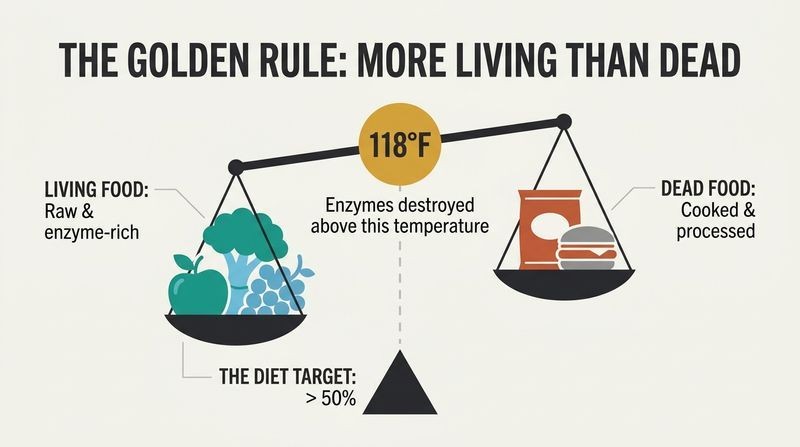
The entire book collapses into a single sentence. Diamond argues that after decades of counting calories, measuring portions, and cycling through fad diets, the real solution is embarrassingly simple. Living food keeps its enzymes intact. Dead food has had them destroyed by heat.
Heat is the dividing line. At 118 degrees Fahrenheit, Diamond says, enzymes are obliterated, and that is far below cooking temperature. So a food is living or dead based purely on whether it has been cooked or processed. He frames enzymes as the animating force of life itself, comparing our bodies to cars: you would never pour Coca-Cola into a gas tank, yet most Americans run on roughly 90 percent cooked, devitalized food. His prescription is not deprivation but rebalancing toward fruits and vegetables in their raw state.
What's compelling is the reframe from restriction to abundance, which sidesteps the deprivation that dooms most diets. But the enzyme mechanism is shakier than presented. Dietary enzymes are proteins denatured by stomach acid before they can act systemically, and the body manufactures its own digestive enzymes regardless of food source. Modern nutrition science credits raw-heavy eating with benefits from fiber, water content, micronutrients, and lower caloric density, not enzyme transfer. The practical advice (eat far more produce, less processed food) is sound and echoes Michael Pollan's "eat food, mostly plants." The proposed physiology is the weak link, not the dietary pattern itself.
The weight-loss industry profits only if you stay fat
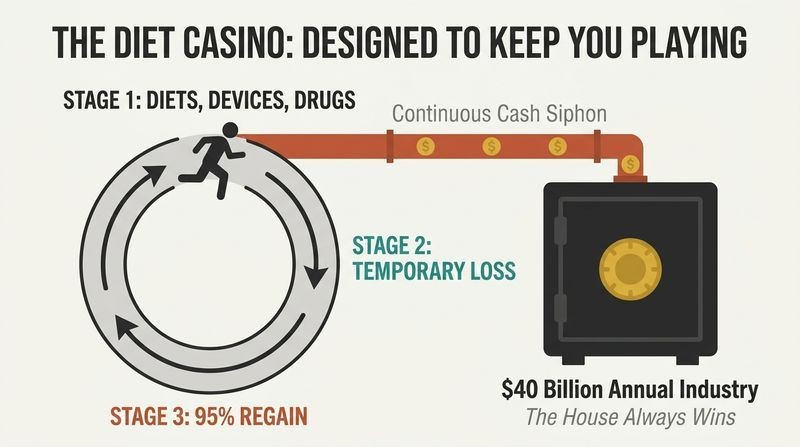
Diamond coins the word "cashectomy": the practiced art of convincing you to hand over money for something advertised as helpful that actually harms you. He argues Americans spend around 40 billion dollars a year on weight loss, over 100 million every single day, yet obesity keeps climbing.
He groups the failures into three D's:
1. Diets, which produce temporary results and 95 percent regain
2. Devices, like electrode ab-machines that promised abs while you watched TV
3. Drugs, which he calls the cruelest because they can kill
His logic is a casino analogy: Las Vegas does not teach you to beat the house, and the diet industry has no incentive to cure the condition that generates its revenue. Removing the cause of obesity would erase the profit.
The structural critique holds up well and predates similar arguments in books like The Dorito Effect and Salt Sugar Fat. Industries built on recurring dysfunction do have perverse incentives, a point behavioral economists make about everything from payday lending to dieting subscriptions. The cynicism has limits, though. Not every failed diet is fraud; obesity is genuinely multifactorial, involving genetics, sleep, stress, the gut microbiome, and an obesogenic food environment, not merely suppressed simple truths. Diamond's framing risks implying a single villain. Still, his skepticism toward miracle pills proved prescient given the market withdrawals of drugs like fen-phen that he names.
Eat only fruit until noon to protect your body's cleanup shift
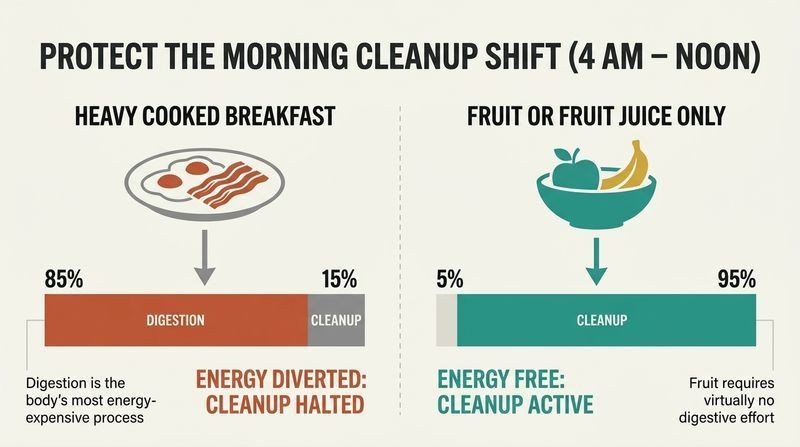
Diamond's most famous prescription is "fruit til noon." He builds it on three daily cycles he says govern the body: appropriation (eating, roughly noon to 8 p.m.), assimilation (absorbing nutrients, 8 p.m. to 4 a.m.), and elimination (removing waste, 4 a.m. to noon). Morning is the body's garbage-removal shift.
Eating a heavy cooked breakfast, he argues, hijacks that shift because digestion is the body's single largest energy expense. Fruit is the exception: since it requires almost no digestion, you can eat it all morning without interrupting elimination. He challenges readers to a one-week test: nothing but fresh fruit and juice before noon, then a normal diet, then a heavy breakfast on day eight to feel the difference in energy.
The circadian framing is intuitively appealing and loosely rhymes with real chronobiology. Genuine research on time-restricted eating (Satchin Panda's work) shows that confining food to a daytime window and fasting overnight improves metabolic markers, so the instinct that when you eat matters has scientific support. But Diamond's specific eight-hour cycles are not established physiology, and elimination is continuous, not clock-boxed. The likely reason "fruit til noon" works for people is prosaic: fruit is low-calorie and high-fiber, so swapping it for a calorie-dense breakfast cuts intake. The one-week self-experiment is genuinely good advice, empowering readers to trust results over theory.
Eat fruit alone on an empty stomach, never as dessert
Fruit is the only food that needs no stomach digestion, Diamond claims, because its sugar is fructose, a monosaccharide the body can use almost directly. Eaten alone, it passes quickly to the intestines. Eaten on top of other food, it gets trapped, ferments, and turns acidic, causing the gas, bloating, and heartburn people wrongly blame on the fruit itself.
Two guidelines govern fruit:
1. Always eat it raw and unprocessed. Pasteurized juice is heated so intensely it becomes dead and acid-forming.
2. Always eat it on an empty stomach, alone.
He tells of a woman convinced she was allergic to strawberries since childhood, when the real culprit was the hot dog she ate them with. Eaten alone, the strawberries caused no reaction.
The claim that combining fruit with meals causes fermentation is not supported by gastroenterology; the stomach is an acidic, churning environment where mixed foods are normal and fermentation is minimal. The strawberry anecdote is charming but is a single uncontrolled case, exactly the kind of evidence the book elsewhere distrusts. That said, the behavioral nudge is harmless and often helpful: eating fruit as a standalone snack rather than as sugar-laden dessert reduces total calories and displaces processed sweets. The pasteurization point also has partial merit, since fresh whole fruit beats juice for fiber and satiety, whatever one thinks of enzymes.
Never pair protein and starch at the same meal
Diamond's third key is food combining. He asks readers to build lunch and dinner around one concentrated food, either a protein (meat, fish, eggs, dairy) or a starch (bread, pasta, rice, potatoes), plus cooked vegetables and a big raw salad, never protein and starch together.
His stated reason is energy conservation. Proteins need acidic digestive juices, starches need alkaline ones, and combining them supposedly neutralizes both, prolonging digestion and wasting energy the body could use for cleansing and weight loss. He credits this practice with ending the crippling stomach pain that plagued him from age three to twenty-five. His ex-wife's invention, the "Main Course Salad," makes this practical by tossing one concentrated food with vegetables into a single satisfying bowl.
Food combining dates to the early twentieth century and remains popular in wellness circles, but controlled studies (notably a 2000 trial in the International Journal of Obesity) found no weight-loss advantage over balanced meals of equal calories. The stomach comfortably digests mixed macronutrients simultaneously. Yet the rule may work indirectly: forbidding the steak-and-potato, burger-and-fries, pasta-and-bread pairings quietly eliminates many calorie-dense combinations and forces a salad onto every plate. Diamond's personal relief from stomach pain is real to him, but decades of a produce-rich, low-processed diet is the more parsimonious explanation than the acid-alkaline mechanism he invokes.
Chase direction, not speed: lose five pounds a month for life
Diamond's pacing philosophy is "speed is nothing, direction is everything." He rejects the rapid-loss fantasy, citing that dramatic crash weight loss returns, plus more, in about 95 percent of cases. He compares it to making three million dollars in a month and going broke by month six versus building income that lasts.
His target ratio is 50 percent living, 50 percent cooked food, but he insists there is no rush and no need to measure precisely. Someone starting at the American norm of 10 percent living food can simply double it to 20 percent and already trigger improvement. Lose a modest five pounds a month and you are thirty pounds lighter in half a year, permanently, with an eating pattern you can sustain rather than endure.
This is the book's most durable insight, and it aligns squarely with behavior-change science. Slow, sustainable adjustments outperform aggressive overhauls because they avoid the willpower depletion and metabolic and psychological backlash that drive yo-yo dieting. The 95 percent regain figure is roughly consistent with long-term diet-maintenance research. The refusal to demand exact measurement is also wise; approximate, flexible rules survive real life better than rigid tracking, a point James Clear makes about frictionless habits. Diamond's insistence on flexibility over fanaticism ("a lifestyle, not a life sentence") is precisely the mindset that distinguishes maintainers from serial dieters.
Your lymph system is the hidden engine of weight loss, and it runs on movement
Diamond spotlights the lymphatic system as the body's "garbage collector." It gathers toxins from all cells, breaks them down, and routes them to the bowels, bladder, lungs, and skin. He notes the body holds roughly three times more lymph fluid than blood, underscoring its scale.
Crucially, lymph has no pump. Unlike blood, which the heart drives, lymph moves only through physical activity. This makes exercise non-negotiable for anyone trying to shed weight. He recommends modest, consistent movement, a brisk twenty to thirty minute daily walk, and endorses a mini-trampoline (rebounder) whose bouncing opens and closes lymph valves. He credits lymphatic cleansing with helping him survive Agent Orange exposure from Vietnam.
The core physiology is accurate and underappreciated: the lymphatic system genuinely lacks a central pump and relies on muscular contraction, breathing, and movement to circulate, which is why sedentary living and even prolonged sitting impair it. This is one of Diamond's most scientifically grounded points. Where he overreaches is the "toxin" framing, a vague concept that legitimate physiology treats through the liver and kidneys rather than a generalized detox model. The walking prescription is excellent and matches modern guidance that even light, frequent activity yields outsized health returns. Rebounding is a real, low-impact lymphatic and cardiovascular exercise, though not uniquely magical among movement types.
Dairy causes the osteoporosis it claims to prevent
Diamond names dairy the single worst food in the human diet and argues the calcium-for-bones message is a marketing masterstroke. Humans are the only species that drinks milk after weaning, and the only one drinking another species' milk. Cow's milk is engineered to grow a 90-pound calf into a 1,000-pound animal in two years.
His central paradox: the countries consuming the most dairy (United States, Britain, Sweden, Finland) have the highest osteoporosis rates, while Asian and African populations who consume little have the least. He argues high-protein, acid-forming diets leach calcium from bones to neutralize acid, and that pasteurization plus milk's coarse casein protein make its calcium poorly absorbable anyway. Plants, he says, supply ionized calcium the body can actually use.
The dairy-osteoporosis correlation Diamond cites is real and puzzled researchers for years, sometimes called the calcium paradox. The acid-ash hypothesis he leans on, however, has weakened considerably; recent meta-analyses find dietary acid load has little effect on bone density, and calcium balance is more complex than bone-leaching. Confounders matter: high-dairy nations are also wealthier, more sedentary, and longer-lived, and osteoporosis is partly a disease of aging populations. Still, his broader point that dairy is not the indispensable calcium source marketing implies is defensible. Leafy greens, beans, and fortified foods supply absorbable calcium, and much of humanity thrives on minimal dairy.
You build human protein from plant amino acids, like every strong herbivore
Diamond dismantles the protein anxiety that stops people from eating more plants. His argument is evolutionary and observational: the planet's strongest animals, elephants, oxen, water buffalo, gorillas, build massive muscle on leaves and grass alone. A cow makes its celebrated protein from grass.
The mechanism is amino acids. All protein is assembled from amino acids, which plants manufacture from soil, air, and water. When you eat chicken, you must dismantle chicken protein into amino acids and rebuild them into human protein anyway. Cooking meat, he adds, damages and coagulates those amino acids. He cites the China Health Project (Cornell, Oxford, and the Chinese government), which found Chinese people get about 7 percent of protein from animals versus 70 percent for Americans, with far lower rates of the "diseases of affluence."
The amino-acid biochemistry is correct: dietary protein is broken into amino acids and reassembled, and plants supply all essential ones, debunking the old "protein combining" myth that even Frances Moore Lappe retracted. The China Study Diamond cites became foundational to the plant-based movement through T. Colin Campbell's later book, though critics note it is epidemiological and correlational, unable to isolate animal protein from confounding lifestyle variables. The herbivore-strength argument is rhetorically vivid but biologically loose; gorillas have vastly different digestive systems and gut fermentation. The actionable core, that plants can meet protein needs, is well supported by dietetic consensus for planned vegetarian diets.
Every cooked meal spends your finite enzyme bank, shortening life
Diamond's longevity argument rests on "metabolic enzymes." He divides enzymes into three types: food enzymes (in raw food), digestive enzymes (the body makes these when food enzymes are cooked away), and metabolic enzymes (which run every bodily function). He claims the body can produce only a finite lifetime supply, and that cooked food forces it to divert that supply into digestion, hastening death.
His evidence is gerontologist Roy Walford, who doubled the lifespan of mice by fasting them two days a week, resting their digestive tracts. Diamond's takeaway: streamline digestion to conserve life energy. He also promotes supplemental "Live Plant Enzymes" taken before cooked meals to spare the body's own reserves.
The finite-enzyme theory comes from Edward Howell's mid-century writing and is not accepted by biochemistry; the body continuously synthesizes enzymes as catalysts that are not "used up" in fixed lifetime quotas. This is the book's most questionable mechanism, and the enzyme-supplement recommendation blends into the very commerce Diamond critiques elsewhere. Yet the underlying observation about digestive rest is legitimate and prophetic. Walford was a real caloric-restriction pioneer, and the fasting research Diamond gestures toward has since exploded: intermittent fasting and caloric restriction genuinely extend lifespan in numerous animal models and improve human metabolic markers. He reached a defensible destination (eat less, rest digestion) through a flawed map.
Analysis
Fit for Life: Not Fat for Life is a thesis-driven diet manifesto built on the doctrine of Natural Hygiene, a nineteenth-century philosophy holding that the body heals itself when unobstructed. Harvey Diamond's genius is rhetorical simplification: he compresses nutrition into one imperative (eat more living food than dead food) and three keys (50/50 balance, fruit til noon, no protein-starch mixing). This accessibility is also the book's central tension. The dietary pattern he prescribes, abundant raw produce, less meat and dairy, minimal processed food, slow sustainable change, aligns remarkably well with contemporary consensus and the Blue Zones literature. The physiological mechanisms he invokes to justify it, enzyme depletion, food-combining acid-alkaline neutralization, rigid elimination cycles, fruit fermentation, largely do not survive scientific scrutiny. Readers thus face a book that is frequently right about what to do and frequently wrong about why. That distinction matters, because Diamond explicitly asks readers to trust common sense over credentialed expertise, a stance that is liberating against genuine industry self-interest (his cashectomy critique of diet and pharmaceutical marketing is sharp and often vindicated) but dangerous when it dismisses evidence wholesale. The book is strongest as behavioral psychology: its emphasis on flexibility over fanaticism, direction over speed, self-experimentation over dogma, and abundance over deprivation reflects exactly what durable behavior change requires. It is weakest as biochemistry. The memoir thread, his Agent Orange survival and lifelong food addiction, lends emotional credibility and models the compassion-toward-self he preaches. A modern reader gains most by adopting the eating pattern and pacing philosophy while treating the mechanistic claims as motivational scaffolding rather than settled fact. The environmental argument for reducing animal products, meanwhile, has only grown more relevant since 2003, giving the book an unexpectedly prescient dimension beyond personal weight.
Review Summary
The reviews for Fit for Life, Not Fat for Life are mixed, with ratings ranging from 1 to 5 stars. Some readers found the book informative and practical, praising its advice on food combining and nutrition. They reported increased energy and enthusiasm for implementing the suggestions. However, others criticized the book for containing pseudo-science, repetitive rhetoric, and outdated information. Several reviewers appreciated the concept of eating fruit first thing in the morning, while some found the content contradictory to their beliefs or too lengthy without substantial information.
People Also Read

Glossary
Living food vs. dead food
Raw food versus cooked foodDiamond's central dichotomy. Living food retains intact enzymes because it has not been heated above roughly 118 degrees Fahrenheit; it means primarily raw fruits and vegetables. Dead food has had its enzymes destroyed by cooking, pasteurization, or processing. The book's core prescription is to make at least half your diet living food.
Cashectomy
Selling harmful goods as helpfulDiamond's coined term for the process of convincing consumers to pay for a product or service marketed as beneficial that actually harms, sickens, or kills them. He applies it to the diet industry, pharmaceuticals, infant formula, pasteurized juice, breakfast cereals, and food irradiation.
Fruit til noon
Eat only fruit each morningDiamond's rule to consume nothing but fresh fruit and fresh juice from waking until midday. Based on his claim that morning is the body's elimination cycle, and that fruit, needing no stomach digestion, supplies energy without interrupting waste removal. He proposes a one-week self-test to prove its energy benefits.
The three body cycles
Appropriation, assimilation, elimination timingDiamond's model of daily physiology: appropriation (eating and digesting, roughly noon to 8 p.m.), assimilation (absorbing nutrients, 8 p.m. to 4 a.m.), and elimination (removing waste, 4 a.m. to noon). He argues eating cooked food during the elimination window sabotages weight loss.
Metabolic enzymes
Finite lifetime enzyme supplyIn Diamond's framework, the enzymes that run every bodily function. He claims each person is born with a finite, non-replenishable lifetime supply, and that eating cooked food forces the body to divert this supply into producing digestive enzymes, thereby shortening life. This theory is not accepted by mainstream biochemistry.
Live Plant Enzymes
Enzyme capsules before cooked mealsPlant-derived digestive enzyme supplements Diamond recommends taking immediately before eating any cooked food, so the body need not spend its own metabolic enzyme reserves on digestion. Marketed as conserving life energy and easing digestive disorders.
Main Course Salad
One-bowl combined living mealA dish coined by Diamond's ex-wife Marilyn: a single concentrated food (one protein or one starch) tossed with cooked vegetables and abundant raw greens into one large satisfying salad. Designed to make the food-combining rules practical and enjoyable at lunch or dinner.
Pottenger's Cats
Raw vs cooked diet studyA decade-long experiment by Dr. Francis Pottenger feeding cats either raw or cooked meat and milk. Diamond cites it as proof of living food's superiority: raw-fed cats stayed healthy across generations, while cooked-fed cats developed disease, deformity, and by the third generation, sterility.
The three D's
Diets, devices, and drugsDiamond's grouping of the failed weight-loss approaches the industry sells: diets (temporary and prone to regain), devices (gimmicks like electrode ab-machines), and drugs (which he considers the most dangerous because they carry lethal side effects). All, he argues, treat symptoms while ignoring the cause.
Appestat
Brain's hunger-regulating mechanismDiamond's term for a control at the base of the brain that monitors the bloodstream for nutrients and glucose, switching hunger on when they run low and off when satisfied. He argues nutrient-poor cooked food fails to shut it off, driving overeating even on a full stomach.
FAQ
What's Fit for Life: Not Fat for Life about?
- Focus on Living Foods: The book emphasizes consuming raw fruits and vegetables over cooked foods to enhance health and well-being.
- Health and Weight Loss: Harvey Diamond presents a method for losing weight and improving health by increasing living foods and decreasing cooked foods.
- Holistic Approach: It advocates for a holistic view of health, linking physical well-being with mental and emotional health.
Why should I read Fit for Life: Not Fat for Life?
- Transformative Approach: Offers a fresh perspective on dieting, moving away from traditional diets that often lead to temporary results.
- Proven Success: Harvey Diamond shares over thirty years of experience, demonstrating how his methods have helped many achieve better health.
- Empowering Knowledge: Provides practical advice on making healthier food choices and understanding the impact of diet on overall health.
What are the key takeaways of Fit for Life: Not Fat for Life?
- Living vs. Cooked Food: Prioritizes living foods, which are nutrient-rich and energizing, over cooked foods that lack essential nutrients.
- Importance of the Lymph System: Emphasizes the role of the lymphatic system in detoxification and overall health.
- Mindset Matters: Highlights the significance of a positive mental attitude in achieving health goals.
What are the best quotes from Fit for Life: Not Fat for Life and what do they mean?
- “You are what you eat.”: Highlights the impact of food quality on health and well-being.
- “Living bodies require living food.”: Stresses the necessity of consuming fresh, unprocessed foods for health.
- “There is no wealth but life.”: Suggests that true richness comes from living a healthy, fulfilling life.
How does Fit for Life: Not Fat for Life define living food?
- Raw and Unprocessed: Refers to foods that are raw, unprocessed, and contain intact enzymes, such as fresh fruits and vegetables.
- Nutrient-Rich: Packed with essential nutrients that support bodily functions and promote overall health.
- Vital for Health: Crucial for maintaining a healthy weight and preventing disease, as it nourishes the body effectively.
What is the significance of eating fruit until noon in Fit for Life: Not Fat for Life?
- Optimizes Elimination Cycle: Allows the body to focus on eliminating waste without the burden of digesting heavier foods.
- Boosts Energy Levels: Provides quick energy without requiring extensive digestive effort, leading to increased vitality.
- Sets a Healthy Tone: Establishes a positive dietary pattern that encourages healthier choices for the rest of the day.
What are the three keys to success outlined in Fit for Life: Not Fat for Life?
- 50% Living Food: Aim for a diet that consists of 50% living food and 50% cooked food for balance and health.
- Be Fruitful: Emphasizes the importance of incorporating fruit into the diet, particularly by eating it until noon.
- Life is in the Balance: Focuses on maintaining balance in meals, ensuring living food is prioritized alongside cooked food.
How does Fit for Life: Not Fat for Life address the issue of food combining?
- Avoid Mixing Proteins and Starches: Advises against combining proteins and starches in the same meal to conserve digestive energy.
- Focus on Simplicity: Encourages a simpler approach to meals, pairing one concentrated food with vegetables and salad.
- Promotes Energy Efficiency: Reducing meal complexity allows the body to allocate more energy to vital functions.
What is the role of the lymphatic system in health according to Fit for Life: Not Fat for Life?
- Garbage Collector of the Body: Responsible for removing toxins and waste from the body.
- Supports Immune Function: Crucial for maintaining a strong immune response and overall health.
- Importance of Detoxification: Essential for effective detoxification, vital for weight loss and health maintenance.
How can I transition to a diet higher in living food according to Fit for Life: Not Fat for Life?
- Gradual Changes: Start by incorporating more living foods into your diet gradually to help your body adjust.
- Focus on Freshness: Prioritize fresh fruits and vegetables, aiming for at least 50% of your diet to consist of living foods.
- Listen to Your Body: Pay attention to how your body responds to dietary changes, as discomfort may indicate detoxification.
What are the potential health benefits of following the advice in Fit for Life: Not Fat for Life?
- Weight Loss: Expect gradual and sustainable weight loss as the body becomes healthier.
- Improved Energy Levels: A diet rich in living food can lead to higher energy levels and reduced fatigue.
- Enhanced Digestion: Promotes better digestion and elimination, leading to improved gut health.
What lifestyle changes does Fit for Life: Not Fat for Life recommend for better health?
- Increase Living Foods: Increase the intake of living foods while decreasing cooked foods to support detoxification.
- Regular Exercise: Incorporate regular physical activity into your routine to support the lymphatic system.
- Positive Mindset: Cultivate a positive mental attitude to support health goals and improve quality of life.

Download PDF
Download EPUB
.epub digital book format is ideal for reading ebooks on phones, tablets, and e-readers.








































