


Key Takeaways
Your feelings, not your thoughts, are the chisel that carves reality
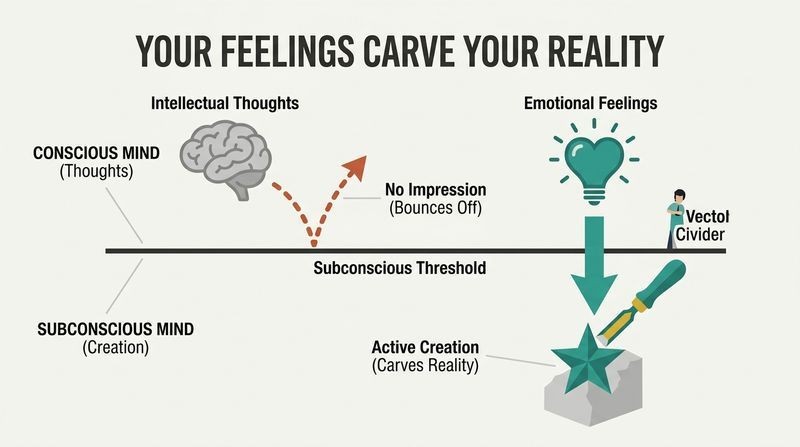
Feeling is the medium of creation. Neville Goddard's 1944 core claim is deceptively simple: the world you experience is your consciousness made visible. He splits the mind into two halves. The conscious mind (which he calls male) generates ideas and selects. The subconscious (female) accepts those ideas without judgment and gives them form. The bridge between them is not logic or willpower but feeling. An idea only reaches the subconscious once it is felt as real.
No feeling, no manifestation. Neville insists the subconscious cannot tell truth from fiction. It faithfully reproduces whatever emotional state you hold, whether beneficial or ruinous. This means fretting over a bill, dwelling on illness, or rehearsing resentment plants those exact conditions. Guard your moods as if they were seeds, because to him they literally are.
What's striking is how Neville anticipates affective neuroscience decades early. Antonio Damasio's somatic marker hypothesis argues emotion, not cold reason, drives most decision-making, echoing Neville's ranking of feeling above intellect. His mind-splitting metaphor also parallels Daniel Kahneman's System 1 and System 2. The obvious challenge: Neville makes an ontological claim (feeling creates matter) that science cannot verify, whereas Damasio makes a neurological one. Still, the practical residue survives scrutiny. Emotional states measurably shape attention, behavior, and self-fulfilling prophecy. Even a skeptic can accept that chronic dread produces different outcomes than confident calm, without buying the full metaphysics.
Feel the wish already fulfilled, not merely wished for
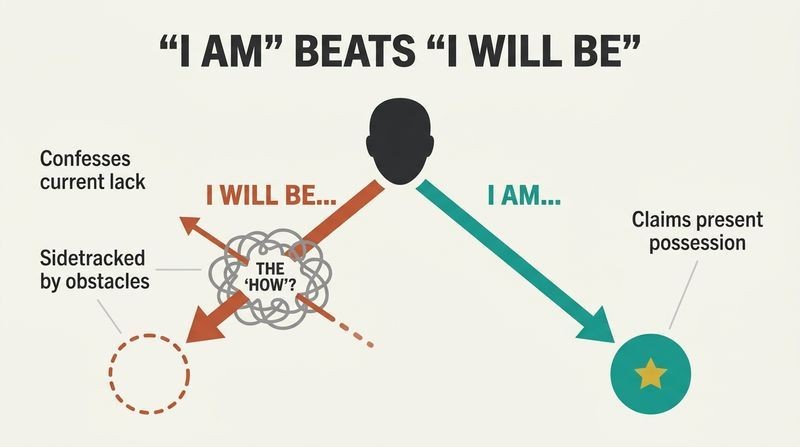
"I am" beats "I will be." Neville argues that between two competing feelings, the dominant one always expresses itself. To feel "I will be healthy" is to secretly confess "I am not healthy now," reinforcing lack. The correct move is to assume the emotional state of already possessing what you want. He calls this assuming the feeling of the wish fulfilled.
Ignore the how. When you define your desire, concern yourself only with the end result, never the means or obstacles. Dwelling on difficulties, delays, or barriers instructs the non-selective subconscious to manufacture exactly those. Neville frames it theatrically: you cast yourself in a role, and the outer world becomes the stage that must corroborate it. Accepting the end, he says, automatically wills the means into being.
This is Neville's most testable and most abused idea. The "assume the end" principle maps onto research on mental contrasting by psychologist Gabriele Oettingen, who found that pure positive fantasy often reduces effort and success. Her WOOP method deliberately adds obstacles back in, seemingly contradicting Neville. Yet the reconciliation is subtle: Neville is not describing goal-setting but identity adoption. Behavioral science on self-concept shows people act consistently with who they believe they are. The danger is passivity, treating visualization as a substitute for action rather than a precursor. Neville sidesteps this by claiming the means arrive unbidden, a claim that comforts believers and frustrates empiricists alike.
Sleep is the unlocked door into your subconscious mind
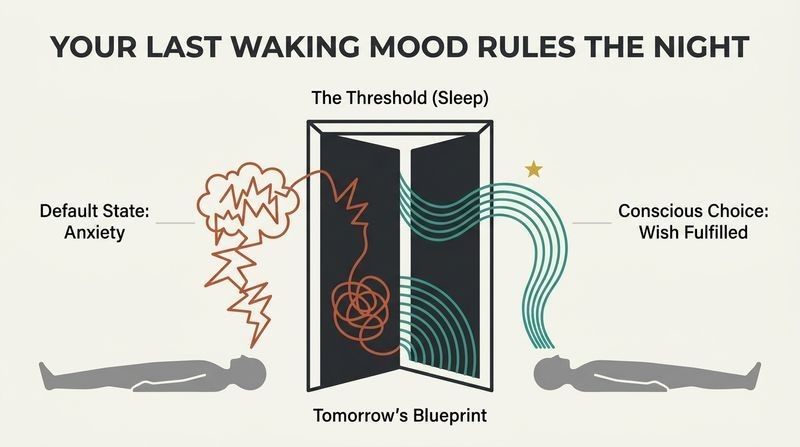
Your last waking mood rules the night. Since sleep occupies a third of life and is the subconscious's natural home, Neville treats the moments before drifting off as sacred. Whatever self-concept you carry across that threshold gets rehearsed and imprinted. He advises lying flat, head level with the body, and quietly relaxing into unconsciousness while feeling the wish fulfilled.
Never sleep in failure. Going to bed discouraged, resentful, or anxious hands the subconscious those exact instructions to embody tomorrow. If you do not consciously choose your pre-sleep state, you default to the emotional residue of the whole day. Neville reframes daily events as effects, not causes: your waking life merely confirms the impressions planted the night before. Free will, in his view, is only freedom to choose which mood you assume.
Neville's pre-sleep prescription lands squarely on modern sleep science. The hypnagogic state, that drowsy borderland before sleep, is genuinely a period of heightened suggestibility and loosened rational defenses. Studies on sleep-dependent memory consolidation show the brain replays and stabilizes whatever was salient before sleep, which lends unexpected credibility to guarding your final thoughts. Athletes and clinicians use pre-sleep visualization for exactly this reason. Where Neville overreaches is causality: consolidating a feeling is not the same as bending external events. But the ritual itself, ending the day in gratitude rather than grievance, has robust support in positive psychology's gratitude research.
Effective prayer means yielding to a wish, never forcing it
Prayer is reception, not petition. Neville reframes prayer as a technique, not a plea to an external deity. It works by entering a relaxed, drowsy reverie that dims the outer world and makes the mind receptive, then feeling the desire as already accomplished. The single condition, drawn from scripture, is to believe you have already received.
Struggle is fatal. The undisciplined person trusts only the evidence of the senses and cannot believe what sight denies. So Neville says to shut out the senses first. Crucially, effort backfires. When your feeling conflicts with your wish, feeling always wins, so straining harder only intensifies the sense of absence. He teaches a practical entry: recline, close your eyes, imagine drowsiness spreading until a pleasant heaviness settles, then picture the wish fulfilled and let go.
The insistence on effortlessness is psychologically shrewd. It resembles the paradox of ironic process theory, Daniel Wegner's finding that trying hard not to think of something guarantees you think of it. Straining to feel abundant reminds you of scarcity, exactly Neville's point. His relaxation protocol is functionally self-hypnosis, and he inherited it from French pharmacist Emile Coue, famous for the mantra about getting better every day. Clinically, guided relaxation and hypnotherapy do reduce anxiety and can shift ingrained self-perceptions. The weak link remains the leap from internal calm to external causation, but the technique for quieting a threat-obsessed mind is sound and repeatable.
Stop editing others; revise your own inner picture of them
Change yourself, change the world. Neville's radical claim is that other people and even nations are only what you believe them to be. You cannot suggest a desired state to another person directly. Instead, you convince yourself that they already embody what you wish for them. A friend job-hunting? You mentally congratulate them on the perfect job already secured.
Outer mirrors inner. "As within, so without" is his refrain. It is easier, he admits, to blame your feelings on external events than to accept that conditions reflect your feelings. But he holds the reverse is true. You have no opponent and no helper in producing change, only yourself. This also means abandoning regret: replaying past mistakes with feeling merely re-infects you with the state you want to escape.
Taken literally this is solipsism, and Neville embraces it, holding that no two people occupy the same world. Philosophically it echoes George Berkeley's idealism and, curiously, occultist Aleister Crowley's claim that each person inhabits a private universe. The interpersonal advice, however, has a defensible psychological core. The Pygmalion effect, documented by Robert Rosenthal, shows that others tend to rise or fall to the expectations we hold of them, transmitted through subtle behavioral cues. Believing in someone's competence genuinely changes how you treat them, which changes them. Neville's insistence on releasing regret also anticipates cognitive therapy's war on rumination, a proven driver of depression.
Enter the drowsy hypnagogic state to reprogram your mind
Neville's three-step method, per Mitch Horowitz. The historian distills the practice into a repeatable formula:
1. Identify a sincere, intense desire, digging past superficial wants to what you truly crave.
2. Enter physical immobility, the drowsy hypnagogic state just before sleep, when rational defenses slacken.
3. Run a short, simple scene in your mind that would follow naturally from the wish fulfilled, feeling it emotionally.
See from inside the scene. Neville was adamant you must not watch yourself as if on a screen. To imagine climbing a ladder, you feel your hands grip the rungs and your weight shift upward. A woman wanting marriage was told to feel the weight of a ring on her finger. Persist and, in his phrase, the assumption hardens into fact.
The first-person perspective instruction is Neville's most empirically vindicated detail. Sport psychology confirms that internal (embodied) imagery activates motor and emotional circuits more powerfully than external (spectator) imagery, improving skill transfer. Horowitz sharpens Neville by naming the emotional component Neville underspecified, borrowing from Stanislavski's method acting, where actors summon real feeling through sensory memory. The honest-desire step is quietly profound: Horowitz recounts a psychic telling him he craved power, a truth he spent years denying. Depth psychology from Jung onward agrees that unacknowledged desire festers. The technique's weakness is falsifiability, since practitioners attribute success to the method and failure to insufficient feeling.
Emotion, body, and intellect run on separate tracks, and intellect is weakest
You are not one unified self. Horowitz extends Neville by insisting we are made of pieces. The physical, intellectual, and emotional aspects each pursue their own agenda. You vow not to eat, yet the body overrides you. You resolve to stay calm, yet emotion erupts into rage. This fragmentation explains addictions and impulsive outbursts: intellect, the part making resolutions, is the feeblest of the three.
Feeling must accompany the picture. This is why visualization alone often fails. The positive-thinking movement's error, Horowitz argues, is equating thought with emotion. When you mentally rehearse a promotion, picturing your boss's congratulations is not enough. You must generate the actual emotional charge you would feel. Coue captured the hierarchy in his plank example: anyone walks a plank on the floor, but raise it twenty feet and imagination-fueled fear overrides physical ability.
This tripartite model of a divided self has deep roots, from Plato's charioteer to Freud's id, ego, and superego, to Jonathan Haidt's elephant and rider, where the emotional elephant dwarfs the rational rider. Modern dual-process theory and research on ego depletion (though now contested) support the claim that willpower is a thin, exhaustible resource. Coue's plank is a vivid illustration of what psychologists call arousal-driven choking under pressure. The practical upshot corrects a real flaw in shallow manifestation culture: affirmations recited without felt emotion are inert. Where the framework strains is treating these as literally separate entities rather than integrated neural processes, but as a working metaphor it is potent.
There is no God outside your own human imagination
Imagination is the only God. This is Neville's most audacious teaching. He read all scripture not as history but as psychological allegory. The story of Christ, descending into flesh, forgetting his divinity, crying out in abandonment on the cross, then resurrecting, is the blueprint of every individual awakening to the creative power within. He meant this literally, not as poetic flourish. Do not believe in Jesus, he said. Believe you are the creative power the Jesus story symbolizes.
Try it, then judge. Neville sold nothing and copyrighted nothing, letting followers freely record and distribute his lectures. His single demand was experimental: put the law to the test tonight, and if it fails, discard him. He offered no arguments or testimonials, only the challenge to prove it in your own life.
Neville's "try it and discard me if it fails" stance is rhetorically brilliant and epistemologically slippery. It borrows the language of empiricism while insulating itself from disconfirmation, since any failure can be blamed on insufficient belief. Yet the refusal to monetize or institutionalize is genuinely rare among spiritual teachers and lends him credibility. His imagination-as-God theology sits within a long Romantic lineage, especially William Blake, who wrote of cleansing the doors of perception and building Jerusalem through mental fight. Feuerbach made a parallel move in 1841, arguing God is humanity's own essence projected outward. Neville simply reclaims the projection and hands its power back to the individual.
Everything you can imagine already exists; you select it, not create it
A universe of infinite possibilities. Neville taught that when you picture something, you are not manufacturing it but claiming a reality that already exists among infinite parallel outcomes. The very capacity to experience it mentally proves its availability. Horowitz links this to quantum physics, specifically Schrodinger's Cat: a subatomic particle exists in a wave state, everywhere at once, until a conscious observer measures it and collapses it into one location. By analogy, observation selects a reality from many.
Time leaks. Why don't we see this instantly? Neville explained that in our dense three-dimensional world, time moves so slowly we lose the thread connecting inner cause to outer effect. Physicists call the parallel phenomenon information leakage, the blurring of quantum reality as scale increases. Neville called it, in effect, time leakage.
The quantum analogy is the summary's most seductive and most contested thread. Physicists overwhelmingly reject the idea that human consciousness collapses wave functions; the measurement problem involves any interaction with a macroscopic apparatus, not a mind. Schrodinger devised his cat to ridicule such absurdities, not endorse them, a point Horowitz honestly acknowledges. Invoking quantum mechanics to license mind-over-matter is a recognized category error, memorably skewered as "quantum woo." That said, the philosophical intuition that observation participates in reality has serious defenders, from Wheeler's participatory universe to certain interpretations of the many-worlds hypothesis. The honest reader should enjoy the resonance while resisting the claim that physics proves Neville right.
Positive expectation measurably boosts anomalous results in the lab
When mood moved the needle. Horowitz marshals parapsychology to bolster Neville. At Duke in the 1930s, J.B. Rhine ran tens of thousands of card-guessing trials using five-symbol Zener cards, where pure chance yields 20% hits. Certain subjects consistently scored 25 to 27%, small but statistically anomalous over massive samples. Rhine's quiet observation: high scores correlated with enthusiasm, hope, belief, and an encouraging atmosphere, while boredom and fatigue dropped them.
The drowsy edge. In the 1970s, Charles Honorton's ganzfeld experiments placed relaxed subjects in sensory-reduced isolation, eyes covered, white noise playing, inducing a near-sleep state, then had a sender try to transmit one image among four. Results again exceeded chance. The recurring theme: the hypnagogic, emotionally positive state, the exact condition Neville prescribed, is when the mind performs its strangest feats.
This is the summary's boldest evidentiary gamble, and it deserves both respect and caution. Rhine and Honorton were serious researchers, and ganzfeld meta-analyses genuinely show above-chance effects. But parapsychology remains scientifically marginal precisely because of replication failures, and the field has been dogged by disputes over protocol and selective reporting. The psychologist Daryl Bem's 2011 precognition studies, in the same tradition, famously triggered psychology's replication crisis. So the honest verdict: these findings are provocative and not fraudulent, but they fall well short of establishing Neville's mechanism. What is more defensible is the narrower claim that positive expectation shapes performance, a well-documented effect across placebo research and beyond.
Repeated thoughts physically rewire the brain, so choose them deliberately
Neuroplasticity validates substitution. Horowitz cites UCLA psychiatrist Jeffrey Schwartz, who treats obsessive-compulsive disorder by teaching patients to replace an obsessive thought with a pleasurable activity the instant it arises, whether jogging, music, or anything absorbing. Brain imaging, replicated widely, shows that repeating this exercise physically alters neural pathways. Thoughts change brain biology.
A 1911 prophet. What captivates Horowitz is that New Thought writer John Henry Randall described this exact prescription in 1911, calling it substitution, with no brain scanners and no neuroscience. His language and the vocabulary of twenty-first-century neuroplasticity researchers are nearly identical. It is a case of an intuitive spiritual insight arriving a century before the instruments existed to confirm it, suggesting the old mental-healing traditions occasionally hit on real mechanisms.
This takeaway rests on the firmest scientific ground in the entire summary. Schwartz's work is legitimate, and his approach, now called mindfulness-based cognitive therapy in its broader form, is evidence-based treatment for OCD. Neuroplasticity, the brain's lifelong capacity to rewire, is textbook neuroscience thanks to researchers like Michael Merzenich and Norman Doidge. The convergence with Randall's 1911 "substitution" is a genuinely elegant observation, though it risks retrofitting: vague old advice can seem prophetic once we know the answer. Cognitive behavioral therapy formalized thought-substitution with far more rigor. Still, the core lesson is unimpeachable and immediately actionable: you are not stuck with your default thoughts, and deliberate mental redirection leaves lasting physical traces.
Certainty without personal experiment is the true poverty of thought
TRY: the one-word creed. Horowitz closes with a slogan from nineteenth-century American occultist P.B. Randolph, later echoed in the mysterious letters received by Theosophy's founders: simply TRY. Neville's entire ethic reduces to this. He mocked critics who dismissed Coue's simple mantra as obviously worthless without ever testing it, comparing them to a character insisting flight is impossible while airplanes fly overhead.
Neville lived his own claims. The book documents verifiable episodes. Drafted into the Army at 37 in 1942, desperate to return to Greenwich Village, Neville nightly imagined himself home. Within months he received an honorable discharge, and military records confirm the dates and the odd stated reason, a "vital civilian occupation." Horowitz cannot prove causation but notes the forensic details consistently check out. The invitation stands: judge only after you have run the experiment yourself.
Ending on "TRY" reframes the whole book from doctrine into invitation, which is its most honest posture. The barb about certainty without experience carries real philosophical weight, echoing the pragmatism of William James, who argued that some truths become available only to those willing to act as if they were already true (the "will to believe"). The discharge story is tantalizing but epistemically thin: a single confirmed outcome amid unrecorded thousands is textbook survivorship bias, and Horowitz commendably says as much. The durable value here is neither metaphysical nor mystical but methodological. In a culture drowning in armchair opinion, a bias toward firsthand experiment remains genuinely radical advice.
Analysis
Feeling Is the Secret is really two books bound together. The first is Neville Goddard's slender 1944 treatise, a compressed, aphoristic manual arguing that consciousness is the sole reality and feeling the mechanism by which imagination becomes fact. The second, roughly three times longer, is historian Mitch Horowitz's 2013 lecture reconstructing Neville's life, sources, and possible scientific vindications. This pairing is the edition's genius and its tension: Neville asserts with prophetic certainty, while Horowitz supplies the biography, lineage, and empirical hedging Neville deliberately withheld.
Neville's originality lies less in his claims (New Thought had circulated similar ideas for a century) than in his radical simplicity and his refusal to institutionalize. He coined no jargon empire, sold nothing, and copyrighted nothing, staking everything on a single falsifiable dare: test it tonight. That experimental posture is philosophically closer to William James's pragmatism than to conventional religion, and it remains his most defensible legacy.
Horowitz's contribution is intellectual genealogy. He traces the current from Hermeticism through Mesmer's animal magnetism, Quimby's mental healing, Coue's autosuggestion, and Blake's visionary Romanticism, showing Neville as a synthesizer rather than a lone oracle. His detective work on Abdullah, the mysterious teacher possibly identifiable as Barbados-born rabbi Arnold Josiah Ford, is genuine scholarship.
The book's vulnerability is its scientific reach. Invoking quantum measurement, parapsychology, and neuroplasticity to underwrite mind-over-matter blends solid ground (neuroplasticity, expectation effects) with contested (ganzfeld) and misapplied (Schrodinger) material. Horowitz is admirably candid about ambiguity, repeatedly saying he cannot prove causation. The wise reader separates the durable psychological core, that emotional states shape attention, behavior, self-concept, and self-fulfilling prophecy, from the unfalsifiable metaphysics. Read as a discipline for governing one's inner life, especially the moments before sleep, the book is quietly powerful. Read as physics, it overreaches. Its own remedy applies: try it, and judge for yourself.
Review Summary
Feeling is The Secret receives mostly positive reviews, with readers praising its concise and powerful message about manifesting desires through feelings and beliefs. Many find it life-changing and appreciate Goddard's explanations of consciousness and the subconscious mind. Some readers note its religious content and interpretations of Biblical concepts. Critics argue it promotes unrealistic thinking and lacks scientific basis. Overall, readers value its insights on positive thinking, prayer, and the power of imagination, though some find it overly simplistic or bordering on pseudoscience.
People Also Read







Glossary
Feeling of the wish fulfilled
Emotionally inhabiting the desired outcomeNeville's central technique: assuming and sustaining the exact emotional state you would have if your desire were already realized. Because the subconscious accepts as true whatever is felt as true, feeling "I am" (already possessing) rather than "I will be" (still lacking) is the mechanism that impresses the subconscious and, in Neville's view, objectifies the wish into physical reality.
Hypnagogic state
Drowsy borderland before sleepThe transitional, half-awake condition just before falling asleep (and its waking counterpart, hypnopompia). Neville and Horowitz identify it as the moment when rational defenses slacken and the mind becomes maximally suggestible. It is the optimal window for impressing the subconscious with a felt scene, achieved by relaxing into physical immobility until a pleasant heaviness and loss of desire to move set in.
The subconscious
Impersonal formative aspect of mindIn Neville's model, the receptive, non-selective half of consciousness (which he calls female) that accepts ideas conveyed through feeling and gives them outer form without judging their truth or benefit. It is the realm of cause; the conscious mind is the realm of effect. It responds to persuasion rather than command and never sleeps.
Assumption hardening into fact
Persistent belief becoming external realityNeville's phrase for what happens when you persist in a felt mental state despite contrary sensory evidence. The imagined assumption, held with feeling and repetition, eventually manifests in the outer world through unforeseen means. The practitioner ignores the how, trusting that accepting the end automatically wills the means into existence.
Three-step method
Horowitz's distilled Neville formulaMitch Horowitz's practical summary of Neville's practice: (1) identify a sincere, intense desire, digging beneath superficial wants; (2) enter physical immobility in the drowsy hypnagogic state; (3) run a short, simple, emotionally charged mental scene that would naturally follow from the wish fulfilled, experienced from inside the scene rather than watched from outside.
Abdullah
Neville's mysterious teacherThe turbaned black man of Jewish descent whom Neville claimed taught him kabbalah, scripture, and mental metaphysics in New York starting in 1931 for five years. Horowitz's research suggests he may have been Arnold Josiah Ford, a Barbados-born rabbi and Marcus Garvey associate in the Black Hebrew and Ethiopianism movements, though the timeline is not conclusive.
Substitution
Replacing obsessive thoughts to rewire brainA term used by New Thought writer John Henry Randall in 1911 and echoed by UCLA psychiatrist Jeffrey Schwartz's neuroplasticity-based OCD treatment. It means deliberately replacing an unwanted or obsessive thought with a pleasurable activity the moment it arises. Repetition physically alters neural pathways, demonstrating that thoughts change brain biology.
FAQ
What's "Feeling Is the Secret" about?
- Core Concept: "Feeling Is the Secret" by Neville Goddard explores the idea that the human imagination is the true God, and that our feelings and thoughts shape our reality.
- Mechanism of Creation: The book explains the relationship between the conscious and subconscious mind, emphasizing that feelings are the medium through which ideas are impressed upon the subconscious.
- Practical Application: Goddard provides a method for realizing desires by controlling feelings and using imagination to create the desired reality.
- Philosophical Foundation: The book is rooted in the belief that the external world is a reflection of one's internal consciousness.
Why should I read "Feeling Is the Secret"?
- Transformative Potential: The book offers a practical guide to transforming your life by harnessing the power of your imagination and feelings.
- Simplicity and Clarity: Goddard's teachings are straightforward, making complex metaphysical concepts accessible to readers.
- Empowerment: It empowers readers to take control of their destiny by understanding and applying the law of consciousness.
- Timeless Wisdom: Despite being written in 1944, the principles in the book remain relevant and applicable to modern life.
What are the key takeaways of "Feeling Is the Secret"?
- Imagination as God: The human imagination is the creative force behind all experiences and realities.
- Feeling is Crucial: Feelings are the only medium through which ideas are impressed upon the subconscious mind, leading to their manifestation.
- Conscious and Subconscious: Understanding the relationship between the conscious (male) and subconscious (female) aspects of the mind is essential for creation.
- Control of Emotions: Mastery over one's feelings and emotions is vital for achieving desired outcomes in life.
How does Neville Goddard suggest we use our imagination?
- Assume the Feeling: Goddard advises assuming the feeling of the wish fulfilled, as if the desired state is already a reality.
- Enter a Drowsy State: Use the hypnagogic state, a drowsy condition before sleep, to impress the subconscious with your desires.
- Simple Mental Scenes: Create simple, clear mental scenes that would naturally occur if your wish were fulfilled, and feel them as real.
- Persistence is Key: Continuously practice this method until the desired reality manifests in your life.
What is the "law of consciousness" according to Neville Goddard?
- Consciousness as Reality: Goddard posits that consciousness is the only reality, and everything in the world is a manifestation of it.
- Two Aspects: Consciousness is divided into the conscious (personal and selective) and subconscious (impersonal and non-selective) minds.
- Impression and Expression: The conscious mind impresses ideas onto the subconscious, which then expresses these ideas into reality.
- Control Through Feeling: By controlling feelings and ideas, one can control the subconscious and, consequently, their reality.
How does "Feeling Is the Secret" relate to sleep?
- Sleep as a Gateway: Sleep is described as a natural door into the subconscious, where the conscious mind can impress desires.
- Pre-Sleep Ritual: Before sleep, assume the feeling of the wish fulfilled to influence the subconscious during sleep.
- Unconscious Influence: The state of consciousness before sleep defines the subconscious impressions that manifest in waking life.
- Creative Union: Sleep is a time when the conscious and subconscious minds are creatively joined, allowing for the realization of desires.
What role does prayer play in "Feeling Is the Secret"?
- Prayer as a State: Prayer is seen as a state of relaxation and receptivity, akin to the hypnagogic state before sleep.
- Feeling of Fulfillment: Successful prayer involves assuming the feeling of the wish fulfilled, believing it as an accomplished fact.
- Yielding to the Wish: Prayer is about yielding to the wish, not forcing it, and creating a passive state to sense its reality.
- Belief in Realization: The only condition for prayer is the belief that your prayers are already realized, leading to their manifestation.
What is the significance of the subconscious in "Feeling Is the Secret"?
- Womb of Creation: The subconscious is described as the womb of creation, receiving ideas and giving them form.
- Non-Selective Nature: It is impersonal and non-selective, accepting as true whatever the conscious mind feels to be true.
- Impression Through Feeling: Ideas are impressed on the subconscious through feelings, which then manifest in the outer world.
- Faithful Servant: The subconscious faithfully serves man, giving form to his feelings and beliefs without alteration.
How does Neville Goddard's philosophy compare to other metaphysical teachings?
- Unique Perspective: Goddard's philosophy is unique in its emphasis on the imagination as God and the central role of feeling.
- Influence of Hermeticism: His ideas share similarities with Hermetic principles, focusing on the creative power within individuals.
- Contrast with Traditional Religion: Unlike traditional religious teachings, Goddard's philosophy dismisses the idea of an external God.
- Alignment with Modern Theories: Some of his concepts prefigure modern theories in quantum physics and neuroplasticity.
What are the best quotes from "Feeling Is the Secret" and what do they mean?
- "Feeling is the secret." This encapsulates the book's core message that feelings are the key to manifesting desires.
- "The subconscious never fails to express that which has been impressed upon it." It highlights the reliability of the subconscious in manifesting impressed ideas.
- "You are already that which you want to be." This quote emphasizes the idea that realization comes from assuming the feeling of the wish fulfilled.
- "Your world in its every detail is your consciousness objectified." It underscores the belief that the external world is a reflection of one's internal consciousness.
How can "Feeling Is the Secret" be applied to everyday life?
- Daily Practice: Regularly practice assuming the feeling of the wish fulfilled, especially before sleep, to influence the subconscious.
- Emotional Awareness: Be mindful of your emotions and feelings, as they directly impact the subconscious and, consequently, your reality.
- Visualization Techniques: Use simple mental scenes to visualize desired outcomes, reinforcing them with strong emotions.
- Persistent Application: Consistently apply these principles to various aspects of life, from personal goals to relationships and career.
What impact has "Feeling Is the Secret" had on modern spiritual thought?
- Influence on New Thought: The book has significantly influenced the New Thought movement, emphasizing the power of the mind in creating reality.
- Resurgence in Popularity: In recent years, Goddard's teachings have gained renewed interest, aligning with contemporary spiritual and self-help philosophies.
- Inspiration for Authors: Prominent authors like Wayne Dyer and Carlos Castaneda have drawn inspiration from Goddard's ideas.
- Alignment with Science: Some of Goddard's concepts resonate with modern scientific theories, such as quantum physics and neuroplasticity, bridging spirituality and science.
About the Author
Other books by Neville Goddard






Download PDF
Download EPUB
.epub digital book format is ideal for reading ebooks on phones, tablets, and e-readers.








































