

Key Takeaways
Fawning is the fourth trauma response nobody named for you
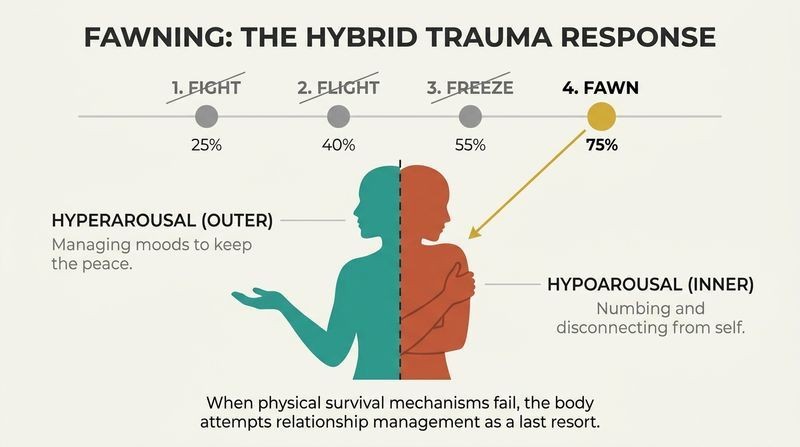
Beyond fight, flight, and freeze. When a threat appears and fighting is too dangerous, fleeing impossible, and freezing insufficient, the nervous system reaches for a fourth option: becoming more pleasing to the very thing endangering you. Therapist Pete Walker coined the term fawning, defining it as responding to a threat by becoming more appealing to it. Clayton illustrates with her own memory at thirteen, trapped in a hot tub with a grooming stepfather. She could not fight a man twice her size, could not run, and could not fully freeze because she had to keep navigating. So her body played it cool, appearing agreeable while terrified.
A hybrid state. Fawning activates both branches of the nervous system at once: hyperarousal (frantically managing another's moods) and hypoarousal (numbing your connection to yourself).
What's striking is how this reframe fills a genuine gap in trauma vocabulary. The classic fight-flight-freeze triad, rooted in Walter Cannon's 1915 work and Stephen Porges's polyvagal theory, never accounted well for the socially embedded, relational survivor who smiles through danger. Naming fawning gives clinical shape to what many intuit but cannot articulate. The move parallels how attachment theory expanded beyond behaviorism to explain relational bonds. One caution: because fawning overlaps behaviorally with ordinary politeness and prosocial warmth, the concept risks over-application, letting anyone relabel conflict-avoidance as trauma. Clayton's insistence that true fawning arises from genuine disempowerment, not mere social lubrication, is the necessary guardrail.
You merge with people who hurt you because you depend on them
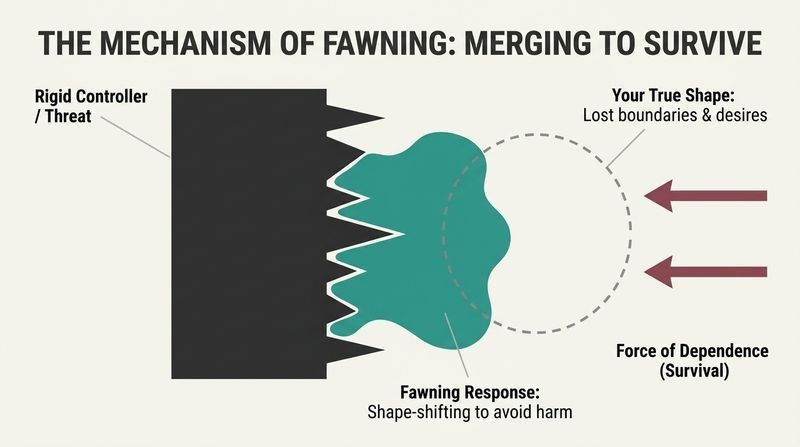
Connection means protection. Clayton compares fawning to aikido, the martial art whose name means way of harmonizing: rather than attacking or retreating, you move with your opponent's energy to sense their next move and defuse harm. When we cannot escape someone who controls our safety, our paycheck, our access to children, or our very survival as children, we sync with them. Staying connected is the strategy.
The invisible cost. Merging with someone else's desires means surrendering your own. You forfeit assertiveness, override your gut, and lose the ability to read red flags because internal safety becomes entirely dependent on external safety. Clayton describes decades of dating exploitative men, joking she wore a sign reading "users and abusers, please apply here." The body remembers what worked once and repeats it, mistaking familiar chaos for home.
This illuminates a paradox that baffles outsiders: why victims defend abusers. The dependency framing echoes Bowlby's attachment research showing infants cling harder to inconsistent caregivers, and Harlow's monkeys clutching wire mothers that harmed them. Clayton's insight that fawning erodes threat detection connects to Gavin de Becker's work on the gift of fear: survivors of chronic danger often have their instinctual alarm systems overwritten. The aikido metaphor is elegant but worth complicating, since aikido is a conscious, skilled choice while fawning is involuntary. Still, both reveal that yielding can be a form of power when direct force would be suicidal.
It isn't people-pleasing or codependency; it's a hijacked nervous system
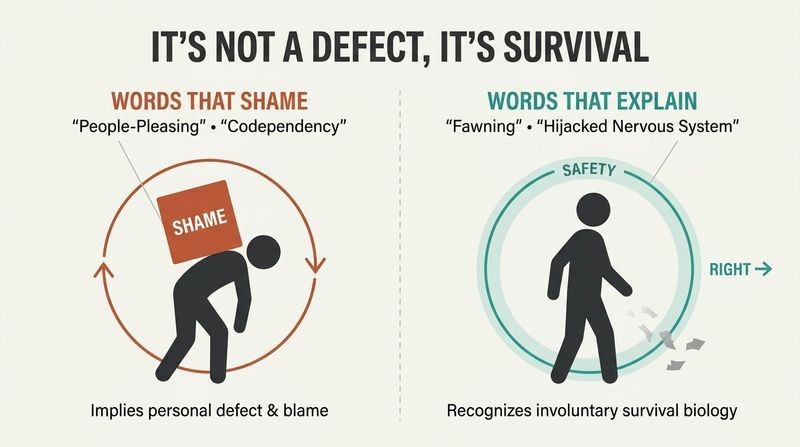
Words that shame versus words that explain. Clayton argues that codependency and people-pleasing, though useful, carry a judgmental undertone that keeps defenses up. Melody Beattie's classic definition frames the codependent as someone "obsessed with controlling" another's behavior, language that implies agency and blame. People-pleasing implies a goody-two-shoes who leaves others satisfied, when in truth, as her friend quipped, "people were not pleased."
Fawning names the why, not just the what. The chronic fawner is not sucking up for an A or brownnosing for a raise. They are seeking safety amid exploitation, often while flooded with fear, disgust, and resentment. Reframing these behaviors as an involuntary trauma response, not a defect of character, dissolves shame. And shame, Clayton insists, is what keeps a fawner fawning. Only when shame recedes can the pattern loosen.
This is the book's most therapeutically consequential claim: that language itself can perpetuate or heal. It aligns with the trauma-informed care movement's shift from "What's wrong with you?" to "What happened to you?" Research on self-compassion by Kristin Neff supports the mechanism, showing that self-criticism activates threat physiology while self-kindness enables change. There is genuine tension here worth naming, though. Reframing behavior as involuntary survival could, misapplied, reduce accountability for harm one causes others. Clayton addresses this directly, insisting fawners must still make repairs. The reframe explains origin without granting a permanent pass.
Patriarchy, racism, and hierarchy don't just permit fawning, they demand it
Fawning is bigger than one body. Clayton catalogs the structures that reward self-erasure and rename it virtue: patriarchy calls a woman's deference "being a team player"; "respect your elders" becomes obey without question; corporate, academic, and religious hierarchies expect self-abandonment as loyalty. A law firm, she notes, runs on fawning at every rung.
Code-switching as survival. Her client Davis, a Black man, describes adjusting his entire presentation to make others comfortable, echoing Questlove's description of coolness as a mask Black men wear for protection. Actor Dax Shepard admitted he "grew out of" fawning only because he became a six-foot-two man who could finally fight back, a privilege most women and smaller people never gain. The shame of having fawned, Shepard said, hurt worse than the violence itself.
Situating fawning in systems rather than individual pathology is the book's most politically ambitious move, connecting personal trauma to sociology. It resonates with W.E.B. Du Bois's double consciousness and with research on "racial battle fatigue" and minority stress. The Shepard anecdote is quietly devastating: it reveals fawning as a hierarchy of bodily vulnerability, where the option to fight is distributed by size, gender, and power. This systemic lens usefully resists the self-help tendency to place all repair on the individual. The risk is fatalism, since if systems demand fawning, personal healing can feel futile. Clayton threads this by focusing on internal reclamation despite unchangeable external structures.
The double bind forces a brutal choice: be yourself or be safe
Damned either way. Clayton names the fawner's core trap: two contradictory demands that cannot both be met. Be assertive, but don't be difficult. Set boundaries, but don't make anyone uncomfortable. Just be yourself, but not if it costs you the job. In a double bind, something must be sacrificed, and fawners instinctively sacrifice themselves, not nobly but because equal footing was never available.
Finding pivot points. When Randy was dying, Clayton's mother begged her to help nurse him. Every fiber said a "good daughter" should come. Her friend asked one clarifying question: what would you do if you put yourself first? The answer was obvious: never see that man again. Choosing herself carried real consequences, including the unraveling of the relationship with her mother. Growth, she notes, requires growing pains.
The double bind concept originates with anthropologist Gregory Bateson's 1956 theory of contradictory communication, once controversially linked to schizophrenia. Clayton repurposes it precisely: the fawner is punished for complying and punished for not complying, so the psyche splits. Her prescription, hunting for small "pivot points" rather than heroic overhauls, is behaviorally sound, mirroring how exposure therapy titrates fear in tolerable doses. What deepens the insight is her honesty that choosing yourself does not guarantee a happy ending; her mother never truly reconciled. This refusal to promise clean resolution distinguishes the book from tidier self-help and respects the reader's intelligence.
Learn to recognize fawning by its telltale signs in your own life
Self-abandonment wears many disguises. Clayton maps the recurring signposts so readers can spot the response operating beneath "just being nice":
1. Self-minimization: shrinking your needs to fit the sliver of space left in a relationship.
2. Hypervigilance and anxiety: scanning moods, walking on eggshells, mistaking control for calm.
3. Shapeshifting: wearing a different self for every context until, like her client Grace, you no longer know who you are.
4. Conflict avoidance: putting on blinders so you cannot even see the harm.
5. Compulsive caretaking: treating everyone's crisis as a fire only you can extinguish.
Underneath them all sits the need to be chosen. Grace's father once erupted because she said she didn't want onions, then dragged her out by her hair, teaching her to always "want what he wanted."
This diagnostic inventory is the book's most immediately practical section, functioning like a symptom checklist that builds self-recognition without a formal questionnaire. The signs map neatly onto documented trauma sequelae: hypervigilance and startle appear in PTSD criteria, while "shapeshifting" resembles what psychologists call self-concept instability. Grace's onion story is a small masterpiece of showing how trivial preferences become life-threatening in volatile homes, which is exactly why survivors lose access to preference itself. A useful extension: Gabor Mate's distinction between authenticity and attachment, where children who cannot have both suppress the self to preserve the bond. That trade-off is the engine beneath every sign listed here.
Trauma bonds hook you like a slot machine's unpredictable payouts
Intermittent reinforcement is the trap. When abuse alternates with rescue and tenderness, the brain latches onto the relief rather than the harm, associating the abuser with safety. Clayton compares it to a slot machine: the unpredictability, not consistency, breeds obsession. The relief when affection returns feels like a jackpot. This hormonal attachment gets mistaken for love, with the highs feeling magical precisely because they contrast with the lows.
Francis and Colin. Her client Francis endured a boyfriend who raged while she scrubbed his studio floor, yet insisted he was "the love of her life." Only after nervous-system-based therapy could Francis feel the truth in her body during a fight: "This is disproportionate. This is not about me doing something wrong." Leaving triggered debilitating panic, because her body was finally safe enough to process a lifetime of stored pain.
Intermittent reinforcement is one of the most robust findings in behavioral psychology, from B.F. Skinner's pigeons that pecked hardest under unpredictable reward schedules to modern research on gambling addiction and even social media engagement. Clayton's application to abusive relationships is well supported by the trauma-bonding literature (Patrick Carnes). The neurochemistry she gestures at (dopamine driven by anticipation, oxytocin from reconciliation) makes the "it feels like love" confusion physiological, not foolish. What her account adds is that leaving often feels worse before better, a counterintuitive truth that explains relapse into toxic relationships. Naming that healing crisis in advance may prevent the shame that pulls people back.
You cannot think your way out; healing happens in the body
Insight is not enough. Clayton earned a PhD, ran a marathon, worked twelve-step programs, and read every self-help book, yet kept repeating the same patterns. Conscious awareness never relieved the instinct. Real change came through body-based work, moving from "What do you think?" to "What do you notice?"
Practical entry points. Drawing on Peter Levine's Somatic Experiencing, she offers concrete tools:
1. Orienting: slowly scanning your surroundings with each sense until your nervous system registers present safety.
2. Resourcing: asking not just "What do I need?" but "What do I need right now?" and following the nudge, whether a walk, water, or art.
3. Taking space: putting literal distance between you and triggering people.
Reprocessing modalities like EMDR, Internal Family Systems, and Somatic Experiencing let trapped survival energy finally discharge, the way animals shake off threat.
The primacy of the body over cognition is now mainstream trauma orthodoxy, popularized by Bessel van der Kolk's The Body Keeps the Score and grounded in polyvagal theory. Clayton's lived demonstration, that credentials and analysis left her "still fawning," is a persuasive rebuttal to purely talk-based or cognitive approaches for complex trauma. The evidence base varies by modality: EMDR has strong randomized-trial support for PTSD, while Internal Family Systems is promising but less rigorously validated. Orienting is a genuinely accessible practice anyone can try immediately, which is its strength. The honest caveat she includes, that regulating your nervous system will not change an ongoing external threat, keeps the tools from becoming spiritual bypass.
Reclaim your buried anger to finally locate your voice
The snuffed-out fire. For fawners, fighting back never worked, so the fight response went dark. Clayton describes carrying "the rage of a three-hundred-pound linebacker" behind a calm exterior. Anger, she argues, is a valuable teammate: it signals "I'm not okay" and forms the bridge between buried hurt and the ability to assert yourself.
Feeling it safely. In a Somatic Experiencing session, triggered by her mother praising her brother's sobriety while never acknowledging hers, Clayton let her body punch, throw a beanbag, and chant "I am here" until decades of stored rage released into grief. Anger need not be relational or explosive; her husband "big stomps" around the block to move the energy, then returns able to talk. Healthy anger is about respect: telling others your limits so they can choose how to respond.
Reframing anger as information rather than danger counters both spiritual traditions that pathologize it and the specifically gendered training that punishes women's and marginalized people's anger. The distinction between feeling anger somatically and weaponizing it is crucial and often missed in "just let it out" catharsis advice, which research (Bushman) shows can actually rehearse aggression. Clayton's version is closer to Focusing (Eugene Gendlin) and titrated somatic discharge, where the emotion is metabolized, not dumped. The insight that anger is a "bridge" to sadness underneath is clinically astute: rage often guards grief. Her husband's comic stomping ritual is a memorable, replicable model of regulation before communication.
Boundaries protect you; they were never meant to fix other people
A common misunderstanding. Fawners believe that if they just phrase a boundary perfectly, the other person will finally change, take responsibility, or treat them well. Clayton corrects this: boundaries are a continuation of self-care regardless of whether anyone else changes. You can voice a need, but you cannot make your boss agree. Setting a boundary is about speaking up and then gathering information from whatever response comes.
Two flavors. When fawning leans toward caretaking, the boundary is finding your no: "I won't be more responsible for your life than you." When it leans toward appeasement, the boundary closes the door: "I won't let you infringe on me this way." Clayton's own hardest boundary was cutting off contact with her mother after learning she still called her a liar, a decision that brought both grief and sturdiness.
This dismantles the self-help cliche that boundaries are magic incantations that reform difficult people. By decoupling the boundary from the outcome, Clayton relocates power to the only place it exists: one's own response. This is consistent with acceptance-based therapies (ACT) that emphasize committed action independent of controllable results. Her two-flavor taxonomy (finding your no versus closing the door) is practically clarifying because caretaker-fawners and appeaser-fawners need opposite corrections. The searing example of estranging her own mother resists the culture's sentimental insistence that family bonds must be preserved at all costs. Notably, she leaves room for boundaries to soften over time, avoiding rigid absolutism.
Become the parent you needed instead of searching for one
Are you my mother? Clayton invokes the children's book in which a lost bird asks every creature if it is her mother. Fawners do the same, scanning bosses, lovers, and friends for the protection and unconditional love they never received. The pivot in healing is realizing you can become that caregiver for yourself, a process called reparenting.
In practice. It means removing the blinders to admit where parents failed you, then meeting your own needs for rest, nourishment, play, and validation. Her client Francis, in a session, imagined returning to her old bedroom, taking her younger self's face in her hands and saying "I've got you," then driving them both away from harm. Clayton carries a preschool photo of herself in her wallet as a reminder of who she is caring for now. Even adults, she insists, still need parenting.
Reparenting has roots in transactional analysis and is central to schema therapy and Internal Family Systems, where the adult Self tends to wounded child "parts." The neuroscience Clayton cites, that the brain activates similar regions whether performing an action or vividly imagining it, is the same principle behind athletic visualization and imagery rescripting, a technique with growing evidence for trauma and nightmares. The bird-book framing makes an abstract concept instantly graspable. A fair critique is that "just parent yourself" can sound like bootstrapping that ignores the real human need for co-regulation, which Clayton acknowledges by stressing that healing also happens in safe relationships. Self-parenting complements, rather than replaces, being genuinely cared for by others.
Analysis
Clayton's contribution is less a discovery than a precise act of naming. Fawning as a trauma response was coined by Pete Walker, but this book builds the fullest popular architecture around it, weaving her own incest-adjacent childhood with seven longitudinal client stories spanning up to sixteen years of therapy. The result is a hybrid genre: part memoir, part clinical case study, part self-help manual, structured as anatomy (Part One) then recovery (Part Two).
The book's central intellectual maneuver is destigmatization through relabeling. By insisting that codependency and people-pleasing pathologize the survivor, Clayton repositions the behavior as intelligent physiology rather than moral weakness. This is genuinely useful and aligns with the trauma-informed turn in psychology. It also carries risk: a totalizing framework where nearly all accommodation becomes trauma response can obscure ordinary reciprocity, and could theoretically be used to dodge accountability. Clayton mostly guards against this, devoting a full section ("Righting Our Wrongs") to the harm fawners themselves cause and the necessity of repair.
Empirically, the book sits on solid mainstream trauma science (van der Kolk, Levine, Porges, Herman's complex trauma) but leans heavily on clinical anecdote and single-case narrative rather than controlled evidence. The modalities she champions vary in validation: EMDR is well-supported, IFS less so, psychedelic-assisted therapy still emerging. Readers should treat the case stories as illustrative, not proof.
What elevates the work is its refusal of tidy resolution. Clayton's mother never truly reconciles; some of Davis's boxes stay closed. Healing is framed as layered, lifelong, and without a finish line. The book's honesty about how healing can hurt worse than the original wound, and how leaving a trauma bond triggers physiological collapse, is its most valuable and least commercial insight. For readers who have long felt broken for going along to get along, the reframe that they were adaptive, not defective, may be genuinely liberating.
Review Summary
Fawning explores the fourth trauma response alongside fight, flight, and freeze. Readers praise Clayton's insightful exploration of this overlooked behavior, combining clinical expertise with personal experiences. Many found the book validating and transformative, offering tools for healing and self-discovery. Reviewers appreciated the balance of technical information and relatable stories. Some noted repetition and organization issues, while others wanted more concrete strategies for addressing societal triggers. Overall, the book is highly recommended for those interested in trauma responses and personal growth.
People Also Read







FAQ
What is Fawning: Why the Need to Please Makes Us Lose Ourselves—and How to Find Our Way Back by Ingrid Clayton about?
- Exploration of fawning: The book examines fawning as a trauma response, where individuals appease others to avoid conflict or harm, often sacrificing their own needs and identity.
- Personal and clinical insights: Ingrid Clayton blends her personal story with client narratives, offering both memoir and clinical expertise to illustrate how fawning manifests in various relationships.
- Path to healing: The book outlines the process of “unfawning,” guiding readers toward reclaiming self-trust, boundaries, and authentic connection, emphasizing that healing is a lifelong journey.
Why should I read Fawning by Ingrid Clayton?
- Understanding trauma responses: The book introduces fawning as the “fourth F” trauma response, expanding the traditional fight, flight, and freeze model, and helps readers recognize misunderstood behaviors.
- Destigmatizing coping mechanisms: Clayton reframes fawning as an adaptive survival strategy rather than a personal failing, encouraging self-compassion and reducing shame.
- Practical healing guidance: Readers receive tools and hope for breaking free from trauma bonds, navigating societal structures, and reclaiming their authentic selves.
What are the key takeaways from Fawning by Ingrid Clayton?
- Fawning as survival: Fawning is a trauma-based survival mechanism, not a conscious choice, and often leads to self-abandonment.
- Unfawning as healing: The journey to “unfawning” involves building self-trust, setting boundaries, and reconnecting with one’s authentic self.
- Body-based healing: Healing from fawning requires nervous system regulation and trauma-informed therapies, not just cognitive understanding.
- Relational transformation: Unfawning changes how individuals relate to others, fostering healthier, more authentic connections.
How does Ingrid Clayton define “fawning” in Fawning?
- Trauma response definition: Fawning is “a response to a threat by becoming more appealing to the threat,” where individuals merge with others’ desires to stay safe.
- Connection as protection: It involves seeking safety through appeasement, often by surrendering personal needs, values, and opinions.
- Hybrid nervous system activation: Fawning activates both hyperarousal and hypoarousal, leading to active appeasement while disconnecting from self-awareness.
How does Fawning by Ingrid Clayton differentiate fawning from codependency and people-pleasing?
- Rooted in trauma: Fawning is a trauma-based survival mechanism, while codependency and people-pleasing are often seen as behavioral choices.
- Lack of agency: Fawning is involuntary and shaped by relational trauma, whereas codependency and people-pleasing imply more conscious decision-making.
- Adaptive origins: Fawning is honored as a lifesaving instinct, not a personal flaw, and Clayton advocates for trauma-informed language to validate its protective role.
What are the most common signs of fawning according to Fawning by Ingrid Clayton?
- Self-minimization: Fawners shrink themselves physically and emotionally, minimizing their needs and justifying others’ harmful behaviors.
- Hypervigilance and anxiety: They are constantly alert to others’ moods, leading to anxiety, perfectionism, and difficulty asserting boundaries.
- Shapeshifting and conflict avoidance: Fawners adopt different personas to fit situations, suppressing authentic feelings to avoid conflict.
How does Fawning by Ingrid Clayton explain the relationship between fawning and complex trauma?
- Complex trauma context: Fawning often develops from ongoing interpersonal threats, such as childhood abuse, neglect, or systemic oppression.
- Misunderstood trauma: Many fawners don’t recognize their experiences as trauma due to its subtle, relational nature and historical under-recognition.
- Daily manifestations: Complex trauma and fawning can result in low self-esteem, anxiety, addiction, and relational difficulties, requiring holistic, body-based healing.
What is the “double bind” in fawning as described by Ingrid Clayton?
- Contradictory demands: Fawners face impossible choices between authenticity and safety, often feeling “damned if they do, damned if they don’t.”
- Sacrifice for survival: The double bind forces fawners to abandon their needs to maintain relationships or safety, creating internal conflict.
- Awareness as a pivot: Recognizing the double bind is a crucial step toward choosing oneself and beginning the healing process.
How does Fawning by Ingrid Clayton describe trauma bonding and its connection to fawning?
- Hormonal attachment: Trauma bonding arises from cycles of abuse and relief, creating strong emotional ties to abusers.
- Fawning as coping: Fawning serves as a mechanism within trauma bonds to mitigate harm and maintain attachment.
- Perpetuating the cycle: Trauma bonds involve justifying abuse and self-blame, with fawning intensifying these patterns and prolonging unhealthy relationships.
What is “unfawning” and how does Ingrid Clayton suggest beginning this healing journey in Fawning?
- Reclaiming self-trust: Unfawning is the process of regaining one’s voice, boundaries, and authentic self after chronic fawning.
- Body-based healing: Healing involves tuning into bodily sensations and emotions through trauma-informed therapies like EMDR and Internal Family Systems.
- Compassion and patience: Clayton emphasizes honoring the protective role of fawning and allowing space for discomfort, recognizing healing as a lifelong journey.
What trauma therapies and healing practices does Ingrid Clayton recommend in Fawning?
- Internal Family Systems (IFS): IFS helps identify and communicate with internal parts, including the fawning protector, fostering self-leadership and healing.
- Somatic Experiencing (SE): SE focuses on bodily sensations and completing the trauma response cycle, using techniques like orienting and resourcing.
- EMDR: Eye Movement Desensitization and Reprocessing helps process traumatic memories and reduce their emotional charge, facilitating trauma integration.
What are the best quotes from Fawning by Ingrid Clayton and what do they mean?
- “You were never broken. You make perfect sense.” This quote encourages self-compassion, reminding readers that fawning is a logical survival response.
- “Fawning is not a problem that needed fixing. It was in fact the solution.” This reframes fawning as an adaptive mechanism, challenging shame and blame.
- “Unfawning means taking up more space, taking deeper breaths. We are reclaiming our voices, opinions, preferences, and desires.” This highlights the essence of unfawning as reclaiming authenticity and autonomy.
- “Triggers are normal. Symptoms are a wise communication, conveying what we’ve been through and how we learned to cope.” This reframes trauma symptoms as meaningful signals, inviting compassion and curiosity.
Download PDF
Download EPUB
.epub digital book format is ideal for reading ebooks on phones, tablets, and e-readers.








































