

Key Takeaways
You can consciously leave your body, and roughly one in four already have
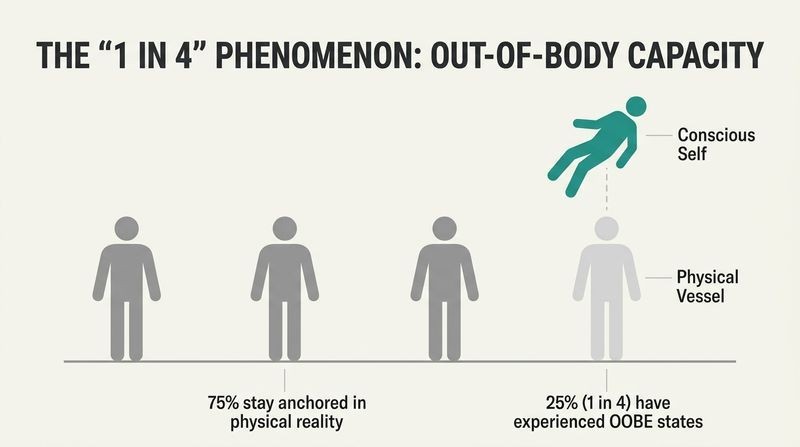
The out-of-body experience is trainable. Robert Monroe, a successful radio and TV executive, began involuntarily floating outside his physical body in 1958, terrified he had a brain tumor or was going insane. Medical exams found nothing. Rather than accept a diagnosis of "minor hallucinatory dysfunction," he investigated. He defines an OOBE as a state where you are fully conscious outside your body, able to move through walls, travel vast distances, and perceive as vividly as waking life.
It is common, not exotic. Surveys he cites suggest about 25 percent of adults recall at least one such episode, often dismissed as a vivid dream. Monroe argues everyone exits the body nightly during deep sleep; most simply never remember. The trained version differs from dreaming by its overwhelming, undeniable realness.
What's striking is Monroe's insistence on framing a mystical topic in engineering language, a reflection of his broadcast-technology background. The 25 percent figure aligns loosely with modern surveys of spontaneous OOBEs and with neuroscience of the temporoparietal junction, where Olaf Blanke's lab induced out-of-body sensations via electrical stimulation. Skeptics reasonably read these as brain-generated body-schema disruptions rather than literal travel. Monroe sidesteps the proof question, which is both his weakness and his wisdom: the appended psychiatric studies found him sane and high-functioning, suggesting that whatever this is, it is not pathology. The phenomenology deserves study regardless of metaphysics.
Sound can synchronize both brain hemispheres and unlock altered states
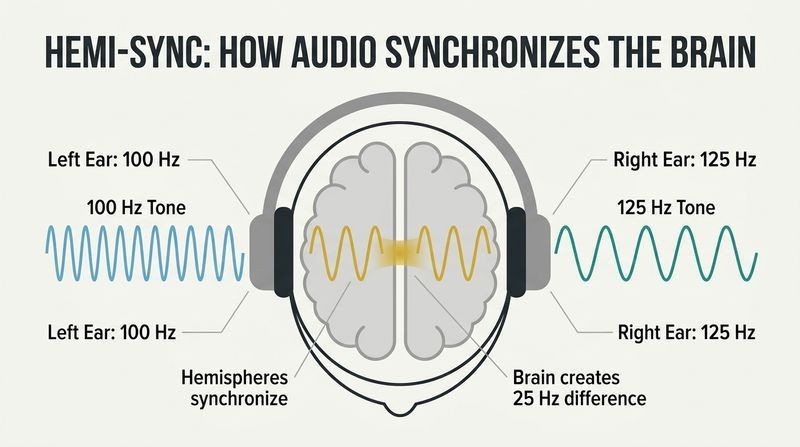
Hemi-Sync engineers consciousness with audio. At his Virginia lab, Monroe discovered the Frequency-Following Response: play a specific sound pattern and brainwaves begin matching it. He patented the method in 1975. Hemi-Sync (hemispheric synchronization) sends a slightly different tone to each ear (say 100 in one, 125 in the other). To reconcile them, both hemispheres must generate the difference frequency together, producing a unified brain state you can steer at will.
Practical payoffs were measurable. Reported results included pain control during surgery with no anesthesia complications, faster post-op recovery, a Morse code class improving 30 percent, and government trainees gaining 75 percent in motor skills. The technique required no years of meditation, just headphones.
Binaural beats are now a consumer wellness staple, though the peer-reviewed evidence remains mixed. Some studies show modest effects on relaxation and attention; others find little beyond placebo. Monroe's specific claims (halved recovery time, surgery without anesthesia) are anecdotal and uncontrolled, exactly the sort of data that demands replication he himself invites. Yet the underlying neuroscience of auditory entrainment and interhemispheric coherence is legitimate and actively researched. What's valuable here is the reframe: consciousness as a tunable energy state rather than a fixed given, an idea that anticipates modern neurofeedback and closed-loop brain stimulation by decades.
Stop steering with your analytical mind and let your total self drive
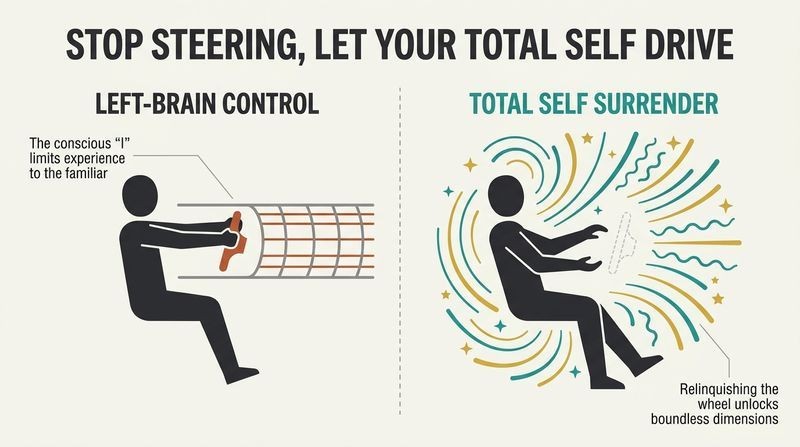
Surrender beats control. For years Monroe's OOBEs grew boring because his conscious, left-brain "I" made all the decisions, and it lacked imagination for the nonphysical. In spring 1972 he tried an experiment: he mentally handed decision-making over to his "total self" (soul). That night, after waking between sleep cycles, a tremendous surge of energy launched an entirely new era of experiences beyond anything his conscious mind could conceive.
The limiting factor was himself. His analytical faculty, honed by producing audio for a living, refused to let go of here-now attention. The breakthrough came from deliberately relinquishing the wheel. The Gateway affirmation he taught students encodes this: a stated desire to expand, plus a request for guidance from wiser intelligences.
This maps neatly onto flow research and the psychology of "letting go." Csikszentmihalyi's flow, Iain McGilchrist's work on left-versus-right hemisphere modes, and the therapeutic use of psychedelics all converge on the same paradox: peak experiences arrive when the controlling ego stands down. The default mode network, associated with self-referential thinking, quiets during both meditation and psychedelic states. Monroe reached this through will and audio rather than chemistry. The caveat worth flagging: surrendering to an "external navigator" is epistemically slippery, since a relaxed brain can readily generate the felt sense of an outside guide. The subjective benefit, however, seems real.
Nonverbal communication transmits whole experiences, not just words
NVC dwarfs language. Monroe claims every intelligent species he encountered communicates nonverbally, transmitting complete experiences instantly rather than serial words. If a picture is worth a thousand words and a talking movie a hundred thousand, NVC is a further quantum leap: direct transfer of an event including its emotions, sensations, and meaning. He could theoretically pass his son a lifetime of education in seconds.
Why humans got stuck on words. He speculates Earth is a rare planet with clear skies, letting our ancestors see sun, moon, and stars, which pushed us toward astronomy, physics, and eventually verbal-mathematical science. Cloud-covered worlds, unable to see the cosmos, developed NVC instead. Our radio telescopes hunting alien signals amuse other species, like measuring exhaust fumes to detect a passing car.
The idea that language is a low-bandwidth bottleneck resonates with contemporary debates about brain-to-brain interfaces and Elon Musk's stated Neuralink ambition of "conceptual telepathy." Cognitive scientists note that speech transmits perhaps 39 bits per second, a stunning constraint given the richness of inner experience. Monroe's telepathy-as-experience-download is unfalsifiable, yet the framing captures something真实: translation loss. His planetary just-so story about clouds shaping cognition is charming but pure conjecture with no evidentiary basis. Still, the humility embedded in it, that our proudest science might be a parochial detour, is a useful corrective to human exceptionalism.
Earth may be a farm, and human emotion the harvested crop
The Loosh hypothesis. Monroe's most unsettling download, delivered via his alien friend BB, reframes Earth as a cultivated garden. A being called Someone engineered life to produce "loosh," a rare energy generated by the carbon-oxygen cycle and refined through living organisms. The purest loosh comes from human emotion, triggered deliberately through love, fear, pain, conflict, and loss. The tools of the harvest are named plainly: family, greed, hate, disease, war, religion, ambition.
Conflict is the catalyst. Someone discovered that struggle and unfulfillment (loneliness especially) yield the highest-grade loosh, so he split beings into halves seeking reunion and encouraged dominance and predation. Monroe cycled through shock, anger, and depression before grudgingly conceding the theory explained the purpose behind existence with disturbing tidiness.
This is Monroe at his most provocative and least verifiable, a gnostic cosmology dressed in agricultural metaphor. It echoes ancient Gnosticism (a flawed creator harvesting souls), the simulation hypothesis, and Philip K. Dick's paranoid metaphysics. The emotional logic is potent: it explains suffering as functional rather than random, which is precisely why it is seductive and why it should be held at arm's length. Any theory that neatly accounts for everything explains nothing testable. Yet as literature and as a thought experiment about whether human misery serves some external economy, it lands with genuine philosophical weight. Monroe's own revulsion makes it more, not less, credible as sincere testimony.
Physical life is an addictive school, and death traps those who forget it
Earth as compressed learning. In Monroe's cosmology, nonphysical energy units enter human bodies to learn, blanking their prior memory so past lives will not interfere. The trouble is that physical existence is addictive, like alcohol. Souls become "repeaters," cycling through hundreds of lifetimes, hooked on survival, sex, and emotion.
The rings of the trapped. Monroe maps the near-Earth afterlife into zones. The Dreamers are sleeping people temporarily out of body. The Locked-Ins are physically dead but do not know it, haunting old houses and even their own graves. The Wild Ones sense they are different and exploit the apparent freedom bizarrely. Beyond them lie rings of souls preparing to reincarnate, and finally the Last-Timers, glowing and nearly free, headed "Home."
Monroe's afterlife bureaucracy strikingly parallels the Tibetan Book of the Dead's bardo states and Emanuel Swedenborg's 18th-century spirit-world reports, where the newly dead often fail to realize they have died. Cross-cultural convergence like this fascinates researchers of near-death experiences (the tunnel, the light, the life review recur across traditions). Skeptics attribute the convergence to shared neurobiology of the dying brain and to cultural cross-pollination. The addiction framing is psychologically astute regardless of metaphysics: attachment as the engine of return is pure Buddhism, recast in the language of a recovering culture that understands substance dependence better than it understands enlightenment.
Your survival instinct, wildly overshot, is what chains you to Earth
Distortion is the disease. Monroe argues the survival imprint, essential at birth, metastasizes into the source of nearly all human dysfunction. It splits into body maintenance (endless food varieties, fashion, luxury housing far beyond need), and reproduction (where the sensory thrill of the act eclipses its original purpose, spawning guilt, obligation, and possessiveness). These overshoots are the "adhesive" binding heavy particles to the soul, dragging its orbit into decay.
Ego is the densest load. He calls ego a sprout of the survival imprint that devours emotional reinforcement, disguising itself as necessary for confidence and achievement. His diagnostic test: would you still pursue this goal with zero public or private credit? If yes, you are freer than you think. If no, you have found an ego power feed to unplug.
The credit test is genuinely usable and anticipates modern work on intrinsic versus extrinsic motivation (Deci and Ryan's self-determination theory) and Ryan Holiday's popularization of ego as saboteur. Monroe's account of consumption as survival-instinct-run-amok also prefigures evolutionary mismatch theory: appetites calibrated for scarcity misfire in abundance, driving obesity, hoarding, and status competition. Where he overreaches is treating all attachment as pathology, a stance that, taken literally, would dissolve the very relationships and ambitions that generate meaning. The wiser reading, which he gestures toward, is not suppression but redirection: keep the energy, drop the compulsion.
Kill worry by sorting it into three lists and acting today
Indecision is the killer. Monroe received a practical formula in an OOB "class" for reducing anxiety. Since any decision carries roughly a 50 percent chance of being right, and a wrong turn can often be reversed, the odds of an irreversible mistake are at most one in four. Better odds than most historic decisions. So act; paralysis accumulates toxins.
The three-list method:
1. A-list: everything you worry about but cannot affect today (tomorrow's weather). Destroy it and dismiss it.
2. B-list: worries you can act on today. Take one small action on each, resolving or at least starting the flow.
3. C-list: your unfulfilled hopes and desires. Do one thing, however small, toward one of them.
Repeat daily until only the C-list remains.
Stripped of its astral packaging, this is crisp cognitive-behavioral therapy, nearly identical to the "control versus no-control" partitioning taught for worry management and to Stephen Covey's circle of influence. The insight that starting a task drains its psychic charge maps onto the Zeigarnik effect, where unfinished tasks nag at working memory until action releases them. The one-in-four claim is rhetorically motivating rather than statistically rigorous (real decisions are not coin flips), but as a bias against paralysis it is sound. That such actionable, secular advice arrived inside a mystical experience is itself interesting: the unconscious dispensing practical wisdom in symbolic dress.
Emotion is misfired creative energy, and love is its only pure form
All emotion is Prime Energy diffused. Monroe reframes joy, hate, greed, curiosity, and worry as scattered, distorted expressions of a single Creative Force inside each person. The concept of unemotional rationality is an illusion; even cold objectivity hides an emotional agenda, and observers unconsciously alter every experiment. The problem is that most emotions bind only to time-space events and cannot exist elsewhere, so they weigh the soul down.
Super Love is the exception. He distinguishes ordinary "love" (usually sexual attachment) from Super Love (SL): indestructible, objectless, dependent on nothing external, radiating without needing return. It is the one accurate representation of the original Prime Energy and the fuel for spiritual escape velocity. The purpose of the human school is to learn to generate this energy at will, not merely reflect it.
The distinction between conditional attachment and unconditional radiance maps directly onto the Greek eros versus agape, and onto Erich Fromm's argument in The Art of Loving that mature love is a generative capacity, not a transaction. Monroe's claim that emotion drives all history and that politicians win on feeling anticipates Jonathan Haidt's finding that moral reasoning is mostly post-hoc rationalization of gut intuition. The observer-alters-experiment line borrows loosely from quantum measurement, a common and usually illegitimate analogy. Still, the core reframe, that emotion is raw power awaiting skillful direction rather than a nuisance to suppress, is both psychologically mature and practically liberating.
Emotional intensity, not repetition, is what burns learning into memory
Depth of learning tracks depth of experience. Monroe outlines how humans actually absorb information. Primary learning comes from focused conscious attention driven by pain or pleasure, and it is dramatically deepened when emotion is present. Extreme experience etches itself in; shallow experience barely registers. This is why rote classroom learning, the most widespread yet most unnatural method, fails: it ignores the body's built-in systems and depends on discipline most minds lack.
Three learning channels run constantly:
1. Primary: emotionally charged conscious attention (the strongest).
2. Secondary: sensory data absorbed without focus, stored in detail, less than 20 percent consciously recallable.
3. Sleep-state learning: absorbed nightly, embedded deep, rarely remembered but shaping decisions.
This is well ahead of its 1985 vintage and squarely confirmed by modern neuroscience. The amygdala tags emotionally arousing events for preferential consolidation via stress hormones, which is why flashbulb memories of shocking news persist while ordinary Tuesdays vanish. Educational research now champions emotion, story, and active experience over drill, echoing Monroe almost exactly. His secondary-learning channel prefigures work on implicit and incidental memory, and sleep-state learning aligns with the now-robust science of memory consolidation during slow-wave and REM sleep. Here the mystic and the laboratory shake hands: whatever one thinks of astral travel, his account of how humans learn is essentially correct.
Curiosity, not fear, is the trait that lets a soul graduate
The unexpected engine. When Monroe finally meets the INSPECs (intelligent species predating humanity by millions of years), he learns his special function hinges on his most dubious personal trait: curiosity. He had always seen it as a troublemaker generating more problems than solutions. They call it the most undistorted form of Prime Energy and the underlying force behind humanity's greatest achievements.
Graduation and its price. Souls advance by needing physical life less and less, their radiation shifting until they "click out" and never return. Monroe's guides refuse to define what lies beyond, insisting he must perceive it himself. When he touches a single ray near the ultimate source, the shock is so total he knows he will forget it, because his current self cannot yet contain the reality, yet the echo will reverberate through him forever.
Reframing curiosity as spiritually load-bearing inverts traditions that prize obedience or faith, and it dovetails with psychological research linking openness to experience with wellbeing, creativity, and cognitive longevity. The refusal of the guides to hand over final answers is pedagogically shrewd, mirroring the Zen insistence that enlightenment cannot be transmitted in words, only pointed at. The motif of an experience too vast to remember appears across mystical literature, from Plotinus to psychedelic ego-death reports, and conveniently insulates the claim from scrutiny. Whatever its ontological status, the elevation of wonder over dread as the growth mechanism is a genuinely humane and energizing philosophy of life.
Humanity faces a rare crossroads: transcend as a species or vanish
The Gathering. In a possible future beyond the year 3000, Monroe visits an Earth restored to ecological balance, populated by fewer "H-plus" humans who feed on their own energy, materialize food from soil, and store spare bodies under oak trees. Then comes the crisis: a rare convergence of energy fields, occurring perhaps once every 87 million years, drawing countless nonphysical beings to witness.
Danger and opportunity. Borrowing the two-part Chinese symbol for crisis, Monroe frames the event as the possible birth of a new unified human energy that could range far beyond time and space. If humanity seizes it, consciousness leaps forward. If missed, humans retreat as the dominant species until they no longer survive in any form, and the gardeners simply start over with new humans on another planet.
The restored-Earth vision is utopian ecology decades before it was fashionable, and the "crisis equals danger plus opportunity" trope, though a beloved motivational cliche, is actually a mistranslation of the Chinese weiji, whose second character means something closer to "incipient moment" than "opportunity." The high-stakes evolutionary either-or resonates with contemporary longtermism and existential-risk thinking (Toby Ord, Nick Bostrom), which likewise frame the present as a hinge on which the entire human future turns. Monroe's optimism, that we might graduate collectively into something post-physical, is unprovable but functions as a call to raise consciousness now. As closing note, it reframes personal spiritual work as civilizational stakes.
Analysis
Far Journeys (1985) is the middle volume of Robert Monroe's out-of-body trilogy, and it occupies an odd, compelling genre space: part memoir, part experimental report, part channeled cosmology. Monroe was no fringe mystic but a hard-nosed broadcast executive who patented an audio technology, founded a research institute, and submitted himself to psychiatric evaluation (appended to the book, which found him sane and high-functioning). This biography is the source of the book's distinctive voice: an engineer narrating heaven.
The book's structural challenge for a summarizer is that it lurches between rigorous-sounding laboratory documentation (Hemi-Sync, Explorer transcripts, EEG data) and unfalsifiable metaphysics (the Loosh farming hypothesis, the INSPECs, the year-3000 utopia). Monroe himself flags the translation problem repeatedly: nonphysical events, he insists, cannot be rendered accurately in words, so his "rote" vocabulary and his fictionalized AA-BB dialogues are admitted approximations. He anticipates skepticism and welcomes replication, which is more intellectually honest than most in the genre.
What elevates the work above typical New Age fare is the recurring intrusion of genuinely practical, secular wisdom: the three-list anxiety method is textbook CBT, the emotion-drives-memory model is confirmed neuroscience, and the ego "credit test" is sharp self-inquiry. These arrive dressed as cosmic downloads but stand alone as sound psychology, suggesting Monroe's unconscious was doing serious work regardless of whether astral planes exist. The darkest and most original contribution is the Loosh hypothesis, a gnostic vision of Earth as an emotion farm. It is unverifiable and deliberately disturbing, yet functions as a profound thought experiment about whether suffering serves an external economy. Read charitably, Far Journeys is less a travel guide to the afterlife than an extended meditation on consciousness, attachment, and human purpose, one that happens to converge, again and again, with Buddhism, Gnosticism, flow research, and modern neuroscience of learning and dying.
Review Summary
Far Journeys receives mixed reactions. Enthusiastic readers find profound connections to mystical traditions, citing themes like loosh (energy harvesting), reincarnation, and encounters with higher beings. Many praise Monroe's explorations of consciousness and non-physical reality as mind-expanding. Critics find it reads like poor science fiction, with overly technical jargon, inconsistent narratives, and less practical value than his first book. Common complaints include difficult-to-follow transcripts, excessive abbreviations, and fantastical dialogues that strain credulity. Most agree it's less accessible than "Journeys Out of the Body" but appeals to those seeking metaphysical understanding.
People Also Read



Glossary
OOBE (Out-of-Body Experience)
Conscious awareness outside physical bodyA state in which a person is fully conscious and perceiving from a location outside their physical body, able to move through matter and across distances while retaining vivid sensory awareness. Monroe distinguishes it sharply from dreaming by its overwhelming realness and argues everyone enters it nightly during deep sleep, though most never remember.
Hemi-Sync
Audio-induced brain hemisphere synchronizationShort for hemispheric synchronization, a patented technique using slightly different sound frequencies in each ear. The brain must generate the difference tone by using both hemispheres in unison, producing a controllable unified brain state used to induce relaxation, sleep, meditation, and altered consciousness including OOBEs.
Focus 10, 12, etc.
Mapped states of consciousnessNumbered labels for specific states reachable via Hemi-Sync. Focus 10 is "mind awake, body asleep." Focus 12 shuts off physical sensory input so perception occurs through nonphysical means. Higher numbers denote progressively deeper or more expanded states used as navigational guideposts in Monroe's training.
Loosh
Energy harvested from human emotionIn Monroe's channeled cosmology, a rare and valuable energy generated by carbon-based life, purest and most potent when produced by human emotion. A creator being called Someone allegedly engineered Earth as a garden to cultivate loosh, using conflict, love, fear, and loss as the catalysts and harvesting tools.
NVC (Nonverbal Communication)
Instant transfer of whole experienceA mode of communication Monroe claims all intelligent nonhuman species use, transmitting complete experiences (emotions, sensations, meaning) instantly and directly, far surpassing words. He considers mastering NVC a prerequisite for humans to communicate with other intelligent energy systems.
INSPEC
Ancient benevolent intelligent speciesMonroe's coined shorthand for "intelligent species," nonphysical beings existing millions of years before humanity who guide and fine-tune the human learning process. They appear as brilliant radiant forms, communicate through NVC, and claim to have been involved with human existence since its beginning.
Rote
Compressed packet of total experienceA term from Monroe's "replica vocabulary" for a bundle of thought containing complete memory, knowledge, information, and experience transferred whole in nonverbal communication. One "runs the rote" to unpack its detailed contents after receiving it instantly.
Super Love (SL)
Pure, objectless, radiating loveMonroe's term for an indestructible form of love distinct from ordinary sexual or conditional affection. It requires no object, depends on nothing physical, radiates continuously without needing anything in return, and represents the one accurate expression of the original Creative Force or Prime Energy.
The Rings
Near-Earth afterlife zonesConcentric layers of nonphysical reality surrounding Earth, populated by souls at various stages: Dreamers (sleeping living people), Locked-Ins (dead but unaware), Wild Ones, repeaters awaiting reincarnation, and outermost Last-Timers preparing for a final lifetime before departing "Home."
FAQ
1. What is Far Journeys by Robert A. Monroe about?
- Exploration of Consciousness: The book chronicles Monroe’s personal and scientific exploration of out-of-body experiences (OBEs) and altered states of consciousness.
- Human Energy and Reality: It investigates the nature of human consciousness as an energy form that can separate from the physical body and travel to other realities.
- Cosmic Energy Dynamics: Monroe introduces the concept of “loosh,” a cosmic energy produced by living beings, and explores its significance in the universe.
- Purpose of Human Life: The narrative frames human existence as a learning process, with multiple lifetimes and nonphysical realities contributing to soul evolution.
2. Why should I read Far Journeys by Robert A. Monroe?
- Unique Firsthand Accounts: Monroe provides detailed, firsthand descriptions of OBEs, offering rare insight into nonphysical realities and consciousness exploration.
- Scientific and Practical Approach: The book blends personal experience with scientific research, including the development of sound technologies like Hemi-Sync for inducing altered states.
- Philosophical Depth: Readers gain exposure to profound metaphysical concepts about life, death, and the evolution of consciousness.
- Transformative Potential: Many readers find Monroe’s work life-changing, reporting increased peace, reduced fear of death, and a broader understanding of existence.
3. What are the key takeaways from Far Journeys by Robert A. Monroe?
- Consciousness Beyond the Body: Human consciousness can exist and function independently of the physical body, exploring other dimensions and realities.
- Energy and Evolution: Life is a process of learning and energy production, with “loosh” as a central concept linking human experience to cosmic processes.
- Practical Methods: Techniques like Hemi-Sync and the Gateway Program can help individuals safely explore altered states and OBEs.
- Survival and Growth: The book asserts that consciousness survives physical death and continues to evolve through multiple lifetimes and realities.
4. How does Robert A. Monroe define and describe out-of-body experiences (OBEs) in Far Journeys?
- Conscious Separation: OBEs are states where self-awareness separates from the physical body, allowing vivid perception from outside the body.
- Sensory Replication: Most physical senses are replicated during OBEs, enabling observation of real-world events from impossible vantage points.
- Not Dreams: Monroe distinguishes OBEs from dreams by their clarity, realism, and the ability to verify observed events.
- Varied Triggers: OBEs can occur spontaneously or be induced, often during deep relaxation or meditative states, and are not linked to illness or trauma.
5. What is the Monroe Institute and what role does it play in OBE research in Far Journeys?
- Research Foundation: The Monroe Institute was established to scientifically study OBEs and related states of consciousness.
- Laboratory Setting: It provides controlled environments with isolation booths, physiological monitoring, and audio stimulation for research and training.
- Development of Techniques: The Institute developed methods like Frequency-Following Response (FFR) and Hemi-Sync to induce and control altered states.
- Training Programs: Programs like the Gateway Program help individuals explore consciousness and experience OBEs in a structured, supportive setting.
6. What is Hemi-Sync and how does it facilitate altered states in Far Journeys by Robert A. Monroe?
- Definition and Mechanism: Hemi-Sync (hemispheric synchronization) uses binaural beats—slightly different sound frequencies in each ear—to synchronize brain hemispheres.
- Inducing States: This technology helps the brain enter desired states such as Focus 10 (“mind awake, body asleep”) and Focus 12 (expanded awareness).
- Applications: Hemi-Sync is used for stress reduction, pain control, improved sleep, enhanced learning, and facilitating OBEs.
- Non-Drug Approach: It offers a safe, drug-free method for achieving altered states and exploring consciousness.
7. What is the Gateway Program in Far Journeys and how does it expand Monroe’s research?
- Structured Training: The Gateway Program is a series of workshops using Hemi-Sync and other techniques to help participants explore expanded states of consciousness.
- Focus States: Participants learn to enter Focus 10 and Focus 12, enabling out-of-body experiences and perception beyond the five senses.
- Life-Changing Outcomes: The program helps individuals overcome fear, gain insights, and experience a sense of survival beyond physical death.
- Professional and Public Access: Thousands, including professionals, have attended the program, which is conducted in specialized facilities with advanced monitoring.
8. What is “loosh” and why is it important in Far Journeys by Robert A. Monroe?
- Definition of Loosh: Loosh is a form of energy produced by all organic life, especially humans, through emotions and intense experiences.
- Cosmic Role: The book suggests loosh is harvested by higher beings or entities and is central to the cosmic energy system.
- Human Behavior Link: Much of human history, behavior, and even suffering is connected to the production of loosh.
- Spiritual Growth: Understanding loosh is key to comprehending human existence, emotional balance, and spiritual evolution.
9. How does Far Journeys by Robert A. Monroe explain the human learning process and reincarnation?
- Life as a School: Human life is portrayed as a compressed learning system for souls or energy forms to evolve through experience.
- Multiple Lifetimes: Reincarnation is described as non-sequential, with multiple lifetimes possibly overlapping or occurring in different realities.
- Emotional Imprints: Survival drives and emotional attachments heavily influence learning and behavior, often causing distortions.
- Graduation and Evolution: Souls eventually “graduate” from physical life, moving to higher states of consciousness and continuing their growth.
10. What are the “rings” or levels of consciousness described in Far Journeys by Robert A. Monroe?
- Inner Rings: These contain recently deceased or confused souls who are unaware of their death and remain attached to physical-like states.
- Intermediate Rings: Souls here begin to recognize their nonphysical state and start detaching from earthly attachments.
- Outer Rings: Inhabited by more evolved souls preparing for their next incarnation or transition to higher realities.
- Null Points: Energy fields and null points between rings influence soul movement, learning, and transitions.
11. Who or what are the “friendly entities” or beings encountered during OBEs in Far Journeys?
- Intelligent Nonhuman Beings: Explorers often encounter intelligent entities, sometimes appearing as hooded figures or other forms, radiating warmth and friendliness.
- Nonverbal Communication: Communication is typically telepathic or nonverbal, involving direct transmission of experience, emotion, and knowledge.
- Guidance and Healing: These entities assist with healing, guidance, and facilitating experiences during OBEs.
- Role in Evolution: They are part of a larger energy system, helping humans learn and evolve across different planes or dimensions.
12. What practical advice and methods does Robert A. Monroe offer for exploring OBEs and expanded consciousness in Far Journeys?
- Relaxation and Focus: Achieving deep relaxation and mental calmness is essential for inducing OBEs; techniques include visualization, intention setting, and controlled breathing.
- Use of Hemi-Sync: Monroe recommends using Hemi-Sync audio patterns to induce Focus 10 and Focus 12 states for relaxation and OBE facilitation.
- Emotional Preparation: Organizing worries, reducing anxiety, and overcoming fear barriers are crucial for safe exploration.
- Trust and Surrender: Readers are encouraged to trust guiding presences, surrender control to the “total self,” and seek support from experienced guides or groups.
The Journeys Trilogy Series


About the Author
Other books by Robert A. Monroe
Download PDF
Download EPUB
.epub digital book format is ideal for reading ebooks on phones, tablets, and e-readers.








































