

Key Takeaways
Stop chasing customers — create fans who'll drive 40 hours to see you
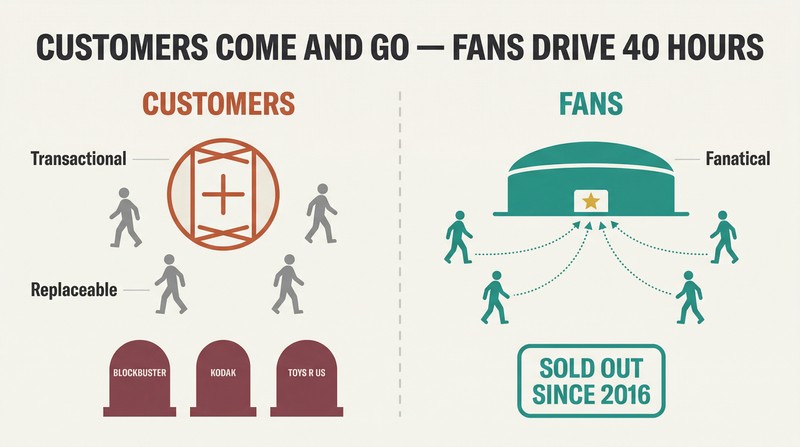
The Savannah Bananas shouldn't exist. A college summer baseball team playing in a century-old ballpark with zero corporate sponsors, no digital scoreboard, and a staff of former interns — yet every game has sold out since opening night in 2016, the ticket waitlist is thousands deep, and a family once drove forty hours from Utah during a pandemic to attend. ESPN calls them "the greatest show in baseball." Their social media following surpasses many MLB teams.
The secret is a mindset flip. Blockbuster, Kodak, and Toys "R" Us had millions of customers but failed to stay relevant. The Bananas built their entire operation around a single filter called the Fans First Way: for every decision, ask "Is this Fans First?" If not, don't do it. Fans don't just buy — they mold their beards into bananas, volunteer for a dad-bod cheerleading squad, and show up two hours early. That fanaticism is worth more than any transaction.
Treat your budget constraints as creative fuel, not excuses
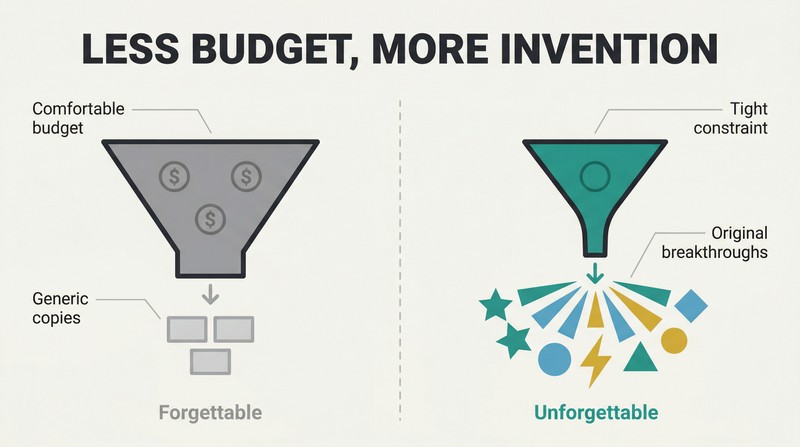
The Bananas almost died at birth. Three months before opening day, co-founder Jesse Cole got a call: the team was broke. He and his wife Emily sold their house, emptied their savings, and moved into a cockroach-infested duplex with an air mattress. Their "staff" was a 24-year-old president and three recent graduates working from a folding table in a stadium with no internet and ripped carpets.
Poverty became their edge. With zero marketing budget, they couldn't copy other teams — so they invented the Name the Team contest, created a senior citizen dance team, offered Barack Obama an internship, and built all-you-can-eat tickets. When their PA announcer missed a game, instead of hiring a replacement, they let a player introduce himself at bat with a microphone — the clip went viral on ESPN. Every constraint forced a creative answer they'd never have found with a comfortable budget.
Engineer 'you wouldn't believe' moments instead of buying ads
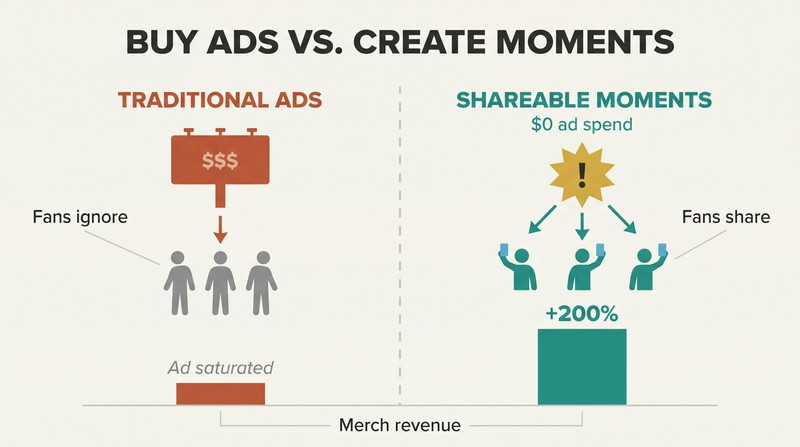
74% of consumers say word of mouth drives purchasing decisions, and 83% trust recommendations from friends over advertising. The Bananas spend zero dollars on traditional marketing. Instead, they create moments so outrageous fans can't help sharing — the break-dancing first base coach, a player delivering roses in the stands, a man with a banana-shaped beard. These "you wouldn't believe" moments become the ultimate marketing engine.
Going ad-free proved the model. When the Bananas removed every billboard, sponsor announcement, and corporate sign from their ballpark — giving the stadium "back to the fans" — critics predicted bankruptcy. Instead, merchandise sales jumped over 200%, more than replacing lost ad revenue. Not a single competitor has copied them. In an era of ad saturation, the absence of advertising became its own differentiation.
Every pay point is a pain point — audit and eliminate friction
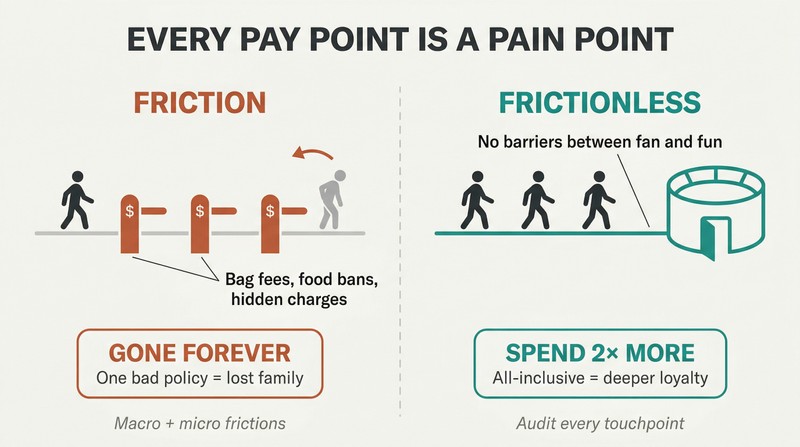
A family once sat on hot pavement eating Chick-fil-A because Cole's former ballpark banned outside food. They finished, stood up, walked to their car, and never came back. That one industry-standard policy destroyed a family of potential fans. Cole eliminated it the next day and later designed the Bananas' all-inclusive ticket: unlimited burgers, hot dogs, chicken, soda, and dessert — all included. Result? Bananas fans spend twice as much at the ballpark as fans at other stadiums.
Southwest Airlines proved the same principle. When competitors added bag fees during the 2008 recession, Southwest launched "Bags Fly Free" and added over $1 billion to their bottom line within a year. The Bananas distinguish between macrofrictions — big obvious pain points like boring baseball — and microfrictions — confusing website navigation, bad hold music, unclear parking signs. Both types destroy loyalty quietly.
Every touchpoint is a stage — even bathrooms and invoices
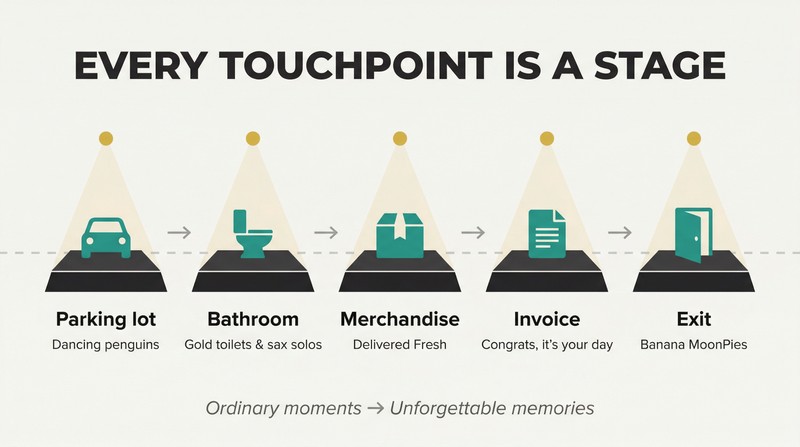
The Bananas script seven stages of entertainment, from the parking lot (staffed by dancing "parking penguins") to the last impression (banana MoonPies at the exit). Bathrooms feature gold toilets, a working banana phone, and surprise saxophone solos from the stall next door. Merchandise arrives in yellow boxes stamped "Delivered Fresh" with yellow tissue paper, personalized notes, and free extras. Their invoices read: "Congrats. This is your day, the day you've been waiting for. Today's the day you get to pay."
Magic Castle Hotel in Hollywood proves small businesses can do this too. Despite having no elevator, gym, or restaurant, it maintains 90%+ occupancy. The secret: a red poolside phone that delivers free popsicles on demand, a free snack bar, and free laundry. Guests don't notice what's missing — they talk about what surprised them.
Run four new experiments every single game night
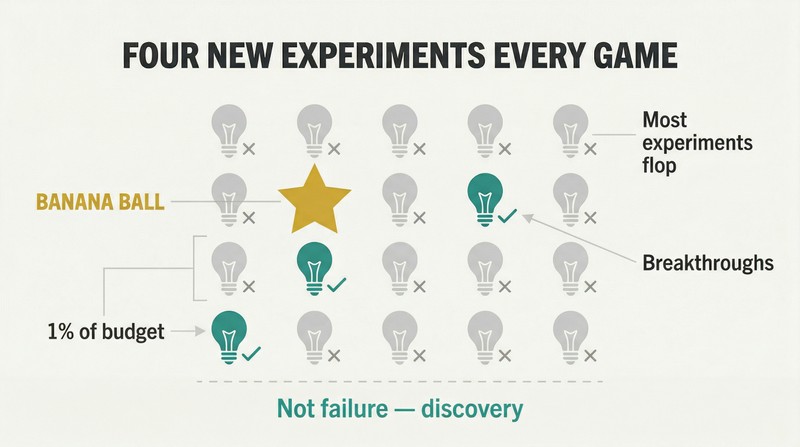
The Bananas commit to at least four new promotions per game — pregame, in-game, a new batting entrance, and a new scoring celebration. Most flop. A horse-race promotion left Cole chasing horse-masked children who couldn't see or hear. The inaugural bagpipe halftime show was painfully awkward. Neither mattered — Reggie Jackson holds the career strikeout record and is remembered only for his home runs.
This relentless experimentation produced Banana Ball — a reinvented version of baseball with nine new rules, including no bunting, batters stealing first, fans catching foul balls for outs, and a two-hour time limit. Games finish in 99 minutes. The Wall Street Journal and Boston Globe covered it. The Bananas allocate 1% of their budget specifically for experiments and give awards for best experiment of the year. As Cole puts it, eliminate the word "failure" from your vocabulary — replace it with "discovery."
Invest in one fan's story — they'll tell it to thousands
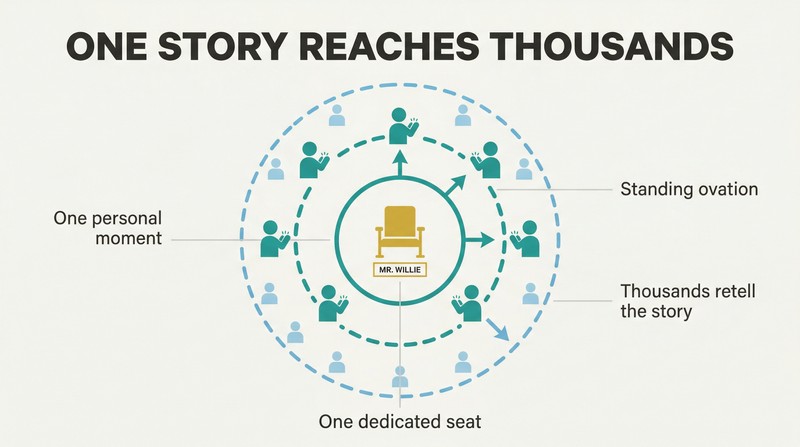
Mr. Willie first attended Grayson Stadium in the 1940s — sitting in the segregated section. When age made the stairs to his favorite seat impossible, the Bananas created a dedicated seat with a nameplate. When his health worsened further, they moved him to the front row behind home plate. Opening night, the PA announced "Mr. Willie is here!" and the entire stadium gave him a standing ovation. A man born in the segregated South now had the best seat in the house.
The Bananas track these moments nightly using their Three Ms framework — moment, matter, meaning. Notice what matters to someone, then create a meaningful moment around it. A military dad surprised his children through the player tunnel. A grieving fiancée received a signed ball from every player. Coach Gillum's H3 rule — hug, high-five, or handshake — gives every player a script for connection from day one.
When your team brings ideas, ask 'What do you think?'
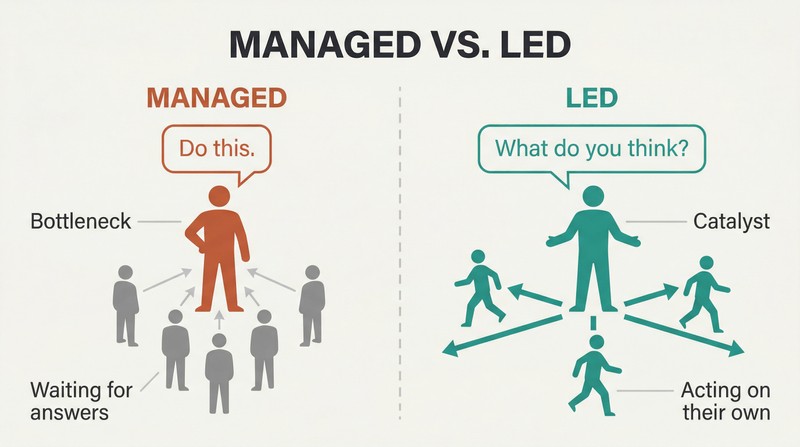
Cole's first mentor never answered his questions. When young GM Jesse Cole pitched midnight games, grandma beauty pageants, or FlatulenceFun Nights, team owner Ken Silver replied with one phrase: "What do you think?" Eventually Cole stopped asking permission and started deciding — which was the point. He now uses the identical question with his own team.
The result is autonomous creativity at every level. Intern Berry Aldridge learned a ticket-buying family had just lost their mother, planned an entire VIP night on his own — reserved front-row seats, autographed bats, a jersey with the wife's name — without asking anyone. Intern Laura walked a fan a mile home in a rainstorm without permission. A ticket coordinator put buttcheeks on game tickets because "a Banana with butt cheeks is objectively hilarious." When your North Star is clear, people don't need approval. They need permission to act.
Spend 1% of top-line revenue surprising your team
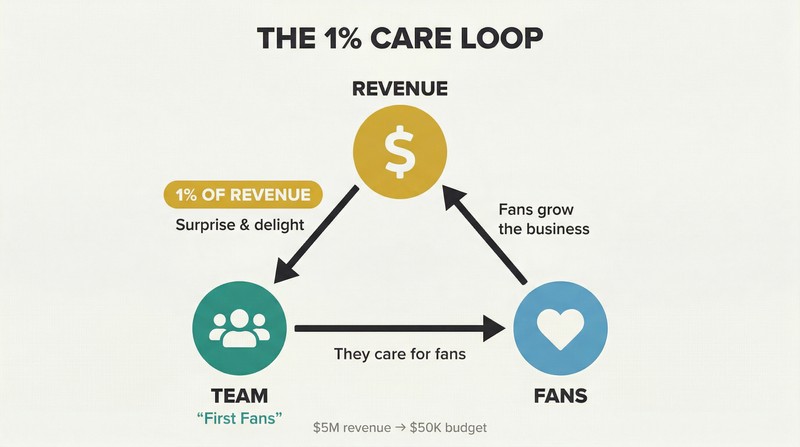
The Bananas call their employees "First Fans" and allocate 1% of top-line revenue — not profit — for Surprise and Delight moments. For a $5 million company, that's $50,000 built into the budget as fixed as rent. No permission needed, no other budgets raided.
The surprises are personal and extravagant. After their first profitable season — which began $1.8 million in debt — they took the entire staff on a cruise. They've done surprise $500 shopping sprees, COVID grocery deliveries with personalized poems, and a dream trip to Ireland for a key leader and her skeptical father. Maintenance worker Reginald was so beloved that players made him a dugout coach — and handed him the championship trophy. They write handwritten letters to parents of new hires and begin every meeting with specific peer shout-outs. No annual reviews; only quarterly check-ins focused on the person, not the performance. This practice is formalized as the One Percent Rule — a fixed budget line ensuring team appreciation is systematic rather than sporadic.
Always plus the experience — give more than fans paid for
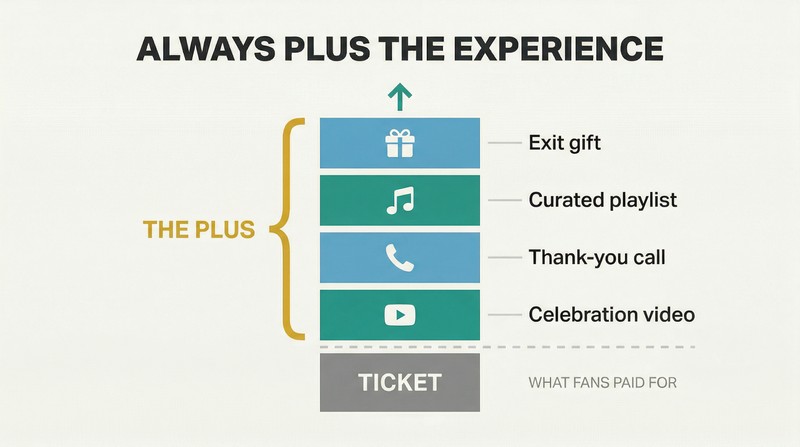
Walt Disney spent $350,000 on a Christmas parade when Disneyland was already at record attendance. His accountants protested. Walt replied: "We should do the parade precisely because no one is expecting it." Plussing means improving an experience beyond what fans paid for — making every touchpoint feel like a gift.
The Bananas plus relentlessly. Ticket buyers receive a celebration video, a thank-you call, and a curated pregame playlist for the drive to the ballpark. Fans leaving early get banana MoonPies at the exit: "We're over the moon you came out tonight!" A grocery bagger named Johnny added positive affirmations to each customer's bag; his checkout line became the longest in the store. Ask "what if?" at every touchpoint, and treat every day as if you're hosting someone for the very first time — because you probably are.
Analysis
Cole's Fans First occupies a distinctive position in the customer experience canon. Its intellectual lineage runs through Pine and Gilmore's Experience Economy, Disney's service philosophy, and Southwest Airlines' operational simplicity — all influences Cole openly acknowledges. What he contributes is a vivid mid-market proof of concept demonstrating that cult-like fandom doesn't require Disney's budget or Amazon's data infrastructure. A college summer baseball team in a century-old ballpark, staffed largely by interns, built a brand with millions of social media followers and a ticket waitlist thousands deep.
The Five Es framework is operationally useful if conceptually modest. Its real value lies in the specific, transferable tools embedded within: the Undercover Fan program for detecting invisible friction, the seven stages of entertainment for mapping customer touchpoints, and the One Percent Rule for systematizing team appreciation. The Banana Ball innovation — rewriting the literal rules of the game — demonstrates the difference between cosmetic experience design and structural reinvention of a product.
The book's most counterintuitive data point is the decision to eliminate all corporate sponsors and watch merchandise sales grow 200%. This challenges fundamental assumptions about revenue diversification and suggests that in saturated markets, the absence of advertising can itself become differentiation — a genuinely provocative claim for any business dependent on sponsorship revenue.
Cole's blindspot is survivorship bias. The book attributes success entirely to culture and creativity, underweighting Savannah's tourism economy, the novelty factor of a deliberately absurd brand in the age of viral TikTok content, and the inherent shareability of sports entertainment. His claim that 'anyone in any business' can replicate this model deserves scrutiny — a divorce attorney or industrial supplier faces fundamentally different emotional registers than a baseball team. Still, the psychological reframe from 'customers' to 'fans' changes every subsequent business decision. When you optimize for stories worth telling rather than transactions to complete, the economics tend to follow. That shift alone justifies the read.
People Also Read

Glossary
Fans First Way
Core fan-centered operating philosophyThe Savannah Bananas' guiding philosophy that filters every business decision through one question: 'Is this Fans First?' It encompasses the belief that creating fanatical fans—not transactional customers—should drive every touchpoint, policy, and innovation. When something isn't Fans First, the Bananas don't do it.
Five Es
Five operating principles for fandomThe Bananas' five-part framework for creating fans: Eliminate friction (remove pain points), Entertain always (every touchpoint is a stage), Experiment constantly (try new things relentlessly), Engage deeply (create individual human connections), and Empower action (give team and fans ownership). Each E represents a chapter of the team's operating playbook.
Banana Ball
Reinvented, faster version of baseballA new version of baseball invented by the Savannah Bananas with nine rule changes designed to make the game faster and more fan-friendly. Key rules include: no bunting, batters can steal first base, fans can catch foul balls for outs, no mound visits, a two-hour time limit, and every inning counts as its own contest worth one point. Games typically finish in 99 minutes.
Undercover Fan
Disguised employee experiencing as customerA friction-detection program where Bananas team members disguise themselves and attend games as regular fans, taking notes on pain points throughout the experience—parking, lines, food, sound levels, seating. Every team member rotates through this role. Observations are shared post-game and drive specific operational changes like adding shade, fixing potholes, or adjusting ticket wording.
First Fans
Employees as the priority fansThe Bananas' term for their own team members—staff, interns, and players. The concept reflects the belief that you cannot create external fans if your internal team isn't treated like fans first. Taking care of First Fans through recognition, empowerment, and appreciation is considered a prerequisite to delivering a great fan experience.
Plussing
Exceeding expectations at every touchpointA concept borrowed from Walt Disney meaning to give fans more than they paid for or expected. Plussing goes beyond incremental improvement—it's about mixing the familiar with the unexpected to create new memorable moments. Examples include thank-you calls for ticket purchases, banana MoonPies at the exit, and surprise fireworks shows. The question driving plussing is always 'What if?'
Three Ms
Engagement framework for fan momentsA framework for creating deep fan connections consisting of Moment, Matter, and Meaning. The process: notice what matters to the individual fan (their story, their needs, their situation), then create a meaningful moment around that observation. Used by the Bananas to guide nightly 'Fans First Moments'—specific experiences designed for individual fans.
Macrofrictions and Microfrictions
Big and small customer pain pointsTwo categories of friction in the fan experience. Macrofrictions are large, obvious pain points—like baseball being long and boring, or fans being nickel-and-dimed at concessions. Microfrictions are small, often invisible irritants—confusing website navigation, unclear signage, bad hold music, or poor email wording. Both types erode fan loyalty, but microfrictions are harder to detect without deliberate auditing such as the Undercover Fan program.
Ideapalooza
Offsite team brainstorming sessionsPeriodic brainstorming sessions where the entire Bananas team goes offsite (with alcohol) to generate ideas freely. All ideas are welcomed regardless of feasibility. Ideapaloozas were used during COVID-19 lockdowns to generate entertainment ideas for fans stuck at home, producing music video parodies and a live cooking show series. The format prioritizes volume of ideas over immediate quality.
One Percent Rule
Budget allocation for team appreciationThe Bananas' practice of allocating 1% of top-line revenue specifically for Surprise and Delight moments for their team. This money is budgeted as a fixed line item, not discretionary spending, so no permission is needed to use it. It funds gifts ranging from staff cruises and shopping sprees to personalized dream trips, ensuring team appreciation is systematic rather than sporadic.
'You wouldn't believe' moments
Shareable, remarkable fan experiencesThe Bananas' term for experiences so outrageous, surprising, or emotionally powerful that fans are compelled to share them with others using the phrase 'you wouldn't believe...' These moments serve as the primary marketing engine, replacing traditional advertising entirely. The Bananas aim to create multiple 'you wouldn't believe' moments every game night, driving word-of-mouth that reaches far beyond the stadium.
FAQ
1. What is "Fans First: Change The Game, Break the Rules & Create an Unforgettable Experience" by Jesse Cole about?
- Fans First Philosophy: The book details Jesse Cole’s journey building the Savannah Bananas baseball team using a “Fans First” philosophy, where every decision is made to prioritize the fan experience above all else.
- Business Reinvention: It’s a guide for businesses and leaders on how to stand out by breaking industry norms, creating unforgettable experiences, and fostering deep loyalty.
- Real-World Examples: Cole shares stories from the Bananas and other companies, illustrating how putting fans (or customers) first leads to remarkable growth and word-of-mouth success.
- Actionable Framework: The book introduces the “Five Es” (Eliminate Friction, Entertain Always, Experiment Constantly, Engage Deeply, Empower Action) as a practical framework for transforming any organization.
2. Why should I read "Fans First" by Jesse Cole?
- Applicable to Any Industry: The lessons go beyond baseball, offering strategies for any business or leader who wants to create loyal fans, not just customers.
- Proven Results: The Savannah Bananas’ success—sold-out games, viral moments, and a global fanbase—demonstrates the effectiveness of the Fans First approach.
- Inspiring and Entertaining: Cole’s storytelling is energetic, humorous, and filled with memorable anecdotes, making the book both fun and motivating to read.
- Practical Takeaways: Readers get actionable steps and real examples to implement in their own organizations, regardless of size or sector.
3. What are the key takeaways from "Fans First" by Jesse Cole?
- Fans Over Customers: Stop chasing customers and start creating fans by focusing on memorable, joyful experiences.
- Break the Rules: Success comes from challenging industry norms and daring to be different, even if it means facing criticism.
- Five Es Framework: Use the Five Es—Eliminate Friction, Entertain Always, Experiment Constantly, Engage Deeply, Empower Action—to guide every business decision.
- Fanaticism is Good: Become a fanatic about your mission and let that energy infect your team and your fans.
- Stories Drive Growth: Word-of-mouth and storytelling are more powerful than traditional marketing for building lasting loyalty.
4. What is the "Fans First" philosophy described by Jesse Cole?
- Fans First Defined: It’s a mindset where every decision is filtered through the question, “Is this Fans First?”—if not, it’s not done.
- Long-Term Focus: The philosophy prioritizes creating lifelong fans over short-term profits, believing that loyalty leads to sustainable growth.
- Inclusive Approach: Fans First applies to everyone touched by the business—customers, employees, partners, and even the community.
- Joy and Fun: At its core, Fans First is about delivering joy, fun, and unforgettable moments at every touchpoint.
5. What are the "Five Es" in "Fans First" and how do they work?
- Eliminate Friction: Remove obstacles and pain points from the customer journey, making every interaction easy and enjoyable.
- Entertain Always: Treat every moment as a stage to surprise, delight, and amuse your fans, even in unexpected places (like bathrooms or invoices).
- Experiment Constantly: Foster a culture where trying new things, learning from failures, and rapid iteration are encouraged and rewarded.
- Engage Deeply: Build genuine, personal connections with fans and team members, making them feel seen, heard, and valued.
- Empower Action: Give your team and your fans the freedom and encouragement to contribute ideas, take risks, and co-create the experience.
6. How did Jesse Cole and the Savannah Bananas apply the "Fans First" method in practice?
- All-Inclusive Tickets: They introduced all-you-can-eat tickets, eliminating nickel-and-diming and making the value clear upfront.
- Unique Entertainment: Every game is a show, with break-dancing coaches, dad-bod cheerleaders, and wild promotions that go beyond baseball.
- Fan Involvement: Fans help choose the team name, mascot, merchandise designs, and even influence in-game decisions.
- No Ads Policy: The Bananas removed all ballpark advertising to focus entirely on the fan experience, even at the cost of short-term revenue.
- Continuous Experimentation: The team constantly tests new ideas, from Banana Ball rules to quirky halftime shows, learning and iterating quickly.
7. What is "Banana Ball" and how does it reflect the Fans First philosophy?
- Rule-Breaking Baseball: Banana Ball is a new version of baseball with nine unique rules designed to make the game faster, more exciting, and more interactive.
- Fan Participation: Fans can catch foul balls for outs, and every inning counts, keeping the energy high and fans engaged throughout.
- Shorter, More Fun Games: With a two-hour time limit and no mound visits, the pace is quick and there’s never a dull moment.
- Entertainment Over Tradition: The rules are designed to maximize fun and eliminate the “long, slow, boring” aspects of traditional baseball.
8. How can businesses in other industries implement the Fans First approach from Jesse Cole's book?
- Audit Friction Points: Identify and remove pain points in your customer journey, from confusing websites to hidden fees.
- Script and Surprise: Map out every stage of your customer experience and look for ways to add delight, humor, or surprise.
- Encourage Team Ideas: Empower employees at all levels to suggest and implement new ways to serve and entertain customers.
- Make Fans the Stars: Find ways to involve customers in your brand story, celebrate them, and let them co-create the experience.
- Measure What Matters: Focus on metrics that reflect fan engagement and loyalty, not just sales or profit.
9. What are some of the most memorable "Fans First" moments or stories from the book?
- Opening Night Chaos: Despite rain, food delays, and a losing game, the Bananas created joy by dancing in the rain and connecting with fans.
- Fan-Led Promotions: From a grandma beauty pageant to a professional high-fiver, fans and staff are empowered to create unforgettable moments.
- Personal Touches: Handwritten thank-you notes, surprise gifts, and personalized merchandise packaging make fans feel special.
- Community Impact: Stories like Mr. Willie’s reserved seat and the Nunn family’s special game night show the deep, personal connections built.
10. What are the best quotes from "Fans First" by Jesse Cole and what do they mean?
- “Whatever’s normal, do the exact opposite.” – Encourages breaking industry norms to stand out and create memorable experiences.
- “Fans First, Entertain Always.” – The guiding mantra that puts fan joy and entertainment at the center of every decision.
- “You can’t create fans until you are a fan of what you do.” – Reminds leaders to cultivate their own passion and energy first.
- “Long-term fans beat short-term profit.” – Emphasizes the value of loyalty and relationships over immediate financial gain.
- “Do for one what you wish you could do for many.” – Highlights the power of creating special moments for individuals, which ripple out to the larger community.
11. How does "Fans First" by Jesse Cole address building and empowering teams?
- First Fans Are Employees: The book stresses that employees are your “First Fans” and must be treated with the same care and excitement as customers.
- No Policies, Just Mindset: The Bananas eliminate rigid policies and annual reviews, focusing instead on trust, recognition, and personal growth.
- Onboarding as Celebration: New hires are welcomed with parties, costumes, and personalized attention to make them feel valued from day one.
- Empowerment and Ownership: Team members are encouraged to take initiative, experiment, and even leave for better opportunities if it serves their growth.
- Recognition and Care: Regular shoutouts, handwritten notes to parents, and surprise gifts foster a culture of appreciation and loyalty.
12. What is the long-term impact and legacy Jesse Cole envisions with the Fans First movement?
- Changing Business Culture: Cole hopes to inspire a global shift where companies prioritize fans and employees, not just profits or shareholders.
- Creating Contagious Stories: The goal is to spark a movement where unforgettable experiences and stories are the main drivers of growth and reputation.
- Sustainable Success: By focusing on joy, experimentation, and deep connection, organizations can thrive for generations, not just quarters.
- Personal Fulfillment: Ultimately, the Fans First movement is about finding passion, making a difference, and leaving a legacy of happiness and belonging for fans, teams, and communities.
Download PDF
Download EPUB
.epub digital book format is ideal for reading ebooks on phones, tablets, and e-readers.








































