


Key Takeaways
Codependence is a childhood wound, not just clinging to an addict
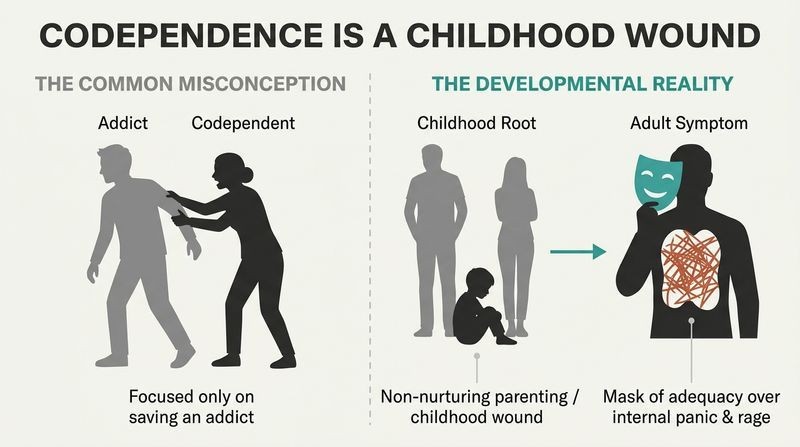
The disease predates the addict. Therapists first spotted codependence in the spouses and children of alcoholics, drowning in shame, fear, pain, and anger while compulsively trying to fix the addict. But something strange happened: when the alcoholic got sober, the family often stayed sick, sometimes even sabotaging the recovery. Mellody's radical claim is that codependence exists on its own, in millions of families with no addict at all.
The real root is less-than-nurturing parenting. She defines abuse broadly as any childhood experience (birth to seventeen) that falls short of nurturing. The codependent arrives in adulthood with feelings wildly out of proportion to events: panic instead of fear, rage instead of irritation, or total numbness. They wear a mask of adequacy while feeling crazy inside.
Mellody's reframing anticipated the modern trauma-informed movement by decades, echoing what Bessel van der Kolk later documented in The Body Keeps the Score: adult symptoms are encoded childhood adaptations. What's striking is her insistence that codependence can be lethal, showing up on death certificates as suicide, accidents, or stress-related illness rather than by name. A fair critique: her expansive definition of abuse risks pathologizing ordinary imperfect parenting, and her clinical, non-research framework (drawn from patients at one Arizona treatment center) means these are field observations, not controlled findings. Still, the shift from blaming the sufferer to examining their formative environment remains genuinely liberating.
Five broken capacities form the anatomy of codependence
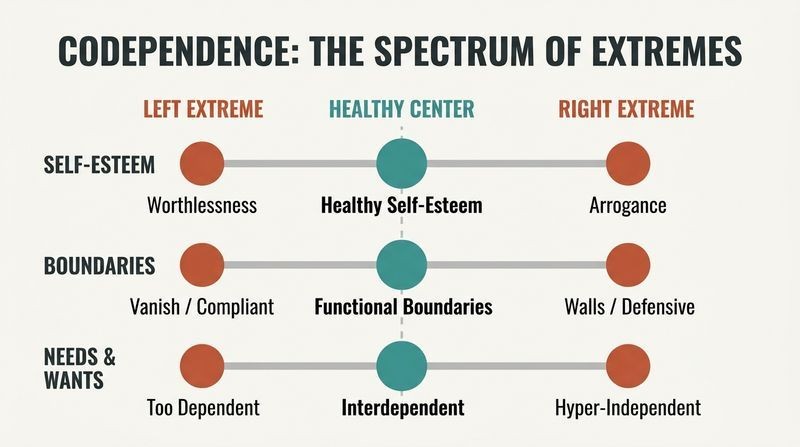
One disease, five failure points. Rather than cataloging endless symptoms, Mellody organizes codependence around five core difficulties an adult carries:
1. Experiencing healthy self-esteem
2. Setting functional boundaries
3. Owning and expressing your own reality
4. Identifying and meeting your adult needs and wants
5. Experiencing and expressing reality with moderation
Each symptom swings to two opposite extremes. Self-esteem collapses into worthlessness or inflates into arrogance. Boundaries vanish entirely or harden into walls. You become too dependent or fiercely self-sufficient. You live in chaos or rigid control. This two-poles structure is the book's diagnostic engine: functional behavior sits near the center, and either extreme signals the disease. The most important relationship, she argues, is with yourself, because repairing it automatically makes relationships with others less dysfunctional.
The bipolar framing (every trait has a collapse pole and an overcompensation pole) is clinically shrewd because it captures people who look nothing alike. The arrogant, invulnerable, hyper-controlling executive and the timid, boundaryless doormat share one disease. This resonates with Aristotle's doctrine of the mean, where virtue lives between deficiency and excess, and with attachment theory's anxious versus avoidant styles. The framework's weakness is falsifiability: if both extremes and everything between them can indicate codependence, what does not? Mellody's answer, moderation felt from within, is intuitively right but hard to measure, which is precisely why academic psychology long resisted the concept.
Build self-esteem from within or stay hostage to otheresteem
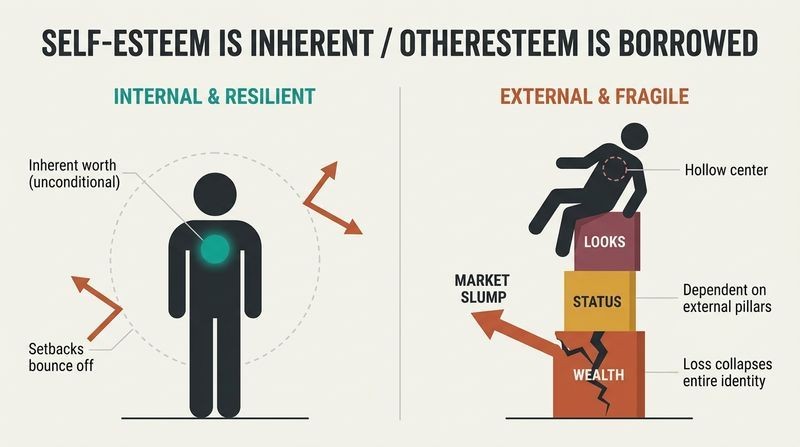
Preciousness is inherited, not earned. Healthy self-esteem, in Mellody's telling, is the felt sense of your own value that survives mistakes, rejection, a bad haircut, or bankruptcy. Children absorb it from caregivers who treat them as worthy simply for existing, not for performing. When parents send less-than messages, the child cannot generate worth from inside as an adult.
Otheresteem is the fragile counterfeit. She coins otheresteem for worth borrowed from external sources: money, looks, job titles, a powerful spouse, high-achieving kids. Frank, a wealthy architect, collapsed into suicidal depression when a market slump erased his fortune, because his esteem lived entirely in his bank account. James, still rich, was worse off: his money masked the same emptiness so completely he could not even see the problem. External esteem can be revoked at any moment.
The distinction maps neatly onto self-determination theory (Deci and Ryan), which separates intrinsic worth from contingent self-worth, the latter reliably linked to anxiety and fragile motivation. Mellody's clinical intuition also foreshadows research on narcissism showing grandiosity as a defense against underlying shame rather than genuine high esteem. Her sharpest insight is that success can be a trap: the person whose otheresteem still works has no incentive to heal. One caution: the line between healthy pride in accomplishment and otheresteem is blurrier than she suggests. Deriving genuine satisfaction from mastery and contribution is psychologically healthy, not merely a fragile prop.
You need two boundaries: one to protect, one to own responsibility
Boundaries are invisible fences with two layers. The external boundary controls physical and sexual distance and touch: who gets close, who may touch you, and your care not to invade others. The internal boundary governs thinking, feelings, and behavior: it lets you own yours and stop absorbing responsibility for everyone else's.
Four ways boundaries break. Mellody describes:
1. Nonexistent boundaries (no protection, and no sense others have them)
2. Damaged boundaries (holes: fine except with authority figures, or when tired)
3. Walls instead of boundaries (anger, fear, silence, or words that block all intimacy)
4. Swinging between walls and nothing
Charlotte snapping that her roommate makes her angry by wearing a bathrobe shows collapsed internal boundaries: she blames another for her own feeling. Walls protect completely but guarantee loneliness.
The two-boundary model is unusually precise for self-help, separating the right to protect yourself from the duty to stop controlling others, two failures people rarely see as connected. It parallels Murray Bowen's concept of differentiation of self: the capacity to stay emotionally connected without fusing. The walls insight is especially useful; anger and withdrawal feel like strength but function as isolation. What Mellody underplays is cultural variation. Boundary norms around touch, privacy, and family enmeshment differ across cultures, so what reads as damaged boundaries in one context may be healthy interdependence in another. The framework works best as a personal diagnostic, not a universal yardstick.
Knowing your own reality means owning body, thoughts, feelings, and behavior
Reality has four components. Mellody defines your reality as your body (how you look and function), your thinking (how you interpret data), your feelings (emotions), and your behavior (what you do or fail to do). Codependents complain they don't know who they are, which she traces to being unable to experience these four honestly.
Two levels of disconnection. At Level A you know your reality but hide it, fearing you're unacceptable. At Level B, the deeper delusion, you genuinely don't know it. An anorexic woman at eighty pounds sees fat in the mirror; a 265-pound man sincerely believes he is robust. Children learn this by having their perceptions denied, like eight-year-old Molly told the terrifying fight she witnessed was a normal, harmless argument, until she concludes she must be crazy.
The Molly example is essentially a description of gaslighting before the term entered popular usage, and it illuminates why it damages so deeply: when caregivers systematically override a child's perception, the child sacrifices trust in reality itself to preserve the belief that parents are good. This connects to research on epistemic trust in developmental psychology, the child's confidence that their read on the world is valid. Level B, the loss of access to one's own emotions, closely resembles alexithymia, a measurable trait linked to trauma and psychosomatic illness. Mellody's claim that a floating-head, disembodied feeling often signals buried sexual abuse is provocative and clinically plausible, though it should be held as a flag for exploration, never proof.
Learn to name needs and ask, because both extremes leave you empty
Needs are survival; wants are joy. Mellody separates dependency needs (food, shelter, clothing, medical care, physical and emotional nurturing, sex, money) from wants (preferences that bring joy). Mature adults are interdependent: they know their needs, meet what they can, and ask safe people for help with the rest.
Four dysfunctional patterns. Codependents fall into one or more:
1. Too dependent (know needs, wait for others to meet them)
2. Antidependent (would rather go without than ask)
3. Needless and wantless (unaware needs even exist)
4. Confusing needs with wants (buying clothes while starving for a hug)
Mellody confesses she once went thirty-six hours without eating, fainting at work, genuinely unaware she needed food. She picked fights with her husband nightly because she couldn't recognize she simply wanted a hug.
The hug confession is quietly profound: unmet, unnamed needs don't disappear, they leak out sideways as conflict, manipulation, or addiction. This aligns with Marshall Rosenberg's Nonviolent Communication, which argues that anger is almost always an unmet need wearing a mask. The confusing-needs-with-wants pattern offers a sharp lens on consumer culture and behavioral addiction: shopping, gambling, and overeating often substitute for emotional nurturing that the person cannot even feel themselves craving. The antidependent pattern deserves special attention because our culture celebrates it as admirable self-reliance, which means the people most praised for independence may be the most quietly starved.
Recovery feels like overcorrecting, but moderation is the actual goal
Codependents have no rheostat. The most visible symptom, Mellody says, is the inability to be moderate. They are totally involved or totally detached, ecstatic or miserable, trusting everyone or no one. A moderate response never feels like enough; only too much feels like enough. Her husband literally discounted everything she said by thirty percent to compensate for her overselling.
The opposite of dysfunction is more dysfunction. She rejects the word normal, because much of what our culture calls normal is unhealthy, and preferring functional. When a person raised by explosive parents becomes a parent who won't discipline at all, they've swung to the opposite extreme, which is not recovery. Functional behavior sits near the center. Her breakthrough came when she counted the household lights, divided by three, and decided that number was moderate for her.
The lights anecdote is disarmingly honest about how alien moderation feels to someone who has never experienced it: she had to compute the middle mathematically because she couldn't feel it. This captures a crucial recovery paradox echoed across therapy traditions, that health initially feels wrong precisely because dysfunction feels familiar. Dialectical Behavior Therapy makes the same point with its wise mind between emotion mind and reasoning mind. Mellody's rejection of normal in favor of functional is more than semantics; it inoculates against the trap of measuring yourself against a dysfunctional majority. The risk is that centrism can be its own dogma. Sometimes intensity, passion, or a hard boundary is the genuinely functional response.
A shame core installed in childhood drives the whole disease
Feelings get induced, then carried. Mellody's central mechanism: when a shame-filled parent abuses a child while denying their own feelings, those feelings transfer into the child like current jumping between two coils. The child absorbs the parent's shame, rage, fear, and pain and carries them into adulthood, where they resurface as overwhelming reactions to ordinary events.
Carried feelings are always overwhelming. Healthy anger energizes; carried anger becomes rage. Healthy fear protects; carried fear becomes panic. Healthy shame whispers you're human and fallible; carried shame screams you're worthless. This shame core is the generator that powers all five symptoms and passes the disease down the generations. A child with two shame-based parents inherits a double dose, which is why Mellody believes each generation grows more anxious than the last.
The distinction between healthy and toxic shame is Mellody's most enduring contribution, later popularized by John Bradshaw and validated by affect researchers who link chronic shame (I am bad) rather than guilt (I did something bad) to depression, addiction, and aggression. The intergenerational transmission claim now has biological support: research on epigenetics and on the ACE (Adverse Childhood Experiences) study documents how trauma effects cascade across generations. Her electrical-induction metaphor is poetic rather than mechanistic, and the notion that a child absorbs a parent's specific emotion has no direct empirical proof. But as a clinical description of how children internalize a caregiver's disowned emotional state, it rings remarkably true.
Abuse includes the covert and the empowering, not just beatings
Two axes most people miss. Abuse can be overt (visible, like hitting) or covert (hidden, like a mother withdrawing love unless obeyed). It can also be disempowering (shaming a child into feeling less-than) or empowering, teaching a child they are superior, above the rules, better than a parent. Empowering abuse produces adults who offend and exploit others, and Mellody calls it especially hard to treat because the person feels no shame to work with.
Emotional sexual abuse needs no touch. When a parent makes a child, rather than the spouse, their primary emotional companion, drawing the child up through the boundary into the marriage, the child is abused. The Daddy's little girl who's told she's more fun than Mom later measures every man against her father and cannot grow up.
Naming empowering abuse fills a real blind spot. Most abuse frameworks assume the victim is made to feel small, but Mellody identifies the entitled, grandiose adult as equally a product of childhood distortion, which reframes some offenders as wounded rather than simply evil, without excusing them. Her concept of emotional incest (covert enmeshment with no sexual contact) is now well established in family-systems literature under terms like parentification and spousification. The insistence that intention is irrelevant to whether harm occurred is bracing and correct from the child's experience, though it can feel harsh to well-meaning parents. The point is diagnostic honesty about impact, not moral condemnation.
Hug your demons: face your history or repeat it forever
Denial is the enemy of recovery. Mellody's blunt motto is that if you don't embrace what's dysfunctional in your past, you're doomed to repeat it. Defense mechanisms that once saved a child, repression, suppression, dissociation, minimization, denial, and delusion, calcify into barricades that hide the adult disease. Body memories (sudden unexplained physical sensations) and feeling memories (waves of panic or shame from nowhere) are doorways back to buried truth.
Recovery is remission, not cure. She compares it to managing diabetes: follow the program and you thrive; assume you're cured and you relapse. The path she prescribes: a written inventory of the five symptoms, a Twelve-Step group like Codependents Anonymous, a same-sex sponsor who nurtures and confronts, and holding caregivers accountable without blaming, because blame keeps you handcuffed to the offender.
The accountability-versus-blame distinction is the ethical core of the recovery model and preempts a common criticism that trauma work breeds victimhood. Blame, Mellody argues, cedes power to the offender and freezes you; accountability restores agency regardless of whether the offender ever changes. This mirrors the locus-of-control research in psychology, where internal agency predicts resilience. Her caution against retrieving dissociated memories with untrained friends is prescient given the recovered-memory controversies that erupted in the 1990s, when suggestive techniques produced false memories and shattered families. The framework's limitation is its heavy reliance on the Twelve-Step model, which works powerfully for some but not all; contemporary options like EMDR and somatic therapies extend her map.
Analysis
Facing Codependence occupies a strange and important place in the self-help canon. Pia Mellody built it not from academic research but from the cauldron of her own breakdown and thousands of patient interviews at The Meadows, a fact she states proudly and that constitutes both its power and its vulnerability. The book's appendix candidly admits that mainstream psychology had barely engaged the concept by 1989, tracing thin threads back to Karen Horney's morbid dependency and Theodore Millon's dependent personality. This is grassroots clinical theory, and it should be read as a working practitioner's map rather than validated science.
What makes the book endure is its architecture. By collapsing a sprawling symptom list into five core capacities, each with two opposite poles, Mellody produced a diagnostic tool flexible enough to capture both the doormat and the tyrant as sufferers of one disease. Her most original contributions, the split between self-esteem and otheresteem, healthy shame versus a carried shame core, and covert and empowering forms of abuse, have quietly seeped into the broader trauma and recovery vocabulary, often uncredited.
The intellectual risks are real. The expansive definition of abuse as anything less than nurturing can pathologize normal parental fallibility, and the two-extremes framework borders on unfalsifiable. Her feeling-induction mechanism is metaphor dressed as physics. Yet on the central questions, contemporary science has largely vindicated her: the ACE study links childhood adversity to adult disease, affect researchers confirm toxic shame's distinct destructiveness, and attachment and family-systems theory corroborate emotional enmeshment and intergenerational transmission.
Read today, the book's deepest gift is its stance toward the reader: you are not crazy, your reactions have a history, and that history is knowable and workable. The insistence on accountability without blame threads a genuinely wise needle, honoring both the reality of harm and the necessity of adult agency. It remains a compassionate, unsettling, structurally elegant field guide to a wound most people carry without a name.
Review Summary
Facing Codependence by Pia Mellody receives mixed reviews. Many readers find it insightful for understanding codependency, childhood trauma, and dysfunctional family dynamics. The book's strengths include its thorough explanation of codependency symptoms and their origins. However, some criticize its broad definition of abuse, lack of practical recovery strategies, and occasional heteronormative language. While many appreciate the book's personal anecdotes and relatable examples, others find the writing style repetitive or poorly edited. Despite these criticisms, many readers consider it a valuable resource for self-reflection and healing.
People Also Read









Glossary
Codependence
Disease from less-than-nurturing childhoodMellody's redefinition of codependence as a distinct disease caused by less-than-nurturing or abusive childhood parenting, not merely dependency on an addict. It manifests as an immature adult unable to esteem themselves, set boundaries, own their reality, meet their needs, or act moderately, and it can exist even in families with no addiction present.
Otheresteem
Worth borrowed from external sourcesMellody's coined term for the counterfeit self-worth codependents derive from things outside themselves: money, appearance, job status, a powerful spouse, or children's achievements. Because its source is external and can vanish at any time, otheresteem is fragile and undependable, unlike genuine self-esteem, which is felt from within regardless of circumstances.
Shame core
Internalized carried shame from abuseThe reservoir of induced shame a child absorbs from shame-based caregivers during abuse. It constantly signals to the person that they are less-than or worthless, forming the heart of codependence, powering all five core symptoms, and driving the disease from one generation to the next.
Carried (induced) feelings
Absorbed emotions from abusive caregiverEmotions (shame, rage, fear, pain) transferred into a child during abuse when a caregiver denies or is irresponsible with their own feelings. Carried feelings are always overwhelming, unlike a person's own healthy feelings, and resurface in adulthood as reactions wildly out of proportion to present events.
External and internal boundaries
Two protective invisible fencesMellody's boundary model. The external boundary controls physical and sexual distance and touch, protecting the body. The internal boundary governs thinking, feelings, and behavior, letting a person take responsibility for their own reality while stopping the absorption of, or blame for, others' realities.
Level A and Level B
Degrees of disconnection from realityTwo levels of difficulty owning one's reality. At Level A a person knows their reality (body, thoughts, feelings, behavior) but hides it for fear of being unacceptable. At the more dysfunctional Level B, the person genuinely does not know their reality and lives in delusion, like an anorexic seeing fat in the mirror.
Empowering abuse
Teaching a child false superiorityAbuse that teaches children they are better than others, above the rules, or more valuable than a parent, giving a false sense of superiority. It produces arrogant, entitled adults who offend and exploit others and who often feel no shame, making them especially difficult to treat.
Emotional sexual abuse
Child as parent's emotional partnerA nonphysical abuse in which a parent makes a child, rather than the spouse, their primary emotional companion, drawing the child into the intimate world between the parents. Even without any sexual contact, it damages the child's sexual identity, affections, and adult relationships (for example, the Daddy's little girl dynamic).
Perfectly imperfect
Accepting human fallibility as normalMellody's phrase for the healthy stance of accepting that humans are meant to be imperfect. Embracing one's fallibility and sharing it with others opens the door to spirituality, humility, and connection with a Higher Power, whereas believing one must be perfect blocks all three.
FAQ
What is Facing Codependence by Pia Mellody about?
- Explores codependence origins: The book examines what codependence is, tracing its roots to childhood abuse and dysfunctional family systems.
- Describes symptoms and impact: It details the five core symptoms of codependence and how they sabotage adult relationships and self-esteem.
- Focuses on recovery: Mellody offers a practical model for recognizing, understanding, and recovering from codependence, drawing on clinical experience and personal insight.
Why should I read Facing Codependence by Pia Mellody?
- Uncovers hidden patterns: The book helps readers identify codependent behaviors that often go unrecognized but deeply affect health, relationships, and self-worth.
- Links childhood to adulthood: It provides clarity on how less-than-nurturing or abusive childhood experiences shape adult emotional pain and dysfunctional behaviors.
- Offers hope and guidance: Mellody shares therapeutic strategies and recovery stories, encouraging readers to face their codependence and begin healing.
What are the key takeaways from Facing Codependence by Pia Mellody?
- Codependence is widespread: Many people suffer from codependence due to dysfunctional family systems, often without realizing it.
- Five core symptoms: The book identifies low self-esteem, impaired boundaries, trouble owning reality, difficulty meeting needs, and extremes in behavior as central to codependence.
- Recovery is possible: Facing one’s history, embracing imperfection, and engaging in structured recovery processes can break the cycle of codependence.
What are the five core symptoms of codependence according to Pia Mellody in Facing Codependence?
- Low or nonexistent self-esteem: Codependents base their worth on external validation, leading to feelings of shame or grandiosity.
- Difficulty setting functional boundaries: They struggle with either nonexistent or overly rigid boundaries, making them vulnerable or controlling.
- Trouble owning and expressing reality: Codependents often deny or distort their feelings, thoughts, and behaviors, hindering authenticity.
- Difficulty meeting needs and wants: They may neglect their own needs, become overly dependent, or confuse needs with wants.
- Operating in extremes: Codependents tend to live in emotional, behavioral, or cognitive extremes, lacking moderation.
How does Pia Mellody define codependence in Facing Codependence?
- A disease of relationships: Codependence is described as a disease rooted in dysfunctional family systems and childhood trauma.
- Characterized by core symptoms: It manifests through impaired self-esteem, boundaries, reality, needs, and moderation.
- Perpetuated by shame: The “shame core” from childhood abuse drives codependent thinking, feeling, and behavior throughout life.
How does Facing Codependence by Pia Mellody explain the origins of codependence?
- Dysfunctional family systems: Codependence originates from less-than-nurturing or abusive parenting, including physical, sexual, emotional, intellectual, or spiritual abuse or neglect.
- Cultural norms as contributors: The book highlights that many accepted parenting practices are actually abusive or neglectful, impairing healthy development.
- Internalized shame and pain: Children absorb overwhelming feelings from caregivers, creating a “shame core” that underlies codependence.
What types of abuse are discussed in Facing Codependence by Pia Mellody, and how are they defined?
- Physical abuse: Includes overt acts like beating or neglect of physical needs, as well as inappropriate physical nurturing.
- Sexual abuse: Encompasses physical acts (incest, molestation), nonphysical abuse (voyeurism, exhibitionism), and emotional sexual abuse.
- Emotional, intellectual, and spiritual abuse: Covers verbal attacks, ridicule, neglect of emotional needs, suppression of thinking, and misuse of religion or spiritual authority.
What is the significance of the “shame core” in Facing Codependence by Pia Mellody?
- Central emotional wound: The shame core is the foundational wound from childhood abuse, causing feelings of being “less than.”
- Drives codependent behaviors: It perpetuates low self-esteem, isolation, and dysfunctional relationships.
- Transmitted generationally: The shame core is often unconsciously passed from parents to children, continuing the cycle of codependence.
How does Facing Codependence by Pia Mellody describe the role of boundaries in codependence?
- Boundaries as protection: Boundaries are invisible “fences” that protect physical, emotional, intellectual, and spiritual space.
- Types of impairment: Codependents may have nonexistent, damaged, or overly rigid boundaries, or fluctuate between these extremes.
- Impact on relationships: Impaired boundaries lead to vulnerability to abuse, difficulty respecting others, and dysfunctional relationships.
How does Facing Codependence by Pia Mellody explain the impact of codependence on adult relationships?
- Negative control dynamics: Codependents may try to control others or allow themselves to be controlled, leading to manipulation and resentment.
- Resentment and punishment: Holding onto anger and a need to punish isolates codependents and damages relationships.
- Impaired intimacy: Difficulty with boundaries, self-esteem, and emotional expression blocks true intimacy and trust.
What practical recovery advice does Pia Mellody offer in Facing Codependence?
- Face the disease honestly: Recovery starts with recognizing and admitting codependent symptoms and embracing one’s history.
- Behavioral experiments: Mellody suggests trying new behaviors and learning through experience and feedback in supportive environments.
- Use support systems: Engaging in Twelve-Step programs, finding a sponsor, and possibly working with a therapist are recommended for ongoing recovery.
How does Facing Codependence by Pia Mellody describe the impact of codependence on parenting and generational cycles?
- Impaired self-esteem affects parenting: Codependent parents may praise conditionally and shame children for imperfections.
- Boundary issues lead to abuse: Poor boundaries result in violation of children’s physical and emotional space.
- Perpetuates dysfunction: Without recovery, codependence and its shame core are unconsciously passed to the next generation, continuing cycles of abuse and dysfunction.
About the Author
Other books by Pia Mellody

Download PDF
Download EPUB
.epub digital book format is ideal for reading ebooks on phones, tablets, and e-readers.








































