
Key Takeaways
1. "Everything I Want To Do Is Illegal": The Core Conflict
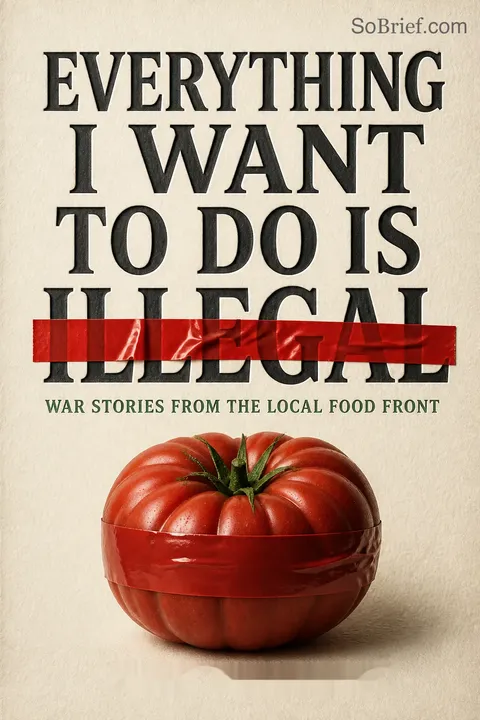
"But is it legal?" This is by far and away the most common question I am asked after doing a workshop on local food systems and profitable farming principles.
The pervasive question. Joel Salatin, a farmer and philosopher, highlights the constant struggle faced by small, local food producers against a bureaucratic system that criminalizes common-sense, sustainable practices. His frustration stems from a culture that prioritizes regulation over self-motivated entrepreneurship, especially in food production. This leads to farmers constantly looking over their shoulders, fearing government intervention.
A system of control. Salatin argues that the regulatory framework, far from ensuring safety, acts as an impediment to noble, neighbor-to-neighbor food sales. He recounts blurting out "Everything I want to do is illegal" at an international forum, a statement that resonated with other farmers facing similar hurdles in "developed countries" where local, indigenous foods are stifled. This sentiment encapsulates the core conflict between Polyface Farm's ecological, transparent model and the entrenched industrial food system.
The struggle is real. The book is a testament to a lifetime of dealing with government officials who have tried to "criminalize, demonize, dismiss, and laugh at" Polyface. Salatin emphasizes that without constant resistance, his farm, a "darling of local food advocates," would not exist. He shares real stories of harassment, confiscation threats, and criminal charges, lamenting that many aspiring local food farmers give up due to these overwhelming obstacles.
2. Bureaucracy's Absurdity: Raw Milk to Bacon
"If a little girl wants to make cornbread muffins and sell them to families in her church, why should the first question be 'but is it legal?'"
Criminalizing common sense. Salatin illustrates the absurdity of regulations through examples like raw milk and on-farm meat processing. He dreamed of milking ten cows and selling raw milk, a practice common throughout history, only to find it illegal. Similarly, dressing beef and pork on his farm, where animals are raised humanely, is prohibited by zoning laws that mandate massive, centralized slaughterhouses.
Innovation stifled. The regulatory burden, often requiring expensive infrastructure for even embryonic businesses, prevents innovation. Salatin likens it to requiring an eBay seller to have numerous licenses and certifications before listing a single item. This "still-birth dreams" scenario means that small-scale producers cannot experiment or grow organically, as mandated accoutrements are too large for a prototype.
The "level playing field" fallacy. Regulations, ostensibly for food safety, often create non-scalable costs that disproportionately harm small operators. For instance, making bacon requires an inspected curing facility, which is illegal in agricultural zones and demands costly infrastructure. Salatin highlights how bureaucrats justify these rules by claiming a "level playing field," ignoring that small and large operations are not playing the same game.
3. Zoning and Regulations: Fragmenting the Farm
"The notion that animals can be raised, processed, packaged and sold in a model that offends neither our eyes nor noses cannot even register on the average bureaucrat’s radar screen."
Segregation of activities. Zoning laws, born from the industrial model's need to separate noxious factories from residences, now fragment traditional farm activities. Salatin's farm, zoned agricultural, is prohibited from hosting paid school tours (deemed an "educational institution") or charging for farm visits (making it a "Theme Park"). This disconnect prevents consumers from understanding agriculture and farmers from diversifying income.
"Wal-Mart" on the farm. Selling products not produced on the farm, even a neighbor's excess zucchini, transforms a farm into a "Wal-Mart" in the eyes of regulators, triggering requirements for commercial entrances, handicapped access, and public bathrooms. This stifles collaborative marketing and local economic synergy, forcing each farm to duplicate infrastructure or forgo sales.
Criminalizing good deeds. Salatin lists activities like hosting kindergartners, conducting farming seminars, or milling a neighbor's log as "evil" in the eyes of the law. He argues these are "decidedly wholesome, good, neighbor-friendly things to do" that build communities. This regulatory overreach, he contends, reduces farms to mere "raw products production units," akin to colonial exploitation, stripping them of their integrated cultural and economic vitality.
4. Labor and Housing: Stifling the Next Generation
"A young person old enough to be squired into a classroom and instructed in the intricate uses of a condom can’t operate a cordless screwdriver?"
Outlawing meaningful work. Salatin laments that child labor laws, while well-intentioned, prevent teenagers from engaging in meaningful farm work. A 16-year-old can drive a car but cannot legally operate a 4-wheeler to gather eggs or use a cordless screwdriver for pay on a farm, unless employed by parents. This denies youth valuable experience, purpose, and self-respect, contributing to societal issues like boredom and gang activity.
Apprenticeship hurdles. The farm relies on apprentices, often young people seeking to learn sustainable farming. However, minimum wage laws and housing regulations make it difficult to offer immersive, on-farm learning experiences. The government views non-traditional compensation or housing (like tents or renovated chicken houses) as "exploitive," even if willingly chosen by the apprentice, forcing farmers to incur prohibitive costs or forgo mentorship.
Housing code absurdities. Salatin's son faced immense challenges building a modest, debt-free home on the farm. Building codes mandated a minimum 900 sq. ft. (later expanded to 2,160 sq. ft. due to other requirements), citing "resale value" even though the family had no intention of selling. Requirements for septic systems (even with composting toilets) and specific construction materials (ungraded lumber deemed inferior) added significant cost and complexity, turning a simple project into a two-year, financially draining ordeal.
5. Taxation: An Unfair Burden on Farmers
"For the first time in our civilization, real estate values have no relationship to the productive capacity of the land."
Unconventional expenses. Salatin highlights how the tax code, designed for industrial models, fails to recognize the unique expenses of a sustainable farm. Ponds, for instance, are capital improvements but function as fertilizer, irrigation, and insect control. The Eggmobile acts as a grubicide, sanitizer, manure spreader, and insecticide. These integrated, multi-functional assets don't fit neatly into conventional accounting, leading to higher tax burdens or complex, often losing, arguments with accountants.
Discriminatory property tax. Farmland disproportionately subsidizes residential governance expenses, paying more in taxes per dollar of services used than residential properties. This fundamental unfairness, coupled with inflated land values driven by "viewscape" rather than productive capacity, burdens farmers with taxes that cannot be recouped from agricultural income. This forces farmers to sell land for development, undermining preservation efforts.
The "death tax" and beyond. Inheritance taxes, or "death taxes," are particularly devastating for farmers, forcing families to pay substantial sums to retain land that has appreciated in paper value but not productive capacity. Salatin advocates for a "Fair Tax" (consumption tax) and the ability to earmark taxes, arguing that the current system is confiscatory and destroys the very fabric of rural communities and multi-generational farms.
6. Industrial Agriculture's Self-Inflicted Crises
"I will say some things now that are conjecture because deep internal industry secrets are hard to uncover but I will lay down the information I have as clearly as possible to show you why many, many people here—including many industry growers—believe this was a contrived outbreak."
Avian Influenza: A convenient crisis. Salatin recounts the 2002 avian influenza outbreak, which he believes was a "contrived" event. He notes inconsistencies: the first infected flocks weren't immediately destroyed, the virus "hopscotched" to affect only birds of a company with collapsed Russian markets, and the outbreak ceased when the ban was lifted. Federal veterinarians, off-duty, admitted they'd be fired for publicly stating the true cause: "too many birds in too tight living quarters."
Mad Cow: A byproduct of industrial feeding. The official cause of Mad Cow Disease (BSE) is feeding animal parts to herbivores. Salatin points out this practice emerged with industrial agriculture, as large slaughterhouses needed to dispose of massive waste streams. USDA initially promoted feeding chicken manure (containing carcasses) to cows as cheap protein. Now, the government, which created the problem, positions itself as the "repository of food safety," penalizing grass-fed producers whose animals naturally develop teeth earlier, making them "older" by arbitrary 30-month rules.
Science for sale. Salatin argues that land-grant university research, often funded by large industries, is inherently biased. He cites studies that "prove" organic farming is unproductive by testing it on chemically depleted soils with hybrid seeds designed for conventional inputs, leading to the false conclusion that "Organics will kill half the world's population." This "politically-massaged spin" perpetuates industrial paradigms and discredits sustainable alternatives.
7. Bioterrorism and NAIS: Centralization's Vulnerabilities
"If you ask me, the biggest bioterrorist threat to the food system comes from pin-striped suits sitting at big oval tables on over-stuffed chairs inside the Beltway."
Centralization as vulnerability. Salatin argues that government officials, while claiming to combat bioterrorism, ignore the inherent vulnerabilities of the industrial food system: centralized production, processing, and long-distance distribution. These systems, with vast, unpopulated farms or crowded, multi-lingual processing plants, are far more susceptible to attack than decentralized, transparent local food chains.
NAIS: A totalitarian tracking system. The National Animal Identification System (NAIS), initially mandatory and now "voluntary" with "chokeholds," proposes RFID chips for every animal, tracking their movements in a database. Salatin views this as a "well-intentioned idea with incredibly terrible consequences," leading to fines for missing animals, logistical nightmares for small farmers (e.g., Amish without computers), and potential market manipulation by powerful interests.
The illusion of safety. Salatin contends that NAIS, like other regulatory schemes, is a "clever public relations campaign" to create the "semblance of protection for an ignorant, duplicitous public." He points to Australia's dismal NAIS record (millions of untraceable animals) and Canada's "joke" system as proof of its ineffectiveness. He fears it will destroy small producers, further centralize the food system, and ultimately fail to prevent disease, while eroding personal freedom and privacy.
8. Animal Welfare: Disconnected Perspectives
"To be sure, I have no problem with vegans or vegetarians. I have no problem with animal worshippers—the ones who say a person is a cat is a fly is a grasshopper. The problem comes when they try to use the political process to outlaw meat consumption."
Urban disconnect. Salatin acknowledges that the animal welfare movement is a reaction to factory farming and urbanization, where the human-animal connection is often limited to pets. This disconnect leads to anthropomorphizing animals and misunderstanding natural life cycles, such as the necessity of death in a food system. He criticizes the inconsistency of some advocates who oppose animal slaughter but support human abortion.
Misguided interventions. Well-meaning animal welfare advocates often push for regulations that harm sustainable practices. For example, banning postal shipment of chicks, deemed "inhumane," would cripple the non-industrial poultry movement, forcing reliance on large-scale, less humane transport. Similarly, efforts to outlaw farrowing crates entirely ignore their role in increasing piglet survivability, even if used for short periods in otherwise humane systems.
The "sacred" horse. Salatin strongly opposes the prohibition of horse slaughter for human consumption, viewing it as "myopic to the extreme." He argues that denying farmers this market value for old or infirm horses is inconsistent, especially when other animals are routinely slaughtered. He fears this agenda ultimately aims to outlaw all animal slaughter by equating animals with humans, a philosophical position he finds untenable and ecologically unsound.
9. A Vision for Food Freedom and Decentralization
"What good is the freedom to worship, the right to keep and bear arms, and freedom of the press if we don’t have the freedom to choose what to feed our bodies so we can go sing, shoot, and speak?"
The right to choose. Salatin proposes a national "Food Security Act" with two parts:
- Freedom of Choice: Allow any American citizen to sign a "I Am Responsible for My Food" waiver, opting out of government-sanctioned food and legalizing all sources for those who sign. This creates a parallel food system, akin to homeschooling, where individuals take responsibility for their choices.
- Waiver of Liability: Consumers who sign the freedom form would agree not to sue their food source for any reason, absolving small producers from crippling liability risks. This shifts the onus for due diligence squarely onto the consumer, fostering transparency and trust.
Dismantling centralization. To truly decentralize the food system and combat bioterrorism, Salatin advocates for radical changes:
- Eliminate all agricultural production subsidies, grants, and tax concessions to private businesses.
- Defund land-grant colleges, which provide biased research.
- Allow any citizen to grow, process, and deliver any food directly to end-users.
- Institute complaint-driven inspection with unannounced sampling, dismantling the current bureaucracy in favor of efficacy.
A call to action. Salatin believes these revolutionary ideas would fundamentally alter the food system, fostering thousands of entrepreneurial farmers and cottage industries. He challenges the notion that consumers are "too stupid" to make informed choices, arguing that a truly free market, unburdened by regulations favoring large corporations, would lead to healthier people, land, and communities. He urges readers to question official narratives and fight for the freedom to choose their food.
Review Summary
Everything I Want To Do Is Illegal presents Joel Salatin's frustrations with government regulations that hinder small-scale farming. Readers appreciate his passion and insights into sustainable agriculture, but some find his political views extreme. The book highlights bureaucratic obstacles faced by local farmers and advocates for food system reform. While many praise Salatin's writing style and arguments, others criticize his tone and digressions into unrelated topics. Overall, the book is seen as thought-provoking but polarizing, appealing more to those interested in local food movements and libertarian perspectives.
People Also Read


About the Author
Download PDF
Download EPUB
.epub digital book format is ideal for reading ebooks on phones, tablets, and e-readers.








































