


Key Takeaways
You already own an untrained ESP core, like a fallow muscle
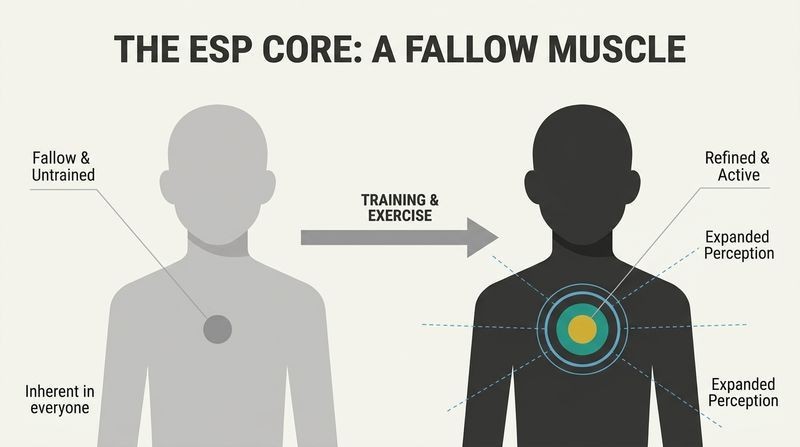
ESP is a natural talent, not a gift. Ingo Swann, the psychic who helped pioneer remote viewing for SRI International and U.S. intelligence, argues that extrasensory perception is a rudimentary human faculty buried in everyone, comparable to an ear for music or a knack for drawing. He calls its center the ESP core: a raw, undeveloped capacity that can be located, exercised, and refined.
The evidence, he says, is that hundreds of ordinary people with no psychic reputation, from Victorian shopgirls to a socialist novelist's wife, produced strikingly accurate results the moment they tried. Polls suggest roughly 80% of people believe they have had extrasensory experiences. The problem was never absence of talent; it was that nobody taught the core how to work.
Framing ESP as a dormant skill rather than a mystical endowment is rhetorically shrewd, sidestepping the believer-versus-debunker war. It echoes how creativity researchers reframed genius as trainable practice. Skeptics would counter that a century of laboratory parapsychology has never produced an effect large enough to survive rigorous replication, and Swann concedes only about a third of experiments even reach significance. Still, the democratizing move is valuable regardless of whether ESP is real: treating any latent human capacity as coachable, feedback-driven, and incremental is exactly how skill acquisition works in music, athletics, and language. The muscle metaphor commits Swann to falsifiable predictions, which is more than most paranormal writing offers.
The words telepathy and clairvoyance are cages, not explanations
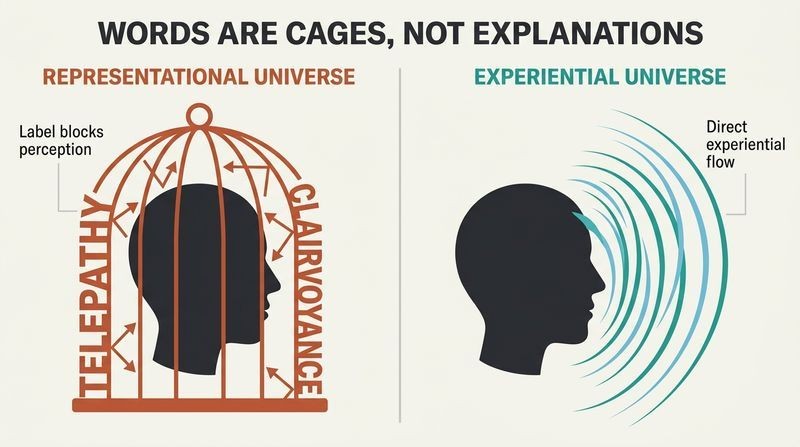
Labels became glue that traps thought. Swann calls our stock of borrowed names the representational universe: terms we mistake for reality. When F.W.H. Myers coined telepathy in 1882, radio and radioactivity were new, so minds were imagined as transmitters beaming signals to receivers. But experiments later showed telepathy works even through shielding that blocks all known radiation, and reception sometimes happens before transmission. The sending model is a bust, yet the word keeps us thinking that way.
Swann's own first lab trials failed because he tried to summon ESP through these intellectual labels. Nothing happened. Only when he abandoned them did the mechanisms reveal themselves. Reality, he insists, must be met in the experiential universe, through self-experience, not through dictionary definitions that prejudge what should occur.
This is essentially a Kuhnian and Wittgensteinian point dressed in plain clothes: the vocabulary a field inherits silently constrains the hypotheses it can form. Cognitive linguists call this the framing effect, and the history of science is littered with metaphors that outlived their usefulness (caloric fluid, luminiferous ether). Swann's diagnosis that parapsychology chased statistical card-guessing to look respectable while losing the phenomenon itself is a genuinely sharp critique of methodology capture. The weakness is that discarding operational definitions makes claims harder, not easier, to test. If telepathy is whatever escapes every label, it risks becoming unfalsifiable, the very trap that keeps critics jubilant.
Sketch what you sense; never try to name it in words
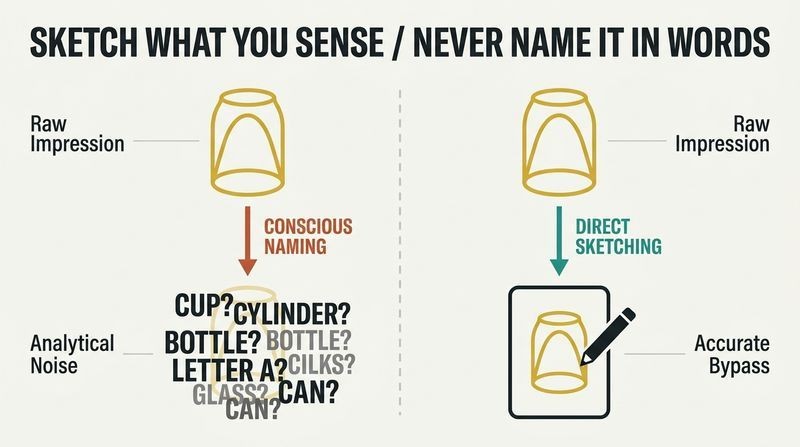
The 7-UP can that changed everything. Wired to a polygraph at the American Society for Psychical Research in 1971, Swann struggled to verbally describe hidden targets. Naming a shape triggered a flood of associated images, drowning the signal in noise. On a subway he noticed wordless airport pictograms and had a breakthrough: draw the impression instead of describing it. On December 30, 1971, he drew what looked like Arabic letters. Turned upside down, it was a perfect 7-UP can. The psychic mind had even rendered it inverted, bypassing his conscious recognition.
Swann's rule: imaging is older and deeper than language. Children draw before they speak. Words are a second, culturally acquired translation layer where distortion creeps in. Picture drawings let raw information surface before consciousness mangles it.
The insight that verbalization corrupts perceptual data has real support outside parapsychology. Psychologists Schooler and Engstler-Schooler documented verbal overshadowing, where describing a face in words measurably degrades later recognition of it. Betty Edwards built Drawing on the Right Side of the Brain on the same premise that language dominance blocks accurate seeing. Whatever one believes about hidden targets, Swann stumbled onto a robust cognitive principle: naming forces premature categorization. The upside-down 7-UP detail is his most persuasive anecdote precisely because a fraud would draw it right-side up. That the conscious mind failed to recognize its own output is the kind of quirk that is hard to fake and easy to remember.
Reframe ESP as retrieving information, not exercising a spooky power
Chase the data, not the faculty. Swann adopts the Russian term bioinformation, which sidesteps whether telepathy, clairvoyance, or precognition are separate abilities and focuses attention on the information acquired. He splits ESP into three grades by how provable the information is:
1. Hardwired: sensing a physical object you can then go verify, like naming what sits on a hidden tray.
2. Semisoft-wired: receiving an idea or invention you can later build and demonstrate.
3. Soft-wired: unverifiable material such as visions, prophecies, or contact with other planes.
He recommends beginners train only on hardwired targets, because they allow repeated trials with immediate feedback. Master that footing first, and the softer categories may develop on firmer ground. The shift from hunting a mysterious power to gathering checkable information is the whole reorientation.
Reframing an ability as an information channel is quietly modern. It anticipates how the SRI remote viewing program was later structured around describable, scorable perceptual data rather than vague pronouncements. The three-tier taxonomy is also a smart epistemic hygiene move: it quarantines the unfalsifiable soft-wired claims from the testable hardwired ones, so a practitioner does not contaminate verifiable practice with wishful metaphysics. The obvious tension is that immediate feedback, which Swann rightly prizes as the engine of learning, is also the exact channel through which sensory leakage and unconscious cueing can inflate results. The methodological virtue and the methodological risk share the same door.
A deeper self taps a reality where all information is connected
The second reality underlies the physical one. Swann leans on quantum physics, citing Bohm's implicate order, Sheldrake's morphic fields, and Soviet researchers Dubrov and Pushkin, to propose a nonlocal substrate where, at the energetic level, information is simultaneously available everywhere. A clairvoyant does not send a signal across space; the person focuses and brings out a wave structure of the distant object that is already latent at every point.
Contacting this requires what he names the deeper self, a term he prefers to soul, oversoul, or subliminal ego. It is the part of us wired into the interconnected field. Spontaneous ESP, like Napoleon weeping at the hour his estranged wife Josephine died, happens when the deeper self pushes urgent, personally meaningful information past consciousness on its own.
Invoking quantum nonlocality to explain the paranormal is the book's most contested move. Physicists are emphatic that entanglement cannot transmit usable information faster than light (the no-communication theorem), so borrowing its language as a mechanism for ESP overreaches. Swann is honestly transparent that even the physicists cannot explain interconnectedness, but that candor does not license extrapolating from particles to minds. The more defensible kernel is psychological: much of cognition is genuinely nonconscious, and meaningful, emotionally charged information does cross the threshold more readily. That maps onto attention and salience research without needing exotic physics. The deeper self is a useful phenomenological label even if the cosmology is speculative.
Believers outscore skeptics: disbelief physically jams the signal
Sheep beat goats. In 1945 parapsychologist Gertrude Schmeidler ran controlled tests dividing subjects into believers, whom she nicknamed sheep, and disbelievers, goats. Across a large sample the sheep scored reliably higher. Differences per trial were small but statistically significant. Swann treats this as proof that attitude gates access to your own ESP core.
He pictures disbelief like white blood cells swarming a virus: incoming psychic information rises toward awareness and the skeptic's conditioned consciousness rushes to obliterate it. This immunization, he stresses, is culturally acquired, not natural. Encouragingly, he cites surveys showing hardcore disbelievers are a minority, with the majority open to ESP even in academia. So a friendly, unantagonistic partner and a benign attitude materially improve results, while a teaser or scoffer can degrade them.
The sheep-goat effect is one of parapsychology's most replicated findings, which cuts two ways. A believer reads it as evidence that expectation unlocks a real faculty; a skeptic reads it as evidence of exactly what corrupts the research, since expectation also shapes scoring leniency, motivated interpretation, and experimenter effects. It rhymes with placebo response and stereotype threat, where belief measurably alters performance through ordinary psychological channels. Swann's framing usefully predicts that hostile labs report null results, but that is equally consistent with rigorous labs catching artifacts that friendly ones wave through. The honest takeaway is narrower than his: attitude undeniably shapes outcomes, though whether it unlocks signal or manufactures it stays unresolved.
Information takes two routes; consciousness is the one adding static
The unimpeded route versus the idea-forming route. Swann models perception as preconscious processing that arrives already formed, then crosses a subliminal threshold into awareness. Correct ESP takes the unimpeded route: information rises, takes shape, and outputs accurately without conscious meddling. The idea-forming route detours the data through conscious idea generation, where the mind slaps interpretations onto it, usually wrong.
He borrows Norman Dixon's subliminal perception charts to show this is not unique to ESP; ordinary awareness is largely built from preconscious processes hidden from waking thought. The practical implication is counterintuitive: the goal is not to try harder or concentrate more. Concentration recruits consciousness, which is the source of the noise. The task is to get out of your own way and let the core deliver.
This inverts the folk model of psychic effort as intense mental straining. It aligns neatly with dual-process theory (Kahneman's fast System 1 versus slow System 2) and with research on insight, where solutions surface when the analytic mind relaxes rather than grinds. Athletes call the overthinking failure the yips; musicians choke when they attend to automated motor sequences. Swann's claim that conscious interpretation is the primary corruptor of a preconscious signal is psychologically credible whether or not the signal is paranormal. The elegant consequence is a testable prescription: shorter, faster, less deliberate responses should be more accurate than labored ones, which matches his advice to draw quickly and stop.
Study your misses; a jumble that won't cohere signals progress
Diagnose the drawing, do not just score it. Swann sorts every attempt into four categories and insists errors teach more than hits. His debugging scheme:
1. Error contributions: imagination hijacks a correct shape and elaborates it into something wrong, like turning a scissors target into an umbrella.
2. Associations: the signal triggers a related feeling or image instead of the object, like sketching motion when the target was a coiled snake.
3. Lack of fusion: all the right pieces arrive but refuse to assemble, as when Mary Craig Sinclair drew a swastika's parts and gave up saying they would not go together.
4. Accuracies: correct in whole or part, sometimes reversed or overdeveloped.
Counterintuitively, lack of fusion is good news. It means the core is working alone, without imagination papering over gaps, and is about to level up.
Treating failure taxonomies as the real curriculum is sound pedagogy far beyond ESP. Expert-performance research (Ericsson's deliberate practice) shows improvement comes precisely from error identification and targeted correction, not from repetition of successes. Swann's insistence on labeling each element and comparing against feedback is a legitimate learning loop. The interpretive leap worth flagging is that lack of fusion is framed as inherently encouraging, which conveniently makes even fragmented failures into evidence of imminent breakthrough. That is a heads-I-win pattern: hits prove ESP, and a certain kind of miss also proves ESP is developing. The diagnostic categories are genuinely useful; the unfalsifiable optimism attached to one of them is the part to hold loosely.
Run the experiment yourself: simple target, trusted friend, instant feedback
The kitchen-table protocol. Swann democratizes the whole enterprise into a setup anyone can try. His rules:
1. Use plain unlined white paper (lines and colors steer the hand) and a sharp pencil.
2. Pick a genuinely interested friend, never a teaser, since emotions leak into the result.
3. Start with single, easily recognized objects, a spoon not a whole drawer of silverware, because the core processes bits and pieces and complexity overwhelms it.
4. Calm yourself, work in silence, then let the drawing appear fast, often in seconds.
5. Look immediately, circle in red what matches, and note in green where imagination intruded.
The drawing, he stresses, matters more than any guess, because it records what the core actually did and lets your whole system learn from the comparison.
The genius of the protocol is the tight, immediate feedback loop, which is the single strongest ingredient in any skill-building system from language flashcards to surgical simulators. But it is also where a methodologist winces. Two friends in adjacent rooms, one having just handled and placed a target, with the receiver eager to circle matches in red, is a design saturated with opportunities for unconscious cueing, generous scoring, and confirmation bias. The very features that make it motivating and repeatable at home are the ones formal parapsychology spent a century trying to eliminate with sealed envelopes and blind judging. As a self-development exercise it is harmless and engaging; as evidence it proves little.
Quit while you're hot: pushing a winning streak collapses it
Overtraining kills the core. Parapsychologists long noticed psi-missing, the maddening moment when a subject on a hot streak suddenly cannot hit anything, sometimes permanently. Researchers made it worse by cheering, do a few more, and the bottom dropped out. Swann found his answer in an unlikely place: bodybuilding literature on overtraining, where a muscle worked past exhaustion shrinks instead of growing.
He treats the ESP core the same way. It is a fragile system that expends energy and must reload, like a runner who has just finished a hard race. His personal rule for nearly nine years: stop just after doing excellently, before the flat feeling arrives. Do only one or two trials, then rest a full day. Accuracy and endurance then climb steadily instead of crashing.
Psi-missing is real as a data pattern, though skeptics read it simply as regression to the mean plus fatigue plus declining attention, no paranormal energy required. What is genuinely portable is the training wisdom. The bodybuilding analogy captures a principle now central to sports science and cognitive skill work: recovery is not the absence of training but part of it, and consolidation happens during rest, notably during sleep. The counsel to end a session on a high, before decline sets in, mirrors advice given to writers (stop mid-sentence) and to students against cramming. Swann's instinct to import a physical-training model into a mental domain is his most quietly practical contribution.
Maybe ESP isn't yours at all, but a field connecting everyone
Flip the whole premise. Swann closes with a radical inversion of parapsychology's assumption. What if ESP is not an individual mental gadget to be located inside a person, but a vast interconnecting plane linking all humanity and all existence? On this view, gifted psychics are not special hardware; they are simply better integrated into the shared field, while everyone else has individuated away from it.
He notes this reframing dissolves puzzles at once. It explains why disbelief blocks ESP (it disconnects you) and why the deepest human communion feels nonverbal. He points to flocking birds turning as one organism and to N. Katherine Hayles's field concept in physics, where object, event, and observer belong inseparably to the same field. Real connection, he suggests, happens beneath consciousness, not through intellect.
Recasting a private faculty as participation in a collective field is philosophically closer to Jung's collective unconscious and to Eastern nondual traditions than to Western individualism, and Swann knows it, crediting the culture's obsession with autonomy for our disconnection. The move is intellectually elegant because it converts anomalies into predictions. But elegance is not evidence, and the flocking-bird example has since been explained by simple local rules (each bird tracking a few neighbors, as Reynolds's boids model showed) with no field required. The enduring value here is less cosmological than ethical: the claim that genuine human communion runs deeper than words is a humane thesis that stands on its own, independent of whether a psychic field exists.
Analysis
Ingo Swann's 1987 guide occupies a strange and interesting niche: it is a how-to manual written by an insider trying to reform a field he believes has failed itself. Rather than defending ESP against skeptics, Swann turns his sharpest criticism inward, arguing that a century of card-guessing and dice-rolling optimized parapsychology for the appearance of scientific respectability while losing the actual phenomenon. That methodological self-critique is the book's most durable intellectual contribution, and it holds up whether or not one accepts his metaphysics. His central practical discovery, that drawing outperforms verbalizing because language forces premature categorization, converges independently with the cognitive psychology of verbal overshadowing and with art educators like Betty Edwards. Strip away the paranormal framing and there is a real cognitive principle underneath.
The book's weaknesses are equally clear. Swann's appropriation of quantum nonlocality as a mechanism for mind-to-mind contact runs against the physics consensus that entanglement transmits no usable information. His enthusiasm for a bioelectromagnetic aura and for the Cold War Soviet psychic-gap narrative reads as period-bound speculation. And his home-experiment protocol, while pedagogically brilliant in its feedback loop, reintroduces precisely the sensory-leakage and scoring-bias problems that rigorous parapsychology spent decades trying to eliminate. Most tellingly, his framing makes both hits and certain misses into evidence of developing ability, a structure difficult to falsify.
Yet the book deserves reading as a document of disciplined practice and honest phenomenology. Swann's descriptions of the inner texture of an ESP attempt, the flood of word-triggered images, the piecemeal arrival of shapes, the fatigue of psi-missing, are unusually candid and self-observant. His deepest theme, that consciousness is more obstacle than instrument and that the task is to stop interfering with preconscious processing, resonates far beyond ESP into insight, flow, and creativity. Read as a study of attention, trust, and getting out of one's own way, it rewards even the committed skeptic.
Review Summary
Everybody's Guide to Natural ESP by Ingo Swann receives mostly positive reviews (4.26/5) for its scientific, professional approach to psychic phenomena. Readers appreciate Swann's intelligence and expertise as a remote viewing pioneer, praising the book's clear explanations and experimental evidence. Many note it clarifies misconceptions about ESP and emphasizes that everyone possesses these abilities. The book focuses on drawing techniques rather than verbal recognition. Some reviewers find certain sections repetitive or difficult, and note it's more about proving ESP exists than teaching activation techniques. Overall, readers value its practical, non-mystical approach to understanding natural psychic abilities.
People Also Read








Glossary
ESP core
Innate untrained psychic facultySwann's term for the foundational, undeveloped psychic capacity he believes exists in every person, buried within the deeper mind. Like an ear for music, it can be located, exercised, and refined through practice with feedback. It processes incoming information as raw shapes and forms below conscious awareness, and its outputs surface as picture drawings before consciousness has a chance to distort them.
picture drawings
Sketching psychic impressions, not describingSwann's core technique of recording extrasensory impressions by drawing rather than verbalizing them. Because imaging precedes language developmentally and words trigger a flood of distracting associations, sketching lets raw information surface with less corruption. He argues the drawings from different people across a century resemble each other so closely they form a universal psychic pictolanguage of basic shapes and forms.
bioinformation
Russian reframing of ESPA term Swann borrows from Soviet researchers that recasts ESP as the acquisition of information rather than the exercise of a mysterious faculty. It bypasses the disputed distinctions among telepathy, clairvoyance, and precognition by focusing on the data received, which Swann finds easier to categorize (hardwired, semisoft-wired, soft-wired) than the hypothetical powers that supposedly acquire it.
second reality
Nonlocal field of interconnected informationSwann's name, drawn from quantum physics writers like Bohm and Sheldrake, for a nonmaterial substrate beneath the physical universe in which information is simultaneously available everywhere. He proposes that psychics do not send signals but focus to draw out information already latent at every point, and that the deeper self is permanently connected to this field.
deeper self
Nonconscious mind wired to fieldSwann's preferred label (over soul, oversoul, or subliminal ego) for the nonconscious part of the mind that is connected to the interconnected second reality. It processes psychic information into completed form and pushes urgent, personally meaningful material into awareness on its own, as in spontaneous premonitions about endangered loved ones.
lack of fusion
Correct pieces that won't assembleOne of Swann's four diagnostic categories for picture drawings, describing when all the correct elements of a target arrive but refuse to combine into a recognizable whole. He interprets it counterintuitively as a positive sign that the ESP core is working on its own, without imagination filling gaps, and is about to improve. It often appears when a target is too complex.
sheep-goats effect
Believers outscore disbelievers on ESPGertrude Schmeidler's 1945 finding, cited by Swann, that subjects who believe in ESP (sheep) score reliably higher on tests than disbelievers (goats). The per-trial difference is small but statistically significant across large samples. Swann uses it to argue that disbelief is a culturally acquired block that jams access to one's own psychic faculty.
psi-missing
Sudden collapse after a streakThe parapsychological phenomenon where a subject on a successful run abruptly loses all accuracy, sometimes permanently, especially when pushed to continue. Swann explains it by analogy to muscle overtraining, arguing the fragile ESP core expends energy and must rest. His remedy is to stop just after peak performance and rest a full day before trying again.
representational universe
Labels mistaken for realitySwann's term for the accumulated stock of words and definitions (telepathy, clairvoyance, and so on) that we treat as real knowledge but which merely represent things we think we know. He argues these labels act as filters that block genuine ESP experience, which can only be reached in the experiential universe of direct self-experience.
About the Author
Other books by Ingo Swann

Download PDF
Download EPUB
.epub digital book format is ideal for reading ebooks on phones, tablets, and e-readers.








































