

Key Takeaways
Seven core emotions wear the same face in every human culture
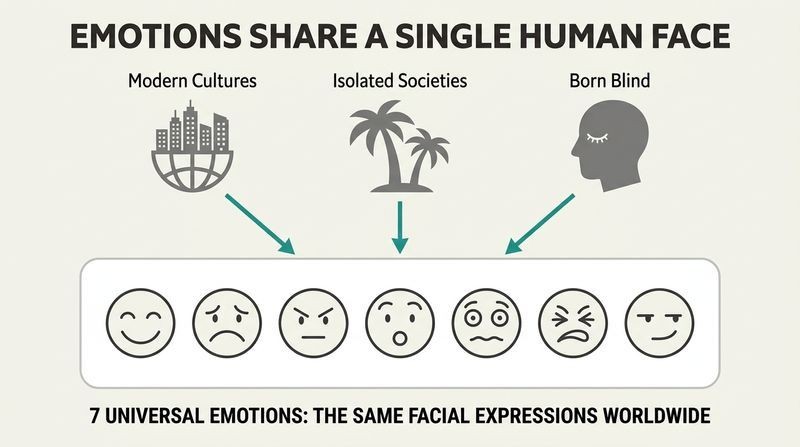
Darwin was right; the anthropologists were wrong. Ekman set out in the 1960s expecting to prove that facial expressions were learned and culture-specific, as Margaret Mead and others believed. Instead, showing photographs across Chile, Argentina, Brazil, Japan, and the United States, he found universal agreement about which emotion each face displayed. The decisive test came in the highlands of Papua New Guinea, among the Fore, a Stone Age people who had never seen movies, magazines, or outsiders. They read the same emotions into the photos, and their own posed expressions were correctly identified by American college students.
The universals are sadness, anger, surprise, fear, disgust, contempt, and enjoyment. Even congenitally blind children produce them without ever having seen a face.
What's striking is Ekman's admission that a finding is more trustworthy in behavioral science when it contradicts the researcher's expectations, precisely because replication is rare. His universality thesis has held up across roughly twenty cultures, though critics like Lisa Feldman Barrett argue that forced-choice photo tasks inflate agreement and that emotion categories are partly constructed by language. The truth is likely layered: biology supplies a shared toolkit of muscle movements, while culture writes the rules for when and how strongly to deploy them. Ekman's Papua New Guinea fieldwork remains a rare instance of a psychologist physically testing a theory at the edge of the modern world.
Culture doesn't change the face; it edits when you show it
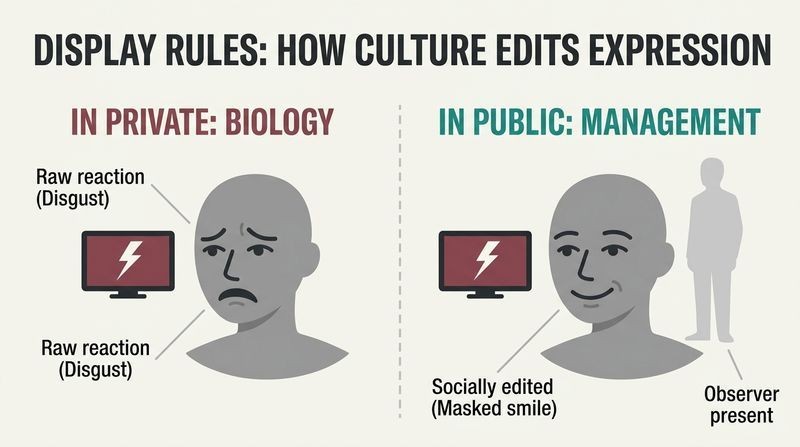
Display rules reconcile nature and nurture. If expressions are universal, why did travelers report Japanese people smiling through sad news? Ekman's answer: display rules, the socially learned conventions governing who may show which emotion to whom and when. In a landmark study, Japanese and American subjects made identical disgust faces while watching gruesome surgery films alone. But when a scientist sat beside them, the Japanese masked their negative expressions with smiles far more than the Americans did.
In private, biology; in public, management. These rules can diminish, exaggerate, hide, or mask what we feel. They explain the parent's command to wipe a smirk off a face, and why the losing athlete swallows disappointment. Symbolic gestures like the head nod or the A-OK sign, by contrast, genuinely are culture-specific.
This distinction dissolved a decades-long feud in a single elegant experiment. The insight anticipates sociologist Erving Goffman's dramaturgical model of everyday life as performance, and it maps neatly onto Arlie Hochschild's concept of emotional labor, the managed feeling that flight attendants and service workers sell. What Ekman adds is a physiological floor: the managed face sits atop an involuntary one, and traces of the suppressed emotion tend to leak. The practical lesson is that reading people across cultures requires separating the felt signal from the culturally imposed overlay, a skill diplomats, clinicians, and negotiators ignore at their peril.
Emotions fire before your conscious mind even shows up
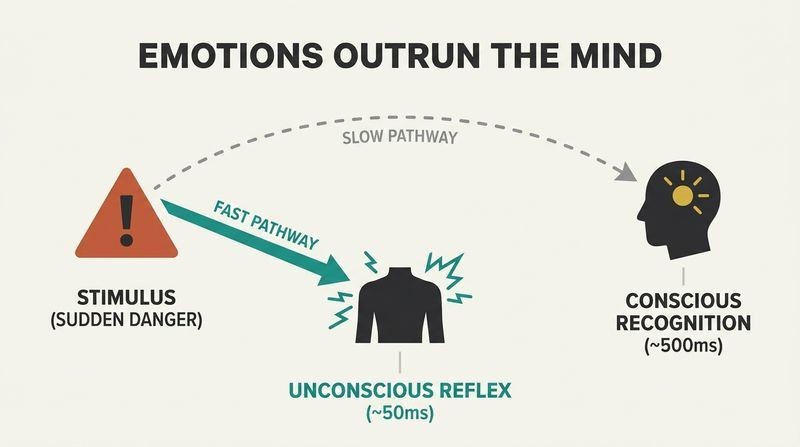
Autoappraisers scan the world faster than thought. Ekman argues emotions evolved to handle survival-critical events without deliberation. Picture driving while chatting; a car suddenly veers at you. Before you consciously register danger, your foot hits the brake, fear floods your face, and blood rushes to your legs. These automatic appraising mechanisms, which he calls autoappraisers, continuously monitor for what matters to our welfare, drawing on both evolutionary and personal history.
Speed is the gift and the curse. If appraisal were slower, we would not survive emergencies, but we would also be able to interrupt inappropriate reactions before they seize us. Because it happens in milliseconds, outside awareness, we often cannot even reconstruct afterward what our brain detected. The fear churns for ten to fifteen seconds before subsiding.
Ekman's autoappraisers prefigure the now-dominant dual-process picture of the mind, Daniel Kahneman's fast System 1 and slow System 2, and dovetail with Joseph LeDoux's neuroscience of the amygdala's rapid low road that bypasses the cortex. The evolutionary logic is sound: a nervous system that paused to deliberate over every rustle in the grass would be selected out. The trade-off Ekman names is profound for personal responsibility. If the trigger fires before consciousness, blame and self-improvement must target not the instant of reaction but the slower work of reshaping what our appraisers are tuned to notice. That reframing is the practical heart of the book.
For a few seconds, an emotion blinds you to disconfirming facts
The refractory period filters reality to fit the feeling. Once an emotion grips us, Ekman says we enter a refractory state in which we can access only the knowledge and interpretations that justify and sustain the emotion. Contradictory information, whether stored in memory or arriving fresh, becomes temporarily unavailable. Consider Helen, annoyed when her husband Jim says she must pick up their daughter. Even after he explains his boss called an emergency meeting, if she is still in the refractory period, her anger clings and hunts for the last word.
Brief is useful; prolonged is destructive. A refractory period of a second or two focuses attention on the problem. When it stretches for minutes or hours, often fueled by poor sleep, background resentment, or an imported script, it distorts our view of others and ourselves.
This is one of the book's most actionable concepts, and it aligns with cognitive research on confirmation bias and emotional congruence in memory retrieval. Ekman borrows philosopher Jerry Fodor's idea of informational encapsulation to explain how relevant knowledge becomes briefly walled off. The clinical implication is powerful: arguing facts with someone mid-refractory is futile, a lesson couples therapists operationalize when they enforce time-outs. What Ekman does not fully resolve is why refractory length varies so wildly between people and episodes, an open question that modern affective neuroscience is only beginning to probe through measures of emotional recovery and vagal tone.
You cannot erase an emotional trigger, but you can cool it
Learned fear may be indelible. Drawing on neuroscientist Joseph LeDoux, Ekman explains that when we learn a trigger, cells in the brain form a lasting assembly, a physical record that stress or mood can reactivate. We cannot delete it. But we can weaken it, breaking the link between trigger and cell assembly, or between cell assembly and behavior.
Six factors govern how hard cooling will be:
1. Closeness to the evolved theme (road rage resists change because blocked physical movement resembles the raw anger theme).
2. How closely current events resemble the original learning.
3. How early in life it was learned.
4. The initial emotional charge.
5. Density, meaning repeated intense episodes crammed together.
6. Affective style, our individual speed and strength of response.
Ekman illustrates with Tim, whose father's cruel teasing wired him to rage at any joke.
The framework is genuinely useful because it converts a vague hope (control yourself) into a diagnostic checklist explaining why some buttons are nearly unpushable. It resonates with exposure therapy and with Bruce Ecker's later work on memory reconsolidation, which suggests emotional learnings can sometimes be genuinely rewritten, a more optimistic view than LeDoux's indelibility. Ekman's honesty about the thin evidence base is refreshing. The road-rage example is particularly sharp: it explains the paradox that people erupt over trivial traffic slights yet stay calm about serious professional criticism, because the merging lane triggers a deep evolutionary theme while the memo does not.
Build the skill of catching yourself mid-emotion, before regret
Attentiveness is the master skill. Ekman coins the awkward but crucial phrase attentively considering our emotional feelings: observing yourself during an emotional episode, ideally within seconds, so you can decide whether to go along with the impulse or interrupt it. It resembles what Buddhists call mindfulness but is aimed specifically at emotion. Most people are gripped mindlessly, questioning nothing while in the swing of it.
Three routes cultivate it. First, learn the specific triggers and hot buttons for each emotion. Second, learn the distinctive bodily sensations each emotion produces, using them as internal alarm bells. Third, get better at reading others' faces, using their emotional signals as cues to check your own. Ekman recounts his own failure: waiting for his wife's call, he cycled through anger, fear, and jealousy, unable to reappraise until the refractory period passed.
That Ekman shares his own botched episode, importing an abandonment script rooted in his mother's death when he was fourteen, models intellectual humility rare in self-help. The concept sits at the crossroads of contemplative practice and clinical psychology; it foreshadows the mindfulness-based cognitive therapy that Segal, Williams, and Teasdale developed for depression relapse. A useful nuance he flags: even a well-honed attentiveness fails under intense emotion, sleep deprivation, physical pain, or an active mood. This is a corrective to the wellness-industry fantasy that enough meditation makes you unflappable. The realistic goal is not emotional silence but a widened gap between impulse and action.
Anger is your most dangerous emotion because it summons more anger
The signature hazard is escalation. Ekman calls anger the most dangerous emotion because it invites retaliation; another person's anger is itself a potent trigger, so the cycle spirals. Its triggers include interference with our goals, physical or psychological threat, someone else's anger, disappointment in those we love, and moral offense. The impulse to hurt appears to be built in; infants slash and thrash at obstacles, and children must be taught to inhibit hitting.
Direct anger at the act, not the person. Ekman, echoing Richard Lazarus and the Dalai Lama, recommends recognizing that an offender under stress may not be fully responsible, so you address the behavior without attacking the human. His research found that patients with coronary artery disease who relived anger during interviews showed silent ischemia, their hearts starved of oxygen. Anger can literally be heart-stopping.
The physiological finding is the sleeper insight here: it is not merely that hostile people develop heart disease but that in people who already have it, the act of getting angry acutely raises the risk of a cardiac event. This bridges emotion research and cardiology and complements the Type A personality literature that later narrowed hostility as the toxic core. Ekman resists the once-popular catharsis myth, citing Carol Tavris, that venting reduces anger; venting typically rehearses and amplifies it. The Maxine Kenny courtroom story, a mother striking her daughter's unrepentant murderer, forces a hard question the book leaves open: is hatred ever legitimately useful to the person who holds it?
Sadness cries for help; medicating it may cost you the comfort
The face of grief recruits care. Ekman splits this emotion into two alternating sides: agony, the active, protesting agitation, and sadness, the passive, resigned helplessness. Intense loss oscillates between them in waves. The expression, with its telltale raised inner eyebrow corners that few can fake, evolved to call others to comfort us, and comforting in turn feels good to the giver, binding communities.
A caution about numbing normal grief. Ekman raises a genuinely provocative worry: if medication erases the visible signs of sadness in someone who is not clinically depressed, that person may receive less of the healing social attention the expression was designed to summon. He is careful to distinguish this from clinical depression, where he fully endorses medication. He also notes we may not fully feel a loss without expressing it, as when a New Guinea mother's grief erupted only among her own people.
The evolutionary reading of sad expressions as social recruitment signals is well supported and connects to attachment theory and to research showing that visible distress elicits caregiving across mammals. Ekman's medication caution is speculative and he says so, but it anticipates real debates about the overmedicalization of ordinary bereavement, a concern that shaped revisions to psychiatric diagnostic criteria around the grief exclusion. The distinction between agony and sadness is clinically useful, mapping onto the agitated versus retarded subtypes of depression. What lingers is the counterintuitive idea that suffering has a function, that the point of feeling bad may be to keep us connected to the people who help us heal.
Fear feels worst when you can do nothing, not when danger is worst
Coping suppresses the terror. Ekman distinguishes fear by three factors: intensity of threatened harm, timing (immediate or impending), and coping (whether action is possible). Counterintuitively, when you can act on an immediate threat, the unpleasant sensations may vanish and consciousness narrows onto the task. He recounts a Papua New Guinea bush plane whose wheels fell off on takeoff; instructed to hold the door ajar and prepare to jump, he felt no terror during the crash landing, only afterward when he had nothing to do.
Immediate versus impending threats differ. An immediate threat triggers freezing or flight and can be analgesic, dampening pain. An impending threat produces vigilance, muscle tension, and magnified pain. Panic attacks, like the ones he suffered before colon surgery, are the extreme, and worry is fear's related mood, called anxiety when we cannot name its source.
The coping insight has real teeth: it explains why soldiers, surgeons, and first responders often report calm under acute pressure and dread only in the waiting. It aligns with research showing that perceived control is among the strongest buffers against stress-related pathology, and with Arne Ohman's finding that humans learn to fear snakes and spiders far faster than guns or electrical outlets, evidence that evolution pre-tuned our fear circuitry to ancestral dangers. The three-factor breakdown is more analytically precise than everyday talk of fear, and it usefully separates the state (fear), the mood (anxiety), the trait (timidity), and the disorders (phobia, PTSD, panic) that share the same emotional core.
Only the eye muscle you can't fake reveals a genuine smile
The Duchenne smile tells truth from politeness. More than 150 years ago, French neurologist Duchenne de Boulogne discovered that a true smile of enjoyment involves two muscles: the zygomatic major, which pulls the lips up and obeys the will, and the outer part of the orbicularis oculi, which circles the eye, raises the cheeks, and cannot be voluntarily contracted by about ninety percent of people. Fake smiles miss the eye action.
The eye smile predicts real outcomes. People who show it report more happiness, lower blood pressure, and are rated happier by spouses. Women displaying it in college yearbook photos reported greater well-being thirty years later. Infants use it for their mothers but not for strangers. And there is not one happy emotion but perhaps sixteen, from amusement to fiero to naches, distinguished mainly by the voice, not the face.
The Duchenne marker is one of psychology's most replicated and portable findings, now embedded in automated facial coding, animation, and deception research. Its power lies in exploiting an anatomical honesty: because most people cannot consciously fire the outer eye muscle, the signal resists faking, a rare biological lie detector. Ekman's insistence that positive emotions splinter into many distinct states, borrowing fiero (the glow of meeting a hard challenge) from Italian and naches (pride in a child's achievement) from Yiddish, challenges the lazy positive-versus-negative binary that still dominates emotion measurement. The vocabulary gap is telling: English simply lacks words for enjoyments that other cultures name precisely, and what we cannot name we tend not to notice.
Suspending disgust is how intimacy is built and love is proven
Disgust protects us but dehumanizes others. Rooted in oral rejection, disgust's most universal triggers are bodily products: feces, vomit, blood, urine. Psychologist Paul Rozin showed people will not drink water they have just spat into, though the saliva was in their mouth a second before. For adults, though, the most intense disgust is moral, not physical: sixty-two percent named morally objectionable acts as the most disgusting thing imaginable. Its danger is that finding people disgusting strips them of humanity, which is why Martha Nussbaum argues law should rest on outrage, not disgust.
Love lowers the disgust threshold. Following legal scholar William Miller, Ekman notes that changing a child's diaper, cleaning a sick partner, or welcoming a lover's tongue means crossing boundaries that would revolt us with anyone else. That suspension is not just a byproduct of love but a way of building it.
This reframing of disgust as an intimacy gauge is the book's most quietly profound move. It connects to Rozin's contamination research and to studies showing disgust sensitivity predicts moral and political attitudes, including out-group prejudice. The dark corollary, that propagandists routinely label victims as vermin or filth to unlock atrocity, is one of social psychology's grimmest confirmed patterns, from genocide studies to dehumanization research by Nick Haslam. Ekman's finding that witnessing suffering sometimes triggers disgust rather than compassion, because blood and wounds are contaminating, exposes a tragic design flaw: the very cues of another's agony can push us away exactly when they need us close. Cultivating compassion, then, means actively overriding an evolved reflex.
Knowing how someone feels never tells you why, so resist Othello's error
Expressions reveal the emotion, never its cause. This is Ekman's repeated warning for using facial reading in real life. He names the trap Othello's error, after Shakespeare's hero who saw genuine fear and anguish on Desdemona's face and read it as a guilty adulteress's terror, when it was an innocent wife's terror of not being believed. Both look identical. The fear of the guilty and the fear of the falsely accused are indistinguishable, which is why polygraphs fail.
Read the signal, then stay humble about the source. A subtle expression may mean an emotion is beginning, is weak, is fading, or is being concealed; a micro expression lasting under a fifth of a second may betray deliberate or unconscious suppression. What you do with that information depends entirely on your relationship and context. Detecting a supervisee's fear or a daughter's sadness opens a choice, not an obligation to name it.
Othello's error is arguably the single most important safeguard against the seductive fantasy of face-reading as mind-reading, a fantasy the surveillance and security industries have monetized aggressively. Ekman himself trained the FBI, CIA, and TSA, yet the book insists expressions are ambiguous without context, a caution that the field's commercial applications, including the discredited SPOT program for airport screening, notoriously ignored. The deeper epistemological point echoes across disciplines: a signal underdetermines its cause. Meteorologists, physicians reading symptoms, and detectives all face versions of this. The mature use of emotional literacy is probabilistic and relational, sharpening questions rather than delivering verdicts, and Ekman's relentless case-by-case examples model exactly that restraint.
Analysis
Emotions Revealed is a synthesis book: Paul Ekman distilling four decades of pioneering research into an accessible guide for improving emotional life. Its structure is hybrid, opening with a scientific memoir of the universality discovery, moving through a theoretical middle on triggers and regulation, then devoting a chapter each to the universal emotions with photographs and self-tests. The audience is the intelligent lay reader, not the specialist, which explains Ekman's habit of flagging where he speaks from evidence versus intuition, an honesty uncommon in popular psychology.
The book's intellectual spine is a resolution of the oldest debate in the field, nature versus nurture in emotion. Ekman's answer, that biology supplies universal expressions and appraisal themes while culture and personal history supply display rules and learned variations, is now the mainstream position, though the constructionist challenge from Lisa Feldman Barrett and others contends that his forced-choice methods overstate universality and that emotion categories are more culturally assembled than he allows. A fair reading grants Ekman the muscle-movement universals while conceding that meaning, labeling, and experience are more plastic than his framework emphasizes.
What elevates the book beyond a taxonomy is its therapeutic ambition. The concepts of the refractory period, hot triggers, and attentiveness form a practical psychology of self-regulation that anticipated the mindfulness turn in clinical practice. Ekman's willingness to expose his own failures, the abandonment script from his mother's early death, the panic before surgery, gives the science human stakes.
The work is dated in places: the Type A construct has been superseded, and the tools he lacked, functional imaging with adequate temporal resolution, have advanced enormously. Yet the core apparatus endures. The Facial Action Coding System remains the gold standard, the Duchenne smile is textbook, and Othello's error is a permanent inoculation against the pseudoscience of reading guilt off faces. Its lasting value is teaching readers to widen the gap between feeling and acting.
Review Summary
Emotions Revealed receives mixed reviews. Many praise Ekman's research on universal facial expressions and find the practical applications valuable. Readers appreciate the detailed explanations of emotions and their manifestations. However, some criticize the writing style as dry and repetitive, finding certain sections unnecessary. The book's strengths lie in its scientific approach and insights into recognizing emotions, while its weaknesses include dense content and occasional oversimplification. Overall, it's considered informative but potentially challenging for casual readers.
People Also Read




Glossary
Autoappraisers
Automatic emotion-triggering brain mechanismsEkman's term for the automatic appraising mechanisms that continuously and unconsciously scan the environment for events relevant to our welfare, triggering emotions in milliseconds before conscious awareness. He uses the plural because he expects many such mechanisms exist, each drawing on both evolutionary themes and personally learned variations to detect what matters to survival.
Display rules
Cultural rules for showing emotionSocially learned, often culturally specific conventions about the management of emotional expression: who may show which emotion to whom, and when. They dictate whether we diminish, exaggerate, hide, or mask what we feel. Ekman demonstrated them by showing Japanese subjects masked disgust with smiles when observed but not when alone.
Refractory period
Window where emotion filters informationThe span, from a second or two to hours, during which an active emotion filters our thinking so we can access only knowledge and interpretations that justify and sustain that emotion, while disconfirming information becomes temporarily unavailable. A brief refractory period usefully focuses attention; a prolonged one distorts perception and drives inappropriate behavior.
Emotion alert database
Stored triggers for each emotionEkman's metaphor for the brain's store of emotional triggers, both universal themes written by evolution and learned variations written by individual experience. It is an open system, continually adding new triggers, but resistant to removing them, reflecting that our emotional system was built to keep triggers in, not delete them.
Themes and variations
Universal triggers plus learned elaborationsEkman's distinction between universal emotional themes, the abstract, evolved events that trigger an emotion in everyone (loss for sadness, threat of harm for fear), and variations, the specific learned elaborations that differ across individuals and cultures (fear of a mugger versus a wild pig). Themes are largely indelible; variations can be weakened.
Attentiveness
Observing your emotion as it happensEkman's abbreviation for attentively considering our emotional feelings: a form of consciousness in which we observe ourselves during an emotional episode, ideally within seconds, recognize we are being emotional, and can then choose whether to reappraise, interrupt, or go along with the impulse. Related to but distinct from Buddhist mindfulness.
Affect program
Inherited system directing emotional behaviorA term from Silvan Tomkins, adopted by Ekman, for an inherited central mechanism that directs emotional behavior. Ekman treats affect programs as open, allowing learned input during life, containing both evolution-preset instructions (signals, action impulses, autonomic changes) and behaviors learned for coping with emotional situations, all running automatically once triggered.
Duchenne smile
Genuine smile using eye muscleThe true smile of enjoyment, named for neurologist Duchenne de Boulogne, in which the outer portion of the orbicularis oculi muscle around the eye contracts alongside the lip-raising zygomatic major. Because about ninety percent of people cannot voluntarily activate that outer eye muscle, its presence distinguishes felt enjoyment from polite or fake smiles.
Fiero
Pride from meeting a challengeAn Italian word Ekman borrows for the distinctive, intensely enjoyable feeling of having met a difficult challenge and succeeded, felt about oneself and requiring no audience. An athlete winning a hard match or a person solving a tough intellectual problem experiences fiero. He argues it has motivated great human achievement throughout history.
Naches
Pride and pleasure in childrenA Yiddish word for the glow of pleasure and pride a parent feels at a child's accomplishment, sometimes even when the child exceeds the parent. Ekman notes its expression is kvelling, and argues naches ensures parental investment in children's growth. He extends it to teachers and mentors feeling it toward students.
Othello's error
Misreading an emotion's causeEkman's term for wrongly inferring the cause of a correctly perceived emotion. Named for Shakespeare's Othello, who accurately saw Desdemona's fear and anguish but misread them as a guilty adulteress's rather than an innocent wife's terror of disbelief. The core lesson: expressions reveal that an emotion is occurring, never why.
Facial Action Coding System (FACS)
System for measuring facial movementsA tool Ekman and Wallace Friesen published in 1978 that objectively describes and measures all visible facial muscular movements in anatomical terms, independent of emotional interpretation. Used by hundreds of scientists worldwide, it enabled Ekman to analyze thousands of expressions, identify micro expressions, and detect the muscular signs that betray concealed or false emotions.
FAQ
What's Emotions Revealed about?
- Understanding Emotions: Emotions Revealed by Paul Ekman delves into the nature of emotions, their expressions, and their impact on our lives. It emphasizes the importance of recognizing and understanding emotions to improve communication and emotional well-being.
- Cultural Insights: Ekman explores how emotions are expressed universally across cultures, supported by his extensive research. He highlights the role of facial expressions in conveying emotions and the potential for misinterpretation.
- Practical Applications: The book offers practical advice on managing emotions, recognizing emotional triggers, and enhancing interpersonal relationships through better emotional awareness.
Why should I read Emotions Revealed?
- Expertise of the Author: Paul Ekman is a renowned psychologist with over forty years of research in emotions and facial expressions, making the book a credible source.
- Improving Communication: It provides tools to enhance emotional intelligence, leading to better communication in personal and professional relationships and preventing misunderstandings.
- Personal Growth: Readers can learn to identify their emotional triggers and responses, fostering personal growth and improved emotional regulation.
What are the key takeaways of Emotions Revealed?
- Universal Emotions: Ekman identifies seven universal emotions—sadness, anger, surprise, fear, disgust, contempt, and happiness—each with distinct facial expressions.
- Emotional Triggers: The book discusses how specific events trigger emotions and how these triggers can be modified or weakened over time.
- Emotional Signals: Ekman emphasizes the importance of facial and vocal signals in conveying emotions, which can improve empathy and emotional responses.
What are the best quotes from Emotions Revealed and what do they mean?
- "Emotions determine the quality of our lives.": This quote highlights the significance of emotions in shaping our experiences and relationships.
- "Emotions can, and often do, begin very quickly.": It emphasizes the automatic nature of emotional responses, which can occur before conscious awareness.
- "We organize our lives to maximize the experience of positive emotions and minimize the experience of negative emotions.": This reflects the human tendency to seek happiness and avoid pain.
How does Paul Ekman define emotions in Emotions Revealed?
- Emotions as Reactions: Ekman defines emotions as reactions to events that significantly affect our welfare, preparing us to deal with important situations.
- Physiological Changes: Each emotion triggers specific physiological changes, observable through facial expressions and body language.
- Cultural Universality: While emotions are universal, their expression can vary across cultures, making understanding these nuances essential.
What methods does Ekman suggest for recognizing emotions in others?
- Facial Action Coding System (FACS): Ekman developed FACS to categorize facial movements associated with different emotions, helping identify subtle expressions.
- Observing Microexpressions: Recognizing microexpressions—brief, involuntary facial expressions—can enhance emotional awareness and empathy.
- Contextual Understanding: Considering the context in which emotions are expressed provides insights into why someone feels a certain way.
How can I change what I become emotional about, according to Emotions Revealed?
- Identify Triggers: The first step is to identify specific emotional triggers that lead to unwanted responses, possibly by keeping a diary.
- Reappraisal Techniques: Using cognitive reappraisal to change the interpretation of triggering events can alter emotional responses.
- Practice Mindfulness: Developing mindfulness enhances awareness of emotional states, allowing for better regulation and response choices.
What role do cultural differences play in emotional expression, as discussed in Emotions Revealed?
- Universal vs. Cultural Expressions: Basic emotions are universal, but their expression can vary significantly across cultures.
- Display Rules: Culturally specific guidelines dictate how emotions should be expressed, influencing public emotional displays.
- Cross-Cultural Research: Ekman’s research shows that while emotions are innate, expressions can be influenced by cultural norms.
How does Emotions Revealed address the relationship between emotions and mental health?
- Emotional Disorders: Emotions can lead to mental health issues like depression and anxiety when out of control.
- Therapeutic Approaches: Therapy can help manage emotions effectively, with techniques like cognitive-behavioral therapy aiding in altering responses.
- Importance of Emotional Awareness: Being aware of emotions is essential for mental well-being, leading to healthier coping strategies.
What exercises does Ekman recommend for improving emotional awareness?
- Emotion Diary: Keeping a diary of emotional experiences helps track feelings and identify triggers, enhancing self-awareness.
- Facial Expression Practice: Practicing recognizing and mimicking facial expressions can improve the ability to read emotions in others.
- Mindfulness Meditation: Engaging in mindfulness meditation fosters greater emotional regulation and awareness in daily life.
What is the Facial Action Coding System (FACS)?
- System for Measuring Expressions: FACS categorizes facial movements based on the muscles involved, allowing systematic analysis of expressions.
- Applications in Research: Used in psychological research, law enforcement, and animation, it helps create realistic character expressions.
- Understanding Emotions: FACS provides insights into subtle emotional cues, enhancing emotional intelligence and communication.
What is the significance of recognizing micro-expressions?
- Brief Emotional Signals: Micro-expressions are fleeting facial expressions that reveal true emotions, often occurring in less than a second.
- Improving Communication: Identifying micro-expressions enhances interpersonal communication and understanding, useful in various settings.
- Emotional Intelligence: Recognizing micro-expressions contributes to emotional intelligence, leading to more empathetic interactions.
About the Author


Download PDF
Download EPUB
.epub digital book format is ideal for reading ebooks on phones, tablets, and e-readers.








































