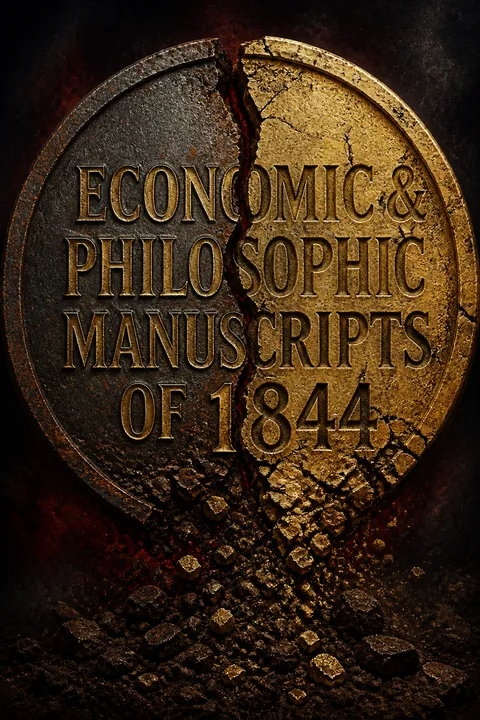
Key Takeaways
1. Under capitalism, the worker is reduced to a miserable, self-devaluing commodity.
The worker becomes all the poorer the more wealth he produces, the more his production increases in power and range.
Devaluation of humanity. In the capitalist system, the expansion of the material world of things directly correlates with the devaluation of the human world. The worker does not merely produce goods; they produce themselves as an increasingly cheap commodity. This paradox means that the worker's physical and spiritual impoverishment is directly proportional to the magnitude of their labor's output.
The subsistence minimum. Political economy treats the worker not as a human being, but as a mere "working animal" or beast of burden. Wages are driven down by fierce competition to the absolute minimum required to keep the worker alive and ensure the working class does not die out.
- The worker's existence is subject to the whims of the rich and market fluctuations.
- Labor is treated as a commodity that must be sold instantly to avoid starvation.
- The division of labor makes the worker highly dependent on monotonous, machine-like tasks.
The tragic paradox. Ultimately, the worker must struggle not only for physical survival but for the very opportunity to work. When the wealth of society declines, the worker suffers most cruelly; when it advances, they suffer from overwork, spiritual degradation, and intense competition.
2. Estranged labor alienates humanity from its products, its work, its species-being, and other people.
What applies to a man’s relation to his work, to the product of his labour and to himself, also holds of a man’s relation to the other man, and to the other man’s labour and object of labour.
Fourfold alienation. Marx identifies four distinct dimensions of estranged labor that strip humanity of its essence. First, the worker is alienated from the product of their labor, which confronts them as an alien, hostile power owned by the capitalist. Second, they are alienated from the act of production itself, which feels like forced, coerced labor rather than a spontaneous, satisfying activity.
Loss of species-being. Third, estranged labor alienates humans from their "species-being"—their unique capacity for free, conscious, and creative activity. Instead of transforming nature to express their humanity, workers are forced to treat their life-activity as a mere means for physical survival.
- Nature is reduced from man's "inorganic body" to a hostile, external resource.
- Creative production is replaced by animalistic survival instincts.
- The worker only feels free in basic animal functions like eating, drinking, and procreating.
Social fragmentation. Fourth, this internal estrangement inevitably manifests as the alienation of man from man. Because the worker is alienated from their own human essence, they view others through the lens of competition and exploitation, transforming society into a battleground of hostile interests.
3. Capital is stored-up labor that concentrates wealth and crushes the working class.
Capital is stored-up labour.
The power of capital. Capital is not a neutral economic force; it is the governing power over labor and its products. The capitalist exercises this power not because of their personal virtues, but because they own the stored-up labor of others. This ownership grants them absolute command over the market and the lives of the working class.
The competitive squeeze. As capital accumulates, competition among capitalists intensifies, leading to the ruin of smaller enterprises. The big capitalists, benefiting from economies of scale and cheaper raw materials, easily crush smaller competitors, forcing them into the ranks of the proletariat.
- Large capitals accumulate much faster than small ones, accelerating wealth concentration.
- The fall in interest rates forces middle-class rentiers to become active, desperate business owners.
- Fixed capital requirements become too high for small-scale producers to survive.
Systemic overproduction. This relentless drive for accumulation and competition forces capitalists to maximize division of labor and mechanization. The inevitable result is chronic overproduction, which leads to sudden market crashes, mass unemployment, and the further degradation of wages.
4. Landed property inevitably loses its feudal romance and dissolves into industrial capital.
The final consequence is thus the abolishment of the distinction between capitalist and landowner, so that there remain altogether only two classes of the population—the working class and the class of capitalists.
Demystifying the soil. Feudal landed property once enjoyed a romantic, political illusion of nobility, honor, and intimate connection to the soil. However, the inexorable laws of private property strip away this sentimental veneer, transforming land into a mere commercial commodity. The landlord is unmasked as a parasitic monopolist who reaps where they never sowed.
The industrialization of agriculture. Under the rule of capital, agriculture is transformed into a modern industry managed by tenant farmers. The landlord becomes a common capitalist, and rent is reduced to the interest yielded by capital invested in the soil.
- Feudal ties of allegiance are replaced by cold, monetary transactions.
- The division of land increases the number of debt-encumbered small proprietors.
- Large-scale industrial agriculture eventually swallows up fragmented small holdings.
The two-class society. Ultimately, the distinction between the landowner and the capitalist completely disappears. Society is simplified and polarized into two hostile camps: the property-owning capitalists and the propertiless workers, setting the stage for a final revolutionary clash.
5. Private property is the direct consequence and material realization of alienated labor.
Private property is thus the product, the result, the necessary consequence, of alienated labour, of the external relation of the worker to nature and to himself.
Reversing the premise. Classical political economy takes private property for granted as a natural starting point without explaining its origin. Marx reverses this assumption, demonstrating through analysis that private property is actually the product and consequence of alienated labor. It is the material, objective expression of the worker's self-estrangement.
The reciprocal loop. Although private property appears to be the cause of alienated labor, the relationship eventually becomes reciprocal. Private property becomes the means by which labor alienates itself, and the realization of this alienation in the real world.
- Wages and private property are identical, as wages are merely a consequence of labor's estrangement.
- A simple increase in wages only provides better payment for a slave, without restoring human dignity.
- Emancipation from private property must take the political form of the emancipation of the workers.
Universal human liberation. Because the entire system of human servitude is rooted in the relation of the worker to production, the liberation of the working class is not a narrow class interest. It contains within itself universal human emancipation, freeing all of society from the chains of alienation.
6. True communism is the positive recovery of human nature, not the crude leveling of wealth.
Communism is the riddle of history solved, and it knows itself to be this solution.
Crude communism criticized. Marx strongly rejects "crude communism," which merely seeks to generalize private property and level down all talents and wealth. This immature form of communism is driven by envy and the desire to reduce everyone to a common minimum, replacing the individual capitalist with the community as an abstract, universal capitalist.
The positive transcendence. True communism is the positive transcendence of private property and human self-estrangement. It represents the real appropriation of the human essence by and for man, allowing humanity to return to its social, fully-developed nature.
- It resolves the conflict between man and nature, and between man and man.
- It reconciles existence with essence, objectification with self-confirmation, and freedom with necessity.
- It is a conscious return of man to himself as a social, cooperative being.
The historical process. This humanistic communism is not a utopian blueprint but the actual, necessary phase of historical development. It is the conscious resolution of history's struggles, grounded in the real, material movement of private property and production.
7. Capitalism reduces the rich spectrum of human senses to the singular "sense of having."
Private property has made us so stupid and one-sided that an object is only ours when we have it—when it exists for us as capital, or when it is directly possessed, eaten, drunk, worn, inhabited, etc.,—in short, when it is used by us.
Sensory impoverishment. Under the reign of private property, the rich, multi-dimensional relationship of humans to the world is utterly crushed. In place of all physical and mental senses—seeing, hearing, smelling, tasting, feeling, thinking, and loving—comes the sheer, alienated "sense of having." We are reduced to absolute poverty so that we may accumulate external wealth.
The humanized senses. The transcendence of private property is therefore the complete emancipation of all human senses and attributes. When the objective world becomes a social, human object, our senses become "theoreticians" in their own right, relating to things for their own sake rather than for mere utility.
- A musical ear is only cultivated through the objective richness of music.
- The starving man cannot appreciate the human form of food, only its abstract existence as nourishment.
- The dealer in minerals sees only commercial value, not the unique beauty of the stone.
The rich human being. True wealth is not the accumulation of capital, but the creation of the rich human being who is in need of a totality of human life-activities. Under socialism, even human poverty receives a social significance, acting as the passive bond that makes us experience our need for other human beings.
8. Money acts as an omnipotent, distorting power that turns all human realities into their contraries.
Money, then, appears as this overturning power both against the individual and against the bonds of society, etc., which claim to be essences in themselves.
The universal confounding. Money is the alienated ability of mankind, acting as an omnipotent pimp between human need and the object of life. It possesses the magical property of buying and appropriating everything, thereby transforming real human incapacities into their exact opposites. It is the universal agent of divorce and the ultimate binding force in bourgeois society.
The inversion of identity. Through money, an individual's actual qualities become entirely irrelevant. A person may be ugly, dishonest, stupid, and cowardly, but if they have money, they can buy beauty, honor, intelligence, and bravery, rendering their natural defects powerless.
- Money transforms wishes from the realm of imagination into real, sensuous existence.
- It converts real, effective demand into objective reality, while leaving moneyless needs unfulfilled.
- It fraternizes impossibilities, forcing contradictory attributes to embrace.
The divine whore. Shakespeare and Goethe brilliantly depicted money as the "common whore of mankind" and a "visible divinity." It confounds all natural and human qualities, turning fidelity into infidelity, love into hate, and virtue into vice, establishing the complete domination of dead matter over living humanity.
9. Hegel correctly grasped labor as human self-genesis but mystified it as abstract self-consciousness.
The outstanding thing in Hegel’s Phenomenology and its final outcome—that is, the dialectic of negativity as the moving and generating principle—is thus first that Hegel conceives the self-genesis of man as a process, conceives objectification as loss of the object, as alienation and as transcendence of this alienation; that he thus grasps the essence of labour and comprehends objective man—true, because real man—as the outcome of man’s own labour.
Hegel's great insight. Marx acknowledges Hegel's profound achievement in the Phenomenology: grasping the dialectic of negativity as the moving and generating principle of human history. Hegel correctly understands that man creates himself through his own labor, experiencing objectification, alienation, and the eventual transcendence of that alienation.
The idealistic error. However, Hegel's fatal error is that he conceives labor only as abstract, mental labor, and man only as abstract self-consciousness. Consequently, the alienation he describes is merely the alienation of thought, and its transcendence is reduced to a purely intellectual exercise within "Absolute Knowledge."
- Real, material objects are treated merely as thought-entities or abstractions.
- The real world is restored in a speculative, uncritical way, leaving actual alienation untouched.
- Nature is treated as a defective, externalized "other-being" of the Absolute Idea.
The materialist correction. Marx, heavily indebted to Feuerbach's humanistic criticism, corrects this mystification. By replacing abstract self-consciousness with real, corporeal man firmly planted on the solid earth, Marx transforms Hegel's speculative dialectic into a revolutionary, materialist science of human liberation.
10. Free trade is a hypocritical system of licensed fraud that inevitably produces devastating crises.
Political economy came into being as a natural result of the expansion of trade, and with its appearance elementary, unscientific swindling was replaced by a developed system of licensed fraud—a complete get-rich economy.
The hypocrisy of free trade. In the Appendix, Engels exposes the historical transition from the crude, candid selfishness of the mercantile system to the sophisticated hypocrisy of modern free trade. While Adam Smith and his followers lauded free trade as a humanitarian bond of friendship, it is actually a refined system of mutual swindling and competitive warfare.
The cycle of crises. The fundamental law of competition is a blind, natural force driven by the mutual ignorance of producers and consumers. This lack of conscious organization leads to a permanent state of fluctuation, resulting in devastating, periodic trade crises that occur every few years.
- Demand and supply never truly balance, causing wild price fluctuations.
- Speculators exploit disasters, bad harvests, and market collapses for personal gain.
- The Malthusian population theory is invented to blame the poor for the systemic failures of capitalism.
The path to revolution. Ultimately, the relentless struggle of competition concentrates all wealth in the hands of a few millionaires while reducing the vast majority to paupers. This systemic polarization, combined with the rapid advance of labor-displacing machinery, makes a total social revolution absolutely inevitable.
Review Summary
People Also Read



About the Author
Other books by Karl Marx
Download PDF
Download EPUB
.epub digital book format is ideal for reading ebooks on phones, tablets, and e-readers.








































