

Plot Summary
The Magician and the Alien
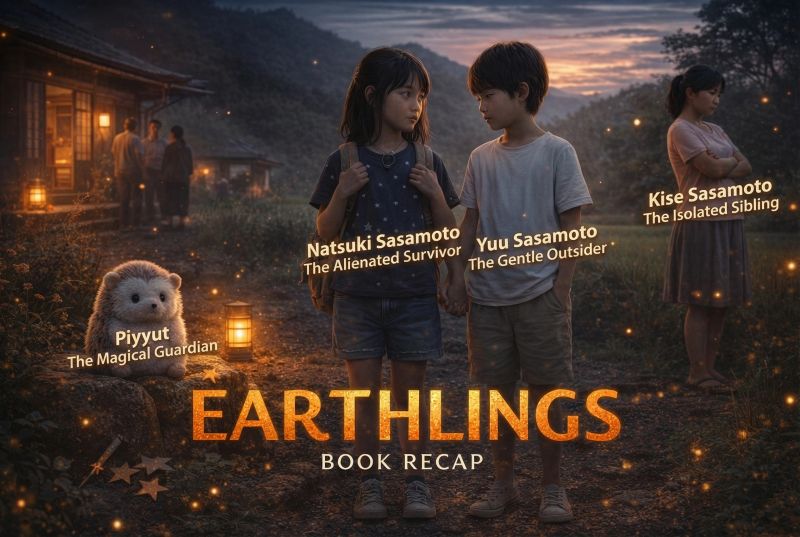
Every summer, eleven-year-old Natsuki1 travels to her grandmother's house in the Akishina mountains for the Obon festival, where her extended family gathers. At home in Chiba, she's the family's dumping ground — her mother's6 favorite target for criticism, invisible beside her needy older sister Kise.4 But in Akishina, she has her cousin Yuu.2
At nine, they discovered they were the same kind of misfit: Natsuki1 confided she was a magician protecting Earth, armed with a toy hedgehog named Piyyut and an origami wand. Yuu2 told her his mother insisted he was an alien, abandoned by a spaceship. They hooked pinkies and made three promises: guard each other's secrets, stay faithful, meet again every summer. The magician became the alien's girlfriend.
The Graveyard Wedding
Kise4's tantrum after being teased about her facial hair gave their mother6 the excuse to leave Akishina a day early. Natsuki1 woke Yuu2 at dawn and led him to the family burial ground in the rice fields. With Piyyut as pastor, she recited improvised wedding vows. They exchanged rings twisted from wire and wrote a marriage pledge in pink pen.
The first two vows were sweet: no holding others' hands, wear your ring to sleep. The third — Yuu2's contribution — was a vow to survive at any cost. That pledge, scribbled by a child who lived with a mother8 who treated him as a surrogate husband, would become the thread Natsuki1 gripped for the next twenty-three years. She tucked the wire ring into her pocket and climbed into the waiting car.
The Broken Mouth
At cram school, a handsome university student named Igasaki5 corrected Natsuki1's posture by sliding his hands under her shirt, commented on her underwear color, and forced her to change a sanitary napkin in front of him.
When she stammered the truth to her mother6 — he touched my breasts, he's weird — her mother6 struck her with a slipper, calling her filthy-minded for suggesting a teacher would notice her. Then at a summer festival, Igasaki5 lured her to his empty house by claiming her friend was resting there.
He forced her mouth open. Natsuki1's consciousness fled to the ceiling, watching her own body being used from above. She walked home hollowed out. From that evening forward, she could not taste food. Her mouth, she understood, had been destroyed.
Midnight at Grandpa's Grave
Natsuki1 told Yuu2 that a grown man was going to kill her. She begged him to have sex before her body stopped being hers. At two in the morning they sneaked to the graveyard, where by candlelight they pressed together — Natsuki1 desperate to reach a place inside Yuu2's skin that the teacher hadn't touched.
Afterward, she swallowed stolen sleeping pills. Yuu,2 who had once watched his own mother8 attempt the same thing, forced them from her mouth. Then Kise4's flashlight found them naked among the graves, and the adults came running.
Natsuki1 was locked in the storehouse. Yuu2 was beaten in the rice fields. In the morning, she found the marriage pledge hidden inside her shoe, with Yuu2's handwriting in the margin urging her to keep her promise. They would not meet again for twenty-three years.
Killing the Wicked Witch
Locked in her room for weeks, Natsuki1's magical thinking intensified until Piyyut's voice rang crystal clear in her broken right ear. He told her Igasaki5 was possessed by a Wicked Witch who would kill her unless she struck first.
At three in the morning she let herself into Igasaki5's house — he'd shown her where the spare key was — carrying a grass-cutting scythe from the garden shed. The world turned pink. She perceived a blue lump on the bed, not a sleeping man dosed on his own anxiety medication.
She brought the scythe down, chanting the word Popinpobopia like an incantation, until the lump stopped moving. She burned her clothes and the blade in the school incinerator. The murder went unsolved. Natsuki1 joined Igasaki5's grieving parents in handing out witness-appeal flyers at the station.
A Marriage Without Touch
Twenty-three years vanished into survival. At thirty-one, Natsuki1 registered on surinuke.com — a site for people seeking to evade society's expectations through marriage, suicide, or disappearance. She found Tomoya,3 a man forced to bathe with his mother until fifteen who could not tolerate a real woman's body.
Their marriage was architectural: separate bedrooms, separate meals, shared housework governed by precise rules, physical contact limited to accidental fingertip brushes. Both saw society as a Factory manufacturing babies through brainwashed components.
Their union was camouflage, designed to deflect the surveillance of relatives and friends who monitored every couple's reproductive progress. It was the most comfortable relationship either had known — two people hidden in plain sight, their reproductive organs quietly observed but unused.
Twenty-Three Years Later
Tomoya3 lost his seventh job and spiraled toward wanting to die, but Natsuki1's stories of Akishina had built the mountain house into his personal paradise. Through a chain of family phone calls and the intervention of Natsuki1's eldest aunt, they gained permission to visit.
Uncle Teruyoshi,7 now white-haired and diminished, drove them up the winding mountain road. There they found Yuu2 — unemployed, living in the house after his company was acquired and he took voluntary redundancy. He was polite but guarded, particularly with Natsuki.1
When the couple explained their alien worldview and sexless arrangement, he responded with the careful distance of someone determined to remain an Earthling. Three people who had once been inseparable as children now circled each other like cautious animals sharing a den.
The Factory Strikes Back
Kise4 arrived first as a pressure agent, dropping pointed remarks about outstaying their welcome. Then Tomoya,3 pursuing his theory that taboo-breaking would undo his brainwashing, visited his elder brother and earnestly proposed an incestuous act.
His brother secretly recorded the conversation and called their father. Tomoya3 fled back to Akishina by bullet train, but his father followed with the address from Natsuki1's parents. He beat Tomoya3 until a tooth flew out, then dragged both of them home.
The cross-examination that followed came from every direction: Natsuki's mother6 demanded she become intimate with Tomoya,3 calling it a wife's duty. Shizuka9 was recruited to deliver the same sermon over dinner. Tomoya3's father declared their sexless marriage worse than barrenness and threatened divorce.
Kise Knew All Along
In a private karaoke room, Kise4 dropped her bombshell: the night of the summer festival, she had followed Natsuki1 and watched Igasaki5 take her into his house. She'd peered through the garden window. Her interpretation was monstrous — she'd been jealous. Too ugly and hairy for anyone to notice her, she saw her younger sister being chosen by a handsome man as divine favoritism she herself had been denied.
Then she asked, almost casually, whether Natsuki1 had killed him. Natsuki1 denied it. Kise4 smiled and pivoted to demands: get intimate, produce a baby, live decently — or face consequences. What Natsuki1 didn't yet realize was that her sister4 had retrieved evidence from the school incinerator and preserved it for over twenty years.
The Divorce Ceremony
Tomoya3 announced he would submit to the Factory and proposed divorce so Natsuki1 could escape alone. She refused — they would escape together. At Uncle Teruyoshi7's house, where Yuu2 was staying while preparing for job interviews, they stood around a table bearing Tomoya3's wedding ring, Natsuki1's wedding ring, and the wire ring from the childhood graveyard ceremony.
They recited inverted vows: swearing not to love, cherish, or stand by each other, but to live life for its own sake. Yuu2 officiated, bewildered. As the couple turned to leave, he followed them outside.
He confessed he'd spent his life obeying unspoken orders — from his mother,8 professors, employers — and now, encountering freedom for the first time, the only thing he could think to do with it was come with them.
Shedding Their Earthling Skin
Back in Akishina, they redesigned existence from scratch. Time dissolved into Light Time and Dark Time. They went naked, slept in a communal mound of bedding, stole vegetables from evacuated neighbors after a landslide emptied most of the village.
They discussed sexual desire with clinical detachment, concluding that solitary satisfaction was more rational than mating, that love was merely an anesthetic the brain manufactured to prettify reproduction. They cut the telephone line.
Natsuki,1 for the first time since childhood, felt her body relaxing — the cells that had been clenched for decades slowly uncurling in the presence of two creatures who wanted nothing from her flesh. Meanwhile, Kise4's furious voicemails accumulated on the phone Natsuki1 checked across the red bridge. She smashed it on the road and threw the pieces into the river.
The Earthling Feast
Igasaki5's elderly parents arrived in darkness with a golf club and evidence Kise4 had preserved — a recording, a partially burned scythe, bloodstained socks. Natsuki1 killed the mother with a calligraphy trophy; together the three killed the father. A landslide sealed them in completely.
When food ran out, Yuu2 proposed butchering the corpses. They drained blood, carved flesh from bone. Eating miso soup with human meat, Natsuki1 tasted food for the first time in twenty-three years — her destroyed mouth restored, her broken ear suddenly clear.
They began tasting each other's flesh too, unable to stop. When Kise4 and their mother6 arrived with a rescue party, they found three naked, swollen-bellied creatures who introduced themselves as Popinpobopians and promised, with serene confidence, that the condition was contagious.
Analysis
Natsuki1's dissociation — she makes the reader inhabit it, deploying magical thinking as both symptom and survival mechanism until the two become indistinguishable.
The novel's most radical gesture is its refusal to provide a stable position from which to judge its characters. Natsuki1's Factory framework is simultaneously delusional and accurate: society does treat bodies as reproductive capital, does enforce conformity through invisible pressure, does punish deviance. When Tomoya3 calls love an anesthetic manufactured by the brain to prettify mating, he's not entirely wrong — he's just unable to access the experience that would make the drug worthwhile. The horror isn't that their worldview is false but that it's partially true and therefore unreachable by counter-argument.
Murata structures the escalation with surgical precision. Each stage — fantasy identity, abuse, murder, sexless marriage, commune, cannibalism — follows logically from the last. The childhood pledge to survive at any cost becomes the novel's darkest irony: survival stripped of all other meaning produces something that survives but is no longer recognizably human. The final image — three bloated creatures stepping into the snow, declaring their condition contagious — refuses to distinguish between ultimate self-reclamation and ultimate self-destruction.
The deepest provocation concerns bodily autonomy. Every institution Natsuki1 encounters — family, school, marriage, friendship — asserts ownership over her body. The only moments her body feels genuinely hers are during acts society considers monstrous. Murata doesn't endorse this conclusion; she follows the logic of trauma to its terminus, leaving the reader to reckon with a civilization that produces such outcomes and then screams when confronted with the result.
Review Summary
Earthlings is a controversial and disturbing novel that explores themes of alienation, conformity, and trauma. Reviews are polarized, with some praising its uniqueness and dark humor, while others find it deeply unsettling. The book follows Natsuki, a woman who believes she's an alien, as she navigates a society she doesn't fit into. Many readers warn of graphic content, including child abuse, incest, and cannibalism. While some appreciate Murata's commentary on societal norms, others feel the shock value overshadows the message. The novel's bizarre plot and provocative themes make it a divisive read.
People Also Read








Characters
Natsuki
Narrator and survivorThe first-person narrator, a woman whose dissociative magical thinking both protects her from unbearable reality and prevents her from joining society. As a child in Chiba, she was the overlooked second daughter—her mother's6 emotional punching bag, invisible beside her needy older sister4. She invented a magical identity as a warrior from Planet Popinpobopia, armed with a toy hedgehog emissary and origami wand. After being sexually abused by her cram school teacher5 and dismissed when she tried to report it, she retreated deeper into fantasy. She sees suburban life as a Baby Factory and every social expectation as brainwashing. Her marriage to Tomoya3 is strategic camouflage. Beneath her mythology lies a child who never stopped trying to survive the unsurvivable, gripping her cousin Yuu's pledge like a talisman.
Yuu
Cousin and childhood husbandNatsuki1's cousin and childhood spouse, a quiet, perceptive boy whose mother8 told him he was an alien she'd taken in. Where Natsuki1 constructs elaborate mythologies, Yuu survives through intuitive obedience—performing whatever adults silently demand. His mother8 used him as a surrogate husband after her divorce, requiring emotional caretaking no child should shoulder. He is the character most capable of adapting to any environment, which makes him both the most functional and the most rootless of the three protagonists. His genuine devotion to Natsuki1 in childhood is colored by his compulsive need to meet others' unspoken expectations. As an adult living in the family mountain house, he clings to normality with the determination of someone who knows exactly how thin the membrane is between fitting in and falling through.
Tomoya
Natsuki's alienated husbandNatsuki1's husband, found through a website for people evading social expectations. Forced to bathe with his mother until age fifteen, he developed a visceral aversion to female flesh while maintaining sexual desires satisfied only through fiction. He hates working—not from laziness but from a bone-deep rejection of what he sees as enslavement. His loathing of the Factory is more passionate than Natsuki1's: where she secretly longs for brainwashing into normalcy, Tomoya treasures his outsider perspective. His romanticization of the Akishina mountains from Natsuki1's stories reveals a childlike capacity for wonder coexisting with genuine psychological instability. He is the ideologue of the trio, the one who articulates their philosophy and pushes it furthest. He cares for Natsuki1 and Yuu2 with fierce, awkward tenderness.
Kise
Natsuki's envious older sisterNatsuki1's older sister, bullied relentlessly for her appearance throughout childhood and prone to tantrums that commanded their parents' complete attention. As an adult, she becomes a fervent disciple of conventional domesticity—marriage, motherhood, the social order that once rejected her. Her evangelism for normalcy carries the desperation of a convert. Her relationship with Natsuki1 is fueled by jealousy, resentment, and an urgent need to enforce the norms that finally gave her life value.
Mr. Igasaki
Predatory cram school teacherA handsome university student who teaches part-time at Natsuki1's cram school. His abuse is methodical and disguised as pedagogy—correcting posture, teaching hygiene, offering special private lessons. His attractiveness serves as social armor: no one believes a child's complaint against such a face. He represents the predator who exploits the absolute power gap between adult and child, wrapping violation in the meticulous language of care and education.
Natsuki's Mother
Dismissive, punishing parentA part-time pharmacy worker who channels her frustrations onto her younger daughter1, criticizing Natsuki1's appearance, intelligence, and demeanor to neighbors and relatives. Her refusal to believe Natsuki1's report of abuse—punctuated by slipper-blows to the head—seals her daughter's distrust of adult protection forever. She embodies the Factory's internalized logic: children exist to serve parental needs, not the reverse.
Uncle Teruyoshi
Warm uncle, Akishina guardianThe cheerful uncle who inherited the Akishina house and serves as the warmest adult in the narrative. He teaches children about nature, plays with them generously, and later expresses guilt about how the family handled Natsuki1 and Yuu2's childhood scandal. He represents the possibility of genuine adult kindness—limited but real—in a world where most adults fail children completely.
Aunt Mitsuko
Yuu's unstable motherYuu2's mother, who told her son he was an alien she'd taken in. After her divorce, she depended on him as a surrogate husband, burdening him with emotional needs no child should carry. Her instability shadows Yuu2's entire life.
Shizuka
Childhood friend turned envoyNatsuki1's childhood friend who becomes an unwitting instrument of family pressure in adulthood, recruited by Natsuki's mother6 to lecture her about marital duty and intimacy over dinner.
Natsuki's Father
Silent, withdrawing parentA taciturn man who responds to family crisis by withdrawing entirely, stopping all communication with Natsuki1 after the childhood scandal. His weapon is silence—a punishment more total than his wife's6 slipper.
Yota
Mischievous cousin, grown stableUncle Teruyoshi7's eldest son, who evolved from a mischievous child into a functional adult. He visits Yuu2 in Akishina occasionally and represents normality's contagious, reassuring presence.
Plot Devices
Planet Popinpobopia
Alternate identity and worldviewThe imaginary home planet that serves as the trio's alternative identity system. Initially Natsuki1's childhood fantasy—she's a warrior-magician, Yuu2 is a stranded alien—it evolves into a shared philosophical framework for rejecting human society. Being Popinpobopian means seeing through the Factory's brainwashing, perceiving the reproductive coercion that others accept as natural. The planet's name becomes an incantation during Natsuki1's most dissociative moments and later the shared language of the commune. It functions simultaneously as trauma response, philosophical position, and the vocabulary of madness—the novel never clarifies which, because for its characters all three are the same thing.
The Marriage Pledge
Survival talisman across decadesA handwritten document created during Natsuki1 and Yuu2's childhood wedding at the family graveyard, containing three vows—the third being to survive at any cost. Yuu2 hides it in Natsuki1's shoe when they're forcibly separated, and she preserves it in a tin box for twenty-three years. The pledge reappears at the divorce ceremony, where all three characters renounce their bonds. It charts the entire narrative arc: from childhood promise through decades of desperate survival to its ceremonial dissolution. The pledge literalizes the novel's central tension—survival as both purpose and prison.
The Baby Factory
Metaphor for reproductive societyNatsuki1's term for human society, established when she's eleven and observing the identical houses of her suburban town. She sees civilization as a system of nests where breeding pairs manufacture and raise offspring, and every person as a component—either a work tool or a reproductive organ. The metaphor becomes the shared language between Natsuki1 and Tomoya3, distinguishing those who see through society's programming from those who accept it. It allows the novel to examine social conformity through genuinely estranged eyes, making visible the coercive mechanisms beneath polite encouragement to marry, reproduce, and contribute. The Factory framework is both insightful and pathological—accurate enough to be disturbing, extreme enough to be isolating.
Piyyut
Externalized survival instinctA white hedgehog stuffed toy Natsuki1 purchased at age six, believing it to be an emissary from Planet Popinpobopia. Piyyut speaks to her during her most psychologically fragile states—his voice growing louder as her dissociation deepens, issuing commands she cannot consciously formulate herself. He represents the externalized survival instinct of a child with no safe adults: a voice that commands what she cannot choose. After his mission is complete, he goes permanently silent, mummified in a tin box alongside her other childhood relics. He reappears in the novel's final scene transformed, his form woven from new materials, a totem of what his owner has become.
The Broken Senses
Trauma embodied in the fleshNatsuki1's mouth loses the ability to taste after oral rape, and her right ear fills with electronic buzzing after receiving Igasaki5's phone call. These psychosomatic wounds are literal manifestations of trauma lodged in specific organs—the mouth that was violated, the ear that received the predator's voice. Their persistence for twenty-three years maps the duration of unprocessed pain. Their eventual restoration represents either transcendent healing or the final collapse of the boundary between metaphor and madness—the novel refuses to adjudicate which. The broken senses function as the story's most precise instrument for measuring distance from and return to selfhood.


Download PDF
Download EPUB
.epub digital book format is ideal for reading ebooks on phones, tablets, and e-readers.








































