

Key Takeaways
Every empire that dominated the world first out-tolerated its rivals
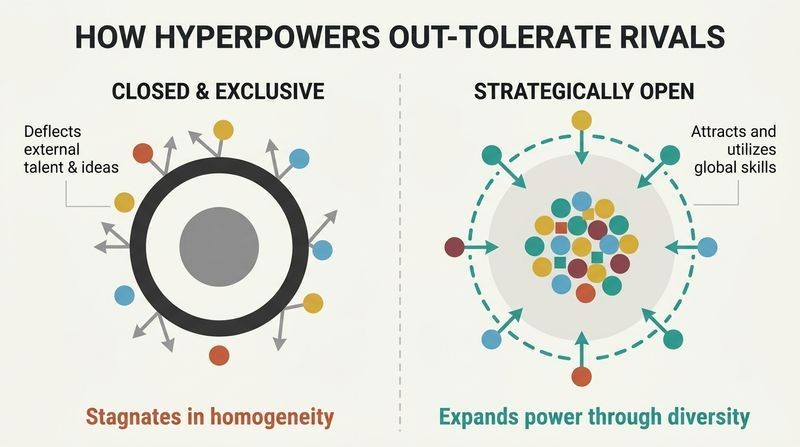
Tolerance is the hidden engine of hyperpowers. Chua's central thesis is that every society that achieved genuine global dominance, from Achaemenid Persia to the United States, was strikingly more tolerant than its competitors during its rise. She defines a hyperpower narrowly: it must clearly surpass all known rivals, be inferior to no power on earth, and project power over an enormous share of the globe. Rome, the Mongols, and the British qualify. The Aztecs and Louis XIV's France do not.
Tolerance here means something cold and strategic, not modern human-rights respect. It simply means letting different peoples live, work, and rise in your society, often for pure self-interest. The logic is intuitive: the world's best talent, wealth, and skills are never concentrated in one ethnic or religious group, so whoever pulls them in pulls ahead.
What's compelling is how Chua redefines tolerance downward to make it analytically useful. By stripping out moral connotations, she can call Genghis Khan tolerant without absurdity. This resembles economists' concept of allocative efficiency: talent flows to where it is best rewarded. The claim echoes Acemoglu and Robinson's Why Nations Fail, where inclusive institutions beat extractive ones. A fair challenge: tolerance may be a consequence of power rather than its cause, since confident, expanding states can afford magnanimity that anxious ones cannot. Chua concedes tolerance is necessary but not sufficient, which protects the thesis but also makes it harder to falsify cleanly.
Cyrus the Great conquered by respecting the gods of the conquered
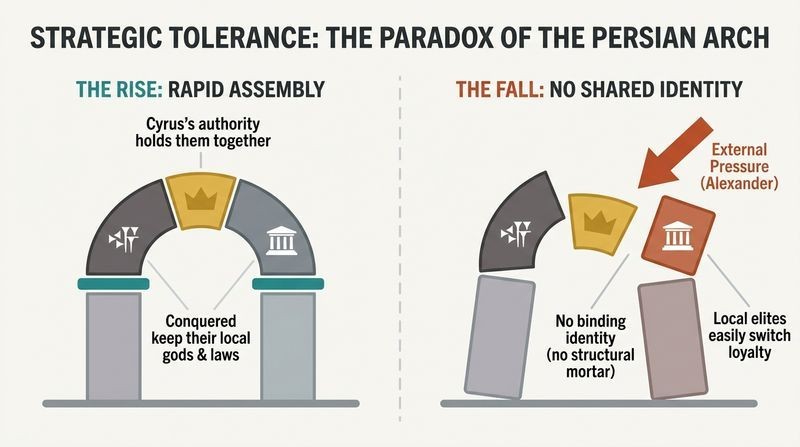
Strategic tolerance built the first world empire. Cyrus, founder of Achaemenid Persia around 559 BC, ruled perhaps 42 million people, nearly a third of humanity. His method was not annihilation but co-optation. When he took Babylon, he bowed before the god Marduk and presented himself as a divinely chosen liberator. He freed the Jews from captivity, rebuilt their temple, and let conquered peoples keep their laws, languages, and rulers.
This was expediency, not principle. Honoring local deities gave Cyrus legitimacy and reduced rebellion. His successor Darius drew craftsmen from sixteen peoples to build Susa's palace and staffed his army with Medes, Phoenicians, Libyans, and Bactrians. Yet the same tolerance that assembled the empire left it with no common identity. When Alexander arrived, local elites simply switched masters, having never been true patriots.
The Cyrus Cylinder is sometimes hailed as the first charter of human rights, a reading Chua rightly calls anachronistic. Her deflationary account is more persuasive: Cyrus practiced what modern management would call decentralized federalism, minimizing the transaction costs of governing diversity. The deeper insight is the paradox she introduces here, that tolerance which preserves distinct identities also preserves the fault lines along which empires later crack. This anticipates a tension political scientists call the integration-diversity tradeoff. Persia never solved it. The lesson foreshadows every hyperpower's eventual problem: how to bind conquered peoples together without erasing what made recruiting them valuable in the first place.
Rome let a Spaniard, an African, or a Gaul become emperor
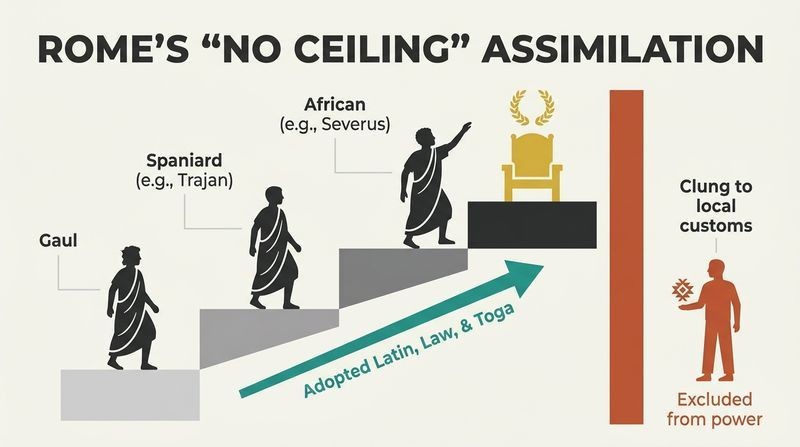
Rome turned assimilation into an ideology. Unlike Persia, Rome offered conquered elites a cultural package so appealing that Britons and Berbers wanted to become Roman. There was no ceiling: Trajan was born in Spain, Septimius Severus was African. In AD 212 Caracalla extended citizenship to every freeborn male in the empire. The formula rewarded assimilation, not diversity for its own sake. Barbarians who adopted the toga, the Latin language, and Roman law were welcomed; those who clung to trousers and their own gods were scorned.
Rome came closest to solving the glue problem by making the conquered into stakeholders. Its religious tolerance was practical: Romans absorbed foreign gods the way they absorbed foreign soldiers. Decline set in when Rome turned intolerant, persecuting Christians, then heretics and pagans, and finally practicing apartheid against its own Germanic recruits.
Rome's genius was psychological branding centuries before the term existed. Citizenship functioned like equity in a startup: it aligned the incentives of provincial elites with imperial survival, so that, as Gibbon observed, magistrates rarely needed troops. The contrast with Persia is instructive for any multiethnic organization, from nations to corporations: assimilation with upward mobility generates loyalty that mere autonomy cannot. Chua's causal claim about Christianity and decline is more contested. Gibbon blamed Christianity too, but modern historians emphasize fiscal crisis, plague, and military overstretch. Intolerance likely accelerated fragmentation rather than initiating it, a nuance that keeps the thesis honest.
The Mongols conquered the world on merit, not bloodline
Genghis Khan destroyed the tribal caste system of the steppe. Born an outcast named Temujin, he reorganized his army into interethnic squads of ten who lived and fought as brothers regardless of tribe. He promoted camel boys and cowherds to general based on talent and loyalty, while excluding untrustworthy blood relatives. He decreed religious freedom for Buddhists, Christians, Muslims, and shamanists alike, and exempted clergy of all faiths from taxes.
Illiterate nomads ran the largest land empire ever by absorbing the skills they lacked. They took Chinese engineers to build siege catapults, Uighur scribes to create a writing system, and Persian administrators to govern. At Karakorum, the Great Khan hosted structured interfaith debates. This openness let a people with no agriculture or technology rule Baghdad, Kiev, and Beijing. When the four khanates turned to religious zealotry, the empire splintered.
The Mongol case is Chua's most provocative because it forces readers to separate brutality from intolerance, which are not the same thing. Genghis Khan was savage in war yet remarkably neutral about identity, a combination that unsettles modern intuitions. Recent scholarship, including Jack Weatherford's work she draws on, frames the Pax Mongolica as an early globalization that moved plague, gunpowder, paper money, and printing across Eurasia. The meritocratic army prefigures how modern militaries and firms outperform nepotistic ones. The counterpoint: Mongol tolerance was thin, extending to usefulness but never to shared identity, which is precisely why the empire dissolved within a few generations.
Spain expelled its Jews and financed its own decline
Intolerance can bankrupt a rising power. Medieval Spain was Europe's most religiously diverse society, with large Muslim and Jewish populations who dominated finance, trade, and skilled crafts. Jewish bankers funded the crown; Muslim laborers farmed the south. Then in 1492, the same year Columbus sailed, Ferdinand and Isabella expelled the Jews. The Inquisition burned thousands of conversos, and later expulsions drove out roughly 250,000 Moriscos, gutting Spain's agricultural base.
Spain destroyed its own credit system. Having driven out its financiers, the crown became dependent on hated foreign bankers, chiefly the Genoese, at ruinous interest rates. American gold and silver flowed in but was pledged in advance to foreigners. Royal bankruptcies followed in 1557 and 1575. Purity of blood statutes and the expulsion of Jesuits capped a self-destructive pattern that ensured Spain would never achieve world dominance.
Spain is Chua's clearest natural experiment: a society that chose ideological purity over economic pragmatism and paid immediately. The parallel to modern brain drain is exact. When Nazi Germany expelled Jewish physicists, it handed the atomic bomb to America; when Uganda expelled its Indian entrepreneurs in 1972, its economy collapsed. Economists would call this a self-inflicted supply shock to human and financial capital. Ferdinand's own reported acknowledgment of the harm underscores that leaders sometimes knowingly sacrifice prosperity for cohesion or zeal. The episode also complicates triumphalist narratives of Spanish empire: the gold of the Americas masked a rotting financial core.
Tiny Holland got rich by welcoming Europe's persecuted outcasts
A swamp became a hyperpower through refugee talent. The seventeenth-century Dutch Republic, a nation of barely two million, eclipsed every European rival. Its 1579 founding charter guaranteed that no one would be persecuted for religion. While the rest of Europe burned heretics, Amsterdam became a haven for Sephardic Jews fleeing Spain, Protestant merchants fleeing Antwerp, Huguenots fleeing France, and Pilgrims fleeing England.
Tolerance was a deliberate economic strategy. Dutch leaders argued openly that religious freedom would attract the immigration their economy needed. It worked spectacularly. Refugee capital and skill built the Amsterdam Stock Exchange, cornered the global diamond trade, and created the United East India Company. The Dutch pioneered a new model of dominance: not conquest of neighbors but commerce backed by naval power. By 1670 they owned more shipping tonnage than England, France, Portugal, Spain, and Prussia combined.
The Dutch mark Chua's pivotal turn from conquest to commerce, and from tolerating the conquered to attracting the persecuted. This is the template modern nations still use. Richard Florida's research on the creative class found that cities scoring high on tolerance and openness attract talent and generate innovation, a direct twentieth-first-century echo. The Dutch also show that smallness is no barrier when a country becomes a magnet rather than a conqueror. One caution Chua herself raises: Dutch tolerance was purely internal. Abroad, in Java and South Africa, the Dutch practiced slavery and apartheid, revealing that domestic openness and colonial brutality coexisted comfortably.
Britain's rise ran on Scots, Jews, and Huguenots it once scorned
Yesterday's outcasts became the empire's builders. After 1689, Britain shifted from vicious religious warfare toward tolerance, and three formerly marginalized groups powered its ascent. A Scot conceived the Bank of England, Huguenots funded it, and Jews brokered its largest loans. Jewish financiers introduced the stock exchange and made London the world's financial capital. Scots, integrated after the 1707 Act of Union, became the empire's most aggressive administrators, soldiers, and inventors, giving Britain James Watt's steam engine and the industrial revolution.
But British tolerance hit a wall of race and religion. In Catholic Ireland and across its nonwhite colonies, Britain ruled as an Occidental despot, presuming white Christian superiority. It made Britons of Welshmen and Scots but never of the Irish or Indians. This failure of tolerance, too little and too late, is why Britain ultimately lost both Ireland and its empire.
Britain embodies Chua's most modern tension: it rose after the Enlightenment made equality a moral ideal, so its instrumental tolerance at home collided with racist domination abroad. The Scottish story is a striking case of converting a defeated, resentful population into loyal empire-builders, essentially the opposite of what Spain did to its minorities. Sociologists would call this successful incorporation. The Irish counterexample is equally sharp: Colley's work on British identity shows it was forged on anti-Catholic Protestantism, which structurally excluded Ireland. The lesson generalizes uncomfortably: tolerance extended selectively, along racial or sectarian lines, plants the grievances that later dismember empires.
America's atomic bomb and Silicon Valley were built by immigrants
The United States is the first nation of immigrants to dominate the world. Its edge has always been human capital drawn from everywhere. When Hitler expelled Jewish scientists, Einstein, Fermi, Teller, Szilard, von Neumann, and others fled to America and built the atomic bomb, arguably the single greatest immigrant contribution in history. Chua calls it the greatest influx of ability on record.
The pattern repeated in the digital age. Eugene Kleiner, a refugee from Nazi Vienna, cofounded Fairchild Semiconductor and then invented modern venture capital. Andy Grove, who fled Hungary, drove Intel to produce most of the world's microchips. More than half of Silicon Valley startups founded between 1995 and 2005 had at least one immigrant founder. America's founders also made a genuinely radical move in 1789: declaring there would be no national church, extending religious tolerance further than Britain or Holland ever had.
America perfects the Dutch model at continental scale, pairing a nation of immigrants with a free market and democracy, a trifecta Chua argues no rival matched in the nineteenth century. The venture-capital angle is underappreciated as a form of strategic tolerance: it is a financial mechanism for rewarding talent regardless of origin. Endogenous growth theory (Paul Romer) confirms that ideas and skilled people, not land or raw materials, drive modern wealth. The unresolved question Chua presses is whether America's post-9/11 immigration restrictions are quietly dismantling this advantage, precisely as Gates and other executives warned, handing talent to competitors just as earlier empires did.
The tolerance that builds empires also seeds their collapse
Every hyperpower faces the same trap. Tolerance attracts diverse peoples and lets them keep their identities, but this very diversity eventually strains the social fabric. Chua argues tolerance repeatedly hits a tipping point that triggers backlash, xenophobia, and calls for purity. Persia fragmented because it had no common identity. Rome descended into religious persecution and ethnic apartheid against its Germanic recruits. Tang China turned violently xenophobic after a foreign general's rebellion, slaughtering foreign merchants and banning foreign religions.
Decline correlates with intolerance in every case, though cause and effect blur, since intolerance can be both a trigger of decline and a symptom of it. The recurring danger is that a dominant core group, feeling threatened, reasserts its true identity and expels the outsiders who fueled its rise. This is the surest path to unraveling.
This is the book's tragic structure and its most sobering contribution. It resembles what historian Arnold Toynbee called the breakdown of civilizations through loss of creative capacity, and what Peter Turchin's cliodynamics models as elite overproduction and social fragmentation. The mechanism is psychologically real: research on threat and intergroup bias shows that perceived scarcity or insecurity reliably spikes in-group favoritism and out-group hostility. Chua's honesty about the cause-versus-symptom ambiguity is a strength, not a weakness. The uncomfortable implication for any successful pluralistic society is that its openness is not self-sustaining; it must be actively defended against the backlash its own success generates.
China and the EU cannot become hyperpowers because they repel outsiders
Rising powers still lack the immigrant magnet. Chua argues neither of America's chief rivals can achieve true world dominance because neither attracts the world's best talent. China is a spectacular success of internal tolerance, having forged one Han identity from hundreds of diverse peoples over three thousand years. But it remains a nonimmigrant society: a Westerner cannot become Chinese, and the government does not want foreigners to. China borrows talent through its diaspora and by forcing technology transfers, imperfect substitutes for genuine immigration.
The European Union built a magnet for nations, not individuals. Its expansion through voluntary accession is a novel form of strategic tolerance, but its tolerance points inward, uniting Europeans while resisting immigrants, especially Muslims. Germany's failed green card scheme, offering skilled workers jobs but no path to citizenship, shows why the EU keeps losing talent to Australia, Canada, and the United States.
The framework yields a genuinely falsifiable prediction, which is rare for grand historical theories. Chua's distinction between a magnet for nations (the EU) and a magnet for individuals (the US) is analytically sharp. The China argument is the most debatable point in the book: China's growth since 2007 has been staggering, and dominance may not require immigration if a nation can educate and mobilize 1.4 billion people while acquiring technology abroad. Yet the deeper claim holds up well, that the cutting edge of global talent is never confined to one ethnicity, so ethnically closed societies face a structural ceiling on innovation-driven supremacy.
America may stay dominant only if it stops trying to be
Empire-building is obsolete for a democratic hyperpower. Chua argues the post-9/11 calls for an American empire misread history. Rome could make conquered peoples into citizens; a modern democracy cannot annex Iraqis or grant them votes in US elections. So America dominates billions who feel no allegiance to it, generating the fierce anti-Americanism that direct military intervention only inflames. The face of American empire, she writes, is a war with no upside.
The winning formula is the old one: be a magnet, not a conqueror. America should attract enterprising talent, reward ingenuity regardless of origin, and avoid self-destructive military adventures. To solve the glue problem abroad without offering citizenship, she suggests open immigration, multinational corporations that give foreigners a stake in American success, and multilateral leadership on shared problems like climate, disease, and terrorism.
Chua's prescription lands as a plea for soft power before Joseph Nye's term became ubiquitous in policy circles: influence through attraction rather than coercion. Her insight that a democratic hyperpower is structurally weaker than an autocratic one at binding conquered populations, because it cannot offer subjecthood or citizenship, is genuinely original and cuts against the assumption that democracy is an unmitigated strategic asset. The practical suggestions are sensible if modest. Written in 2007, before the 2008 crisis, the populist immigration backlash, and renewed great-power rivalry, the argument reads as prescient about the costs of overreach and the fragility of the talent magnet America long took for granted.
Analysis
Day of Empire is a thesis-driven work of comparative world history, sweeping from Achaemenid Persia to twenty-first-century America to defend a single elegant proposition: relative tolerance is a necessary (not sufficient) condition for world dominance, and intolerance reliably attends decline. Chua, a Yale law professor writing in the shadow of the Iraq war, wields the historian's breadth with a lawyer's argumentative discipline. The book's power lies in its deflationary redefinition of tolerance as strategic self-interest, which lets her treat Genghis Khan and Thomas Jefferson under one analytic lens without pretending they shared values.
The framework's greatest strength is falsifiability. Chua stakes clear claims: no society built on racial purity or religious zealotry has ever achieved global hegemony; the EU and China face structural ceilings. This invites productive disagreement rather than vague admiration. Her weakest link, acknowledged candidly, is the cause-effect ambiguity between intolerance and decline. Intolerance may be a symptom of insecurity that decline itself produces, making the correlation real but the arrow uncertain. Turchin's cliodynamics and Acemoglu-Robinson's institutional economics offer more mechanistic accounts of the same pattern.
The book's deepest contribution is the glue problem: hyperpowers must bind dominated peoples into common purpose, yet the tolerance that recruits diverse talent also preserves the identities along which empires later fracture. This tension, sharpened by her observation that democracies cannot offer subjecthood as Rome offered citizenship, reframes American power as structurally constrained rather than unlimited. Written in 2007, before the immigration backlash, renewed nationalism, and intensified China rivalry, the argument has aged into unexpected relevance. What dates it is optimism about globalization's inevitability. What endures is the warning, delivered through her own immigrant family's story, that a nation's openness is never self-sustaining and must be defended against the very backlash its success provokes.
Review Summary
Day of Empire argues that tolerance is essential for empires to achieve global dominance. Amy Chua examines historical "hyperpowers" including Persia, Rome, China, the Mongols, Dutch, British, and America, showing how their rise correlated with accepting diverse peoples and their decline with growing intolerance. Reviewers appreciate the compelling thesis and accessible writing but note repetitiveness, historical oversimplifications, and potential confusion between causation and correlation. Critics question whether tolerance causes success or results from it, and some find the evidence cherry-picked. Most agree it's thought-provoking and relevant, though scholarly depth varies.
People Also Read


About the Author

Download PDF
Download EPUB
.epub digital book format is ideal for reading ebooks on phones, tablets, and e-readers.








































