Key Takeaways
1. Donald Trump embodies the quintessential narcissistic personality.
If one were to strike from the ranks of political leaders all those with significant narcissistic personality traits, the ranks would be perilously impoverished.
Defining narcissism. Trump exhibits a pervasive pattern of grandiosity, an insatiable need for admiration, and a profound lack of empathy, aligning with the Diagnostic and Statistical Manual's criteria for Narcissistic Personality Disorder (NPD). This includes:
- A grandiose sense of self-importance, exaggerating achievements.
- Preoccupation with fantasies of unlimited success, power, and brilliance.
- Belief in being "special" and unique, associating only with high-status individuals.
- A sense of entitlement, expecting favorable treatment and compliance.
Underlying insecurity. Beneath this arrogant façade lies deep-seated insecurity, which Trump defends through aggression and deflection. His extreme sensitivity to perceived slights, such as losing the popular vote or criticism of his physical appearance, triggers intense reactions. This fragility necessitates a constant external validation to maintain his inflated self-image.
Malignant narcissism. At the extreme end of the spectrum, Trump displays traits of malignant narcissism, characterized by a weak or absent conscience, a readiness to betray, and unconstrained aggression. His loyalty is a one-way street, fostering a sycophantic inner circle unwilling to challenge him, as seen in his treatment of figures like Jeff Sessions.
2. His entrepreneurial background shaped a relentless drive for success.
Trump often states that his father taught him to “be a killer,” and told him that “you are a king.”
Family legacy. Trump's drive for success is deeply rooted in his family's entrepreneurial history, particularly his paternal grandfather Friedrich, who amassed a fortune during the Gold Rush, and his millionaire real estate developer father, Fred. Fred Trump, a "King of Brooklyn and Queens" real estate, groomed Donald as his successor, instilling in him a desire not just to follow, but to surpass.
Shaping influences. While his father's influence was overt and celebrated, his mother, Mary, played a more detached role, leading to an apparent lack of a solid maternal relationship. This absence may have contributed to his problems with trust, underlying insecurity, and difficulties with empathy. His early life was marked by:
- Accompanying his father on property rounds, learning business tactics.
- Being a "tough kid" and troublemaker, leading to military academy enrollment.
- Thriving in military discipline, which he later equated to military service.
Ambition and rebellion. Despite his father's warnings against Manhattan real estate, young Donald saw it as a challenge, incubating his dream of becoming a major player there. This blend of admiration for his father's success and a rebellious ambition to exceed it defined his early career trajectory.
3. A constant need for admiration fuels his pursuit of the spotlight.
If you don’t tell people about your success, they probably won’t know about it.
Celebrity as validation. Trump has consistently sought celebrity status to gain recognition for his wealth and success, viewing it as essential for self-worth. This need for constant admiration compensates for his underlying insecurity, driving him to display himself, his wealth, and his achievements to evoke attention.
Media manipulation. His career has been a "rollercoaster of successes and failures," but he masterfully used media to control his image. From his best-selling book The Art of the Deal to his reality TV show The Apprentice, he rebranded himself as an icon of American success, even when his businesses faced bankruptcy. Key aspects include:
- Belief that "bad publicity is sometimes better than no publicity at all."
- Using his show The Apprentice to transform his image from "disgraced huckster" to "titan of industry."
- Co-ownership of Miss Universe, where he allegedly entered dressing rooms, reinforcing his desire for attention.
Insatiable craving. No amount of positive attention satisfies him; he continuously seeks new audiences and recognition. This insatiable craving ultimately led him to run for president, expanding his audience from national celebrity to global figure.
4. Trump's relationships are transactional, serving his self-esteem.
For a man to be successful he needs support at home, just like my father had from my mother, not someone who is always griping and bitching.
Self-object relationships. Trump views his wives, children, and even friends as "self-objects," whose primary function is to bolster his self-esteem and provide reassurance for his fragile ego. Their physical attractiveness and willingness to mirror his desired image are paramount. His current wife, Melania, is described as a "perfect mate" who "doesn't make waves" and "enjoys her role of stepping back."
Disposable partners. His two divorces stemmed from partners no longer fulfilling his narcissistic needs. When Ivana began focusing on work, he felt he was "married to a businessperson rather than a wife," leading to his affair with Marla Maples. He lacks the capacity to empathize with his wives' individual needs, forming only shallow attachments.
Children as extensions. Trump sees his children as reflections of himself, equating their success with his own. While he claims to be a "very good father," he admitted he wouldn't "do anything to take care of them," preferring to "supply funds." His eldest children, Donald Jr., Eric, and Ivanka, now serve as loyal sycophants, defending him and bolstering his image, often making controversial statements themselves.
5. He governs as "King Donald," applying business tactics to the presidency.
This man who was once the King of New York and eventually the King of Real Estate, has in his presidential role transitioned into King Donald of the United States.
Regal decision-making. Trump approaches the presidency as if he were still a business tycoon, a "King of Real Estate," applying his personal "rules of the kingdom" to national governance. This style is characterized by:
- Impulsive decisions, often announced via early morning tweets.
- Discomfort with nuance, viewing challenges to his ideas as personal criticisms.
- A "royal imperative" to his thoughts, expecting immediate implementation without consultation.
Distrust and paranoia. His leadership is guided by principles like "hire the best people, and do not trust them" and "be paranoid." This inherent distrust impedes effective collaboration with Congress and fosters a sycophantic White House staff wary of inciting his anger. His decision-making prioritizes:
- What benefits Donald J. Trump.
- What appeals to his base.
- What is best for America (often last).
"Liar-in-Chief." A remarkable feature of his presidency is the frequent propagation of untruths, from "big lies" to habitual "little lies." He uses hyperbole to excite his followers, believing "people want to believe that something is the biggest and the greatest and the most spectacular." This intentional assault on truth is a core component of his governing style.
6. The charismatic lock-and-key dynamic explains his base's unwavering loyalty.
There is a powerful, almost chemical attraction between the mirror-hungry charismatic leader and the ideal-hungry charismatic follower.
Mutual intoxication. Trump's "mirror-hungry" personality thrives on the adoration of his followers, while his "ideal-hungry" followers seek a powerful, nurturing figure to complete their "wounded selves." This creates a mutually reinforcing, almost hypnotic, relationship. His rallies serve as a vital arena for this exchange, where his externalizing rhetoric against perceived enemies is met with chants of approval.
Heroic rescuer. Trump appeals to individuals who feel "overwhelmed, besieged by fear and doubt," offering a sense of conviction and certainty. His "Make America Great Again" (MAGA) slogan resonates with those yearning for an idealized past, particularly the working class and rural communities who feel abandoned. He provides an external target for their anger, absolving them of personal responsibility.
Destructive charisma. Unlike "reparative charismatics" who heal societal divisions, Trump exemplifies a "destructive charismatic" leader. He pulls his followers together by exporting hatred to an external enemy, using absolutist, polarizing rhetoric ("us versus them," "good versus evil"). This dynamic is evident in chants like "Lock her up!" and his encouragement of violence against protesters.
7. Trump's rhetoric grants "permission to hate," emboldening extremists.
Neither Trump nor the KKK of the 1920s created hate, rather they appealed to the hate many Americans were already feeling.
History of divisive rhetoric. Trump has a long history of being accused of racism, from a 1970s housing discrimination lawsuit to his 1980s calls for the death penalty for the "Central Park Five" (later exonerated). His 2015 announcement speech, referring to Mexicans as "criminals and rapists," set the tone for a presidency marked by derogatory language towards minority groups.
Emboldening extremists. His rhetoric, including terms like "globalist" and "invasion," has been embraced by right-wing extremists, white supremacists, and neo-Nazis. Figures like David Duke and Richard Spencer have publicly supported Trump, believing he is "one of them" and that his presidency empowers them to operate more freely. This has led to:
- A 64% increase in violence against Muslims, Sikhs, Arabs, and South Asians since November 2016.
- A 37% increase in anti-Semitic hate crimes in 2017.
- A 226% increase in hate crimes in counties hosting Trump rallies.
Hate crime hoax theories. Trump and his supporters often propagate theories that hate crimes are hoaxes, fabricated by the left to undermine him. This narrative, echoed by white supremacist groups, dismisses legitimate concerns and further fuels division, suggesting that only white and Christian communities are true victims of hate.
8. His presidency has significantly impacted the nation's mental health.
Increasingly the term paranoia has been used to refer not only to clinical paranoia but also more broadly to a personality trait and a personality style characterized by guardedness, suspiciousness, hypersensitivity, and isolation.
Widespread stress and anxiety. Trump's presidency has led to increased stress across a broad spectrum of the American public, particularly among women, minorities, and LGBTQ+ communities. Studies by the American Psychological Association show a continuous rise in stress related to the political climate since 2016, leading to:
- Increased reports of anxiety and depression.
- "Trump Anxiety Disorder" characterized by unpredictable sociopolitical climate.
- Traumatic effects on the transgender community due to policy changes.
Societal division. The political polarization has fractured families and friendships, with many Americans reporting arguments or even ending relationships over political differences. This "hatred of the other side" makes it difficult to engage in constructive dialogue or empathize with opposing viewpoints.
Cultivating paranoia. Trump's own "paranoid style," which he views as a positive attribute, has become a political strategy. He fosters a sense of "us versus them," portraying adversaries as "enemies to be destroyed." This is evident in:
- His relentless attacks on the media as "fake news" and "enemy of the people."
- Accusations of a "deep state coup" against his administration.
- Propagation of conspiracy theories about immigration and terrorism.
9. "America First" defines his disruptive and self-serving foreign policy.
American interests come first. Always. No apologies.
Unilateral approach. Trump's "America First" foreign policy prioritizes perceived American interests above traditional alliances and international norms. He often acts unilaterally, bypassing diplomatic protocols and consulting himself first, leading to:
- Strained relationships with European allies, imposing tariffs and questioning NATO's value.
- Dismissal of expert advice, as seen in his interactions with Defense Secretary Mattis and Secretary of State Tillerson.
- A focus on transactional relationships, valuing countries based on their financial contributions or perceived benefits to the U.S.
Contradictory stances. His foreign policy is marked by shifting views and contradictions, often driven by personal gain or a desire to dismantle Obama-era policies. Examples include:
- Initially condemning Saudi Arabia, then defending strong ties despite human rights abuses, citing "cash" and arms deals.
- Fluctuating positions on Syria, from condemning Assad's chemical attacks to withdrawing troops and declaring ISIS defeated prematurely.
- Boasting about a "deal of the century" for Israeli-Palestinian peace while making unilateral decisions like moving the U.S. Embassy to Jerusalem.
Appeasing the base. Many of his foreign policy decisions, however chaotic they appear, are aimed at appeasing his base. His anti-humanitarian intervention stance resonates with Americans wary of foreign entanglements, and his rhetoric against globalization, immigration, and environmentalism aligns with the concerns of his working-class and rural supporters.
10. The future holds potential for conflict if Trump refuses to concede.
Should he lose, it will not be gracefully accepted. Rather he will “rage, rage, at the passing of the light,” for the loss of the limelight which has been such a rewarding accompaniment of the presidential role will be very difficult for him to tolerate.
Refusal to accept defeat. Trump's past statements and behavior suggest he may not gracefully accept defeat in the 2020 elections. In 2016, he refused to commit to honoring election results if he lost, and later claimed massive voter fraud. His consistent attacks on the media and intelligence community further indicate a predisposition to discredit any outcome not in his favor.
Vulnerability of the interregnum. The period between the election and inauguration would be particularly vulnerable if Trump loses. His tendency to take bold actions when facing setbacks could lead to impulsive decisions, potentially escalating conflicts in regions like Venezuela or with North Korea, as a way to regain a sense of control and attention.
Supporter reactions. Trump's rhetoric has already inspired violent actions from some supporters, including attacks at rallies and attempted mail bombings. If he calls foul play or promotes conspiracy theories after a loss, the extreme reactions of some of his base could lead to further civil unrest. The divisions his presidency has caused will likely take years, if not decades, to mend, regardless of the 2020 outcome.
Review Summary
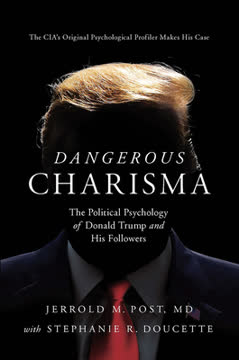
Reviews for Dangerous Charisma are mixed, averaging 3.56 out of 5. Readers appreciate the psychological framework analyzing Trump's narcissism and the symbiotic relationship between charismatic leaders and their followers. Many praise Post's credentials and his eerily accurate predictions about Trump's refusal to accept 2020 election results. Common criticisms include excessive repetition of widely known information, poor editing, and insufficient psychological depth. Some felt the book read more like a news summary than a professional psychiatric analysis, while others found it scholarly, compelling, and essential reading.