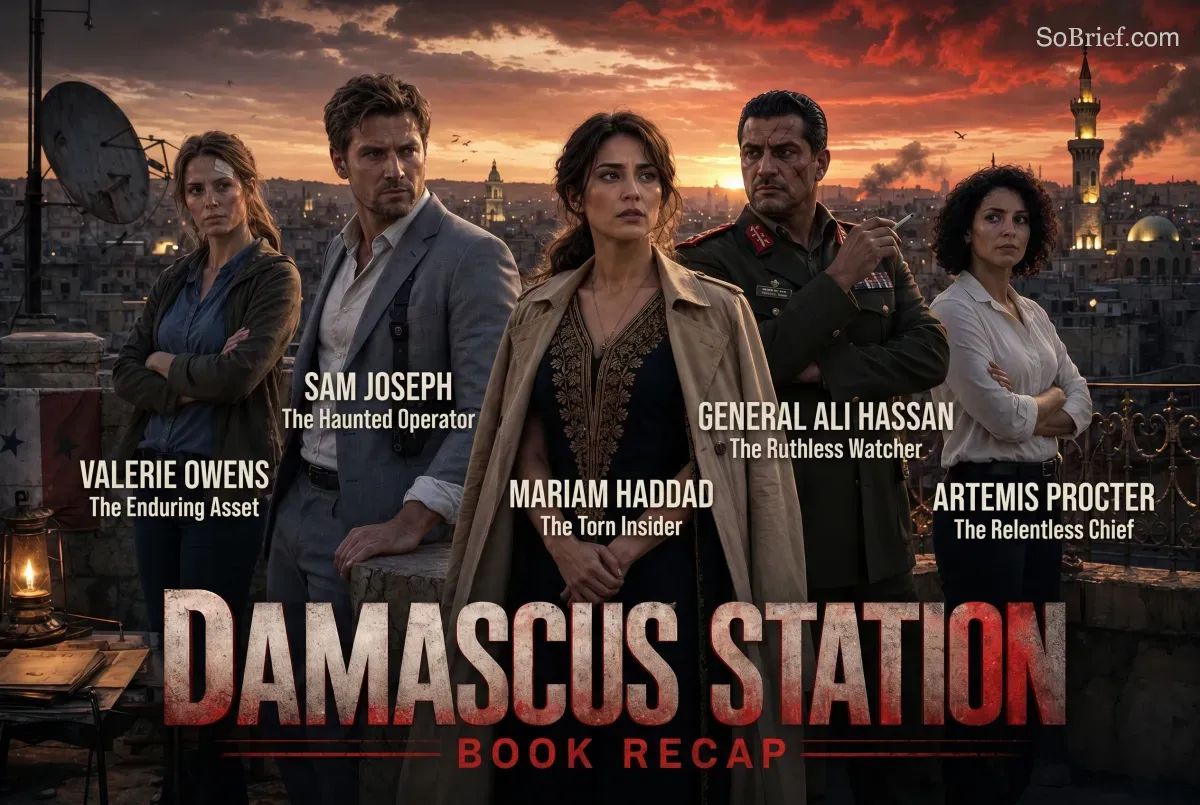


Plot Summary
Val's Scream at Dawn
Sam1 drives into wartime Damascus under Canadian cover to extract KOMODO, a CIA asset inside Syria's chemical weapons program, and bring home Val Owens,12 KOMODO's handler and his close friend from Baghdad. Eight hours of surveillance detection routes, six checkpoints — he passes them all.
But KOMODO never appears. Val12 arrives at the safe house confirming he missed every pickup window. Before dawn, the mukhabarat smashes through the front door. Val12 cannot fold her six-foot frame into the car's hidden compartment — built for a five-foot-five scientist.
They make a split-second decision: Val12 stays, shielded by diplomatic immunity. Sam1 drives into the night. The last sound he hears is Val12 screaming. That sound will pursue him across continents, into new missions, into a love affair that remakes his life.
Choosing Mariam
At Langley, NE Division chief Ed Bradley6 tasks Sam1 with approaching a Syrian Palace delegation visiting Paris. Procter,4 the ferocious Chief of Station Damascus, joins the planning.
Sam1 and analyst Zelda Zaydan11 scour trace results and identify Mariam Haddad2 — a thirty-two-year-old political counselor to Assad, daughter of a general commanding III Corps in Aleppo, niece of a colonel in the SSRC's chemical weapons branch. A stolen mukhabarat report reveals that Mariam's cousin Razan7 was arrested and beaten at a protest — her eye destroyed by a club.
Sam1 sees the angle: a well-connected insider with access, family grievance, and a gateway to her uncle's10 chemical weapons knowledge. He deploys to Paris with the Kassab triplets13 — Elias, Yusuf, and Rami — three Syrian-American brothers who run countersurveillance for CIA.
The Red Dress Rescue
The Kassab brothers13 discover a three-man Syrian surveillance team shadowing Mariam2 through Paris — amateur watchers, likely sent by her own government. Sam1 needs a natural setting. A diplomatic reception provides it.
He spots Mariam2 cornered by a tedious Bulgarian diplomat and sweeps in with a warm hug, improvising as old friends. She plays along, radiant in a red silk dress. A mukhabarat minder warns her to report all American contacts; she dismisses him coldly.
Over drinks the next evening, their connection deepens — she describes arriving in Paris at sixteen, feeling freedom for the first time, an invisible pressure lifting from her chest. He tells her about poker and Vegas. She shares the story of Razan's beating at the protest. He extends his hand across the table. She takes it.
Three Bodies in Villefranche
Sam1 follows Mariam2 to the French Riviera, where she's pressing exiled opposition leader Fatimah Wael15 to denounce the rebellion. They meet at Mariam's2 old Krav Maga studio, where she is ferocious — head-butting Sam1 through his face mask, pinning him, driving knees into his ribs. That evening, he walks her to her hotel room. The doorknob bears scratch marks.
Inside: three men with pistols and a baton, sent by Palace counselor Jamil Atiyah14 to abduct her. Sam1 head-butts the largest, seizes a baton, hurls a lamp. Mariam2 kicks a gun from one man's grip. Sam1 fires a suppressed pistol until all three lie dead. Blood freckles Mariam's2 forehead. They hang a Do Not Disturb sign and flee. A Paris Station crew arrives with saws and acid.
ATHENA Born in Èze
At a CIA safe house perched above the Mediterranean, Sam1 confesses he works for the Agency. Mariam2 is unsurprised — she had deduced his fighting skills, the villa, the careful questions. On the terrace, she agrees to spy for the CIA.
He walks her through dead drops, signals, and communication plans. She refuses payment. They practice retrievals along coastal trails, Sam1 filming as she learns to kneel, plant, and move fluidly. Procter4 flies from Damascus, puts Mariam2 through punishing surveillance-detection drills in the streets of Nice.
Mariam2 spots the overhead drone, evades it by ducking under awnings and emerging in a garish tourist T-shirt. That night, in the chateau's master bedroom, Sam1 crosses the line the Agency forbids — sleeping with his newly encrypted asset, ATHENA.
Val's Star on the Wall
A Syrian document thief photographs proof that Val12 is dead. Procter4 shows Sam1 the image on a Langley walking path: Val's12 face, a thin incision tracing her hairline. Ali's3 official report claims heart failure. The truth, confirmed by Agency doctors: Basil Mahkluf,8 Rustum Hassan's5 enforcer, scalped her during interrogation.
At CIA's annual memorial ceremony, a 134th star is chiseled into the marble wall. No name appears in the Book of Honor. Sam1 embraces Val's12 sobbing mother, unable to explain that her daughter was murdered.
The President signs a lethal finding: Ali Hassan3 is to be eliminated as national self-defense, zero collateral damage. Procter4 orders Sam1 to Damascus with the Kassab brothers13 to build an assassination plan. Sam1 detours through Vegas to grieve, sending his poker winnings home to his mother.
Two Thousand Tons
Sam1 plants a USB stick at the mountaintop dead drop in Damascus. Mariam2 retrieves it and sneaks the device into Bouthaina's9 computer during a ten-second window while her boss takes a phone call.
Analyst Zelda,11 running on caffeine and four hours of sleep, decodes the haul: the Palace has facilitated procurement of two thousand metric tons of sarin precursors through shell companies — enough for two hundred fifty tons of weaponized nerve agent. A redirected spy satellite confirms the production site near Jableh, where trucks bear SSRC Branch 450 plates.
Meanwhile, Rustum5 forces Mariam's uncle Daoud10 to witness a sarin test on prisoners locked in tunnels beneath an emptied village. Fifty-seven people die. The regime is not stockpiling a deterrent. It is building an arsenal for domestic slaughter.
Moscow Sends Its Best
Ali Hassan3 — spy hunter, detective, reluctant servant of the regime — reads SVR intelligence confirming the CIA has recruited a new source inside Syria. He cross-references Sam's1 name from the embassy roster with a Paris mukhabarat report describing his warm conversation with Mariam2 at a diplomatic reception.
Ali3 summons Mariam2 for questioning. A Russian cargo plane lands at Mezzeh Military Airport carrying twelve SVR and FSB officers under General Volkov,19 veterans of counterintelligence operations against the CIA in Moscow.
They build a command center, organize seven combined teams, and track Sam's1 every movement — phone calls, apartment bugs, street tails. While this net tightens, Sam1 and the Kassab brothers13 position a car bomb — Semtex fitted inside a Pajero's door speaker — on Ali's3 nightly smoking route outside the Security Office.
Ali Takes Razan
The night before Mariam2 flies to Italy for a meeting with Sam1 and Procter,4 Ali3 and his lieutenant Kanaan16 knock on her apartment door. They arrest Razan7 under the Emergency Law — sedition, punishable by imprisonment or death.
Mariam2 tackles her cousin as Razan7 tries to vault the balcony railing, pulling her back from a four-story plunge. Razan7 begs to be released, begs to jump. Ali's3 message is surgical: cooperate against the American, and your cousin lives. In Tuscany, Mariam2 arrives hollow-eyed and guarded.
Sam1 senses something catastrophically wrong but cannot identify it. She weeps at dinner, clings to him in a moonlit vineyard, whispers for his promise. She does not tell him what Ali3 has done. She has already surrendered the covcom device CIA gave her.
The Planted Briefcase
Back in Damascus, Mariam2 executes the frame-up of Atiyah.14 She smuggles a CIA-fabricated replica of his Ferragamo briefcase into the Palace — loaded with false-name American passports, cash, and a planted device — and switches it with his original during a narrow window when he leaves his office.
Retreating, she ducks into Bouthaina's9 washroom just as Rustum5 arrives unannounced. Trapped behind the door, she overhears Rustum5 tell Bouthaina9 about a backup sarin facility at a place called Wadi Barada.
She endures thirty minutes of their lovemaking, motionless, clutching the stolen bag. When they finally leave, she escapes. The Wadi Barada intelligence burns in her mind — critical, time-sensitive — but Ali3 has the covcom device. The dead drop would take too long. She has no channel left.
Three Seconds from Death
Sam1 runs a twelve-hour surveillance detection route through Damascus, heading for the safe house overlooking the Security Office. He doesn't know the Russian-Syrian combined team has surrounded him in an invisible bubble — fixed watchers in shops, mobile teams relaying his movements.
Near a train station, his instincts spike: a repeat pair of shoes, a radio crackle. He breaks the perimeter by diving into a car trunk, emerging in a wig and fake gut. At the safe house, he arms the bomb. Ali3 emerges, smoking, strolling toward the Pajero.
Fifty yards. Twenty-five. Ten. Then Volkov19 sprints from the building, shouting that they've located the American. Ali3 pivots and jogs back. The infrared sensor never triggers. The lead is false — a French diplomat in Kafr Sousa, mistaken for Sam.1
Three Kills, One Confession
Mariam2 has no device, no drop site, and information that could change the war. She follows Sam1 from the embassy on foot. Three militia — dispatched by Basil8 on Rustum's5 orders — block his path with rifles and a club.
Mariam2 charges barefoot from behind, drives a nail file into one man's groin, seizes his AK-47, and empties the magazine into the other two. At a safe house, sitting on a bare mattress, she breaks. She tells Sam1 everything: Ali3 arrested Razan,7 coerced her into surrendering the device, used her against him for weeks.
She passes the Wadi Barada intelligence. Then Uncle Daoud10 calls. Shattered by what the regime forced him to witness, he gives Mariam2 a paper listing five sarin deployment sites. Sam1 phones Procter.4 Within hours, the targets reach the President. American bombs are authorized.
Sam Walks into the Trap
Sam1 confesses to Procter4 that he is in love with his asset. She punches him in the jaw, then listens. His plan: let Ali3 capture him and endure interrogation, offering Atiyah's14 name as the mole. The switched briefcase, the planted device, the strange messages on Atiyah's14 phone — all will corroborate the false confession. If Ali3 buys it, Mariam2 stays hidden.
Sam1 will absorb the regime's suspicion into himself. Procter4 sees no alternative that saves both the agent and the intelligence stream. She shows him the seven stars tattooed on her back — officers killed at Khost Base — and warns that if he fails, she will hunt him beyond this life. That evening, Sam1 walks to the safe house knowing Ali3 waits inside. A blow from behind. Darkness.
The Basement Reckoning
Damascus convulses. A rebel bomb detonates at a security meeting, wounding Ali,3 Rustum,5 and Assad. American jets crater sarin sites across the country. Rustum,5 unhinged, shoots Bouthaina9 in her bathtub after intelligence links her to the leak. In the Security Office basement, Ali3 wires Sam1 with electrodes.
Electricity boils through his body in searing loops. He feeds Ali3 expendable information — safe houses, signals — building toward the gift-wrapped name: Atiyah.14 When he gasps it out, Ali3 dispatches men to ransack the counselor's office. They find the planted briefcase.
But Rustum5 drags Mariam2 into the cell, delirious with grief over Bouthaina.9 He carves a knife across Sam's1 face, then plunges the blade into Mariam's2 side. Ali3 tackles his brother5 and drives the knife into Rustum's5 throat. The commander of the Republican Guard bleeds out on the floor.
Procter's Mossberg
Basil's8 militia storms the American Embassy with RPGs and automatic rifles, killing Marines and diplomats. In the Station vault, Procter4 initiates destruction protocols. Two militia descend the basement stairs. She steps into the hallway with her combat shotgun and drops them both.
On security monitors, she watches Basil8 — clutching a fresh scalp — shoot analyst Zelda11 on the staircase. Procter4 drags Zelda11 to safety under fire, sends buckshot into Basil's8 backside, and screams in Arabic that she is the Angel of Death and today is not her time.
Ali,3 reeling from his brother's5 corpse in the basement, fights through the compound to deliver Sam's1 battered body to the shattered embassy. Fourteen Americans die that day. Zelda11 will not survive her wounds. Damascus Station is finished.
The Mountain Note
Six weeks later, Sam1 sits on administrative leave, career on the edge. Bradley6 hands him a scrap of paper Ali3 tucked into a folder alongside the videotape proving Basil8 murdered Val.12 Sam1 dials the Syrian number and speaks a coded phrase. Ali3 answers.
When Basil8 visits the Security Office days later, Ali3 texts a single word: Leaving. The Kassab brothers13 position the Pajero. Basil8 walks past the passenger door. The blast shreds through. In Damascus, Razan7 — freed from prison — departs as a refugee, choosing the name Umm Abiha, the old woman from Douma who once sheltered two drunk Christian girls.
Mariam,2 recovering from Rustum's5 knife, receives an envelope with French postage containing a flyer for the Èze chateau. She climbs Mount Qasioun at dusk, clutches her side, and places a note in an aluminum can.
Analysis
Damascus Station interrogates the moral architecture of complicity. McCloskey constructs a world where no character enjoys clean hands — not Sam,1 who sleeps with his asset while planning an assassination; not Mariam,2 who threatens a dissident's elderly mother before breakfast and steals state secrets by evening; not Ali,3 who rescues neighbor boys from detention and electrocutes CIA officers in his basement. The novel's central insight is that in a surveillance state, morality becomes positional rather than absolute. Every character acts from within a cage of constraints — family, regime, bureaucracy, love — and the story measures virtue not by outcomes but by the narrowness of the choices available.
The book deconstructs espionage fiction's romance with moral clarity. Where conventional thrillers divide the world into handlers and assets, heroes and villains, McCloskey's Damascus offers only gradations of entrapment. Mariam2 is simultaneously a CIA asset, a regime operative, an informant coerced by Ali,3 and a woman protecting her cousin7 — four irreconcilable roles inhabiting one body. Sam1 cannot separate professional duty from desire, and the novel suggests this fusion is not weakness but inevitability: the intimacy required to recruit a human being cannot be cleanly distinguished from love.
McCloskey also challenges the American reader's assumption of geopolitical distance. The sarin, the barrel bombs, the tortured prisoners are not exotic spectacles but policy consequences, enabled by bureaucratic inertia in Washington, where the President deliberates while children in Douma eat grass. The novel's most devastating commentary may be its quietest: a Las Vegas fountain dancing while Val's12 body cools in a Damascus basement. The distance between those two Americas — the one that gambles and the one that kills — is measured in twelve hours of economy-class airfare and in the moral compromises of everyone who fills the gap between them.
Review Summary
Damascus Station received mostly positive reviews, with readers praising its realistic portrayal of espionage and Syrian politics. Many appreciated the author's CIA background, which lent authenticity to the spy craft details. The plot, centered on a CIA officer recruiting a Syrian asset, was described as tense and engaging. Some critics found the pacing slow or the romance elements distracting. Overall, reviewers commended the book for its compelling characters, accurate depiction of Syria, and thrilling narrative.
People Also Read

Characters
Sam Joseph
CIA case officer and recruiterA CIA operations officer from small-town Minnesota who escaped a working-class life through poker before being recruited into the Agency. Fluent in Arabic, he has recruited fifteen assets—the most in his class. Beneath the professional confidence lies deep guilt over his younger brother Charlie's accidental death in childhood. Sam is drawn to risk, to reading people, to the intoxicating edge of operations in hostile territory. His emotional intelligence, honed at poker tables and across the Arab world, makes him a devastating recruiter but also dangerously susceptible—he forms attachments that erode his judgment. His relationship with Mariam2 tests the boundary between officer and asset, duty and desire, with consequences that reshape every life it touches.
Mariam Haddad
Syrian Palace counselor turned spyA thirty-two-year-old Syrian Christian serving as political counselor in Assad's Palace. Trained in Krav Maga during a Paris adolescence, she carries quiet ferocity beneath diplomatic polish. Born into a powerful military family, Mariam navigates the regime's internal wars while privately harboring doubts seeded during a formative night in Douma—where she glimpsed the suffering her privilege obscured. Her devotion to cousin Razan7, who lost an eye to a mukhabarat club at a protest, is both moral compass and greatest vulnerability. Mariam inhabits the agonizing middle ground of a person who sees systemic evil clearly but lacks obvious means of resistance—neither naïve idealist nor cold operative, but someone searching for the courage to choose a side.
Ali Hassan
Syria's spy hunter with a conscienceDirector of Syria's Security Office, spy hunter, and reluctant servant of the Assad regime. A former criminal investigator, Ali approaches intelligence work with a detective's precision, preferring psychological pressure over brute force. His childhood was scarred by trauma: his parents were murdered by Islamist rebels, and his older brother Rustum5 tried to slit his throat that same night—leaving a scar Ali carries on his neck. Despite serving a murderous government, Ali maintains a private code: he rescues a neighbor's son from detention, argues against torture, returns home to wrestle with his twin boys. Trapped between his family's survival and his conscience, Ali embodies the regime's most tragic paradox—the decent man compelled to enforce indecent orders.
Procter
Ferocious CIA Chief of StationArtemis Aphrodite Procter, CIA Chief of Station Damascus, is a five-foot force of nature whose frazzle of black hair, explosive temper, and acid tongue conceal operational brilliance. Named by a father obsessed with Greek mythology, she earned the nickname 'the Proctologist' for her intensity. Her back bears seven tattooed stars honoring officers killed at Khost Base in Afghanistan, where she led the retaliatory strike team. Procter operates by two rules: collect the intelligence and protect your agents. Everything else—career politics, diplomatic niceties, bureaucratic chains—registers as noise. She calls bad plans dogshit in official cables, drinks Coors Light in war zones, and keeps a combat shotgun next to her office trash can. Her loyalty to her people is absolute and ferocious.
Rustum Hassan
Republican Guard commander, Ali's brotherCommander of Syria's Republican Guard and Ali's3 older brother, Rustum is the regime's enforcing fist. A veteran of the 1982 Hama massacre where he took scalps alongside Basil8, he views savage violence as essential governance. His relationship with Bouthaina9 and his rivalry with Ali3 define his emotional life. Volatile, possessive, and driven by an ideology of total war, Rustum oscillates between strategic calculation and dissociative rage rooted in childhood trauma.
Ed Bradley
CIA division chief, Sam's mentorChief of CIA's Near East Division, Bradley is a towering former Texas linebacker who masks sharp operational instincts behind a folksy drawl. A father figure to Sam1, he balances the demands of political masters and congressional overseers with loyalty to his officers. His Virginia horse farm, equipped with a basement SCIF, reflects the dual life intelligence work demands. Bradley is the steady hand that dispatches Sam1 to his most dangerous missions.
Razan Haddad
Mariam's rebellious, wounded cousinMariam's2 fiery cousin, nearly her twin in age, Razan lost the sight in her right eye when a mukhabarat officer clubbed her at a protest. Rebellious, politically aware, and unflinching, she represents the idealism Mariam2 both admires and fears. Her vulnerability—the eye patch, the vodka, the grief—makes her the emotional center of Mariam's2 moral crisis and the pressure point through which the regime ultimately seeks to control them both.
Basil Mahkluf
Rustum's scalp-taking enforcerRustum's5 chief enforcer, nicknamed Comanche for his scalp-taking during the 1982 Hama massacre. His dishwater eyes and damaged voice—a shredded trachea from combat—mask a capacity for clinical brutality. Military psychologists note his dissociative episodes and third-person self-references. He manages the Republican Guard's missile forces while personally executing Rustum's5 darkest orders, bridging the gap between bureaucratic soldier and instrument of atrocity.
Bouthaina Najjar
Palace counselor and Mariam's bossSenior Palace counselor and Mariam's2 boss, Bouthaina is a cunning political operator locked in a turf war with rival Jamil Atiyah14. She is also Rustum Hassan's5 girlfriend. Sharp, ambitious, and willing to deploy cruelty in service of position, Bouthaina manages opposition negotiations and facilitates covert financial transactions for the Republican Guard—transactions that unknowingly create the paper trail CIA exploits.
Daoud Haddad
Mariam's uncle in chemical weaponsMariam's2 uncle and Razan's7 father, Daoud is a colonel in the SSRC's Branch 450—chemical weapons security and transport. A grieving widower and conflicted patriot, he took his position to protect a large Christian family in Syria. His anger over Razan's beating and growing horror at what the regime asks him to witness create an opening for Mariam's2 intelligence work, transforming him into a critical subsource.
Zelda Zaydan
CIA analyst decoding the sarin trailA Syrian-Mexican-American CIA analyst with a beaky nose and jet-black bob, Zelda brings fierce intellectual energy to the Damascus posting. She decodes Bouthaina's9 stolen financial records, mapping the sarin procurement network with precision. Her gum-chewing, labneh-stained intensity and willingness to work on minimal sleep make her invaluable to Procter's4 stripped-down Station.
Val Owens
Captured CIA officer and catalystSam's1 close friend from their Baghdad tour, Val is KOMODO's handler in Damascus—a sinewy, six-foot case officer with a desperate laugh and exceptional tradecraft. Her capture during the failed exfiltration sets the entire plot in motion. Val's fate becomes the moral weight the story carries, the unpaid debt that propels Sam1 to Damascus and drives CIA's pursuit of revenge.
The Kassab Brothers
Syrian-American surveillance tripletsElias, Yusuf, and Rami are Syrian-American triplets recruited by Sam1 as CIA support assets. Despite being triplets, they look nothing alike—squatty, lean, and medium. Cryptonym: BANDITO. They run countersurveillance, secure safe houses, position car bombs, and consume an improbable quantity of Pizza Hut. Their loyalty, dark humor, and street competence make them indispensable from Paris through the final operation.
Jamil Atiyah
Palace counselor and predatorA bald, muscular Palace counselor whose predilection for underage girls is well known but politically protected. Bouthaina's9 bitter rival for influence, Atiyah targets Mariam2 with physical threats and assassination attempts in France, making him both a genuine danger and a convenient target for the CIA's frame-up operation.
Fatimah Wael
Defiant exiled oppositionistA brave Syrian opposition leader in European exile, Fatimah resists Mariam's2 threats with dignified refusal. She represents the moral clarity Mariam2 envies but cannot adopt, serving as a mirror for the compromises Mariam2 makes in service of the regime.
Kanaan
Ali's loyal lieutenantAli's3 devoted colonel, educated at the University of North Dakota, who translates English vulgarities and executes interrogation logistics. His bond with Ali3 is professional and unwavering.
Abu Qasim
Rebel bomb-maker seeking vengeanceA former textile businessman turned rebel commander and bomb-maker who lost a finger to his own explosives. He plots a parallel assassination against the regime's security leadership in Damascus.
Sarya
Sniper called the Black DeathAbu Qasim's17 wife, a devastating sniper with over a hundred confirmed kills. Her barren womb is her husband's greatest source of gratitude in wartime, sparing children from the hell they inhabit.
Volkov
Russian surveillance general in DamascusAn SVR general sent by Putin to help Ali3 track CIA operations. Hard-drinking and competent, he brings Moscow's counterintelligence expertise to the Syrian capital's streets.
Layla
Ali's wife and anchorAli's3 wife and mother of their twin boys. She asks no questions about his work, offers quiet warmth, and serves as his one uncomplicated anchor amid the regime's horrors.
Plot Devices
The Pajero Bomb (The Frisbee)
Targeted assassination weaponBuilt by a CIA bomb-maker, the Frisbee is a disc of Semtex plastic explosive fitted inside a Mitsubishi Pajero's passenger-door speaker. A passive infrared sensor connected to a satellite phone arms the circuit; when the target crosses its plane, the charge detonates outward in a controlled burst—lethal within feet, harmless beyond. Tested on cadavers on a mock Damascus street, the device travels from a CIA proving ground to Amman to a Damascus car dealership, changing doors at each stop. Its first intended target evades it by seconds when a Russian officer19 pulls him back. The repurposed Pajero eventually finds its mark against a different man—one whose crimes demand an even older accounting.
The PLATYPUS Device
Covert agent communication systemA modified iPad indistinguishable from a commercial tablet, containing a hidden burst-transmission program activated by a unique swipe pattern. The agent types a message in a fake email interface and hits send, triggering an encrypted satellite burst. The program doesn't live permanently on the device, making forensic detection nearly impossible. It represents CIA's most advanced covcom technology and the culmination of millions in research. For Mariam2, it becomes both lifeline and catastrophe: the means to communicate safely with Sam1, but also—once surrendered under coercion—a potential weapon against every agent sharing the satellite platform, forcing CIA to scramble and transition multiple assets worldwide.
The Atiyah Briefcase
Evidence-planting frame-up toolA CIA-fabricated exact replica of Jamil Atiyah's14 black Ferragamo document bag, built by an Office of Technical Services specialist using high-resolution photos from Mariam's2 necklace camera. The replica contains a hidden compartment sewn into its bottom, loaded with false-name U.S. passports, cash, and a planted communication device. Deliberately frayed stitching ensures investigators will find the compartment during a search. Combined with manufactured messages arranged on Atiyah's14 phone, the bag creates an airtight treason case. Mariam2 switches the bags during a narrow window when Atiyah14 leaves his office. The planted evidence becomes Sam's1 insurance policy—the name he offers under torture, backed by physical proof Ali's3 men discover within hours.
The Necklace Camera
Covert office surveillance toolA sapphire necklace matching one from Mariam's2 personal jewelry collection, rebuilt by CIA technicians with a subminiature camera powered by a strontium battery. Activated by inserting a hairpin into a tiny hole, it records up to thirty hours of footage and can be submerged in water or dead-dropped without damage. Mariam2 wears it during meetings with Atiyah14, capturing his office layout, the position of his briefcase, and his movements—intelligence the CIA uses to fabricate the replica bag. The necklace embodies the intimacy of espionage: a piece of jewelry that belongs against Mariam's2 skin, repurposed as a weapon against a man who undresses her with his eyes every time she enters his office.
Razan's Injured Eye
Moral catalyst and leverage pointWhen a mukhabarat officer clubs Razan7 at a Damascus protest, the blow craters her right eye, leaving her with a patch and likely permanent blindness. This single act of violence radiates outward through the entire narrative: it fuels CIA's recruitment angle on Mariam2, drives Uncle Daoud's10 willingness to share chemical weapons intelligence, and gives Ali Hassan3 leverage when he arrests Razan7 to coerce Mariam's2 cooperation. The eye patch functions as both wound and symbol—a visible record of the regime's casual brutality that divides the Haddad family between those who serve the government and those who resist it, forcing every character who sees it to confront the cost of their own complicity.
FAQ
Synopsis & Basic Details
What is Damascus Station about?
- CIA officer's Syrian mission: The novel centers on CIA officer Sam Joseph's mission to extract a chemical weapons scientist (KOMODO) from Syria during the early years of the Syrian uprising, while also navigating complex relationships and dangerous political landscapes.
- Palace insider's moral conflict: It explores the moral conflict of Mariam Haddad, a Palace political counselor, as she becomes disillusioned with the Assad regime and is drawn into espionage, facing threats and making difficult choices.
- Espionage and betrayal in Syria: The story weaves together themes of espionage, betrayal, and personal sacrifice against the backdrop of a war-torn Syria, highlighting the human cost of political conflict and the search for redemption.
Why should I read Damascus Station?
- Authentic espionage thriller: The novel offers a realistic and gripping portrayal of espionage, drawing on the author's own experiences in the CIA, providing an insider's perspective on tradecraft and operational challenges.
- Complex characters and moral dilemmas: Readers will be drawn into the complex lives of the characters, grappling with difficult moral choices and navigating shifting loyalties in a high-stakes environment.
- Insightful look at Syrian conflict: The book provides a nuanced understanding of the Syrian conflict, exploring the political and social dynamics, the human cost of war, and the challenges of operating in a hostile environment.
What is the background of Damascus Station?
- Syrian Uprising context: The novel is set against the backdrop of the Syrian Uprising, which began in 2011 as part of the Arab Spring, providing a historical and political context for the events and characters.
- Chemical weapons program: The story references Syria's chemical weapons program, a significant aspect of the conflict and a point of international concern, adding a layer of geopolitical tension to the narrative.
- CIA operations in hostile territory: The novel explores the challenges and risks of CIA operations in a denied-area environment like Syria, where the agency has limited access and faces constant surveillance and threats.
What are the most memorable quotes in Damascus Station?
- "For even friendly intelligence services do not share, they trade.": This quote highlights the transactional nature of intelligence work, even among allies, emphasizing the constant negotiation and exchange of information.
- "If you weren't twitchy driving in a hostile country with no lifeline, you were probably a sociopath.": This quote encapsulates the psychological toll on intelligence officers operating in dangerous environments, suggesting that a healthy dose of fear is a sign of sanity.
- "We are loyal, silent, and complacent in exchange for safety. We are model Syrians. The regime broke its end of the deal.": This quote captures the disillusionment and sense of betrayal felt by many Syrians who had previously supported the regime, highlighting the breakdown of trust and the growing unrest.
What writing style, narrative choices, and literary techniques does David McCloskey use?
- Realistic and detailed prose: McCloskey employs a realistic writing style, providing detailed descriptions of settings, characters, and tradecraft, immersing the reader in the world of espionage and Syrian politics.
- Character-driven narrative: The story is driven by the complex motivations and internal conflicts of its characters, exploring their psychological and emotional journeys as they navigate dangerous situations and make difficult choices.
- Suspenseful pacing and plot twists: The novel utilizes suspenseful pacing and unexpected plot twists to keep the reader engaged, creating a sense of uncertainty and danger that reflects the unpredictable nature of espionage and war.
Hidden Details & Subtle Connections
What are some minor details that add significant meaning?
- The yellowed atlas: The yellowed atlas used by Sam as a prop during his SDR highlights the dated and often inadequate resources available to CIA officers in the field, contrasting with the high-tech world of espionage.
- The broken coffee mug: Sam shattering the coffee mug after learning the Dubai acquisition is on hold symbolizes his frustration and the crumbling of carefully laid plans, foreshadowing the operation's unraveling.
- The Stinger missile system: Ed Bradley's neutralized Stinger missile system serves as a reminder of past CIA successes and failures, highlighting the cyclical nature of conflict and the long-term consequences of covert operations.
What are some subtle foreshadowing and callbacks?
- Razan's rebellious nature: Early mentions of Razan's rebellious spirit foreshadow her later arrest and the consequences for Mariam, highlighting the risks of dissent in Syria.
- Val's Baghdad experience: References to Val's past experiences in Baghdad foreshadow her ability to handle pressure and make difficult decisions in Damascus, emphasizing her competence and resilience.
- The Krav Maga training: Mariam's Krav Maga training in Paris gains significance later when she uses those skills to defend herself and Sam, demonstrating her resourcefulness and strength.
What are some unexpected character connections?
- Ali and Rustum's sibling rivalry: The deep-seated animosity between Ali and Rustum, stemming from childhood and professional competition, unexpectedly influences the plot, leading to betrayal and violence.
- Mariam and Fatimah's potential friendship: The suggestion that Mariam and Fatimah could have been "sisters in another life" highlights the shared humanity and potential for connection even between individuals on opposing sides of a conflict.
- Sam and Max Huston's history: The connection between Sam and Max Huston, the talent spotter from Vegas, reveals the unconventional paths that can lead individuals to the CIA, challenging traditional notions of recruitment.
Who are the most significant supporting characters?
- Zelda Zaydan: As an analyst, Zelda provides crucial intelligence and insights into Syrian politics and the regime's inner workings, directly influencing Sam's operational decisions and highlighting the importance of analytical support in espionage.
- The Kassab Triplets (BANDITOs): The BANDITOs' surveillance skills and local knowledge are essential for Sam's operations, demonstrating the value of support assets in navigating complex and dangerous environments.
- Ed Bradley: As Sam's superior, Ed Bradley provides guidance, resources, and protection, shaping Sam's career trajectory and influencing key decisions in the field, highlighting the importance of mentorship and leadership in the CIA.
Psychological, Emotional, & Relational Analysis
What are some unspoken motivations of the characters?
- Sam's guilt and need for redemption: Sam's unspoken guilt over Val's capture and death drives his determination to succeed in Damascus and avenge her, seeking personal redemption through his work.
- Mariam's desire for agency and control: Mariam's unspoken desire for agency and control over her own life motivates her decision to spy, seeking to break free from the constraints of the regime and her family's expectations.
- Ali's fear for his family's safety: Ali's unspoken fear for his family's safety motivates his actions, driving him to make difficult choices and navigate treacherous alliances in a desperate attempt to protect them.
What psychological complexities do the characters exhibit?
- Sam's emotional detachment: Sam exhibits a degree of emotional detachment, a coping mechanism developed through years of operating in high-stress environments, but this detachment is challenged by his growing feelings for Mariam.
- Mariam's moral ambiguity: Mariam grapples with moral ambiguity, torn between her loyalty to her family, her conscience, and her desire for a better future for Syria, leading to internal conflict and difficult decisions.
- Ali's internal conflict: Ali exhibits a complex psychological profile, torn between his loyalty to the regime, his personal morality, and his desire to protect his family, leading to internal conflict and ultimately, betrayal.
What are the major emotional turning points?
- Val's capture and death: Val's capture and death serve as a major emotional turning point for Sam, fueling his determination to seek revenge and driving his actions throughout the story.
- Mariam's decision to spy: Mariam's decision to spy marks a significant emotional turning point, as she embraces a dangerous path that challenges her loyalties and forces her to confront her own moral compass.
- The discovery of the sarin test: The discovery of the sarin test serves as a major emotional turning point for both Sam and Mariam, highlighting the regime's brutality and solidifying their commitment to stopping it, despite the risks.
How do relationship dynamics evolve?
- Sam and Mariam's relationship: Sam and Mariam's relationship evolves from a professional partnership to a deep emotional connection, blurring the lines between their roles and creating a complex dynamic that influences their decisions and actions.
- Ali and Rustum's relationship: Ali and Rustum's relationship is characterized by sibling rivalry and mistrust, ultimately leading to betrayal and violence, highlighting the destructive nature of power struggles.
- Mariam and Razan's relationship: Mariam and Razan's relationship is tested by their differing political views and the consequences of the conflict, but their deep bond ultimately endures, providing a source of support and strength amidst the chaos.
Interpretation & Debate
Which parts of the story remain ambiguous or open-ended?
- The long-term consequences of the bombing: The long-term consequences of the American bombing campaign on Syria and its people remain ambiguous, leaving the reader to consider the ethical implications of intervention and the complexities of achieving lasting peace.
- Mariam's future: Mariam's ultimate fate and her ability to find peace and happiness after the events of the story remain open-ended, leaving the reader to imagine her future and the challenges she will face.
- The true extent of Ali's redemption: The extent of Ali's redemption and his motivations for helping Sam remain somewhat ambiguous, leaving the reader to question whether his actions were truly selfless or driven by self-preservation.
What are some debatable, controversial scenes or moments in Damascus Station?
- The torture of Marwan Ghazali: The scene depicting the torture of Marwan Ghazali raises ethical questions about the use of torture in intelligence gathering, prompting debate about the justifications and consequences of such practices.
- The decision to use lethal force: The decision to use lethal force against Ali Hassan raises ethical questions about the morality of targeted killings and the potential for unintended consequences, prompting debate about the justifications and limitations of such actions.
- The romantic relationship between Sam and Mariam: The romantic relationship between Sam and Mariam raises ethical questions about the exploitation of power dynamics and the potential for compromising operational integrity, prompting debate about the boundaries of personal and professional conduct in espionage.
Damascus Station Ending Explained: How It Ends & What It Means
- Ambiguous future for Sam and Mariam: The ending leaves the future of Sam and Mariam ambiguous, with their relationship and their individual paths uncertain, reflecting the unpredictable nature of life after conflict and the challenges of building a new beginning.
- Cycle of violence continues: The cycle of violence and betrayal continues, even after the deaths of key figures, suggesting that the underlying conflicts and power struggles in Syria are deeply entrenched and difficult to resolve.
- Moral compromises and sacrifices: The ending highlights the moral compromises and sacrifices made by the characters, emphasizing the human cost of war and the difficult choices individuals must make in the face of adversity, leaving the reader to ponder the true meaning of victory and loss.
Damascus Station Series
Download PDF
Download EPUB
.epub digital book format is ideal for reading ebooks on phones, tablets, and e-readers.








































