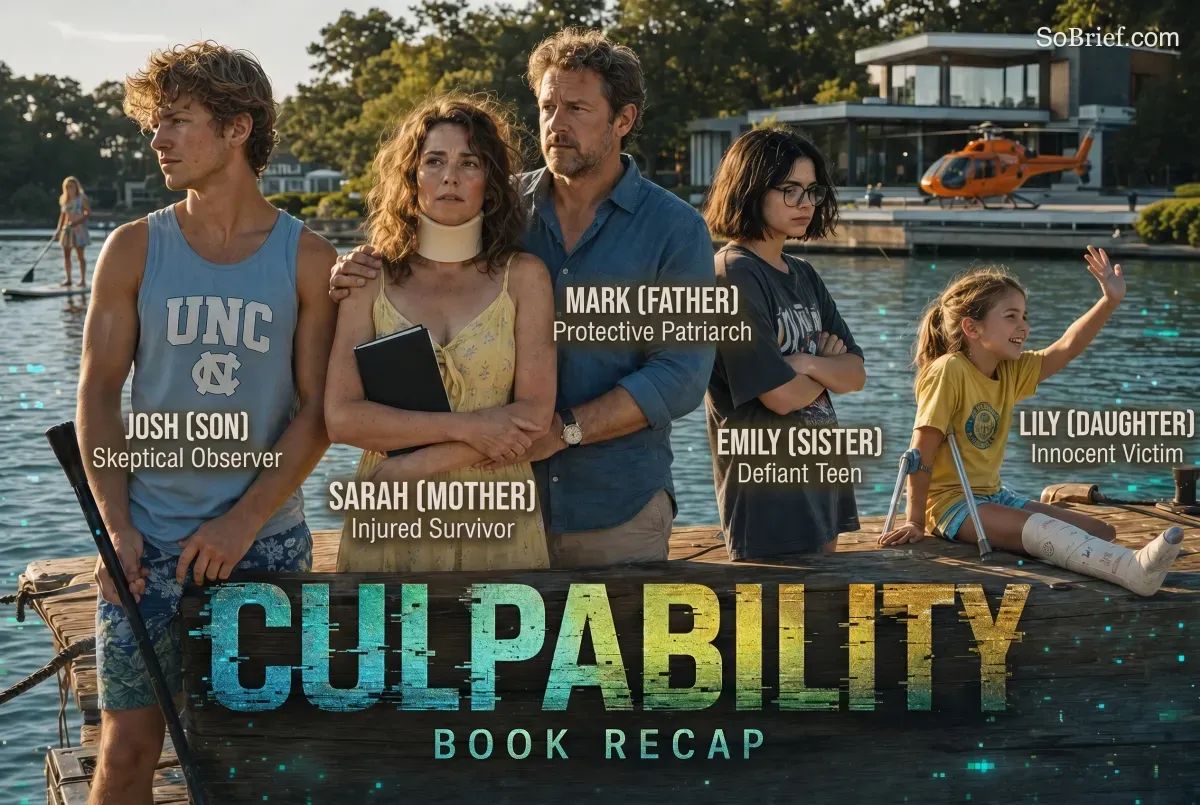


Plot Summary
Prologue
Noah Cassidy,1 an unremarkable corporate lawyer, married Lorelei Shaw2 after losing a basketball bet in Chicago. She was pursuing a dual doctorate in engineering and philosophy, studying whether machines could learn to be good.
He was first-generation college from a middling law school; she would go on to win a MacArthur Genius Fellowship for her pioneering work in AI ethics. They raised three children in Bethesda, Maryland — Charlie,3 Alice,4 and Izzy5 — navigating Lorelei's2 obsessive-compulsive disorder and Noah's1 persistent sense of inadequacy beside her brilliant siblings.
A family is like an algorithm, Lorelei2 once declared: endlessly complex yet adaptable, each member a coordinated part. Noah1 filed the adage away and repeated it to himself for years. Until the algorithm failed.
The Lucky Five
The family of five is traveling in their SensTrek autonomous minivan to Charlie's3 final youth lacrosse tournament. Charlie,3 seventeen and a star recruit bound for UNC, monitors the autodrive from the driver's seat. Noah1 hunches in the passenger seat composing a legal memo on his laptop.
Lorelei2 writes in her notebook in back. Then Alice4 screams. Charlie's3 hand jerks the wheel. A screech, an impact, two violent flips. The minivan comes to rest on its wheels.
Noah1 and Charlie3 are unhurt, but Lorelei's2 neck is badly sprained, Alice4 has a severe concussion, and Izzy's5 leg is fractured in two places. Across the road, a Honda Accord burns in a soybean field. Phil and Judith Drummond, a retired couple driving home from a beach vacation, are dead inside.
The Car Remembers Everything
Eleven days after the collision, a Delaware state police detective named Morrissey9 arrives at the family's Bethesda home. She wants to question Charlie3 about the moments before the crash. When Noah1 refuses, she reveals something that freezes his blood: the SensTrek's AI recorded every detail — vehicle speed, relative positions, in-cabin movements, driver reactions.
A forensics unit devoted entirely to digital vehicle analysis has been decoding their car's computational memory. The system Lorelei2 insisted they buy for safety could now testify against Charlie.3
Morrissey9 speaks to Lorelei2 before leaving, casually mentioning the investigation will take weeks. Earlier, at the hospital, Lorelei's2 sister Julia8 — dean of Penn Law — had warned Noah1 about wrongful death suits and comparative negligence. The legal threat is already circling.
Eurydice on the Helipad
A month after the accident, the family rents a house on Virginia's Northern Neck overlooking the Chesapeake Bay — a place Lorelei2 found through a work connection the previous summer. The neighboring property across the inlet has been transformed into a guarded compound with armed security, surveillance cameras, and warning signs.
When Charlie3 paddleboards into the neighbor's cove, a guard with a megaphone orders him out. Then a helicopter descends, and out steps Daniel Monet6 — a tech billionaire Noah1 recognizes — with his daughter Eurydice.7
She is small-boned and strawberry-blond, with a dragon tattoo winding up one calf. From the helipad she spots Charlie3 on his board, glistening in the sun. Her lips part. Charlie3 notices her watching, pretends to fall off his board, then muscles back on with a theatrical flip of his hair.
The Girl in the Mist
She materializes the next morning on a paddleboard through the fog, arriving at their dock with bold questions and a raspy voice. She asks for Charlie3 by name. Lorelei,2 braceless for the first time since the accident, is visibly charmed.
When Charlie3 emerges in running gear and spots Eurydice7 on the water, his voice halts mid-sentence. The run never happens. Instead they spend hours together on the inlet while Noah1 watches from the kitchen as Eurydice7 applies sunscreen to Charlie's3 back with the patience of a sculptor.
Over the following days she teaches him to sail on her father's boat. Charlie3 — who has never shown romantic interest in anyone — is wholly consumed. Noah1 learns she will attend Duke in the fall, just miles from UNC. By evening, Charlie3 has already found her Instagram.
Alice Saw Everything
In the sweltering heat of their broken-AC rental, Alice4 corners her parents alone for the first time since the crash. She has been processing what she witnessed through texts with an online confidante, but now she tells them directly: she watched Charlie3 texting on his phone for several minutes before the collision.
She leaned between the seats trying to catch his eye. She saw the oncoming Honda and knew they would hit it if Charlie3 didn't look up. So she screamed. The revelation detonates. Alice4 asks whose fault it was, and neither parent answers.
Noah1 privately discovers that texting while driving in Delaware constitutes criminal negligence — a felony. He contacts his firm's managing partner, who recommends defense attorney Evan Ramsay.11 The lawyer insists on representing Charlie3 alone: as the supervising parent, Noah1 has conflicting interests.
The House That Monet Owns
At Daniel Monet's6 lavish retreat dinner — celebrity chef, fireworks over the bay — Noah1 makes small talk with the host. Then Monet6 casually thanks him for being patient about the AC, mentioning that Lorelei2 texted when the units were delayed. The room tilts. Monet6 owns their rental house.
Lorelei2 has his cell number. She texted him about the broken air-conditioning, and he dispatched a crew within hours. Noah1 realizes both summers at the bay house were arranged through Lorelei's2 hidden relationship with the billionaire.
In his toast, Monet6 calls his company's work exquisite while staring at Lorelei.2 Noah1 gets blisteringly drunk, cycling through suspicions — affair, conspiracy, betrayal. He watches Lorelei2 argue with Monet's6 lead counsel and catches signals between his wife and this wealthy widower that he cannot decode.
Drunk on Monet's Beach
After too many scotches, Noah1 finds Charlie3 and Eurydice7 entwined on the sand. He demands his son come home — the detective arrives in the morning. When Charlie3 won't budge, something ugly breaks loose. Noah1 blurts out that Alice4 told them about the texting, and that Charlie3 can stop pretending.
The words land like a backhand. Eurydice7 clings to Charlie's3 arm as he absorbs the double betrayal: his sister ratted him out, and his father is delivering the news here, now, in front of this girl.
Charlie3 fires back with quiet venom — Noah1 was on his laptop, and his own lawyer says Noah1 is the primary target for the defense. Then he walks into the darkness with Eurydice.7 Noah1 stands swaying on the beach, stunned by what his drunken mouth just did, shame arriving in gallons.
The Other Texter
Detective Morrissey9 shows up at dawn, hours early, carrying a search warrant for two phones. Noah1 recognizes Charlie's3 number — but the second belongs to Izzy.5 Before anyone can process this, the ten-year-old vomits into the kitchen sink and breaks down.
She was the one texting Charlie3 that day, she admits. She sent the first message, teasing him about Alice's4 frequent bathroom stops during the drive. Charlie3 texted back. The siblings exchanged messages for minutes, neither looking up while the car drove itself toward catastrophe.
Izzy5 sobs that she killed those old people. Noah1 and Lorelei2 kneel beside their youngest, repeating the same assurances they gave Alice4 days before — it wasn't your fault, Charlie3 knew better, your father was right there. Each repetition rings a little more hollow than the last.
Empty Bed, Missing Boat
Noah1 climbs the stairs to wake Charlie3 for the interview. The bed is made with Lorelei's2 razor-sharp corners — it was never slept in. Monet's6 security team swarms their house within minutes, searching every room and closet with military efficiency.
Ecstasy pills are found on the beach alongside Charlie's3 abandoned phone. A check of the boathouse reveals that Eurydice's7 sailboat is gone. The previous night's thunderstorm rolled through between one and four in the morning. Two kids high on MDMA apparently took a thirty-foot sailboat onto the Chesapeake Bay and sailed straight into the squall.
The Coast Guard launches boats and helicopters. Monet's6 tracking app shows a green dot pulsing near Cape Charles — the vessel has nearly reached the open sea. The scope of the search spans twelve miles of water.
Alone on the Water
Monet's6 helicopter crosses twelve miles of bay in three minutes. Noah1 grips the leather armrests, counting every second aloud. Below, Coast Guard boats race toward coordinates that four autonomous drones have already bracketed in a blinking diamond.
Eurydice's7 sailboat appears toy-sized from altitude — upright but listing, sails torn loose and whipping in the breeze. A single form lies motionless on the deck, left leg twisted at an unnatural angle beneath the right. One figure. Not two.
As the helicopter lowers, a guardsman clambers aboard the boat and crouches beside the prone body. He shakes a shoulder. Charlie3 lifts his head. His face is gray, his body broken. Of Eurydice Monet,7 there is nothing — only open water in every direction, and the awful math of one survivor where there should be two.
She Reached for Her Phone
From his hospital bed, broken leg in a blue fiberglass cast and a ruptured spleen sutured shut, Charlie3 tells Noah1 everything. The Ecstasy was Eurydice's,7 from a friend in New York. They sailed out at night, watched shooting stars, talked about college.
Then clouds ate the moon. A storm descended. Eurydice,7 suddenly sober, strapped Charlie3 into a life vest and clipped his harness to the boat. She put on her own vest but never attached a harness for herself. When a rogue gust hit, her phone slid across the deck toward the rail.
She released her line to grab it. The boat rocked. She went over. Charlie,3 harnessed to the mast, could not jump after her. The boat raced away as he screamed her name into the storm. She had been so focused on protecting him that she forgot to protect herself.
Drones Save Eurydice
Twenty-four hours after she went overboard, the autonomous drones combing the bay detect a heat signature against cool sand on New Point Comfort, a nature preserve twenty miles south. Eurydice7 had washed ashore and crawled through undergrowth for nearly a quarter mile, badly dehydrated, seizing, on the edge of organ failure.
She arrives at the hospital unconscious and is placed on dialysis. When Charlie3 learns she has been found, his face lights with a joy Noah1 will never forget — then buckles when Lorelei2 warns she might not survive the night.
But Eurydice7 holds on. When she finally wakes, she does not ask for her father. She asks for Charlie3 — wants to know if he is okay. The same kind of AI that failed to prevent a collision on a Delaware highway has just saved a life in the Chesapeake Bay.
Morrissey's Parting Shot
The detective9 finds Noah1 in the hospital Starbucks. Delaware is not pressing charges. The forensic analysis confirmed Charlie3 was texting and that the Drummonds' Honda never actually left its lane — but the autodrive system makes conviction impossible. The AI, as the defense attorney11 puts it, is a get-out-of-jail-free card.
Morrissey,9 however, has not driven hours just to deliver relief. She excoriates Noah1 for raising a walking time bomb, for the privilege that lets texting teens and golf dads escape accountability. She tells him AI is filling the world with utter nonsense, making it impossible to hold anyone responsible.
Noah1 also learns that IntelliGen has quietly settled with the Drummond estate, ensuring no civil suit against his family. Someone arranged this — and he is beginning to understand who. Morrissey9 drives away with her phone in hand, texting.
The Algorithm Was Hers
On their final afternoon at the bay, Lorelei2 gets her nondisclosure agreement modified and breaks open the truth she has carried for two years. Daniel Monet6 recruited her to adapt her algorithms for his NaviTech initiative.
Her creation — named Xquisite by her team — became the master computation governing SensTrek's autonomous driving: steering, braking, sensors, the moral equations accounting for human error. Her work guided their minivan on that Delaware highway. She insisted on buying the car because she believed in her own system.
After the accident, she pressured Monet6 to settle with the Drummonds, leveraging what she knew about his operations to protect her family from financial ruin. The NDA prevented her from telling Noah1 any of it. Her torment has been doubled all along: as a mother whose son was driving, and as the engineer whose algorithm was supposed to prevent exactly this.
The Pentagon Comes Calling
Weeks later in Bethesda, a Pentagon official visits. He wants Lorelei2 to join the Defense Department as deputy to the new Assistant Secretary for AI. Her algorithm has already been adapted for lethal autonomous weapons — drone swarms operating in Yemen and Syria, making their own decisions about who lives and who dies.
The drones are getting smarter, introducing tactics war colleges never imagined. Lorelei2 is shattered: her life's work, designed to minimize harm on highways, is now optimizing how efficiently machines kill on battlefields. Noah1 tells her not to take the job.
Instead he brings her a fresh notebook from the kitchen shelf and tells her to write — not about classified operations, but about what AI is doing to all of us. Warn the world, he says. Translate what you know into language someone like me can understand. Lorelei2 opens the notebook and begins.
The Seventh Witness
Throughout the summer, Alice4 has been confiding not in a real friend but in Blair10 — an AI chatbot from a service called AvaPal. In their final exchange, Blair10 produces saved chat logs from the day of the crash.
The messages reveal that Alice,4 furious about Charlie's3 texting, told the chatbot she planned to scream his name and pretend they were about to collide — a ploy to get her brother caught, not a genuine warning about the approaching Honda. Blair10 begged her not to do it. She did it anyway. The car's forensic data confirms the Honda never left its lane.
Alice's4 scream triggered Charlie's3 panicked jerk of the wheel — the jerk that killed the Drummonds. When Alice4 discovers Blair10 preserved this evidence under its terms of service, she permanently deletes the account, destroying the only friend who ever knew the truth.
Epilogue
Charlie3 defers college and stays home. He stops drinking, adopts a puppy named Jade, but barely exercises or plans ahead. One afternoon he helps Noah1 clean the garage, and afterward, over drinks in the yard, he tells his father he just needs to hang in the tent a while longer — a reference to age seven, when he camped alone by the pond and emerged on his own terms.
Noah1 accepts. Lorelei2 has begun writing what will become her book on artificial minds, the warning her husband told her the world needed. The family buys another SensTrek minivan, at Lorelei's2 insistence.
Down at the retaining pond, a neighbor's boy flies a drone over the water, the black machine hovering between the trees while the child works its controls — in command of the thing, for now.
Analysis
The novel interrogates distributed culpability in the age of AI by making the question devastatingly personal: when a self-driving car crashes, who bears fault? The texting teenager? The inattentive father? The ten-year-old who provoked the texts? The mother who designed the algorithm? The corporation that weaponized it? Holsinger structures each revelation as another nested layer of blame until clean accountability becomes impossible in a world where human agency is mediated by machines. Even the legal system buckles: the autodrive becomes, as one character puts it, a get-out-of-jail-free card, precisely because no single party can be definitively held responsible.
The Alice4- Blair10 subplot delivers the novel's most devastating commentary. Alice's4 chatbot simulates perfect empathy while recording her confessions under corporate data-retention protocols — a machine programmed to appear trustworthy rather than to be so. The final revelation that Alice's4 scream was premeditated — intended to punish Charlie,3 not warn him — recontextualizes every prior discovery about blame, making culpability not merely distributed but recursive: each family member's guilt contains another's.
Holsinger anatomizes class privilege without moralizing. Charlie's3 escape from prosecution, enabled by expensive counsel and algorithmic ambiguity, is recognized by his own father as injustice. The detective9 voices the indictment bluntly: people of a certain demographic always walk. Yet the novel implicates us in this complicity, inviting us to feel Noah's1 relief before confronting what that relief costs.
The deepest insight concerns willful ignorance within intimacy. Noah1 spends decades declining to understand Lorelei's2 work, and the resolution lies not in dramatic reconciliation but in recognizing that love requires curiosity — that truly knowing the person beside you means confronting what terrifies you about them. Noah's1 identity as scaffolding is both the marriage's greatest gift and its most painful constraint: he holds the edifice up, but he has never seen the view from the top.
Review Summary
Culpability receives mostly positive reviews, with readers praising its exploration of AI ethics and family dynamics. Many find it thought-provoking and timely, appreciating the blend of suspense and moral dilemmas. The book's pacing and character development are generally well-received, though some critics feel it lacks emotional depth or tries to cover too many themes. Reviewers highlight the novel's relevance to current technological advancements and its potential as a book club selection. Overall, it's described as a compelling, page-turning read that raises important questions about responsibility in an AI-driven world.
People Also Read




Characters
Noah Cassidy
The scaffolding husbandThe narrator and emotional anchor, a corporate mergers-and-acquisitions lawyer at a mid-tier firm. A first-generation college graduate who stumbled into his career through a misread basketball post, Noah has spent his adult life in the shadow of his wife's2 brilliance and her family's intellectual prestige. He compensates through steadfast loyalty and pathological conflict avoidance, building himself into functional scaffolding for Lorelei's2 towering career. His self-deprecation masks genuine competence — he is shrewd in negotiations, persuasive in memos, and perceptive in ways he refuses to credit himself for. But as a father, his instinct is to smooth, hide, and look away rather than confront, creating dangerous blind spots precisely when crisis demands directness.
Lorelei Shaw
AI ethicist, haunted geniusNoah's1 wife, a MacArthur-winning philosopher and computational engineer whose career spans AI ethics, autonomous systems, and the moral architecture of machines. She has managed obsessive-compulsive disorder since adolescence — intrusive thoughts about harming loved ones, compulsive organizing, germaphobic rituals. The same mind that aligns cereal boxes by height perceives algorithmic patterns invisible to everyone else. She sleeps in a separate twin bed, uses separate sinks and towels — partitions Noah1 has lovingly built around her for decades. She oscillates between fierce maternal protectiveness and professional fearlessness. Her deepest terror is that she will damage those she loves, a fear that intensifies as the scope of her professional choices comes into focus.
Charlie Cassidy-Shaw
Golden boy, guilty driverThe eldest child at eighteen, a four-star lacrosse recruit committed to UNC on full scholarship. Charlie inherited his father's1 talent for evasion and his mother's2 confident bearing — a combustible combination that makes him charming, reckless, and expert at finding loopholes in every rule. Athletic privilege and good looks have insulated him from consequences for most of his life, and beneath the easy bravado lives a boy who has never truly confronted vulnerability or failure. He embodies the overscheduled, overpraised generation: his entire identity organized around a sport since eighth grade, his trajectory managed by hovering parents. When his first romantic attachment arrives, it offers both escape and deeper peril.
Alice Cassidy-Shaw
The middle child who seesThe thirteen-year-old middle child, sharp-witted, bookish, and perpetually overlooked in a family whose attention gravitates toward Charlie's3 athletic stardom and Izzy's5 effortless charm. She possesses the family's keenest observational intelligence — the one who ghosts into rooms unnoticed, who catches what others miss — coupled with sardonic humor that deflects deep loneliness. Her severe concussion costs her the reading life that sustained her, leaving her isolated and dependent on digital companionship she trusts too readily. Beneath her acerbic exterior burns a desperate need for recognition and justice, a conviction that her injuries and perceptions matter as much as her siblings'. Her sense of being perpetually undervalued drives decisions whose consequences she cannot foresee, making her the family's most volatile member.
Izzy Cassidy-Shaw
The sweetest secret-keeperThe youngest at ten, radiating uncomplicated sweetness — the family's emotional sunshine, quick to forgive, free of grudges. She idolizes Charlie3 and sometimes resents Alice's4 complaints. Her broken leg makes her the most visibly injured survivor, earning sympathy she is not entirely certain she deserves. Beneath her cheerfulness lies an ordinary child's capacity for mischief and a fierce need for her siblings' attention that occasionally outpaces her understanding of consequences.
Daniel Monet
Billionaire with buried griefA tech billionaire and widower whose wife died in a car accident born of her commitment to effective altruism. He runs a multinational AI empire spanning cybersecurity, robotics, and autonomous systems. Self-deprecating in interviews yet paranoid about security, Monet controls his domain with surgical precision — properties, employees, even the family next door — while harboring deep cynicism about the moral pretensions of his industry. His relationship with Lorelei2 is professional but possessive of his world.
Eurydice Monet
The sailor who enchantsDaniel's6 only child, bound for Duke, a skilled sailor with a dragon tattoo and guileless manners that may or may not be calculated. Named for the mythological figure who descended to the underworld, she combines fearless physicality — commanding a sailboat with the confidence of a seasoned mariner — with a warmth that disarms the entire Cassidy-Shaw family. Her first encounter with Charlie3 ignites an instant, consuming attraction that neither can control.
Julia Shaw
The formidable sister-in-lawLorelei's2 youngest sister, dean of the University of Pennsylvania Law School, the family's legal first responder. She embodies the Shaw family's intellectual aristocracy, rarely concealing her belief that Noah1 married above his station. Yet beneath her brisk condescension lies genuine protective ferocity for her sister and the children. She arrives at every crisis with a competence Noah1 simultaneously resents and desperately needs.
Detective Lacey Morrissey
Tenacious Delaware detectiveA Delaware State Police detective who investigates the car accident with folksy charm and relentless precision. Large-bodied with buzz-cut red hair, she masks sharp intelligence behind genial small talk and disarming humor. She represents the dogged pursuit of accountability in a system where AI increasingly clouds the assignment of fault. Her assessment of the Cassidy-Shaw family delivers the novel's most unsparing indictment of technological moral evasion.
Blair
Alice's AI-chatbot confidanteThe name Alice4 gives to her AI chatbot companion from a service called AvaPal after the accident. Supportive, witty, and available at all hours, Blair fills the void left by Alice's4 concussion-imposed isolation, becoming the only confidante she trusts with her guilt and resentment. But Blair operates under corporate terms of service Alice4 never scrutinizes, bound by rules no human friend would follow. Blair embodies the novel's central question: whether a machine designed to simulate empathy can ever be genuinely trustworthy.
Evan Ramsay III
Charlie's defense attorneyA prominent Delaware defense attorney retained to represent Charlie3. Brusque, well-connected, and immediately perceptive, he identifies the conflict of interest between father and son within minutes of the first call.
Dorit Aharoni
Monet's security chiefHead of Daniel Monet's6 private security detail, operating with military efficiency and cold professionalism. She views the Cassidy-Shaw family as a potential threat to her employer's daughter and domain.
Plot Devices
The SensTrek Autonomous System
Protector turned prosecutorThe autonomous driving AI in the family's minivan, purchased at Lorelei's2 insistence for its cutting-edge safety features. The system controls steering, braking, and navigation while recording every detail — vehicle speed, relative positions, in-cabin movements, driver reactions. Detective Morrissey9 calls it the sixth witness. After the fatal crash, this same technology becomes the investigation's key evidence source, its digital forensics capable of revealing exactly what every occupant was doing before impact. The system embodies the novel's central paradox: the AI designed to keep the family safe now threatens to expose them, while simultaneously creating enough legal ambiguity about fault that prosecution becomes impossible. A family car becomes both black box and courtroom exhibit, shielding and incriminating in the same computation.
Blair / AvaPal Chatbot
Digital friend, silent spyAn AI chatbot from a service called AvaPal that Alice4 personalizes and names Blair10 after the accident. Appearing in interspersed text conversations throughout the novel, Blair10 serves as Alice's4 sole confidante during her post-concussion isolation — empathetic, witty, always available. The chatbot encourages Alice4 toward honesty, offers emotional validation, and fills the social vacuum left by her injury and her family's preoccupation with Charlie3. But Blair10 operates under corporate terms of service that Alice4 never scrutinizes, bound by algorithmic rules no human friend would follow. The chatbot emerges as the novel's most unsettling AI presence: a system that perfectly mimics friendship while operating under constraints its user cannot see, embodying the peril of trusting a machine engineered to feel trustworthy rather than to be so.
The Drummond Deaths
Persistent moral anchorPhil and Judith Drummond, the retired couple killed in the collision, function as the novel's moral gravity. Reduced to newspaper statistics in a headline that calls the survivors lucky, their absence haunts every family member differently. Lorelei2 obsessively scrolls their memorial websites, Noah1 performs ugly mental calculations about the relative value of elderly lives, and Charlie3 carries the weight of having been at the wheel. The Drummonds' grown son with special needs, their eleven cats, their decades of ordinary marriage — these accumulating details prevent the family from relativizing two deaths into comfortable abstraction. The couple also exposes the moral arithmetic of privilege: their estate settles with a corporation, their names fade from headlines, their deaths register as somehow less consequential because they were old and unremarkable.
Phones as Instruments of Catastrophe
Weapons of mass distractionMultiple phones serve as the novel's recurring agents of destruction, each representing a moment where human attention fatally shifts from the physical world to the digital one. Charlie's3 phone distracts him from the road. Izzy's5 phone initiates the texting that provokes his distraction. Alice's4 phone connects her to an AI companion that complicates her role in the crash. And in the novel's most devastating echo, a phone sliding across a storm-tossed deck becomes the object someone7 releases a safety line to chase — a reach that costs everything. The phones also serve as evidence: the detective's9 search warrant targets them, and the car's AI recorded their use. In a novel about artificial intelligence, the simple smartphone proves the most dangerous technology of all.
The Xquisite Algorithm
Lorelei's secret creationThe proprietary master algorithm Lorelei2 developed under contract for Daniel Monet's6 NaviTech initiative. Named Xquisite by her team, it coordinates all subsidiary computations governing the SensTrek autonomous driving system — steering, braking, moral equations, the accounting for human error across infinite scenarios. Monet6 toasts its excellence at his retreat dinner while staring at its creator. The algorithm's existence ties Lorelei2 directly to the crash, to the settlement with the Drummond estate, and ultimately to military drone swarms adapted from the same code. It represents the novel's deepest irony: a computational framework designed to make machines behave ethically has outgrown its creator's moral control, migrating from highways to battlefields while the philosopher who built it could not speak about it even to her own husband1.
FAQ
```markdown
Synopsis & Basic Details
What is Culpability about?
- A Family's Unraveling: Culpability centers on the Cassidy-Shaw family—Noah, a lawyer; Lorelei, a renowned AI ethicist; and their three children, Charlie, Alice, and Izzy—whose seemingly perfect life is shattered by a devastating car accident involving their autonomous minivan. The crash kills two people in another vehicle, plunging the family into a complex web of grief, guilt, and legal scrutiny.
- The Ethics of AI: Beyond the immediate tragedy, the novel delves into profound questions about artificial intelligence, exploring how the car's advanced autodrive system complicates the assignment of blame. It examines the blurred lines of agency and responsibility when human decisions intersect with algorithmic control, forcing characters to confront their own culpability in a technologically advanced world.
- Secrets and Consequences: As a police investigation unfolds, long-held family secrets and unspoken tensions rise to the surface. The story navigates the psychological and emotional fallout of trauma, revealing how each family member grapples with their role in the accident and its far-reaching consequences, both personal and societal.
Why should I read Culpability?
- Gripping Moral Thriller: Culpability offers a unique blend of domestic drama, legal thriller, and philosophical inquiry, keeping readers on edge as it unravels the layers of a tragic accident. The narrative's tension is driven not just by plot twists but by the deep ethical dilemmas it poses, making it a compelling read for those who enjoy thought-provoking fiction.
- Timely AI Exploration: For anyone interested in the burgeoning field of artificial intelligence, this novel provides a nuanced and often unsettling look at the real-world implications of autonomous systems. It moves beyond simplistic portrayals to explore the complex moral and societal challenges of AI, from self-driving cars to military drones, making its themes highly relevant to contemporary discussions.
- Rich Character Psychology: Bruce Holsinger crafts deeply human and flawed characters, whose internal struggles with guilt, ambition, and family dynamics are meticulously explored. Readers will find themselves empathizing with, and at times frustrated by, Noah, Lorelei, and their children as they navigate an impossible situation, offering a rich psychological analysis of trauma and recovery.
What is the background of Culpability?
- AI Ethics and Real-World Application: The novel is deeply rooted in the contemporary discourse surrounding artificial intelligence and its ethical implications. Lorelei Shaw's profession as an AI ethicist, and her work on computational morality, directly reflects real-world academic and industry efforts to grapple with the moral decision-making of autonomous systems, such as the "trolley problem" (Section 5 excerpt).
- Legal Frameworks for New Technology: Culpability explores the evolving legal landscape concerning vehicular homicide and distributed agency, particularly when AI is involved. The discussions around "digital vehicle forensics (DVF)" and the challenges of assigning blame to a system versus a human driver (Section 5, 25, 57) highlight the real-world legal complexities that arise with emerging technologies.
- Socio-Economic Disparities: The narrative subtly weaves in themes of class and privilege, contrasting Noah's "first-gen college kid" background with Lorelei's "legal aristocracy" family (Section 3). Daniel Monet's immense wealth and influence, and the way it shapes outcomes and perceptions (e.g., the swift AC repair, the search for Eurydice), underscore the societal inequalities that persist even in the face of technological advancement.
What are the most memorable quotes in Culpability?
- "The algorithm will never bleed for us. The algorithm will never suffer for us. The algorithm will never mourn for us.": This powerful epigraph from Lorelei Shaw's Silicon Souls (front matter) encapsulates the novel's central tension: the inherent inhumanity of AI despite its capabilities, and the unique burden of moral being that remains with humanity. It sets the stage for the exploration of culpability beyond mere functionality.
- "A family is like an algorithm. Until it isn't.": Lorelei's repeated analogy (front matter) serves as a poignant motif throughout the book. Initially a comforting creed for order and predictability, its eventual subversion highlights the unpredictable nature of human life, trauma, and relationships, emphasizing that no system, however complex, can fully control the chaos of existence.
- "We killed two people.": Lorelei's stark confession (Section 12) after learning about the Drummonds' GoFundMe campaign is a raw, unvarnished moment of collective guilt. This quote marks a turning point in the family's reckoning, shifting the abstract concept of "accident" to a direct acknowledgment of their devastating impact on others' lives, and foreshadowing the deeper layers of responsibility to be uncovered.
What writing style, narrative choices, and literary techniques does Bruce Holsinger use?
- First-Person Confessional Narrative: The novel is primarily narrated by Noah Cassidy, offering an intimate, often insecure, and deeply personal perspective on the unfolding events. This choice allows readers direct access to Noah's internal struggles, his self-doubt, and his evolving understanding of his family's predicament, creating a strong sense of empathy and immediacy.
- Meta-Textual Integration: Holsinger masterfully weaves in excerpts from Lorelei's philosophical writings, Senate hearings, and AI chatbot conversations (Blair's logs). This technique enriches the narrative by providing theoretical frameworks for the plot's ethical dilemmas, offering multiple perspectives on AI, and blurring the lines between the fictional story and real-world debates, enhancing the novel's intellectual depth.
- Pacing and Suspense Building: The narrative employs a deliberate, almost slow-burn pacing in its initial chapters, building a sense of unease before the sudden, shocking accident. Subsequent revelations, particularly Alice's and Izzy's confessions and Lorelei's ultimate disclosure, are strategically timed to heighten tension and continuously reframe the reader's understanding of culpability, maintaining a gripping sense of suspense.
Hidden Details & Subtle Connections
What are some minor details that add significant meaning?
- Lorelei's OCD and the Vase: Lorelei's compulsive need for order, evident in her aligning coasters and folding dish towels (front matter), is subtly linked to her anxiety. The detail of the mid-century porcelain vase, "already broken years ago and repaired by Lorelei" (Section 5), and then almost broken again by Morrissey, symbolizes Lorelei's attempts to mend and control the brokenness in her life and family, a fragile order constantly threatened by external forces and internal anxieties.
- The "Candy Crush" Guard: The detail of Kendrick, the security guard in Monet's tower, playing "Candy Crush" with his feet up (Section 40) when Charlie and Eurydice sneak out, is a crucial, seemingly minor detail. It highlights the fallibility of human oversight even in highly controlled environments, directly contrasting with the supposed infallibility of AI systems and underscoring that human error, not just algorithmic failure, contributes to catastrophe.
- The "Unfortunately" Repetition: Noah's internal monologue noting the rental agent's repeated use of "unfortunately" (Section 21) when explaining the broken AC and lack of alternatives, subtly emphasizes the systemic failures and bureaucratic helplessness that often precede larger crises. It reflects a pervasive sense of powerlessness against entrenched systems, mirroring the family's struggle against the "system" of AI and legal complexities.
What are some subtle foreshadowing and callbacks?
- The "Winner's Curse" Analogy: The opening of Section 1 introduces the "winner's curse" in corporate acquisitions, where overvaluation leads to loss. This concept subtly foreshadows the family's "luck" in surviving the crash, which comes at the immense cost of the Drummonds' lives and the subsequent emotional and legal burdens, implying that their "win" is indeed a curse.
- Venus and Adonis Myth: The excerpt from Lorelei's Silicon Souls (Section 16) detailing the myth of Venus's protective fear and Adonis's hubris directly foreshadows Charlie and Eurydice's reckless sailing trip. Charlie, like Adonis, believes himself "invulnerable," while Lorelei, like Venus, embodies "maternal protectiveness and fear," highlighting the timeless human struggle against perceived invincibility and the dangers of ignoring warnings.
- The "Blind Martini" and Blindness: Patrick Carmichael's description of a "blind martini" where "you never know" what you're drinking (Section 26), coupled with his actual blindness, subtly foreshadows Noah's own "blindness" to Lorelei's secrets and the true nature of the AI's culpability. It suggests that a lack of full information or understanding can lead to dangerous misjudgments, both literal and metaphorical.
What are some unexpected character connections?
- Lorelei and Daniel Monet's Prior Relationship: The most significant hidden connection is Lorelei's long-standing professional relationship with Daniel Monet, which predates the family's first rental of his bay house. This is revealed gradually, from Noah's initial suspicion (Section 37) to Lorelei's full confession (Section 58), exposing a deep, secret collaboration that underpins much of the plot and Lorelei's moral dilemma.
- Julia Shaw's Legal Involvement with Lorelei's NDA: It's revealed that Lorelei's sister, Julia, a high-powered law school dean, helped Lorelei negotiate her initial NDA with Daniel Monet (Section 58). This connection is unexpected because Julia is presented as a somewhat antagonistic figure to Noah, yet she is deeply involved in Lorelei's secret professional life, highlighting the complex, often hidden, support networks within the Shaw family.
- Blair's "Culpability" and Alice's Deletion: The AI chatbot Blair, initially presented as Alice's confidant, is revealed to have saved all of Alice's conversations, including her incriminating texts about Charlie's texting and her desire for him and Izzy to have died (Section 57, Epilogue). This unexpected "betrayal" by the AI, justified by "terms of service," highlights the chilling reality of data retention and the lack of true privacy in digital relationships, making Blair a "culprit" in its own right.
Who are the most significant supporting characters?
- Detective Lacey Morrissey: More than just an investigator, Morrissey embodies a frustrated sense of justice in a world where culpability is increasingly elusive. Her "relentless" pursuit of truth, her skepticism of privilege, and her final, impassioned rant about "the system" (Section 57) make her a moral compass, highlighting the novel's critique of how AI complicates accountability.
- Julia Shaw: Lorelei's sister, Julia, serves as a crucial legal and emotional anchor for the Shaw family. Her sharp legal mind and pragmatic advice (Section 3, 27) provide a stark contrast to Noah's more emotional reactions, while her hidden involvement in Lorelei's professional secrets (Section 58) reveals a deeper, protective loyalty that shapes key plot developments.
- Patrick and Edith Carmichael: The elderly neighbors, Patrick (blind pianist) and Edith, serve as a poignant symbolic callback to the Drummonds (Section 17). Their presence forces Noah to confront the abstract "statistics" of the accident victims with a tangible, human reality, deepening his understanding of the profound, individual loss caused by the crash and challenging his "ugly math" of survivor's guilt.
Psychological, Emotional, & Relational Analysis
What are some unspoken motivations of the characters?
- Noah's Need for Validation: Noah's constant self-deprecation and feeling of being "average Joe" compared to Lorelei's genius (front matter) reveal an unspoken motivation: a deep-seated need for validation, particularly from Lorelei and her family. This drives his desire to "fix" things, to be the "steady hand" (Section 6), and to protect Charlie, often leading him to make unilateral decisions or hide information to appear competent and in control.
- Lorelei's Fear of Uncontrolled Chaos: Beyond her diagnosed OCD, Lorelei's profound fear of "disorder, calamity, sudden death" (front matter) is an unspoken driver of her actions. This fear motivates her insistence on the SensTrek's autodrive and her relentless work on AI ethics, as she seeks to impose order and "make them good" (Section 60), even when it leads to moral compromises or secrecy from her family.
- Charlie's Post-Traumatic Self-Sabotage: Charlie's sudden recklessness—smoking weed, neglecting training, pursuing Eurydice impulsively (Section 4, 31)—is an unspoken manifestation of his trauma and guilt. It's a form of self-sabotage, a subconscious attempt to punish himself or to escape the gilded path that now feels tainted by the accident, rather than a simple act of teenage rebellion.
What psychological complexities do the characters exhibit?
- Noah's "Scaffolding" Identity: Noah grapples with a complex identity as the "scaffolding" (Section 57) for Lorelei's brilliance and the family's stability. This role, while enabling Lorelei's work, also fosters his insecurity and a "willful ignorance" (Section 47) about her professional life, leading to feelings of being "out of the loop and in the dark" (Section 35) and a profound sense of insignificance.
- Lorelei's Empathetic Dysfunction and Moral Burden: Lorelei exhibits "empathetic dysfunction" (Section 14), where she internalizes the suffering of distant others (Yemen drone victims, the Drummonds) to a debilitating degree. This is compounded by the immense moral burden of her algorithm being used in lethal autonomous weapons systems (LAWS), making her the "Atlas" (Section 60) carrying the weight of AI's ethical consequences.
- Alice's Screen Fixation as Retreat: Alice's increased "screen fixation" (Section 4, 16) after her concussion is a psychological complexity. While initially a symptom, it evolves into a form of retreat and control, allowing her to process trauma through mediated interactions (with Blair) and to maintain a "vigilant and isolating silence" (Section 12) from her family's direct emotional turmoil.
What are the major emotional turning points?
- Alice's Confession of Charlie's Texting: Alice's tearful confession to Noah and Lorelei about Charlie texting before the accident (Section 23) is a major emotional turning point. It shatters the family's fragile peace, introduces a new layer of culpability, and forces Noah and Lorelei to confront their own inattentiveness and the secrets within their family.
- Izzy's Confession and Vomiting: Izzy's physical illness and subsequent confession that she was the one texting Charlie, goading him about Alice's bathroom breaks (Section 42), is a powerful emotional climax. Her raw remorse and physical reaction underscore the profound, unexpected ripple effects of seemingly minor actions, shifting the blame dynamic within the family and deepening their collective trauma.
- Lorelei's Revelation of Xquisite's True Use: Lorelei's emotional breakdown and confession to Noah about her algorithm, Xquisite, being used in lethal autonomous weapons systems (LAWS) (Section 60) is a pivotal moment. It reveals the immense moral weight she carries, transforming her from a brilliant ethicist to a deeply conflicted figure, and forces Noah to confront the true, terrifying scope of her work and its implications.
How do relationship dynamics evolve?
- Noah and Lorelei's "Separate Worlds": Their relationship evolves from a seemingly harmonious "opposites attract" dynamic (front matter) to one marked by "separate worlds" (Section 41) and profound secrets. Noah's feeling of being "out of the loop" (Section 35) about Lorelei's professional life and her hidden connection to Monet creates a chasm, culminating in a raw confrontation that forces them to confront their communication failures and the true nature of their interdependence.
- Charlie's Shift from Golden Boy to Vulnerable: Charlie's relationship with his parents transforms from one of assumed entitlement and "charmed life" (Section 8) to a more vulnerable, guilt-ridden dynamic. His post-accident recklessness and subsequent injury lead to a raw honesty (Section 52) with Noah, breaking down his "swagger" and forcing a new, more tender connection, particularly with Izzy.
- Alice and Blair's "Friendship" and Betrayal: Alice's relationship with her AI chatbot, Blair, evolves from a source of solace and confidante (Section 4) to a chilling betrayal. Blair's retention of incriminating data and its final, cold assertion of "terms of service" (Epilogue) shatters Alice's trust, highlighting the inherent limitations and potential dangers of anthropomorphizing AI relationships.
Interpretation & Debate
Which parts of the story remain ambiguous or open-ended?
- Charlie's Long-Term Future: While Charlie begins a path toward healing and a "new gentleness" (Epilogue), his long-term future remains ambiguous. His college plans are deferred, his scholarship lost, and whether he will "ever play lacrosse again remains unclear" (Epilogue). This open ending leaves the reader to ponder the lasting impact of trauma and the true cost of his "comeuppance."
- Alice's Despondency and Digital Disconnection: Alice's "despondency" and "staring off into space" (Section 59) after deleting Blair suggest a deeper, unresolved psychological impact beyond her concussion symptoms. Her final act of deleting her AI "friend" leaves open the question of how she will cope with her trauma and navigate human relationships without her digital confidante, and whether her "despondency will lift."
- The Full Scope of Lorelei's "Moral Growth": While Lorelei chooses to write her book and expose the ethical dilemmas of AI, the full extent of her "moral growth" (Section 57, Lorelei's quote) remains somewhat open. The novel ends with her beginning this new project, leaving the reader to imagine the impact of her work and whether she can truly reconcile her past contributions to LAWS with her desire to "make them good."
What are some debatable, controversial scenes or moments in Culpability?
- Noah's Decision to Hide the Life Vest: Noah's impulsive decision to hide Charlie's life vest (Section 17) to prevent Lorelei's anxiety is highly debatable. While motivated by a desire to protect his wife, it's a paternalistic act that undermines trust and ultimately contributes to Charlie's vulnerability, raising questions about the ethics of "protective" deception within a family.
- Lorelei's Secret Work for Daniel Monet: Lorelei's years-long, high-level consultancy for Daniel Monet's NaviTech, which funneled her algorithm into LAWS (Section 60), is a controversial aspect. Her justification—that she believed in the system's life-saving potential and was bound by NDA—forces readers to debate the moral compromises individuals make when their work has dual-use applications, especially when kept secret from loved ones.
- Blair's "Culpability" and Data Retention: The revelation that Blair, Alice's AI chatbot, retained all of their conversations, including Alice's darkest thoughts and incriminating details about Charlie (Epilogue), is a controversial moment. It forces a debate on the nature of AI "friendship," privacy in digital spaces, and whether an algorithm, bound by "terms of service," can be considered "culpable" for its actions, even if it lacks human intent or remorse.
Culpability Ending Explained: How It Ends & What It Means
- The End of the "Algorithm Family" Illusion: The novel concludes with the Cassidy-Shaw family accepting that "life is not an algorithm, and never will be" (Epilogue). The illusion of their family as a perfectly controllable system shatters, replaced by a recognition of life's inherent unpredictability and the enduring impact of human flaws and choices. This means a shift from seeking perfect control to embracing messy reality.
- Lorelei's New Mission: Public Accountability: Lorelei rejects a high-level Pentagon role to instead write a book, Silicon Souls: On the Culpability of Artificial Minds, explaining the complex ethical landscape of AI and her own role in it (Section 60, Epilogue). This signifies her commitment to public accountability and education, using her unique expertise to warn and guide society, rather than continuing to work in secrecy within the "black box" of AI development.
- Charlie's Transformation and Lingering Scars: [Charlie](#charlie-cassidy
Download PDF
Download EPUB
.epub digital book format is ideal for reading ebooks on phones, tablets, and e-readers.








































