

Key Takeaways
Everyone praises critical thinking, but almost nobody can define it
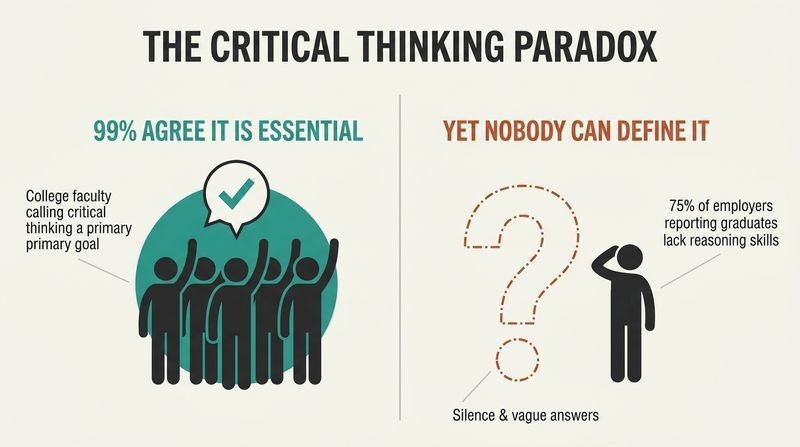
The paradox at the book's heart: 99% of college faculty call developing critical thinking an essential goal, yet over 75% of employers say graduates lack it. The 2011 study Academically Adrift found gains in reasoning during the first two years of college were, for many students, statistically nonexistent. Presidents from George H. W. Bush to Obama, plus international bodies like the OECD, have made it a national priority.
Yet ask most people what critical thinking actually is and you get silence. Haber's core claim is deceptively simple: the biggest critical-thinking problem today is that not enough people do enough of it. He refuses to crown a single definition, arguing instead that we already know enough to start teaching, practicing, and measuring it.
What's striking is Haber's diagnosis of a rhetoric-reality gap. A term invoked by governments and CEOs alike has become an empty vessel, meaning everything and nothing. This mirrors what linguists call semantic bleaching, where overuse drains a word of precision (think 'synergy' or 'innovation'). The danger is real: if a skill cannot be defined, it cannot be taught or assessed, and 'critical thinking' risks becoming a credentialing slogan rather than a genuine competency. Haber's pragmatic move, refusing definitional paralysis, echoes engineering culture, where practitioners build bridges without resolving every philosophical dispute about the nature of mathematics.
Critical thinking rests on three legs: knowledge, skills, and dispositions
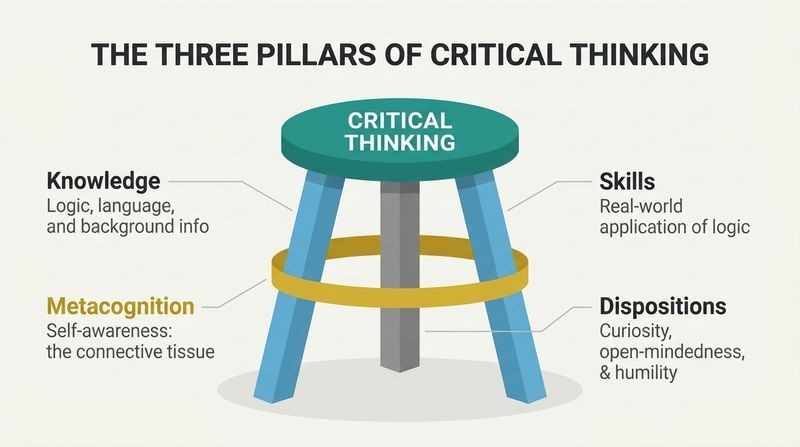
Despite competing definitions, Haber finds a durable consensus. A critical thinker needs all three of the following, working together:
1. Knowledge, including the mechanics of logic, language, and argumentation, plus subject-matter background.
2. Skills, meaning the ability to apply those tools to messy real-world situations.
3. Dispositions, the personal traits (curiosity, open-mindedness, intellectual humility) that make someone willing to reason well when shortcuts beckon.
Most failures come from missing a leg. You can know every fallacy by name and still lack the disposition to question a belief you cherish. You can be curious yet ignorant of a subject, so your reasoning collapses. Add metacognition, awareness of your own thinking, as the connective tissue tying the three together.
The three-part model is more sophisticated than popular self-help framings that treat thinking as pure technique. Dispositions are the sleeper element. Psychologists distinguish between competence (can you do it) and performance (do you actually do it), and dispositions govern performance. Keith Stanovich's research on rationality shows intelligence and rational thinking are only loosely correlated: smart people fall for cognitive traps precisely because they lack the disposition to engage reflectively. This validates Haber's insistence that character traits belong in a reasoning curriculum, though it raises an uncomfortable question he flags honestly: schools are far better at teaching content than cultivating virtues.
Translate messy real arguments into premises and a conclusion
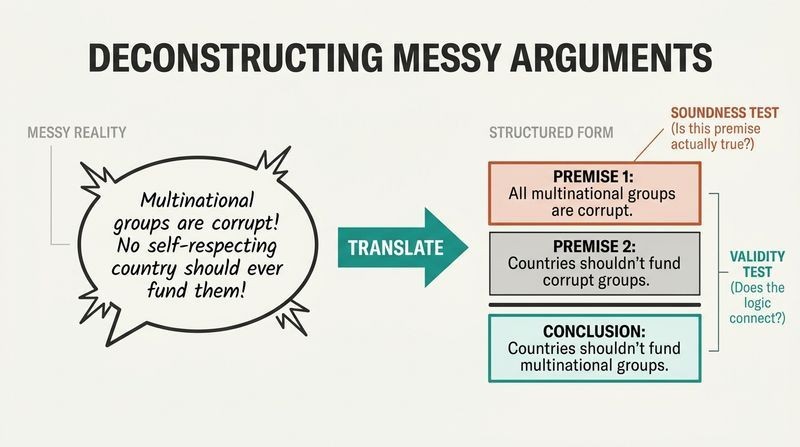
The workhorse skill of critical thinking is turning everyday speech into structured arguments so you can inspect the reasoning. An argument is a set of premises (evidence) leading through inference to a conclusion. A valid deductive argument makes it impossible to accept the premises yet reject the conclusion; add true premises and it becomes sound.
Take a dinner-party rant: 'Multinational organizations are corrupt and wasteful, so no self-respecting country should fund them.' Rewrite it as premises and a conclusion and the structure becomes visible, and attackable. The argument may be valid (logically airtight) yet unsound, because the premise that all such groups are corrupt collapses the moment you name one that isn't. Validity concerns form. Soundness concerns truth. Confusing the two is a classic error.
This translation skill is where abstract logic meets daily life, and it is genuinely powerful. Once internalized, it functions like X-ray vision through political spin and advertising. The distinction between validity and soundness deserves emphasis: much public disagreement is really an argument over the truth of a hidden premise, not the logic connecting premises to conclusion. Worth noting a limit Haber acknowledges through cognitive science: humans reason poorly with abstract logical forms but well with concrete, socially embedded content (the famous Wason selection task shows this). So the act of formalizing an argument is itself cognitively demanding and requires deliberate practice, not mere exposure.
Most real-world reasoning is inductive probability, not airtight deduction
Textbook logic celebrates deduction, where conclusions follow with certainty (all men are mortal, Socrates is a man, therefore Socrates is mortal). But nearly every argument that matters in life is inductive: the premises make the conclusion likely, not certain. Deciding which car to buy, which candidate to back, or whether to change a tax code all involve claims about a future that hasn't happened yet.
Even science runs mostly on induction. The claim that the sun will rise tomorrow rests on overwhelming probability, not proof. Inductive arguments can't be valid or invalid; they sit on a spectrum from strong to weak, judged by the probability, relevance, and sufficiency of their premises. Even Sherlock Holmes, who claimed to 'deduce,' was usually inferring the most likely explanation from clues.
This reframing is quietly liberating. People often demand certainty before acting, then feel paralyzed when it never arrives. Recognizing that good thinking traffics in probabilities, not proofs, aligns critical thinking with Bayesian reasoning, where beliefs are updated by degrees as evidence accumulates. It also inoculates against a common manipulation tactic: the demand for absolute proof as a stalling device (climate denial and tobacco lobbying both weaponized this). The nuance worth adding is that induction has famous philosophical vulnerabilities, Hume's problem of induction chief among them, but Haber wisely treats these as reasons for humility rather than excuses for inaction.
Learn the recurring fallacies so broken arguments announce themselves
Bad arguments break in predictable ways, and naming these fallacies lets you spot them fast. Formal fallacies are structural. Affirming the consequent, for instance: 'If Torrance gambled away his money he'd be broke; Torrance is broke; therefore he gambled it away.' He could have gone broke a hundred other ways. Informal fallacies concern content and language:
1. Ad hominem: attacking the person, not the argument.
2. Straw man: attacking a distorted version of the opponent's position.
3. Hasty generalization: concluding from too little evidence.
4. False dichotomy: presenting only two options when more exist.
5. Guilt by association: smearing someone via their loose connections.
Haber stresses these aren't harmless parlor errors. Bigotry that condemns a whole race for a few members' behavior is the composition fallacy doing real damage.
Fallacy-spotting is the most popular entry point to critical thinking, and for good reason: it feels like acquiring a superpower. But there is a well-documented failure mode worth flagging. Novices, once armed with a fallacy list, often turn into 'fallacy police,' slapping labels on any argument they dislike, which is itself a shortcut that dodges genuine engagement. Context matters enormously: attacking someone's character is fallacious ad hominem, unless their honesty is the actual issue (a witness convicted of perjury). The deeper lesson, which Haber's charity principle addresses, is that fallacy-hunting should sharpen understanding, not replace it.
Argue against the strongest version of your opponent's position
The principle of charity asks you to translate and engage with the most robust version of an argument, not a weakened caricature you can easily topple. Philosopher Nigel Warburton's example: if someone says 'all animals should have equal rights,' the uncharitable reply mocks the idea of giraffes voting. The charitable reading interprets it as 'equal rights of protection from harm,' then engages that.
Charity is more than politeness. Engaging strong arguments stretches your mind the way competing against skilled athletes improves your game. It also demands empathy, entering another's mind to grasp what they believe and why. That empathy is a potent antidote to confirmation bias, our built-in tendency to swallow what confirms our views and reject what threatens them. Compare this to internet comment sections, where debaters pounce on typos and parody their rivals.
Charity is the ethical and strategic core of the book, and it inverts our tribal instincts. It anticipates what Rapoport's rules and Daniel Dennett popularized as steelmanning: restate your opponent's view so well they thank you before you rebut it. There is strong instrumental logic here. Defeating a straw man changes no minds and teaches you nothing, while engaging the steelman either sharpens your position or honestly changes it. The connection to confirmation bias is the sharpest insight: charity is not just good manners but a cognitive discipline that forces exposure to disconfirming evidence, the one thing our biased brains most want to avoid.
Your reason runs on shortcuts that quietly sabotage your judgment
For centuries, reason was seen as what separates humans from beasts, with irrationality blamed on emotion or instinct overwhelming it. Then Daniel Kahneman and Amos Tversky showed reason itself is systematically flawed. The mind uses heuristics, mental shortcuts that manage information efficiently but produce predictable biases.
Examples: the anchoring effect, where any number you're shown first (a house's asking price) distorts your later estimate, even when you try to resist. The availability heuristic, where a recent vivid conversation sways a major decision more than careful research done earlier. And most corrosive of all, confirmation bias, arguably the engine behind tribalism and 'fake news.' These shortcuts likely evolved for survival: an ancestor who assumed the rustling bush hid a predator outlived the one who paused to gather data.
Integrating Kahneman and Tversky into a critical-thinking framework is essential and correct, because it means the enemy is not just other people's bad arguments but your own hardware. This is humbling: no amount of logical training fully immunizes you, since biases operate below awareness. The honest implication, which the behavioral-economics literature confirms, is that debiasing is hard and often fails through willpower alone. This strengthens Haber's case for environmental and social fixes, like the scientific method's peer review, which works precisely because it distributes bias-checking across many minds rather than trusting any individual to catch their own blind spots.
Think like a scientist about everything, not just science
The scientific method, refined from the Renaissance through the Enlightenment by figures like Copernicus, Newton, and Descartes, gave humanity a reasoning template: pose a question, propose a tentative hypothesis, gather evidence to test it, and hold your belief conditionally. Charles Peirce, founder of American Pragmatism, argued we adopt beliefs mainly to escape the discomfort of doubt. He named four ways we do it: cling to what's comfortable (a priori), defer to authority, stubbornly hold on regardless of evidence (tenacity), or use science.
Only the last treats beliefs as provisional and inches toward truth. The powerful point: you don't need a lab. Choosing a college, a car, or a candidate benefits from the same discipline of proposing an answer, testing it for reasonableness, and concluding based on results rather than jumping to the first comfortable belief.
Reframing science as a portable attitude rather than a profession is one of the book's most useful moves. Peirce's taxonomy of belief-fixation is a small masterpiece of practical psychology, and it maps neatly onto modern political dysfunction, where a priori comfort and authority-deference dominate. One nuance worth adding: philosophers of science like Kuhn showed that even science advances through paradigm shifts driven by social and psychological factors, not pure rationality, so 'thinking like a scientist' is an idealization. Still, as a corrective to gut-first decision-making, the discipline of provisional belief and honest testing is among the highest-leverage habits an individual can build.
You cannot think critically about a subject you know nothing about
Reasoning is not a free-floating skill you can apply anywhere. Cognitive scientist Daniel Willingham's observation drives this home: a student who learned to estimate answers in math class fails to notice his chemistry calculations sum to over 100%, and a student who weighs both sides of the American Revolution never thinks to question how Germans viewed World War II. Thought processes are entangled with what is being thought about.
Since facts form the premises of arguments, you can neither build nor critique an argument without domain knowledge. This is why background knowledge is a named component of critical thinking, and why the internet complicates things. Access to information is not the same as the ability to locate quality sources, evaluate them, and synthesize them, a skill set librarians formalized as information literacy.
The domain-specificity of thinking is one of the most robust and underappreciated findings in cognitive science, and it punctures a cherished myth: that schools can teach 'transferable critical thinking skills' in the abstract. Chess masters and expert physicians reason brilliantly in their domains and unremarkably outside them. This has sharp policy consequences: a standalone 'critical thinking' course may transfer poorly, which is why Haber leans toward embedding reasoning instruction inside rich subject matter. The tension with the transfer goal is real and unresolved in the field. The practical takeaway for individuals is humbling: expertise is not optional, and confident reasoning without knowledge is just fluent error.
Skill comes from deliberate practice on messy problems, not lectures
Explaining logic or argument mapping takes minutes. Getting good at it takes years. Drawing on K. Anders Ericsson's research, Tim van Gelder notes that elite performance across fields tends to require roughly a decade of deliberate practice, about four hours a day. Critical thinking is no different, and the practice must target the skill itself, not just thinking hard about some topic.
The best training uses ill-defined problems: open-ended questions with no clean right answer, like ethical dilemmas or real editorials packed with tangled, branching arguments. Meta-analysis of 117 interventions with over 20,000 students found the mixed method (teaching critical thinking as an explicit track inside a content course) worked best, while immersion (hoping it emerges as a byproduct) worked worst. Teacher training mattered enormously. Some educators even model courses on martial-arts belts, awarding advancement only when students can actually 'throw the punch.'
Grounding critical thinking in the deliberate-practice literature is a smart corrective to the fantasy that a single course produces reasoners. The martial-arts analogy is apt because it foregrounds demonstrated mastery over seat time or effort, a competency-based model gaining traction across education. One caveat: Ericsson's ten-year figure was drawn from chess, music, and sports, and its application to reasoning is an inference, not a measured result, as Haber concedes. The meta-analytic finding that explicit instruction beats osmosis is the actionable gold here, and it quietly indicts the common practice of listing 'critical thinking' as a course goal while doing nothing structural to build it.
Emotion is data, not the enemy of good reasoning
A tempting misreading of critical thinking is that we should become emotionless logic machines. Haber uses Star Trek's Vulcans, who suppress feeling in the name of logic, to reject this. Emotion and instinct supply valuable information that can legitimately inform the premises of an argument. A parent reads a child's needs through emotional attunement long before the child can speak.
The discipline is not to banish emotion but to interrogate it: did this feeling inform the premise or distort it? Balance the emotional, intuitive, and reasoning selves rather than amputating any of them. The same holds for conviction. Holding strong beliefs and joining causes does not require abandoning reason. In fact, interrogating your beliefs strengthens the sound ones (letting you advocate with more force) and lets you revise the weak ones. That is strength, not weakness.
This is a mature stance that separates Haber from caricatures of rationalism. Neuroscience backs him: Antonio Damasio's work on patients with damaged emotional processing showed they became catastrophically bad at ordinary decisions, unable to assign value to options. Emotion is not opposed to reason; it is the valuation system reason operates on. The genuinely hard part, which the takeaway names but cannot fully solve, is distinguishing emotion-as-information from emotion-as-distortion in the moment, when they feel identical from the inside. This is where the earlier dispositions (intellectual humility) and social checks (charity, peer review) earn their keep, since others often spot our distorting emotions before we do.
Bad reasoning built Fukushima; better thinking is a civic survival skill
Haber opens his final chapter at the Foundation for Critical Thinking during the 2011 Fukushima disaster, where a nuclear plant on a fault line failed after an earthquake and tsunami. The question 'What were they thinking?' becomes literal: what premises justified that location, and what logic linked them to the decision? The premises were faulty, built on best-case wishful thinking and corrupted by regulators beholden to nuclear-expansion interests. The argument was constructed like the plant itself, from unsound materials and a flawed design.
He extends this to politics, where voters increasingly reject anyone they disagree with, retreat into like-minded bubbles, and consume caricatures assembled from out-of-context clips by consultants and hostile foreign powers who profit from short-circuiting reason. The remedy requires no remaking of human nature, only using the faculties we already have a bit better and a bit more often.
Ending on stakes rather than technique is rhetorically shrewd, and the Fukushima case study demonstrates the book's own method: decompose a catastrophic decision into premises and inferences to locate exactly where reasoning failed. The framing of critical thinking as democratic infrastructure connects to a long tradition from Dewey to contemporary work on epistemic security and disinformation. The sober note is that individual reasoning skill may be necessary but insufficient against industrialized manipulation and algorithmic outrage, which exploit biases faster than any curriculum can patch them. Haber's optimism that small, widespread improvements compound is plausible, but the collective-action problem of building a genuinely critical-thinking culture remains formidable.
Analysis
Haber's slim MIT Press volume is a synthesis, not a manifesto. Its ambition is to map a contested field rather than plant a flag, and that restraint is both its strength and its limitation. Structurally the book moves from genealogy (philosophy, science, psychology, Pragmatism, and Dewey) to components (logic, language, argumentation, background knowledge, creativity, dispositions) to the practical trinity of defining, teaching, and assessing. The through-line is a refusal to be paralyzed by definitional disputes: we know enough to act.
What distinguishes the book is its intellectual honesty about tensions the popular critical-thinking industry papers over. Two stand out. First, the transfer problem: reasoning is domain-specific (Willingham), yet the entire selling point of teaching critical thinking is transferable skill. Haber leans on Ennis's infusion and mixed approaches and the deliberate-practice literature to bridge this, but the gap is real and the field has not closed it. Second, the dispositions problem: everyone agrees traits like open-mindedness and intellectual humility matter, yet schools built for content delivery have no reliable machinery for cultivating character. Haber's redirection toward the home and toward martial-arts-style mastery models is honest about this shortfall.
The book's treatment of Kahneman and Tversky is where it earns its contemporary relevance. By locating the enemy inside our own cognition, Haber shifts critical thinking from a debating skill to a discipline of self-correction, best achieved socially (peer review, charity) rather than through solitary willpower. His Pragmatist grounding via Peirce and Dewey, seeing thought as doubt-resolution, is underused elsewhere and gives the book a coherent psychological spine.
Weaknesses: the assessment chapter, while thorough, is dry and inconclusive, essentially arguing that many imperfect tests exist. And the closing civic exhortation, though stirring, underestimates how structural forces (attention economics, algorithmic outrage) may outrun individual skill. Still, as a clear-eyed field guide, it succeeds admirably.
Review Summary
Critical Thinking receives mixed reviews, with an average rating of 3.63/5. Readers appreciate its concise overview of critical thinking's history, components, and educational applications. Many find it valuable for educators but less practical for general readers seeking to improve their own skills. The book is praised for its accessible writing and additional resources, though some criticize its focus on pedagogy rather than practical techniques. Reviewers highlight its exploration of critical thinking's importance in modern society and its potential to foster independent, systematic thinkers.
People Also Read




FAQ
What's "Critical Thinking" by Jonathan Haber about?
- Overview: "Critical Thinking" by Jonathan Haber is part of the MIT Press Essential Knowledge series, offering a comprehensive exploration of what critical thinking entails, its historical development, and its importance in education and society.
- Content Structure: The book is divided into four main chapters: the genealogy of critical thinking, its components, how it can be defined, taught, and assessed, and the future directions for critical thinking.
- Purpose: It aims to provide readers with a foundational understanding of critical thinking, emphasizing its role in education and its necessity for informed decision-making in modern society.
- Target Audience: While primarily aimed at educators, the book is also valuable for anyone interested in improving their reasoning skills and understanding the importance of critical thinking in various aspects of life.
Why should I read "Critical Thinking" by Jonathan Haber?
- Educational Insight: The book offers valuable insights into how critical thinking can be integrated into educational curricula, making it a useful resource for educators and policymakers.
- Skill Development: It provides practical guidance on developing critical thinking skills, which are essential for problem-solving and decision-making in both personal and professional contexts.
- Comprehensive Understanding: Readers gain a thorough understanding of the historical and philosophical roots of critical thinking, enhancing their appreciation of its significance.
- Global Relevance: The book discusses the global importance of critical thinking, highlighting its role in addressing contemporary challenges such as misinformation and political polarization.
What are the key takeaways of "Critical Thinking" by Jonathan Haber?
- Three Components: Critical thinking consists of knowledge, skills, and dispositions, all of which are necessary for effective reasoning and decision-making.
- Educational Integration: Critical thinking should be explicitly taught and practiced across various subjects to ensure students develop transferable reasoning skills.
- Historical Context: Understanding the historical development of critical thinking, from ancient philosophy to modern educational practices, is crucial for appreciating its current applications.
- Future Directions: The book emphasizes the need for continued emphasis on critical thinking in education to prepare individuals for the complexities of the modern world.
How does Jonathan Haber define critical thinking in the book?
- Purposeful Judgment: Critical thinking is described as purposeful, self-regulatory judgment that involves interpretation, analysis, evaluation, and inference.
- Self-Improvement: It includes the ability to improve one's thinking by skillfully analyzing, assessing, and reconstructing it.
- Overcoming Bias: Critical thinking requires a commitment to overcoming egocentrism and sociocentrism, which are internal and external biases, respectively.
- Metacognition: The process involves metacognition, or thinking about one's own thinking, to enhance the quality of reasoning.
What are the components of critical thinking according to Jonathan Haber?
- Structured Thinking: This involves using logic and reasoning to make clear what we or others are thinking and to determine if reasons for belief are justified.
- Language Skills: Critical thinkers must be skilled at translating everyday language into structured arguments for logical analysis.
- Argumentation: The ability to construct and analyze arguments is central to critical thinking, encompassing both formal and informal logic.
- Dispositions: Personal traits such as curiosity, open-mindedness, and intellectual humility are essential for practicing critical thinking effectively.
How can critical thinking be taught, according to the book?
- Explicit Instruction: Critical thinking should be taught explicitly, whether as a standalone course or integrated into other subjects.
- Deliberate Practice: Students need opportunities for deliberate practice to develop their critical thinking skills through real-world applications.
- Teacher Preparation: Educators should receive training on how to teach critical thinking principles and integrate them into their lessons.
- Use of Ill-Defined Problems: Teaching should involve engaging students with ill-defined problems that require critical thinking to solve.
What role does creativity play in critical thinking as per Jonathan Haber?
- Creative Hypotheses: Creativity is essential for generating hypotheses and designing experiments, which are fundamental to scientific and reflective thinking.
- Pattern Recognition: Critical thinkers use creativity to identify patterns and develop new solutions to complex problems.
- Integration with Logic: While logic provides structure, creativity offers new material and perspectives for critical analysis.
- Educational Emphasis: The book highlights the importance of incorporating creativity into educational practices to enhance critical thinking skills.
How does the book suggest assessing critical thinking skills?
- Standardized Tests: Various commercial assessments, like the Watson-Glaser Critical Thinking Appraisal, are used to measure critical thinking skills.
- Performance-Based Assessments: These involve tasks that require students to demonstrate their reasoning abilities through open-ended responses.
- Survey Assessments: Dispositions are often measured using surveys that assess personal traits related to critical thinking.
- Validation Process: Professional test development involves a rigorous process to ensure assessments accurately measure the intended constructs.
What are some challenges in defining critical thinking, according to the book?
- Multiple Definitions: There are numerous definitions of critical thinking, each emphasizing different aspects such as skills, dispositions, or metacognition.
- Philosophical Debates: The book discusses philosophical debates over whether critical thinking is an individual or social process.
- Cultural Considerations: Critical thinking is often viewed through a Western lens, raising questions about its universality and applicability across cultures.
- Integration with Other Skills: The book explores how critical thinking intersects with other 21st-century skills like creativity and collaboration.
What are the best quotes from "Critical Thinking" by Jonathan Haber and what do they mean?
- "Errors in judgment continue to plague us at the individual and societal levels." This highlights the ongoing need for critical thinking to address personal and collective decision-making challenges.
- "Teaching ourselves and others to become critical thinkers requires a grounding in core principles." Emphasizes the importance of foundational knowledge in developing critical thinking skills.
- "The most important critical-thinking issue facing the world today is that not enough people are doing enough of it." Stresses the urgency of promoting critical thinking to tackle global issues effectively.
- "Critical thinking is not just a body of content to be taught but rather consists of three interconnected components: knowledge, skills, and personal dispositions." This quote encapsulates the comprehensive nature of critical thinking as presented in the book.
How does Jonathan Haber address the role of biases in critical thinking?
- Cognitive Biases: The book discusses how cognitive biases, such as confirmation bias, can distort reasoning and decision-making.
- Controlling Bias: Critical thinking involves understanding and controlling for biases to improve the quality of reasoning.
- Empathy as a Control: Empathy is highlighted as a powerful tool for controlling biases by allowing individuals to understand opposing viewpoints.
- Educational Focus: The book emphasizes the need for education to address biases explicitly as part of critical thinking instruction.
What future directions for critical thinking does the book propose?
- Educational Reform: The book advocates for integrating critical thinking into educational standards and teacher training programs.
- Cultural Shift: It calls for a cultural shift that values and rewards critical thinking skills in various aspects of life.
- Global Perspective: Emphasizes the importance of critical thinking in addressing global challenges such as misinformation and political polarization.
- Continued Research: The book encourages ongoing research into effective methods for teaching and assessing critical thinking skills.
Download PDF
Download EPUB
.epub digital book format is ideal for reading ebooks on phones, tablets, and e-readers.








































