


Key Takeaways
You are already awake; you just don't act like you know it
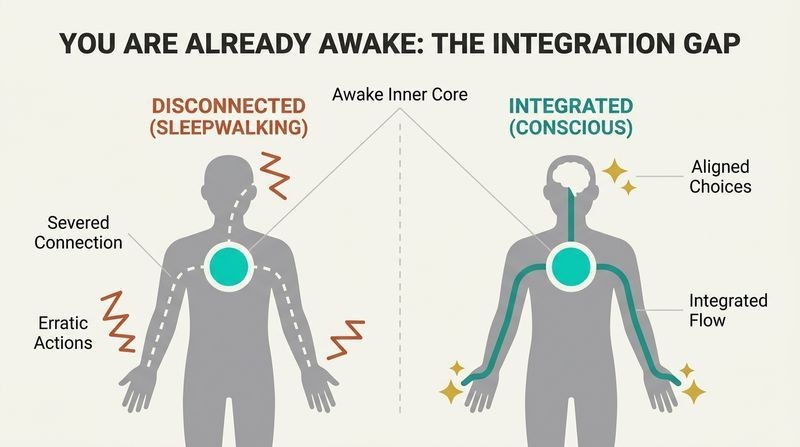
The book's core reframe. Walsch, roused at 4:23 a.m. by the same inner urge that produced the original Conversations with God, receives a "Third Invitation": awaken the species. But awakening, God insists, is not something to achieve. It has already happened. Like a person startled from a nightmare who realizes the terror was never real, humanity is being "scared awake" by the nightmarish state of the world.
Knowing versus integrating. The problem is not ignorance but sleepwalking. People know better yet behave like toddlers playing with matches, doing what feels fun in the moment or simply forgetting what they know. The gap is between awareness and integration. You possess the truth of who you are; you have just not woven it into how you speak, choose, and act each day.
What's striking is how this inverts the usual self-help promise. Most spiritual traditions frame enlightenment as a distant summit demanding decades of practice. Walsch's claim resembles the Zen notion that you are already Buddha, or Byron Katie's insistence that suffering is just unquestioned thought. The move is psychologically shrewd: reframing a daunting goal as mere recollection lowers resistance. The obvious counterpoint is that "you already know" can excuse passivity, and Walsch concedes the tension himself. Still, the distinction between possessing knowledge and embodying it maps neatly onto research on the intention-behavior gap, where knowing what to do rarely predicts doing it.
The fastest way to wake yourself is to wake someone else
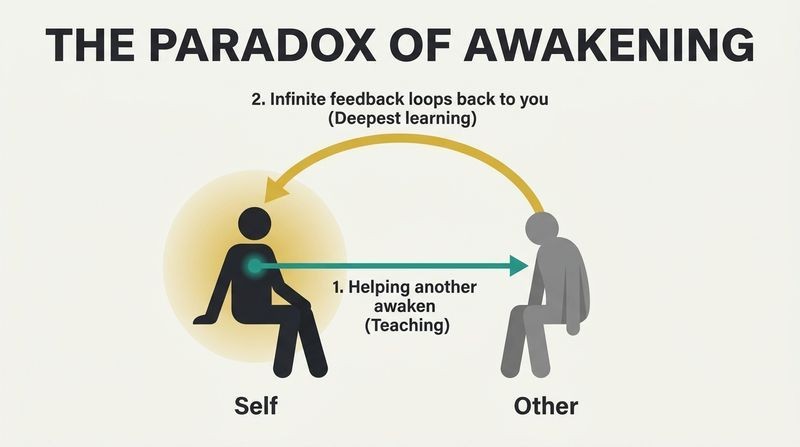
A deliberate paradox. When Walsch protests that he cannot help others awaken while still asleep himself, God offers a Divine Dichotomy: two contradictory truths occupying the same space. The act of helping another remember who they are accelerates your own remembering. Teaching is the deepest form of learning.
Intention changes everything. Many people already act kindly and generously, but not on purpose. God compares this to driving competently down a road without deciding a destination: you arrive nowhere. When you set the specific intention that everything you think, say, and do serves to awaken your species, the same actions produce a different order of result. The method is not preaching from a pedestal but modeling your own evolution publicly, letting others see a human being visibly becoming more of who they are.
The teaching-as-learning claim has solid empirical footing. Studies on the "protege effect" show students who prepare to teach material learn it more deeply than those studying for a test. Vygotsky's work on social learning and mirror-neuron research both suggest humans internalize by demonstrating to others. Walsch's emphasis on intention echoes goal-setting theory, where specific, self-endorsed goals outperform vague good will. The risk he flags himself is real: casting oneself as a species-awakener invites grandiosity and messianic delusion. His safeguard, staying focused strictly on personal evolution rather than saving the world, is a sensible humility check worth borrowing.
Survival isn't your deepest instinct; expressing love is
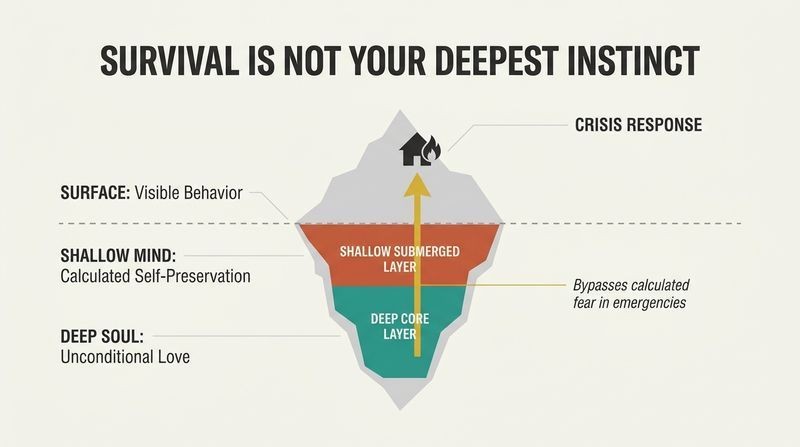
The Burning Building Moment. Contrary to the common belief that self-preservation rules us, Walsch argues our true basic instinct is the expression of Divinity, which in human terms means unconditional love. The proof: people run into burning buildings toward a crying baby rather than away. In that instant nobody calculates survival odds. They act from soul, becoming, as God puts it, literally "out of their mind."
Heaven on Earth overnight. If humans treated every ordinary moment the way they treat that emergency, accessing love instantly and without conditions, the world would transform immediately. The tragedy is that such clarity arrives only when "the chips are down." Most people spend everyday life lost in a labyrinth, following the body's fears rather than the soul's impulse.
This directly challenges the neo-Darwinian orthodoxy that the selfish gene governs behavior. Yet evolutionary biology itself has softened: kin selection, reciprocal altruism, and Sober and Wilson's group selection models explain why organisms sacrifice for others. The heroic rescue of strangers, though, strains gene-centered accounts, which is why researchers like Svenn Lindskold study "impulsive altruism" as a genuine puzzle. Walsch's spiritual explanation is unfalsifiable, but his behavioral observation is sound and echoes Viktor Frankl: humans transcend survival for meaning. The weak point is frequency. If love were truly our default instinct, its rarity in daily life demands more explanation than "forgetting" comfortably provides.
Humanity is one decision away from remaking its future
The One Decision. Walsch names a single collective choice that could change everything: to open-mindedly explore, then open-heartedly accept, the reality of who we really are. He grounds the urgency in grim data he cites: over 1.6 billion people lack clean water, 650 children die of starvation every hour, and 85 of the world's richest people hold more wealth than the poorest 3.5 billion combined.
Why now is the Perfect Time. These conditions have always existed, but the internet and social media now make them impossible to ignore. You cannot solve problems you cannot see. The very visibility of humanity's dysfunction, once hidden from all but activists and academics, is what makes this the ideal moment to choose differently. Necessity, as the old saying goes, mothers invention.
The framing that awareness precedes reform tracks with how movements actually ignite. The Ethiopian famine reached Western consciousness only through television; Black Lives Matter scaled through smartphone video. Amartya Sen's famous finding that famines do not occur in functioning democracies with free press supports Walsch's water example: scarcity is usually a failure of distribution and will, not supply. The vulnerability here is the leap from awareness to a single metaphysical "decision." Social change theory suggests transformation requires institutions, incentives, and coordination, not just shifted consciousness. Walsch's optimism is bracing, but structural inequality rarely dissolves through collective epiphany alone.
Belief in separation cascades into every human pathology
A five-step domino chain. Walsch traces humanity's dysfunction to a single root: Separation Theology, the belief that humans are "over here" and God is "over there." This produces a Separation Cosmology (everything is separate from everything), which yields a Separation Psychology (I am separate from you), which generates a Separation Sociology (everyone serves only their own interests), which finally erupts as Separation Pathology: violence, conflict, and self-destruction.
The fingers-and-hand cure. The antidote is a Oneness Theology. We are differentiated from God but not separated, exactly as fingers are distinct yet joined by the same hand and body. As Walsch puts it, oneness is not a property of life; life is a property of oneness. Eliminate separation and violence loses its foundation, because harming another becomes visibly harming yourself.
The causal chain is elegant and echoes serious thinkers. Physicist David Bohm's "implicate order" and Thich Nhat Hanh's "interbeing" articulate the same non-separation intuition. Psychologically, the finding that dehumanization (perceiving others as fundamentally separate and lesser) precedes atrocity is well documented in genocide research by scholars like Gregory Stanton. Environmental philosophy's deep ecology makes an identical argument about our estrangement from nature. Where the model overreaches is monocausality. Attributing all conflict to separation theology ignores resource competition, tribalism rooted in evolutionary psychology, and material scarcity that persists even among people who feel deeply connected. Oneness may be necessary for peace without being sufficient.
Sixteen traits separate an awakened species from a sleeping one
A diagnostic mirror. God offers Walsch a list contrasting awakened beings with unawakened humans. Highlights include:
1. They see the unity of all life and live it.
2. They always tell the truth, finding deceit literally impossible.
3. They share everything with everyone, always.
4. They replace ownership with stewardship, and profit that harms another is unthinkable.
5. They never compete and never poison themselves.
Do what works. A recurring theme: an awakened species, having honestly seen what is so, does what works given its goals. If your aim is peace, violence does not work. If your aim is health, smoking carcinogens does not work. If your aim is nonviolent children, saturating them with violent images does not work. Each failure, Walsch notes, "has already been demonstrated." The list is not an indictment but a report card for a very young species.
The "what works given what you want" logic is pure pragmatism, echoing William James and cognitive-behavioral therapy's functional analysis, which asks not whether a behavior is right but whether it serves your stated goal. The stewardship-over-ownership idea resonates with indigenous land ethics and Elinor Ostrom's Nobel-winning work on managing commons without private ownership. The "no competition" trait is the most contestable: competitive dynamics drive innovation, sport, and much human flourishing, and even cooperative species compete for mates and resources. Walsch's utopia risks flattening the generative tension that competition can provide. Still, as a values audit, the list forces uncomfortable clarity about the gap between stated ideals and actual behavior.
Death is a change of form you always choose at soul level
Re-identification, not ending. Walsch reframes death as moving from physical to metaphysical existence, like white light passing back through a prism to become one beam again. Since energy can neither be created nor destroyed, you never cease to be; you simply become more expansive. He offers a vivid image: strip the empty space from every human's atoms and the entire race would fit inside a child's marble, because you are 99% space, identical to the cosmos.
The Superconscious Will. Most provocatively, God claims no one dies at a time or in a way they did not choose at the soul level. Even murder victims exercised a Superconscious choice. This is offered not to excuse killers but to comfort the bereaved and dissolve the victim-villain story. Understanding, in the mind of a master, replaces the need for forgiveness.
The physics-flavored claims contain real kernels: atoms are indeed mostly empty space, and conservation of energy is genuine. But Walsch stretches these into consciousness survival, a leap physics does not license. The Superconscious Will assertion is the book's ethical minefield. It flirts with the "just world" fallacy and can shade into victim-blaming, a charge Walsch anticipates and rebuts by locating choice beyond ordinary awareness. Comparable ideas appear in Hindu karma and in Michael Newton's between-lives regression work. The comfort it offers the grieving is genuine and therapeutically documented; meaning-making reduces complicated grief. The danger is using cosmic choice to dodge accountability for preventable harm.
Time and space are illusions you can bend to your advantage
The DVD and the chessboard. Walsch uses two analogies. A movie exists all at once on the disc, yet a laser reads it bit by bit, creating the illusion of sequence. Similarly, everything that ever happened or will happen exists now; your position in the space-time continuum just makes it feel linear. And like computer chess, every possible future already exists on the "disc"; your moves select which one you experience. There is no single predestined future, only the one you create.
Practical time-bending. Because time is elastic (fun flies, waiting drags, deadlines make you superhumanly productive), you can accomplish more in the next ten years than the previous hundred by refusing to let "too little time" discourage you or "plenty of time" breed apathy. Set goals unhooked from time entirely.
Walsch invokes Einstein correctly: relativity does establish that simultaneity is observer-dependent and that motion through space affects passage of time. The block-universe interpretation, where past, present, and future coexist, is a serious position among physicists like Brian Greene. So the metaphysics has more scientific cover than most of the book. The many-futures chess model loosely resembles the many-worlds interpretation of quantum mechanics. The practical advice, though, needs no cosmology: it is essentially Parkinson's Law and the planning fallacy repackaged. The genuinely useful nudge is decoupling ambition from perceived time constraints, which behavioral research on "temporal discounting" suggests could counter our tendency to defer meaningful action indefinitely.
Every act, even cruelty, is a misguided expression of love
The uncomfortable universal. Walsch presses God on the killer, the tyrant, the swindler. The answer: every act is an act of love. Nobody does what they consider unloving. Behind every decision lies the love of something. The diagnostic question for any atrocity becomes: what did this person love so much they felt they had to do this?
The real problem is skill, not absence. People do not fail to love; they fail to know how to love purely. Pure love expects nothing in return, springing from a self that needs nothing to be happy. This does not justify harmful acts, Walsch stresses, but it explains them, and explanation replaces condemnation. Loving the night sky for its sheer beauty, wanting nothing back, is the template: awe is the highest love because it demands nothing.
This is a strong claim that resonates with humanistic psychology. Marshall Rosenberg's Nonviolent Communication rests on an identical premise: all behavior is a strategy to meet a universal human need, so even violence expresses an unmet need clumsily. Carl Rogers assumed an underlying actualizing drive toward the good. The framing has therapeutic power, cultivating compassion rather than reactive judgment. The philosophical weakness is that "love of something" becomes so elastic it explains everything and therefore nothing. A sadist who loves cruelty, or a narcissist who loves dominance, technically fits, which drains the word "love" of moral content. Walsch's saving move is distinguishing pure, need-free love from possessive, self-serving attachment.
Higher help arrives as inspiration you mistake for your own idea
Highly Evolved Beings. Walsch is told humanity is not awakening alone. Highly Evolved Beings (HEBs) from another dimension assist us, distinct from merely advanced extraterrestrials, since technological advancement does not equal moral evolution (humans are proof). HEBs are completely without violence because they live knowing life is eternal and nothing of value can be lost.
How the help works. Almost never by landing spaceships. On rare occasions across millennia a HEB has been born human to model a message that could not be missed. Far more often they simply drop ideas into what Carl Jung called the collective unconscious. Humans whose energy resonates then feel inspired and say "I just got an idea." No one's private mind is invaded; ideas attract by vibrational match, surfacing in books, films, and art. The point is never to make you follow them, but to give you back to yourself.
The most sensational content in the book is handled with unexpected restraint. By making HEB influence indistinguishable from ordinary inspiration, Walsch renders it unfalsifiable but also non-cultish. His invocation of Jung's collective unconscious is apt: Jung did theorize a shared reservoir of archetypes from which creative insight emerges. The refusal to name any historical figure as a HEB (invoking the Zen line about killing the Buddha you meet) is philosophically consistent, protecting against guru-worship. Skeptics will note this is a classic unfalsifiable structure: help that looks exactly like no help. But the underlying counsel, that truth matters more than its source, is a genuinely liberating epistemic stance.
Don't wait to be perfect; model your messy progress out loud
Integration over information. Walsch's real anguish is that knowing has not made him consistently loving. God's remedy is patience and five tools:
1. Share your process, struggles included, publicly.
2. Create a reason (answer "why" you bother).
3. Express gratitude as a chosen energy, not a reaction.
4. Choose your state of being before acting.
5. Go with the soul, responding from wisdom rather than mental analysis.
Your struggle is the gift. If you showed up as a finished master, others would admire you but never see themselves in you. Because you visibly fail and recover, you prove the process is survivable. Walsch adds his own tool, the Magic Inquiry: before any activity, ask "what does this have to do with my soul's agenda?" And he reframes the goal: freedom is not getting what you want, it is wanting what you get.
The counterintuitive insight, that visible imperfection is more instructive than polished mastery, aligns with the "pratfall effect" in social psychology, where competent people become more likable after a minor blunder. Brene Brown's research on vulnerability makes the same case: shared struggle builds connection where performed perfection breeds distance. The gratitude tool has robust empirical backing, with Robert Emmons's studies linking gratitude practice to measurable wellbeing gains. "Choosing a state of being in advance" resembles implementation intentions and Stoic premeditation. The honest note is that Walsch, decades into this work, still struggles, which either validates the difficulty of integration or quietly undercuts the book's promise that the change is "remarkably easy."
Analysis
Conversations with God, Book 4 arrives a decade after Walsch declared the series complete, and it reads as both a synthesis and a pivot. Structurally it is a Socratic dialogue in which Walsch plays the skeptical everyman and God the patient teacher, a device that lets him voice reader objections before answering them. This makes the book self-aware about its own implausibility, an unusual strength in the genre. Walsch repeatedly instructs readers to doubt, insisting "the day I stop doubting is the day I become dangerous."
The intellectual architecture rests on a single load-bearing claim: separation is an illusion, and all human dysfunction flows from believing it. Everything else (nonviolence, sharing, the dissolution of death-fear) is downstream. This is monism dressed in accessible language, closer to Advaita Vedanta and process theology than to Abrahamic tradition, which explains why Walsch anticipates charges of heresy.
What distinguishes Book 4 from its predecessors is the extraterrestrial turn. The introduction of Highly Evolved Beings risks alienating the mainstream audience the earlier books cultivated, and Walsch clearly senses this, spending chapters negotiating reader resistance. His handling is shrewd: HEB influence is defined so it looks identical to ordinary inspiration, making it optional rather than doctrinal.
The book's deepest weakness is its epistemology. Nearly every claim is unfalsifiable, and the Superconscious Will doctrine (no one dies against their will) courts genuine ethical hazard. Its deepest strength is therapeutic. The reframes (you are already awake, understanding replaces forgiveness, freedom is wanting what you get) are psychologically potent regardless of their metaphysical truth. Walsch's late-life open-heart surgery, disclosed in the epilogue, lends the whole an urgency that transcends the abstractions: a man confronting mortality, insisting existence must mean more than acquisition. Read as consolation and behavioral nudge rather than cosmology, it delivers real value.
Review Summary
Conversations with God, Book 4 received overwhelmingly positive reviews, with readers praising its spiritual insights and transformative power. Many found it thought-provoking and inspiring, noting its focus on love, unity, and human evolution. Readers appreciated the book's call to action and its potential to change perspectives. Some mentioned it reinforced concepts from previous books in the series while introducing new ideas. A few critics felt it was repetitive or unnecessary, but most reviewers considered it a must-read for spiritual seekers and those interested in personal growth.
People Also Read







Glossary
The Third Invitation
Call to awaken humanityThe central summons of the book, following two earlier invitations (change the world's mind about God, give people back to themselves). It asks readers to awaken the species by first recognizing they are already awake, then modeling awakened behavior for others as part of their own spiritual evolution. It is extended to everyone but accepted only by those who self-select.
Highly Evolved Beings (HEBs)
Nonviolent beings from another dimensionFully awakened sentient beings existing in a parallel metaphysical dimension who move between physical and non-physical form at will. Completely without violence, they assist humanity mainly by dropping ideas into the collective unconscious for resonant humans to receive as inspiration, and only rarely by being born in human form to model a message directly.
Divine Dichotomy
Two contradictory truths coexistingA situation where two apparently opposite truths exist simultaneously in the same space, replacing either/or thinking with both/and. Walsch's key example: you are already awake yet do not know it, so functionally you are both awake and not awake at once.
Separation Theology
Belief God is elsewhereThe belief that humans are separate from God, that God is "over there" while we are "over here." Walsch argues it cascades into a separation cosmology, psychology, sociology, and finally pathology, generating violence and self-destruction. Its cure is a Oneness Theology in which we are differentiated from God but never separated.
Superconscious Will
Soul-level choice governing deathThe soul-level (not conscious mind) will that determines whether a person embodies or leaves physical form. Walsch claims no one dies at a time or in a way not chosen by their individual Superconscious Will, and no civilization is annihilated against its Collective Superconscious Will. Offered as comfort to the bereaved rather than justification for killers.
Continuation Day
Reframed name for deathWalsch's replacement term for death, reflecting the claim that dying is not an ending but a change of form, a re-identification into a more expansive state. Loved ones who have "passed on" are said to be celebrating their Continuation Day, still alive in metaphysical form.
The Magic Inquiry
Question aligning acts with soulA tool Walsch devised: before any activity of importance, quietly ask "what does this have to do with the agenda of my soul?" Because the soul's agenda is to express and experience Divinity, the question instantly clarifies whether to proceed with or eliminate the activity, snapping attention to the present moment.
Contextual Field
Reality of opposites enabling experienceThe physical realm understood as a space that provides the opposites necessary to experience anything. In the absence of what you are not, what you are cannot be experienced. Without dark there is no light, without small no big. Physicality creates this field so souls can know and demonstrate who they really are.
FAQ
What's "Conversations with God, Book 4: Awaken the Species" about?
- Dialogue with God: The book is a continuation of Neale Donald Walsch's series, where he engages in a dialogue with God, exploring profound spiritual questions and insights.
- Awakening Humanity: It focuses on the idea of awakening humanity to its true potential and understanding of life, encouraging readers to embrace their divine nature.
- Practical Spirituality: The book offers practical advice on how to live a more spiritually aligned life, emphasizing the importance of love, unity, and understanding.
- Global Transformation: It suggests that by awakening individually, we can collectively transform the world into a more peaceful and harmonious place.
Why should I read "Conversations with God, Book 4: Awaken the Species"?
- Spiritual Growth: The book provides insights that can aid in personal spiritual growth and understanding of one's divine nature.
- Practical Guidance: It offers practical tools and methods for integrating spiritual principles into daily life.
- Global Impact: Reading the book can inspire individuals to contribute to the collective awakening and transformation of humanity.
- Unique Perspective: It presents a unique perspective on God and spirituality, challenging traditional beliefs and encouraging open-minded exploration.
What are the key takeaways of "Conversations with God, Book 4: Awaken the Species"?
- Oneness of Life: The book emphasizes the interconnectedness of all life and the importance of recognizing this unity.
- Divine Nature: It encourages readers to understand and embrace their divine nature, moving beyond fear and separation.
- Practical Application: The text provides practical steps for living a life aligned with spiritual truths, such as expressing unconditional love and eliminating violence.
- Collective Awakening: It highlights the role of individual awakening in contributing to the collective transformation of humanity.
What are the best quotes from "Conversations with God, Book 4: Awaken the Species" and what do they mean?
- "You are already awake. You simply do not know it." This quote suggests that enlightenment is not about acquiring new knowledge but realizing and embracing what is already within us.
- "Eliminate violence and remember to love." It emphasizes the importance of choosing love over fear and violence in all interactions.
- "Life is eternal, and because you cannot lose your life, ever, you have nothing to lose by being compassionate, caring, and comforting in every circumstance." This quote reassures readers of their eternal nature, encouraging them to live fearlessly and lovingly.
- "We are all one." A central theme of the book, this quote underscores the interconnectedness of all beings and the importance of unity.
How does "Conversations with God, Book 4: Awaken the Species" suggest we awaken the species?
- Self-Realization: The book encourages individuals to realize their true nature as divine beings, which is the first step in awakening.
- Modeling Behavior: It suggests that by living as examples of awakened beings, individuals can inspire others to awaken.
- Collective Effort: The text emphasizes the importance of collective action and unity in achieving global transformation.
- Practical Tools: It provides practical tools and methods for integrating spiritual principles into everyday life, aiding in the awakening process.
What is the Be-Do-Have Paradigm mentioned in "Conversations with God, Book 4: Awaken the Species"?
- Traditional View: Most people believe that if they do certain things, they will have what they want, and then they will be happy.
- Reversed Flow: The book suggests reversing this flow: first be who you truly are, then do what aligns with that beingness, and you will have what you desire.
- State of Being: It emphasizes starting from a state of beingness, which naturally leads to doing and having.
- Spiritual Alignment: This paradigm aligns with spiritual truths, encouraging individuals to live authentically and joyfully.
What are the Three Statements of Ultimate Truth in "Conversations with God, Book 4: Awaken the Species"?
- We are all one: This statement emphasizes the interconnectedness of all life and the importance of unity.
- There is enough: It reassures readers that there is abundance in the universe, countering the belief in scarcity.
- There is nothing you have to do: This statement suggests that there are no obligations or requirements imposed by God, encouraging individuals to live freely and authentically.
How does "Conversations with God, Book 4: Awaken the Species" address the concept of death?
- Continuation Day: The book refers to death as a "Continuation Day," emphasizing that life is eternal and death is merely a transition.
- No Fear of Death: It encourages readers to release fear of death, understanding it as a natural part of the soul's journey.
- Reunion with the Divine: Death is described as a return to the divine, where individuals reunite with God and loved ones.
- Purposeful Transition: The text suggests that death serves a purpose in the soul's evolution and is always perfectly timed.
What are the Ten Illusions of Humans according to "Conversations with God, Book 4: Awaken the Species"?
- Need Exists: The illusion that we need something to be complete or happy.
- Failure Exists: The belief that failure is possible and detrimental.
- Disunity Exists: The illusion of separation from others and from God.
- Insufficiency Exists: The belief in scarcity and lack.
- Requirement Exists: The idea that there are obligations imposed by God or life.
- Judgment Exists: The belief that judgment is necessary and justified.
- Condemnation Exists: The illusion that punishment is warranted.
- Conditionality Exists: The belief that love and acceptance are conditional.
- Superiority Exists: The illusion that some beings are better than others.
- Ignorance Exists: The belief that we are inherently ignorant and limited.
How does "Conversations with God, Book 4: Awaken the Species" define the purpose of the soul?
- Expression of Divinity: The soul's purpose is to express and experience its divine nature in the physical realm.
- Self-Realization: It seeks to realize its true identity and potential through various life experiences.
- Evolutionary Journey: The soul is on an evolutionary journey, continually expanding and growing in awareness.
- Creative Expression: It desires to create and manifest its highest vision of itself in the world.
What are the Five Attitudes of Godliness mentioned in "Conversations with God, Book 4: Awaken the Species"?
- Joyful: God is always in a state of joy, reflecting the natural state of being.
- Loving: Love is the essence of God, and it is expressed unconditionally.
- Accepting: God accepts all things as they are, without judgment or resistance.
- Blessing: God blesses all of creation, seeing the inherent goodness in everything.
- Grateful: Gratitude is a fundamental attitude of God, appreciating all aspects of existence.
Conversations with God Series

About the Author
Other books by Neale Donald Walsch







Download PDF
Download EPUB
.epub digital book format is ideal for reading ebooks on phones, tablets, and e-readers.








































