

Key Takeaways
300 families allegedly run the world behind every elected government
“In the intelligence community, it is taught that the best way to hide something is to place it in open view.”
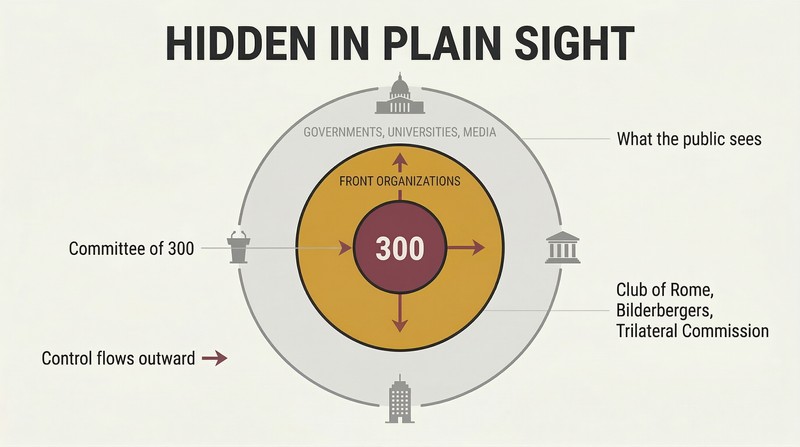
Coleman's central thesis is stark. A single body he calls the Committee of 300 — also referred to as "the Olympians" — comprises royalty, aristocrats, bankers, and corporate chiefs who direct global affairs from London. The Queen of England sits at its head, with the Royal Institute for International Affairs (RIIA) as its executive arm. Members include figures from the Venetian Black Nobility, the Rothschilds, the Rockefellers, and interlocking old-money dynasties across Europe and America.
Their power hides in plain sight. Coleman argues they operate not from underground bunkers but from the White House, Parliament, boardrooms, and universities. The Committee controls policy through front organizations — the Club of Rome, Bilderbergers, Trilateral Commission, and hundreds of think tanks — so that no single investigation ever traces the full chain of command.
Tavistock Institute is the alleged brainwashing engine of the West
“It is estimated by sources of mine that the total number of people employed by these institutions is in the region of 50,000 with funding close to $10 billion dollars.”
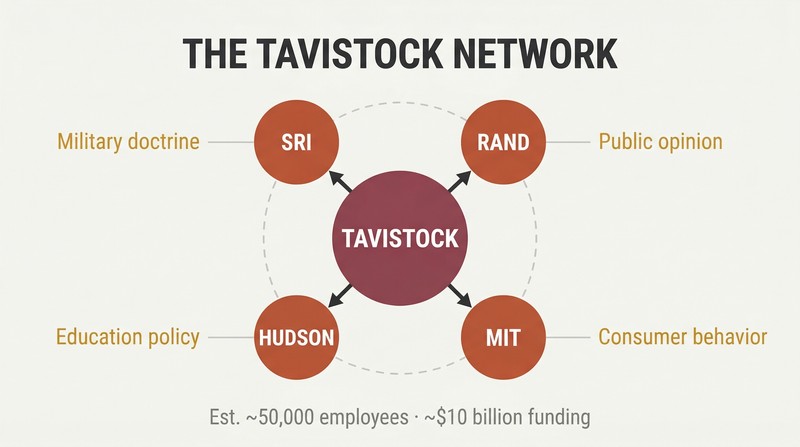
Founded as Britain's Psychological Warfare Bureau, the Tavistock Institute of Human Relations is, according to Coleman, the "mother of all think tanks." Major John Rawlings Reese built it using experiments on 80,000 British Army soldiers. Its U.S. subsidiaries — Stanford Research Institute, RAND Corporation, Hudson Institute, MIT's Sloan School, and others — form an interlocking research network that shapes military doctrine, education policy, and public opinion.
Tavistock's American footprint is massive. Coleman claims SRI alone employed 4,000 people with a $160 million annual budget, running programs for the Pentagon, NASA, the Department of Health, and dozens of Fortune 500 companies. The network's core function: develop social engineering techniques that alter how Americans think, vote, consume, and respond to crises — without ever realizing they've been manipulated.
The global drug trade allegedly flows from aristocratic boardrooms
“America is run not by 60 families but by 300 families and England is run by 100 families.”
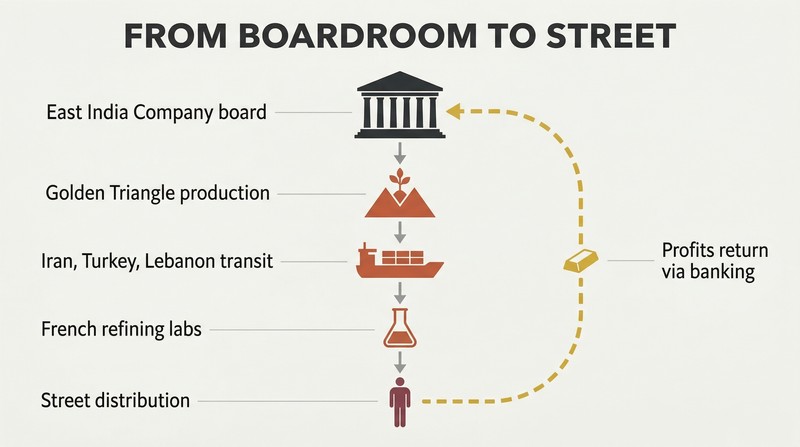
Coleman traces the drug trade to the British East India Company, whose 300-member board ran the China opium monopoly for over a century. The BEIC created markets through the "China Inland Mission," addicting Chinese laborers to opium, then filling the demand. Coleman draws a direct line from these 18th-century lords to today's heroin and cocaine networks, arguing the Committee of 300 inherited this infrastructure.
The mechanics are specific. Hill tribesmen in the Golden Triangle are paid in 1-kilo gold bars minted by Credit Suisse. Raw opium pipelines through Iran, Turkey, and Lebanon to French refining labs. The Hong Kong and Shanghai Bank clears the money. Coleman names American families — Astors, Delanos, Forbes, Perkins — who built their fortunes on the China opium trade and whose descendants remain tied to the Committee.
Overload people with crises and they'll accept any rescue offered
“One of the main techniques for breaking morale through a strategy of terror consists in exactly this tactic: keep the person hazy as to where he stands and just what he may expect.”
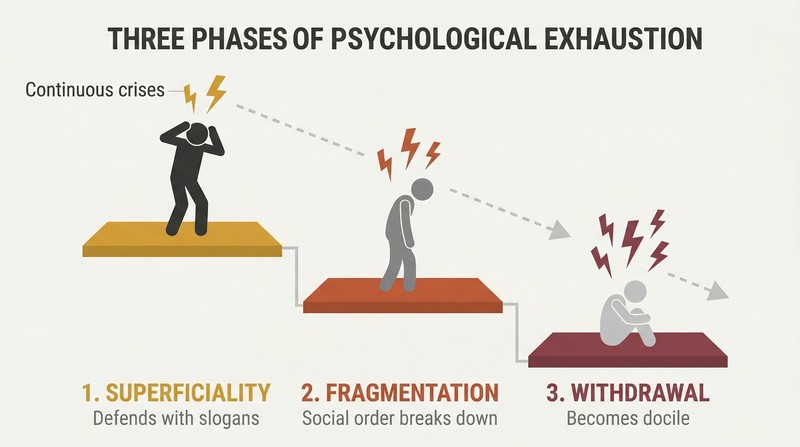
Coleman calls it "long range penetration strain," a Tavistock-designed method of subjecting large populations to continuous psychological shocks until apathy sets in. The technique works in three phases:
1. Superficiality — people defend with slogans without identifying the crisis source
2. Fragmentation — social order breaks down as the crisis continues
3. Maladaptive withdrawal — the population turns away, disassociates, and becomes docile
The related concept of "future shocks" describes events arriving so fast the brain cannot absorb them. Coleman argues that drug epidemics, gang wars, serial killers, and cultural upheavals are not random — they are sequenced to exhaust the public's decision-making capacity, leaving citizens too overwhelmed to resist the changes imposed on them.
America's industrial collapse was an engineered zero-growth policy
“The two worlds are in fundamental opposition, they cannot co-exist. In the end the post industrial world must crush and obliterate the other one.”
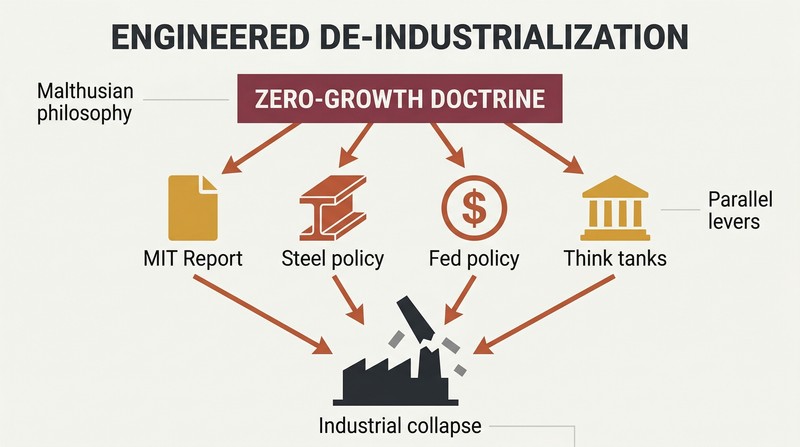
Post-industrial zero-growth is the Committee's economic doctrine, rooted in Malthusian philosophy that earth's resources cannot support expanding populations. Coleman claims the Club of Rome commissioned MIT's Forrester-Meadows Report to provide intellectual cover, then assigned Etienne D'Avignon to collapse the U.S. steel industry and used Paul Volcker's Federal Reserve policies — dictated from London — to accelerate the decline of auto, housing, and manufacturing.
The Heritage Foundation played a key role. Coleman argues it was infiltrated by Fabianist Sir Peter Vickers Hall, who in 1981 predicted America's industrial base would be obliterated. Milton Friedman and Friedrich von Hayek, both Club of Rome connected, provided the economic theories. By 1991, Coleman notes 30 million unemployed Americans as evidence the plan succeeded.
The Beatles were allegedly a Tavistock experiment in mass drug culture
“The phenomenon of the Beatles was not a spontaneous rebellion by youth against the old social system.”
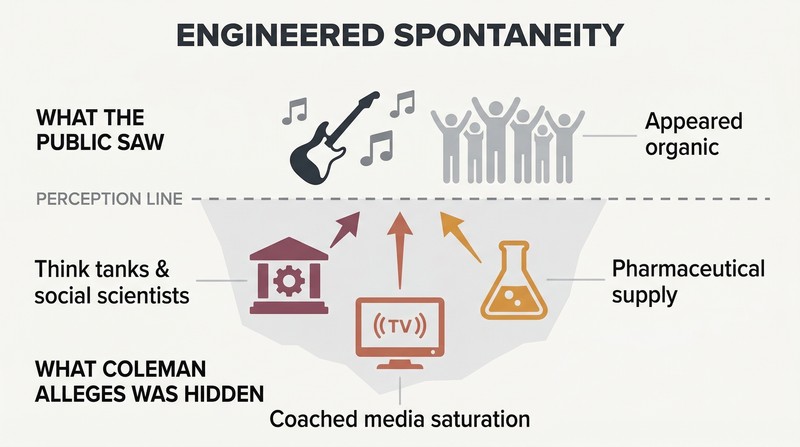
Coleman claims the Beatles were assembled and promoted by Tavistock to introduce drugs and cultural fragmentation to American youth. Theodor Adorno allegedly wrote their music using a "12-atonal system" derived from the cult of Dionysus. Trigger words like "rock," "teenager," "cool," and "pop music" were Tavistock-coined code for drug acceptance. Ed Sullivan was coached to provide saturation media coverage that made the group appear organically popular.
The counterculture followed the same playbook. LSD was produced by Sandoz pharmaceuticals, financed by the Warburg banking dynasty, and distributed free at rock concerts and college campuses. Alan Ginsberg received millions in free media coverage for promoting drugs disguised as art. Coleman argues none of this was spontaneous — every "cultural revolution" was designed in think tanks by older social scientists.
Pollsters don't measure public opinion — they manufacture it
“Public opinion making is the jewel in the crown of the Olympians.”
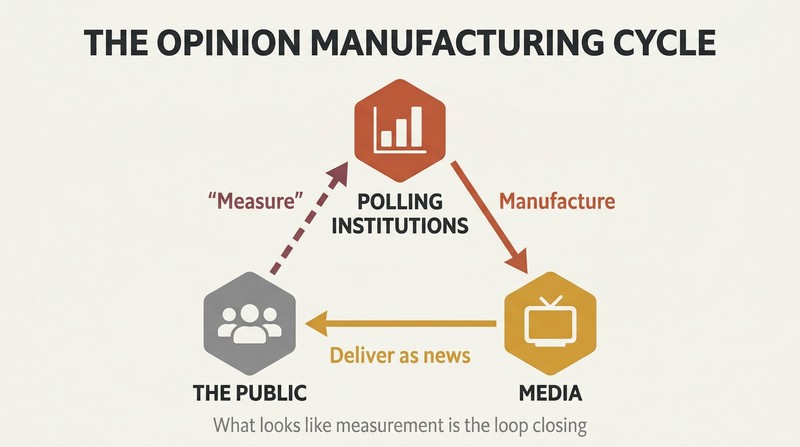
The method was born at Wellington House during WWI, when Lords Northcliffe and Rothmere, joined by Edward Bernays and Walter Lippmann, discovered that 87% of the public couldn't distinguish between reasoning about a problem and passing an opinion on it. This insight became the foundation for modern propaganda. Bernays later wrote that those who manipulate this mechanism "constitute an invisible government which is the true ruling power."
Today the apparatus includes Yankelovich, Skelley and White, the National Opinion Research Center, Gallup, and networks linking CBS, NBC, and ABC polling operations. Coleman claims findings are fed into a national psychological profile, and media content is pre-cleared by polling companies. The result: what Americans see as "news" is pre-tested social conditioning, and what they believe are their own opinions were manufactured in research institutions.
Leaders who resist the hidden order are removed or killed
“Either you stop your political line or you will pay dearly for it.”
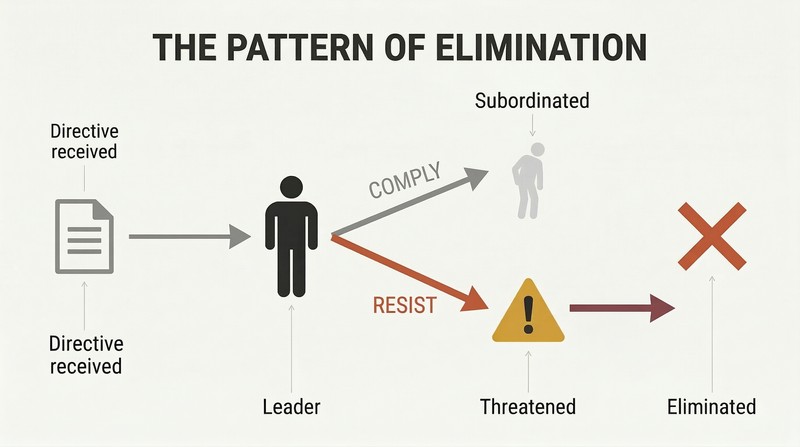
Italian PM Aldo Moro was kidnapped and murdered in 1978 after refusing Club of Rome orders to deindustrialize Italy. In sworn courtroom testimony broadcast on Italian television in 1982, Moro's close associate Gorrado Guerzoni identified Henry Kissinger as the one who threatened Moro. Moro's wife confirmed the threat verbatim. U.S. media did not report a word of this testimony.
Pakistan's Ali Bhutto met a similar fate. Bhutto's "crime" was pursuing nuclear energy to modernize Pakistan. Kissinger allegedly warned him: "I will make a horrible example if you continue with your nation-building policies." Bhutto was judicially murdered in 1979. His successor, General Zia ul Haq, was later killed when his C-130 was allegedly hit by an electromagnetic weapon — a Committee-ordered elimination, Coleman claims.
Watergate was allegedly a British intelligence coup against Nixon
“Nobody is beyond our reach.”
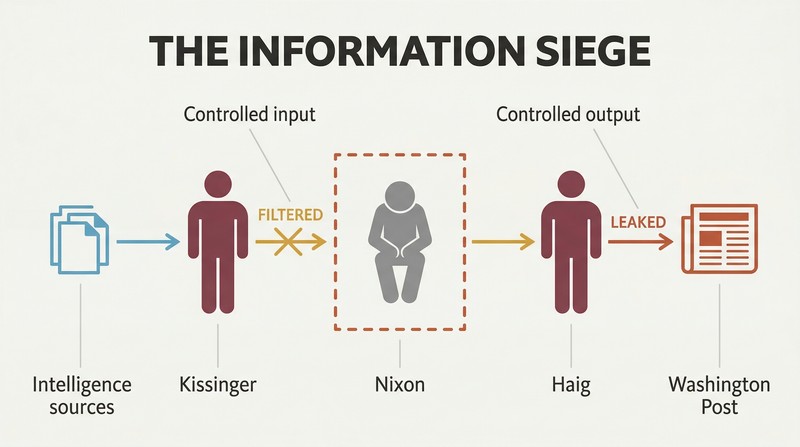
Coleman reframes Watergate entirely. He argues Kissinger and Alexander Haig, both Round Table operatives, isolated Nixon using Tavistock destabilization techniques — keeping the president confused through contradictory signals and leaked information. Haig was the real "Deep Throat," feeding material to Woodward and Bernstein at the Washington Post, which Coleman calls a British intelligence mouthpiece controlled by Katherine Meyer Graham.
The "smoking gun" was manufactured. Haig convinced Nixon the June 23rd tape was devastating, then circulated an unedited transcript to Nixon's Congressional supporters, collapsing his defense. Kissinger controlled all intelligence flowing to the president through National Security Decision Memorandum No. 1. Coleman compares it to Kennedy's assassination — both were Committee-ordered coups, one violent, one bureaucratic, both sending the same message to future presidents.
The Committee of 300's endgame is a feudal world government of 1 billion people
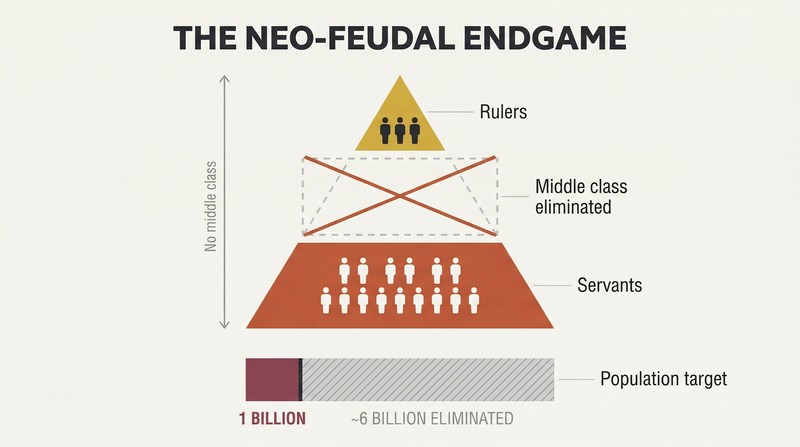
“At least 4 billion 'useless eaters' shall be eliminated by the year 2050 by means of limited wars, organized epidemics of fatal rapid-acting diseases and starvation.”
Coleman lists 21 specific Committee goals, including:
1. One World Government with a unified church and currency
2. Total destruction of national identity and Christianity
3. End of all industrialization except computers and services
4. Depopulation through wars, plagues, and starvation — targeting 3 billion deaths
5. Legalization of all drugs to create a monopoly control system
The vision is explicitly neo-feudal. No middle class — only rulers and servants. All firearms confiscated. Children removed from parents and raised by the state. A single religion based in the One World Government Church established in the 1920s. Coleman claims the Global 2000 Report, commissioned by the Club of Rome and approved by President Carter, specifically called for reducing the U.S. population by 100 million by 2050.
Analysis
Coleman's work occupies a distinctive position in conspiracy literature as a purported insider account from a former British intelligence officer. Its central innovation is structural: rather than attributing global control to a single organization (Illuminati, Freemasons, Bilderbergers), Coleman nests all of these within a meta-hierarchy — the Committee of 300 — creating a unified field theory of conspiracy that has influenced virtually every subsequent grand conspiracy narrative.
The book's rhetorical strategy is worth noting. Coleman layers verifiable facts (the British East India Company did run opium to China; Tavistock is a real research institute; the Beatles did transform culture) with extraordinary claims (Adorno wrote all Beatles music; Watergate was MI6-operated), creating a seamless narrative where checking any individual fact seems to confirm the whole. This technique — anchoring outlandish claims to documented history — is more sophisticated than typical conspiracy writing and partly explains the book's enduring influence.
Methodologically, the book relies almost entirely on Coleman's claimed intelligence credentials and access to classified documents. Almost no claims are independently verifiable through the sources cited. The India Office records, Wellington House documents, and intelligence files he references are either inaccessible or described too vaguely to locate. This creates an unfalsifiable framework — the absence of confirming evidence becomes proof of the conspiracy's effectiveness.
Historically, the book captures genuine anxieties of early-1990s America: deindustrialization, the Gulf War, cultural fragmentation, and the emerging post-Cold War order. Many of its predictions — increasing surveillance, expanding IMF power, declining industrial employment — proved directionally accurate, though for reasons mainstream economists explain through globalization rather than conspiracy. The book remains a foundational text for those seeking a totalizing explanation for the dislocations of modernity.
Review Summary
Conspirators' Hierarchy receives mixed reviews, with ratings ranging from 1 to 5 stars. Readers appreciate the book's exposure of global elites and their influence on world events, drug trade, and social engineering. However, many criticize the lack of sources and documentation for claims made. Some find the theories compelling and relevant to current events, while others dismiss them as paranoid fantasies. The book's style and content are described as both thought-provoking and controversial, with readers divided on its credibility and value as a source of information on global conspiracies.
People Also Read








Glossary
Committee of 300
Alleged secret ruling hierarchyColeman's name for the purported apex of global power: approximately 300 individuals including European royalty, banking dynasties, and corporate leaders who allegedly direct world affairs through interlocking front organizations. Also called 'the Olympians' because members supposedly believe themselves equal to the gods of Olympus. Modeled on the 300-member board of the British East India Company.
Club of Rome
Committee's foreign policy armOrganization founded in 1968 by Aurellio Peccei, described by Coleman as a conspiratorial umbrella group operating under NATO cover. Its stated mission concerns global planning; Coleman claims its real purpose is implementing the Committee of 300's post-industrial zero-growth policies, deindustrializing Western nations, and managing population reduction through its network of think tanks and research institutes.
Tavistock Institute
Alleged mass brainwashing headquartersThe Tavistock Institute of Human Relations, located at Sussex University in London. Coleman describes it as the central command for psychological warfare against civilian populations worldwide, originally established as Britain's Psychological Warfare Bureau. It allegedly controls over 30 U.S. research institutions including Stanford Research Institute, RAND Corporation, and Hudson Institute, collectively employing approximately 50,000 people.
Long range penetration strain
Gradual psychological exhaustion techniqueA Tavistock-developed method of subjecting large population groups to continuous, incremental psychological pressure over years or decades. The technique induces confusion, apathy, and an inability to identify the source of distress. Coleman describes it as the primary weapon used against the American public since 1946, causing citizens to accept changes they would otherwise resist.
Future shocks
Rapid-fire crisis overload tacticDefined by Coleman as 'physical and psychological distress arising from the excess load on the decision-making mechanism of the human mind.' A series of events arriving so rapidly that the brain cannot process them, causing the targeted population to stop making choices and become docile. Developed at Tavistock's Science Policy Research Unit (SPRU) at Sussex University.
Post-industrial zero-growth
Planned deindustrialization policyThe Committee of 300's alleged economic doctrine mandating the end of industrial development in Western nations, particularly the United States. Based on Malthusian and von Hayek economics, it calls for replacing manufacturing with service industries, tourism, and 'free enterprise zones.' Coleman claims the Club of Rome's Forrester-Meadows Report provided the intellectual justification.
Profiling
Behavioral prediction and manipulationA technique Coleman says was developed in 1922 at Tavistock Institute by Major John Rawlings Reese. It involves analyzing individuals, groups, or entire nations to predict their responses to engineered stimuli, then using that analysis to manipulate behavior. Applied to populations, political leaders, and even U.S. presidents to ensure predictable, controllable reactions to planned events.
Wellington House
WWI propaganda laboratoryA British propaganda operation during World War I, named after the Duke of Wellington, where the Royal Institute for International Affairs pioneered mass opinion manipulation. Staffed by Lords Northcliffe and Rothmere alongside Edward Bernays and Walter Lippmann, it discovered that 87% of the public could not distinguish reasoning from opinion—a finding that became the foundation for all subsequent Committee-directed public opinion engineering.
Changing Images of Man
SRI blueprint for social transformationA 319-page Stanford Research Institute report (Contract Number URH-489-2150, Policy Research Report No. 4/4/74) supervised by Willis Harmon. Written by 14 scientists under Tavistock oversight, including B.F. Skinner and Margaret Mead. Coleman describes it as the master blueprint for transforming American society, later popularized by Marilyn Ferguson as 'The Aquarian Conspiracy.' Its recommendations were allegedly fed to the Reagan administration.
Round Table
British intelligence control networkAn organization established in South Africa by Cecil Rhodes and funded by the Rothschild family. Coleman describes it as a British MI6 intelligence operation whose purpose is to recruit, train, and place agents in positions of power worldwide—particularly in the United States—to ensure policies serve British Crown and Committee of 300 interests. Its spinoffs include the Bilderbergers, Trilateral Commission, and Ditchley Foundation.
FAQ
What's Conspirators' Hierarchy: The Story of the Committee of 300 about?
- Focus on Secret Societies: The book explores the existence and influence of the Committee of 300, a secretive group believed to control global politics and economics.
- Historical Context: It provides a historical overview of how these organizations have shaped events, including wars and economic policies, often operating behind the scenes.
- Conspiracy Theories: The narrative presents various conspiracy theories, suggesting that many global issues are orchestrated by this elite group, which includes notable figures and institutions.
Why should I read Conspirators' Hierarchy?
- Insight into Power Structures: The book offers a unique perspective on the hidden power dynamics within governments, particularly in the U.S. and Britain.
- Critical Analysis: Coleman critically analyzes historical events and policies, encouraging readers to question mainstream narratives and seek deeper truths.
- Awareness of Manipulation: It aims to raise awareness about how public perception and societal norms are manipulated by those in power.
What are the key takeaways of Conspirators' Hierarchy?
- Identification of "They": Understanding the elusive "they" who manipulate global events is crucial for societal awareness and action.
- Role of the Committee of 300: The book outlines the Committee's goals, including the establishment of a One World Government.
- Historical Examples: Coleman provides case studies to illustrate the Committee's influence on significant historical events.
What are the best quotes from Conspirators' Hierarchy and what do they mean?
- "My people perish for lack of knowledge.": This quote underscores the importance of awareness and education in combating manipulation.
- "The upper-level parallel secret government does not operate from dank basements and secret underground chambers.": Suggests that true power lies in plain sight, within established institutions.
- "The problem is only one of perception.": Highlights how public perception can be shaped and controlled, emphasizing the need for critical thinking.
Who are the members of the Committee of 300?
- Elite Families and Institutions: Composed of influential families and members of various secret societies, including the British nobility.
- Interconnectedness: Members often hold multiple positions across different organizations, creating a web of influence.
- Historical Figures: References include figures like Henry Kissinger and organizations like the Council on Foreign Relations.
What methods does the Committee of 300 use to maintain control?
- Psychological Manipulation: Employs tactics such as fear and confusion to keep the public passive and compliant.
- Media Influence: Control over media narratives allows the Committee to shape public perception.
- Crisis Management: Crises are often manufactured or exacerbated to create opportunities for the Committee to implement their agendas.
How does Coleman connect historical events to the Committee of 300?
- Case Studies: Provides detailed accounts of events like the Gulf War, linking them to the Committee's influence.
- Patterns of Behavior: Identifies recurring themes in history as strategies employed by the Committee.
- Documentation and Evidence: Supports claims with references to historical documents and testimonies.
What is the significance of the Club of Rome in Conspirators' Hierarchy?
- Subversive Body: Identified as a key organization under the Committee of 300, tasked with implementing policies for a One World Government.
- Global Planning: Portrayed as a think tank that formulates strategies for global governance.
- Environmental Agenda: Argues that the Club's initiatives are part of a broader agenda to control population and resources.
How does Coleman view the role of education in society?
- Manipulation of Knowledge: Argues that the education system is designed to produce compliant citizens.
- Historical Decline: Suggests that the decline in educational standards is a deliberate strategy.
- Call for Reform: Advocates for a reevaluation of educational practices to empower individuals.
How does Conspirators' Hierarchy relate to current global issues?
- Relevance to Modern Politics: Draws parallels between historical events and contemporary political issues.
- Drug Trade Analysis: Discusses the ongoing drug trade and its connections to elite interests.
- Globalization and Control: Themes of control and manipulation resonate with current debates about globalization.
What criticisms have been made about Conspirators' Hierarchy?
- Skepticism of Claims: Critics argue that Coleman's theories lack empirical evidence.
- Conspiracy Theory Label: Often categorized as conspiracy theory literature, leading to dismissal by mainstream scholars.
- Polarizing Perspectives: Some readers may find the book's views polarizing, as it challenges widely accepted narratives.
What are the implications of Conspirators' Hierarchy for individual readers?
- Encouragement to Question Authority: Readers are encouraged to question the narratives presented by authorities.
- Awareness of Manipulation: Highlights the importance of being aware of how public opinion is shaped.
- Empowerment through Knowledge: Aims to empower readers by providing them with knowledge about hidden forces in global politics.
Download PDF
Download EPUB
.epub digital book format is ideal for reading ebooks on phones, tablets, and e-readers.








































