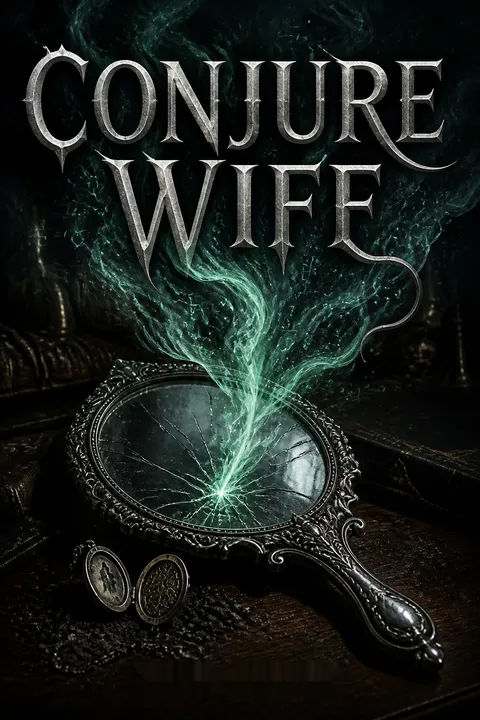

Plot Summary
Perfect Marriage, Hidden Secrets
Norman Saylor, a young sociology professor at Hempnell College, reflects on his seemingly perfect marriage to Tansy and their surprising success at a stifling small-college world plagued by ritual and social rivalries. Their teamwork is unorthodox but mutually reinforcing, with Tansy expertly handling the academic and social intrigues that Norman often stirs up with his iconoclastic ideas. Their home is a sanctuary against the toxic competitiveness and respectability worship at Hempnell. But one lazy spring afternoon, Norman, in an idle, loving mood, idly rummages through Tansy's dressing room. His discovery—a secret cache of bottles containing labeled graveyard dirt, bits of hair and nail clippings, horse nails, and various odd paraphernalia—shatters his assumptions. Tansy, in turn, enters and catches him red-handed. The foundation of their relationship quivers; Norman, the rationalist and skeptic, has stumbled onto something far darker and stranger than infidelity—a hidden life of magic.
Tansy's Confession, Norman's Denial
Norman confronts Tansy, who breaks down and confesses: for years, she has quietly practiced conjure magic, using folk charms and spells to protect Norman and his career from the malice and rivalry rife at Hempnell. Norman struggles between anger, reason, and empathy. Tansy details how Hempnell's hostility made her desperate enough to draw on the conjure lore she learned as a girl—rationally knowing it's superstition, yet driven by fear and the need for control. Norman analyzes her belief as a psychological ritual, a private neurosis, and persuades her to stop—asserting that their successes stem from talent and hard work, not magic. Tansy protests, fearful that discarding the charms will leave them unprotected, but Norman insists. Together they burn all her magical talismans, attempting to banish superstition from their lives—unaware they may have also destroyed the fragile safeguards keeping them safe.
The Burning of Charms
That evening, after burning Tansy's hidden charms, a heavy mood invades the house. Norman attempts to rationalize and process his feelings—did they truly rely on magic? He catches himself dismissing the possibility, framing Tansy's belief as a product of stress and feminine "primitivism." Yet, a subtle anxiety creeps in. As Norman tidies up, he discovers a small protective charm Tansy forgot—a "hand" in his locket. He angrily burns it, determined to make a clean break from superstition. Instantly, the atmosphere grows cold, as if something intangible has entered. Disturbing phone calls follow—one from a paranoid expelled student, another from a deluded girl, both deeply unsettling. Despite Norman's resolve to banish magic, the house grows subtly menacing. It is as if, with the destruction of Tansy's protections, unseen forces—hostile coincidence, bad luck, or something supernatural—are closing in.
The Witch Women Revealed
As new misfortunes mount—accusations, suspicions, reminders of faculty jealousies—Norman is drawn into the social labyrinth of Hempnell. He meets with various women—Mrs. Carr, Mrs. Gunnison, Evelyn Sawtelle—faculty wives with their own secretive power plays. The tension at a faculty bridge night is palpable, as Norman realizes that the women's politeness masks bitter rivalry and something more. His anthropological mind toys with the ethnographic resemblance between faculty wives and tribes of tribal witches, each secretly fighting for her husband's advancement using all tools available, including possible magic. Tansy, unprotected and isolated, senses the hostility of the others. The disturbed symmetry of the group and strange symbolic doodling suggest that her abandonment of magic has marked her as an outsider. The realization dawns: she is not the only witch at Hempnell—there is a clandestine war among the college's women.
The Cussedness of Things
Norman's life begins to unravel as inexplicable misfortunes dog his every step, from academic crises to social gaffes. Apparent coincidences—a string of sabotage attempts, freak accidents, and psychological attacks—suggest to Norman that, without Tansy's protection, he is exposed to the full malice of his rivals, perhaps even their own magic. He alternates between rational explanations and growing paranoia. Tansy, meanwhile, feels the psychic pressure intensifying, until, after a sleepless night, she believes she has at last overcome her obsession. Norman, despite trying hard to maintain reason, is troubled by the mounting likelihood that these events are more than random. The idea of "the cussedness of things"—matter itself turning against him—becomes both a joke and a possible explanation. Everywhere, the sense of besiegement grows, and the fragile boundary between coincidence and supernatural attack blurs.
Bridge Night Tensions
As Norman and Tansy host a faculty bridge night, the unspoken tensions among the faculty wives surface in subtle and hostile ways. Norman's imagination recasts his guests as tribal witches—rivalrous, manipulative, dangerous. He notices occult symbols in Evelyn Sawtelle's doodles, likely tarot cards with ominous imagery. Every phrase, every joke, takes on double meaning, hinting at psychic contest. Tansy, once a guardian, seems out of place and vulnerable amid these expert social players. The symbolic imagery and the eerily dull hands at play suggest that more is at stake than cards. Afterwards, Tansy confides her discomfort and fear, feeling that her abdication of magic has marked her. Norman, determined to maintain normalcy, remains in denial, but the sense of lurking supernatural danger only increases. The war is no longer only in the mind—it is moving into real and perilous territory.
A Darkening Academic World
Norman's academic troubles intensify. He faces complaints, orchestrated slanders, and budding scandals—all of which seem eerily coordinated. The game of academic advancement becomes a supernatural battleground, where luck and careers are manipulated not just by gossip, but by spells and psychic warfare. Margaret Van Nice recants her accusation, yet the climate of suspicion remains. Norman begins to connect the dots, realizing that his misfortunes align perfectly with the period he's been without Tansy's protection. He becomes aware of surveillance and subtle sabotage from the circle of faculty wives, as their private wars use him as a pawn. Finally, a violent student, driven mad by paranoid delusions, attacks Norman with a gun. Only luck and quick thinking save him. Still, the web is tightening and Norman's attempts at rational defense seem ever more inadequate. The rational world, and his standing in it, is eroding.
Suicide Impulses and Shadows
Norman's grip on reality falters. As pressures mount and his life seems to crumble, intrusive thoughts of suicide afflict him. His actions become mechanical, fraught with a sense of being watched and driven by an agency not his own. He experiences hallucinations—voices commanding him to end his life, visions of monsters or shadows flitting just out of sight. He comes to believe that the witch women, having failed to destroy him through social means, are now attacking his mind and soul directly. Tansy, too, begins to sense a presence closing in; she receives psychic warnings and cryptic impulses, culminating in her sudden disappearance. Norman is left bereft, desperately afraid that both his sanity and his wife are slipping irretrievably away, victims of a curse or malicious conspiracy whose existence he can no longer deny.
Tansy Disappears, Norman Searches
Tansy vanishes, leaving Norman a hurried, fragmented note with instructions to perform obscure magical rituals. Convinced she has absorbed the curse meant for him and is trying to save his life at the cost of her own, Norman races to follow her path—chasing bus routes, train stations, and towns, and piecing together her trajectory from her cryptic messages. He finds himself gathering graveyard dirt, tying magical knots, and performing superstitious rituals with scholarly precision. The rational scientist is forced to embrace magic as his only hope to save Tansy from suicide—or supernatural destruction. Every step draws him deeper into the world of spells and conjure magic, as he must now act the sorcerer to rescue his wife from literal annihilation at the hands of her enemies and the personified forces of evil. The stakes are now nothing less than souls.
Black Magic at Bayport
In a dingy hotel room in Bayport, Norman completes the desperate magical ritual his wife prescribed. The material trappings—knots, flannel, graveyard dirt—take on weight until the intangible forces become terrifyingly real. The air crackles with hostility and cold; Norman battles with his own skepticism as the ritual concludes, apparently bringing Tansy to him—soaked, stunned, soulless. Tansy's body has returned, but she is an automaton, answering questions mechanically, devoid of self—her soul taken. Norman's sense of grievance and loneliness deepens into horror as he contemplates her state. The possibility that his actions, or his rivals' black magic, have destroyed Tansy's soul—or imprisoned it somewhere—becomes the new agonizing reality. He realizes now that belief is beside the point: he must treat magic as real, because the effects are real, and the cost of incredulity is incalculable loss.
Tansy's Mindless Return
Norman, in agony, discovers that Tansy's soul has been stolen—her body functions but she is "not there." She explains in halting monotone that her soul is trapped by Evelyn Sawtelle, orchestrator of the black magic campaign. Conversation with the soulless Tansy is chilling—she answers questions but possesses no self-awareness, no emotion except the blind hunger for her soul's return. When Norman confronts Evelyn, he finds she too is now a victim—the soul has passed from one rival to another in a chain of theft, the heart of the witches' war. Norman's world collapses into a cold calculus of spirit and survival. Traditional psychology offers no remedy. Instead, Norman commits to matching the women's magic with his own—throwing himself into research and innovation, determined to perform the ultimate act of conjure: the reclaiming of a stolen soul.
The Truth About Souls
Now forced to take sorcery seriously, Norman studies magical theory as he once did anthropology—compiling formulae, recruiting Professor Carr's mathematical expertise to distill the "master formula" that might return Tansy's soul. He learns the logic of soul theft, the mechanics by which malevolence is propagated, and the central role played by symbolic weapons, mirrors, knots, and ritual. The witches' war is revealed as both social and metaphysical—a continuous chain of theft, retaliation, and hostage-taking. Norman realizes the true depths of Mrs. Carr's power, the matriarch among matriarchs. The more he uncovers, the more vividly he sees that the world is an ongoing struggle of rationality versus the irrational—a tension played out in every household, every institution, and nowhere more so than in his own battle to rescue Tansy's soul and survival.
Norman's Descent Into Sorcery
Embracing the paradox, Norman convinces Tansy (and himself) that he can wield the magic he studied as a scholar. He navigates the world of primitive and modern sorcery, intent on outmatching his rivals at their own supernatural game. He strategizes, gathers occult ingredients, and leverages Professor Carr's reductions of magical formulae. The logic of magic—trial, error, efficiency—becomes his new weapon. Yet, he is always aware that belief and pretense have become indistinguishable. The pressure of action, the horror of Tansy's soulless state, and the possibility that all is delusion press in on him as he prepares for a final confrontation. The boundary between the rational and the irrational is obliterated in Norman's fevered work, as his scientific mind embraces magic—not for superstition's sake, but out of love and existential necessity.
The Final Reckoning
Norman executes his plan. Using a magical stratagem, he traps Mrs. Gunnison's soul in a shattered mirror—a calculated reflection of what the witches themselves do. For a moment, he glimpses into the psychic darkness of Mrs. Gunnison's mind—her history of cruelty, domination, and the ethics of magical warfare among women. With her power broken, and Tansy's soul restored to her body, Norman hopes for relief. Yet the ominous warning remains: Mrs. Carr, the most powerful and elderly of the witches, has only allowed this outcome for her own purposes. She still possesses the most dangerous powers of all, including the "evil eye" and the capacity for soul-theft at a glance. The thirst for youth, the hunger for survival, and the unstopping progression of age make Mrs. Carr the ultimate threat—a calculating, ancient force whom Norman and Tansy must still face.
The Balance Restored
In a tense, final confrontation, Norman and Tansy play out the last round of magical-political warfare at Mrs. Carr's house, with their enemies assembled. Mrs. Carr attempts the supreme act—possessing Tansy's body and soul, driven by an old woman's longing for youth and love. Through guile and careful manipulation of magic and psychology, Norman and Tansy defeat her, restoring every soul to its rightful body, and dispelling the network of hostilities. As ritual equilibrium returns, the campus and their lives resume serenity—though Norman privately questions whether he believes in magic at all, or whether he allowed the conventions and delusions of others to sweep them all along for a week of collective madness. The lesson is ambiguous: the "rational" world lies always on a fragile foundation, and the border with the irrational—superstition, luck, and magic—is permeable, shaped by desire, fear, and love.
Analysis
Conjure Wife remains a compelling exploration of the tension beneath modern rational life—a satire of polite society that ultimately exposes the lurking irrational forces of fear, rivalry, and power. Leiber's genius is in never quite deciding—nor letting the reader decide—whether the magic is literal or psychological, superstition or social reality. By framing witchcraft as the covert weaponry of women in a man's world, a parallel set of rules and rituals that balances and subverts institutional power, Conjure Wife argues that beneath our routines lies an ever-present, ambiguous chaos. The novel questions not only what is real, but whether the mechanisms of reason—science, logic, and skepticism—are simply another form of ritual to ward off the intolerable. The lessons are manifold: do not discount the unseen dynamics of social interaction; recognize the double-edged power of belief; and understand that love, fear, and ambition carve runic channels through every "rational" life. By its end, Conjure Wife suggests that survival depends not merely on knowledge, but on humility before the unknown, the acceptance that magic—literal or not—may have its place in a world that will never be fully tamed.
Review Summary
Conjure Wife is widely praised as a clever, well-plotted supernatural horror novel that remains impressively readable despite its 1943 origins. Reviewers consistently highlight its intriguing premise—all women are secretly witches—and its sharp satire of petty academic politics. Most acknowledge dated sexist attitudes but argue these are often presented with knowing irony. The writing is frequently described as fast-paced and skillfully crafted. Common criticisms include a slower second half and predictable plot elements. Many compare it favorably to Bewitched and note its influence on subsequent horror and fantasy works.
People Also Read

Characters
Norman Saylor
Norman Saylor is a young sociology professor rooting his sense of self in reason, scholarship, and progressive ideals. His marriage to Tansy has enabled his improbable rise in reputation at Hempnell, with her support subtly insulating him from the poisonous campus politics. Beneath his intellectual bravado, Norman is vulnerable—unconsciously dependent on Tansy's unseen protection not only emotionally but existentially. When her secret use of magic is revealed, Norman is thrust into a psychological and ontological crisis: everything he's based his life upon—the reliability of reason, the objectivity of reality—is called into question. Over the course of the story, Norman transforms from a rationalist debunker of superstition to a desperate practitioner of magic. His arc is a journey into the heart of primal anxiety and love, forced to use the tools he once dismissed, all for the sake of his wife, and perhaps survival itself.
Tansy Saylor
Tansy is both Norman's beloved and a cipher—outwardly modern, witty, and helpful, but secretly immersed in the world of primitive belief. Her magical rituals are not self-serving but devotedly protective, an extension of her love for Norman as well as a survival mechanism in a hostile academic world. Tansy's psychological complexity lies in her self-awareness: she knows the "irrationality" of her actions, yet is unable to abandon them. When forced by Norman to destroy her protections, Tansy suffers anxiety and loss, her inner structure crumbling along with her magic. After the soul-theft, she is rendered an empty shell, catalyzing Norman's journey from skepticism to magical action. Ultimately, Tansy's return reunites the divided halves of her personality: rational intellect and ancestral intuition, embodying the story's central question about the limits of reason and the enduring power of love and fear.
Mrs. Carr
Mrs. Carr is the oldest and most formidable of the faculty wives: a spider at the center of Hempnell's web. Outwardly sweet, grandmotherly, and proper, she cloaks predatory ambition and supernatural abilities behind her harmless exterior. Psychoanalytically, she is the dark side of social respectability—her insatiable hunger for youth, power, and survival is expressed through domination, manipulation, and, literally, the "evil eye." She coordinates the witch alliance that assails Tansy and orchestrates the deeper magical-political conspiracies, finally attempting the most audacious act—possessing Tansy's young body to fulfill her own frustrated desires. Mrs. Carr represents the unseen, relentless, and anti-rational currents underlying patriarchal institutions, blending societal suppression with elemental, forbidden hungers.
Mrs. Gunnison
Mrs. Gunnison is robust, boisterous, and overbearing—a force in both faculty circles and supernatural warfare. She dominates her husband, manipulates social dynamics, and is feared by staff and peers alike. Her brand of witchcraft is practical, using modern trappings (photography) to animate forces like the cement dragon—making her a bridge between ancient superstition and technological modernity. Her psyche is driven by the need for control and the pleasures of domination, frequently crossing ethical lines to secure advantage. When Norman confronts and traps her soul, her inner world reveals cruelty and defensiveness—a testament to how social power can devolve into psychological and spiritual predation.
Evelyn Sawtelle
Evelyn is neurotic, snobbish, and secretly ambitious—a self-declared bohemian with the soul of a conformist. She practices magic more for status and control within the secret world of faculty women than for genuine belief or personal power. Her insecurity and jealousy toward both her husband and Tansy make her susceptible to Mrs. Carr's manipulations. Psychoanalytically, Evelyn's embrace of witchcraft is an attempt to overcome a lifelong sense of sexual and social inadequacy—her spells are laced with patterns of spite, envy, and repressed desire. Her ultimate fear is exposure and humiliation, which the magical battle renders more than metaphorical.
Hervey Sawtelle
Hervey is Norman's academic competition—a nervous, twitchy, self-doubting professor forever overshadowed by his wife and more talented peers. He is used as a pawn in the witches' war, his career manipulated by Evelyn's efforts. Psychologically, Hervey represents the casualties of competitive academia: lost in anxiety, driven to the brink of breakdown by unattainable expectations and petty rivalries. His obliviousness to the magical undercurrents heightens the absurdity and danger of his role.
Harold Gunnison
Dean Gunnison is one of Norman's few sympathetic male colleagues: level-headed, pragmatic, and more fatherly than authoritarian. Though caught up in institutional politics, he helps Norman navigate Hempnell's perils without awareness of the magical battles playing out among the women. He represents the rational, decent side of academe, mostly untouched by the mystical war but deeply connected to its consequences through his wife's role as major antagonist.
Professor Carr
Carr is mathematical purity personified—a dignified, gentle man absorbed in abstract logic and number theory. He assists Norman by deciphering the underlying structure of magical "equations"—unwittingly lending the scientific cachet needed to convince Tansy (and Norman himself) that magic can be tamed by reason. His innocent, supportive marriage to Mrs. Carr stands in poignant contrast to the darkness underlying her soul.
Margaret Van Nice
Margaret is the nervous student who accuses Norman of assault, only to recant. Her personality is marked by excessive suggestibility and deep emotional longing, making her vulnerable to the psychic pressures emanating from the witches' war. She is both victim and catalyst—showing how innocents can become pawns in magical and psychological conflicts they can neither understand nor escape.
Theodore Jennings
Jennings is the expelled, troubled student whose paranoia is weaponized against Norman, possibly through supernatural influence. He represents the human cost and collateral damage of social, psychological, and magical conflict—a young man driven to violence by both internal weakness and external manipulation. In his madness, the boundary between the mundane and the magical is erased, making him as dangerous as any sorcerer.
Plot Devices
Rationality Versus Irrationality
Conjure Wife builds its suspense on the tension between the rational, skeptical worldview and an undercurrent of primitive, irrational belief in magic. By rooting magic in psychological need—fear, love, rivalry—the novel examines the permeability of the scientific mind and the limits of conscious control. Norman's journey from disbelief to sorcerer in action (if not in heart) demonstrates how rationality both masks and enables the irrational, especially in moments of crisis. The device of the hidden world—where all women are potentially witches, and witchcraft is a universal, if unspoken, art—positions magic as a metaphor for buried power, intuition, and social influence.
Social Satire, Academic Microcosm
Leiber uses the small college as an environment where rivalries and hierarchies are amplified, making it fertile ground for both psychological projection and outright magical intrigue. Satirical treatments of committees, bridge games, and academic etiquette serve as subtle analogues for the more dangerous magical battles fought behind the scenes. The women's magic is an extension, and exaggeration, of the endless small wars of "respectability" and influence that dominate academic life. Bridge games, in particular, become both literal battlegrounds for luck and power, and symbolic arenas for the arcane and the forbidden to leak into the everyday.
Doubling, Possession, and Soul Transfer
As the story progresses, Leiber deploys classic horror motifs of doubling, body-snatching, and possession. Tansy's soulless state, the swapping and theft of souls among faculty wives, and Mrs. Carr's ultimate plan to possess Tansy's body are all dramatizations of the porousness of identity under social pressure and magical intrusion. The narrative structure is circular—Tansy is both victim and victor; Norman both skeptic and seer; Mrs. Carr both grandma and demon. These plot devices intensify the theme: in a world where roles, powers, and even souls can be exchanged, what, if anything, can be relied on?
Foreshadowing, Sympathetic Magic, and Repetition
Leiber uses repeated motifs—knots, hands, mirrors, graveyard dirt, incantations, games of chance—to bind the story's magical logic to the psychological reality. The burning of charms, the sudden run of bad luck, and the deliberate use of "scientific" magic mirror both the narrative and emotional arcs. Ordinary accidents are freighted with deeper meaning, and foreshadowing is accomplished via symbols and gestures that only the initiated (and the reader) can interpret. The recurrence of phrases, images (such as the "cussedness of things" and the "evil eye"), and the shifting location of the cement dragon unite the thematic with the supernatural.
Download PDF
Download EPUB
.epub digital book format is ideal for reading ebooks on phones, tablets, and e-readers.








































