


Key Takeaways
Stop chasing the spark; whether you like the sex is what matters
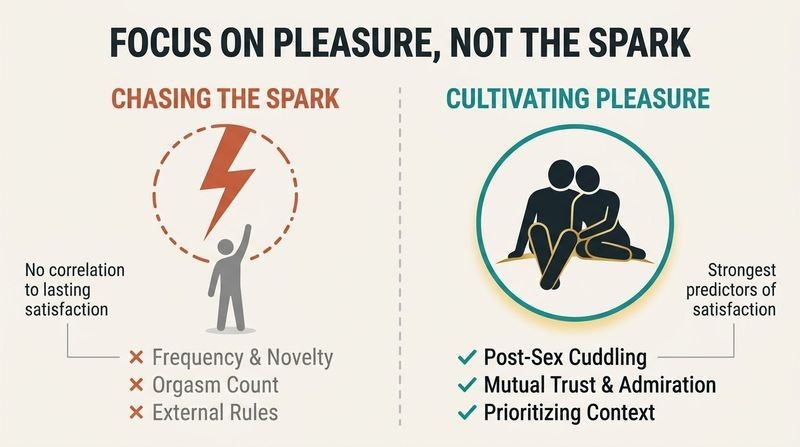
Pleasure, not desire, measures sexual health. Nagoski surveyed the research and found that frequency, novelty, orgasm count, positions, monogamy, and even attractiveness fail to predict lasting sexual satisfaction. The single behavior that does correlate is cuddling afterward. Three traits define couples who stay connected for decades: they trust and admire each other, they decide sex matters enough to prioritize it, and they reject other people's rules about how sex should be.
They co-create a context that makes pleasure easy. That is the whole thesis. A sensation feels good or bad depending entirely on context, so great long-term sex is not about wanting it more, but about liking what you actually have. If everyone at the party is having fun, you are doing it right.
What's compelling is how this inverts the entire self-help genre's premise. Most sex advice sells techniques and frequency targets; Nagoski argues those metrics are noise. The claim aligns with research by Kleinplatz on "optimal sexuality," which found extraordinary lovers cited presence and connection, not acrobatics. One tension worth noting: "pleasure is the measure" risks circularity if pleasure itself proves elusive, which the book concedes when calling pleasure a "shy animal." Still, reframing satisfaction around enjoyment rather than craving has real clinical weight, echoing Acceptance and Commitment Therapy's move away from controlling internal states toward valued action.
Responsive desire is normal; waiting to feel horny first is not required
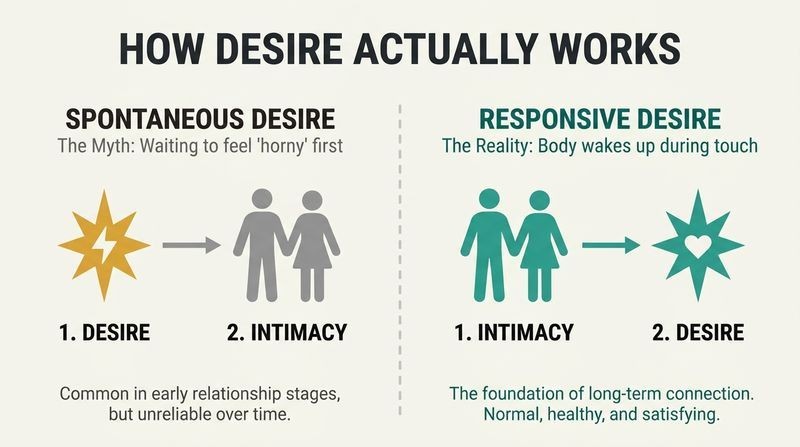
Two normal desire styles exist. Spontaneous desire is the out-of-the-blue craving culture treats as the only "real" kind. Responsive desire emerges in response to pleasure, not before it. You show up to scheduled sex distracted and unaroused, your skin touches your partner's, and your body wakes up: "Oh right, I like this." Responsive desire, not spontaneous, characterizes great long-term relationships.
The desire imperative is the culprit. Nagoski names the cultural lie that spontaneous, obsessive craving is the correct, healthy form, and that planning or talking about sex means you don't want it "enough." This imperative makes people worry, and worry hits the sexual brakes, pushing sex further out of reach. Her fix: treat desire as an optional bonus, like simultaneous orgasm, and center pleasure instead.
This distinction, popularized by Basson's circular model of sexual response, is one of the most clinically useful ideas in modern sex therapy. It reframes what many (especially women in long-term partnerships) experience as dysfunction into a normal variation. The gendered dimension deserves scrutiny: responsive desire is not exclusively female, and framing it as such can reinforce stereotypes. Nagoski avoids that trap by treating it as context-dependent for everyone. The deeper move is philosophical, borrowing from mindfulness: stop trying to force an internal state and instead arrange the conditions under which it naturally arises.
Your arousal is a balance of accelerators pressed and brakes released
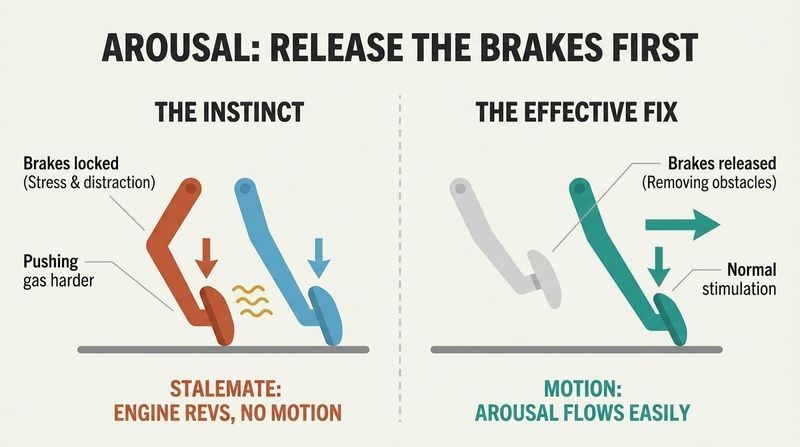
The brain has a dual-control system. One mechanism, the accelerator, scans for everything sexually relevant and sends a "turn on" signal. The other, the brakes, scans for reasons not to be aroused (stress, kids interrupting, body worry, resentment) and sends "turn off." Both run constantly below awareness. Your arousal at any moment is the net balance.
Most problems are too much brake, not too little accelerator. When sex stalls, the instinct is to add stimulation, but usually the fix is removing what hits the brakes. Nagoski's example: a couple had great vacation sex in an old rental where the bed was built into the wall (no squeaking, no fear of waking kids). In a different house, mediocre sex. They built their permanent bed into the wall. Asking "what's hitting the brakes?" beats "what's wrong?"
The dual-control model comes from real sex research (Bancroft and Janssen at the Kinsey Institute), which lends this more empirical grounding than most pop-psychology metaphors. Its power is diagnostic: it separates low arousal from pathology, reframing it as an environmental equation. The built-in-bed anecdote is a lovely illustration of how idiosyncratic brakes can be, no generic advice could have found it. A useful extension: the accelerator/brake balance resembles approach-avoidance motivation systems (Gray's BIS/BAS) in personality neuroscience, suggesting stable individual differences in how sensitive each person's brakes are, which explains why identical contexts affect partners so differently.
Map your emotional floorplan to find the room next door to lust
Your brain has emotional rooms. Drawing on affective neuroscientist Jaak Panksepp, Nagoski describes seven core emotional spaces plus two bonus ones. Four are pleasure-favorable: lust, play, seeking (curiosity), and care (love). Three are pleasure-adverse: fear, rage, and panic/grief. The bonus spaces are the thinking mind and observational distance (calm witnessing).
You cannot always reach lust directly. Like a house where you cannot get to the bedroom without passing through the living room, lust is only accessible via adjacent rooms, usually play, seeking, or care. The trick is to aim not for lust itself but for its neighbor. Nagoski's own way in turned out to be play (laughter), after intellectual curiosity stopped working with her artist husband. One woman realized vacation sex was easy because vacation put her in the play room.
Panksepp's primary-process emotion framework is legitimate neuroscience, though Nagoski uses it metaphorically rather than literally, which she openly acknowledges. The floorplan's genius is making an abstract internal experience spatial and navigable, turning "I can't get in the mood" into a solvable routing problem. It resonates with Internal Family Systems therapy and with emotion-focused approaches that treat feelings as states to move through rather than obstacles. One limitation: the model assumes reasonable self-awareness, and people with alexithymia (difficulty identifying emotions, which Nagoski notes her own twin has) may struggle to locate themselves at all, requiring more scaffolding than a drawing.
You are not broken; sexuality is a cycle of woundedness to healing
Reject the broken-to-perfect line. Most of us imagine sexuality on a line from broken through normal to perfect, forever striving toward an ideal. Nagoski replaces this with a cycle: woundedness to healing and back again, endlessly. Wherever you are in the cycle, you are already normal.
Confidence and joy are the tools. Confidence means knowing what's true about your body and sexuality, even when it contradicts what you were taught. Joy, the harder part, means loving what's true. Her definition of normal sex: erotic contact among peers where everyone is glad to be there, free to leave without consequences, and no one feels unwanted pain. Perfect sex is normal sex approached with calm, warm curiosity. When therapist Peggy Kleinplatz hears "I don't want sex," she replies: "Tell me about this sex you don't want," revealing it is normal not to want sex you don't enjoy.
The reframe from linear perfectionism to a healing cycle borrows from trauma-informed and self-compassion research (Kristin Neff's work shows self-criticism undermines the very change people seek). Nagoski's insistence that "it's normal not to want sex you don't like" is deceptively radical, it dissolves the entire category of "low desire disorder" for many couples by relocating the problem from the person to the sex. Critics might argue this risks under-treating genuine medical or hormonal causes of low desire, which the book does acknowledge exist. But as a first-line reframe, decoupling worth from performance has strong therapeutic precedent and immediate liberating effect.
Admire your partner, and treat annoying quirks as flip sides of virtues
Like beats passion for the long haul. Nagoski argues you don't need to want your partner passionately so much as admire them. When a therapist described a couple who disliked each other but still wanted sex, Nagoski was baffled: why have sex with someone you don't like? Admiration is both a good filter for choosing partners and a tool for surviving rough patches, because stress makes brains fixate on irritations.
Reframe flaws as linked to strengths. Terrence Real calls the buildup of irritation "normal marital hatred." The antidote: recognize that a partner's most annoying trait is often inseparable from their best one. Stubborn becomes persistent; unfocused becomes creative; a clutterbug is loyal to every object. Nagoski interrupts her husband constantly, but that same quick mind lets her stay attuned to him. Trust, meanwhile, is Sue Johnson's question: "Are you there for me?" (emotionally accessible, responsive, engaged).
The strengths-reframe technique has empirical backing in Gottman's decades of couples research, which found that "fondness and admiration" predict marital stability, while contempt is the single best predictor of divorce. Framing a flaw as a virtue's shadow is cognitively similar to reappraisal, one of the most robust emotion-regulation strategies in psychology. The move is not mere positive thinking, it's causal insight: traits genuinely do bundle. One caveat worth flagging: the technique assumes a fundamentally safe, respectful relationship. Applied to genuine mistreatment, "reframe his controlling behavior as decisiveness" becomes dangerous, a boundary the book is careful to mark with its consent-based definition of normal.
Meet illness, aging, and shame with calm, warm curiosity, not fear
Curiosity is the master tool. Nagoski's formula for facing any difficulty: "I see you. I love you. I want to know you." It blends three floorplan spaces: observational distance (calm), care (warmth), and seeking (curiosity). She notes that "reactive" and "creative" are the same letters rearranged, the difference is curiosity. Approaching problems from rage, fear, or panic just triggers stress responses.
Bodies change, and caregiving can be erotic. Stay with a partner long enough and you will become an interabled couple. Nagoski cites couples like Shane and Hannah Burcaw, who refuse to draw a line between caregiving touch and intimate touch. As one nurse friend put it, illness creates the deepest intimacy. The key is seeing your partner as themselves, separate from their needs. Menopause, chronic pain, and disability shift what hits the brakes, so you change how you relate to the change, sometimes with pillows, lube, and humor.
The "calm, warm curiosity" stance is essentially exposure therapy plus self-compassion: approaching feared internal experiences without avoidance while maintaining kindness. This combination appears across evidence-based treatments from ACT to mindfulness-based stress reduction. What's fresh is applying it to the erotic realm and to disability, where mainstream culture assumes sex simply ends. The Burcaws' testimony counters a pervasive ableist script. A subtle strength: Nagoski resists the "limitations make sex better" platitude (mocking a militant vegan's version of it), insisting instead that constraints invite exploration. That honesty, refusing to sugarcoat while still offering hope, gives the chapter credibility that toxic positivity would forfeit.
Change happens in five stages; nudge your partner one step, not five
People don't jump from A to Z. Borrowing the public-health Transtheoretical Model, Nagoski describes five stages of readiness: pre-contemplation (not considering change), contemplation (interested), preparation (planning), action (doing), and maintenance (sustaining). The mistake is expecting a partner to leap straight to agreement. Aim to move them one stage.
Ask, don't argue. As neuroendocrinologist Robert Sapolsky notes, you can't reason someone out of something they weren't reasoned into. For a pre-contemplative partner, offer information gently and lead with admiration to lower defenses. For someone contemplating, ask questions that amplify the advantages of change and disadvantages of the status quo. Never treat it as convincing them they're wrong. Because long-term relationships grant the luxury of time, you can allow change rather than forcing it. Urgency itself is often the enemy of pleasure.
Importing the Transtheoretical Model and Motivational Interviewing (Miller and Rollnick) into sex advice is genuinely clever, these are among the most validated behavior-change frameworks in medicine, used for addiction and chronic-disease management. The insight that eliciting "change talk" from someone beats arguing at them is backed by strong meta-analytic evidence. The application to intimacy is novel and sound. One honest limitation the framework carries: it presumes both partners eventually want to move. When one partner is genuinely stuck in pre-contemplation indefinitely, the model offers patience but no leverage, which is why Nagoski repeatedly points toward therapy and, occasionally, toward leaving.
Old wounds linger as fear, not injury; heal them as a shared third thing
Apologies don't knit people back together. In any long relationship, partners wound each other, usually accidentally. Nagoski's analogy: she once knocked out her twin's front teeth with a baseball bat. Remorse couldn't regrow teeth; only time and care did. Yet her sister's brain still flags danger when Nagoski holds a bat. Emotional wounds work identically: the injury heals, but the brain retains a red-alert that fires in vulnerable moments and hits the brakes.
Two tools decouple pain from the past. The Third Thing Conversation externalizes the hurt as a shared project both partners face together, rather than one person's fault. The "What If?" Daydream has partners vividly reimagine the painful moment with ideal support they never received, even magical support. Because imagination can trigger a stress response, it can also trigger a healing one. Couples report crying and feeling genuine relief from a past that never happened.
The "What If?" Daydream closely resembles memory reconsolidation and imagery rescripting, techniques with growing empirical support in treating PTSD and attachment injuries. The neuroscience is real: reactivated memories become briefly labile and can be updated with new emotional information. Nagoski's framing, that imagination which manufactured the red-alert can also dissolve it, is scientifically defensible and elegant. Externalizing the problem as a "third thing" mirrors Narrative Therapy's foundational move (White and Epston), which reduces blame and defensiveness. The baseball-bat analogy brilliantly makes an invisible emotional dynamic concrete: nobody blames a lip for not healing on cue, so why blame a heart?
Quit measuring sex against the imperatives culture never let you refuse
Unspoken rules run the show. Nagoski catalogs "sex imperatives" absorbed from media, porn, and magazines: the coital imperative (sex means penis-in-vagina), variety, performance, the desire imperative, and the pretty imperative (conform to what her sister calls the Bikini Industrial Complex, the machine that profits from body self-loathing). These operate invisibly. One couple in therapy never realized swallowing ejaculate wasn't the only option; a workshop attendee assumed "anal play" always meant penetration.
Blanket permission and new games dissolve them. The only rules Nagoski enforces: everyone is glad to be there and free to leave without consequences, and no unwanted pain. Beyond that, you can do anything or nothing. To surface hidden imperatives, play: invent silly names for acts, use sex dice, try stop-start games structured like Simon Says, or explore one type of skin sensation at a time. Play lowers the stakes the imperatives inflate.
The concept of internalized cultural "scripts" governing sex comes from sociologists Gagnon and Simon, and Nagoski's "imperatives" are a vivid repackaging. The observation that these operate below awareness, so couples literally cannot see the alternatives, is the sharp point: liberation begins with noticing the cage. The body-image material connects to substantial research linking self-objectification to reduced sexual satisfaction (Fredrickson and Roberts). Play as an antidote is underrated in adult intimacy; developmental psychology treats play as the primary mode of low-stakes learning and bonding. The chapter's main risk is overwhelm, listing so many imperatives could induce the very self-scrutiny it warns against, though the "blanket permission" framing counters that.
In straight fights, the real enemy is the gender mirage, not your partner
Gender is a mirage, not a binary. Nagoski argues the two-role system (the "It's a girl!" handbook trains Givers who sacrifice for others; the "It's a boy!" handbook trains Winners who need nothing and must always win) is an optical illusion projected onto diverse bodies. Intersex people and cultures with three to five gender roles prove biology isn't binary at any level.
Redirect your fire. In heterosexual-type couples, complaints are asymmetric: women complain men follow the Winner rules, men complain women don't follow the Giver rules. Underneath every complaint is "love me more." Borrowing from The Hunger Games, Nagoski says: remember who the real enemy is. The mirage trapped you both in a rigged game. Aim your resentment at the rules, not each other. What everyone actually needs is the same: to be their true self and still belong. Bread and roses. Belonging and authenticity.
The Giver/Winner dichotomy echoes feminist analyses of gender socialization (from Gilligan's care ethics to bell hooks, whom Nagoski cites, on masculinity's emotional amputation). The "real enemy" reframe applies conflict-resolution research: externalizing a shared adversary builds coalition, the same principle behind superordinate goals in social psychology (Sherif's Robbers Cave experiments). The claim that biological sex isn't binary at any level (chromosomal, gonadal, hormonal, anatomical) is scientifically accurate, intersex variation is well documented. Where reasonable readers may push back is the leap from "variation exists" to "the binary is purely illusory"; bimodal distributions are still real patterns. Nagoski's point stands regardless: rigid rules harm everyone, and dismantling them improves sex, a finding echoed in research on egalitarian couples reporting higher satisfaction.
Access ecstasy by moving your body in time with others, by choice
Savoring amplifies pleasure. From positive psychology, savoring means attending to, appreciating, and enhancing good feelings: sharing them aloud, sharpening sensory focus, expressing them physically, and noting how fleeting time is. Its enemy is "killjoy thinking" (dwelling on the dishes mid-intimacy). Savoring locks pleasure into memory, which shapes future choices.
The magic trick is erotic self-transcendence. Nagoski's formula for ecstasy: move your body, in time, with others, for a shared purpose, by choice, with "by choice" being the only non-negotiable. She frames it as accessing a "field of Self" where individual boundaries dissolve. The method with a partner: build arousal, then deliberately let it dissipate, again and again (Di brings Ama close, backs off, chats, returns, over 90 minutes), softening into tension rather than clenching. She has felt it swing dancing, singing in a group, even writing. It is about aliveness itself, not just sex.
Savoring is well-supported research (Bryant and Veroff), and its link to memory is meaningful because humans decide based on remembered rather than experienced utility (Kahneman's distinction). The "magic trick" ventures into more speculative territory, the "field of Self" borrows from Internal Family Systems and loose quantum metaphor, which Nagoski half-admits is more poetry than physics. Yet the underlying phenomenon is real: interpersonal synchrony (moving in time) reliably increases bonding and cooperation, documented in studies of synchronized rowing, dancing, and even bouncing toddlers. The build-and-dissipate technique resembles tantric and "edging" practices. Framing ecstasy as broadly human aliveness, not narrowly sexual, is the chapter's most generous and expansive move.
Analysis
Come Together is a thesis-driven science-and-self-help hybrid that inverts the genre it belongs to. Where most long-term-relationship sex books promise to reignite desire through novelty and technique, Nagoski argues the entire premise is wrong: desire is a red herring, and pleasure, defined as liking the sex you have, is the only meaningful measure. The book's intellectual spine is the dual-control (accelerator/brake) model from the Kinsey Institute and Panksepp's affective neuroscience, translated into accessible metaphors (the party, the garden, the emotional floorplan, the gender mirage). Its structure moves from mechanism (Part 1) to obstacles (Part 2: bodies, change, cultural imperatives, gender, transcendence).
What distinguishes the book is its refusal of prescription. Nagoski repeatedly declines to answer "how often is normal?" because any answer invites self-judgment, which she names the true thief of joy. This is philosophically consistent with third-wave behavioral therapies (ACT, mindfulness): stop controlling internal states, arrange conditions, accept what is. The recurring "I see you, I love you, I want to know you" is essentially self-compassion plus curiosity operationalized for eroticism.
The book's weaknesses are its strengths overextended. The relentless anti-normativity can leave readers craving concrete direction the author deliberately withholds; "go to therapy" recurs as a frequent fallback. The science is often used metaphorically, which Nagoski transparently flags but which may frustrate empirically minded readers. The gender analysis, while accurate on intersex biology, moves briskly from variation to declaring the binary a "mirage," a rhetorical leap.
Yet the core reframes, responsive desire as normal, context over willpower, pleasure over desire, admiration over passion, and the real enemy being cultural rules rather than one's partner, are among the most clinically grounded and genuinely liberating ideas in popular sexuality writing. The book succeeds because it treats readers as gardeners, not patients: not broken, just cultivating.
Review Summary
Come Together receives mostly positive reviews, with readers praising its practical insights on maintaining sexual connections in long-term relationships. Many appreciate Nagoski's inclusive approach and emphasis on communication. The book is lauded for its accessible writing style and helpful exercises. Some readers found certain sections repetitive or too basic, while others felt it was transformative. Critics note that the book may be less relevant for single individuals or those on the asexual spectrum. Overall, reviewers recommend it for couples seeking to improve their intimate relationships.
Glossary
Pleasure is the measure
Enjoyment, not craving, defines sexual wellbeingNagoski's central thesis that sexual wellbeing is measured by how much you like the sex you are having, not by how often you have it, how much you desire it, or whether you orgasm. If you enjoy your sex, you are doing well regardless of frequency or intensity of desire.
Accelerator and brakes
Dual-control system of arousalThe brain mechanism governing sexual response. The accelerator notices sex-related cues and sends a turn-on signal; the brakes notice threats or reasons not to be aroused and send a turn-off signal. Both run constantly below awareness. Arousal is the net balance, and most difficulties stem from too much brake rather than too little accelerator.
Desire imperative
Cultural lie prioritizing spontaneous cravingThe false cultural narrative that spontaneous, out-of-the-blue sexual craving is the only correct, healthy form of desire, and that needing to plan or talk about sex means you don't want it enough. Nagoski identifies this belief as a major source of needless worry that itself hits the sexual brakes.
Responsive desire
Arousal that follows pleasureA normal desire style in which interest in sex emerges in response to pleasure rather than preceding it. You may begin an encounter unaroused, but as pleasurable touch begins, desire wakes up. It contrasts with spontaneous desire and is the style most associated with satisfying long-term relationships.
Emotional floorplan
Map of the brain's emotional roomsNagoski's metaphor, based on Panksepp's affective neuroscience, mapping emotions as rooms in a house. Four pleasure-favorable rooms (lust, play, seeking, care) and three pleasure-adverse rooms (fear, rage, panic/grief), plus thinking mind and observational distance. Since lust cannot be reached directly from every room, the goal is navigating to a room adjacent to lust.
Calm, warm curiosity
Approach stance for difficultiesNagoski's recommended way of facing any problem, wound, or bodily change, summarized as "I see you. I love you. I want to know you." It blends observational distance (calm), care (warmth), and seeking (curiosity), replacing reactive responses of fear, rage, or panic with creative exploration.
Woundedness to healing cycle
Sexuality as ongoing cycle, not lineNagoski's replacement for the broken-normal-perfect linear model. Sexuality moves continually through being wounded (by cultural lies, trauma, or shame) and healing, then being wounded again. Wherever you are in the cycle, you are normal; there is no finished perfect state to reach.
Third thing
Shared external project or problemBorrowed from poet Donald Hall, a shared object of mutual attention that partners face together rather than facing each other. Context, emotional floorplans, and old hurts can all become third things, allowing couples to collaborate on a problem instead of blaming one person for it.
Gender mirage
Illusory binary of gender rolesNagoski's term for the binary gender system, an optical illusion projected onto diverse human bodies. It includes the Giver handbook (girls must be pretty, giving, self-sacrificing) and the Winner handbook (boys must be strong, needless, always winning). She argues it is the most pervasive barrier to erotic connection, especially in heterosexual relationships.
The magic trick
Accessing erotic self-transcendenceNagoski's term for a state of ecstasy where individual boundaries dissolve into a larger "field of Self." Her formula: move your body, in time, with others, for a shared purpose, by choice, with consent being the only mandatory element. Achievable through sex, dance, group singing, and other synchronized activities.
Bikini Industrial Complex
Machine profiting from body self-loathingCoined by Nagoski's twin Amelia, the corporate money machine that profits by convincing people their bodies are unlovely, unhealthy, and immoral unless they conform to an aesthetic ideal. Nagoski counters that every body is already beautiful and health cannot be measured on a scale.
What If? Daydream
Reimagining a past hurt healedA healing technique where partners vividly reimagine a painful past moment as if they had received ideal, even magical, support at the time. Because imagination can trigger a physiological stress response, it can also trigger a healing one, allowing couples to co-create a corrective emotional experience in shared memory.
FAQ
1. What’s Come Together: The Science (and Art!) of Creating Lasting Sexual Connections by Emily Nagoski about?
- Focus on lasting sexual connections: The book explores how to create and sustain satisfying sexual connections in long-term relationships, centering pleasure as the core measure of sexual well-being.
- Science and art of sexuality: Nagoski blends research, lived experience, and practical tools to help couples co-create contexts that make pleasure easier to access and maintain.
- Metaphors and frameworks: Using metaphors like the sexual garden and concepts such as the emotional floorplan, the book guides readers to understand and nurture their sexuality over time.
- Addressing barriers: It tackles emotional, cultural, and relational obstacles to sexual satisfaction, offering compassionate strategies for overcoming them.
2. Why should I read Come Together by Emily Nagoski?
- Debunks common myths: The book challenges widespread beliefs about “keeping the spark alive,” showing that frequency, novelty, or spontaneous desire are not the keys to great long-term sex.
- Science-based and inclusive: Nagoski combines peer-reviewed research with real stories, making the content accessible and relevant to all relationship types.
- Empowers authentic connection: Readers learn to center pleasure, understand emotional and contextual factors, and develop communication skills for sustaining erotic connection.
- Practical and compassionate: The book offers actionable advice for healing old hurts, navigating challenges, and embracing authentic sexual selves.
3. What are the key takeaways from Come Together by Emily Nagoski?
- Pleasure is the measure: Great sex is about how much you enjoy it, not how often you have it or how much desire you feel.
- Context and emotional states matter: Sexual response is shaped by both internal emotions and external circumstances, which can be navigated using tools like the emotional floorplan.
- Rejecting harmful imperatives: The book encourages readers to let go of cultural “shoulds” about sex and instead define their own norms and pleasures.
- Trust, admiration, and communication: Lasting sexual connection relies on emotional accessibility, mutual admiration, and open dialogue.
4. What are the best quotes from Come Together by Emily Nagoski and what do they mean?
- “Pleasure is the measure.” This quote encapsulates the book’s core message: sexual well-being is about enjoying the sex you have, not meeting external standards.
- “Sexuality is a garden.” Nagoski’s metaphor encourages readers to tend to their own and their shared sexual experiences with care and patience.
- “Blanket permission to reject the imperatives.” This phrase empowers readers to let go of societal pressures and define their own sexual norms.
- “Connected authenticity.” The book advocates for being true to oneself and one’s partner, beyond gendered expectations or cultural scripts.
5. How does Emily Nagoski define “pleasure is the measure” in Come Together?
- Pleasure over desire or frequency: The book centers sexual well-being on whether you like the sex you’re having, not how often or how much you want it.
- Sensation in context: Pleasure is not just a physical feeling but is shaped by emotional and situational context; the same act can feel different depending on circumstances.
- Responsive desire: Most people experience desire in response to pleasure (responsive desire), rather than spontaneously, which is normal and healthy.
- Reduces pressure and frustration: Focusing on pleasure rather than chasing desire or frequency helps couples enjoy sex more and feel less stressed.
6. What is the “emotional floorplan” in Come Together and how does it help couples?
- Mapping emotional states: The emotional floorplan identifies seven core emotional spaces—lust, play, seeking, care (pleasure-favorable) and panic/grief, fear, rage (pleasure-adverse).
- Navigating to connection: Recognizing which “room” you or your partner are in helps you find pathways to erotic connection, making transitions smoother.
- Observational distance: Developing the ability to observe emotions without judgment allows for calm, warm curiosity and better communication.
- Supporting each other: Partners can use the floorplan as a shared language to help each other move from adverse to favorable emotional spaces.
7. What is the “accelerator and brakes” model of sexual response in Come Together by Emily Nagoski?
- Dual control model: Sexual response is governed by an accelerator (noticing sex-related stimuli and sending “turn on” signals) and brakes (noticing threats or reasons not to be aroused and sending “turn off” signals).
- Balance is key: Arousal depends on the balance between accelerator activation and brakes being hit; both are equally important.
- Managing context: Reducing brakes (like stress or pressure) and increasing accelerator cues (like feeling admired or safe) is crucial for sexual well-being.
- Personalized approach: Each person’s accelerators and brakes are unique, so understanding and communicating about them is essential.
8. What are the “sex imperatives” in Come Together and how do they affect sexual connection?
- Cultural “shoulds” about sex: Sex imperatives include the coital imperative (penis-in-vagina sex as default), performance imperative (sex as a skill to master), and desire imperative (expectation of spontaneous desire).
- Creates pressure and shame: These imperatives set unrealistic standards, leading to frustration, shame, and conflict when not met.
- Permission to reject: Nagoski encourages readers to give themselves “blanket permission” to reject these imperatives and define their own sexual norms.
- Fosters authentic connection: Letting go of these pressures allows couples to co-create enjoyable, judgment-free sexual experiences.
9. What is the “gender mirage” in Come Together and how does Emily Nagoski suggest overcoming it?
- Definition of the mirage: The gender mirage is the illusion that gender is strictly binary, dictating rigid roles and behaviors for sexuality and relationships.
- Harmful consequences: It enforces roles like Givers (girls) who sacrifice and Winners (boys) who must be stoic, leading to disconnection and dissatisfaction.
- Connected authenticity: The book advocates for supporting each other’s true selves beyond gendered expectations, fostering admiration and trust.
- Collaborative dismantling: Partners are encouraged to work together to “mirage-proof” their relationship and embrace authentic connection.
10. How does Come Together by Emily Nagoski address healing old emotional hurts in sexual relationships?
- Old hurts as a “third thing”: Emotional wounds are treated as shared projects external to either partner, reducing blame and defensiveness.
- Third Thing Conversation: A structured dialogue helps partners name, observe, and separate feelings from past incidents, closing with admiration and trust.
- Imaginative healing: Exercises like the “What If?” Daydream allow partners to reimagine past hurts with ideal caregiving, activating healing responses.
- Fosters connection: These tools help couples heal together, making more of themselves available for pleasure and intimacy.
11. What practical advice does Come Together by Emily Nagoski offer for couples struggling with mismatched desire or sexual difficulties?
- Collaborate on context: Couples are encouraged to co-create a context that makes pleasure easier to access, focusing on shared goals rather than blame.
- Stages of change: Change happens gradually through stages—pre-contemplation, contemplation, preparation, action, and maintenance—with partners possibly at different readiness levels.
- Curiosity and patience: Approach each other’s current state with curiosity and patience, aiming to move one step further in readiness rather than forcing change.
- Center pleasure, not pressure: Shift focus from frequency or spontaneous desire to pleasure and connection, using tools like scheduling, play, and savoring.
12. What is the “magic trick” described in Come Together by Emily Nagoski, and how does it relate to erotic connection?
- Definition of the magic trick: It’s a state of erotic wisdom and ecstasy where individual selves dissolve into a shared field of connection, often through moving together in rhythm and purpose.
- Accessing the magic: The experience involves embodiment, rhythmic entrainment, mutual consent, and voluntary participation, and can be practiced solo or with partners.
- Deepens connection: Experiencing the magic trick enhances body awareness, unity, and intimacy, enriching both sexual and nonsexual relationships.
- Bonus experience: While not required for sexual satisfaction, the magic trick is a powerful, enriching addition to a couple’s shared life.
Download PDF
Download EPUB
.epub digital book format is ideal for reading ebooks on phones, tablets, and e-readers.








































