Key Takeaways
1. Rational Choice Theory (RCT) offers a dangerously narrow and formalistic view of human rationality.
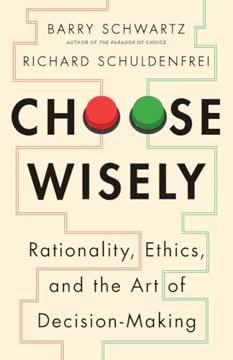
Rationality, Ethics, and the Art of Decision-Making
A flawed paradigm. Rational Choice Theory (RCT), originating from economics, posits itself as the ultimate guide for making "rational" decisions. It assumes individuals possess clear, pre-existing preferences and then systematically evaluate options by quantifying their value (utility) and the probability of achieving them. This process culminates in an algorithmic calculation to maximize expected utility, treating decision-making as a purely mathematical problem.
The gambling analogy. RCT's foundational model is the simple gamble, like a dice roll or card draw, where probabilities and outcomes are perfectly defined. This paradigm, however, is a severe oversimplification of real-world choices. While useful for specific, closed systems, it struggles to account for the vast majority of human decisions, which are far more complex, ambiguous, and context-dependent than a casino game.
Descriptive vs. normative. While RCT aims to be a normative theory (how decisions should be made), research by figures like Daniel Kahneman and Amos Tversky has extensively shown its failure as a descriptive theory (how decisions are made). People consistently deviate from RCT's norms due to heuristics and biases, yet RCT remains the benchmark against which these "errors" are measured, perpetuating a limited understanding of human thought.
2. Real-world decisions inherently defy RCT's demands for precise quantification and closure.
The decisions we face typically in our everyday lives do not come to us closed and quantified.
Unspecified choices. Everyday decisions, such as "What should I do today?" or "Where should I apply to college?", begin as open-ended problems. RCT cannot operate on such amorphous questions; it requires a rigorous process of specification—clearly defining options and their relevant attributes. This initial framing, which is crucial for any decision, is largely outside RCT's formal scope.
Vagueness and entanglement. Real-world concepts are often vague ("good college," "suitable weather") and entangled (academic quality overlaps with pre-law program strength). RCT demands clarification and disentanglement to achieve the precision necessary for quantification. This often leads to arbitrary definitions or oversimplifications that distort the true nature of the decision, sacrificing nuance for the sake of mathematical tractability.
Radical uncertainty. Beyond vagueness, many life decisions involve radical uncertainty, where probabilities cannot be meaningfully assigned (e.g., future economic conditions, personal health, political stability). RCT, which relies on multiplying value by probability, simply breaks down in such scenarios. Attempting to quantify these unknowns often results in fictional probabilities, creating a false sense of rigor and predictability.
3. Framing is an indispensable tool for decision-making, not merely a source of bias.
What we will be arguing, in contrast, is that framing is an important ingredient—perhaps the most important ingredient—in good decision-making.
Beyond "narrow framing." While decision-making research often highlights framing as a source of bias (e.g., choosing differently when outcomes are presented as "lives saved" vs. "deaths"), the authors argue that framing, more broadly understood, is fundamental to all thought. It involves imposing limits and context on a decision, transforming an overwhelming array of possibilities into a manageable problem.
A prerequisite for RCT. For RCT to function, decisions must be framed. This involves:
- Limiting the set of options.
- Clearly defining relevant attributes.
- Separating the decision from its larger context.
- Homogenizing data and preferences for quantitative comparison.
Without this preparatory framing, RCT procedures cannot even begin, making framing a necessary, rather than merely problematic, aspect of rational thought.
Choosing the right frame. The challenge isn't to avoid framing, but to choose the right frame—one that captures all relevant considerations without becoming unmanageably broad. This choice depends on the decision's purpose and context, requiring deliberation and judgment that RCT itself cannot provide. For instance, assessing the "true" cost of beef involves broadening the frame beyond market price to include environmental and health externalities, transforming a simple purchase into a geopolitical consideration.
4. Decision frames "leak" into experience, making subjective outcomes fundamentally different.
When frames leak into the experience of decisions, we can’t really say that two descriptions—two frames—are “really” descriptions of the same situation.
Experience is path-dependent. The way a decision is framed doesn't just influence the choice; it can profoundly shape the experience of the outcome. This phenomenon, termed "leakage," means that the subjective quality of an event (e.g., enjoying a concert) can depend on the mental path taken to arrive at that event (e.g., losing a ticket vs. losing cash). This challenges RCT's assumption that formally identical situations should lead to identical experiences.
Challenging invariance. RCT's principle of invariance states that different descriptions of the same objective situation should not alter preferences. However, if framing affects subsequent experience, then two "objectively" identical situations are subjectively different. For example, beef labeled "75% lean" might taste better than "25% fat" beef, even if they are the same product, because the frame influences perception and enjoyment.
Beyond objective outcomes. Leakage highlights that human experience is not merely a direct response to external objects or events. It's an interaction between the external reality and the internal construction of that reality through framing, expectations, and personal meaning. This implies that evaluating decisions solely on objective outcomes, as RCT tends to do, misses a crucial dimension of human rationality and well-being.
5. RCT's oversimplification can lead to morally questionable and tragically ineffective decisions.
We don’t mean to suggest that the only thing wrong with U.S. policy in Vietnam was McNamara’s analytical approach. By no means. But we do mean to suggest that his approach may have blinded him to considerations that lay outside his analytical frame.
Dehumanizing calculations. RCT's drive for quantification often encourages treating complex human issues as simple mathematical problems, leading to morally dubious conclusions. Examples include:
- Pollution siting: Suggesting pollution be exported to low-wage countries because the "cost of health impairing pollution depends on the forgone earning from increased morbidity and mortality."
- Market for babies: Proposing a market for babies to improve adoption efficiency.
- Voting as irrational: Dismissing civic duty in voting because individual impact is statistically negligible.
These approaches reduce human value to economic terms, ignoring inherent dignity, social bonds, and moral obligations.
Neglect of "other people." RCT typically frames decisions as one-person problems, marginalizing the impact on others. The decision to buy a concert ticket, for instance, rarely accounts for the disappointment of companions if one chooses not to go. This neglect fosters transactional relationships, where interactions are based on mutual gain rather than genuine concern, eroding the fabric of human connection.
Tragic consequences in policy. When applied to public policy, RCT's narrow framing can have disastrous real-world effects. Robert McNamara's reliance on quantitative metrics like "body counts" in the Vietnam War, while ignoring political, cultural, and human complexities, led to a flawed strategy and immense suffering. Similarly, COVID-19 policy decisions, while urgent, often struggled to balance health outcomes with economic, social, and psychological costs, demonstrating the limits of purely analytical approaches in open, complex systems.
6. "Idea technology" and ideology can transform false theories of human nature into self-fulfilling realities.
A theory that is false can become true simply by people believing it’s true.
The power of ideas. Beyond physical technologies, "idea technology"—concepts and ways of understanding the world—profoundly shapes human behavior. Unlike physical objects, ideas can influence people even if they are initially untrue. This phenomenon, termed ideology, can lead to self-fulfilling prophecies, where beliefs about human nature alter social practices until those beliefs become empirically validated.
Workplace transformation. Historically, the nature of work was deeply embedded in social relations and customs. However, the rise of "scientific management" and factory systems, driven by the belief that workers are primarily motivated by wages and are inherently lazy, transformed work into routinized, instrumental tasks. This created a reality where workers did become primarily motivated by pay, thus validating the initial, potentially false, assumption about human nature.
Mechanisms of ideology:
- Reconstrual: Individuals reinterpret their own actions to align with prevailing theories (e.g., seeing altruism as ego gratification).
- Self-fulfilling prophecy: Initial false beliefs about others (e.g., a student being "smart") change behavior towards them, eliciting responses that confirm the initial belief.
- Institutional change: Ideologies shape social structures (e.g., welfare policies, educational systems), which in turn mold human behavior to fit the ideological assumptions.
RCT, by promoting a view of humans as utility-maximizing agents, risks becoming such an ideology. If widely adopted, it could normalize a narrow, transactional view of life, eroding other forms of rationality and human connection.
7. True rationality prioritizes deep understanding and meaning over mere prediction and calculation.
We believe we cannot understand rationality without understanding how understanding changes the way people approach decisions.
Beyond prediction. While RCT focuses on predicting outcomes through probability, true rationality encompasses understanding. Understanding involves placing phenomena within coherent frameworks, recognizing context, and discerning causes—like understanding why a car rolls over, not just that it's statistically likely to. This deeper comprehension allows for more adaptive and informed responses than mere statistical prediction.
The intentional stance. Understanding human beings, unlike inanimate objects, requires recognizing their intentions, motives, meanings, and purposes. This "intentional stance" is crucial for social interaction and a fully human life. RCT, by reducing human actions to utility maximization, often overlooks these vital dimensions, leading to an impoverished view of human agency and relationships.
Reflectiveness and self-knowledge. Rationality also involves reflectiveness—the habit of thinking deeply about situations, one's own motivations, and prejudices. This self-knowledge allows individuals to choose appropriate frames, identify personal biases, and align decisions with broader life goals. This continuous process of self-examination and learning is largely absent from RCT's algorithmic approach.
8. A meaningful life is built on purpose, narrative coherence, and a constellation of balanced virtues.
We think individual decisions should be evaluated with respect to whether and how they contribute to living good lives.
Life as narrative. Instead of viewing life as a sum of isolated, utility-maximizing moments (like Kahneman's "atoms of happiness"), true rationality sees life as a coherent narrative. This narrative is organized around purpose and meaningful goals, which provide unity and direction. Decisions are then evaluated not just for immediate utility, but for how they contribute to this overarching life story.
Beyond mere accumulation. Meaningful lives are distinct from lives of simple accumulation (of money, pleasure, or experiences). While accumulation offers a unity of similarity, a narrative life offers a unity of integration, where each phase and decision grows out of and contributes to a larger purpose. This perspective challenges RCT's implicit focus on maximizing quantifiable "goods."
The role of virtues. A good life, and the ability to make good decisions, depends on cultivating a "constellation of virtues" such as self-respect, courage, perseverance, fairness, and self-control. These character traits provide a "moral geometry" for navigating complex situations, guiding choices beyond mere calculation. They are not fungible or to be maximized in isolation but must be balanced and integrated through practical wisdom.
9. Good judgment, or practical wisdom, is the indispensable skill for navigating life's inherent complexities.
Aristotle taught us that many, perhaps most, on-the-ground decisions require judgment—what he called practical wisdom.
Replacing calculation with thinking. RCT promises to replace subjective judgment with objective calculation. However, the authors argue that the "precision" of RCT is an illusion, as every number entered into its spreadsheets (for value, probability, or importance) requires significant, often arbitrary, judgment. Good decision-making, especially in complex situations, demands nuanced judgment rather than formulaic calculation.
Context always matters. Practical wisdom (Aristotle's phronesis) recognizes that the "right" action is always context-dependent. There are no universal formulas; what works in one situation or for one person may fail in another. This contrasts sharply with RCT's decontextualized approach, which seeks universal rules applicable across all situations.
Cultivating judgment. To exercise good judgment reliably, one must cultivate:
- Understanding: Grasping the nuances of a situation.
- Reflectiveness: Examining one's own biases and motivations.
- Self-knowledge: Understanding one's strengths, weaknesses, and values.
- Values: Articulating and prioritizing worthwhile goals.
RCT, by sidelining these attributes, inadvertently discourages the very qualities essential for sound judgment and truly rational decisions.
10. Moderation, not maximization, is the appropriate and more rational aim for a well-lived life.
We think Aristotle was right and that we should seek the “mean”—the right amount—of all things we value.
The Aristotelian mean. RCT's core goal is maximization: if something is good, more of it must be better. The authors, drawing on Aristotle, argue against this, proposing that true rationality seeks moderation—the "right amount"—which lies between deficiency and excess. For example, courage is the mean between cowardice and recklessness; too much of a good thing can turn it into a vice.
Virtues in balance. This principle applies not only to external goods but also to virtues. One cannot simply maximize honesty or kindness; these traits must be balanced and deployed appropriately according to context. Practical wisdom is needed to coordinate and regulate these virtues, ensuring they work in harmony rather than conflict.
Beyond efficiency and accumulation. The relentless pursuit of maximization, particularly of utility or efficiency, risks making selfish accumulation the central value of life. While RCT can formally include other values like justice or ecological harmony, its underlying framework prioritizes "more" over "right." This can lead to a degraded conception of progress, where quantitative growth overshadows qualitative well-being and purpose. A truly rational life seeks balance, appropriateness, and meaning, rather than endless accumulation.
Review Summary
Choose Wisely receives mixed reviews (3.43/5 average). Readers consistently criticize its heavy focus on critiquing Rational Choice Theory, noting the book could be shorter and better organized. While the authors argue for value-driven, meaningful decision-making over mathematical calculations, reviewers found the alternative approach poorly defined and lacking practical tools. The philosophical density and technical nature proved challenging, though some appreciated the theoretical foundation and critique of hyper-rationality.
People Also Read