
Plot Summary
A Recipe Opens the Door
Rika Machida,1 a thirty-three-year-old journalist at the Shūmei Weekly, has written to Manako Kajii2 for months without reply. Kajii2 — convicted of killing three men she met through dating sites, famous for her lavish food blog — refuses all press.
When Rika1 visits her best friend Reiko3 in her new suburban home, they discover butter is impossible to find due to a national shortage. Over dinner, they read The Story of Little Babaji, where tigers spin round a tree until they melt into golden butter.
Reiko,3 a former PR strategist with a gift for disarming difficult people, suggests Rika1 ask Kajii2 for the recipe of the beef stew she cooked her final victim. Rika1 adds a postscript to her next letter. Days later, a pale-pink reply arrives: Kajii2 will see her.
Butter, Not Margarine
At the Detention House, Kajii2 proves more poised than monstrous — plump but graceful, with ivory skin and glossy hair behind the acrylic screen. She refuses to discuss her case, agreeing only to talk about food. When Rika1 mentions keeping margarine in her fridge, Kajii2 erupts in disgust, launching into a diatribe about trans fats.
She instructs Rika1 to cook freshly made rice with cold Échiré butter and a single drop of soy sauce, describing the sensation as falling — not floating upward, but plunging. That evening, Rika1 buys her first rice cooker and a hundred-gram pat of butter costing a thousand yen. The golden wave that breaks across her tongue is unlike anything she has known. She cooks a second batch well past midnight.
The Pasta Makoto Rejects
Rika1 throws away her margarine, starts making tarako pasta with Calpis butter at midnight, reads Kajii's2 blog with newly receptive eyes. When her boyfriend Makoto5 — a literary editor at the same publishing company, gentle and conflict-averse — stays over unexpectedly, she cooks him pasta on impulse.
He eats in awkward silence, then tells her she doesn't need to act domestic on his account. The misunderstanding stings: she'd cooked for herself, not for him.
When Rika1 begins gaining visible weight and Makoto5 texts that he thinks she shouldn't let herself go, the friction crystallizes into something colder. Their relationship, built on mutual non-interference and meetings twice a month, cannot accommodate a woman whose appetites are widening beyond her carefully maintained silhouette.
A Cake Described Like Snowfall
Kajii2 writes from prison requesting Rika1 eat a West Christmas buttercream cake and describe the experience. The cakes are sold out everywhere, but Reiko's husband Ryōsuke,6 who works at a confectionery company, secures a slice from a competitor taste-testing session.
On Christmas Eve, Rika1 bites into the dense sponge and feels the plummeting sensation Kajii2 described. She rushes to the Detention House and translates taste into language: an unending spiral descent through snow, spinning as if waltzing.
Through the screen, Kajii's2 lips grow moist with unmistakable desire. Rika1 has made a convicted killer hungry using only words. Kajii2 whispers a Christmas greeting, her voice thick as savarin syrup. It is the first time Rika1 has induced desire in anyone intentionally.
Six Kilos of Butter
Rika1 has gained six kilos. Colleagues mock her, her doctor diagnoses oesophageal inflammation, and the weekly magazine's culture of thinness closes in. Kajii2 is exultant — she loathes dieting with a fury rooted in her own mother's12 obsessive calorie-counting, and demands Rika1 eat her way through Tokyo's finest establishments.
Rika1 dines alone at Joël Robuchon, where foie gras with butter-saut éed dried persimmon and champagne-gold interiors transport her into the world Kajii2 once inhabited with her wealthy older lovers.
Amid elderly men and their young companions, Rika1 begins connecting Kajii's2 life to Audrey Hepburn's Holly Golightly — a woman who belonged to nobody. The meal is transcendent, but its aftermath leaves her heavy and disoriented, her former self dissolving faster than butter on the tongue.
Ramen at Three A.M.
Kajii's2 next assignment is her most provocative: eat salt butter ramen immediately after sex, at three in the morning, in the deepest cold. Rika1 books a Shinjuku hotel and invites Makoto.5 Their intimacy, dormant for months, reawakens something honest — sweat, warmth, a reminder of what bodies are for.
But at 2:45 a.m., while Makoto5 sleeps, Rika1 slips out into the freezing city. She finds the chain ramen shop on Yasukuni-dōri, orders firm noodles with extra butter, and discovers the taste has nothing to do with the sex.
It is freedom — the kind savored only alone, in an unknown hour of a familiar city. For the first time, Rika1 understands what Tokyo meant to Kajii:2 a foreign country where a woman from the provinces could move without shame.
The Valentine's Quatre Quarts
Kajii2 sets a new condition for the exclusive interview: Rika1 must bake a quatre quarts — a four-ingredient pound cake — and serve it warm. With Reiko3 unavailable, Shinoi,4 the senior editor who has been Rika's1 confidential source for two years, offers his empty family apartment in Arakichō.
The place is a ruin of absence: his wife and daughter15 left after the girl developed an eating disorder from being bullied about her weight. Shinoi4 whisks the butter until it turns cloud-light, confessing his failure as a father while Rika1 folds in flour.
The scent of lemon zest and warm dough fills rooms that haven't smelled sweet in years. Rika1 wraps the cake and runs through midnight streets to deliver it to Makoto5 at the office. Their chapped lips, tasting of butter and citrus, finally touch.
Snow Country Confession
Rika1 takes the bullet train to Niigata, and Reiko3 boards uninvited with a heavy suitcase and fake photographer credentials. In the Kajii2 family home in Agano, they find an overheated house cluttered with plants and stained soft toys.
At a neighboring dairy farm, Rika1 milks a cow and has a hallucinatory flashback to finding her father's body. Later, Reiko3 presses Kajii's sister Anna8 with facts she'd independently uncovered at a local primary school. Anna8 breaks down: as a child, a prowler had targeted her. She struck him with a hoe, drawing blood on the snow.
Her older sister Manako2 found the injured man, became his protector, and reframed the assault entirely — men were weak, fragile creatures, and women's coldness was to blame. This sex offender became the first person to make Kajii2 feel understood.
Platform Farewell at Niigata
At the station, the friends prepare to part — Rika1 for Tokyo, Reiko3 claiming she'll visit her hometown in Kanazawa. As the departure announcement sounds, Reiko3 reveals she has known about Rika's1 father since university; Rika's mother9 confided while Rika1 was out.
She tells Rika1 plainly: whatever happened, it wasn't her fault. Rika1 cannot nod, cannot confirm or deny the guilt she has carried for eighteen years — the guilt of a teenager who broke a dinner promise and found a corpse three days later.
Reiko3 drops the subject gently, with the care of someone selecting words against a closing door. They mouth goodbyes through glass as the train pulls away. Rika1 presses her forehead against the cold window, straining to see her friend3 vanish behind a curtain of snow.
Reiko Vanishes
Reiko's3 phone goes dark. She never arrives at her parents' home. Ryōsuke6 appears at Rika's1 office, sweating and bewildered — he cannot reach his wife.3 When Rika1 confronts Kajii,2 the prisoner gleefully reveals that Reiko3 visited her twice at the Detention House, consumed with worry that Rika1 was being consumed. Kajii2 mocks Reiko's3 thinness, her sexless marriage, her obsessive concern with her friend's body.
She claims she told Reiko3 the unvarnished truth: that anyone not having sex regularly is maladapted to society. Pressed for Reiko's3 location, Kajii2 drops a clue from the fairy tale that started everything — how many tigers did it take to turn into butter? Four, not three. Three of Kajii's2 men are dead. The fourth still lives.
The Macaroni Gratin Confession
Before Kajii2 will say more, she extracts a price: how did Rika1 kill her father? Rika1 tells the story of the macaroni gratin she promised to cook at age fifteen — and never did. She lied about a test, her father sighed and called her a poor excuse for a daughter, and she hung up without speaking.
Three days later she found his body. Kajii2 pronounces them both murderers and drops the clue: the fourth man is Yokota, the one she lived with before her arrest. With Kitamura's7 help, Rika1 finds the address.
In a narrow Kawasaki house, Reiko3 stands in the doorway making béchamel sauce, a border collie at her heels. A diary chapter narrated by Reiko3 reveals she posed as an abuse victim — cooking, cleaning, and being rejected by Yokota exactly as she was at home.
The Arakichō Commune
Rika1 installs Reiko3 and her dog Melanie in Shinoi's4 empty apartment, and what was meant as shelter solidifies into something stranger and warmer. Kitamura7 shows up with his laptop and a zombie shooter game. Yū10 brings her graduation thesis and a band hoodie.
Shinoi4 arrives with bags of takeaway fried chicken. Reiko,3 still fragile, speaks only to the game controller and the dog. Rika1 cooks pot-au-feu and asparagus with hollandaise for the group, practicing the recipes she's learning. Each person occupies a separate room, doing their own work, orbiting the kitchen.
Gradually Reiko3 begins eating, texting Ryōsuke,6 walking Melanie each morning. The apartment that once housed a broken family now shelters a provisional one — assembled not by blood but by coincidence and butter-scented generosity.
The Turkey Nobody Ate
Rika1 and Reiko3 infiltrate Le Salon de Miyuko under false names. In Madame Sasazuka's14 Roppongi apartment, they cook soupe de poisson, cumin pie, and lamb with orange alongside six affluent women. Afterward, a student named Chizu11 — who once worked alongside Kajii2 — reveals the incident that ended everything.
When the class voted to roast a turkey, Kajii2 went berserk, overturning a pot of stock and shattering glass. She fled and never returned. A turkey feeds ten people. Kajii2 did not have ten.
She did not even have one she could invite. Two months later, a frozen turkey was found rotting in her refrigerator after her arrest — the feast she had planned for classmates who had already torn up her invitations without reading them. The loneliest dish in the world.
Two People Already Dead
In a Kagurazaka cafe, Rika1 tells Makoto5 she cannot promise to stay thin, compliant, or manageable. He asks whether he could support her if her career drew public attack; his answer is that she should simply try hard enough not to be criticized.
The disconnect crystallizes — he believes effort resolves everything, and she has learned that effort itself can become a prison. When he says they've gone back to being friends, Rika1 realizes they never progressed beyond that. She doesn't cry.
The idol group he abandoned because its lead singer gained weight sits between them like an unspoken verdict on conditional admiration. Walking home, her phone flashes in her bag all night with his calls. She has nothing left to give him, and this is not grief but clarity.
Kajii's Revenge Article
A rival magazine publishes an interview conducted by Kajii's2 new fiancé — a freelance editor she has apparently agreed to marry in prison. In it, Kajii2 claims Rika's1 serialized feature was fabricated, motivated by a warped romantic obsession.
She accuses Rika1 of sexual harassment for discussing her intimate life. She spins an ornate narrative about her father's death designed to contradict everything Rika1 published. Le Salon de Miyuko discovers Rika's1 true identity and permanently bars her. The Shūmei Weekly removes her from all public-facing work.
Online, strangers dissect her face and body with clinical cruelty. Rika1 finally understands how Kajii's2 victims died: the thing they had treasured most was methodically shattered, and the sensation of falling that Kajii2 once likened to butter never stopped.
Blood on the Pavement
Rika1 spends days in bed, unable to eat, scrolling through a torrent of online abuse. She visits the Detention House one last time, but Kajii2 refuses to see her. Stepping into the road without checking the lights, she is struck by a car. She lies on the pavement, cheek pressed to hot concrete, blood running from her knees and elbows. A young mother helps her to a taxi.
The woman's small son stares at Rika's1 wounds with frank fascination and whispers that scabs taste really good. Back in her empty apartment, Rika1 peels a chunk of her own scab and licks it — metallic, salty, undeniably alive. She remembers that milk comes from blood, and butter from milk. Her body is still producing heat. She picks up her phone and asks someone for help.
Pancakes from an Ex-Boyfriend
Past one in the morning, Makoto5 arrives in a Scream concert T-shirt, still flushed from the farewell show of the idol he'd abandoned when she gained weight. He'd gone back. He makes pancakes from boxed mix, frying them in butter from Rika's1 fridge — the only food she has left. As the batter sizzles, he confesses his sister once made him pancakes as a child, and the smell matches the Valentine's cake Rika1 baked him months ago.
She eats a quarter of the pancake, her first solid food in days. The cooled butter leaves white tracks across its surface like the trails of shooting stars. A funky idol song fills her apartment with heat and color. She loads her dirty clothes into the washing machine and pushes the button. The machine whirs to life.
The Feast She Built Alone
Rika1 has bought an apartment with a proper oven, landed a new assignment for the company's women's magazine, and resolved to cook the meal Kajii2 never could. Over four days she defrosts, brines, stuffs, and roasts a 5.8-kilogram turkey.
Her guests arrive: Reiko3 and Ryōsuke,6 her mother,9 Kitamura,7 Yū,10 Shinoi4 with his estranged daughter Saya15 — meeting him in person for the first time in years — and a former colleague with her family. When the golden bird emerges from the oven, the room erupts.
Afterward, alone with bones and leftovers, Rika1 invents her first original recipe: turkey seiro — cold soba noodles dipped in warm broth made from the carcass, soy sauce, and butter. A Japanese dish from a Western bird. The tiger- butter, transmuted, becomes entirely her own.
Analysis
Butter interrogates the infrastructure of care — who cooks, who eats, who cleans up afterward — as a lens on gender, loneliness, and the right to occupy space. Yuzuki positions food not as metaphor but as medium: Rika's1 transformation occurs literally through her mouth, as unfamiliar tastes rewire her relationship with desire, labor, and her own body. The novel's central provocation is that domesticity — cooking, cleaning, nourishing others — functions simultaneously as the primary site of women's oppression and their most radical form of self-expression. Kajii2 cooks spectacularly but only to manipulate; Rika1 cooks imperfectly but with honest intention. The distinction proves decisive.
The case itself operates less as a whodunit than as a Rorschach test for Japanese misogyny. Every character projects their anxieties onto this overweight, unapologetically appetitive woman. Men ridicule her appearance while becoming enslaved by her cooking. Women oscillate between revulsion and fascination. Rika's1 investigation gradually reveals that Kajii's2 victims were already deteriorating — corroded by loneliness, by the conviction that only a woman's domestic service could sustain them, by a culture that framed male helplessness as romantic tragedy rather than personal abdication.
Yuzuki's most subversive argument concerns what a character calls 'a good amount' — the Japanese cooking instruction to season to taste, elevated here to a philosophy of self-determination. In a society demanding women be simultaneously thin and nurturing, hardworking and soft, professionally ambitious and sexually available, the capacity to determine your own portion size constitutes genuine rebellion. Rika's weight gain functions not as a flaw to correct but as proof of a consciousness awakening.
The novel proposes that the opposite of Kajii's2 narcissistic self-sufficiency is not self-sacrifice but something harder to name: the willingness to cook a meal you cannot eat alone, trusting that the people you love will appear at your door to share it. In this, Butter argues that true nourishment — of the body, of relationships, of a faltering society — requires equal parts vulnerability and butter.
Review Summary
Butter is a complex novel exploring themes of food, feminism, and Japanese society. Many readers found it compelling, praising its vivid food descriptions and cultural insights. However, some felt it was too long and slow-paced. The book challenges beauty standards and examines women's roles in Japan. While marketed as a thriller, it focuses more on character development and social commentary. Opinions were divided on the translation quality and plot execution. Overall, it's a thought-provoking read that resonated with many but wasn't for everyone.
People Also Read









Characters
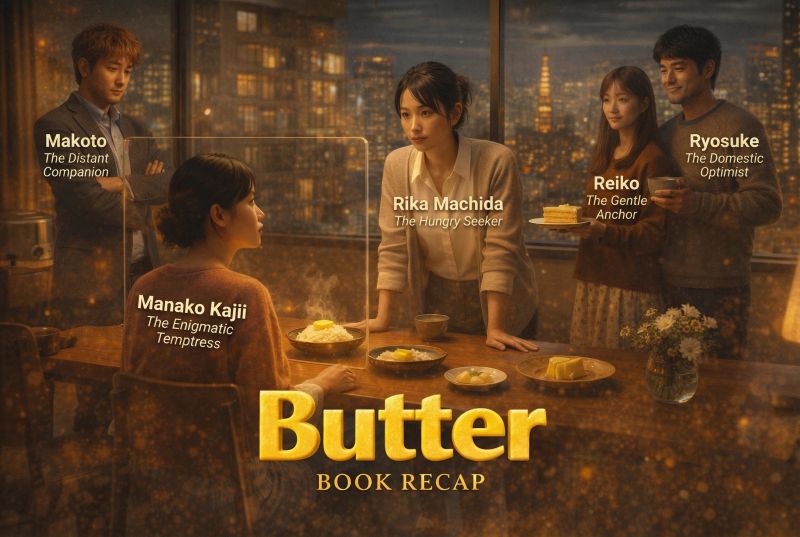
Rika Machida
Journalist drawn into Kajii's orbitA thirty-three-year-old journalist at the Shūmei Weekly—tall, androgynous, deliberately thin—Rika has built her identity around discipline and self-erasure, subsisting on convenience store meals and never cooking. Beneath her professional competence lies an adolescent wound: she broke a dinner promise to her lonely, divorced father and found his body days later. This unprocessed guilt makes her vulnerable to Kajii's2 gravitational pull, drawn to a woman who also left men to fend for themselves. She approaches every relationship—romantic, platonic, professional—as a caretaker who never asks for care in return. Her arc traces a revolution from deprivation to appetite, from control to creative autonomy. Through learning to cook, taste, and accept her expanding body, she reclaims the domestic sphere not as obligation but as self-expression.
Manako Kajii
Convicted suspect, food obsessiveThe thirty-five-year-old woman at the center of Japan's most sensational murder case—convicted of killing three men she met through dating sites. Overweight, flamboyant, and imperious behind the acrylic screen, she demands worship rather than friendship. Her obsession with butter, French cuisine, and luxury brands masks a childhood of profound isolation: maturing early in rural Niigata, invisible to her peers, she found her first validation from a deeply damaged man. Her philosophy—that women should serve men and that feminists and margarine are equally intolerable—conceals a paradox: she is the most self-sufficient person in the story. She cooks extravagantly but has never had anyone to share a meal with honestly. Her manipulation operates through food, flattery, and the deliberate withholding of herself—a black hole disguised as a feast.
Reiko Sayama
Rika's fierce, fragile best friendRika's1 best friend since university—petite, glossy-haired, devastatingly competent, perpetually mistaken for a teenager. A former PR strategist who quit her career to pursue pregnancy, she has become trapped in a suburban house with a husband who won't touch her6. Behind her delicate exterior lies volcanic intensity: she infiltrates Kajii's2 case independently, confronts suspects, and drives across prefectures on impulse. Her childhood in Kanazawa, where her parents maintained an open marriage behind elegant facades, instilled both impeccable taste and a pathological need for control. She cannot tolerate disorder in others because she cannot bear it in herself. Her relationship with Rika1 operates as a love story without sex—protective, jealous, nourishing—and her extraordinary cooking is an expression of devotion she cannot otherwise articulate.
Yoshinori Shinoi
Source, surrogate father figureA senior news editor turned media commentator, forty-eight, gaunt, and perpetually exhausted. Shinoi provides Rika1 with confidential tip-offs that fuel her career, meeting her monthly in a dingy izakaya under railway girders. He maintains two apartments—one nearly empty, where his family once baked cakes before his daughter's15 eating disorder shattered everything. His empty kitchen becomes the site of Rika's1 Valentine's cake, and later a refuge for Reiko3. He offers connections, domestic space, and an undemanding companionship that matures from professional alliance into something paternal.
Makoto Fujimura
Rika's well-meaning boyfriendA literary editor at the same company as Rika1, gentle and conflict-averse. Raised by a single mother, he recoils instinctively from any suggestion that a woman might labor on his behalf. He texts Rika1 about her weight gain with anxious conviction that he's helping. His passion for a teenage idol group, which he conceals out of embarrassment and abandons when the lead singer gains weight, mirrors his relationship with Rika1—admiration contingent on discipline and palatability. His kindness is genuine but armored against vulnerability.
Ryōsuke Sayama
Reiko's paralyzed husbandReiko's3 husband, a cheerful confectionery company employee with rosy cheeks and a quarterback's build. His warmth disguises a paralysis around intimacy: terrified that fertility testing will reveal the problem is his, he sabotages two clinic appointments. He loves Reiko3 ardently but cannot reconcile sexual desire with familial closeness, echoing—in ways neither of them initially recognizes—the dysfunction of Reiko's3 parents. His helplessness when Reiko3 vanishes strips away his joviality to reveal genuine anguish.
Kitamura
Lazy colleague, sharp observerRika's1 junior colleague, four years younger, famously indifferent to career advancement yet impeccably efficient. He neither drinks nor smokes, leaves on time, and produces accurate copy faster than anyone. This nonchalance masks genuine principles: he admires journalists who try to change a broken system and grows alarmed when he sees Rika1 compromising hers. He follows her to Shinoi's4 apartment, confronts her about ethics, then helps rescue Reiko3 from Yokota's house without complaint. His video games and fried chicken become fixtures of the commune.
Anna Shōji
Kajii's devoted younger sisterKajii's2 younger sister, twenty-eight, who divorced and returned to their Agano home after the arrest. Small, colorless, and childlike in demeanor, she idolizes her sister with a loyalty that obscures devastating personal trauma. The assault she suffered as a child—and Kajii's2 radical reinterpretation of it as women's fault—became the founding myth of both sisters' lives. She manages their ailing mother12 alone, reciting her sister's innocence with the rehearsed conviction of someone who has staked everything on belief.
Misaki
Rika's resilient, stylish motherA boutique owner in her sixties who raised Rika1 single-handedly after divorcing a self-destructive English professor. Cheerful, impeccably dressed, and fiercely independent, she refuses financial help from her daughter while caring for her increasingly difficult elderly father. She carries decades of unspoken anguish from her marriage, processed through work and practicality rather than complaint. She still visits her ex-husband's grave, an act of compassion so quiet that it shocks Rika1 when she learns of it.
Yū Uchimura
Youngest ally, idol-group fanA university student turned full-time employee at the Shūmei Weekly. Sharp-tongued and tech-savvy, she becomes an unexpected pillar of support during Reiko's3 crisis, arriving at the commune with her graduation thesis and a Scream hoodie. Her generational bluntness cuts through the older characters' overthinking.
Chizu
Cooking school whistleblowerA Le Salon de Miyuko student and Diet member's secretary, trousered and direct. She provides crucial testimony about Kajii's2 behavior at the cooking school—the invasive questions, the genuine sweetness beneath the posturing, and the catastrophic turkey incident that ended Kajii's2 attendance. She is the friend Kajii2 almost made.
Masako
Kajii's complicated motherKajii's2 mother, a former flower-arranging teacher in her sixties. Sociable and starved for validation, she eagerly feeds visitors sekihan made from her late mother-in-law's recipe while serving cream stew from packaged roux—an encapsulation of her fraught relationship with domesticity.
Hatoko Yamamura
Victim's sister, estate agentSister of Kajii's2 third victim and a capable estate agent. Reserved and sharp, she harbors the belief that her brother bore some responsibility for his own death, making her perspective uniquely aligned with Rika's1. She eventually becomes the catalyst for Rika's1 apartment purchase.
Madame Sasazuka
Cooking school matriarchOwner of Le Salon de Miyuko and wife of a renowned French chef. Warm yet discerning, she lends Rika1 her personal recipe notebook with trusting generosity—then bars her permanently when the journalistic deception is exposed. Her recipes ripple outward through the narrative like dropped ingredients.
Saya Kamiyama
Shinoi's estranged daughterShinoi's4 daughter, now a university nutrition student. Her appearance at Rika's1 turkey party—uninvited by Rika1, brought by a tentative father—signals reconciliation. She carves the bird with practiced hands, a young woman who turned her painful history with food into expertise.
Plot Devices
Butter
Catalyst for transformationButter operates as the novel's central substance—not merely symbolic but physically transformative. Kajii's2 instruction to eat Échiré butter with rice initiates Rika's1 awakening to desire, pleasure, and eventually self-knowledge. As Rika1 progresses from margarine to artisanal varieties to mastering beurre blanc sauce, butter tracks her evolution from deprivation to creative autonomy. It connects the Niigata dairy farms where Kajii2 grew up to the Parisian cuisine she idolized, and links the blood of living cows to the golden cream spreading across Rika's1 tongue. The national butter shortage that opens the novel functions as social backdrop—a country literally unable to supply its own richness—while butter's tendency to melt, harden, and change form mirrors the characters' shifting states.
The Story of Little Babaji
Recurring structural metaphorThe picture book about tigers who spin around a tree until they melt into butter—which a family then spreads on pancakes—is introduced at Reiko's3 house and recurs throughout the novel as an interpretive lens. For Rika1, it initially represents the victims' self-destructive competition. For Shinoi4, it illustrates natural selection. Kajii2 deploys the story's structure as a coded message, and the number of tigers becomes a crucial investigative clue. The fairy tale's cheerful cruelty—predators transformed into breakfast spread, their bones nowhere to be found—mirrors the novel's central question about whether Kajii's2 victims were consumed by her appetites or destroyed themselves through their own futile spinning.
Le Salon de Miyuko
Safe space and crime sceneThe exclusive women's cooking school, run by the wife of a renowned French chef14, serves dual narrative functions. As a location, it represents exactly what Kajii2 lacked and desperately wanted: a community of women who cooked together without competition, sharing recipes and warmth in a professional kitchen. Rika's1 undercover attendance there provides both investigative access and genuine personal growth—she learns technique, confidence, and the collaborative spirit of cooking for others. The school's history with Kajii2 crystallizes the case's emotional core: a woman who could master any recipe but could not master the art of belonging. The school's eventual rejection of Rika1 mirrors the expulsion Kajii2 brought upon herself.
Rika's Weight Gain
Social barometer of misogynyRika's1 progression from 50 to 59 kilos functions as the novel's most visible provocation. Her expanding body triggers responses from every character—Makoto's5 anxiety, colleagues' mockery, Kajii's2 delight, Reiko's3 complex jealousy—each reaction revealing more about the observer than the observed. The weight gain is neither crisis nor triumph but a diagnostic tool, exposing how thoroughly Japanese society polices women's bodies. When Rika1 discovers that the medically recommended weight for her height is 60 kilos—ten kilos heavier than the industry standard she'd internalized—the gap between health and aesthetics becomes the novel's sharpest indictment. Her decision to stop apologizing for her size becomes an act of quiet defiance.
The Roast Turkey
Symbol of communal possibilityThe turkey that Kajii2 planned to cook but never served becomes the novel's culminating image. A dish requiring ten guests, four days of preparation, and collaborative carving, it represents everything Kajii2 could not achieve: genuine community, shared vulnerability, a table set for people who chose to be there. When Rika1 roasts her own turkey for a housewarming party—stuffed with mochi rice and giblets, basted with butter, carved by a stranger's daughter15—she completes the meal Kajii2 could only dream of. The leftover bones, simmered into broth for a Japanese noodle dish of Rika's1 own invention, transform a Western tradition into something personal and hybrid, proving that recipes need not be followed to the letter to nourish.
FAQ
Synopsis & Basic Details
What is Butter about?
- A journalist's obsession: Rika Machida, a journalist, becomes deeply intrigued by the case of Manako Kajii, a woman accused of multiple murders, and seeks to understand her motivations.
- Exploring female identity: The story delves into themes of female identity, societal expectations, and the search for self-fulfillment through the lens of Rika's interactions with Kajii and her own personal journey.
- Culinary and emotional journey: Rika's exploration of food and cooking becomes a metaphor for her emotional and psychological journey, as she grapples with her own desires and the complexities of human relationships.
Why should I read Butter?
- Unique character study: The novel offers a compelling character study of both Rika and Kajii, exploring their complex motivations and challenging conventional notions of good and evil.
- Intriguing thematic depth: Butter delves into thought-provoking themes of misogyny, societal pressures, and the search for authenticity, making it a rich and rewarding read.
- Subtle and nuanced narrative: Asako Yuzuki's writing style is subtle and nuanced, revealing layers of meaning through seemingly ordinary details and creating a captivating reading experience.
What is the background of Butter?
- Contemporary Japanese society: The novel is set in contemporary Japan, exploring the cultural and societal pressures faced by women in a modern urban environment.
- Media and public perception: The story examines the role of media in shaping public perception and the sensationalism surrounding criminal cases, particularly those involving women.
- Food culture and symbolism: Food and cooking are central to the narrative, serving as a lens through which the characters explore their emotions, desires, and relationships, reflecting the importance of food in Japanese culture.
What are the most memorable quotes in Butter?
- "I only want to spend my time with people who know the real thing when they see it.": This quote from Manako Kajii's blog encapsulates her elitist worldview and her obsession with authenticity, highlighting her complex character.
- "Your problem is you've decided that butter is bad without even understanding what it tastes like.": This line from Kajii to Rika reveals Kajii's strong opinions and her desire to control others' perceptions, while also foreshadowing Rika's own culinary awakening.
- "Women who love to cook are so delighted when someone asks them for a recipe that they'll tell you all kinds of things you haven't asked for along with it. It's a law of nature.": This quote from Reiko highlights her understanding of human nature and her ability to use it to her advantage, while also revealing her own passion for cooking.
What writing style, narrative choices, and literary techniques does Asako Yuzuki use?
- Subtle and nuanced prose: Yuzuki employs a subtle and nuanced writing style, revealing layers of meaning through seemingly ordinary details and creating a captivating reading experience.
- Internal monologue and reflection: The narrative often delves into Rika's internal thoughts and reflections, providing insight into her psychological state and her evolving understanding of the world.
- Symbolism and metaphor: Yuzuki uses symbolism and metaphor, particularly through food and cooking, to explore complex themes and emotions, adding depth and richness to the narrative.
Hidden Details & Subtle Connections
What are some minor details that add significant meaning?
- The hangnail: Rika's hangnail, mentioned in the first chapter, becomes a recurring motif, symbolizing her anxiety and unease as she navigates her life and the Kajii case.
- The butter shortage: The butter shortage in Tokyo serves as a backdrop to the story, highlighting the characters' desires and obsessions, and also foreshadowing Kajii's fixation on butter.
- The picture book: The children's book, "The Story of Little Babaji," becomes a recurring motif, reflecting the themes of power, manipulation, and the cyclical nature of violence, and also foreshadowing the fate of Kajii's victims.
What are some subtle foreshadowing and callbacks?
- The melted tigers: The image of the tigers melting into butter in "The Story of Little Babaji" foreshadows the way Kajii's victims are consumed by her, and also symbolizes the destructive nature of desire.
- The Échiré butter: Rika's initial purchase of Échiré butter foreshadows her growing obsession with food and her desire to understand Kajii's motivations, and also serves as a callback to Kajii's blog posts.
- The "you smell" comment: Makoto's comment about Rika's "you smell" foreshadows the shift in their relationship, and also serves as a callback to their early days when they were more physically intimate.
What are some unexpected character connections?
- Rika and Kajii's mothers: Both Rika and Kajii have mothers who are complex and independent women, which may explain their own struggles with societal expectations and their desire for self-fulfillment.
- Reiko and Kajii's shared traits: Despite their contrasting personalities, Reiko and Kajii share a passion for food and a strong will, which may explain why Rika is drawn to both of them.
- Shinoi and Rika's fathers: Both Shinoi and Rika's fathers are portrayed as men who struggled with their health and personal lives, which may explain their shared sense of melancholy and their ability to connect on a deeper level.
Who are the most significant supporting characters?
- Kitamura: Rika's colleague, Kitamura, provides a contrasting perspective on the media industry and serves as a foil to Rika's ambition, highlighting the different ways people navigate their careers.
- Yū Uchimura: The university student who works part-time at the office, Yū represents the younger generation's perspective on the Kajii case and provides a glimpse into the changing attitudes towards gender and power.
- Hatoko Yamamura: The sister of one of Kajii's victims, Hatoko provides a unique perspective on the case and challenges Rika's assumptions about the victims' motivations, and also serves as a mirror to Rika's own struggles.
Psychological, Emotional, & Relational Analysis
What are some unspoken motivations of the characters?
- Rika's desire for validation: Rika's pursuit of the Kajii case is driven by a deep-seated need for validation and recognition, as she seeks to prove her worth as a journalist and a woman.
- Kajii's need for control: Kajii's actions are motivated by a desire for control and power, as she seeks to manipulate and dominate the men around her, and also to control her own narrative.
- Reiko's search for fulfillment: Reiko's decision to leave her job and focus on starting a family is driven by a desire for fulfillment and a sense of purpose, but also by a need to escape the pressures of her career.
What psychological complexities do the characters exhibit?
- Rika's internal conflict: Rika struggles with her own desires and societal expectations, torn between her ambition and her need for connection, and also between her desire to be seen as a strong, independent woman and her need for validation from others.
- Kajii's narcissism and insecurity: Kajii exhibits a complex mix of narcissism and insecurity, as she seeks to control and manipulate others while also craving their admiration and approval, and also reveals a deep-seated fear of being seen as ordinary.
- Reiko's hidden anxieties: Despite her seemingly content life, Reiko harbors hidden anxieties about her own worth and her ability to fulfill her desires, and also struggles with the pressure to conform to traditional gender roles.
What are the major emotional turning points?
- Rika's culinary awakening: Rika's experience with Reiko's cooking and her subsequent exploration of food mark a turning point in her emotional journey, as she begins to connect with her own desires and find a sense of purpose.
- Rika's encounter with Kajii: Rika's meeting with Kajii forces her to confront her own biases and assumptions, leading to a shift in her understanding of the case and her own motivations.
- Reiko's confession: Reiko's confession about her struggles with her marriage and her own sense of self marks a turning point in her relationship with Rika, as they begin to connect on a deeper emotional level.
How do relationship dynamics evolve?
- Rika and Reiko's friendship: The friendship between Rika and Reiko evolves from a comfortable familiarity to a deeper understanding and mutual support, as they navigate their individual challenges and learn to appreciate each other's strengths.
- Rika and Makoto's relationship: The relationship between Rika and Makoto deteriorates as they struggle to communicate their true feelings and desires, highlighting the limitations of a relationship based on routine and superficial connection.
- Rika and Shinoi's connection: Rika's relationship with Shinoi evolves from a professional connection to a more personal one, as they find common ground in their shared experiences and their desire for authenticity.
Interpretation & Debate
Which parts of the story remain ambiguous or open-ended?
- Kajii's true motivations: The novel leaves the reader questioning Kajii's true motivations, as it is never fully clear whether she is a manipulative killer or a victim of societal pressures.
- The nature of love and desire: The story raises questions about the nature of love and desire, leaving the reader to ponder the complexities of human relationships and the motivations behind them.
- The possibility of redemption: The ending of the novel leaves the reader wondering whether any of the characters will find redemption or whether they are destined to repeat their mistakes, and also leaves the reader questioning whether or not Kajii is capable of change.
What are some debatable, controversial scenes or moments in Butter?
- Kajii's manipulation of men: The novel presents a controversial portrayal of Kajii's relationships with men, raising questions about the nature of consent and the power dynamics between men and women.
- Rika's fascination with Kajii: Rika's fascination with Kajii is a source of debate, as it challenges conventional notions of good and evil and raises questions about the nature of empathy and understanding.
- The portrayal of female relationships: The novel presents a complex portrayal of female relationships, highlighting both the support and the competition that can exist between women, and also challenges the idea that women are always supportive of one another.
Butter Ending Explained: How It Ends & What It Means
- Rika's self-acceptance: The ending of "Butter" sees Rika embracing her imperfections and her desires, choosing to live her life on her own terms, and also accepting that she is not responsible for the actions of others.
- Reiko's path to self-discovery: Reiko's journey towards self-discovery is ongoing, as she begins to prioritize her own needs and desires, and also to challenge the traditional roles she has been playing.
- Ambiguous future: The novel concludes with a sense of hope and possibility, but also with a recognition of the complexities of life and the challenges that lie ahead, and also leaves the reader questioning whether or not the characters will find true happiness.
Download PDF
Download EPUB
.epub digital book format is ideal for reading ebooks on phones, tablets, and e-readers.








































