
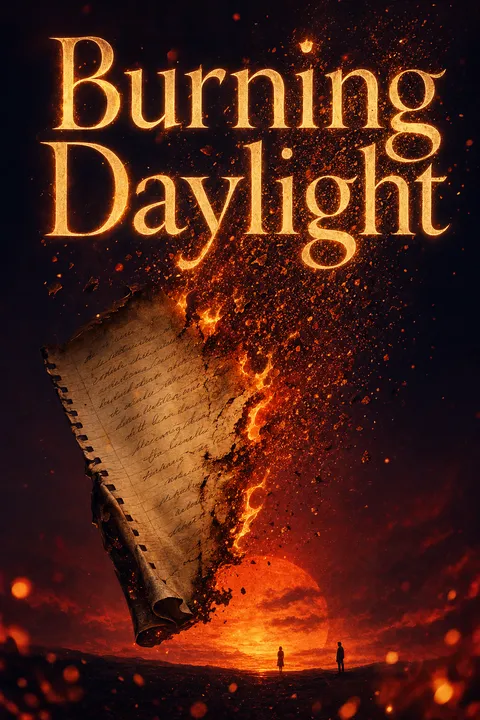


Plot Summary
Prologue
Hidden beneath a staircase, thirteen-year-old Juliette Calloway1 eavesdrops as her father Craig6 corners Marcus Montgomery5 in his study, demanding he dissolve the century-old WayMont pact so Craig6 can seize HillPoint land. Marcus5 refuses and warns Craig6 to leave his family alone. Craig6 only smiles, hinting darkly at tragedy.
Two days later, the local tabloid reports that artist Heather Argent4 and her two children died when their car wrapped around a tree in Montgomery territory, brakes mysteriously failed. Watching the news over breakfast, Craig6 smiles again. Bewildered, Juliette1 scribbles everything into her notebook of stories, not understanding what she witnessed, but certain she never wants to forget it.
The prologue plants the feud's rotten seed through a child's uncomprehending gaze, establishing Juliette as both witness and inheritor of violence she did not choose. McIntire weaponizes dramatic irony: the reader intuits the crash was no accident long before Juliette can name it. Craig's smile becomes the story's original sin, a paternal cruelty disguised as business. The notebook introduces writing as Juliette's survival mechanism, her way of metabolizing horror into narrative. By opening on a death that will later prove foundational to the romance, the book frames love and murder as tangled roots of the same poisoned tree, honoring its Shakespearean source while promising darker machinery beneath the fairy tale.
The Rescue at the Rock
Sent by her mother17 to track down her missing brother Lance,8 seventeen-year-old Juliette1 hikes to a cliffside boulder called Upside Down Rock. Lying with her feet toward the sky, she hears footsteps, panics, and slides toward open air. A tattooed stranger2 seizes her arm and hauls her back, and she lands sprawled on top of him. Sparks ignite instantly.
He refuses to give his name, teases her mercilessly, and calls her Princess.1 She dubs him Trouble2 and invokes an imaginary boyfriend to keep her balance. He suggests she return tomorrow; she claims she never will. She walks away thrilled and rattled, then pours the encounter into her secret notebook. For four years afterward, she searches for him in every crowd and never finds him.
The meet-cute inverts the damsel trope even as it deploys it: Juliette resents needing saving, and her combativeness becomes the truest expression of attraction. McIntire codes their chemistry as danger from the first breath, the near-fall foreshadowing how loving him will require standing at precipices. His refusal of a name is both flirtation and self-protection, a boy who has learned that identity is a liability. Juliette's immediate retreat into fiction reveals her core coping strategy, transmuting overwhelming feeling into story. The scene establishes the rock as neutral ground outside family surveillance, the one place she authors her own life rather than performing the choreographed Calloway daughter.
Romeo in the Gallery
Four years later, finishing college in California, Juliette1 lets her roommate Felicity9 drag her to a gallery show for an anonymous street artist who signs everything RMO, nicknamed Romeo.2 The murals of burning pills and kneeling children stir something unexpected in her.
Then a familiar low voice mocks her critique. It is Trouble,2 older, more inked, still infuriating. He arrived with a woman named Amanda but insists they are merely friends. Juliette1 escapes to the alley; he follows, lights a joint, flirts, and again withholds his name.
Their pull is magnetic and unnerving. She learns he sketches, and he offers to draw her before she flees. She never realizes he is the very artist whose work moved her, nor that he already suspects exactly who she is.
Coincidence here masquerades as fate, a deliberate romantic convention the book will later detonate. Juliette's aesthetic awakening before his art mirrors her emotional awakening before the man, art functioning as an unfiltered channel to a self her upbringing suppressed. The anonymity game continues, but now it carries dramatic weight: he knows something she does not, tilting their intimacy toward imbalance. McIntire seeds the Romeo nickname to invoke the tragedy overtly, daring the reader to expect doom. The alley's grime against the gallery's polish externalizes the class chasm between them, a wound Roman carries constantly, measuring his poverty against her effortless wealth even while she sees only him.
The Boy Behind the Alias
The narrative shifts to Trouble, whose real name is Roman Montgomery,2 living under the alias Ryder Speare. He visits the crumbling duplex where his drug-dependent mother, Heather,4 and chronically ill teenage sister, Brooklynn,12 survive on whatever his art earns.
Heather,4 once a celebrated painter, is now hollowed by oxycodone and heroin, and she pressures Roman2 to grovel to his estranged father for money. Years earlier, Marcus Montgomery5 faked their deaths and erased their identities following a car crash.
Roman2 resists, but Brooklynn's12 mounting medical bills and vanishing seizure medication corner him. When Brooklynn's12 carefully hoarded savings disappear, Roman2 grasps the ugly truth: his mother4 is holding his little sister's12 health hostage to bend him toward the father who abandoned them all.
Switching to Roman's perspective humanizes the mysterious stranger into a caretaker crushed by inherited dysfunction. The book renders addiction with painful nuance, separating the mother Heather was from the illness that consumed her, while refusing to sentimentalize the damage she inflicts. Roman's devotion to Brooklynn is his moral center and his exploitable weakness, the lever every manipulator in his life will pull. His fake name literalizes a stolen selfhood: he cannot even own his identity because his father buried it. The chapter reframes the swaggering flirt as a young man performing confidence over desperation, establishing that both leads wear masks demanded by families that treat children as assets.
Drawn on His Couch
Learning she leaves California in two days, Juliette1 trails Roman2 to his shabby studio to apologize for her coldness. He agrees to sketch her; posing on his couch, she confesses her buried love of writing and the suffocating expectations of her family. The drawing melts into seduction, and he brings her to climax with his hand before a knock shatters the moment.
It is Heather,4 strung out, who dismisses Juliette1 without a second look. Outside, the two argue and laugh, both pretending the goodbye means nothing. At the last second Roman2 offers a name, Ryder,2 still a fabrication, and lets her walk away. Afterward his mother4 confirms the dread coiling in his gut: the girl is Juliette Calloway,1 daughter of his family's mortal enemy.
Being sketched is the book's central metaphor for intimacy, Roman rendering Juliette as art worth remembering while she has only ever been rendered as a Calloway product. Her vulnerability on the couch, confessing forbidden ambition to a near-stranger, reveals how starved she is to be genuinely seen. The interrupted encounter and Heather's contempt puncture the fantasy, dragging class and family back into the room. The false name is a small betrayal that will metastasize, and the reader now shares Roman's terrible knowledge. McIntire structures the scene so that pleasure and dread coexist, priming the star-crossed engine: every tender beat carries the freight of who they are.
A Bargain with the Dying
Heather4 escalates, spinning theories that Craig Calloway6 engineered the family's crash and admitting she deliberately drained Brooklynn's12 medication fund to manipulate her son.2 She threatens to expose the Montgomerys' faked deaths unless Roman2 contacts Marcus.5
Desperate for Brooklynn,12 Roman2 finally phones the father who discarded him.5 Marcus,5 warmer than anticipated, agrees to fund health insurance and a trust, but only if Roman2 returns to Rosebrook Falls for good.
Roman2 signs papers restoring his Montgomery name and establishing Brooklynn's12 trust, blind to a buried clause that forfeits everything should he leave or die. Marcus5 then reveals he is dying of stage four cancer and wants Roman2 to inherit his crumbling empire. Roman2 accepts, chaining himself to the family that erased him.
This is Roman's point of no return, a Faustian bargain in which love for a sister purchases servitude to a father. The forfeiture clause, glossed over in the moment, is the narrative trap that recontextualizes the entire homecoming, planted so its later spring feels earned rather than arbitrary. Marcus's unexpected warmth is the cruelest manipulation of all, dangling paternal love before a son who has starved for it, making Roman complicit in his own captivity. The cancer reveal weaponizes mortality, converting reunion into legacy transfer. McIntire threads a devastating psychology here: Roman despises his father yet still yearns for him, and that unresolved hunger renders him endlessly exploitable.
You're Alive
Roman2 relocates to HillPoint and, alongside Benjamin Voltaire,13 Rosalie Bault,15 and Merrick Carter,14 crashes the gate of a Calloway political fundraiser. Juliette,1 hauled home from graduation to perform beside her ex Preston,16 wanders outside and finds her brothers Paxton10 and Lance8 locked in a standoff with the intruders.
Then she spots Trouble2 among them. He greets her by her nickname, entirely unsurprised, and horror crashes over her: he knew who she was all along. Craig6 storms in, drains of color, and names the stranger Roman Montgomery,2 the son everyone believed dead.
Juliette's1 world tilts as every stolen moment curdles into suspicion. Roman2 coldly performs the villain for her father6 while privately gutted by the wound blooming in her eyes.
The public unmasking fuses romance and feud, transforming a private California flirtation into a dynastic collision. Juliette's grief is less about the lie than the loss of the one relationship untouched by her surname, and its contamination is the book's most poignant reversal. Craig's blanched recognition confirms the prologue's buried crime, retroactively arming every earlier scene. Roman's forced performance of enmity dramatizes the tragedy's engine: identity as destiny, two people compelled to enact hatred they do not feel. McIntire stages the moment at a threshold gate, a literal boundary between territories, underscoring that their love has always been a trespass across lines drawn by dead men and living tyrants.
The Balcony and the Rock
Days later Roman2 scales the ivy trellis to Juliette's1 balcony, dangling recklessly until she relents and forgives him. He explains he never knew her identity at their first meetings and that everyone believes her father6 once tried to kill him. Though loyalty says she should hate him, she agrees to meet at Upside Down Rock, and the cliff becomes their refuge.
There he draws her while she writes, and they swap confessions between barbs and flirtation. Roman2 reveals his mother4 was once a radiant artist before addiction devoured her; Juliette1 admits how thoroughly her family cages her. What began as verbal sparring deepens into aching intimacy, two heirs of feuding houses building a hidden country where their last names cannot follow them.
The balcony scene is McIntire's most direct Shakespearean homage, repurposed as active choice rather than passive longing. Forgiveness here is Juliette exercising agency against inherited loyalty, a small rebellion that foreshadows larger defiance. The rock functions as heterotopia, a space where social rules suspend and authentic selves surface, and the parallel creative acts, his sketching and her writing, become a shared language more intimate than sex. Their exchanged wounds, his addicted mother and her emotional cage, forge attachment through mutual recognition of captivity. The section reframes the romance as two prisoners glimpsing freedom in each other, deepening stakes by making the relationship feel less like desire than like oxygen.
Painting the Family Down
Marcus5 hands Roman2 a folder documenting Calloway corruption: shell companies, bribed officials, predatory HillPoint loans. He asks Roman2 to expose it through anonymous street art.
Roman2 begins tagging murals across Rosebrook Falls that cast Craig6 as a puppet master pulling the mayor, judges, and council, and public protests swell against the family. Frederick Lawrence,3 the lawyer who represents both houses, appears at Roman's2 door brandishing intercepted photos of him with Juliette1 and interrogating his intentions.
He cryptically warns that the only way to protect love is to carry it somewhere no one can reach it. Torn between the sister he is rescuing12 and the girl he is falling for,1 Roman2 keeps painting, knowing every mural drives Juliette1 further away even as they draw closer.
Roman's art, once pure self-expression, becomes an instrument of proxy war, corrupting his one uncompromised gift into his father's weapon. The tension between his authentic creativity and its coerced deployment mirrors his broader captivity: even his rebellion is scripted by others. Frederick's entrance introduces the story's true intelligence, a figure who watches, warns, and manipulates under the guise of protection; his aphorism about hiding love reads as counsel but functions as bait. The murals externalize the feud as spectacle, the tabloid public consuming the leads' relationship as content. McIntire builds dramatic irony: Roman thinks he controls the message while unknowingly serving a scheme that will consume everyone he loves.
Restroom Confession, Reluctant Ally
Marcus5 publicly introduces Roman2 as his heir, cementing his role in town. The lovers fall harder, trading family secrets: he learns Marcus5 is dying, she learns the full scope of his mother's4 manipulation.
When Juliette1 suffers a date with Preston16 at her brother Paxton's10 restaurant, a jealous Roman2 corners her in the restroom, and they finally have sex while her father6 and ex16 sit only yards away. Afterward Paxton10 drives her home and, in a rare unguarded moment, confesses he married Tiffany purely for the family and vows to shield Juliette's1 happiness.
Egged on by Frederick's3 counsel and her nanny Beverly's7 whispers, the lovers begin to believe their only escape from Rosebrook's bloodlines is to disappear together, somewhere their names hold no power.
The clandestine consummation stages transgression as the ultimate assertion of ownership over their own bodies against families that traffic in arranged unions like Preston's. Roman's possessiveness, framed as desire, also betrays his terror of losing the one good thing he cannot legally keep. Paxton's confession humanizes the golden-boy heir into a fellow prisoner, expanding the book's thesis that dynastic wealth devours its children indiscriminately, and his alliance seeds later salvation. The gathering push toward flight, encouraged conveniently by both Frederick and Beverly, should register as suspicious; McIntire lets hope blind the lovers precisely as the trap closes, making their romantic optimism a vulnerability the manipulators exploit.
The Gala Rebellion
At the VU Founders' Gala, Juliette1 finally revolts, announcing at the family table that she will become a writer, refuses to marry Preston,16 and rejects her mother's17 control. Paxton10 stuns everyone by publicly backing her and threatening to seize power from their father6 if the parents interfere.
Emboldened, Juliette1 slips outside to mend things with her cousin Tyler,11 who has discovered her involvement with Roman.2 Tyler11 unloads Rosebrook's buried machinery: the Calloways bribe judges, mayors, and criminal syndicates, and his own parents died as retaliation in the feud.
When Juliette1 confesses she loves Roman,2 Tyler11 recoils, declares her dead to him, and swears to warn her brothers. Unknown to her, Roman2 has already agreed with Frederick3 to vanish with her once the gala ends.
Juliette's dinner-table declaration is her genuine coming-of-age, converting private notebook dreams into public self-authorship, with Paxton's backing signaling generational revolt against parental tyranny. The scene grants her the agency the prologue denied her thirteen-year-old self. Tyler's exposition darkens the world beyond the romance, revealing the feud as organized crime dressed in old money, and his rejection dramatizes the true cost of choosing love over clan loyalty. His grief-hardened absolutism, born of orphaned trauma, makes him both victim and menace. McIntire braids triumph and dread here: Juliette wins her voice in the same hour she loses a beloved cousin, and the hidden flight plan turns her hope into a fuse.
Blood on the Courtyard
The confrontation spills onto the campus courtyard where both camps collide. A trembling Tyler11 draws a hidden gun, and when the drunk Merrick14 sways, a muffled shot tears through his side. Lance8 disarms Tyler11 in an instant. Then Frederick3 calmly retrieves the weapon and shoots Tyler11 in the chest, revealing that he, not the warring families, has been orchestrating everything.
Bleeding, Merrick14 gasps that both houses are cursed. Frederick3 presses the gun into Roman's2 blood-slick hand to frame him, boasts that he poisoned the dying Marcus,5 and admits he means to inherit the Montgomery fortune through Roman's2 forfeiture clause. As sirens approach, Roman2 flees into the darkness, suddenly a hunted man accused of a murder he never committed.
The massacre is the book's tonal pivot from forbidden romance to conspiracy thriller, and its choreography rewards attentive readers: the forfeiture clause and Frederick's ubiquity pay off simultaneously. Merrick's cursed-houses cry openly channels the source tragedy while McIntire subverts it, redirecting fate from cosmic to criminal, from stars to a lawyer's ledger. Frederick's unmasking recasts every prior warning as grooming; his fatherly guidance was always the spider's thread. Roman's framing traps him inside his father's paranoid architecture, the faked-death machinery now turned against him. The scene's brutality strips away romantic pretense, insisting that in Rosebrook Falls love is the anomaly and calculated violence the true native language.
The Cousin Who Confesses
In hiding, Roman2 corners Benjamin,13 who spills the entire conspiracy. Frederick3 is the secret half-brother of Eleanor Voltaire, Marcus's5 late wife, whom Marcus5 murdered when she planned to run away with Craig.6
For years Frederick3 has manipulated both dynasties, and Roman's own mother4 sold him out, feeding his desperation on Frederick's3 orders and even poisoning Brooklynn12 to keep him pliable. Merrick,14 it emerges, survived his wound. Benjamin,13 sick with guilt after his best friend14 was shot, warns that Frederick's3 people are abducting Juliette1 to lure Roman2 to Upside Down Rock.
The gallery show, the reunion, the homecoming, all of it was staged. Realizing he is the last obstacle between Frederick3 and the fortune, Roman2 races to save the girl who was always bait.1
The confession collapses the romance's foundational coincidences into design, retroactively poisoning the fairy tale, the ultimate dark-romance gut-punch that even fate was fabricated. Learning his mother poisoned Brooklynn severs Roman's last filial illusion, completing his orphaning. The Eleanor revelation deepens the tragedy's genealogy, revealing that the present carnage is grief metastasized across a generation, Frederick avenging a murdered sister. Benjamin's turn, motivated by loyalty misfiring into remorse, complicates the villain-ally binary McIntire has been troubling all along. The section reframes Juliette not as a partner in flight but as a hostage engineered to move Roman, transforming their planned escape into the trap's final chamber and propelling the climax.
Reckoning at Upside Down Rock
Beverly the nanny7 drugs Juliette1 and sends her fleeing straight into the arms of Heather,4 who delivers her, unconscious and bound, to Upside Down Rock. Roman2 arrives to find Frederick3 waiting with Heather4 at his side and learns the full breadth of his mother's4 treachery. Frederick3 raises the gun; Roman2 lunges, wrestles it free, but cannot bring himself to fire.
Instead he passes it to Lance,8 who has secretly been Frederick's3 coerced prisoner too. Lance8 beats Frederick3 and shoots him dead, and Benjamin13 wipes the weapon to take the blame so Lance8 stays free for Juliette.1 Heather4 bolts into the trees. Roman2 scoops up the drugged Juliette1 and rushes her to the hospital, the mastermind3 finally silenced, the feud's puppeteer gone.
The climax returns to the sanctuary, corrupting the lovers' private Eden into a killing ground, a spatial irony that measures how thoroughly the outside world has invaded their refuge. Roman's inability to shoot preserves his moral distinction from the men who made him, his refusal to become his father even at gunpoint. Lance's execution and Benjamin's cover-up dramatize a grim solidarity among the feud's used children, justice enacted outside a law the families own. Heather's flight denies Roman confrontation and closure, leaving the wound of maternal betrayal open. McIntire resolves the thriller plot while withholding clean catharsis, insisting that surviving the machine is not the same as being healed by it.
Waking to a New World
Juliette1 wakes in her bedroom wired to a monitor, Roman2 asleep at her side. He gives her the sanitized public version: Frederick,3 officially ruled a suicide, has been exposed as the mastermind behind the murders and the graffiti smear; Marcus5 is dead; Tyler11 survived; and both Beverly, whose true name is Cassandra Troy,7 and Heather4 have vanished.
Her brothers crowd the room, bickering and tender, and Paxton10 reveals he barred their parents from her bedside. Lance,8 who reached her first at the cliff, quietly accepts her gratitude.
The Montgomery and Calloway feud begins to dissolve, with Roman2 inheriting one empire and Paxton10 the other. For the first time in her life, Juliette1 gets to choose her own path, held by found family and Roman's2 love.
The resolution privileges chosen family over blood, banishing the toxic parents and elevating siblings and lovers into Juliette's true kin. Her hospital awakening literalizes rebirth into a self-determined life, the notebook dreamer finally permitted to write her own ending. Yet McIntire refuses tidy triumph: the missing women, the ruled-suicide fiction, and the empires simply changing hands signal that power's machinery survives its operator. The reconciliation feels hard-won rather than magical, purchased with a cousin's near-death and a father's murder. The lovers' happy ending is real but shadowed, earned by surviving the tragedy their namesakes could not, a deliberate rewrite of Romeo and Juliet toward defiant continuance.
Epilogue
At Marcus Montgomery's5 crowded funeral, the old feud is buried alongside him; even Craig6 attends, and Roman2 now heads the Montgomery empire while Paxton10 runs the Calloways. A recovering Tyler11 sits beside Rosalie.15 Yet Juliette1 senses the rot beneath Rosebrook Falls runs far deeper than one dead lawyer.3
Beverly7 and Heather4 remain missing, and strangers in dark suits, apparently linked to Lance8 and the bartender Ginny,20 watch the mourners from the tree line before slipping away.
Two months later at the Round Table, Roman,2 Juliette,1 and their patchwork family drink and squabble in hard-won peace. Roman2 clocks the charged tension between Lance8 and Genevieve20 and the secrets his brother-in-law still carries, then pulls Juliette1 close, content, for now, to paint their fragile happiness across the sky.
The epilogue closes the romance while cracking open the series, balancing catharsis against unease. Burying the feud with Marcus offers symbolic closure, yet the changing of empire hands, not their dismantling, warns that structures outlast individuals. The watching strangers and Lance's opaque entanglements convert resolution into cliffhanger, reframing the whole book as one movement in a larger dynastic saga. Juliette's intuition that secrets remain buried echoes the prologue's child witness, suggesting the cycle of hidden violence has merely paused. McIntire lets the lovers claim genuine peace while insisting it is provisional, a deliberate refusal of finality that honors both the standalone romance and the interconnected world still humming with menace beneath the surface.
Analysis
Burning Daylight refracts Romeo and Juliet through a dark contemporary romance, then quietly dismantles the tragedy's central conceit. Where Shakespeare blamed the stars, McIntire relocates catastrophe to human machinery: contracts, addiction, grief, and a lawyer's patient revenge. The result reads as both love story and conspiracy thriller, insisting that the forces separating lovers are not fate but the deliberate architecture of the powerful. The book's most resonant idea is that dynastic wealth devours its own children. Nearly every young character, Juliette,1 Roman,2 Paxton,10 Lance,8 Tyler,11 Rosalie,15 is a prisoner of a surname, treated as leverage by parents who prize legacy over love. Against this, the novel elevates chosen bonds: friendship, siblinghood, and a romance built on being truly seen. Juliette's1 arc, from choreographed daughter to self-authoring writer, dramatizes the reclamation of voice, with her notebook functioning as both symptom of repression and instrument of liberation. Roman's2 parallel arc interrogates the hunger for parental love, showing how that unmet need becomes the lever every manipulator pulls. Addiction receives unusually careful treatment, framed as an illness that conceals rather than defines a person, though the narrative refuses to absolve the harm it enables, a tension the author flags explicitly. The murals and sketches propose art as truth-telling in a town built on buried secrets, while the tabloid interludes satirize a culture that consumes private pain as spectacle. Formally, the dual first-person structure lets dramatic irony flourish, the reader knowing what each lover cannot. The climax's revelation that even the meet-cute was engineered delivers the genre's signature gut-punch, corrupting romantic coincidence into design. Yet McIntire ends on defiant continuance rather than graves, granting her star-crossed pair survival shadowed by unresolved menace, a rewrite that honors the source while refusing its despair, and seeds a larger saga still humming beneath the surface.
Review Summary
Characters
Juliette Calloway
Caged heiress and writerThe only daughter of Rosebrook Falls's most powerful family, Juliette has spent her life choreographed into the perfect Calloway girl: piano, etiquette, four languages, a smile for the tabloids. Beneath the polish burns a storyteller who scribbles the world into notebooks, transmuting pain into fiction because she has never been allowed to speak plainly. Sharp-tongued, secretly tender, and terrified of the passivity her upbringing bred, she craves a self untethered from her surname. Her defining wound is emotional neglect from a cold mother17 and absent father6, which leaves her both hungry for love and skittish of intimacy. Meeting a stranger who sees her2 rather than her name cracks open the possibility of authorship over her own life, and choosing it becomes her fiercest act of courage.
Roman Montgomery
Disowned son, secret artistRaised under the alias Ryder Speare after his father5 faked their deaths, Roman is a tattooed street artist who signs his work RMO and pours his suffocated feelings onto walls and pages. Charming and cocky on the surface, he is a young man bent under impossible weight: an addicted mother4 who manipulates him and a chronically ill sister12 he would sacrifice anything to protect. His core wound is paternal abandonment, a hunger for a father's love5 that persists despite his rage and renders him endlessly exploitable. He self-medicates with sarcasm and control, terrified of being not enough, a poor boy pressing his face to the glass of wealth he never shared. Love offers him the first thing that feels chosen rather than survived, and he clings to it like salvation.
Frederick Lawrence
Lawyer to both housesAn aging attorney in argyle socks and gangster-era hats, Frederick has served both the Calloways and Montgomerys for twenty-five years, prizing usefulness over loyalty. He presents himself as a weary diplomat who keeps the table steady while everyone plays their hand, a man who claims to want only peace for a town built on whispers rather than law. Polished, patient, and unnervingly omniscient, he seems to know every secret and kill every unwanted story. His measured aphorisms about protecting love land like counsel from a mentor, and his apparent care for Juliette1 since her birth reads as genuine tenderness. What drives him beneath the civility remains cannily obscured, a stillness that suggests either exhaustion or something colder waiting underneath.
Heather Argent
Roman's addicted motherOnce a vibrant painter who danced barefoot and blew bubbles for her children, Heather is now hollowed by years of oxycodone and heroin dependency that followed a devastating car crash. She oscillates between flashes of the loving mother Roman2 remembers and a manipulative shell who guilts, blackmails, and exploits him. Her obsessive, unrequited love for Marcus Montgomery5 organizes her whole broken psyche, a devotion she prizes above her own children. She embodies the book's most painful thesis, that addiction hides a person somewhere beneath itself, leaving her son2 forever chasing a mother who no longer exists.
Marcus Montgomery
Dying construction patriarchFluid where Craig6 is rigid, Marcus is the blond magnate who once ruled Rosebrook Falls and now clings to a shrinking hilltop territory. Charismatic, calculating, and dying of stage four cancer, he summons his erased son2 home to inherit a crumbling empire. He offers unexpected warmth and claims everything he did was protection, but his affection arrives tangled with agenda, making him impossible for Roman2 to trust or fully hate.
Craig Calloway
Ruthless real-estate tycoonJuliette's1 father, all starched suits and blade-sharp smiles, Craig treats people as leverage and suggestions as commands that leave the disobedient hurt. He weaponizes politicians, loans, and family alike to grind the Montgomerys off the map. Cold to his children and married to a woman he despises17, he is the feud's living engine, a man whose smiles chill the room and whose ambition poisons everything he touches.
Beverly
Devoted family nannyThe Calloway household manager who raised Juliette1, Beverly is all sharp tongue and hidden softness, the closest thing to a mother Juliette1 ever had. She smacks feet to wake sleepers, doles out morbid warnings, and swears her loyalty lies with Juliette1 above the house itself. Terrifying, tender, and unexpectedly knowledgeable about the town's buried machinery, she urges Juliette1 toward the light of love, though her true history proves murkier than anyone imagined.
Lance Calloway
Brooding fighter brotherTrained in combat since childhood, Lance is the Calloway sibling closest to Juliette1 and the most estranged, vanishing for days and returning with split knuckles. Fiercely protective yet cagey, he keeps company with people he claims to hate and warns Juliette1 from town corners he himself haunts. His dangerous edge masks a brother desperate to shield her from the family rot, even at brutal personal cost.
Felicity
Juliette's loyal best friendJuliette's1 roommate since childhood, heir to a grocery empire, and self-appointed agent of chaos, Felicity is crude, hilarious, and fiercely devoted. She nicknames Martha17 a Romulan, drags Juliette1 toward living, and champions every act of rebellion. Her love language is teasing, threats, and unconditional presence, the friend who scrapes Juliette1 off bathroom floors and demands she seize joy.
Paxton Calloway
Golden-boy eldest heirThe firstborn Calloway and VP of the family enterprise, Paxton mirrors his father6 in cold control but hides a bruised heart beneath. Engaged then married to Tiffany purely for strategy, he carries the family's weight like a yoke. Distant and duty-bound, he slowly reveals himself as an unexpected protector who refuses to let Juliette1 suffer the loveless fate he accepted for himself.
Tyler Bault
Grief-hardened, volatile cousinJuliette's1 strawberry-blond cousin, Tyler nurses explosive anger rooted in his parents' deaths, which he blames on the Montgomerys. Loyal to Juliette1 and devoted to a sister who has drifted away15, he carries a gun, a chip on his shoulder, and a hatred of the Montgomery name that outpaces even Craig's6. His trauma makes him both a fierce ally and a dangerous loose cannon.
Brooklynn
Roman's ailing sisterSeventeen and brilliant, a bookworm who devours philosophy while skipping dull classes, Brooklynn suffers a mysterious chronic illness marked by seizures. She is Roman's2 whole reason and his fiercest critic, resenting his choices even as she depends on him. Sharp, wounded, and proud, she wants independence more than rescue, calling her brother Bear2 as she pushes him away and pulls him close.
Benjamin Voltaire
Marcus's polished nephewEleanor's nephew and Marcus's5 kin by marriage, Benjamin is a slick, pretentious operator who wraps insults in compliments and needles everyone around him. Quick to claim a fight yet quicker to protect his own, he moves through the Montgomery orbit with practiced privilege. His loyalties run deeper and more tangled than his flippant surface suggests.
Merrick Carter
Charming social wildcardA scholarship kid turned social butterfly, Merrick is the most gregarious man in Rosebrook Falls, all theatrical charm, philosophical riddles, and cheerful cynicism about love. He appoints himself Roman's2 sidekick and calls him sweetheart, offering the newcomer a friend with no obvious stake in the feud, though his loyalty proves truer than his jokes let on.
Rosalie Bault
Estranged, withdrawn cousinJuliette's1 cousin and Tyler's sister11, Rosalie has drifted from the Calloways into Benjamin's13 orbit, growing quiet and unreachable. Once spirited, she now smiles and nods and lets herself be pulled along, hiding something behind her hair.
Preston Ascott
Juliette's polished exThe governor's son and Juliette's1 high school boyfriend who dumped her by text, Preston returns eager to rekindle things, backed by both families as a political merger. Handsome, gentlemanly, and condescending, he treats Juliette's1 rebellion as cute rather than real.
Martha Calloway
Cold socialite motherJuliette's1 mother, queen of Rosebrook Falls society, is all bespoke clothing, red talons, and perpetual disapproval. She judges her daughter's1 body and choices, weaponizes silence, and treats family as a portfolio to be managed rather than loved.
Alex Calloway
Theatrical philosopher brotherThe movie-star-handsome Calloway sibling, an actor with a philosophy degree, Alex favors their mother's17 looks and lightens every room with quotes, drama, and a persistent crush on Felicity9. Warm and comic, he provides levity amid the family's darkness.
Art Penngrove
Mayor's corrupt sonOnce an aspiring anarchist rebelling against his politician father, Art now shadows the mayor and owns the Round Table Tavern after a loan default. Entangled in the town's underground dealings and dating the bartender Ginny20, he embodies inherited compromise.
Genevieve
Sharp-tongued bartenderKnown as Ginny, the copper-haired Round Table bartender is new to town, quick with a barb, and unafraid to charge Benjamin13 extra for being a prick. Dating Art19 but drawing charged glances from Lance8, she seems tied to something larger simmering beneath Rosebrook Falls.
Plot Devices
Upside Down Rock
Sanctuary that becomes a snareA boulder perched on a cliff above Rosebrook Falls, first the site of Juliette1 and Roman's2 fateful rescue and later their secret meeting place. Free of family surveillance, it functions as a heterotopia where the lovers shed their surnames, sketch and write side by side, and speak truths forbidden elsewhere. McIntire uses the location as an emotional barometer, tracking the relationship from near-death meet-cute through deepening intimacy to whispered plans of escape. Its recurrence gives the sprawling plot a fixed emotional center. The device pays off darkly when the climax returns there, converting the couple's private Eden into the mastermind's3 killing ground, a spatial irony measuring how thoroughly the outside world invades every refuge the lovers build.
The Rosebrook Rag
Gossip chorus and narratorA local tabloid whose sensational posts punctuate the chapters, reporting engagements, deaths, graffiti, and scandal with hashtags and innuendo. It operates as a Greek chorus, framing public perception against the private truth the reader witnesses, and its dramatic irony is constant: the town speculates while we know. The Rag opens the story by reporting Heather's4 fatal crash and threads through every major beat, from Roman's2 resurrection to Frederick's3 downfall. It also functions as a plot mechanism, since controlling which stories run and which get buried becomes a lever of power. The device satirizes wealth-culture voyeurism while advancing exposition efficiently, letting McIntire compress town-wide fallout into punchy interludes that heighten tension between spectacle and reality.
Art and the notebook
Twin channels of true selfRoman2 draws and Juliette1 writes, and their creative acts are the book's language of authentic identity. His murals and sketches externalize feelings his life forces him to suppress; her notebook transmutes trauma and desire into fiction she cannot voice aloud. When he sketches her, it functions as intimacy deeper than touch, and when she writes him into stories, she claims a life beyond her surname. The paired outlets recur in nearly every quiet scene, deepening characterization and mirroring the two prisoners recognizing each other. McIntire also corrupts the device, turning Roman's2 art into a weapon in the feud, and redeems it in the finale, where writing and painting become vows to keep each other present forever.
The forfeiture clause
Contract as hidden trapWhen Roman2 returns to Rosebrook Falls, he signs paperwork restoring his name and funding his sister's12 trust, but buried within is a clause dictating that if he leaves town or dies, his entire inheritance passes elsewhere. Glossed over in the moment as mere insurance, the fine print is the machinery on which the whole conspiracy turns. It recontextualizes the homecoming, the encouragement to flee, and the framing, revealing that Roman's2 every apparent choice was engineered to trigger the clause. McIntire plants it early and springs it late, so the payoff feels inevitable rather than arbitrary. The device literalizes the book's theme that in this world love, family, and freedom are all commodities written into someone else's contract.
Romeo and Juliet framing
Tragedy template, then subversionThe book announces its source through an epigraph, the RMO artist nicknamed Romeo2, feuding houses, a balcony, and characters quoting Shakespeare's star-crossed lovers. This scaffolding primes the reader to expect doom and lets McIntire play with fate as a theme, having characters invoke curses and cosmic inevitability. The device generates dread, since every tender beat carries the freight of the original tragedy's ending. Its power lies in subversion: the narrative gradually reveals that the lovers' apparent fate was not cosmic but criminal, engineered by a scheming lawyer3 rather than the stars. By granting Juliette1 and Roman2 survival and defiant continuance where their namesakes found graves, the book rewrites tragedy into hard-won, shadowed hope.
About the Author





Download PDF
Download EPUB
.epub digital book format is ideal for reading ebooks on phones, tablets, and e-readers.








































