

Key Takeaways
Bipolar disorder may fuel entrepreneurship, then quietly try to destroy it
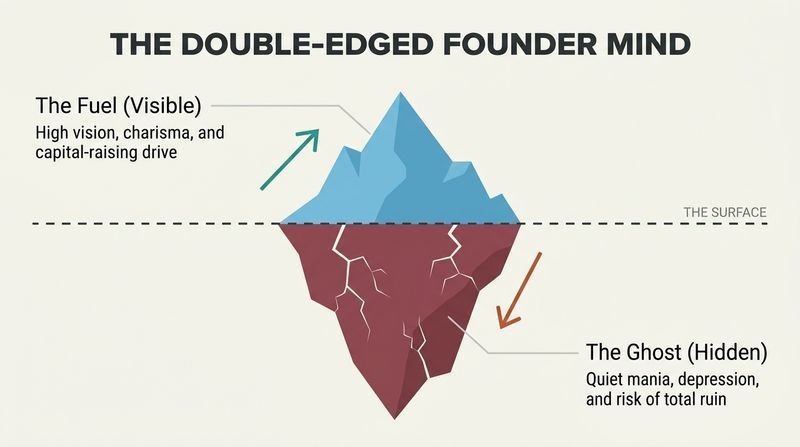
The Ghost is a double-edged gift. Andy Dunn built Bonobos, sold it to Walmart for $310 million, and spent sixteen years secretly living with bipolar disorder type I. He cites startling numbers: bipolar disorder affects roughly 3% of people but may be seven times more common among entrepreneurs, potentially meaning 20% of founders carry it. One NIH study found nearly half of entrepreneurs report mental health issues versus 32% of non-entrepreneurs.
Dunn calls the illness a Faustian bargain. The same elevated energy that raises capital, inspires teams, and generates vision can, unchecked, escalate into psychosis, hospitalization, and violence. The book reframes the airbrushed "living the dream" founder myth as often masking something darker underneath the swagger.
What's striking is Dunn's refusal to romanticize the link. Research by psychiatrist Kay Redfield Jamison (whom he quotes) documents elevated mood-disorder rates among creative and driven people, but correlation invites dangerous mythmaking. The "tortured genius" narrative can discourage treatment by implying medication kills the magic. Dunn threads this needle carefully: the traits overlap, but the illness is not the talent. Selection effects matter too. Hypomanic risk tolerance may push more affected people into founding companies, inflating the numbers without proving causation. The honest takeaway is that ambition and instability often travel together, and pretending otherwise costs lives.
Naming a shameful truth out loud takes years but seconds
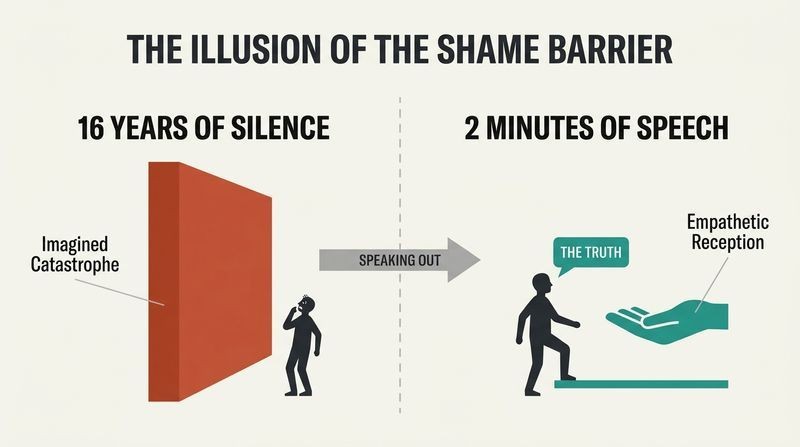
Stigma makes the unspeakable feel eternal. Dunn spent sixteen years unable to say "I have bipolar disorder," even to therapists. When he finally disclosed to his board after his arrest, the confession that had felt impossible in a thousand universes took under two minutes. An elder board member responded softly that he had suspected as much, and Joel Peterson said the condition was manageable and affirmed full confidence in him.
Dunn observes that decades of buried pain can surface in under a minute of actual speech. The barrier was never the words themselves. It was the imagined catastrophe of judgment, job loss, and social exile that never materialized when he finally spoke.
This mirrors exposure therapy's core finding: avoidance inflates fear far beyond reality. The dreaded outcome, once faced, usually shrinks. Brene Brown's shame research argues that secrecy is the oxygen shame breathes, and that disclosure to empathetic listeners deflates it. Dunn's experience is a case study, though a privileged one, as he acknowledges. His "exited startup" wealth insulated him from financial ruin, and his board already respected him. For someone junior, brown-skinned, or uninsured, the calculus differs sharply. The insight holds, but the safety of disclosure is unevenly distributed. Institutions, not just individuals, must lower the cost of speaking.
Mania and depression are opposite poles of the same escape
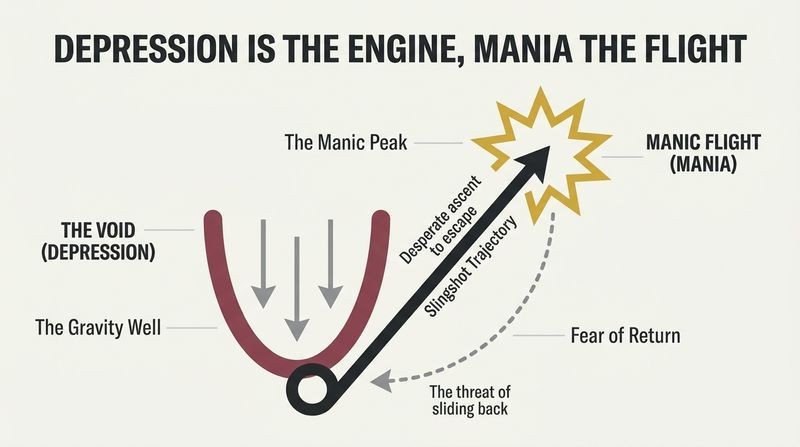
Depression is the engine, mania the flight. Dunn describes depression not as sadness but as acute worthlessness so total that suicide feels like a logical exit from pain rather than a desire to die. He compares it to hunger: nobody wants to be full, they want to end the hunger. His depressive weekends meant sleeping thirty-eight of forty-eight hours, eating cereal, dodging his sister's texts.
Mania, he argues, is the sprint away from that void. After clawing out of depression, he would cling to any spark of good mood and rocket upward, terrified of sliding back. His psychiatrist frames mania as possibly the most extreme form of depression, a manic flight from a state too grim to re-enter.
This reframing challenges the popular image of bipolar disorder as random mood swings within a single day. Dunn stresses the cycles last weeks or months. Clinically, this matters: rapid within-day shifts often point elsewhere. His hunger analogy is genuinely illuminating for understanding suicidality as pain-cessation rather than death-seeking, a distinction crisis counselors emphasize. The self-medicating pattern he describes, using caffeine and alcohol to flip depressive lows into functional highs, is textbook and dangerous, since substance use frequently triggers episodes. His candor here does real public-health work, demystifying an illness usually described only from the outside.
Attacking a rival is often shadowboxing your own hidden wound
The enemy you invent is you. For eighteen months Dunn waged war against his co-founder Brian Spaly, the fashionable, athletic, disciplined man who had actually invented Bonobos. Dunn collected a 360-degree review of Spaly, lobbied the board and investors, and eventually pushed him out, all while conducting no equivalent review of himself. Spaly left with grace, reading a poem to the company.
Only years later did Dunn see the projection. He borrows the Franciscan friar Richard Rohr's idea that we become a mirror image of whatever we fight too long. What Dunn hated in Spaly, the superiority and volatility, lived in himself. He fired Spaly for issues that went unexamined in his own conduct, then discovered the truly unpartnerable person was him.
Dunn's honesty about scapegoating is rare in founder memoirs, which usually cast co-founder splits as clean tales of misalignment. Psychodynamically, projection lets us externalize intolerable self-knowledge, and Dunn names it precisely. The business lesson compounds the psychological one: he sought advice that confirmed his narrative and ignored Andy Rachleff's correct diagnosis that operating expenses, not Spaly's inventory, were the problem. This is motivated reasoning, or confirmation bias, in a high-stakes setting. The uncomfortable implication for any leader is that intense certainty about a colleague's flaws should trigger self-scrutiny, not action. Conviction feels like clarity but often signals the opposite.
Your company's culture is locked in by your first ten hires
Values are descriptive, not aspirational. Marc Lore, the entrepreneur who sold Diapers.com and Jet to Amazon and Walmart, taught Dunn that culture is not what you wish it were. It is the traits your first ten employees actually share, set permanently in the company's DNA. You cannot change it later. You can only hire and fire to protect it.
Dunn went home, sorted his roughly thirty employees into best, middle, and worst, and asked what the cultural carriers had in common. Five words emerged in sixty seconds: self-awareness, empathy, positive energy, intellectual honesty, and judgment. Lore also taught a passion test: offer two packages, one high-cash-low-equity, one low-cash-high-equity. Candidates who grab the cash believe less in the mission.
Lore's claim that culture ossifies after the founding cohort echoes organizational research by Edgar Schein, who argued founders embed assumptions that become invisible and self-reproducing. The counterpoint is that culture can shift under acquisition, crisis, or deliberate re-founding, so "you can't change it" is more warning than law. The two-offer passion test is clever behavioral design, revealing preference through tradeoff rather than words, though it risks filtering out talented people who simply need cash, disproportionately those without family wealth. Bonobos's midwestern-heart-in-a-New-York-fashion-company identity shows how founder background seeds culture, for better and worse.
A demanding job can function as an antidepressant, not the cause
Blame the brain, not the calendar. For years Dunn blamed his depressions on Bonobos, on Spaly, on the cash crunch. Then in 2015 he engineered his own exit, handed the CEO role to a hire named Fran, and flew to Beijing for a six-week idyll with his girlfriend Manuela. Instead of bliss, he sank into the worst depression of his life, sleeping twenty hours a day, unable to walk to the bathroom, stuck for two hours on a single page of a novel.
The revelation: the grueling job had been keeping him tethered. Its relentless demands forced him out of bed, gave him purpose, and pulled him from the doldrums. Eighty-six days after leaving, he schemed to get his job back, then asked Fran to step aside.
This inverts the common wisdom that stressful work damages mental health. For some, structure and purpose are protective, a finding echoed in research on retirement depression and in Viktor Frankl's argument that meaning sustains us through suffering. But the insight is double-edged. Using overwork as mood regulation is unsustainable and can mask deterioration until collapse. Dunn's own manic episodes erupted precisely amid the intensity he credits with saving him. The healthier reading is that humans need engagement and rhythm, which a job can supply, but which should not be the sole scaffold holding a person upright. Redundancy in support systems matters.
Sleep loss is the fuse that detonates a manic episode
Guard sleep like your life depends on it. Dunn's episodes share a signature: he stops sleeping, and within days the guardrails of sanity collapse. Before his 2000 college break he stayed up for three nights, believing he no longer needed to sleep. In 2017, a single all-nighter after his wife's bridal shower and a Holocaust remembrance service triggered a psychotic break on a Manhattan sidewalk, where he flung his five-foot mother into an iron fence.
His psychiatrist explains a manic brain can run four or five nights before crashing, the mind disconnecting from the body. Recovery's first step is always forced sleep via medication. Dunn's family later built a daily sleep report, tracked by a Fitbit and shared with his wife, mother, sister, and doctor, as an early-warning system.
The sleep-mania link is one of psychiatry's most robust findings. Sleep deprivation reliably induces hypomania in bipolar patients, and chronotherapy and strict sleep hygiene are frontline interventions. Dunn's family's sleep report is essentially a homemade biomarker dashboard, anticipating the digital-phenotyping tools now emerging in psychiatry, where wearables flag mood episodes before symptoms surface. The bidirectional trap he names is crucial: sleeplessness both causes and signals mania, so it accelerates itself. For anyone, not just those with mood disorders, the lesson lands. Protecting sleep is not indulgence but infrastructure, and its erosion is often the first domino in a cascade.
Denying a diagnosis feels like self-preservation but invites catastrophe
"Differential diagnosis" became a life raft. When first diagnosed at twenty, Dunn was told that if he stayed episode-free for five years, it might have been a one-off psychotic event rather than bipolar disorder. That single word, differential (a diagnosis confirmed only by what the future reveals), gave his family a decade-long excuse for denial. He rejected the label, refused medication, and lectured an outpatient psychiatrist on why it did not apply to him.
Dunn explains why people abandon meds: early drugs like Depakote dulled his joie de vivre and creative spark, so he preferred rolling the dice as himself over being a stranger. Stigma compounds this. If the illness is shameful and unspeakable, why swallow a daily pill that internalizes that shame?
Dunn's account of non-adherence is more textured than the usual "patients are irrational" framing. He identifies real tradeoffs: identity loss, blunted affect, and social stigma, alongside family denial. Psychiatry increasingly recognizes that medication adherence hinges on preserving a patient's sense of self, not just symptom control. His grandmother's generation swept mental illness under the rug, quite literally institutionalizing his grandmother and moving to avoid embarrassment, showing how denial transmits across generations. The tragedy is structural: a hopeful-sounding clinical caveat, meant to avoid over-labeling, enabled sixteen years of avoidable suffering. It suggests clinicians should weigh how ambiguity lands on a frightened patient primed to flee.
Avoiding hard conversations is the founder flaw that compounds
Stonewalling sank his partnerships. Dunn identifies his three early flaws: trusting his intuition about people blindly, acting incongruently with his true feelings, and dodging the candid conversations that are the bedrock of a CEO's job. Raised by a father who never returned fire and crossed his arms in silence, Dunn assumed any back-and-forth argument was the beginning of the end. In reality, he learned, the absence of that friction is what ends things.
He invokes relationship researcher John Gottman's Four Horsemen of doomed partnerships: criticism, contempt, defensiveness, and stonewalling. Dunn checked all four with Spaly. He also cites the trap of hiring an accounting firm without checking references, letting them steal from him, then flinching from confrontation until debt collectors in leather jackets confronted him at a restaurant.
Gottman's Four Horsemen, drawn from decades of predicting divorce, transfer aptly to business partnerships, which Dunn argues are more fragile than friendships because they layer obligation onto a bond built on its absence. The deeper point is developmental: he traces conflict-avoidance to a father who modeled dominance through withdrawal. Family-systems theory holds that we import childhood templates into every relationship until we consciously rewrite them. Dunn's insight that arguing can be generative, not terminal, aligns with research showing high-functioning teams fight openly about ideas. The actionable core: a leader's discomfort with confrontation is not a personality quirk to tolerate but a liability that metastasizes into the whole organization.
Being accepted after your worst moment is what makes recovery possible
Unconditional love is the actual medicine. After Dunn struck his girlfriend Manuela and kicked her mother during his 2016 break, he expected abandonment. Instead, Manuela stayed, and her mother Leni put her hand on his and compared the illness to diabetes: manageable if he took his medication and saw his doctor. That acceptance, from a family that had no obligation to keep him, was the stuff of redemption.
Manuela later told him that the passion he poured into managing his illness was the only reason she stayed. Acceptance was not unconditional in the sense of requiring nothing. It was conditional on his relentless commitment to treatment: daily pills, therapy up to three times a week, sleep reports, and radical transparency with everyone he loved.
There is a productive tension here worth naming. Dunn frames Leni's forgiveness as grace, yet also stresses it came paired with an expectation of rigorous self-care. This is closer to what psychologists call "loving accountability" than to unconditional acceptance, and it may be the more useful model. Support without expectation can enable avoidance; expectation without support breeds shame. The combination, warmth plus a clear standard, mirrors what works in addiction recovery and trauma treatment. Dunn's diabetes analogy, borrowed from Leni, is powerful destigmatizing rhetoric, though it slightly understates bipolar disorder's episodic unpredictability. Still, reframing a brain illness as a chronic-but-treatable condition, rather than a moral failing, is exactly the cultural shift the book argues for.
Privilege determined whether a mental health crisis ended in treatment or tragedy
The same episode, different outcomes. Walking out of Bellevue psychiatric ward, Dunn was met by four NYPD officers and charged with misdemeanor and felony assault. Yet at nearly every turn, privilege caught him: a booking officer who joked to ease his panic, a defense attorney his sister summoned, a family that flew in and set up indefinite lodging, a forgiving girlfriend, an accepting board, and no press leak. His case was adjourned, then dismissed and sealed.
Dunn repeatedly notes what he saw others lack. In the holding cell, he was one of two non-Black men. He watched men casually accept being sent to Rikers. His psychiatrist names a recurring quartet, mental illness, addiction, homelessness, and criminal justice, as an interwoven cluster of pain that swallows those without his advantages.
Dunn's insistence on flagging his own privilege elevates the memoir beyond personal confession into social critique. The data support him: people of color in mental health crises face vastly higher rates of police violence, and the criminalization of untreated illness fills American jails, where the largest psychiatric facilities are now prisons like LA County and Rikers. His observation that a compassionate cop is itself a form of privilege is sharp. The book stops short of policy prescription, which some readers may want, but its power lies in the granular contrast between what saved Dunn and what routinely destroys the less fortunate facing identical symptoms.
Managing a chronic illness means never getting to let up, ever
Discharge is the beginning, not the end. Dunn's stability rests on a permanent, non-negotiable regimen he built with his psychiatrist, Dr. Z. The anchor is Lamictal, a mood stabilizer originally developed for epilepsy that is both anti-manic and anti-depressive, narrowing his mood range without flattening him into numbness the way earlier drugs did. Because he has bipolar type I, standard antidepressants risk catapulting him into mania, so any use is cautious and supervised.
His maintenance system includes therapy multiple times weekly, daily sleep tracking, and total transparency with family. He frames the goal not as eliminating all highs but permitting controlled hypomania and rare peak experiences while shaving off the dangerous extremes. On his wedding day and at his son's birth, both classic mania triggers, he pre-medicated and monitored to stay grounded.
The pharmacological nuance Dunn shares is genuinely educational for a general reader. Lamictal's off-label journey from anticonvulsant to bipolar staple reflects how much of psychiatry advances by serendipity, and the antidepressant caution reflects real risk of treatment-emergent mania. His reframing of the treatment target is the most sophisticated idea here: not a flat, safe monotone but a deliberately preserved band of human feeling, including some elevation. This challenges a purely risk-averse medical model and honors quality of life. The phrase that closes his story, that the day he stops fearing the illness is a bad day, captures a hard-won maturity: vigilance as love, not paranoia.
Analysis
Burn Rate is a hybrid the business-memoir genre rarely produces: a startup success story that refuses to be triumphant, deliberately inverting the founder-hagiography formula. Andy Dunn built Bonobos into a Walmart acquisition while secretly cycling through undiagnosed and untreated bipolar disorder for sixteen years. The book's structural cleverness lies in how it braids two narratives usually kept apart, the mechanics of venture-backed entrepreneurship (angel rounds, valuations, LTV-to-CAC, culture-building) and the phenomenology of severe mental illness, until the reader cannot tell where founder grandiosity ends and clinical mania begins. That ambiguity is the thesis. Dunn asks whether the hypomanic engine that raises capital and inspires teams is separable from the illness that produces psychosis, and he honestly answers that he cannot know, because he lived the two as one.
What distinguishes the book intellectually is its resistance to the seductive myth it could easily have peddled. The "mad genius entrepreneur" trope would have flattered Dunn and sold copies. He rejects it, insisting we neither celebrate nor stigmatize "crazy" but simply treat mental illness like the medical reality it is. This is the book's most durable contribution: a normalizing, destigmatizing frame delivered from inside the notoriously stability-obsessed business world, where, as Dunn notes, no one talks.
The memoir's limits are its strengths inverted. Dunn's relentless self-flagellation about privilege, while admirable and accurate, can feel like preemptive defense against criticism, and the book gestures at systemic reform (the criminalization of mental illness) without developing it. The prose occasionally strains for literary weight. But as a first-person clinical document, it is invaluable: few accounts render the interior logic of mania, why homeless people become angels, why a plane must crash, so vividly while remaining self-aware. Its ultimate argument, that recovery is not cure but permanent, loving vigilance, reframes chronic illness as a discipline of self-knowledge rather than a defeat.
Review Summary
Burn Rate receives high praise for its raw honesty about mental health and entrepreneurship. Readers appreciate Dunn's vulnerability in sharing his struggles with bipolar disorder while building Bonobos. The book is described as engaging, well-written, and a page-turner. Many find it refreshing to see a successful entrepreneur openly discuss mental illness. Some note the author's privilege but still commend his bravery. The book is seen as an important contribution to destigmatizing mental health in business and society.
People Also Read







Download PDF
Download EPUB
.epub digital book format is ideal for reading ebooks on phones, tablets, and e-readers.








































