

Key Takeaways
Your personality creates your reality, so a new self demands a new personality
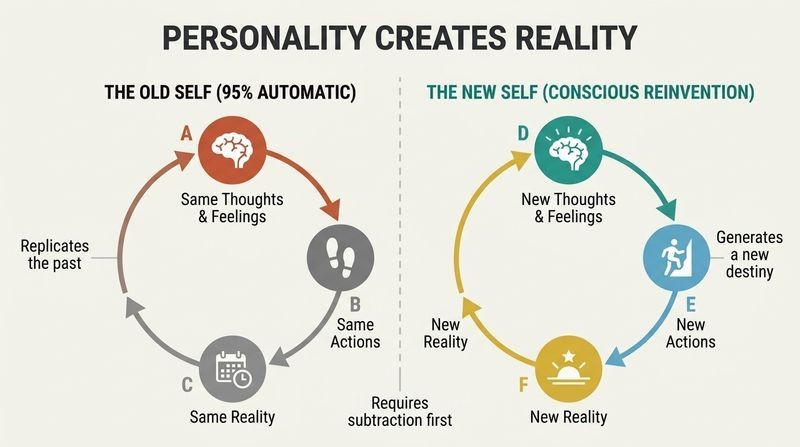
The title concept is the thesis. Dispenza argues that most of who you are (roughly 95% by your mid-30s) runs as automatic subconscious programs: memorized thoughts, reflexive behaviors, and habitual emotional reactions. Your personality (how you think, act, and feel) generates your personal reality. Wake up, repeat the same thoughts and feelings, and you reproduce the same life.
Change is subtraction before addition. To create a different destiny you must first stop being the old self, then reinvent a new one. He frames this as losing your mind and creating a new one. A chiropractor and neuroscience educator, Dispenza built the book after investigating people who reversed terminal conditions, concluding their recoveries were not spontaneous but driven by deliberate internal change.
What's striking is how Dispenza fuses behavioral neuroscience with a quasi-spiritual promise. The core claim, that we are creatures of automated habit, is well supported: psychologists like William James and modern researchers on habit loops agree most daily behavior is non-conscious. The bolder leap is that reprogramming personality reliably reshapes external circumstances. That crosses from psychology into metaphysics. Readers can extract enormous value from the conservative version (change your inner patterns, change your behavior, change outcomes) without accepting the strong version (thought directly organizes matter). The distinction matters, because conflating the two is where critics push back hardest.
Rehearse a new self mentally until your brain believes it already happened
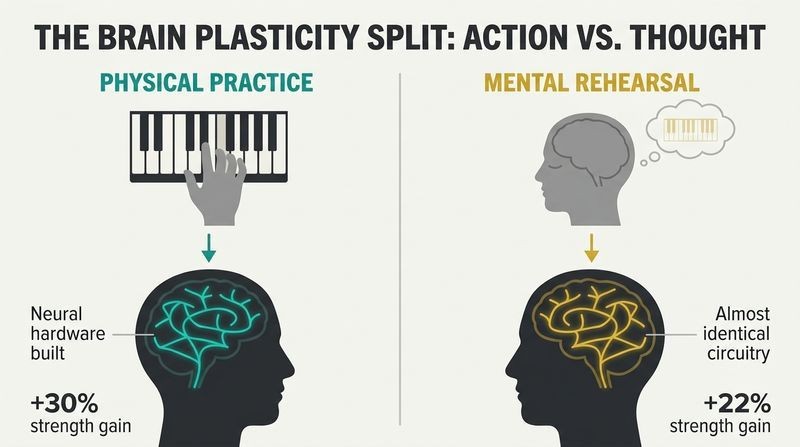
Thought can rewire the brain without action. Dispenza cites a study where people who only imagined piano exercises for two hours daily grew nearly the same neural circuits as those who physically played. A separate finger-strength study showed mental rehearsers gained about 22% strength versus 30% for physical exercisers, without lifting a finger. The lesson: when you focus intensely enough, the brain does not distinguish vivid imagination from real experience.
Install the hardware before the event. Through repeated mental rehearsal, you can build the neural circuitry of your future self ahead of time. He points to historical figures like Gandhi and Joan of Arc who held a future so vividly they lived as if it were already real, unswayed by contrary evidence in their environment.
The mental-rehearsal research is genuinely robust. Motor imagery is used in elite sports and stroke rehabilitation, and neuroimaging confirms overlapping activation between imagined and executed movement. Dispenza's extension from motor skills to wholesale personality change is more speculative, since rehearsing a bicep curl is far more constrained than rehearsing courage or abundance. Still, the underlying principle connects to cognitive behavioral therapy and to Bandura's self-efficacy work: expectation shapes behavior. The practical takeaway holds even for skeptics: visualization primes attention and reduces the friction of acting differently when the real moment arrives.
Your body memorizes emotions until feeling becomes a chemical addiction
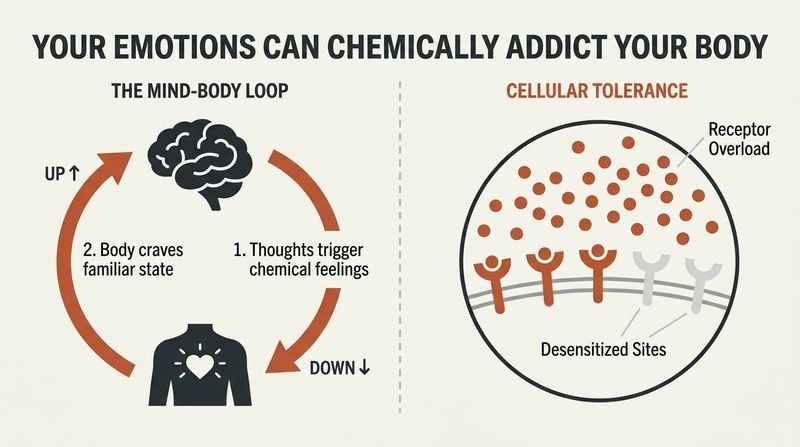
Emotions are the residue of past experience. Every thought triggers brain chemicals (neurotransmitters, neuropeptides, hormones) that make the body feel the way the mind thinks. Feel a certain way long enough and you start thinking to match the feeling, creating a self-reinforcing loop Dispenza calls a state of being. Replay an old grievance for years and your body relives it as if the event were happening now.
Cells get addicted like drug receptors. Bathe your cells in guilt or resentment chemicals daily and their receptor sites desensitize, demanding ever stronger hits, just like tolerance to a substance. This is why breaking an emotional pattern feels like withdrawal: the body physically craves its familiar chemical state and sends up sabotaging thoughts to restore it.
The receptor-desensitization framing draws on Candace Pert's molecules-of-emotion research, which established that peptides and their receptors form a body-wide communication network. Calling chronic emotions literal addictions is a useful metaphor and partially defensible physiologically, though the neuroscience of emotional habituation is messier than the tidy tolerance analogy suggests. The genuinely actionable insight is recognizing that the urge to return to a familiar bad mood is not moral weakness but predictable homeostatic resistance. Naming that resistance as a body-level craving, rather than a personal failing, is precisely what makes it easier to override.
Genes are not your destiny; your emotional state flips their switches
Epigenetics dismantles genetic fatalism. Dispenza cites that fewer than 5% of diseases stem from single-gene disorders, while roughly 95% relate to lifestyle, chronic stress, and environment. Epigenetics is the study of how signals from outside the cell activate or silence genes without altering the DNA code itself. Identical twins with the same genes often diverge dramatically in health because their internal environments differ.
Emotion sends chemical signals to your genes. He describes a Japanese study of type 2 diabetics: those who watched a comedy show for an hour saw post-meal blood sugar rise about half as much as those who sat through a dull lecture, and researchers found 23 gene expressions altered by laughter alone. Sustained stress chemicals, by contrast, wear genes down until they make inferior proteins.
Epigenetics is real and revolutionary, and Dispenza is right that it overturned crude genetic determinism. The nuance is that most well-documented epigenetic effects involve diet, toxins, and developmental exposures more than momentary emotional states. The single laughter study is intriguing but small, and Dispenza leans on it heavily. The steelman: the hypothalamic-pituitary-adrenal axis demonstrably links psychological stress to cortisol, inflammation, and downstream gene expression, so the causal chain from chronic emotion to cellular wear is plausible. The overreach is implying you can deliberately author specific genetic outcomes on demand. Direction of effect: sound. Magnitude and controllability: oversold.
To become new, escape your environment, your body, and time
The Big Three keep you looping. Dispenza names environment, body, and time as the three anchors that hold you in your familiar self. Your environment (people, places, possessions) fires the same brain circuits daily, prompting you to think equal to your surroundings. Your body runs memorized emotional programs. And you live either replaying the past or dreading the future, rarely present.
Freedom requires transcending all three. In survival mode, stress hormones force obsessive focus on the Big Three, making you materialistic and reactive. To create genuine change you must become, in his phrasing, no body, no thing, no time: forgetting the self, the surroundings, and the clock long enough to enter a state of pure possibility. Only by transcending the Big Three, he argues, can you gain dominion over them.
The Big Three is a memorable organizing device, and the underlying claim connects to mindfulness research: present-moment awareness interrupts the default-mode network's habitual self-referential chatter. The idea that environmental cues automatically trigger old behavior echoes Wendy Wood's context-dependent habit research, which shows changing your surroundings is often more effective than willpower. Where Dispenza goes further is treating time-transcendence as a gateway to a literal field of infinite potential. Stripped of metaphysics, the advice is sturdy and practical: novel change is nearly impossible inside the same room, routine, and mental time-loop that manufactured the old you.
Stop living in survival mode; chronic stress is a self-inflicted emergency
Humans uniquely keep the alarm on. A deer flees a predator, then calmly grazes minutes later. Humans, by contrast, can trigger the fight-or-flight response by thought alone, replaying old threats or rehearsing future ones. No organism is built to run its emergency system continuously, so sustained stress starves the immune, digestive, and repair systems of energy, setting the stage for disease.
Survival makes you selfish and materialistic. Stress chemicals force attention onto the body, environment, and time, shrinking identity down to the physical. Dispenza tells of Bill, a roofer whose 30 years of memorized resentment coincided with recurring melanoma. After two weeks in Baja unmemorizing that emotion and rehearsing a new self, his tumor reportedly fell off and he became cancer-free.
The stress physiology here is textbook and credible, drawing directly on Robert Sapolsky's work on why zebras do not get ulcers: the chronic activation of an acute-threat system is genuinely corrosive. Bill's cancer-reversal anecdote is where rigor collapses. A single uncontrolled testimonial cannot establish that emotional change cured melanoma, and presenting it as evidence risks encouraging people to substitute meditation for treatment. The responsible reading separates the strong, well-supported claim (chronic stress harms health and reducing it aids healing) from the anecdotal leap (mindset alone eliminates tumors). The former can change your life safely; the latter demands far more caution.
Feel grateful before the outcome arrives, not after
Gratitude is normally backward-looking. We reserve thankfulness for what already exists: family, home, a job. That is cause-and-effect living, waiting for the external world to grant permission to feel good. Dispenza inverts it: generate the elevated emotion of a desired future now, so vividly your body believes the event has already occurred.
Coherence, not wishing, moves the needle. He cites a HeartMath experiment where trained participants held vials of DNA. Positive emotion alone did nothing; clear intention alone did nothing; only when heightened emotion and focused intention combined did the DNA measurably change shape, in some cases by up to 25%. The principle: thoughts are the brain's language, feelings the body's, and the two must broadcast the same signal. Gratitude, he says, is the ultimate state of receivership because it signals completion.
The gratitude-first prescription overlaps meaningfully with well-validated positive psychology: gratitude practices reliably boost wellbeing and, plausibly, the persistence and openness that help goals materialize. Framing it as pre-experiencing the emotion resembles what athletes and performers call embodied visualization. The HeartMath DNA study, however, is not widely replicated and appears in institute publications rather than mainstream peer-reviewed venues, so the 25% figure should be held loosely. The transferable wisdom, independent of the physics: aligning what you think with what you feel reduces self-sabotage. Wanting wealth while feeling poor sends a divided signal to your own behavior, which is where most goals quietly die.
Close the gap between who you appear to be and who you truly are
Two selves, one exhausting performance. Dispenza describes a personal turning point: outwardly a successful lecturer from the film What the BLEEP Do We Know!?, inwardly numb and empty whenever the applause stopped. He pictured two hands separated by a gap: the top hand is the image you project, the bottom hand is how you actually feel when nobody is watching. Layers of memorized emotion (shame, fear, unworthiness) fill that gap.
The wider the gap, the deeper the addiction. Maintaining the facade drains enormous energy, and we distract ourselves with possessions, achievements, and stimulation to keep buried feelings buried. Escalating addictions (shopping, gambling, alcohol) are attempts to change the inside from the outside, which only widens the gap. Transparency, when how you appear equals who you are, releases that trapped energy as joy.
This is the book's most psychologically resonant and least controversial section. The appearance-versus-reality gap maps cleanly onto Jung's persona-versus-shadow, Winnicott's true-self-versus-false-self, and modern research on the health costs of emotional suppression and inauthenticity. The insight that escalating consumption is a failed attempt to regulate internal states from outside is echoed by addiction researchers like Gabor Mate. Dispenza's contribution is framing authenticity not as a moral virtue but as an energy-conservation strategy: pretending is metabolically expensive. His own confessional example lends credibility precisely because it is specific and unflattering, avoiding the guru's temptation to appear already enlightened.
Meditate to slip past the analytical mind into the subconscious
The 5% cannot outvote the 95%. Positive thinking fails because the conscious mind (about 5%) fights the subconscious body-mind (about 95%) running old programs. Between them sits the analytical mind, a barrier that forms around ages 6 to 12. Meditation's real purpose, Dispenza argues, is to quiet that analytical gatekeeper and enter the subconscious operating system where the programs actually live.
Brain waves are the doorway. Waking analysis happens in fast Beta waves; chronic stress produces volatile high-range Beta. By closing the eyes, slowing the breath, and shifting attention, you drop into slower, more coherent Alpha and Theta states, the programmable realm. He cites Wisconsin studies of Buddhist monks who sustained extraordinarily coherent Gamma-wave patterns even after leaving meditation and walking through a chaotic world.
The brain-wave taxonomy is real, though Dispenza's tidy developmental story (Delta to Theta to Alpha to Beta as children mature) simplifies a noisier picture. The core mechanism, that meditative states relax critical-analytical processing and increase suggestibility, is consistent with hypnosis research and with studies of reduced default-mode activity in experienced meditators. The Wisconsin monk studies (Davidson and Lutz) are legitimate and genuinely showed remarkable gamma synchrony. The reasonable takeaway: sustained meditation demonstrably reshapes baseline brain function and emotional reactivity. The looser claim is that any beginner can quickly rewrite deep personality programs; the monks studied had logged tens of thousands of hours.
Change in joy and inspiration rather than waiting for crisis to force you
Most people only change when cornered. We wait for diagnosis, divorce, loss, or bankruptcy before examining how we live. Dispenza's provocation: why wait for pain when you can evolve from inspiration? Change entails discomfort either way (a break from routine, a period of not knowing), but you can choose the trigger.
Feedback proves the process works. He offers a seven-step meditative sequence spread over four weeks: induction, recognizing the emotion to unmemorize, admitting and declaring it, surrendering it to a greater intelligence, observing and reminding yourself who you no longer want to be, redirecting (saying Change out loud when old patterns surface), and finally creating and rehearsing the new self. Success shows up as unpredictable synchronicities. He tells of Pamela, who released years of victimhood and days later received about $22,000 from an online promotion and long-overdue child support.
The change-in-joy-not-pain reframe is the book's most humane message, and it inverts the common self-help trope that suffering is the only teacher. Behavioral science supports it: fear-driven change tends to fade once the threat passes, while intrinsically motivated change persists. The seven-step protocol is essentially structured self-inquiry plus visualization plus behavioral interruption (the Change cue functions like a pattern-interrupt used in habit-reversal therapy). Pamela's windfall, like Bill's tumor, is presented as causal evidence when it is testimonial and vulnerable to confirmation bias and survivorship bias. The method's genuine engine, deliberate daily rehearsal of a chosen emotional and behavioral state, works regardless of whether the universe delivers surprise checks.
Analysis
Breaking the Habit of Being Yourself (2012) is a framework-driven self-help book wearing a lab coat. Dispenza, a chiropractor and neuroscience educator popularized by What the BLEEP Do We Know!?, assembles four disciplines (neuroplasticity, epigenetics, psychoneuroimmunology, and quantum physics) into a single argument: because personality is mostly automated subconscious programming, and because thought and emotion physically shape the brain, body, and gene expression, you can deliberately author a new self through structured meditation. Parts I and II build the theory; Part III delivers a four-week, seven-step practice.
The book's real strength lies in its middle layer. The neuroscience of habit, the physiology of chronic stress, the emotion-as-chemistry loop, epigenetic non-determinism, and the appearance-versus-reality gap are all well-grounded and genuinely actionable. Here Dispenza is synthesizing legitimate science (Hebbian learning, Sapolsky's stress work, Pert's neuropeptides, Davidson's meditation studies) into an unusually practical program. His humane reframe, that you can change from inspiration rather than waiting for catastrophe, is both original in emphasis and behaviorally sound.
The weakness is the quantum scaffolding and the causal claims resting on single anecdotes. The observer effect from quantum mechanics does not license the conclusion that human consciousness organizes macroscopic reality; that is a category error most physicists reject. Testimonials of vanished tumors and windfall checks are presented as evidence when they are, at best, hypothesis-generating stories vulnerable to survivorship and confirmation bias. A reader could be harmed by inferring that mindset substitutes for medical treatment.
The pragmatic move is to read Dispenza on two tracks. Track one, the conservative and well-supported version: interrupt automated emotional patterns, rehearse desired states, reduce chronic stress, align thought with feeling, and act authentically. This alone can meaningfully improve a life. Track two, the metaphysical promise that intention collapses reality to order, is unfalsifiable and best held as inspiration rather than mechanism. The value survives even when the physics does not.
Review Summary
Breaking the Habit of Being Yourself receives mixed reviews. Supporters praise its insights on neuroplasticity, meditation, and personal transformation, finding it life-changing. Critics argue it misuses quantum physics concepts and promotes pseudoscience. Some appreciate the practical meditation techniques but dislike the spiritual aspects. Many find the book too long and repetitive. Readers are divided on Dispenza's credibility, with some viewing him as insightful and others as a charlatan. Overall, the book's ideas resonate with those open to alternative approaches to personal growth, while skeptics remain unconvinced.
People Also Read


Glossary
Breaking the Habit of Being Yourself
Dismantling automatic personality programsDispenza's central concept: since your personality is a set of memorized thoughts, behaviors, and emotional reactions running mostly on subconscious autopilot, becoming a new person requires consciously stopping the old automated self before building a new one. Summarized as losing your mind and creating a new one.
The Big Three
Environment, body, and timeThe three anchors that keep people locked in their familiar identity. The environment triggers habitual thoughts, the body runs memorized emotions, and obsessing over past or future prevents presence. Dispenza argues you must transcend all three (become no body, no thing, no time) to change, and thereby gain dominion over them.
State of being
Aligned thought-feeling loopThe condition created when mind and body work as one, when how you think and how you feel reinforce each other in a continuous loop. A memorized state of being becomes an identity (I am angry, I am unworthy). Dispenza claims the quantum field responds to who you are being, not merely what you want.
Survival vs. Creation
Stress mode versus creative modeDispenza's contrast between two modes of living. Survival means stress-driven, materialistic, ego-focused living dominated by fight-or-flight chemicals and obsession with the Big Three. Creation means transcending self, environment, and time to enter pure consciousness, associated with elevated emotions like joy, gratitude, and love and with healing and change.
The gap
Distance between appearance and authenticityThe space between how you appear to others (the projected image or facade) and who you really are (how you feel when unobserved). Layers of memorized emotion like shame and fear fill it. The wider the gap, the greater the emotional addiction. Closing it produces transparency and releases trapped energy as joy.
Unmemorizing emotion
Erasing a conditioned emotional patternThe process of no longer thinking the thoughts that produce a habitual feeling, and vice versa, until the body stops craving that emotional-chemical state. Dispenza argues a memory stripped of its emotional charge becomes wisdom, freeing you to act independent of past conditioning.
Heart coherence / HeartMath DNA study
Emotion plus intention altering DNAResearch cited from the HeartMath Institute in which trained participants held DNA samples. Positive emotion alone or focused intention alone produced no change, but combining elevated emotion with clear intention measurably altered the DNA's shape, reportedly up to 25%. Dispenza uses it to argue thought and feeling must be coherent to affect matter.
FAQ
What's Breaking the Habit of Being Yourself about?
- Transformative Self-Change: The book by Joe Dispenza focuses on breaking free from habitual thinking, feeling, and behaving to create a new self. It integrates neuroscience, quantum physics, and meditation to show how thoughts shape reality.
- Mind-Body Connection: Dispenza emphasizes how emotional states influence physical health and well-being, offering techniques to rewire the brain and change one's state of being.
- Practical Application: A structured meditation process is provided to help readers apply these concepts for personal transformation and creating a new reality.
Why should I read Breaking the Habit of Being Yourself?
- Empowerment Through Knowledge: The book provides scientific evidence that thoughts can create reality, encouraging readers to take control of their lives by changing internal states.
- Accessible Science: Complex scientific concepts are presented in an easy-to-understand manner, blending science and spirituality for a holistic approach to self-improvement.
- Proven Techniques: Practical exercises and meditative practices are included, allowing readers to implement changes immediately and enhance emotional and spiritual well-being.
What are the key takeaways of Breaking the Habit of Being Yourself?
- Thoughts Create Reality: Our thoughts profoundly affect our lives, shaping experiences and realities. Dispenza states, “What you think today determines how you live tomorrow.”
- Neuroplasticity and Change: The brain's ability to change and adapt allows individuals to rewire thinking patterns and emotional responses, enabling life changes through thought changes.
- Meditation as a Tool: Meditation is crucial for personal transformation, with step-by-step techniques provided to align the mind and body for effective change.
How does Breaking the Habit of Being Yourself define meditation?
- Meditation as a Process: Dispenza explains meditation as a process to access the subconscious mind and create lasting change, emphasizing getting beyond the analytical mind.
- Creating New Neural Pathways: Meditation helps rewire the brain to support new ways of thinking and being, installing new neural circuits for desired changes.
- Emotional Conditioning: It conditions the body to new emotional states, enabling individuals to feel as if they have already experienced desired outcomes, key to manifesting change.
What is the quantum model of reality discussed in Breaking the Habit of Being Yourself?
- Interconnectedness of Mind and Matter: The quantum model suggests mind and matter are interconnected, with the observer effect indicating that attention directs energy.
- Potential Realities: All potential realities exist simultaneously in the quantum field, and focusing thoughts and emotions can collapse these potentials into physical reality.
- Energy and Frequency: Everything is energy, and thoughts and feelings emit frequencies that influence experiences. Higher-frequency emotions like love and gratitude lead to positive outcomes.
What are the three brains mentioned in Breaking the Habit of Being Yourself?
- Neocortex (Thinking Brain): Responsible for conscious thought, reasoning, and decision-making, allowing individuals to think about desired changes.
- Limbic Brain (Emotional Brain): Governs emotions, creating and maintaining chemical states associated with feelings, encoding experiences into memories.
- Cerebellum (Subconscious Mind): Stores habitual thoughts, attitudes, and behaviors, crucial for embodying new states of being once learned.
What is the significance of neuroplasticity in Breaking the Habit of Being Yourself?
- Ability to Change: Neuroplasticity refers to the brain's ability to reorganize by forming new neural connections, emphasizing the importance of engaging in new thoughts and behaviors.
- Rewiring the Brain: By consciously changing thoughts and feelings, individuals can rewire their brains to support new habits and emotional states, essential for breaking old habits.
- Pruning and Sprouting: Concepts of pruning (removing old connections) and sprouting (creating new ones) are vital for personal transformation, developing a new personality and reality.
How can I apply the concepts from Breaking the Habit of Being Yourself in my life?
- Practice Meditation: Incorporate meditative techniques from the book into your daily routine to access the subconscious mind and begin the process of change.
- Focus on Thoughts and Emotions: Be mindful of thoughts and feelings, consciously choosing positive thoughts and elevated emotions to create a new state of being.
- Set Intentions: Clearly define desired changes and visualize embodying them, using the quantum model principles to focus energy on potential realities.
What is the meditation process outlined in Breaking the Habit of Being Yourself?
- Induction: Enter a relaxed state to access the subconscious mind, using techniques like Body-Part Induction or Water-Rising Induction to shift brain waves.
- Recognizing and Admitting: Identify and acknowledge emotional states and accompanying thoughts, crucial for understanding the old self needing change.
- Surrendering and Creating: Surrender limitations to a greater intelligence and create a new self through mental rehearsal, visualizing the desired future and embodying associated emotions.
What does Dr. Dispenza mean by "emotional addiction"?
- Conditioned Responses: Emotional addiction refers to habitual reliance on certain emotions dictating behavior and thought patterns, often stemming from past experiences.
- Impact on Identity: These emotional states can define identity, making change difficult. Recognizing and unmemorizing these emotions is essential for transformation.
- Breaking the Cycle: Steps are outlined to break free from emotional addictions, allowing individuals to create a new self through conscious awareness and meditation.
What are the benefits of meditation as described in Breaking the Habit of Being Yourself?
- Accessing the Subconscious: Meditation bypasses the analytical mind to access the subconscious, where deep-seated beliefs and emotions reside, crucial for lasting changes.
- Rewiring the Brain: Regular meditation leads to changes in brain structure and function, promoting neuroplasticity and allowing individuals to change minds and behaviors.
- Emotional Regulation: Meditation increases awareness of emotional states, improving management of feelings, reducing stress, and enhancing overall well-being.
What are the best quotes from Breaking the Habit of Being Yourself and what do they mean?
- “What you think today determines how you live tomorrow.”: Emphasizes the book's core message that thoughts shape reality, highlighting the importance of intentional thinking.
- “The moment you change your mind, you change your life.”: Highlights the transformative power of mindset, suggesting significant changes in experiences and outcomes through altered thoughts.
- “You are more than your past.”: Encourages breaking free from past limitations, reinforcing the idea that change is possible and individuals can redefine themselves.
About the Author
Other books by Joe Dispenza

Download PDF
Download EPUB
.epub digital book format is ideal for reading ebooks on phones, tablets, and e-readers.








































