

Key Takeaways
Broke is normal in America, and the system engineered it that way
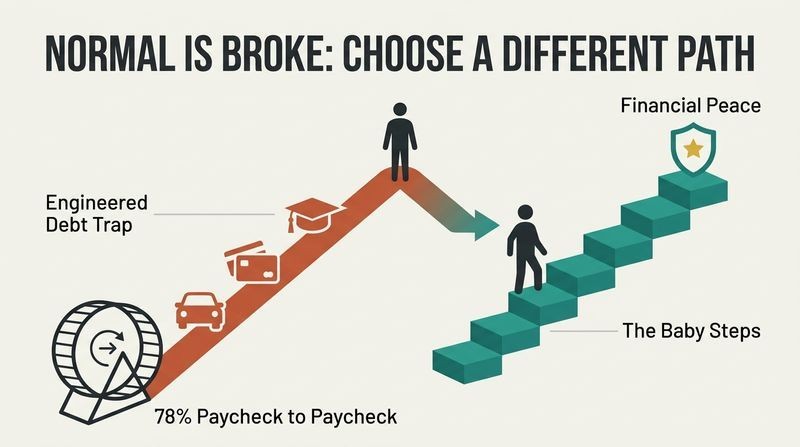
The house always wins. Roughly 78% of American workers live paycheck to paycheck, including a startling share of six-figure earners. Kamel's argument is that this isn't an accident or a moral failing. It's the predictable output of a machine built from credit scores, credit cards, student loans, car financing, and relentless marketing, all designed to keep you borrowing.
Your fault or not, it's your job to fix. Kamel financed college with Sallie Mae's "monopoly money," woke up to $40,000 in debt, then clawed to a $1 million net worth in a decade using Dave Ramsey's Baby Steps (seven ordered money milestones). His thesis: normal is broke, so refuse to be normal. The gap between financial stress and peace is littered with traps you can learn to dodge.
The framing echoes behavioral economics: individuals operate inside "choice architectures" that nudge them toward debt, much as Thaler and Sunstein described. Kamel's "not your fault, but your responsibility" splits a genuine tension. Structural critics argue wages stagnated while housing, tuition, and healthcare exploded, so willpower alone cannot close the gap. Kamel largely concedes the structure is rigged, then pivots to agency. That pivot is empowering but risks underplaying that a minimum-wage single parent faces different math than a debt-financed college grad. The strongest read: systems shape defaults, but reclaiming attention over your money is the one lever nearly everyone can still pull.
Your credit score measures debt loyalty, not wealth or success
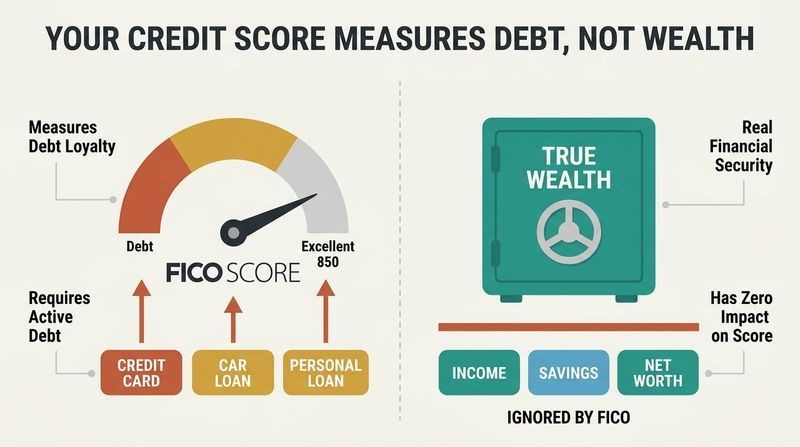
It's an "I love debt" score. A FICO score (300 to 850) rewards how faithfully you borrow and repay, weighting payment history, amounts owed, length of credit history, new credit, and credit mix. Every ingredient involves debt. Pay off a car or student loan and your score drops. It ignores your income, net worth, and savings entirely.
No score beats a bad score. Kamel distinguishes credit invisibility (no score because you're debt-free) from a low score (missed payments). About 11% of Americans, some 32 million people, are credit invisible and function fine. He renting apartments, cars, and buying a home via manual underwriting (a human reviewing rent, utility, and income history instead of a computer pulling a score). Ditch the game, and your greatest wealth tool, your income, stays yours.
Kamel's logic is internally airtight and refreshingly contrarian, but the real world imposes friction he underweights. Credit scores quietly price auto and home insurance in most states, gate some rentals, and affect deposit sizes, as his own recorded landlord calls reveal (higher deposits for no tradelines). Manual underwriting exists but has narrowed; fewer lenders offer it, and the process is slower. The deeper insight holds: conflating creditworthiness with financial health is a category error the lending industry profits from. Still, for someone mid-journey with existing debt, torching the score prematurely can raise costs before the payoff arrives. Timing matters.
Credit cards make you spend more even when you pay in full
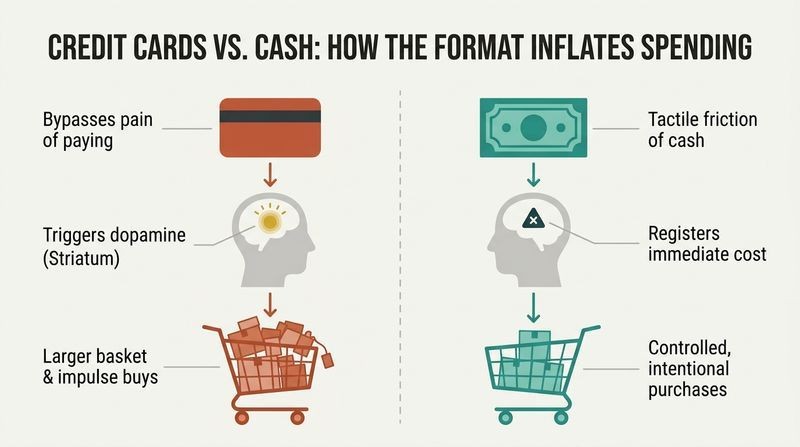
Convenience is the whole con. An MIT study using brain imaging found that paying with plastic activates the striatum, the brain's reward center tied to dopamine, and doesn't just dull the pain of spending, it actively accelerates it. Card users buy bigger baskets and make more impulsive purchases. So the "I pay it off every month" defense misses the point: the format itself inflates spending.
The poor subsidize the rewards. A 2023 Federal Reserve study estimated $15 billion moves annually from less-educated, poorer, higher-minority areas to wealthy cardholders through interest and fees funding those cash-back perks. Americans carry over $1 trillion in card debt at roughly 22% interest. Kamel's fix: cut the cards, use debit and cash, which carry nearly identical fraud protections under the Electronic Fund Transfer Act.
The neuroscience is the strongest plank here. "Coupling" research by Prelec and Simester showed people will pay dramatically more for the same item when using cards versus cash, and mobile wallets likely widen the gap by removing even the swipe. The regressive-rewards finding is genuinely underdiscussed: interchange fees raise prices for everyone, including cash payers, while rewards flow upward. The nuance Kamel underplays is that a disciplined minority genuinely profits, and the float and purchase protections have real value. But his behavioral point is the trump card: the system is engineered by people who study your psychology full-time, and most players quietly lose.
There is no such thing as "good debt," especially student loans
The American Dream sold as a nightmare. Americans hold $1.6 trillion in student loans across 43 million borrowers, averaging about $40,000 each. At 5.5% interest over 20 years, a $40,000 loan can cost $94,000 in total payments. Tuition rose roughly 1,400% since 1977, over three times inflation, because guaranteed federal loans let schools charge whatever they wanted.
Reframe the word "investment." Calling loans an investment hides the risk: only about 60% of enrollees graduate within six years, and many degrees don't pay. Kamel urges going to college debt-free via community college first (up to 93% cheaper), in-state schools, scholarships, and working 15-20 hours weekly. Don't bank on forgiveness; the Public Service Loan Forgiveness program historically approved under 1% of applicants. Attack existing loans with focused repayment.
Kamel's cost critique is well-documented; the Bennett Hypothesis (subsidized loans inflate tuition) has real empirical support. His skepticism of forgiveness proved prescient given the 2023 Supreme Court ruling. Where economists push back: the college wage premium remains large and durable. Lifetime earnings for degree holders still substantially exceed non-graduates, so blanket loan-aversion could cost a future engineer or nurse more than it saves. The sharper framing is his friend Ken Coleman's filter: is a degree the only way and the best way to your goal? That converts a tribal culture-war question into a rational, field-specific calculation, which is exactly where this decision belongs.
New cars are wealth-destroying machines; buy used with cash
Depreciation is the silent thief. A new car loses 9-11% of its value driving off the lot and roughly 60% within five years. So you make payments for 68 months on an asset plummeting in value. Kamel's rule: total value of everything with a motor should stay under half your annual income, and never buy new unless you're already a millionaire.
Leasing is the worst of all. A lease bakes depreciation into your payments, hides the interest rate (the FTC doesn't classify leases as debt requiring disclosure), and hands the car back at the end. Kamel's own study of over 10,000 millionaires found the average one drives a four-year-old car and 80% pay cash. Invest a $700 monthly payment from age 22 to 62 at historical market returns and it could exceed several million dollars.
The opportunity-cost math is the emotional core, and it's directionally sound, though the multimillion-dollar projection assumes uninterrupted 11% returns for 40 years, which is optimistic versus the more commonly cited 7% real return. Dealers' shift from selling cars to selling financing is a documented reality; the "what monthly payment are you looking for?" opener is a known anchoring tactic. One nuance: in the post-2020 market, some used cars appreciated or held value abnormally, temporarily scrambling the depreciation gospel. And a reliable newer used car can beat an old money pit on repair risk. Kamel's principle survives: pay cash, let someone else eat the first cliff of depreciation.
Only one mortgage is worth having: 15-year fixed under 25% of pay
Most mortgage products exist to trap you. Kamel dismantles ARMs, FHA, interest-only loans, subprime, reverse mortgages, cash-out refinances, and HELOCs, most of which get people into homes before they're ready or turn home equity back into debt. The word mortgage literally derives from Old French for "death pledge."
Buy a home the right way. Get completely out of consumer debt, build a full emergency fund, then choose a 15-year fixed-rate conventional loan with a payment no more than 25% of take-home pay, ideally 20% down to skip private mortgage insurance. Kamel's own numbers: a 15-year loan cost him about $9,000 in interest paid off early, versus $49,000 on schedule or $106,000 on a 30-year. His millionaire study found the average member pays off their house in about a decade.
The interest-savings argument is arithmetically real, yet the 15-year versus 30-year debate is livelier among economists than Kamel lets on. A 30-year loan's lower payment plus disciplined investing of the difference can, in bull markets, outperform aggressive payoff, and it preserves liquidity during job loss. Kamel's rebuttal is behavioral, not mathematical: guaranteed debt freedom beats a probabilistic edge most people never actually capture because they spend the difference. His warning on cash-out refinancing and HELOCs is especially timely; treating a home as an ATM helped detonate 2008. The "death pledge" etymology is a nice mnemonic for a genuinely serious, decades-long commitment.
Build wealth like a crockpot, not a microwave: slow and boring wins
Get-rich-quick is a wealth killer. Kamel torpedoes the flashy options: crypto (speculation, not investing), NFTs, day trading (one study found 97% of persistent day traders lost money), whole-life insurance, annuities, gold, and leveraged real estate. Their common root traits are greed, fear, and pride, countered by generosity, contentment, and humility.
The unsexy formula actually works. Once debt-free with a full emergency fund, invest 15% of income into retirement accounts using "Match beats Roth beats Traditional": grab the employer match first, then Roth (tax-free growth), then traditional. Put it in growth-stock mutual funds spread across four types. Kamel's study found 80% of millionaires built wealth through a workplace 401(k), not exotic bets. Thanks to compound growth, $10,000 invested at 22 could become roughly $450,000 by 62 without adding another dime.
This is Bogleheads philosophy in a hoodie: low-turnover, diversified, long-horizon investing beats stock-picking for nearly everyone, a claim backed by decades of SPIVA data showing most active managers trail their index. One friction point: Kamel favors actively managed growth-stock mutual funds while insisting they beat index funds, a position much research contradicts on an after-fee basis. His own "average investor" humility slightly undercuts the fund-selection confidence. The behavioral packaging, though, is the gold: framing greed, fear, and pride as the real portfolio risks aligns with Kahneman's work on how emotion, not ignorance, drives most investing mistakes. Patience is the edge no algorithm can sell you.
Interrogate every purchase with five questions before you buy
Marketing knows you better than you know you. The average person sees thousands of ads daily, and companies deploy personal selling, product placement, brand association, sales, frictionless payments, and financing (buy now, pay later) to separate you from your money. Apple Pay's original tagline literally celebrated making spending effortless.
Become a SMART spender. Kamel's defensive filter is an acronym you run before buying: Self-awareness (will this add real value?), Motive (right reason, or am I sad, pressured, or showing off?), Affordability (in my budget, in cash?), Research (best option and price?), and Timing (is now right, or is this urgency manufactured?). Pair it with the 48-hour rule: wait two days on big purchases and the dopamine rush usually fades. Answer yes to all five, or it's a "not now."
The SMART filter is essentially structured metacognition, inserting deliberation (Kahneman's System 2) between impulse and checkout. The "if nobody saw this purchase, would I still want it?" question, borrowed from Rachel Cruze, is a sharp probe for status-driven consumption, echoing Veblen's theory of conspicuous consumption. The 48-hour rule exploits a real finding: anticipatory desire spikes and decays, so time is a free debiasing tool. The honest tension is that no framework fully neutralizes industries running thousands of A/B experiments on you. The realistic win isn't immunity but friction. Making spending slightly less convenient measurably reduces it, which is why deleting saved card info is such underrated advice.
A zero-based budget gives you permission to spend, not restrictions
Give every dollar a job. Six in ten Americans skip budgeting, imagining it as a cage. Kamel reframes it: income minus expenses equals zero, meaning every dollar is pre-assigned before the month begins to giving, saving, bills, and fun. You're not aiming for zero in your account; you're leaving no dollar unemployed. The recommended anchors: give 10%, keep housing under 25%, invest 15% during the wealth-building steps.
It takes three months to click. Kamel calls his pre-budget self a "ditty bopper," strolling through life financially oblivious until a crisis. The fix is attention: list income, list expenses, budget to zero, then track spending every day or two so nothing hides. His mantra, borrowed from John Maxwell, is telling your money where to go instead of wondering where it went.
Zero-based budgeting isn't new (corporations use it, and Kamel adapts YNAB-style logic), but the reframe from restriction to permission is psychologically astute. Self-determination theory suggests autonomy fuels motivation, and a budget you author yourself feels like freedom rather than a diet imposed from outside. The three-month learning curve is honest and important; most budget abandonment happens in weeks one and two when estimates are wrong. One limitation: zero-based budgeting demands consistent cognitive effort, which decision-fatigue research shows is a depletable resource. Automation and habit formation, which Kamel recommends, are what convert a taxing monthly chore into a five-minute reflex. The tracking step, not the planning, is where most people fail.
Pay debts smallest to largest; momentum beats math
The Debt Snowball runs on psychology. List debts smallest balance to largest, ignoring interest rates. Pay minimums on all but the smallest, attack that one with every spare dollar, then roll its freed-up payment onto the next. Each payoff snowballs. Mathematically, paying highest interest first (the "Debt Avalanche") saves a bit more, but Kamel argues debt is 80% behavior and 20% math.
Quick wins keep you in the game. Early victories deliver the feedback humans need to sustain hard change, a claim backed by a Harvard Business Review study finding people are more motivated when they start with the smallest debt. Kamel walks through a $30,000 example cleared in under 22 months. Start only after a $1,000 starter emergency fund, exclude the mortgage, and pause during storms like job loss or a new baby.
The Snowball-versus-Avalanche debate is one of personal finance's most productive disputes, and the evidence genuinely favors Kamel's behavioral read. Research by Gal and McShane, and separately Northwestern's Kellogg School, found closing accounts (progress on number of debts, not dollars) best predicted full payoff. This mirrors goal-gradient theory: motivation intensifies as a finish line nears, so many small finish lines outperform one distant one. The rational objection stands for the highly disciplined: on large, high-interest balances the Avalanche can save meaningful money. But Kamel's point is that optimality you abandon is worth less than a suboptimal plan you complete. Behavior change, not spreadsheet purity, is the binding constraint.
A fully funded emergency fund turns crises into mere inconveniences
Savings is bought peace. About one-third of Americans have zero savings, and only half have $1,000 or more, meaning the next broken HVAC or vet bill becomes 22% credit card debt. Kamel's sequence: a $1,000 starter fund first (Baby Step 1), then after clearing consumer debt, three to six months of expenses (Baby Step 3).
Keep it boring, liquid, and secure. Save three months if you're single with stable income, six if you're a single-income household, self-employed, or have irregular pay. Park it in a plain savings, money market, or high-yield savings account, never investments or CDs where you'd risk loss or penalties. It's insurance, not an investment; it exists to protect you, not grow. Use it only for expenses that are unexpected, necessary, and urgent, then refill it fast.
The emphasis on liquidity over yield is quietly sophisticated. An emergency fund's job is optionality, and behavioral research on "mental accounting" shows that naming and segregating this money makes people far less likely to raid it. The three-to-six-month range aligns with unemployment data: median job searches often run months, so a thinner cushion leaves genuine exposure. A reasonable extension Kamel doesn't emphasize: in high-inflation stretches, cash loses real value, so a high-yield account matters more than he implies. Still, the core reframe is powerful. Most "bad luck" with money is really the absence of a buffer, and building one manufactures the calm that lets you make non-desperate decisions.
Giving, not spending, is the most joy you'll ever get from money
Generosity is the point, not the postscript. Kamel argues you can only do three things with money, save it, spend it, or give it, and giving delivers the most joy. He cites the "giver's glow": research from Stony Brook's Stephen Post shows giving releases dopamine and oxytocin. Carnegie Mellon found volunteering roughly four hours weekly cut high-blood-pressure risk by 40%.
Give a little until you can give a lot. He splits giving into three buckets: planned (regular monthly giving), spontaneous (his "Bless Up" fund for people who cross your path), and outrageous (life-changing gifts once debt-free and wealthy). His model story: a couple who paid off $986,000, then secretly paid off their adult children's mortgages live on air. The whole point of budgeting, debt payoff, and wealth is margin, which buys the freedom to be generous.
The neuroscience of "warm glow" giving is well-established (Harbaugh's brain-imaging work showed charitable giving lights up reward circuits similarly to receiving money), so Kamel isn't overstating. The health-longevity links are more correlational than he implies; volunteers may simply be healthier and more social to begin with. Still, the framing that money is a magnifying glass amplifying whoever you already are is genuinely wise, and consistent with research showing wealth doesn't reliably increase generosity absent intention. The deeper move is philosophical: by defining the finish line as generosity rather than accumulation, Kamel gives the entire grind a purpose beyond a bigger number, which is likely why the plan sustains people.
Analysis
Breaking Free from Broke is George Kamel's Gen-Z and millennial repackaging of Dave Ramsey's decades-old Baby Steps, and its cleverness lies in structure. The book is split cleanly in two: the first seven chapters are prosecutorial, exposing credit scores, cards, student loans, auto financing, mortgages, investing fads, and marketing as an interlocking system that profits from keeping people in debt. The final chapters are prescriptive, walking through budgeting, spending discipline, margin, the Debt Snowball, emergency savings, patient investing, and generosity. This anger-then-hope arc is deliberate rhetorical engineering: Kamel wants readers metabolizing outrage into behavior change. What distinguishes the book from generic finance advice is its consistent behavioral thesis, that winning with money is roughly 80% behavior and 20% math. Nearly every contrarian position (kill your credit score, snowball smallest debts first, avoid rewards cards, buy used cars in cash) sacrifices mathematical optimization for psychological adherence. That is both its strength and its most debatable feature. Economists can and do win arguments against Kamel on the margins: the college wage premium is real, index funds usually beat the actively managed funds he prefers, and a disciplined investor can rationally carry a low-rate 30-year mortgage. But those rebuttals assume a discipline most people demonstrably lack, which is precisely Kamel's point. The book's blind spots are its near-total individualism (structural wage stagnation gets acknowledged then set aside) and its faith-inflected certainty that leaves little room for edge cases. Its underrated contribution is reframing money not as an end but as an instrument for peace, margin, and generosity, aligning personal finance with well-being research rather than mere net-worth maximization. For a reader drowning in debt and noise, the plan's rigidity is a feature: a simple, ordered, emotionally sustainable sequence beats a sophisticated one abandoned in month two. Trustworthy on behavior, occasionally overconfident on investment mechanics.
Review Summary
Breaking Free From Broke receives mostly positive reviews, with readers praising its humor, relatable content, and practical financial advice. Many appreciate the updated take on Dave Ramsey's principles for a younger audience. Critics note excessive product promotion and disagree with some investment advice. The book is commended for its easy-to-understand approach to getting out of debt and building wealth. While some find the content repetitive if familiar with Ramsey's teachings, others value the refreshed perspective and entertaining delivery, especially in audiobook format.
People Also Read









Glossary
The Baby Steps
Seven ordered money milestonesDave Ramsey's sequential plan Kamel builds on: (1) save $1,000 starter emergency fund, (2) pay off all non-mortgage debt via the Debt Snowball, (3) save 3-6 months of expenses, (4) invest 15% of income for retirement, (5) fund children's college, (6) pay off the home early, and (7) build wealth and give. Steps 1-3 are done one at a time; 4-6 run simultaneously.
Debt Snowball
Pay smallest debts firstA debt-payoff method where you list debts from smallest to largest balance regardless of interest rate, make minimum payments on all but the smallest, and throw every spare dollar at that smallest one. Once cleared, its payment rolls onto the next debt, building momentum. Kamel favors it over the mathematically cheaper high-interest-first "Debt Avalanche" because early wins sustain motivation.
Zero-based budget
Assign every dollar a jobA monthly budgeting method where income minus all planned expenses (including giving, saving, and spending) equals zero, so every dollar is assigned a purpose before the month begins. The goal is not zero dollars in the bank but zero unassigned dollars. Kamel promotes it via the EveryDollar app as the foundation of the entire plan.
SMART Spender
Five-question purchase filterKamel's acronym for questions to ask before buying: Self-awareness (will it add real value?), Motive (buying for the right reason?), Affordability (in budget, payable in cash?), Research (best option and price?), and Timing (is now right?). A yes to all five means buy with confidence; any no means "not now." Paired with a 48-hour waiting rule for big purchases.
"I love debt" score
Kamel's reframe of credit scoresKamel's derisive relabeling of the FICO credit score. Because every factor in the score (payment history, amounts owed, credit age, new credit, credit mix) measures borrowing behavior rather than income, savings, or net worth, he argues it only rewards how well you manage debt, not money, and can be safely abandoned by living debt-free.
Match beats Roth beats Traditional
Retirement investing priority orderKamel's five-word strategy for investing 15% of income: first capture any employer retirement-account match (an instant 100% return), then invest in Roth accounts (after-tax dollars that grow tax-free), and only then use traditional tax-deferred accounts if needed to reach the full 15%. The employer match does not count toward the 15%.
Fully funded emergency fund
Three to six months' expensesBaby Step 3: savings covering three to six months of household expenses, kept liquid and secure in a savings, money market, or high-yield account rather than invested. Three months suits stable dual incomes; six suits single-income, self-employed, or irregular-income households. Kamel calls it insurance, not an investment, meant to turn a financial crisis into a mere inconvenience.
Baby Steps Millionaire
Millionaire made via Baby StepsSomeone who reached a net worth of $1 million or more by following Ramsey's Baby Steps, typically through a paid-off home and consistent retirement investing rather than a high income. Kamel's National Study of over 10,000 millionaires found 80% built wealth via a workplace 401(k), and one-third never earned six figures in any single year.
FAQ
What’s Breaking Free From Broke by George Kamel about?
- Practical financial freedom guide: The book provides a step-by-step roadmap to escape debt, break free from toxic money culture, and achieve lasting financial peace.
- Exposes financial traps: It uncovers how the financial system, marketing, and societal myths keep people stuck in debt and stress.
- Actionable and relatable: George Kamel combines humor, research, and personal stories to make personal finance accessible and engaging for all readers.
- Focus on legacy and peace: The ultimate goal is to turn money from a source of stress into a tool for building a life and legacy you’re proud of.
Why should I read Breaking Free From Broke by George Kamel?
- Relatable author journey: George Kamel shares his transformation from broke and in debt to financial independence, making his advice credible and inspiring.
- Fresh, modern perspective: The book updates classic financial wisdom with humor and a millennial/Gen Z viewpoint, endorsed by experts like Dave Ramsey.
- Comprehensive and practical: It covers budgeting, debt, investing, and more, offering actionable steps and tools for real-life financial challenges.
- Addresses emotional and spiritual aspects: The book goes beyond mechanics, helping readers build a healthy relationship with money.
What are the key takeaways from Breaking Free From Broke by George Kamel?
- Debt is a thief: Aggressively paying off all consumer debt is essential for financial freedom.
- Budgeting equals freedom: Creating and sticking to a budget gives you control, margin, and the ability to save and give.
- Credit scores are overrated: True financial success doesn’t require a high credit score; living debt-free is possible and preferable.
- Mindset matters: Shifting your mindset from consumerism to intentionality is crucial for lasting wealth and peace.
What is the Ramsey Baby Steps method in Breaking Free From Broke?
- Seven-step financial plan: The Baby Steps guide you from saving a starter emergency fund to building wealth and giving generously.
- Proven and widely used: Developed by Dave Ramsey, this method has helped millions—including Kamel—achieve financial stability.
- Sequential and disciplined: The steps emphasize living below your means, attacking debt, and building savings before investing.
- Focus on order and simplicity: Following the steps in order helps avoid common financial pitfalls and confusion.
How does George Kamel explain credit scores in Breaking Free From Broke?
- Credit score basics: A credit score measures your ability to manage debt, not your actual wealth or financial health.
- Myth-busting: High scores mean you’re good at borrowing, not necessarily good with money; paying off debt can lower your score.
- Living without a score: The book explains how to buy cars, rent, and get mortgages without relying on a credit score, using cash and manual underwriting.
- Encourages debt-free living: Kamel advocates for a life where you don’t need to worry about your credit score at all.
What does Breaking Free From Broke by George Kamel say about credit cards?
- Credit cards as traps: They are compared to “the cigarette of the financial world,” designed to lure users into debt with rewards and perks.
- High costs and risks: Credit card companies profit from interest and fees, and the average interest rate is about 22%, making debt expensive.
- Debunking common excuses: The book addresses and refutes reasons people keep credit cards, urging readers to cut them up and use debit or cash.
- Faster wealth building: Ditching credit cards helps regain control and accelerates the path to financial freedom.
How does Breaking Free From Broke address student loans and education debt?
- Student loan crisis explained: The book details how government policies and lenders have created a $1.6 trillion student loan problem.
- Risks and regrets: Many borrowers face long repayment periods, regret their loans, and delay major life milestones due to debt.
- Avoiding loans: Kamel encourages choosing affordable schools, seeking scholarships, and working while studying to avoid debt.
- Aggressive payoff: For those with loans, the Debt Snowball method is recommended for rapid repayment.
What is zero-based budgeting in Breaking Free From Broke and how does it work?
- Every dollar has a job: Zero-based budgeting means assigning every dollar of income to a specific purpose before the month begins.
- Ensures control and margin: This method helps you live on less than you make and prioritize goals like debt payoff and savings.
- Tools for success: The EveryDollar app is recommended to simplify budgeting and track expenses.
- Flexible and adjustable: Budgets can be tweaked monthly to reflect changing needs and priorities.
How does the Debt Snowball method work according to Breaking Free From Broke?
- List debts smallest to largest: Pay minimums on all debts except the smallest, which gets all extra money until paid off.
- Builds momentum: Each paid-off debt frees up more money for the next, creating a snowball effect.
- Psychological motivation: Quick wins boost motivation and help maintain progress, making it more effective than purely mathematical approaches.
- Central to debt freedom: This method is a cornerstone of the Ramsey Baby Steps and Kamel’s advice.
What investing strategies does George Kamel recommend in Breaking Free From Broke?
- Start after debt and emergency fund: Only invest after paying off consumer debt and saving 3–6 months of expenses.
- Invest 15% of income: Allocate 15% of gross income to retirement accounts, prioritizing employer match, Roth, then traditional plans.
- Focus on mutual funds: Diversify across growth, growth and income, aggressive growth, and international mutual funds for balanced risk and returns.
- Avoid risky shortcuts: Steer clear of get-rich-quick schemes, high-fee products, and speculative investments.
How does Breaking Free From Broke address consumerism and marketing influence?
- Reveals marketing tactics: The book explains how brands, sales promotions, and easy payment methods manipulate spending habits.
- Encourages defensive spending: Readers are urged to unsubscribe from marketing emails, make spending less convenient, and avoid impulse buys.
- SMART spending plan: Kamel introduces the S.M.A.R.T. acronym—Self-Awareness, Motive, Affordability, Research, Timing—to guide thoughtful purchases.
- Promotes intentionality: The goal is to spend in alignment with your values, not marketing messages.
What is the role of generosity and margin in wealth-building according to Breaking Free From Broke?
- Margin as breathing room: Margin means having financial cushion to handle emergencies, reduce stress, and create options.
- Spend less, make more: The formula Spend Less + Make More = Margin is central to building financial freedom.
- Generosity brings joy: Giving is described as the most enjoyable use of money, with planned, spontaneous, and outrageous giving all encouraged.
- Spiritual and scientific benefits: Generosity improves mental health, fosters community, and aligns with principles of stewardship and legacy.
What are the best quotes from Breaking Free From Broke by George Kamel and what do they mean?
- “A budget is telling your money where to go instead of wondering where it went.” —John Maxwell. Highlights the importance of intentional budgeting.
- “Wealth gained hastily will dwindle, but whoever gathers little by little will increase it.” —Proverbs 13:11. Emphasizes patience and steady growth.
- “If you live like no one else, later you can live—and give—like no one else.” —Dave Ramsey. Encourages disciplined habits now for future freedom.
- “The love of money is the root of all evil.” —1 Timothy 6:10. Warns against greed and promotes a healthy relationship with money.
- “The wicked flee when no one is chasing them.” —Proverbs 28:1. Encourages courage and proactive financial management.
Download PDF
Download EPUB
.epub digital book format is ideal for reading ebooks on phones, tablets, and e-readers.








































