


Key Takeaways
Stop trying to defeat self-doubt; change your relationship to it
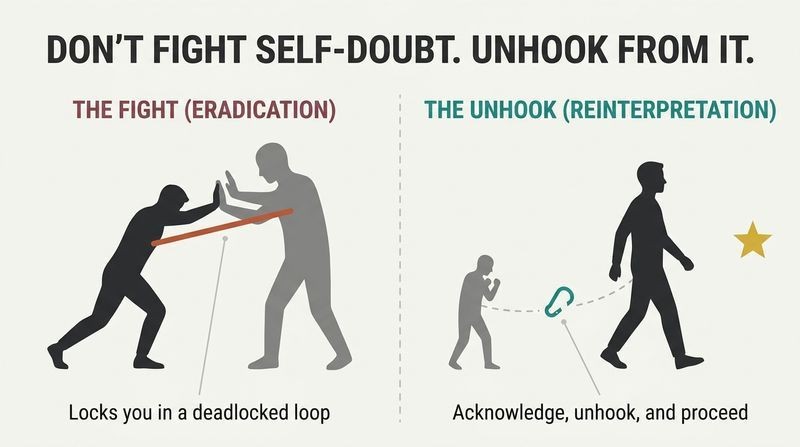
Doubt is a misfiring bodyguard. Zahrai, a former lawyer turned behavioral researcher, opens with a provocation she sent to dozens of psychologists: what is the most effective way to sabotage someone? The near-unanimous answer was to plant self-doubt. Like the barbed burrs that inspired Velcro, doubt clings and spreads through your mental operating system. But the mistake most people make is treating doubt as an enemy to silence.
Doubt is trying to protect you. She distinguishes good doubt (a passenger saying your fuel light is on) from bad doubt (a backseat driver overriding your GPS). The goal is not eradication but reinterpretation. Notice it, name it, and unhook it. More success and knowledge do not quiet doubt; they morph it into new fears at new thresholds.
The reframe echoes Acceptance and Commitment Therapy, which treats difficult thoughts as passengers on a bus rather than the driver. What is refreshing is Zahrai's refusal of the hustle-culture promise that enough achievement finally silences insecurity. Research on the hedonic treadmill supports her: people adapt to gains and reset expectations. One caution worth noting is that framing all doubt as protective can slide into over-rationalizing genuine incompetence signals. The skill she is really teaching is discernment: distinguishing the warning worth heeding from the noise worth dismissing, which is harder than either blanket trust or blanket suppression.
Map your doubt across four trainable attributes, not one blob
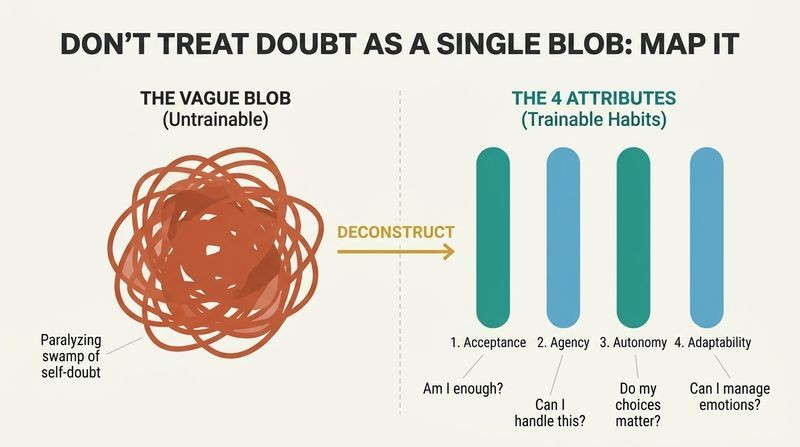
Doubt is not one thing. Drawing on her PhD research with over 4,000 people, Zahrai argues self-doubt fractures into four distinct, measurable attributes, each answering a core question:
1. Acceptance: Am I enough as I am?
2. Agency: Can I handle this?
3. Autonomy: Do my choices matter?
4. Adaptability: Can I manage my emotions?
Together they form your Doubt Profile, scored by a twelve-question diagnostic. These are habits, not fixed traits. Because each attribute is a repeated pattern of thought and behavior, it can be strengthened deliberately. When one drops, it drags the others down. Her research found 20 percent of people score in the lowest zones across all four. The point is precision: instead of drowning in a vague swamp of insecurity, you locate exactly where doubt latches on.
The framework's clinical roots give it credibility: it maps onto Core Self-Evaluations, an established construct in organizational psychology built from self-esteem, self-efficacy, locus of control, and emotional stability. Zahrai essentially rebrands academic constructs into an actionable vocabulary, which is legitimate popularization. The risk of any typology is the Barnum effect, where vague profiles feel personally revealing to everyone. Her defense is that the attributes are prescriptive, each pointing to specific practices, not just descriptive labels. Diagnosing where you are stuck genuinely does beat generic pep talks, a principle borrowed from medicine: accurate diagnosis precedes effective treatment.
Your brain hates uncertainty so much it invents comforting lies
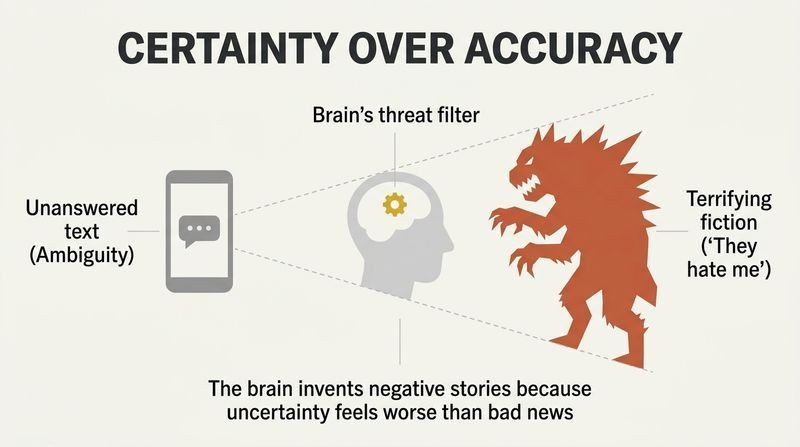
Certainty is a survival instinct. Zahrai describes the brain as a boardroom with a CEO (vision), Strategist (planning), Automations Lead (routines), and Risk Analyst (threat detection). When doubt hijacks any seat, the whole operation stalls, as it did for Marco, a would-be founder frozen in endless research. Our ancestors survived by predicting threats, so the brain treats modern ambiguity (an unanswered text, a quiet boss) like a predator in the bushes.
We fill blanks with fiction. Psychologists call this confabulation: the brain autofills plausible but false stories ("they didn't reply because they hate me") to restore the illusion of control. These stories skew negative because threat detection outranks accuracy. A Harvard study found our wandering thoughts predict happiness more than our actual circumstances. The fix: schedule a daily "Worry Time" to contain rumination instead of letting it run all day.
The confabulation point is well grounded. Split-brain experiments by Michael Gazzaniga showed the brain's "interpreter" fabricating reasons for actions it did not consciously control. Zahrai's delayed-return environment concept connects neatly to why anxiety plagues modern knowledge workers: our reward loops evolved for immediate feedback, not annual review cycles. The Worry Time technique has real clinical backing as stimulus-control therapy for generalized anxiety. One extension: the boardroom metaphor risks implying these brain regions work as tidy departments, when neuroscience shows massively distributed, overlapping networks. As a teaching device, though, it usefully externalizes the machinery so you stop identifying with every anxious thought.
Peel off the labels you mistake for your identity
Beliefs carve grooves. A 1970s experiment applied a fake facial scar to participants, showed them the mirror, then secretly removed it before conversations with strangers. Afterward, the "scarred" people insisted strangers treated them coldly, though nothing had changed but their expectation. Your self-image projects onto reality. Zahrai compares repeated thoughts to sandboarding down a dune: each run deepens the track until it becomes your automatic route.
Labels are lazy shortcuts, not verdicts. When Rashida introduced herself as "intense," a word her siblings and boss had stuck on her, Zahrai suggested "passionate" instead, and Rashida's whole posture shifted. Meg LeFauve, an Inside Out screenwriter, reclaimed the anxiety her family teased her about as the source of her creativity. You cannot delete old neural pathways, but through neuroplasticity you can carve deeper new ones by repetition and by taking opposite physical actions.
The scar study (Kleck and Strenta) is a durable illustration of expectation bias, and it pairs well with Robert Rosenthal's Pygmalion research showing that others' expectations also shape outcomes. Zahrai's honesty that relabeling is a start, not a cure ("sometimes therapy"), keeps this from tipping into positive-thinking snake oil. The embodied cognition angle, that sitting up straight or smiling shifts mood, has a mixed replication record; some power-posing findings collapsed under scrutiny. But the broader principle, that behavior can lead belief rather than only follow it, is solidly supported by behavioral activation therapy for depression.
Name the four inner voices sabotaging you, then talk back
The inner critic is a squad. From hundreds of interviews, Zahrai identified four "Inner Deceivers," each disguised as protection:
1. The Classic Judge, replaying past mistakes as proof of unworthiness.
2. The Misguided Protector, catastrophizing the future to keep you safe and small.
3. The Ringmaster, tying your worth to relentless productivity (93 percent of surveyed people felt guilt when they stopped working).
4. The Neglecter, chasing approval to avoid abandonment.
Separation strips their power. Naming which voice is speaking creates psychological distance: there is you, and there is the meddling voice that is not you. Her four-step response (Recognize, Remember, Reframe, Respond) has you thank the voice for trying to help, then reclaim control. Even Einstein confessed feeling like an "involuntary swindler," and up to 82 percent of people report impostor feelings.
This maps loosely onto Internal Family Systems therapy, which treats the psyche as sub-personalities ("parts") each with protective intent, and onto cognitive defusion in ACT. The move of thanking the critic rather than fighting it is smart: suppression triggers the rebound effect, making unwanted thoughts return stronger. The four archetypes risk oversimplifying, real inner critics blend and shift, but as a naming tool they lower shame by externalizing the voice. The productivity-guilt statistic points to a cultural pathology worth naming: when self-worth fuses with output (what she calls obsessive passion), rest itself becomes threatening, a trap high achievers rarely recognize.
Broaden your identity beyond one role so setbacks can't shatter you
Single identities are brittle. Cognitive scientist Maya Shankar was a violin prodigy bound for a professional career until a torn tendon at fifteen ended it, leaving her grieving not just the instrument but her sense of self. Zahrai calls this Role Fusion: when your entire worth rides on one title, any setback feels like a verdict on your existence. Johan turned down a promotion he had prepped months for because failing would confirm "I'm not a leader."
Hobbies are worth insurance. When Zahrai took up Latin dance during a stressful career switch, it changed how she showed up everywhere: she treated mistakes as feedback, trusted her instincts, and stopped needing every meeting to be flawless. A 2023 study of over 93,000 people across 16 countries linked hobbies to better health, happiness, and life satisfaction. A life resting on one pillar collapses when that pillar cracks.
This connects to research on self-complexity by psychologist Patricia Linville, who found that people with more distinct self-aspects are buffered against depression when one domain fails. The mechanism is diversification, the same logic that governs financial portfolios applied to identity. There is a subtle tension worth flagging: elite performance often demands the very obsessive single-mindedness Zahrai warns against, and some world-class achievers credit their narrowness. Her counterpoint holds for sustainable wellbeing rather than peak output. The practical wisdom is that even highly focused people need at least one arena where they are a beginner, unjudged, and playing for its own sake.
You cannot measure your way to confidence, so run your own race
Comparison is rigged against you. When you already doubt yourself, your brain hunts for confirmation, not fair comparison, so it collects evidence you are falling behind. Nathan, five weeks into a new role, was crushed watching a friend's LinkedIn promotion. Zahrai invokes the odd finding that Olympic bronze medalists often seem happier than silver medalists, who fixate on the gold they almost won (upward counterfactual thinking).
Prepare, don't compare. Michael Phelps never worried about the swimmer in the next lane; he rehearsed every disaster scenario (snapped goggles, a late start) so nothing could rattle him. When his goggles filled with water at the 2008 Olympics, he swam blind and won gold. The antidotes: a daily gratitude practice to refocus on what is yours, and turning envy into emulation by asking "how did they do that?" instead of "why am I behind?"
Leon Festinger's social comparison theory, cited here, explains why comparison is instinctive, but social media has industrialized it by making everyone's curated highlight reel constantly visible. The bronze-versus-silver research (Medvec, Madey, Gilovich) is a vivid demonstration that satisfaction depends on your reference point, not objective rank. Zahrai's emulation reframe aligns with Bandura's finding that watching similar others succeed raises self-efficacy. The gratitude prescription is well supported, though it can curdle into forced positivity if used to suppress legitimate ambition. The sharper version of her point: comparison is only toxic when it is upward and passive; comparison that generates a concrete question to learn from is fuel.
Confidence is the result of action, never the prerequisite
Waiting to feel ready is a trap. The word confidence comes from Latin roots meaning "with trust," and trust is earned by doing. Zahrai offers two ways to live: act only when you feel ready (a lifetime of limbo) or act regardless (momentum and growth). Payam Zamani arrived in the US as a refugee with 75 dollars, knew nothing about tech, faced over 150 rejections pitching car dealerships, and built a company that went public at a 1.2 billion dollar valuation.
Play lowers the stakes. Five-year-olds beat adults at the Marshmallow Challenge (building the tallest spaghetti tower) because they experiment while adults strategize and posture. Pixar's Ed Catmull says every film starts as an "ugly baby" needing patience to grow. The remedy is a daily ten-minute creative dabble where the outcome does not matter, plus "side quests" that let you test new skills without pressure, because you discover talent by doing, not deliberating.
This inverts the intuitive causal order and matches behavioral evidence: action precedes motivation more reliably than motivation precedes action, the core insight behind behavioral activation. David Epstein's Range, which Zahrai cites, adds that experimentation ("match quality" through sampling) beats early specialization for long-term success. The play emphasis has neurological support: low-stakes exploration engages the brain's dopaminergic seeking system without the cortisol of evaluation. One nuance: survivorship bias haunts stories like Zamani's, since we rarely hear of the persistent founders who failed anyway. The reliable claim is not that action guarantees success but that inaction guarantees stagnation, and that competence, once built, retroactively produces the confidence people wait for.
Shift your locus of control inward: choose your response, always
Autonomy is believing your choices matter. Distinct from Agency (doubting your capacity), low Autonomy means doubting whether your efforts change anything, breeding resignation. Zahrai names three self-poisoning habits: complaining (which rewires the brain for negativity), resentment (fixating on others' unfair advantages), and dwelling (rehearsing helplessness). Bruno, a successful founder, walked in blaming traffic, weather, staff, and investors for everything.
Focus only on what you control. Your locus of control is where you place responsibility, inside yourself or in external forces. Benched college quarterback Tom Brady complained he only got two practice reps until a sports psychologist told him to make those two reps perfect. He stopped tracking others and poured everything into what was his to control, eventually becoming the starter. A concrete lever: swap "I have to" for "I choose to," a small language shift shown to restore motivation and ownership.
Locus of control, from Julian Rotter's social learning theory, is one of psychology's most robust predictors of wellbeing and performance. Zahrai wisely inserts a caveat that structural injustice is real and not solvable by mindset, distinguishing her position from toxic bootstrap ideology. The Brady example is the Stoic dichotomy of control (Epictetus) in athletic dress: separate what is up to you from what is not, and invest only in the former. The language reframe ("choose to" over "have to") draws on self-determination theory, where perceived autonomy fuels intrinsic motivation. The honest tension is that an internal locus taken too far becomes self-blame; the healthy version owns responses without owning outcomes.
Choose your hard: comfort carries a delayed, compounding tax
The comfort zone silences you. Sonya, a teacher of fifteen years, dreamed of urban planning but stayed stuck, partly from the sunk-cost fallacy (past investment dictating future choices) and partly from fearing uncertainty. Zahrai's reframe: both paths are hard. Staying is hard, leaving is hard, so choose your hard wisely. The most potent motivator, research shows, is not purpose but the felt experience of progress, which requires movement.
Be a bison, not a cow. Cows flee storms and stay in the bad weather longer; bison walk into storms and pass through faster. The practice is to microdose discomfort, shrinking a feared task to its smallest version (one comment online, one voice note) and scaling up. This expands your "Luck Surface Area": Christopher Nolan seems weather-lucky filming, but he simply commits to shoot in any conditions, so unplanned storms become unforgettable footage. Showing up consistently makes you discoverable to opportunity.
The bison metaphor is memorable and biologically grounded, and it dramatizes systematic desensitization, the gold-standard exposure technique for anxiety, where graded contact with a feared stimulus extinguishes the fear response. The progress-beats-purpose claim draws on Teresa Amabile's Progress Principle, a genuinely underappreciated finding: small daily wins drive motivation more than grand mission statements. Luck Surface Area reframes serendipity as partly manufacturable, echoing Richard Wiseman's research showing "lucky" people simply create and notice more opportunities. The subtle risk in "choose your hard" is that it can guilt people who face genuinely constrained options; the framing works best for those who do have agency but are hiding behind the language of impossibility.
Treat emotions as data to decode, not enemies to suppress
Adaptability is staying grounded, not unfeeling. At a dinner where an executive belittled freelancers, Mira felt rage, embarrassment, and defensiveness but breathed, smiled, and secured a follow-up meeting. Emotions are messengers, singer Jewel called anxiety a "neon sign" that something needs attention. Suppression backfires through the rebound effect: the more you push a feeling away, the more your brain flags it.
Name it to tame it. Neuroimaging shows that labeling an emotion reduces amygdala reactivity, like tapping the brakes. Instead of the vague "I'm stressed," locate it in the body ("tightness in my chest") and plot it on two axes: intensity (arousal) and pleasantness (valence). Then use cognitive defusion: say "I'm noticing anxiety" rather than "I am anxious," separating the feeling from your identity. Critically, self-doubt is often not doubt at all but overload, four hidden loads (cognitive, emotional, physical, stimulation) that make everything feel heavier the longer you hold them.
The affect labeling research (Lieberman, UCLA) is genuinely robust and underpins why journaling and therapy "talking it out" work neurologically. The arousal-valence map is Russell's circumplex model of affect, a standard framework in emotion science. Zahrai's most useful practical distinction is between doubt and depletion: the glass-of-water parable (weight depends on how long you hold it) reframes what feels like personal inadequacy as accumulated load. This challenges the hustle advice to "push through," since you cannot outthink exhaustion. Alison Wood Brooks's finding that reframing anxiety as excitement (both are high-arousal states) beats forcing calm is a standout, because fighting your physiology loses, while redirecting it wins.
Build self-trust one habit at a time, then let it ripple outward
Big Trust is the destination. Zahrai's central thesis: self-trust, the ability to back yourself under pressure, is built not in one dramatic moment but through repeated small choices that strengthen the four attributes. She likens self-doubt to a Manila palm stuck at six feet indoors that would reach twenty-five feet in open soil. You mistake the pot (internalized labels and stories) for your potential. Change the environment of your habits and you expand.
Two accelerants beyond technique. First, self-forgetting: when Fayçal coached a nervous billionaire before a G20 speech, the breakthrough was shifting focus from "how do I look" to the mission itself, and the anxiety dissolved. Frankl warned that success, like happiness, cannot be pursued directly; it ensues from devotion to something bigger. Second, awe: intentionally savoring wonder (a sunset, a reunion, birdwatching) triggers an "undoing effect" that resets the nervous system and shrinks the self and its problems.
The pot-and-plant metaphor elegantly captures the difference between potential and access, the real bottleneck is rarely raw capacity but the constraints we have internalized. Self-forgetting connects to flow research (Csikszentmihalyi), where peak states require the disappearance of self-consciousness, and to Frankl's logotherapy, where meaning outside the self anchors resilience. The awe science is a genuinely fresh contribution to self-help; Dacher Keltner's work shows awe as a self-transcendent emotion that reduces rumination and increases prosocial behavior. The closing move, that inner trust should convert into outer contribution, keeps the book from terminal navel-gazing. The quiet paradox threaded throughout: the surest route out of self-doubt is to stop focusing on the self.
Analysis
Big Trust belongs to the crowded self-help subgenre of confidence and impostor-syndrome books, but it earns distinction through two moves. First, it refuses the standard promise of eliminating self-doubt, instead teaching a changed relationship with it, a stance borrowed from Acceptance and Commitment Therapy that is more psychologically honest than most motivational fare. Second, it disaggregates the vague "blob" of insecurity into four measurable, trainable attributes (Acceptance, Agency, Autonomy, Adaptability), grounded in the established Core Self-Evaluations construct from organizational psychology. This diagnostic precision is the book's genuine intellectual contribution: it converts a mushy feeling into a targetable problem.
Structurally, the book is framework-based but heavily story-driven, alternating client vignettes, celebrity examples, and Zahrai's own arc from doubting law student to peak-performance researcher. The consistent chapter architecture (core question, doubt patterns, promise of the attribute, and an expansive "gift" like self-forgetting, hope, and awe) gives it teachability, though the relentless practices can feel like a workbook interrupting a narrative.
The evidence base is a strength and a vulnerability. Zahrai cites real studies (affect labeling, the Kleck scar experiment, Amabile's progress principle, Keltner's awe research), lending credibility rarely found in the genre. But she also leans on anecdote and survivorship-prone success stories, and some claims (embodied cognition, power-posing-adjacent ideas) rest on contested replications. Her own PhD data, while substantial, functions partly as marketing for a proprietary assessment.
The deepest idea, threaded quietly throughout, is counterintuitive: the exit from self-preoccupation is not more self-work but self-transcendence, through contribution, mission, and awe. This aligns with Frankl and flow research and gives the book a philosophical spine beyond technique. The audience is ambitious professionals, especially high achievers who look competent but privately spiral. For them, the attribute map offers a usefully specific mirror and a menu of small, repeatable interventions rather than one grand fix.
Review Summary
Big Trust by Dr. Shadé Zahrai receives overwhelmingly positive reviews (4.76/5), praised for its practical, science-backed framework to combat self-doubt. Readers appreciate the Four A's model (Acceptance, Agency, Autonomy, Adaptability) and actionable exercises that build genuine self-trust rather than superficial confidence. Reviewers highlight the book's accessibility, research rigor, and relatable stories. Many found it transformative during career transitions or periods of doubt. A few noted the writing occasionally felt AI-influenced, though this didn't diminish the content's value. The book is recommended for leaders, professionals, and anyone struggling with perfectionism, comparison, or imposter syndrome.
People Also Read




Glossary
Big Trust
Grounded, unshakable self-trustThe book's central concept: a deep, stable ability to back yourself under pressure and move through life without being hijacked by doubt. Unlike fleeting confidence, it is built gradually by strengthening four core attributes through small, repeated habits, and it eventually converts inward stability into outward impact on relationships and leadership.
Doubt Profile
Diagnostic of your four attributesA twelve-question self-assessment that scores you on Acceptance, Agency, Autonomy, and Adaptability, revealing exactly where self-doubt takes hold and where you are already strong. Scores fall into zones from Red Alert (destructive) to Superpower (empowering). Built on the Core Self-Evaluations construct from organizational psychology.
The Four Attributes
Acceptance, Agency, Autonomy, AdaptabilityThe four trainable dimensions of self-trust, each answering a question: Acceptance (Am I enough?), Agency (Can I handle this?), Autonomy (Do my choices matter?), and Adaptability (Can I manage my emotions?). They interconnect, so weakness in one drags down the others, and each can be strengthened through habit.
Inner Deceivers
Four sabotaging inner-critic voicesZahrai's term for four archetypes of the inner critic, each disguised as protection: the Classic Judge (replays past mistakes), the Misguided Protector (catastrophizes the future), the Ringmaster (ties worth to productivity), and the Neglecter (chases approval to avoid rejection). Naming which is speaking creates distance and reduces its power.
Role Fusion
Identity fused to one roleA term from cognitive scientist Maya Shankar describing when your entire sense of self is tied to a single identity like a job title or talent. Any setback in that domain then feels like a verdict on your whole worth, making you fragile. The antidote is broadening identity through hobbies and outside pursuits.
Self-forgetting
Shifting focus off yourselfThe practice of redirecting attention away from your insecurities and ego toward something larger, such as your mission or the people you serve. Rooted in a teaching by 'Abdu'l-Bahá and echoed by Viktor Frankl, it dissolves self-consciousness and paradoxically improves performance and self-acceptance.
Luck Surface Area
Exposure that attracts opportunityA concept from entrepreneur Jason Roberts: the more you show up, take risks, and make yourself visible, the more chances you create for good luck to find you. Zahrai links it to building tolerance for discomfort, so consistent presence turns unpredictable moments into earned opportunities.
Microdose Your Hard
Tiny graded exposure to discomfortA technique for facing avoided tasks by shrinking them to their smallest possible version (one comment, one voice note), practicing consistently, and scaling up. Based on systematic desensitization, it expands your comfort zone gradually, embodying the metaphor of a bison walking into a storm to pass through faster.
Name it to tame it
Labeling emotions reduces their intensityAn emotion-regulation practice, backed by neuroimaging showing that putting feelings into words dampens amygdala reactivity. Zahrai extends it: locate the emotion in the body, plot it by intensity and pleasantness, and use distancing language ("I'm noticing anxiety" rather than "I am anxious") to separate the feeling from your identity.
The Undoing Effect
Awe resets the nervous systemThe finding that positive, self-transcendent emotions like awe loosen the grip of stress and restore emotional balance. By intentionally noticing and savoring moments of wonder (a sunset, a reunion), you quiet self-critical brain activity, feel smaller relative to something vast, and recalibrate your whole system.
Download PDF
Download EPUB
.epub digital book format is ideal for reading ebooks on phones, tablets, and e-readers.








































