

Key Takeaways
Stop playing a character; put your own self into the scene
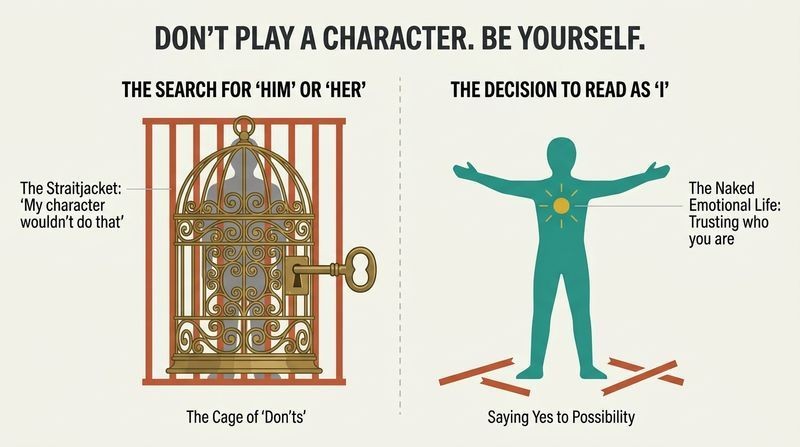
The audition's central paradox. Shurtleff, who cast Broadway hits like Gypsy and The Odd Couple and films like The Graduate, argues that people become actors to escape into glamorous others, but acting is the opposite: using your own naked emotional life in extraordinary situations. In an audition you often get the script overnight, or ten minutes before reading. You cannot mold a full character in ten minutes; character takes weeks of rehearsal. So drop the search for 'him' or 'her' and read as 'I.'
Character becomes a cage. Actors weaponize 'my character wouldn't do that' to rule out choices, imprisoning themselves in a straitjacket of don'ts. Instead, say yes to possibility. There is only one person like you on earth. Trust it, even if you do not love yourself.
This inverts the popular Method mythology of vanishing into a role. Shurtleff's insight aligns with modern research on emotional authenticity: audiences detect microexpressions of genuine feeling that faked characterization cannot produce. The advice also has practical decision theory behind it: with severe time constraints, deep character construction is impossible, so drawing on pre-existing emotional memory is the only efficient strategy. A useful tension worth noting: some transformative actors (Daniel Day-Lewis, Gary Oldman) build from the outside in. Shurtleff's rule is specifically for the compressed audition context, not a universal law of performance, which keeps it defensible.
Ask 'Where is the love?' in every single scene
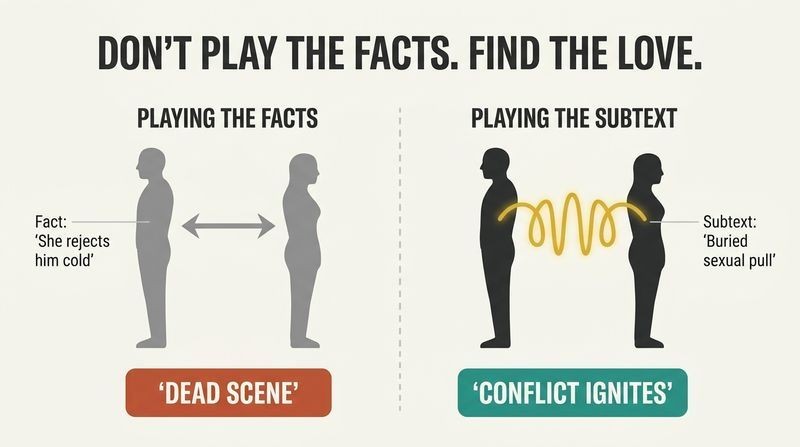
Relationship is the heart of acting. Facts (he is my husband, she is my mother) give you nothing to play. Emotional attitude does. Shurtleff insists every scene is a love scene, meaning you must locate love, its absence, or its perverse forms. In Middle of the Night, actresses read a wife rejecting her husband coldly and the scene dies. Play the buried sexual pull toward him against her longing for an older man, and conflict ignites.
Always answer yes to love. Asked 'Are you in love with him?' say yes, because yes gives rich emotional material and no gives a flat, superficial attraction. Love takes bizarre shapes: the manipulators in Sweet Bird of Youth still crave love. Expand your definition beyond Romeo and Juliet idealism, or you will fail to commit emotionally.
Shurtleff essentially prescribes maximizing emotional stakes as a heuristic, which parallels improv's 'yes, and' principle and negotiation theory's insight that engagement beats withdrawal. The claim that every scene is a love scene is deliberately provocative overreach, but as a working bias it is defensible: choosing the most emotionally involving interpretation produces more watchable behavior than choosing indifference. The counterpoint is that some Pinter or Mamet scenes trade on genuine emotional vacancy and power alone. Yet even there, thwarted longing usually lurks beneath. Attachment psychology supports him: humans are fundamentally driven by the need to give and receive connection.
Replace 'motivation' with 'What am I fighting for?'
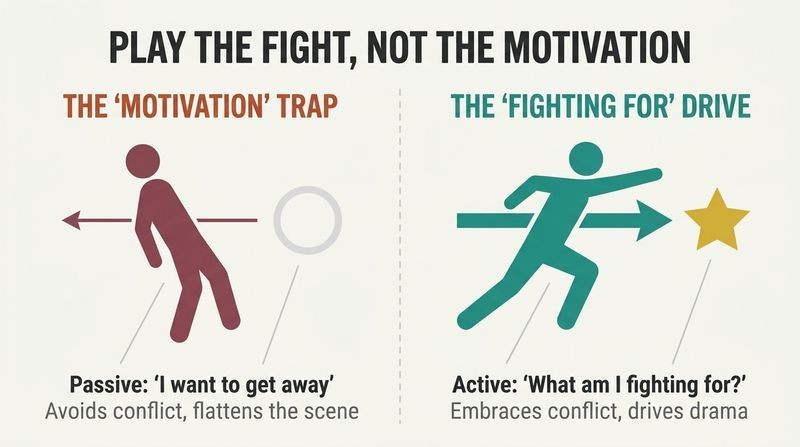
Positive, active goals beat passive ones. Actors say 'I want to get away from her,' which leaves them edging toward the door, emotionally absent. Shurtleff reframes every goal as a fight for something. Chekhov's Three Sisters is not about women who fail to reach Moscow; it is about women fighting like hell to get there. A character who says 'I am bored' cannot be played as boredom, or you become boring. Find what they want instead.
Seek maximum conflict. Drama feeds on conflict and dies on agreement. Actors, trained by life to avoid trouble, iron scenes flat. Do the opposite: hunt for who blocks you, then fight, woo, charm, or revile them, finding as many tactics as possible. Even suicide is fighting the world for what it withheld.
This is functionally Stanislavski's 'objective' sharpened into combat language, and the reframe matters cognitively. Framing a goal as active and positive changes an actor's physical and vocal behavior measurably, much as approach-motivation versus avoidance-motivation shifts posture and energy in sports psychology. The insistence that there are no passive scenes anticipates modern screenwriting's rule that every character wants something in every beat. One caution: relentless maximum conflict can flatten subtlety and tonal variety if applied mechanically. The skill Shurtleff assumes but understates is calibrating intensity through relationship, so competing actors do not simply shout past each other.
Every scene starts in the middle, so build the moment before
Arrive already ignited. Something always precedes the scene. Most actors walk on cold and spend the reading warming up, by which point the auditors have stopped watching. Shurtleff calls the preceding emotional charge the 'moment before,' and it must be specific to this scene, not a vague generalization about the character's whole life. In The Heiress, Catherine waits to elope, every street sound feeling like her lover arriving. Without that brimming expectation, the scene is mundane.
Prime the motor. Like starting an engine, you must talk yourself into feeling before you enter, so feeling propels you rather than your head leading daintily. First impressions are lasting, like a limp handshake that takes months to undo. A richly invested moment before can substitute for the rehearsal you never got.
The concept resonates with sports and performance science on pre-performance routines and priming: emotional and physiological states carry momentum, and entering a task pre-activated improves the opening moments that disproportionately shape evaluation. It also connects to the psychology of thin-slicing, where observers form durable judgments within seconds, so a weak start is costly. The demand for specificity over generalization is the sharpest point: general backstory rarely translates to playable feeling, whereas a concrete imagined instant does. Screenwriters call this entering late and specific. The risk is manufacturing a moment so intense it does not match the scene's actual opening register.
Consistency kills acting, so play the opposite of your choice
Humans are contradictory. Whatever you decide your motivation is, the opposite is also true and belongs in the scene. Love contains hate; deep need breeds resentment of needing. In A Taste of Honey, the mother sings joyfully one moment and collapses into self-pity the next. It is this inconsistency that fascinates us in Brando, Olivier, De Niro, and Pacino: we never know what they will do next.
Choose extremes, avoid 'hunking.' Do not play ten minutes of love then ten minutes of anger (a 'hunk'). Play yes, no, yes, no in rapid alternation, even letting action contradict words (kiss someone while saying 'I hate you'). The wider the opposites, the more the in-between emotions appear instinctively. The playwright often buries opposites in the subtext, so you must dig and supply them.
Opposites map neatly onto how real emotion works: affective science documents mixed emotions and rapid ambivalence, and unpredictability is precisely what sustains attention (the brain habituates to consistency and orients to novelty). Shurtleff's 'hunking' warning is a sophisticated note on temporal texture, close to musical dynamics. Dramatists from Shakespeare to Chekhov built characters on precisely this contradiction. The steelman is strong. The nuance: opposites played simultaneously cancel out and paralyze, which Shurtleff himself flags, so timing the alternation is the real craft. Applied crudely, this can look like mood whiplash rather than layered humanity.
Choose the dream, not the reality, because people live for fantasies
Importance and stakes. Plays capture the extraordinary peaks of life, not humdrum truth, yet actors flatten scenes into safe everyday reality and call it truthful. Watch someone miss a subway and rage though another comes in seven minutes: right now it feels like everything. Make your stakes that high. In Birdbath, an actor read Frankie as bored and pitying a weird girl; reframed as a lonely man who might find someone to believe in him, even after she murdered her mother, the scene came alive.
Dreams motivate everything. The negatives are always written into the script; the actor's job is to supply the positive dream underneath. Reality creates problems, dreams are how humans cope, and leaving out the dream omits the best part of a person.
This anticipates positive psychology's finding that aspiration and hope, not just circumstance, drive behavior, and it echoes narrative therapy's emphasis on preferred futures. Shurtleff's observation that scripts encode the negatives while actors must generate the positives is a genuinely useful asymmetry: dialogue often states resistance ('go away,' 'leave me alone') precisely because the underlying desire is too vulnerable to voice. The subway example is a crisp illustration of subjective salience overriding objective proportion, which behavioral economics studies as the peak intensity of momentary emotion. The critical edge: prizing dream over reality risks melodrama, which Shurtleff embraces rather than avoids, betting theatricality beats naturalism.
Woo the auditors, because hostility loses the war every time
They hold all the power. Actors treat auditions as combat and auditors as enemies, but nervousness leaks out as hostility, which always costs the role. Shurtleff recounts a candidate for a lead opposite a star who, repeatedly and unknowingly protected by kind director Joshua Logan, exploded in temper and stormed out, killing his career over a misunderstanding. The lesson: when they seem to be dumping on you, they may be helping you. Save your rage for home.
Practical intelligence wins. Ask only two legitimate questions: 'Am I in the light?' and, for cold reads, whether you may look the scene over. Never memorize (it is called a reading; the script is your ally). When directed, add the note to what you did rather than discarding everything. Present your résumé as a lively one-act about who you are.
This is emotional intelligence and status management before those terms were popular. The finding that both sides fear each other (directors' careers ride on casting) reframes the power dynamic usefully: the auditors are rooting for you to solve their problem. It parallels interview research showing likability and perceived coachability often outweigh raw qualification. Shurtleff's advice to 'add, not replace' when given direction is shrewd, since directors test adaptability, not obedience. The endorsed white lies (blaming lateness on another audition) are ethically minor but reveal a deeper truth: auditors care about signals of desirability and low-drama collaboration more than literal facts.
Treat every relationship as competitive, even friendship and love
Competition is life, not cruelty. Shurtleff meets fierce resistance teaching that all dramatic relationships compete, because people equate competition with hostility. He redefines it as the healthy stimulation that makes any game worth playing. Friendship, the one relationship of equals, is built on competing over whose cookies are best, whose children are nicest, who suffered most. Scenes between friends go lifeless because actors play cozy niceness instead of the danger and rivalry real friends risk.
Communication is a completed circle. Feeling something is worthless unless sent and received. The goal is duplication: getting the other person to think, feel, and agree as you do, which means the desire to change your partner. Same-sex scenes are the most competitive of all, precisely where actors soften it most.
Shurtleff's framing predates but rhymes with evolutionary psychology's account of prosocial competition and status signaling among allies. The claim that friendship uniquely permits competition because of equality is insightful and matches research on how peer relationships tolerate honest conflict that hierarchical ones suppress. His communication-as-circle model is essentially Shannon-Weaver sender-receiver theory applied to acting, with the crucial addition that listening must visibly change you. Where he overreaches: not every intimate exchange is competitive; cooperative bonding and co-regulation are real. But as a corrective to actors' default of bland agreement, the provocation earns its keep by generating playable friction.
Add mystery and secret: play what you don't know
The unexplainable ingredient. After doing all the other guideposts, Shurtleff says add what you cannot verbalize. The most magnetic actors (Garbo, Brando, Guinness) supply thorough answers yet radiate an unanswerable wonderment about the other person and about themselves. No matter how well you know someone, something in their heart stays unknown, and something in you stays hidden even from you. Bring that pondering into the scene.
Secrets come in layers. You can hold a secret you will never tell, one you want others to know you have, or one you are dying to be coaxed into revealing. In The Graduate, reframing the affair as great rather than lousy sex fills Benjamin with genuine curiosity about Mrs. Robinson's hidden life, transforming a flat interrogation into a charged pursuit.
This is Shurtleff's most elusive and arguably most sophisticated idea, touching on what makes screen presence unteachable. Cognitive science offers support: faces and behaviors that resist full interpretation sustain attention because the brain keeps predicting and updating, never settling. Charisma researchers describe a similar quality of unresolvable depth. The secret taxonomy is practically useful for generating subtext and active listening. The honest limitation is that mystery cannot be manufactured through effort without becoming coy or vague, which Shurtleff acknowledges by placing it last, after everything knowable is nailed down. It is the seasoning, not the meal, and only works atop rigorous specificity.
Rescue a dying reading by blaming or loving your partner
Never stop, never restart. When a reading slips away, actors turn inward and blame themselves, going introspective and dead. Shurtleff's emergency maneuver: instantly blame your partner or shower them with love, using whatever words the script offers. It is irrational and may not fit, but it reconnects you to another human, revives the relationship, and grabs the auditors. Losing your place is no sin; the interesting mountain climber nearly falls and recovers rather than crawling back down.
Play what people do, not what they should. Acting mirrors human behavior, not morality. Revenge motivates far more than actors admit (Night Must Fall's killer proves he is not a nobody). Drink only ever functions to release inhibitions. Shyness is the fight to be bold. Find the active verb beneath every passive stage direction.
The blame-or-love reset is essentially a state-interruption technique, akin to how athletes use a physical trigger to break a choke spiral. Its logic is sound: self-blame is self-focused attention, the documented enemy of flow, whereas an outward action restores relational focus. Shurtleff's broader insistence that acting depicts behavior rather than ethics anticipates the antihero era of prestige drama, where audiences engage with revenge, addiction, and cruelty rendered from the inside. His reduction of stage drinking to a single function (releasing inhibition) is elegant and mostly right, cutting through cliché stumbling, though real intoxication also impairs and isolates, which occasionally serves a scene.
Bring back romance and humor, the ingredients actors fear most
Romance is the secret engine. In a hard, ironic culture, admitting you want romance seems soft, so actors make sensible, rational choices and drain scenes of the dreamy, visionary longing that draws audiences to Equus, A Chorus Line, and Shakespeare. Romance is the dream that something better will happen, and no human lives without it. In The Heiress, playing the aunt's elopement joy rather than banker-like practicality is what makes the scene sing.
Humor is survival, not jokes. Humor is the attitude that keeps you from jumping off a bridge, present even in tragedy because heavy situations demand relief. It exists in Chekhov, O'Neill, and every scene of life. Shurtleff says the single trait he prizes above all in an actor is humor, because it signals intelligence, perception, awareness, and drive.
The romance argument doubles as cultural criticism: an ironic age represses aspiration as naive, and Shurtleff diagnoses this as an artistic loss, echoing later critiques of detached postmodern cool. His definition of humor as an existential coping stance, not comedy, aligns with research linking humor to psychological resilience and to perceived intelligence in social judgment. That he ranks humor as the top castable quality is a bold, testable claim; it correlates with cognitive flexibility, which does predict creative performance. The tension: emphasizing romance and humor everywhere could impose a house style, smoothing over genuinely bleak or affectless material that some modern work demands to stay unresolved.
Persist relentlessly, because luck only rewards the ready
The odds are brutal. Of fifty thousand actors in Shurtleff's file, roughly five hundred earn a living, and much of that from commercials. Talent is not enough; hard work and discipline are. Ruth Gordon rehearsed alone an hour before every performance of a year-long run. Newness comes from discipline, not inspiration. Actors fail mostly because they do not work hard enough, are ruled by their negatives, and quit at the first no.
Manufacture your own luck. Shurtleff wrote David Merrick a letter weekly for seven months, never complaining, until Merrick hired him. Robert Redford thumbed from Hollywood on the final casting day and got the part. Barbra Streisand won a role with a fabricated audition (fake mismatched shoes, imaginary gum). Always audition for everything, even roles you think are wrong for you; concepts change and get rewritten around the bold.
Shurtleff's take on luck is more rigorous than motivational cliché: he separates the uncontrollable (timing, type, a director's subjective whims) from the controllable (preparation, persistence, showing up ready), which mirrors the modern distinction between process and outcome goals. The Streisand anecdote is a masterclass in signaling: her invented eccentricity broadcast fearless creative control, the exact trait casting rewards. His persistence advice resembles sales research on follow-up cadence, and his 'always audition' rule reflects real optionality, since casting concepts genuinely mutate mid-process. The sober note he sounds himself, that persistence guarantees consideration, not the job, keeps this from tipping into false promise.
Analysis
Audition (1978) is a craft manual disguised as a philosophy of human behavior, and that dual nature is what makes it endure well beyond its theatrical audience. Michael Shurtleff, a Broadway and film casting director who watched tens of thousands of readings, built his famous Twelve Guideposts not as abstract theory but as reverse-engineered diagnostics: he noticed the recurring reasons talented actors failed and turned each failure into a question the actor can ask. That structure (relationship, conflict, the moment before, humor, opposites, discoveries, communication and competition, importance, events, place, game and role playing, mystery and secret) is essentially a behavioral checklist for generating maximally alive, watchable human presence under extreme time pressure.
What distinguishes the book is its contrarian anthropology. Shurtleff argues humans are driven by dreams rather than reason, that all relationships compete, that every scene hides love, and that inconsistency, not coherence, fascinates us. These are strong, sometimes overstated claims, but they function as productive biases: an actor who defaults to them will make bolder, more emotionally committed choices than one who plays safe naturalism. Bob Fosse's foreword nails the book's broader relevance by noting that job interviews and first dates are auditions too, and Shurtleff's guideposts do translate into any high-stakes self-presentation.
The book's limitations are the flip side of its strengths. Its maximalist prescriptions (always say yes to love, always find humor, always compete, embrace melodrama) can homogenize performance into a single heightened register, and they suit the emotionally expressive American theatre of its era better than minimalist or absurdist traditions. The teaching format, largely transcribed Socratic dialogues, is repetitive. Yet the core insight remains bracing and modern: stop hiding behind character, risk your actual self, choose the interpretation with the most feeling, and treat every negative on the page as an invitation to supply the positive underneath. It is genuinely a psychology of courage.
Review Summary
Audition is highly regarded as an essential book for actors, with many readers praising its practical advice on auditioning and character development. Reviewers appreciate Shurtleff's insights, anecdotes, and easy-to-grasp writing style. The book's 12 guideposts are particularly valued, offering valuable tips for both auditions and general acting. While some content may be dated, readers find the advice largely timeless and applicable beyond acting. Many consider it a must-read for aspiring actors, with some even recommending it to non-actors for its insights into human behavior and relationships.
FAQ
1. What is Audition: Everything an Actor Needs to Know to Get the Part by Michael Shurtleff about?
- Comprehensive audition manual: The book is a practical, no-nonsense guide for actors, focusing on the audition process as the central challenge in an actor’s career.
- Focus on emotional truth: Shurtleff emphasizes using personal feelings and relationships to create authentic, compelling auditions rather than relying solely on technique or memorization.
- Industry realities: It offers candid advice on dealing with rejection, understanding the audition environment, and presenting oneself effectively to casting directors and producers.
- Twelve guideposts framework: The book introduces twelve key guideposts to help actors analyze and perform scenes with depth and vitality.
2. Why should I read Audition by Michael Shurtleff?
- Indispensable for actors: The book is widely regarded as essential reading for aspiring and working actors, praised for its clear, practical advice.
- Demystifies auditions: Shurtleff breaks down the audition process, offering actionable tips on everything from physical presence to emotional engagement.
- Broad life application: The book’s insights extend beyond acting, helping readers present themselves authentically in high-pressure situations like job interviews or first dates.
- Unique industry perspective: Shurtleff’s experience as a top casting director provides rare, insider knowledge not found in most acting books.
3. What are the key takeaways from Audition by Michael Shurtleff?
- Emotional commitment is crucial: Success in auditions comes from genuine emotional connection and risk-taking, not just technical skill.
- Relationship and conflict drive scenes: Understanding and playing the emotional dynamics between characters is at the heart of compelling acting.
- Auditions are games with high stakes: Treating scenes as competitive games with something vital to win makes performances vivid and engaging.
- Practical strategies for challenges: The book offers tools for handling nerves, bad readings, difficult partners, and unexpected audition situations.
4. What are the Twelve Guideposts in Michael Shurtleff’s audition method, and why are they important?
- Core framework for actors: The twelve guideposts are Relationship, Conflict, The Moment Before, Humor, Opposites, Discoveries, Communication and Competition, Importance, Find the Events, Place, Game Playing and Role Playing, and Mystery and Secret.
- Scene analysis tools: Each guidepost is a question or concept actors use to deepen their understanding and emotional connection to a scene.
- Not rigid rules: The guideposts are flexible prompts, encouraging actors to use their own feelings and imagination for truthful performances.
- Foundation for all acting: While designed for auditions, these guideposts also enhance rehearsal and performance work.
5. How does Michael Shurtleff define "Relationship" in his audition method, and why is it fundamental?
- Heart of acting: Relationship is the most important guidepost; actors must understand their emotional attitude toward the other character, not just the factual connection.
- Emotional specificity: Exploring feelings like love, hate, resentment, or desire within the relationship creates a vivid, charged connection that drives the scene.
- Conflict and love coexist: Even in conflict, Shurtleff urges actors to find "Where is the love?" to add emotional depth and complexity.
- Drives scene dynamics: The relationship determines how lines are delivered and how the scene unfolds.
6. What does "Conflict" or "What Are You Fighting For?" mean in Shurtleff’s audition advice?
- Active motivation: Actors should identify what their character is actively fighting for, rather than passive goals, to energize their performance.
- Conflict as drama’s engine: Every scene is about struggle; knowing what the character wants and what stands in their way creates dynamic tension.
- Multiple strategies: Actors should explore various ways to pursue their goals, adding variety and interest to their performance.
- Keeps scenes alive: Conflict prevents scenes from becoming flat or uninteresting.
7. How should actors use "The Moment Before" according to Michael Shurtleff’s audition method?
- Pre-scene context: Actors must imagine and emotionally live through what happened immediately before the scene starts.
- Emotional priming: This primes the actor’s feelings and energy, ensuring they enter the scene fully engaged.
- Specific and personal: The moment before should be tailored to the scene’s circumstances and drawn from the actor’s own life or imagination.
- Prevents flat starts: It helps avoid slow or lifeless beginnings to scenes.
8. Why does Michael Shurtleff emphasize "Humor" in auditions and acting, even in serious scenes?
- Essential for realism: Humor exists in every life situation, even dramatic ones, making performances more lifelike and relatable.
- Balances seriousness: Humor prevents scenes from becoming dull or melodramatic, adding depth and variety.
- Often overlooked: Many actors neglect humor, but it is a vital ingredient for memorable and engaging performances.
- Endurance and connection: Humor helps both actors and audiences endure and connect with the material.
9. What role do "Opposites" play in Michael Shurtleff’s audition technique?
- Creates emotional complexity: Opposites—such as love and hate, humor and seriousness—add range and unpredictability to characters and scenes.
- Avoids monotony: Embracing contradictions prevents performances from being flat or one-dimensional.
- Subtext and depth: Opposites often exist beneath the surface, requiring actors to explore and express conflicting emotions.
- Makes characters human: Real people are full of contradictions, and so should characters be.
10. How does Michael Shurtleff define "Game" and "Stakes" in acting, and how should actors use these concepts?
- Game as competition: Every scene is a game where characters compete to get what they want, making choices vivid and dramatic.
- High stakes create urgency: Stakes must be emotionally vital—life-and-death or deeply personal—to make the game meaningful.
- Scorekeeping: Actors should track wins and losses in the scene, reacting emotionally to each outcome.
- Play to win: Always make strong, committed choices that show the character’s desire to win.
11. What is the significance of "Mystery and Secret" in Michael Shurtleff’s audition method?
- Adds depth and intrigue: Mystery and secret involve the unknown feelings and hidden motives between characters, making performances richer.
- Embrace the unknown: Actors should cultivate curiosity and wonder about their partner’s inner life and their own.
- Explore possibilities: Playing uncertainty and possibility, rather than certainty, makes scenes more emotionally engaging.
- Creates compelling subtext: Mystery and secret deepen relationships and add layers to the performance.
12. What practical audition advice does Michael Shurtleff give for handling scripts, stage directions, accents, and bad readings?
- Script as ally: Don’t obsess over memorization; use the script to stay emotionally connected rather than focusing on line recall.
- Selective stage directions: Ignore nonessential or limiting stage directions unless crucial to the action, to avoid being trapped by them.
- Accents only if required: Attempt accents only when necessary and well-practiced, as they can interfere with emotional connection.
- Rescue bad readings: If a reading is going badly, take bold action—blame or love your partner to create conflict and revive the scene, never stop or restart.
- Handle nerves and environment: Be seen and heard, control hostility, and treat the audition as a sincere game to increase your chances of success.
Download PDF
Download EPUB
.epub digital book format is ideal for reading ebooks on phones, tablets, and e-readers.








































