

Key Takeaways
Three attachment styles explain almost every pattern in your love life
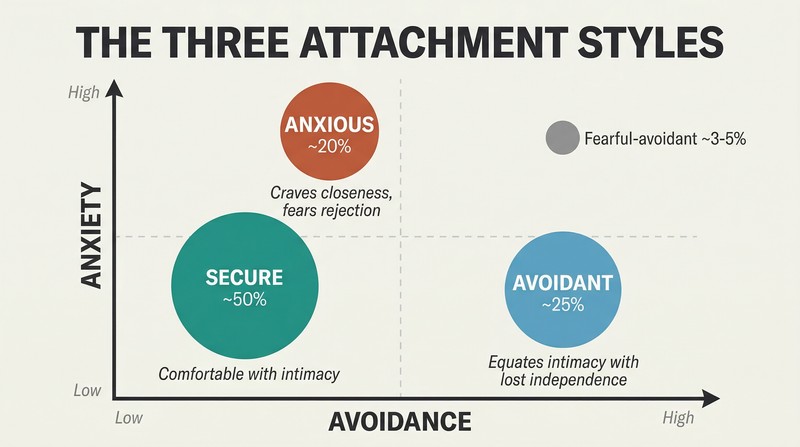
Attachment theory sorts all adults into three styles. Secure people (~50%) feel comfortable with intimacy and communicate needs naturally. Anxious people (~20%) crave closeness but constantly worry their partner doesn't love them enough, becoming hypersensitive to perceived threats. Avoidant people (~25%) equate intimacy with loss of independence and constantly minimize closeness. A rare ~3-5% are a combination of anxious and avoidant.
The authors illustrate this with their friend Tamara (anxious) who became increasingly preoccupied with Greg (avoidant), losing her ability to concentrate at work. Greg pushed her away precisely because closeness was increasing — not because he didn't care. Attachment theory predicted every move both made. Understanding your style and your partner's transforms baffling relationship behavior into something predictable and manageable.
To become more independent, find the right person to depend on
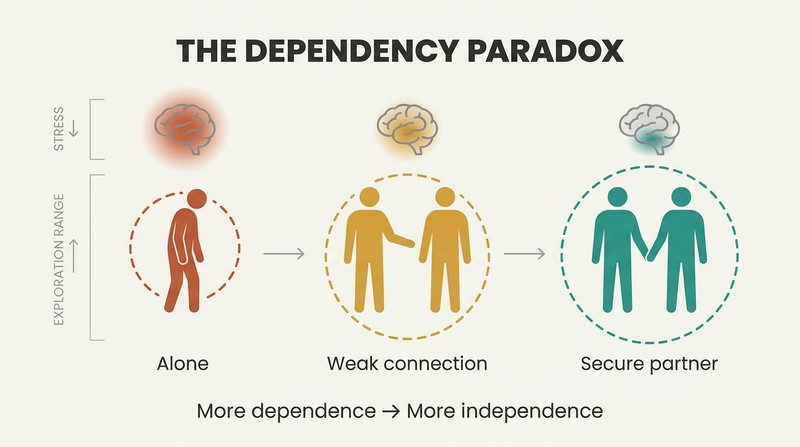
Culture pathologizes neediness, but biology disagrees. Neuroscientist James Coan scanned married women's brains while they anticipated a mild electric shock. Alone, their hypothalamus — the brain's stress center — lit up. Holding a stranger's hand reduced the response somewhat. Holding their husband's hand nearly eliminated it, especially for women in satisfying marriages.
This reflects the dependency paradox: the more securely you lean on a partner, the more confidently you explore the world. On a TV race, Karen needed boyfriend Tim to hold her hand under stress. He refused, thinking it was needy. She lost confidence; he froze before a bungee jump. Had he held her hand early, both would have performed better. Partners who fulfill attachment needs don't create weakness — they fuel courage and independence.
That intoxicating anxiety isn't love — it's an activated attachment system
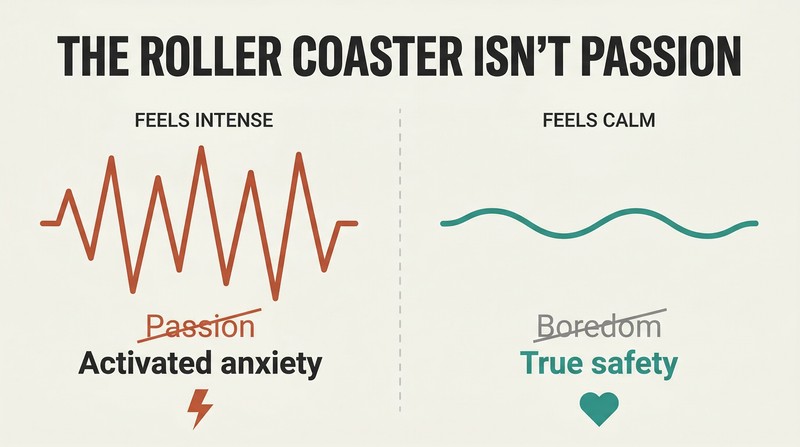
When you date someone avoidant, their mixed signals trigger your attachment system — the brain mechanism monitoring your partner's availability. You feel anxious, then they make a sweet gesture and you're elated. The highs and lows feel intoxicating. You mistake the roller coaster for passion.
Chloe rejected Trevor — a handsome, stable, secure man — because "the spark was missing." Her attachment system stayed calm, and she interpreted peace as boredom. She later married Tony, who constantly put her down. After years of agony, she divorced him and eventually found a loving secure partner. The lesson: when your attachment system is quiet with someone new, don't dismiss the calm as lack of chemistry. A peaceful relationship signals safety — exactly what your biology was designed to seek.
Avoidants flood the dating pool because secures leave it fast
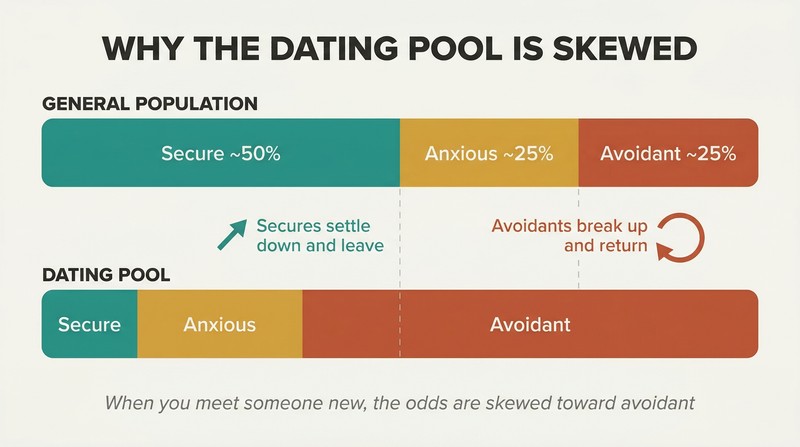
The math of dating is rigged against you. Three facts create a statistical trap:
1. Avoidants end relationships more often and suppress feelings quickly, cycling back into dating fast
2. Secure people settle down and stay in long-term relationships, disappearing from the pool
3. Avoidants almost never date each other — one study couldn't find a single avoidant-avoidant couple
The result: when you meet someone new, the probability they're avoidant is far higher than their 25% share of the population. The authors recommend the abundance philosophy — dating many people simultaneously to increase your odds of encountering someone secure. By spreading your attention, you also desensitize your attachment system and evaluate prospects more objectively.
Avoidants sabotage love with deactivating strategies they can't see
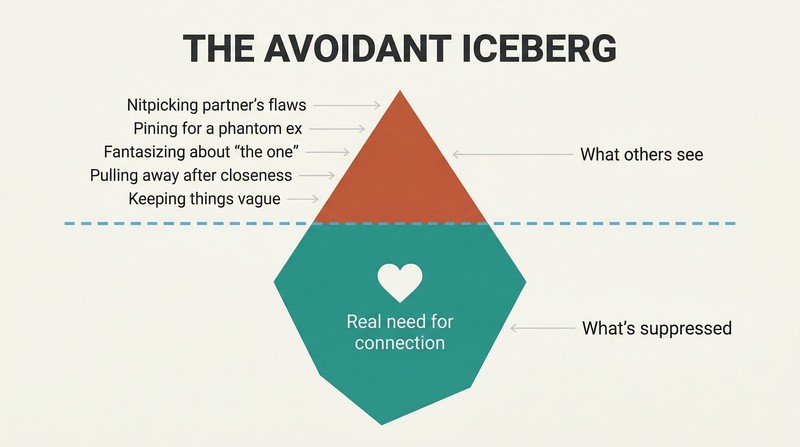
Avoidants use unconscious techniques to suppress intimacy, called deactivating strategies:
1. Focusing on a partner's minor flaws to diminish romantic feelings
2. Pining for a phantom ex — an idealized former partner who blocks new closeness
3. Fantasizing about "the one" who will make everything effortless
4. Pulling away after moments of genuine connection
5. Keeping things deliberately vague — not saying "I love you," leaving plans unclear
Experiments prove these defenses are just that — defenses. When avoidants were distracted by a puzzle, they reacted to words like "separation" and "loss" as quickly as anyone else. Their need for connection is real but actively suppressed. Carole broke up with Bob over his perceived flaws, only to mourn months later that he was the best partner she'd ever had.
When every fight is really about closeness, you're in the anxious-avoidant trap
The anxious-avoidant trap is a self-reinforcing cycle. The closer the anxious partner pushes, the more the avoidant retreats — and that retreat triggers even more frantic pursuit. Janet and Mark fought bitterly over buying a washing machine, but the real issue was that Janet (avoidant) spent weekends doing laundry at her sister's to create distance, while Mark (anxious) wanted the machine so she'd stay home.
The trap manifests as a chronic roller coaster: rare closeness feels euphoric, then withdrawal creates renewed despair. Arguments seem to be about trivial things — sleeping arrangements, Facebook friends, weekend plans — but every fight is secretly about how much intimacy each person can tolerate. Without intervention, the anxious partner steadily loses ground with each clash.
Date a secure partner — their stability is contagious
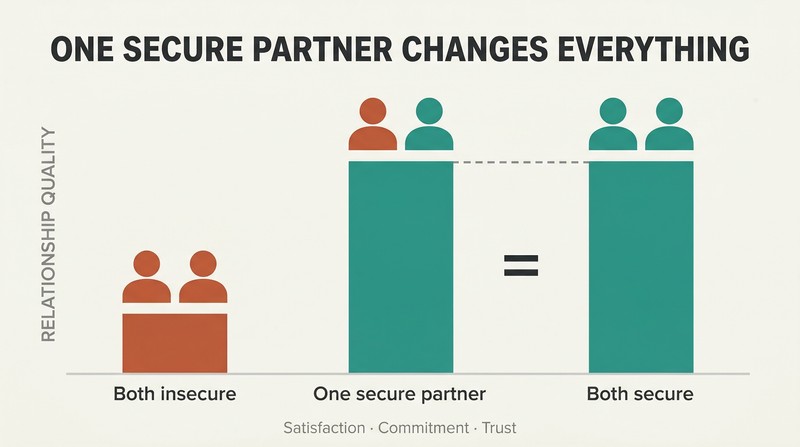
Secure people are relationship multipliers. In Patrick Keelan's University of Toronto study, secure individuals maintained high satisfaction, commitment, and trust over four months — while insecure individuals saw all three decline. More remarkably, couples with just one secure partner functioned as well as couples where both were secure, and far better than fully insecure pairs.
Secures come in every personality type — introverted engineers, social-butterfly producers — but share invisible traits: they expect love, communicate without games, forgive readily, and treat their partner's well-being as their responsibility. During the transition to parenthood, anxiously attached women moved toward security when their partners were available and supportive. Secure people aren't boring — they're what the authors call the "supermates" of evolution.
Express your needs without apology — the response reveals everything
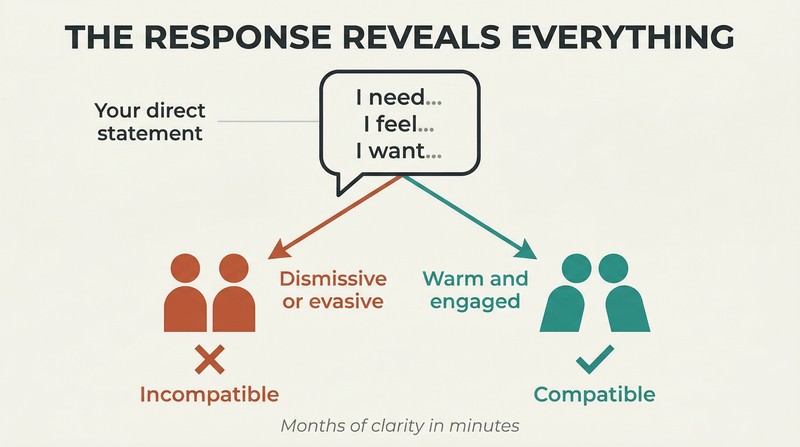
Effective communication means stating needs directly, specifically, and blame-free — using "I need," "I feel," and "I want" instead of accusations. The five principles: be emotionally brave, focus on your needs, be specific, don't blame, and be assertive without apologizing for what you need.
Lauren was confused by Ethan's no-touch policy after three dates. She asked directly: "I'm looking for more than something platonic. What do you have in mind?" His evasive response told her everything — saving months of false hope. Jena told first dates she wanted marriage and kids immediately. Most fled, but she found Nate, who wanted the same. Whether the response is warm or dismissive, direct communication delivers clarity that game-playing never will. A partner's willingness to engage speaks volumes about compatibility.
Plan your breakup like a mission — your biology will fight you
Leaving a bad relationship is neurologically brutal. Researcher Myron Hofer found that when rat pups were separated from their mothers, no single substitute — warmth, food, or touch — relieved all distress symptoms. Only reunion with the mother did. Humans work identically: after a breakup, your attachment system floods you with positive memories while suppressing the bad ones.
The authors recommend tactical preparation:
1. Build a support network before leaving — tell friends what your relationship is really like
2. Write down every reason you're leaving; consult the list when nostalgia strikes
3. Stay with family or close friends the first nights
4. Don't shame yourself for wanting to return — the pain is real, not weakness
5. Remember: no matter how much it hurts now, it will pass
You can rewire your attachment style by studying secure people around you
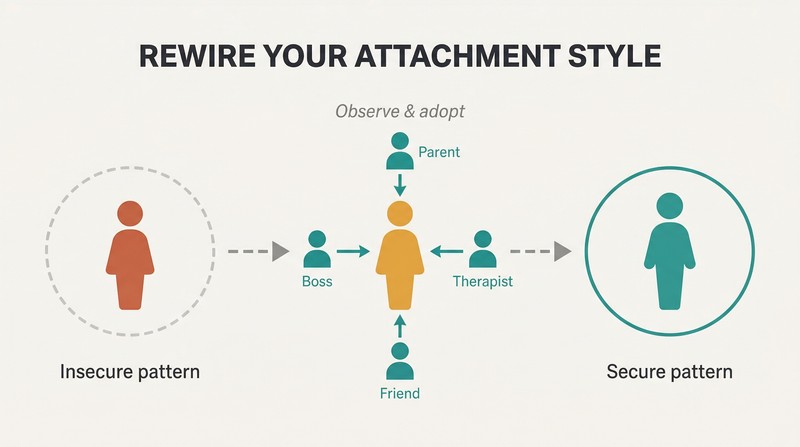
About 25 to 30% of adults shift attachment styles over time, and romantic relationships are the most powerful catalyst. Security priming — recalling experiences with secure people in your life — can help move anyone toward greater security. The authors recommend identifying an integrated secure role model: a parent, friend, boss, or therapist whose relationship behavior you admire, then consciously adopting their responses.
Georgia and Henry were trapped in an anxious-avoidant cycle of missed phone calls and mutual resentment. Each analyzed their working models — their core beliefs about relationships — through a relationship inventory. Henry realized ignoring his wife's calls compounded her anxiety. Georgia saw her protest behavior pushed him further away. Their elegant solution: a pre-written "thinking of you" text. Small shifts, practiced consistently, accumulate into genuine transformation.
Analysis
Attached represents perhaps the most successful bridge between academic attachment theory and popular relationship advice since Bowlby's original work. Levine and Heller's genuine innovation isn't the science — attachment theory has been validated in hundreds of peer-reviewed studies — but the radical practical claim that you should screen romantic partners by attachment style the way you'd screen for shared values or life goals. This reframes dating from a mysterious, feeling-based process into a partially diagnostic one.
The framework's elegance is also its limitation. Sorting all romantic behavior into three categories risks becoming a Barnum effect generator — people see themselves everywhere. The book acknowledges the two-dimensional spectrum (anxiety × avoidance) but reverts to categorical language for accessibility, which can encourage readers to weaponize labels ("He's avoidant, so he'll never change") rather than use them as starting points for growth. The "earned secure" pathway — developing security through therapy or transformative relationships — deserves more clinical depth than the single chapter it receives.
The strongest scientific contributions are genuinely illuminating: the Coan hand-holding fMRI study, the dating-pool statistics that explain why anxious people keep meeting avoidants, and the word-recognition experiments proving avoidants suppress (rather than lack) attachment needs. The dependency paradox — that secure dependence enables greater independence — is both empirically robust and culturally subversive in a society that fetishizes self-sufficiency. The weakest moments arise when attachment theory is asked to explain everything: every fight, every ex, every hesitation gets filtered through three categories, occasionally crowding out other legitimate relationship variables like communication skills, values alignment, or life circumstances.
Ultimately, the practical toolkit — effective communication, the abundance philosophy, smoking guns, the relationship inventory — represents genuine clinical wisdom accessible to non-clinicians. For the millions navigating modern dating with only gut instinct and contradictory advice, this framework is more useful than almost anything else available.
Review Summary
Attached receives mixed reviews. Many readers find it insightful and life-changing, praising its explanation of attachment styles and relationship dynamics. They appreciate the practical advice and examples provided. However, some criticize its simplistic approach, heteronormative focus, and perceived bias towards anxious attachment styles. Critics also note the lack of diverse relationship examples and question the universal applicability of the attachment theory framework. Despite these criticisms, many readers still find value in the book's core concepts and relationship advice.
People Also Read





Glossary
Attachment system
Brain mechanism for partner bondingThe biological mechanism in the brain responsible for creating and regulating connection with attachment figures—parents, children, and romantic partners. It consists of emotions and behaviors designed to keep us close to loved ones. When the system detects threats to a relationship, such as a partner's unavailability or rejection cues, it activates and triggers behaviors aimed at reestablishing closeness.
Activating strategies
Thoughts compelling closeness-seekingThoughts, feelings, and behaviors that compel a person—typically someone with an anxious attachment style—to seek closeness with their partner when their attachment system is triggered. Examples include obsessive thinking about the partner, remembering only their positive qualities, putting them on a pedestal, and believing this relationship is your only chance at love. These strategies persist until the partner provides clear reassurance.
Deactivating strategies
Behaviors suppressing intimacy needsBehaviors and thought patterns used—typically by avoidant individuals—to suppress the attachment system and maintain emotional distance from a partner. Common examples include focusing on a partner's flaws, pining for an idealized ex (phantom ex), fantasizing about 'the one,' avoiding physical closeness, pulling away after intimate moments, keeping plans and feelings vague, and mentally checking out during conversations.
Protest behavior
Actions to regain partner's attentionAny action taken to reestablish contact with a partner and get their attention when the attachment system is activated. Common forms include excessive calling or texting, withdrawing or giving the silent treatment, threatening to leave, acting hostile, trying to provoke jealousy, and pretending to be busy or unavailable. Unlike effective communication, protest behavior rarely addresses the underlying concern directly.
Dependency paradox
Secure dependence enables independenceThe counterintuitive attachment theory principle that the more effectively dependent two partners are on each other—the more they serve as each other's secure base—the more independent, confident, and daring each partner becomes in pursuing goals and exploring the world. Named for its paradoxical logic: thorough dependence on one person produces greater autonomy, not less.
Secure base
Emotional anchor enabling explorationThe emotional anchor provided by an available, responsive attachment figure. When a person knows they can reliably turn to someone for support and comfort, they gain the confidence to explore, take risks, and engage fully with the world. First observed by Mary Ainsworth in the strange situation test, where infants explored freely only when their mother was present in the room.
Phantom ex
Idealized ex blocking new intimacyA deactivating strategy in which an avoidant individual idealizes a former romantic partner, remembering only their positive qualities after the relationship ended. This fixation blocks intimacy with current or potential new partners by making them seem inadequate in comparison. The avoidant typically cannot articulate why the previous relationship actually ended or recall their role in its failure.
Anxious-avoidant trap
Self-reinforcing pursuit-withdrawal cycleA self-reinforcing relationship dynamic where one partner (anxious) seeks increasing closeness while the other (avoidant) withdraws to maintain distance. Each partner's coping behavior amplifies the other's insecurity: the anxious partner's pursuit triggers the avoidant's retreat, and the avoidant's withdrawal triggers escalating attempts to reconnect. The result is chronic dissatisfaction where real issues go unresolved.
Effective communication
Direct, blame-free need expressionA specific approach to expressing relationship needs defined by five principles: emotional bravery, focus on your own needs (using 'I need/feel/want' statements), specificity about what bothers you, avoiding blame, and being assertive without apologizing. In the book it serves dual purposes: maintaining healthy relationships and as a litmus test for whether a potential partner can meet your attachment needs.
Working model
Core beliefs about relationshipsA person's fundamental belief system about romantic relationships, including expectations, assumptions, and default emotional reactions. Working models are shaped by attachment experiences and determine how you interpret a partner's behavior, what triggers your attachment system, and how you respond to conflict. The book's relationship inventory exercise helps people identify and reshape working models toward greater security.
Smoking guns
Early avoidant warning signsSignals early in dating that strongly indicate a potential partner has an avoidant attachment style. Key indicators include sending mixed messages about commitment, longing for an ideal partner while hinting it won't be you, disregarding your emotional well-being, suggesting you are 'too needy,' ignoring things you say that inconvenience them, and responding to your feelings factually rather than empathically.
Abundance philosophy
Dating many to find securityA dating strategy recommended for people with an anxious attachment style, involving dating multiple people simultaneously rather than fixating on one person early. This desensitizes the attachment system so it doesn't get hijacked by a single prospect, prevents premature emotional investment, enables more objective evaluation, and increases the statistical probability of meeting someone with a secure attachment style.
FAQ
What's "Attached: The New Science of Adult Attachment and How It Can Help You Find and Keep Love" about?
- Overview of Attachment Theory: "Attached" by Amir Levine and Rachel Heller explores how adult attachment styles—secure, anxious, and avoidant—affect romantic relationships.
- Purpose of the Book: It aims to educate readers on applying attachment theory to improve relationship satisfaction and dynamics.
- Practical Advice: The book provides tools to identify your own and your partner's attachment styles, offering strategies for healthier relationships.
Why should I read "Attached" by Amir Levine?
- Understanding Relationships: Gain insights into your relationship patterns and those of your partner, helping to address attachment-related issues.
- Practical Strategies: Offers techniques for improving communication and resolving conflicts, enhancing emotional connections.
- Personal Growth: Encourages self-reflection and empowers you to take control of your relationship happiness.
What are the key takeaways of "Attached"?
- Attachment Styles Matter: Understanding secure, anxious, and avoidant styles can help navigate relationships more effectively.
- Effective Communication: Emphasizes the importance of clear communication to meet relationship needs and avoid misunderstandings.
- Self-Awareness and Growth: Encourages self-awareness and personal growth to improve relationship satisfaction.
How does "Attached" define the three main attachment styles?
- Secure Attachment Style: Comfortable with intimacy, warm, and loving, with effective communication skills.
- Anxious Attachment Style: Craves closeness and reassurance, often preoccupied with the relationship, leading to potential conflicts.
- Avoidant Attachment Style: Values independence, struggles with intimacy, and may keep emotional distance from partners.
How can I identify my attachment style according to "Attached"?
- Self-Assessment Questionnaire: The book provides a questionnaire to determine your attachment style based on behaviors and feelings.
- Key Indicators: Highlights traits like comfort with intimacy or sensitivity to rejection associated with each style.
- Reflect on Past Relationships: Analyzing past patterns can offer insights into your attachment style.
What advice does "Attached" offer for someone with an anxious attachment style?
- Acknowledge Your Needs: Recognize and accept your need for intimacy and security as legitimate.
- Avoid Avoidant Partners: Steer clear of partners with avoidant styles who may exacerbate anxieties.
- Effective Communication: Practice clear communication to express needs and assess if your partner can meet them.
How does "Attached" suggest dealing with an avoidant attachment style?
- Identify Deactivating Strategies: Recognize behaviors that distance you from your partner, like focusing on their flaws.
- Seek Secure Partners: Find partners with secure styles who can help you feel more comfortable with intimacy.
- Challenge Negative Beliefs: Work on changing thought patterns that undermine closeness, like fearing dependency.
What is the "dependency paradox" mentioned in "Attached"?
- Definition of the Paradox: Suggests that effective dependency fosters greater independence and daring in individuals.
- Implications for Relationships: Embracing this paradox creates a secure base, allowing partners to explore and take risks.
- Application in Real Life: Encourages viewing dependency as beneficial, enhancing individual growth and relationship satisfaction.
How can effective communication improve relationships according to "Attached"?
- Importance of Communication: Crucial for expressing needs and resolving conflicts, fostering understanding and connection.
- Strategies for Communication: Offers techniques like using "I" statements and avoiding blame to create a safe dialogue space.
- Benefits of Communication: Strengthens emotional connection, trust, and mutual respect, leading to a more secure relationship.
How does "Attached" suggest dealing with the anxious-avoidant trap?
- Understanding the Trap: Occurs when one partner craves closeness while the other seeks distance, leading to conflict.
- Strategies for Escaping: Suggests effective communication, setting boundaries, and fostering self-awareness.
- Importance of Mutual Effort: Both partners must be willing to change and compromise for a healthier relationship dynamic.
What role do secure role models play in "Attached"?
- Definition of Secure Role Models: Individuals who demonstrate healthy attachment behaviors, serving as examples.
- Identifying Role Models: Encourages identifying secure role models in life for guidance on secure relationships.
- Incorporating Role Model Behaviors: Adopting their behaviors helps develop a more secure attachment style.
What are the best quotes from "Attached" and what do they mean?
- "Your attachment needs are legitimate." Emphasizes recognizing and validating one's needs in a relationship.
- "A relationship...should make you feel more self-confident." Highlights the positive impact of a secure relationship on well-being.
- "Remain true to your authentic self." Advises against manipulative tactics, promoting authenticity for lasting happiness.
Download PDF
Download EPUB
.epub digital book format is ideal for reading ebooks on phones, tablets, and e-readers.








































