
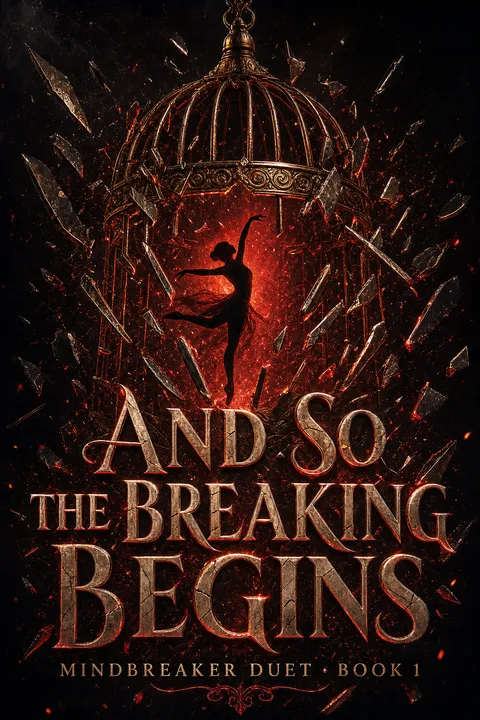


Plot Summary
Prologue
In Thalvireth Palace, Vaeron2 is roused in the dead of night by his sister, Korona Iaoth,6 and her husband, Koron Stadiel.7 The Demons have declared war. Iaoth6 commands her brother,2 the realm's most feared hunter, to track down and capture the pacifist Elessarum's most powerful Seers, killing any too weak to be useful.
Numb and obedient, he takes the scroll and rides out, a weapon aimed by his sister's hand. Left alone, the monarchs reveal their true design: not defense of the realm, but the total extermination of the red-eyed Demon race and the erasure of their dark magic from the continent, all cloaked in the Goddess's holy will.
The prologue establishes the machinery of coercion that powers the entire novel. Vaeron enters shirtless, dragged from bed, a grown warrior still reduced to a tool by kin. The scene frames the central irony: a holy war rebranded as genocide, obeyed by a hunter who privately loathes his leash. By showing the monarchs plotting extermination while invoking their deity, the author denies readers a clean moral side and insists on the gray. It also plants Vaeron's fracture, obedience bought through fear, before we meet the woman who will crack it open. Crucially, power here is intimate, exercised through family rather than armies.
The Mindbreaker's Hunt Begins
Sylaira,1 a Seer among the peace-loving Elessarum, has drugged her mind with virelthorn since childhood to silence horrific visions, ever since a first prophecy revealed a gray-haired, scar-browed male destined to be her mate.2 When her friend Heraphia3 foresees royal hunters closing in on their lake-country hideout, Sylaira1 flees with Heraphia3 and her noble husband Zuriel.4
Racing through the trees, Sylaira1 glimpses the rider leading the pursuit and recognizes those glacial eyes: the Issaraeth,2 the crown's most feared hunter, the man blamed for slaughtering her parents. He is her mate. The three plunge across an icy river and take flight to escape, abandoning their captured kin, while Sylaira1 reels from the cruelest revelation of her life.
The opening fuses romance and horror by making the beloved the predator. Sylaira's virelthorn addiction dramatizes a modern impulse: medicating away foresight because knowledge itself is trauma. Her refusal to See is a refusal of complicity, a pacifist's attempt to keep her hands clean in a world of ritualized slaughter. The recognition scene inverts the fated-mate fantasy, turning divine blessing into doom. Note how the Elessarum's nonviolence is coded as both moral and fatally impractical, a tension the book will keep interrogating. Flight, not fight, is their only grammar, and the abandonment of others already seeds the guilt that will drive Sylaira's arc.
When Their Eyes Meet
Vaeron2 tracks Sylaira1 alone into the Skala Mountains, deliberately prolonging the chase because, for once, the hunt makes him feel alive. He toys with her for days as she starves and flees toward a mountain temple. When she tumbles into a ravine and shatters her kneecap, he Commands her to freeze in midair.
But the instant their gazes finally lock, the mating bond detonates through them both. Vaeron2 realizes the powerful Seer he was ordered to capture1 is the mate the Goddess promised him. Sylaira,1 sealed forever to the monster she loathes, crumples in despair. He cuffs her in bronze, choking off her magic, and carries her away, both of them undone by a fate neither chose.
The bond snaps at the exact moment of maximum violation, capture, injury, forced Command, which encodes the book's most uncomfortable thesis: intimacy and domination are entangled from the start. Vaeron's choice to savor the chase exposes a starved inner life; cruelty is the only sensation his conditioning permits. For Sylaira, the sealing is a violation of autonomy that mirrors the crown's larger project of turning bodies into instruments. The shattered knee is symbolically precise, it maims the dance, her one arena of self-authorship. This is the point of no return, after which loathing and longing become inseparable, and the slow burn of coerced proximity begins.
The Captive and the Dancer
Vaeron2 flies the wounded Sylaira1 to a healer in the town of Stadur, refusing to let anyone else touch her, and confesses the bond to his loyal second, Maelsar.5 As they travel toward the capital by wagon, an uneasy intimacy grows. He learns she trained as a first-class dancer and, guilt-ridden that his chase ruined her knee, begins working her leg each night so she might perform again.
When roadside bandits try to seize her for bounty, Vaeron2 butchers them without hesitation, protecting what is his. Sylaira1 is horrified by the ease of his violence, yet unnerved to feel safer than she has in years. Her hatred, so certain at first, begins to fracture against his relentless, possessive care.
This section performs the enemies-to-lovers alchemy through the body: the man who broke her knee now kneels to heal it. The nightly physical therapy is a courtship disguised as penance, touch reframed as devotion. The bandit massacre is a deliberate destabilizer, forcing Sylaira and the reader to hold two truths, that Vaeron is a killer and that his violence shields her. Dance emerges as the story's key symbol of selfhood; his investment in her recovery signals that he values her personhood, not just her power. The road becomes a liminal space where identities loosen, and Sylaira's pacifist certainties start to blur into ambivalent desire.
The Virelthorn Pact
Catching Sylaira1 swallowing leaves, Vaeron2 assumes she means to kill herself and Commands her to open her mouth and give them up. Then he learns the truth: virelthorn suppresses her Sight, which she dreads more than death because her visions show only slaughter and ruin.
Moved, he vows to keep supplying the herb so she never has to See, on one condition, that she fake occasional prophecies to satisfy his sister the Korona.6 Desperate to remain blind to the future, Sylaira1 agrees to trust him. In the inns along the road they grow closer, sharing a bed, a first kiss, and confessions, including the words carved into his chest by his brutal father: duty above all.
The pact converts a substance of avoidance into a currency of trust, and quietly into a mechanism of control. Vaeron's panic at her assumed suicide reveals how thoroughly the bond has rewired his priorities, yet his solution still routes through management of her body and mind. The scar reveal humanizes the monster: he too was carved into a weapon by a cruel patriarch, his will literally overwritten. Their mirrored trauma, both engineered by others into instruments, becomes the ground of empathy. The first kiss lands not as triumph but as danger, since every tenderness deepens Sylaira's fear that surrender means self-erasure, the very fate she has always fled.
Betrothal at Thalvireth
They reach Thalvireth Palace, seat of the Angel monarchs. Vaeron2 presents Sylaira1 as a captured Seer to his sister, Korona Iaoth,6 without disclosing their bond. Then the trap springs: Dasha,9 daughter of the powerful Herr Elyriane,8 sweeps forward and kisses Vaeron,2 claiming him as her betrothed.
The marriage was arranged by Iaoth6 and her husband, Koron Stadiel,7 to secure the throne, and Vaeron2 never warned Sylaira.1 Feeling betrayed all over again, she is escorted into the Seer's wing while he is hauled off to answer for his outburst. The tender man from the road vanishes behind the cold mask of the Issaraeth,2 and Sylaira1 renews her vow to guard her heart from ever being broken by him.
The betrothal reveal is a structural rhyme with the opening: another moment where Sylaira's trust is punished by concealment. It exposes Vaeron's fatal flaw, an omission-by-duty that he rationalizes as protection, which will detonate again at the climax. The palace itself becomes a character, a gilded panopticon where every kindness is surveilled and weaponized. Iaoth's arrangement of Dasha shows how the monarchy trades bodies for political capital, positioning both women as pawns. Sylaira's retreat into defensive hatred is psychologically apt, a survivor rebuilding walls the instant safety proves conditional. The road's fragile intimacy is revealed as a bubble that court politics immediately punctures.
The Seer's Gilded Cage
In the Seer's wing Sylaira1 reunites with Heraphia,3 now hollowed out by forced prophecy, while Zuriel4 has been shipped to the war front. Learning the palace intends to drug and drain them, the two friends attempt to fly free into the forest, but the mating bond tears at Sylaira1 with agony until Vaeron2 overtakes them.
Rather than punish, he gently guides them back and hides the escape from Iaoth.6 That night Sylaira1 dreams she meets the Goddess herself, who insists she stop rejecting her Sight, names her an instrument of change, and warns that peace will demand a terrible sacrifice. Sylaira1 wakes shaken, certain only that her cage has no exit and her deity offers riddles, not mercy.
The reunion reframes captivity through female solidarity, Heraphia as the sister whose deterioration measures the crown's cruelty. The failed flight literalizes the bond as a leash: love as physiological captivity, an unsettling metaphor for how attachment can shackle. Vaeron's mercy, hiding their crime, marks his shifting loyalties from sister to mate. The Goddess dream introduces theological ambiguity: is Sight a gift or a curse, and is the deity benevolent or manipulative? Her demand for sacrifice foreshadows the cost of peace and pressures Sylaira's pacifism from the divine level. The scene deepens the book's interrogation of faith as another system that conscripts individuals toward ends they did not choose.
Drugged Prophecies, a Dead Seer
Iaoth6 forces the Seers onto crystal chairs, plying them with smoke, stones, and drugs to wring visions of the war from them. Sylaira1 secretly chews virelthorn and, using battlefield details Vaeron2 feeds into her mind, fabricates convincing prophecies to escape suspicion.
But the demands grow crueler by the day, and one overtaxed Seer convulses and burns out, dying on the atrium floor while Iaoth6 laments only that she failed to steal the woman's final vision. Watching a peer perish for output, Sylaira1 grasps that the monarchs treat Seers as livestock, prized for yield, not life. Her dread curdles into something colder, a slow-gathering rage at the crown that no amount of herb can quiet.
The atrium sequence is the novel's clearest indictment of extractive power: bodies mined for prophecy until they break, a resource logic that recalls how war machines consume the vulnerable. Sylaira's fabricated visions make her complicit in the war effort she abhors, tightening the moral vise, there is no clean position inside the cage. The Seer's death is the first concrete casualty of the crown's methods, and it converts Sylaira's fear into political anger. The crystal chairs, ostensibly altars, are revealed as instruments of slow execution. Here the book pivots its heroine from avoidance toward reckoning, planting the seed of the storm she vows to become.
The Ball's Shattering Reveal
At a lavish ball celebrating Vaeron's2 coming vows and the new Seers, Sylaira1 is displayed like a jeweled trophy. Vaeron2 is made to dance with Dasha9 while Herr Elyriane8 pulls Sylaira1 onto the floor and grips her painfully. When she cries out, Vaeron2 snaps, unleashing a Command that freezes every Angel in the ballroom, then beats Elyriane8 bloody and roars to the assembled court that Sylaira1 is his fated mate.
The secret detonates in public. Stadiel7 and Iaoth,6 humiliated and furious, drag him away. The betrothal to Dasha9 collapses instantly, but Vaeron2 has bared his one weakness before the realm's most predatory nobles, and the monarchs now intend to make him pay in blood.
The ball is the third-act external escalation, where private bond becomes public liability. Vaeron's loss of control, freezing hundreds to shield one woman, is both grand romantic gesture and strategic catastrophe, dramatizing how love shatters the disciplined weapon his father forged. The dance floor, Sylaira's sacred space, becomes the site of her violation and his rupture, tying the personal to the political. Exposing the mate bond hands the monarchs exactly the leverage they crave, confirming Iaoth's earlier warnings. The scene marks the collision of Vaeron's two duties, to the crown and to Sylaira, and forces a choice that the following chapters will exact at a terrible price.
Throw the Fight or Lose Her
Behind closed doors, Stadiel7 and Iaoth6 dictate the terms. To restore Elyriane's8 wounded honor, Vaeron2 must face the man in a sacred trial by light and deliberately lose, submitting to a bronze blade that will lock away his magic, then be exiled to the war front. If he wins, Sylaira1 becomes Stadiel's7 personal property forever.
Vaeron2 agrees to throw the fight, the only path that keeps her at his side, and bargains for permission to bring her and Heraphia3 to the front. Returning to Sylaira,1 he confesses everything, explains why he hid the betrothal, and swears to protect her at any cost. Exhausted and grieving her lost freedom, she finally chooses to believe him.
The rigged trial crystallizes the book's theme of engineered defeat: Vaeron must perform weakness to survive, echoing a lifetime of manufactured obedience. The monarchs weaponize sacred ritual, exposing religious institutions as instruments of political control rather than divine justice. Sylaira's decision to trust despite prior betrayal is the emotional hinge, an act of will over evidence that both redeems and endangers her. Note the recurring bargaining logic: every scrap of freedom is purchased with future submission. The chapter reframes the coming trial not as spectacle but as sacrifice, and sets up the cruel irony that winning could be as ruinous as losing, foreshadowing the climax's collapse of the rules.
The Sacred Claiming Night
With the truth laid bare, Sylaira1 asks Vaeron2 to start over and gives herself to him willingly. He claims her fully, consummating the mating bond in a union that rewrites both their souls and finally quiets the ravenous chain between them. For the first time she sleeps without terror, cradled against the man she once swore to destroy.
Yet even in the afterglow guilt gnaws at her, the sense that she has betrayed her murdered parents and her Elessarum vows by loving the crown's executioner. Vaeron,2 meanwhile, admits to himself that he loves her not merely because of the bond but because of her fierce, unbreakable defiance, and that there is no line he will not cross to keep her.
Consummation reframes the coerced bond as chosen, Sylaira reclaiming agency by making surrender a decision rather than a fate. The moment she describes as reclamation, opening herself deliberately, converts submission into self-authorship, the book's answer to its own themes of control. Yet the guilt undercuts triumph: love here is inseparable from betrayal of the dead, dramatizing survivor's conscience. Vaeron's private confession distinguishes bond from love, insisting his devotion is earned by her character, not manufactured by magic, a crucial ethical claim in a story about coercion. His vow that no line exists is romantic and ominous in equal measure, foreshadowing that his protective absolutism may become its own kind of violation.
Sent to the Front
Summoned to Stadiel's7 war council, Vaeron2 learns the Demon army is swelling beyond the Angels' strength and that he will lead reinforcements north after the trial. With Maelsar5 and the disguised Elessarum servant Lyriasthe,10 he quietly amasses leverage against the monarchs, uncovering that Elyriane's8 daughter Dasha9 shares Stadiel's7 bed.
Determined to shield Sylaira1 among the ranks, he bonds his auravane's11 mate, Ysolthe,12 to her, so a legendary tracking bird will guard her if he cannot. In a stolen garden hour they share the rare Goddess fruit, and Sylaira1 dares to hope Vaeron2 truly means to end the war and free her, though he refuses to reveal the full shape of his plan.
This section widens the aperture from bedroom to battlefield, reminding us the romance unfolds inside a genocidal war whose logistics, supplies, disease, sheer numbers, the monarchs mismanage while hoarding jewels. Vaeron's covert intelligence-gathering reframes him as a strategist quietly turning against his own house, the abused instrument learning to aim itself. The Ysolthe bond is tender foreshadowing, a contingency for his possible absence, revealing he already anticipates loss. Goddess fruit, an aphrodisiac and rarity, symbolizes stolen sweetness inside captivity. Yet Vaeron's continued secrecy, plans withheld, quietly violates the transparency Sylaira craves, keeping the betrayal engine idling beneath the hope.
Heraphia's Fatal Vision
Iaoth6 escalates to sacrilege, attempting to share her own magic with a Seer to force a stronger prophecy. Heraphia,3 desperate to help her soldier husband Zuriel,4 volunteers. The Korona6 cuts both their palms, mingles their blood, and floods Heraphia3 with power until she convulses in Sylaira's1 arms, foaming and screaming fragments of what she Sees.
In her final breath she tells Sylaira1 she has seen the end, then dies, her aquamarine eyes going still. Iaoth6 mourns only that she could not steal the vision itself. Sylaira1 snaps, slapping and clawing at the Korona6 until Vaeron2 drags her back. The sister of her heart is gone, burned out by the very gift the crown prizes above all.
Heraphia's death is the book's tragic fulcrum, the sacrifice the Goddess foretold, and the moment Sylaira's pacifism becomes untenable. Power-sharing as blood ritual literalizes exploitation: the powerful drain the vulnerable dry in the name of holy war. Heraphia's love for Zuriel, her reason for volunteering, makes her a martyr to devotion, mirroring the coercions that trap every character. Iaoth's callous grief over the lost vision, not the lost life, is the crown's moral bankruptcy in miniature. Sylaira's physical violence against the Korona marks the death of the peaceful girl she was. Grief here is not softening but forging; loss tempers her into a weapon.
Ashes and Resolve
Sylaira1 endures Heraphia's3 funeral as a public spectacle, the court watching to measure her and Vaeron2 before the trial. A priestess prays for peace, as Heraphia3 would have wanted, while the monarchs shamelessly claim the dead woman perished nobly for the war. Sylaira1 lights the pyre herself, kisses her friend's brow, and whispers goodbye.
Something in her hardens into a blade. The pacifist who once refused all violence, who fled rather than fight, is gone. In her place stands a woman who no longer seeks mere survival but reckoning, resolved to become the storm the crown cannot survive and to wield her cursed Sight as the weapon they always wanted, until it chokes them.
The funeral stages grief as propaganda, the monarchs repurposing even mourning into war messaging, which radicalizes Sylaira precisely by profaning what she loves. Lighting the pyre is a rite of passage: she becomes the agent of Heraphia's final release and, symbolically, of her own transformation. The book's title resonates here, breaking as both destruction and remaking. Sylaira's pivot from survival to destruction inverts the Elessarum creed, suggesting that pacifism sustained under tyranny is not virtue but slow surrender. The gathered nobles, watching for weakness, embody a predatory court, while Sylaira's controlled fury signals she has learned its rules. The storm imagery that has trailed her now becomes intention.
Stadiel's Hidden Weapon
The day before the trial, Iaoth6 and Stadiel7 drag Sylaira1 to a forced ritual meant to wring visions from the Seers through coupling and drugs. When she refuses and calls on her light, Stadiel7 seizes her, pressing his hand to the well of her magic, and reveals his terrible secret: he does not merely resist mind magic, he redirects a wielder's own power against them, which is why he holds her helpless and immune to Command.
Vaeron2 explodes into the atrium with Maelsar5 and Lyriasthe,10 Commanding everyone away from his mate and freeing her. But Stadiel7 warns that Vaeron2 must still perform his humiliating defeat at the trial, or Sylaira1 is forfeit. She collapses afterward, gutted by memories of Heraphia.3
Stadiel's revealed ability, turning others' power against themselves, is the perfect villainous metaphor for the whole regime: it thrives by weaponizing its subjects' own strengths, exactly what it does with Seers, hunters, and soldiers. It also explains his throne, power sustained not by force but by parasitic redirection. The scene raises the stakes to their peak, establishing that even Vaeron's fearsome Command cannot touch the Koron, so brute magic will not save them. Sylaira's collapse into flashback shows trauma compounding, Heraphia's death now haunting every threat. The rescue reaffirms the alliance of Vaeron, Maelsar, and Lyriasthe as the nascent rebellion, even as the trial's rigged terms remain immovable.
Vows Beneath the Goddess Moon
On the night of the trial, under a swollen Goddess Moon, Vaeron2 carries Sylaira1 to the crown of an ancient tree. There, for the first time since her injury, she dances, gliding through the steps at his side without pain, weeping at the return of the one joy the crown could not steal.
He kneels, offers a ring bearing his house sigil, and tells her he loves her, not for the bond but for who she is. She accepts, but exacts a single vow in return: that he never again keep the truth from her. He swears it. Then a gong tolls across the forest, and the moment of stolen peace ends, summoning them both down to the reckoning.
The treetop scene is the emotional apex, restoring Sylaira's dance, her lost autonomy, through the very man who broke her, completing the healing arc begun on the road. Dancing without pain is literal recovery and symbolic reclamation of self. Vaeron's kneeling proposal, using the Elessarum gesture of the heart, signals his conversion toward her values, a hunter adopting a pacifist's rite. Yet the scene is laced with dramatic irony: her demand for total honesty, and his easy vow, sit atop a secret he is already keeping. The tolling gong yanks tenderness into dread. The author suspends peace precisely to sharpen the coming shatter, making joy the setup for devastation.
The Trial's True Price
Forced to throw the trial, Vaeron2 faces Elyriane8 while the hunter Calrien14 holds a blade to Sylaira's1 back to guarantee compliance. When she is stabbed, Vaeron2 loses control, unleashes a storm of magic, and the Goddess's light judges him the true victor, exactly what the monarchs forbade.
Chaos erupts as guards swarm; Vaeron,2 Maelsar,5 and Lyriasthe10 fight to escape, and he presses a dagger into Sylaira's1 hand, begging her to protect herself. Then her body seizes. A vision rises that no virelthorn should ever have allowed, and in Vaeron's2 utter lack of surprise she reads the unbearable truth: he has been secretly priming her to See all along. As betrayal and darkness swallow her, Sylaira1 finally Sees the end.
The climax collapses the rigged rules the entire third act erected: Vaeron cannot lose because love overrides the leash, and the Goddess's verdict overrides the monarchs' script, a triumph that is also a trap. The stabbing that breaks his control mirrors the ball, confirming Sylaira as the reliable detonator of his discipline. Then the final gut-punch reframes every tender act: his protectiveness curdled into the same coercion his father and sister practiced, honesty vowed and immediately voided. The betrayal fulfills the Goddess's warning of sacrifice and the book's title, breaking Sylaira anew. Ending on the withheld vision weaponizes the cliffhanger, making the reader crave what she was denied the right to know.
Analysis
And So The Breaking Begins is a dark romantasy that uses the fated-mate trope to interrogate coercion, the book's explicit thematic core. Nearly every relationship is a study in control: a father who carves obedience into his son's flesh, a sister who threatens to erase memories,6 a king who redirects others' power against them,7 and a Goddess who demands sacrifice while withholding answers. Against this, the central romance asks an uncomfortable question, whether love engineered by destiny, deepened through captivity, and expressed through possession can ever be freely chosen. Lehotzky refuses easy answers, letting tenderness and violation share the same gestures. The recurring motif of the cage, silver bars in Sylaira's1 visions, bronze cuffs, gilded palace walls, insists that her captors include the man who loves her most. Sylaira's1 arc is the novel's spine: a pacifist raised to flee, who medicates away foresight to keep her hands clean, is slowly stripped of the illusion that neutrality is virtue under tyranny. Grief, not romance, completes her transformation; Heraphia's3 death converts survival into resolve, and the peaceful girl becomes the storm. This reframes pacifism not as cowardice but as a luxury the powerless cannot afford, a pointed political argument embedded in fantasy. Vaeron's2 counter-arc, the weapon learning to aim itself, mirrors hers, both instruments seeking authorship of their own wills. Dance recurs as the symbol of that autonomy, and its loss and restoration chart the emotional recovery. The ending weaponizes the reader's investment: the very trust and protection the story built become the mechanism of betrayal, fulfilling both the title and the Goddess's warning. The takeaway is bracing, that breaking can be destruction or remaking, and that reclaiming power sometimes requires becoming the thing your captors feared.
Characters
Sylaira
Defiant pacifist SeerThe narrator of half the book, Sylaira is an Elessarum Seer with ice-blue eyes, the rarest and most powerful color, marking her as a prize the crown would kill to own. A first-class Vaelaï dancer, she finds in movement the only freedom her cursed foresight cannot poison. She has medicated her visions with virelthorn since childhood because they show only death, and she equates Sight with damnation. Fiercely stubborn, sharp-tongued, and loyal to her friend Heraphia3 above all, she weaponizes words when she cannot fight. Psychologically she is a survivor shaped by flight and hiding, terrified of losing herself, of surrender, of the cage. Her arc traces the erosion of her pacifism as grief and captivity temper her into something harder and more dangerous.
Vaeron
The feared MindbreakerKnown as the Issaraeth, Vaeron is the Korona's6 brother and the realm's most dreaded hunter, wielding a Command power that shatters and bends minds. Iron-gray hair and a scarred brow mark a lifetime of violence. Beneath the emotionless weapon lies a broken man, carved by a cruel father into an instrument whose chest bears the literal creed duty above all. He obeys his sister6 out of fear and a starved need for the family he has left. Meeting his fated mate1 cracks the ice around long-buried feeling, awakening obsession, protectiveness, and a capacity for love he was taught to forbid himself. Psychologically he embodies the abused become the enforcer, and his central conflict is whether devotion can override a lifetime of conditioned obedience, and whether his protection is love or control.
Heraphia
Sylaira's beloved friendA gentle Seer with aquamarine eyes and pearlescent hair, Heraphia is Sylaira's1 chosen sister, bonded since childhood. Married to the noble Zuriel4, she is the emotional anchor whose foresight has repeatedly saved their group from capture. Unlike Sylaira1, she does not suppress her visions, and the constant burden of Sight wears her thin. Kind, artistic, and devoted, she clings to faith in the Goddess and to hope for reunion with her husband4 as her twin lifelines.
Zuriel
Noble-born Elessarum husbandHeir to House Ilythari, Zuriel abandoned his noble obligations for love of Heraphia3 and a life among the pacifist Elessarum. Regal, measured, and protective, he alone among the fugitives knows how to fight, having been raised for it. His combat training and calm strategic mind repeatedly guide the group's escapes. His deep devotion to Heraphia3 defines him, and his separation from her drives much of the tension around the war front.
Maelsar
Vaeron's loyal secondSecond son of House Caerelith and Vaeron's2 oldest, only trusted friend, Maelsar serves as second-in-command with a Mirror power that disorients enemies. Wry, map-loving, and irreverent, he provides levity and blunt counsel, sparring with Vaeron2 both literally and verbally. His growing attachment to the disguised servant Lyriasthe10 reveals a loyalty that increasingly runs against the crown, making him a key conspirator in Vaeron's2 quiet rebellion.
Iaoth
The brittle KoronaVaeron's2 sister and queen of the Angels, Iaoth wields the power to manipulate memories. Married off young by their father as a political pawn, she has grown cold, paranoid, and cruel, clinging to her fragile position beside Stadiel7. She uses her brother2 as a tool and hoards Seers like pets, valuing their output over their lives. Psychologically she is a victim who became a tyrant, her manipulations learned at a father's knee and honed into blades against her own kin.
Stadiel
The ruthless KoronKing of the Angel Realm, Stadiel seized his throne through cunning and devotion to the Goddess's holy war, which he frames as extermination of the Demons. Cold, strategic, and immune to mind magic through a hidden ability, he treats people as instruments of ambition. He wields both Iaoth6 and Vaeron2 as weapons and hungers to straddle both realms. He is the novel's embodiment of power as parasitic exploitation, ruling through fear and redirection.
Zarethiel
Rival noble, Dasha's fatherHerr Elyriane, head of a powerful house and Stadiel's7 chief political rival, is proud, grasping, and vindictive. He seeks to marry his daughter9 into power and views any slight to his house as intolerable. Wounded in pride by Vaeron's2 actions, he demands satisfaction, positioning himself as the immediate antagonist whose grievance shapes the story's final confrontation.
Dasha
The arranged betrothedBeautiful, alluring daughter of Herr Elyriane8, arranged to marry Vaeron2 to secure the crown's alliance. Confident and possessive of a match she views as advantageous, she becomes an obstacle between the mates and a symbol of the court's transactional marriages.
Lyriasthe
Hidden Elessarum spyA disguised Elessarum working as a servant among the Seers, Lyriasthe possesses Illusion magic and owes her life to Vaeron2 and Maelsar5. Loyal to the peace-loving cause, she serves as their eyes inside the palace, feeding intelligence and quietly protecting Sylaira1 and Heraphia3. Her presence hints at a wider rebellion stirring beneath Thalvireth's polished surface.
Ilae
Vaeron's bonded auravaneA rare, legendary auravane with crystalline, razor-sharp feathers and silver eyes, bonded to Vaeron2 since he saved its clutch. An unrivaled tracker whose keen sight makes escape nearly impossible, Ilae is fiercely selective about whom it allows near.
Ysolthe
Ilae's auravane mateIlae's11 mate, an auravane living in the Sivy aviary who carries messages between realms. Her willingness to accept a new bond becomes a meaningful gesture within the story of chosen protection.
Ithuriel
Zuriel's noble uncleHead of House Ilythari and Zuriel's4 uncle, sworn to the crown yet secretly sheltering the Elessarum on occasion. Torn between obligation and conscience, he embodies the quiet regrets of a noble complicit in a regime he privately questions.
Calrien
Untrusted fellow hunterA hunter under Vaeron's2 command with Amplifier magic, kept at arm's length and increasingly suspected of serving Iaoth's6 interests. His divided loyalties make him a threat within Vaeron's2 own ranks.
Plot Devices
Virelthorn
Herb that silences visionsA bitter, astringent herb Sylaira1 has chewed since childhood to suppress her Sight, which shows her only slaughter and ruin. Her dependence structures her every choice: she guards her dwindling supply like religion, and its absence risks plunging her into prophecy. When Vaeron2 discovers it, the herb becomes both a bargaining chip and a tether, he supplies it in exchange for her cooperation, converting her deepest fear into leverage. It embodies the book's theme of avoidance versus reckoning, and of who controls a woman's mind and body. Throughout the palace chapters it lets her fake prophecies rather than truly See, and its reliability quietly becomes the hinge on which the ending turns.
The mating bond
Fated, inescapable soul-linkAmong Angels, when two destined souls lock eyes the Goddess snaps a bond into place, sharing thoughts, emotions, and sensations across a living tether in the chest. For Sylaira1 it is a curse binding her to her enemy; for Vaeron2 it is the blessing that cracks his frozen heart. The bond punishes separation with physical agony, calms with proximity, and demands consummation to fully seal. It drives the enemies-to-lovers engine, forcing intimacy the characters resist, and blurs the line between destiny and coercion. Because it lets Vaeron2 feel Sylaira's1 pain and slip into her mind, it also becomes a channel of both tenderness and surveillance, love and control indistinguishable.
Command magic
Voice that breaks mindsVaeron's2 Goddess-blessed secondary power, tied to his rare ice-blue eyes, lets a single spoken word override another's will, freeze them, force actions, or shatter a mind entirely, earning him the title Mindbreaker. Inherited as a derivation of his father's will-warping magic, it is the weapon the crown wields him for. Its use recurs as the story's central ethical crisis: every time he Commands Sylaira1, he violates the autonomy she prizes, and he must reckon with whether he will ever use it on her again. His refusal to Command her becomes a measure of his transformation, while its public unleashing at the ball detonates the plot's third act.
Sight and the crystal chairs
Prophecy as extractive laborSeers receive violent glimpses of the future from the Goddess, prized by the crown to steer the war. In Thalvireth the Seers are seated on crystal chairs and plied with smoke, stones, drugs, and worse to force prophecies, treated as livestock harvested for output until they burn out and die. This apparatus turns a sacred gift into exploitation, dramatizing the regime's parasitic logic. For Sylaira1, Sight is the curse she flees; for the monarchs it is a resource to mine. The escalating demands, culminating in forbidden blood rituals, generate the story's central tragedies and steel Sylaira's1 resolve to bring the whole system down.
The trial by light
Rigged sacred judgment duelAn ancient ritual combat in which two champions fight beneath the Goddess Moon while mirrors flood the arena with light, and the deity supposedly judges whose cause is true; the loser kneels and yields. The monarchs pervert this holy rite into political theater, ordering Vaeron2 to deliberately lose to satisfy Elyriane's8 wounded honor and to be stripped of magic with a bronze blade. The trial gathers all the book's tensions, coercion, faith weaponized, love versus duty, into a single climactic contest. Its outcome hinges on whether the Goddess honors intent over performance, and the collapse of its rigged terms delivers the story's devastating final turn.
Download PDF
Download EPUB
.epub digital book format is ideal for reading ebooks on phones, tablets, and e-readers.








































