Key Takeaways
1. Christ's Victory Over Evil is Our Foundation
The Resurrection of Christ throws open the doors of paradise with one condition: that this salvation is liberally accepted by each man.
Hope's bedrock. The Incarnation and Resurrection of Jesus Christ form the unshakeable foundation of Christian hope, definitively revealing God's merciful face and triumphing over sin, death, and the devil's power. This divine victory opens the path to eternal salvation, a gift freely offered and awaiting our acceptance.
Death defeated. Christ's Passion, death, and Resurrection conquer the three condemnations stemming from original sin: physical death, the decay of our bodies, and our exclusion from paradise. Our bodies are destined to rise, and paradise is now accessible, transforming death from an end into a passage to eternal peace, harmony, and boundless love.
Suffering's purpose. God permits evil not to inflict suffering, but to uphold our free will and offer a path to deeper faith. When human suffering is united with Christ's, it becomes salvific, elevating the afflicted to a level nearer to Christ and enabling them to cultivate hope and participate in the increase of God's Kingdom.
2. Satan's Nature and Primary Tactic: Temptation
The devil is aware that he is stronger and more intelligent than we are, but he also knows that we are not alone in the struggle against him.
Lucifer's fall. Satan, once the most beautiful and intelligent of angels, rebelled against God out of immense pride and disobedience, choosing self-worship over humble submission. Many angels followed him in this folly, creating hell as their eternal state of self-damnation, forever excluded from the Beatific Vision of God.
Temptation's subtlety. The devil cannot read our thoughts or hearts; he can only surmise our inner state by observing our behavior, words, and choices, using his keen intelligence. He then targets these vulnerabilities—pride, money, and lust—to tempt us, seeking to lead us away from God and into sin, which is his primary, "ordinary" action.
Fear of the holy. Despite his superior intelligence and strength, Satan fears God, sanctity, and those who live devoutly. He keeps his distance from those who nurture their faith, frequent the sacraments, and invoke Mary and the saints. He prefers to act undisturbed, especially when people disbelieve in his existence or consider him a mere medieval relic.
3. The Grave Dangers of Occultism and Satanism
When faith disappears, one abandons himself to superstition and occultism.
Occultism's allure. Occultism encompasses practices like magic, astrology, fortune-telling, and spiritism, all based on the belief in controlling hidden spiritual forces. Satanism, a direct worship of Satan, seduces individuals with promises of unlimited liberty, pleasure, and power, but ultimately delivers only indescribable suffering and eternal damnation, making slaves of its followers.
Consecration's cost. Becoming a Satanist often involves a ritualistic "blood pact," a formal selling of one's soul to Satan for worldly gains. These pacts, whether entered into seriously or "as a joke," lead to severe, long-lasting diabolical possession and profound psychological scarring, requiring immense struggle and years of exorcisms to reverse.
Magic and spiritism. Black magic, including seemingly benign "white" and "red" forms, is a grave sin against the First Commandment, seeking to manipulate reality through demonic powers. Spiritism, the evocation of the dead via mediums or Ouija boards, is condemned by the Church as contact with demons in disguise, leading to increased spiritual problems like sleep disturbances, strange presences, and suicidal thoughts.
4. Understanding the Extraordinary Actions of Demons
It should not surprise anyone — and I shall speak of it shortly — if I say that there are more victims of Satan’s ordinary action than of his extraordinary action.
Ordinary vs. extraordinary. Satan's primary method is ordinary temptation, leading souls to sin and away from God, affecting everyone. His "extraordinary" actions—possession, vexation, obsession, and infestation—are rarer but more striking, directly influencing a person's body, mind, or environment, though never through the victim's moral fault.
Possession and vexation. Diabolical possession involves the devil taking control of a person's body (not soul), causing trances, abnormal strength, cursing, or vomiting objects, often triggered by sacred stimuli. Vexations are physical or psychological attacks like unexplained illnesses, scratches, or nightmares, which can affect health, relationships, or work, as famously experienced by saints like Padre Pio.
Obsession and infestation. Diabolical obsession manifests as powerful, repetitive, and irresistible hallucinations, visions, or impulses (e.g., suicide, gender confusion) that heavily condition the mind, often mimicking mental pathologies. Infestations affect places, objects, or animals, causing phenomena like moving objects, strange noises, or unpleasant odors, frequently linked to past occult activities in the location.
5. Exorcism: The Church's Authoritative Tool for Liberation
In brief, without performing the exorcism, it is difficult to determine if there is truly need of it.
Discernment and authority. Exorcism is the Church's specific instrument to combat evil spells, publicly and authoritatively asking for liberation from demonic influence. It is a sacramental, not a sacrament, reserved for bishops or delegated priests who must be knowledgeable, prudent, and upright, reflecting Christ's own power over demons.
The rite's dynamics. During an exorcism, the afflicted person may experience intense discomfort, enter a trance, or exhibit violent reactions, sometimes requiring physical restraint. The exorcist commands the demon in Jesus' name, interrogating it for its name, entry, and departure, which, if revealed truthfully, significantly weakens its power.
Phenomena and duration. Exorcisms can involve spectacular phenomena like speaking in tongues, eye-rolling, levitation, or spitting objects (nails, glass), which materialize from the mouth. The duration varies greatly, from a few sessions to many years, as God permits the struggle for purification or greater good, with liberation often preceded by a worsening of symptoms.
6. Personal Faith, Prayer, and Sacraments are Essential for Freedom
I am convinced that a good confession, which is a very powerful sacrament, is much more efficacious than an exorcism, which, as we shall see, is only a sacramental.
Personal contribution. While community prayer is vital, liberation from demonic influence cannot occur against the afflicted person's will. It requires their active contribution through a life of grace, forgiveness, eradicating vices, and breaking ties to evil, as exorcisms are ineffective without this personal commitment.
Sacramental power. The sacraments, especially Confession and the Eucharist, are immensely powerful in spiritual warfare. Confession, in particular, is highlighted as more efficacious than an exorcism due to its direct grace. A strong sacramental life, coupled with fervent prayer, forms the bedrock of defense and liberation.
Prayer and fasting. Jesus Himself taught that some demons can only be driven out by "prayer and fasting." These spiritual disciplines are indispensable for both the afflicted and the exorcist, strengthening faith and weakening demonic hold. Prayers of deliverance, often led by lay groups like the Catholic Charismatic Renewal, are also crucial in weakening satanic influence.
7. Our Powerful Allies: Mary, Saints, Angels, and Sacramentals
Without her, little is accomplished in the struggle against Satan.
Mary's intercession. Mary, "full of grace" and the Mediatrix of all graces, is Satan's number-one enemy, destined to crush his head. Her intercession is crucial in exorcisms and all struggles against evil, as demons are profoundly humiliated and terrified by her invocation, making the Rosary an exceptionally powerful weapon.
Saints and angels. The saints in heaven, through their intimate union with Christ, powerfully intercede for us, offering their merits to the Father. Invoking them, especially those who suffered similar torments or St. Michael the Archangel, strengthens our fight. Guardian angels, assigned at birth, also protect, assist, and intercede, fighting with spiritual arms against demons.
Sacred objects. Blessed objects like medals (St. Benedict, Miraculous Medal), scapulars, and relics serve as signs of faith and protection against the Evil One, disturbing demonic actions. Sacramentals like blessed salt, water, and oil, when used with faith, are also efficacious instruments for protection, purification, and expelling evil influences from persons and places.
8. The Urgent Need for More Exorcists in the Church
If all the bishops did their duty, as they should, and appointed at least one exorcist in each diocese, the problem would never be presented.
Scarcity and neglect. There is an endemic lack of exorcists, often due to bishops' fear of the devil, difficulty finding willing priests, or inadequate training in seminaries. This leaves many suffering individuals without proper spiritual assistance, forcing them into long, arduous searches for help, often across vast distances.
Amorth's plea. The author advocates for three key changes to Pope Francis: obliging every diocese to have an exorcist, restoring angelology and demonology courses in seminaries (including assisting at an exorcism), and extending the ministry of exorcism to all priests without special authorization, recognizing their inherent power from Holy Orders.
International collaboration. Recognizing the growing need, the International Association of Exorcists was founded to foster collaboration, share experiences, and raise awareness of this vital ministry within the Church. This initiative aims to combat the isolation faced by both exorcists and those afflicted by spiritual evils, promoting a more unified and effective response.
9. Eschatology: Heaven, Purgatory, and Hell as Ultimate Realities
In his will is our peace.
Heaven: ultimate joy. Heaven is the ultimate goal, where those who die in God's grace and are perfectly purified live eternally with Christ, seeing Him face to face. It is a state of perfect beatitude, joy, and love, where our true identity is conserved, and we recognize our loved ones in the fullness of God's love, without envy or sorrow.
Purgatory: purification's path. Purgatory is a state of purification for souls who die in God's grace but are not yet perfectly holy enough for heaven. These souls suffer greatly but are assured of salvation and can intercede for us. Our prayers, Masses, and offered sufferings can powerfully help shorten their time of purification, emphasizing the communion of saints.
Hell: self-chosen damnation. Hell is the permanent state of self-exclusion from God, chosen by those who die in unrepented mortal sin. It is not God's predestination but a consequence of man's free will to reject love. Visions of hell, like those of St. Faustina Kowalska and Gloria Polo, depict it as a place of immense torture, loss of God, perpetual remorse, spiritual fire, and the constant company of Satan, serving as a stark warning.
Review Summary
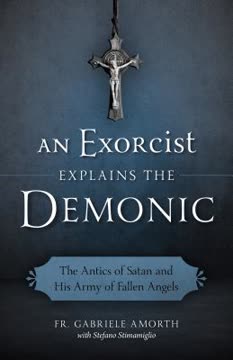
Reviews for An Exorcist Explains the Demonic are sharply divided along belief lines. Catholic readers praise its clarity, theological depth, and hopeful tone, with many finding it spiritually enriching. Critics, however, find the book internally inconsistent, repetitive, and irresponsible, particularly objecting to claims linking Harry Potter, rock music, and Halloween to demonic possession. Some note it lacks detailed case studies, reading more as a theological overview. The book's credibility largely depends on the reader's prior faith commitments.