Key Takeaways
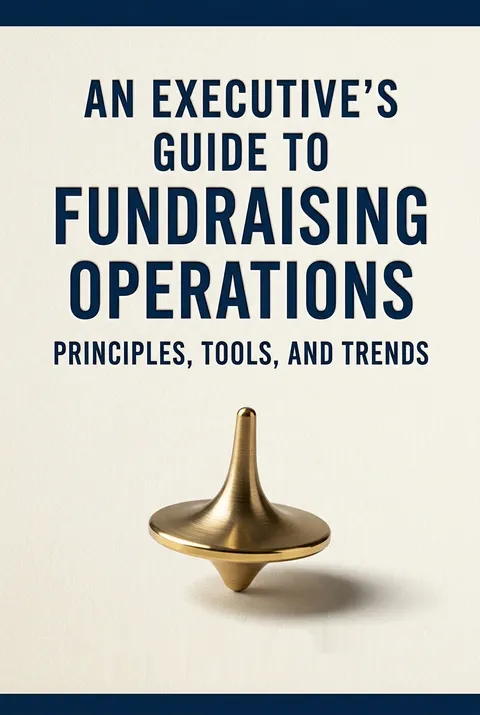
1. The "Spinning Top" Metaphor: A Holistic View of Fundraising Operations
All parts of your fundraising operations—data, technology, reporting, processes, and people—are crucial to supporting success.
Operational Harmony. Fundraising operations, when functioning optimally, resemble a smoothly spinning top. Each of its five core components—data, technology, reporting, processes, and people—must be balanced and well-managed to provide seamless support for fundraising efforts. An imbalance in any one area can cause the entire system to wobble, diminishing overall effectiveness and trust.
Executive's Role. As a fundraising executive, your primary responsibility isn't to master every intricate detail of operations, but to understand what works and what doesn't. This involves quickly identifying imbalances and delegating solutions to your operations professionals. The less time you spend mired in operational minutiae, the more time you have to focus on cultivating donor relationships and securing vital funds for your organization's mission.
Interdependent Components. The success of one operational component often hinges on the health of another. For instance, unreliable data can undermine the effectiveness of sophisticated technology, leading to inaccurate reports and inefficient processes, ultimately impacting the morale and productivity of your team. A holistic perspective ensures that improvements are targeted where they will have the greatest systemic impact.
2. Data is the Fuel: Prioritize Accuracy, Speed, and Volume
The fundamental challenge for many fundraising operations teams is to balance accuracy, speed, and volume.
Core Challenge. Data serves as the essential fuel for all fundraising activities, from high-volume annual giving campaigns to high-touch major gift solicitations. The constant tension between achieving accuracy, maintaining speed, and managing the sheer volume of information is the defining challenge for operations teams. Organizations that master this balance tend to have well-oiled operations, while failures in these areas can severely hamper fundraising success.
Accuracy First. While speed and volume are important, accuracy should be the hallmark of any operations team. Donor-centered organizations must deliver high-quality, error-free materials like receipts and acknowledgments. However, executives must set realistic accuracy expectations, as striving for 100% perfection can be prohibitively expensive and demoralizing for staff. A "front-of-the-line" approach, prioritizing accuracy for top donors and prospects, can be an effective strategy.
Efficiency and Enhancement. Quick turnaround times are crucial for both fundraisers and donors, but speed should not typically trump accuracy. Efficient processes, often achieved through automation or outsourcing, can help manage volume without sacrificing quality. Furthermore, leveraging data enhancement techniques like National Change of Address (NCOA) screenings, address verification, and data appending can significantly improve the completeness and timeliness of your constituent records, making your data more valuable for strategic fundraising.
3. Technology as the Engine: Arbitrate and Advocate for Smart Transitions
Selecting, converting to, and implementing the right tool are some of the most important operations decisions you will make as a fundraising executive.
Executive Oversight. Technology, particularly the constituent database, is the engine driving fundraising operations. The executive's role in technology transitions—from selecting a new system to its conversion and implementation—is paramount. Your primary functions are to arbitrate decisions when no one else can and to advocate for the necessary budget, resources, and morale to ensure a smooth transition.
Navigating the Hype Cycle. Technology projects often follow a "Hype Cycle," moving from inflated expectations to disillusionment before reaching productivity. Executives must manage these expectations, moderating initial enthusiasm and supporting the team through inevitable frustrations. Key steps in a transition include:
- Requirements and Framework: Define clear needs and a cost-benefit rationale.
- Fit-Gap Analysis & Scorecard: Objectively evaluate how solutions meet requirements.
- Negotiation: Secure a fair contract, remembering the vendor will be a long-term partner.
Beyond Conversion. A common myth is that "conversion equals implementation." The reality is that moving data is just the beginning; the harder work lies in fully implementing and integrating the new system into daily operations. Executives must also be vigilant against "shadow databases" or side systems that undermine the central database's integrity, ensuring all staff adopt and leverage the approved technology for institutional memory and accurate reporting.
4. Reporting is the Compass: Ensure Clarity, Consistency, and Actionable Insights
Great reporting tends to assuage any concerns about data, technology, and operations processes.
Bellwether of Operations. The ability to produce accurate, complete, and timely (ACT) reports is an immediate indicator of the caliber and capacity of your fundraising operations. Effective reporting builds trust in your data and technology, providing the crucial insights needed for strategic decision-making. Conversely, inconsistent or unclear reports can quickly erode confidence across the entire fundraising team.
Shared Understanding. A great reporting environment requires a common understanding of terms and definitions across all audiences. Ambiguous requests like "all gifts of $500 or more in the past year" can lead to confusion and delays. Implementing a comprehensive data dictionary ensures that everyone speaks the same language, leading to consistent interpretation and greater accuracy in reports.
Essential Report Types. Fundraising executives need a suite of reports tailored for different purposes. These include:
- Financial Reports: Reflect results based on accounting protocols (e.g., restricted vs. unrestricted).
- Fundraising Progress Reports: Summarize campaign progress against goals, often including recognition levels.
- Program Reports: Track the success of specific fundraising initiatives, distinguishing direct (above-the-line) and indirect (below-the-line) contributions.
- Performance Reports: Measure staff or team-specific metrics, including both dollar and non-dollar activities.
- Recognition Reports: Compile data for honor rolls and donor lists, often reflecting donor intent beyond strict financial accounting.
5. Processes are the Gears: Streamline for Efficiency and Donor-Centricity
The operations team should focus on delivering high-caliber support and service to the fundraising program.
Efficiency is Paramount. Operations processes are the gears that translate data and technology into tangible support for fundraising programs. Executives must ensure these processes are not only effective but also highly efficient, as every minute spent on inefficient operations is a minute diverted from donor engagement. Anecdotal evidence of process breakdowns should trigger a proactive review, not just reactive fixes.
Gift Processing Workflow. Gift processing, a critical operations responsibility, demands discipline and a donor-first approach. A typical workflow involves four stages:
- Intake: How gifts arrive (mail, online, in-person).
- Batch: Preparing gifts for entry (sorting, copying, listing).
- Entry: Adding gift and pledge details to donor records.
- Finalize: Ensuring receipts, acknowledgments, and financial reconciliation.
The industry benchmark of a 48-hour turnaround from receipt to receipting is a key indicator of efficiency.
Training as a Core Process. Effective training is foundational to all operational processes. It ensures that staff understand how to leverage tools and follow procedures, directly impacting accuracy and efficiency. Executives should participate in relevant training, hold trainers accountable for clear content, and expect trainees to retain information. A "train and trust" approach, coupled with post-training surveys, can significantly enhance the effectiveness of your team.
6. People are the Core: Cultivate Talent, Leadership, and Accountability
Given the importance of your people, how well do you know and understand them?
Most Valuable Asset. Operations team members are the linchpin holding the entire framework together, representing the largest portion of a fundraising budget. Executives must invest in understanding, empathizing with, and supporting their operations staff, as loyal and capable team members are invaluable. High turnover in operations can be costly, impacting productivity, morale, and institutional memory.
Leadership Qualities. Effective operations leadership requires a unique blend of skills. Leaders must possess:
- Innate Leadership & Communication: Guiding and motivating the team, managing client expectations, and negotiating deadlines.
- Balance Priorities: Effectively directing staff to manage accuracy, speed, and volume demands.
- Fundraising Acumen: Translating operational work into fundraising impact, understanding donor relationships.
- Action-Oriented: Driving the team to leverage data and resources for strategic action, overcoming inertia.
- Collegiality & Persuasion: Building strong relationships across departments to ensure cross-organizational support.
Essential Team Skills. Beyond leadership, all operations team members benefit from specific skills:
- Service Orientation: Viewing internal colleagues and donors as clients.
- Listening & Interpretation: Understanding needs, even when vaguely articulated.
- Discipline: Consistent application of rules and protocols.
- Technical & Numeric Aptitude: Proficiency with databases, reporting tools, and understanding financial implications.
- Creativity & Problem Solving: Devising solutions for unique challenges, especially for lower-impact issues, to free up executive time.
7. Prospect Development: Turn Information into Strategic Action
Prospect development represents the intersection of all of operations components and responsibilities in a way that no other fundraising function does.
Strategic Intersection. Prospect development, encompassing research, management, and analytics, is where all operational components converge to directly inform fundraising strategy. It transforms raw data into actionable intelligence, guiding fundraisers toward the most promising prospects and effective engagement strategies. Executives must ensure this function is robust and integrated, whether housed within operations or a major gifts team.
Research for Insights. Great prospect research provides critical insights into a prospect's linkage to the organization, inclination to give, and financial ability. While automated tools like prospect screening can efficiently identify wealth indicators, skilled researchers are essential for evaluating nuanced data and avoiding "false positives." The goal is to move beyond mere data collection to deliver actionable information that drives fundraising efforts.
Management and Analytics. A formal prospect management system tracks prospects through identification, cultivation, solicitation, and stewardship. Operations plays a crucial role in maintaining the database, generating portfolio and pipeline reports, and ensuring protocols are followed. Fundraising analytics further enhances this by using descriptive and predictive modeling to identify engagement opportunities and maximize return on investment, helping to build relationships rather than just collect data.
8. Program Support: Integrate Operations for Every Fundraising Initiative
Fundraising programs are the raison d'être for fundraising operations.
Tailored Support. Fundraising operations exist to support the diverse array of fundraising programs, including major giving, annual giving, constituent engagement, events, and special initiatives. Each program has unique operational needs, and executives must ensure that operations are integrated into every program, providing tailored support across data, technology, reporting, processes, and people.
Major and Annual Giving. For major giving, operations provides depth of research data, supports fundraiser technology needs (e.g., mobile access to CRM), and delivers critical portfolio and pipeline reports. For annual and unrestricted giving, operations manages high-volume data, automates direct response processes, and provides analytics for segmentation. Both benefit from streamlined gift processing and robust stewardship tracking.
Engagement and Events. Constituent engagement programs, such as alumni relations and marketing, rely on operations for accurate mailing lists, online community management, and data integration. Events, whether revenue-generating or engagement-focused, require end-to-end operational support for registration, payment processing, reporting (pre- and post-event), and ensuring compliance with benefit deductibility regulations. Operations' efficiency in these areas directly impacts program success and donor experience.
9. Navigate Trends Wisely: Distinguish Innovations from Fads with a Cost-Benefit Lens
New, untested, or perhaps just ill-fitting innovations may pan out, but may just as likely cost much more money and cause much more pain than they are worth.
Evaluating Innovations. The fundraising landscape is constantly evolving with new technologies and approaches. Executives must critically evaluate emerging trends, distinguishing between genuine innovations that will yield significant returns and fleeting fads that drain resources. This requires a rigorous cost-benefit analysis, considering whether a new tool will genuinely help raise more money and if the organization's budget, team, and mission can support its implementation.
Ubiquitous Data & Ethics. The sheer volume, accessibility, and ubiquity of data present both opportunities and ethical dilemmas. While new data sources (e.g., consumer purchase data, social media APIs) can offer valuable insights, executives must establish clear ethical baselines for data collection and usage, guided by principles like AFP's Donor Bill of Rights. Operations teams need parameters to decide which data to pursue and how to manage it responsibly.
Virtualization & Mobility. Trends in virtualization, web applications, and mobile technology (smartphones, text giving, SaaS, ASP) offer increased flexibility and connectivity for both staff and constituents. Executives should explore how these can enhance productivity, remote access, and donor engagement, but also understand their limitations and security implications. Digital imaging, though less glamorous, offers significant benefits in improving data accuracy, speed, and volume by transforming paper-based processes.
10. Measure Impact: Link Operations to Fundraising Results and Staff Performance
Performance measures should naturally lead into another trend in operations: measuring impact.
Beyond Activity Counts. While tracking the volume of operational tasks is useful, executives must push to measure the impact of operations work on fundraising results. This involves linking data updates, process efficiencies, and technology implementations directly to increased revenue or cost savings. Demonstrating this impact transforms operations from a perceived "cost center" into a recognized value driver, justifying future investments.
Performance Management. Effective performance management extends beyond annual reviews. Models like the Performance Management Maturity Model (PMMM) advocate for sequential maturation across all fundraising departments, ensuring balanced growth. Consistent and disciplined use of performance metrics, coupled with honest conversations, is crucial for celebrating successes and addressing insufficient behaviors.
Talent Retention. Retaining talented operations staff is critical for long-term success. Executives should proactively develop "career pathing" and "stay plans" that outline growth opportunities, reward high performance, and address individual needs. While outsourcing can offer efficiencies for high-volume tasks, fostering a "results-only work environment" (ROWE) where appropriate can boost loyalty and productivity by focusing on outcomes rather than strict adherence to traditional work schedules.
Download PDF
Download EPUB
.epub digital book format is ideal for reading ebooks on phones, tablets, and e-readers.








































