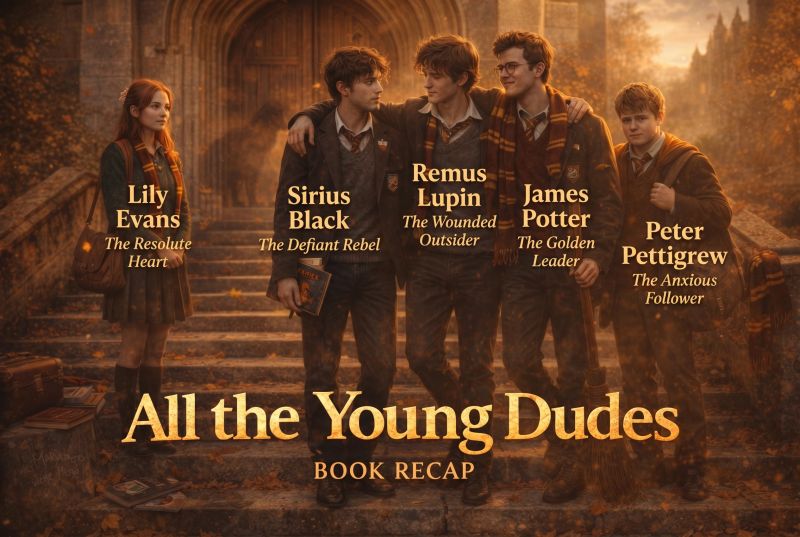

Plot Summary
Prologue
In the summer of 1971, eleven-year-old Remus Lupin1 wakes in a locked room at St Edmund's Boys' Reformatory, his body scarred from another full moon transformation. He has been a werewolf since age five, when Fenrir Greyback9 attacked him as revenge against his father Lyall — a wizard who advocated hunting werewolves, then killed himself from the guilt.
Remus's muggle mother14 abandoned him to the care system. His cell door is plated with silver to keep him contained. Into this bleak existence walks Albus Dumbledore,11 eccentric and impossibly kind, offering the boy a place at Hogwarts School of Witchcraft and Wizardry.
Remus1 protests that he is too thick, too dangerous, too broken. Dumbledore11 promises they will figure it out. Remus,1 who has nothing whatsoever left to lose, agrees.
Accidental Marauders
On the Hogwarts Express, Remus1 claims an empty compartment and tries to disappear. James Potter3 — bespectacled, brimming with confidence — barges in with nervous Peter Pettigrew.4 Then Sirius Black2 arrives, long-haired and aristocratic, fleeing his own family's expectations.
All four are sorted into Gryffindor, a shock to Sirius,2 whose entire bloodline has been Slytherin for five centuries. Sharing a dormitory, they orbit each other warily: James3 is effortlessly sociable, Sirius2 oscillates between charm and melancholy, Peter4 craves acceptance, and Remus1 keeps everyone at a careful distance, terrified someone will discover what he is.
Their first real bond forms over music — Sirius2 owns a muggle record player, and Remus1 is the only wizard who knows The Beatles. It is barely enough. But it is enough.
Lectiuncula Magna
Sirius2 notices what no teacher ever bothered to: Remus1 cannot read. The letters swim before his eyes, rearranging themselves into nonsense. Rather than telling anyone, Sirius2 retreats to the library for months, researching cognitive interpretation spells, sacrificing his own grades in the process.
On New Year's Day of their first year, he presents his creation — Lectiuncula Magna — a charm that makes written words speak directly into Remus's1 mind. Remus1 opens a textbook and reads for the first time in his life.
He weeps. The spell transforms a boy dismissed as thick into one of the brightest students in his year — first in History, near the top in everything else. It also forges a debt between them that Remus1 can never repay, a bond sewn into the fabric of who he becomes.
Moony Unmasked
By second year, James3 has connected the dots — the monthly absences, the scars, the lunar pattern. He asks Remus1 directly: are you a werewolf? Remus1 confirms it and begins packing his trunk, expecting expulsion or exile. Instead, all three boys promise to keep his secret.
Peter4 swears it. James3 nods solemnly. Sirius,2 who has known since Christmas of first year, simply watches with quiet intensity. The revelation catalyzes something extraordinary: the three begin secretly researching how to become animagi — illegal shapeshifters who can safely accompany Remus1 during transformations.
It is a project that will consume years of hidden study, driven by Sirius's2 ferocious research and James's3 tactical planning. They do not tell Remus,1 knowing he would forbid it. Some gifts require conspiracy.
Christmas Eve Exile
Sirius's2 home life worsens each year — cutting curses used as discipline, an arranged betrothal to his cousin Narcissa, howlers screaming about family honour. When the Potters invite him for Christmas in second year, Walpurga arrives on Christmas Eve to reclaim her son.
She silences Sirius2 with a spell when he tries to refuse, then drags him away while the Potters watch, horrified. The incident exposes the full cruelty of the Black household.
Behind the scenes, Remus1 secretly suggests to Narcissa the unbreakable-vow loophole that eventually frees Sirius2 from the engagement — a quiet act of devotion he never reveals. By fifth year, after Sirius's2 parents torture him with the Cruciatus Curse for refusing to join Voldemort, the Potters take him in permanently. He never goes home again.
Padfoot Runs with Moony
In fifth year, after Remus1 has explicitly told them not to, his friends reveal their accomplishment. James3 becomes a stag. Peter,4 a rat. And Sirius2 — whose form simply chose him — becomes a great black dog. That night they join Remus1 in the Shrieking Shack for his transformation. The wolf, which has spent years tearing itself apart in frustrated solitude, finally has a pack.
It does not attack. It plays. Remus1 wakes without a single new scar for the first time in his life. From then on, full moons become adventures — they explore the Forbidden Forest, chase rabbits, howl together beneath the stars. Padfoot, Prongs, Wormtail, and Moony. Their names are sealed into the Marauder's Map, which Remus1 has been building since first year.
Sixteen on the Staircase
On Remus's1 sixteenth birthday, the Marauders throw a raucous party in Gryffindor Tower. On the staircase between floors, half-drunk and bursting with feelings he barely understands, Remus1 grabs Sirius2 by the neck and kisses him. Sirius2 kisses back — parting his lips, softening into it.
It lasts perhaps three seconds. Then Sirius2 pulls away, panicked, and goes straight downstairs to find Mary MacDonald.7 Remus1 watches from the landing as Sirius2 presses Mary7 against the fireplace and kisses her with theatrical enthusiasm, the common room cheering.
What follows is almost two years of agony: Sirius2 comes to Remus1 in secret — bathrooms, broom cupboards, behind drawn bed curtains — while publicly cycling through girlfriends. Remus1 accepts every scrap, because it is Sirius,2 and scraps are more than he has ever had.
Sirius Weaponizes the Wolf
Severus Snape10 has been following Remus,1 obsessively cataloguing his monthly absences. At the end of fifth year, Sirius2 — provoked by Snape's10 cruelty toward the people he loves — tells Severus10 exactly how to get past the Whomping Willow on a full moon night.
Snape10 follows the instructions and nearly reaches the werewolf. James,3 learning what Sirius2 has done, races to drag Snape10 back alive. Remus1 awakens to discover he almost killed someone — and that Sirius2 used his most guarded secret as a weapon. He refuses to speak to Sirius2 for weeks.
The betrayal cuts deeper than anything the Blacks ever inflicted, because it came from the person Remus1 trusted most. Forgiveness arrives slowly, grudgingly, and never quite completely. Remus1 learns that loving someone does not make them safe.
All the Young Dudes
The summer after seventh year, the whole group camps in Cornwall — James3 and Lily5 together now, Peter4 with his girlfriend, Mary,7 Marlene,8 Sirius2 and Remus1 maintaining careful distance. On the first night, drunk on cider as Mott the Hoople plays on a tinny wireless, Remus1 tells them all plainly: he is gay.
The silence that follows is not rejection but recalibration. Later, on the dark beach, Sirius2 finds him. They fight about the secrecy, the girls, the years of pretending.
Then Sirius2 promises to try — no more girlfriends, no more performance. They kiss on the sand as the tide hisses in, and for the first time neither runs afterwards. It is not the beginning of something new, but the admission of something that was always there, finally allowed to breathe.
Soldiers at Eighteen
They leave Hogwarts at eighteen and walk into a war. Dumbledore11 gathers the Order of the Phoenix in borrowed kitchens and cramped safehouses. Remus1 and Sirius2 take a flat in Soho; James3 and Lily5 settle at the Potter estate with baby Harry, born July 1980.
Missions come fast — surveillance, combat, protection. Remus1 is repeatedly sidelined because the Order distrusts a werewolf, while Sirius2 and James3 get the dangerous assignments. The Prewett twins die fighting five Death Eaters. Dorcas Meadowes is murdered.
The Potters fall ill. Christmas 1978 brings a mass attack on Diagon Alley that leaves fifty dead. Each funeral thins their ranks further. The golden certainty of youth — that friendship conquers all, that they will win because they must — begins to corrode.
Greyback's Prodigal Son
Under orders from Moody,19 Remus1 infiltrates Fenrir Greyback's9 werewolf pack. He spends a full month living among them in an enchanted forest — sleeping in a crypt, transforming on the full moon, hunting deer with the pack. He meets Castor17 and Livia,18 Greyback's9 most devoted followers.
The pack offers something Remus1 has never experienced: the sensation of being entirely among his own kind. The wolf inside him does not want to leave. When Greyback9 summons him, the old werewolf is magnetic and terrifying — testing Remus,1 reading his mind, snapping his wand.
Remus1 engineers a split in the pack before escaping, but returns to London fundamentally changed. He has tasted a belonging so deep and so animal it frightens him, and he will carry it like contraband forever.
Hope in a Hospital Bed
Through the Potters' help, Remus1 locates his mother Hope14 in a Cardiff hospital. She is dying of cancer — a tiny Welsh woman with platinum blonde hair who weeps when she sees him. Their meetings are halting, tender, heartbreaking.
She tells him about his childhood before the bite: the farm set with pink piglets, his first steps to a Beatles song on the radio. He remembers none of it. She reveals a half-sister named Siân he never knew existed. She tells him she loves him, and Remus1 finds the words lodged in his throat — jammed there by years of institutional coldness and unspoken grief.
It takes months. But pressed by her fading strength and his own terrible loneliness, he finally manages it. Hope14 dies just before Christmas 1978. He carries those three words forward like a lantern.
Halloween's Final Trick
In the war's final desperate months, Sirius2 is made Secret Keeper for the Potters' hiding place — then switches with Peter4 without telling Remus.1 Sirius2 suspects Remus1 might be the spy; Remus,1 away on a mission with the werewolves, suspects nothing at all. On Halloween 1981, Peter4 delivers the Potters' location to Voldemort. James3 dies at the front door.
Lily5 dies shielding Harry. Only the baby survives. Peter4 fakes his own death, framing Sirius2 for the massacre. Sirius2 is dragged to Azkaban. Mary7 telephones Remus1 with the news, and he falls to his knees on the kitchen floor. In one night he loses James,3 Lily,5 Peter4 as he knows him, and Sirius2 — whom he now believes murdered them all. The grief is total. There is nothing left.
The Muggle Who Stayed
Remus1 drinks. For months, that is all he does — bottles covering every surface, curtains drawn, phone disconnected. He skips the funeral. He cuts off all contact with the wizarding world. Then, on New Year's Day 1982, Grant Chapman6 hammers on the door.
Grant6 — the sunny, streetwise boy from St Edmund's who first kissed Remus1 at fifteen — finds him wrecked and refuses to leave. He cleans the flat, brings food, sits beside Remus1 while he sobs. Over the following years Grant6 moves in, becoming partner, anchor, and nurse.
He is not Sirius2 — they both know this — but he is stubbornly, relentlessly present. He drags Remus1 to his first gay bar, battles his alcoholism, and loves him without demand for equal return. Grant6 stays for thirteen years, holding the door open while Remus1 slowly walks back towards life.
Professor Lupin Returns
In 1993, Dumbledore11 offers Remus1 the Defence Against the Dark Arts post at Hogwarts. Sirius2 has escaped Azkaban — the first person ever to do so — and Dumbledore11 wants Remus1 nearby. He accepts, partly for employment, mostly for Harry. The boy is thirteen now, with James's3 untameable hair and Lily's5 blazing green eyes, and meeting him is like being punched through a wall of time.
Remus1 teaches Harry the Patronus charm, watches him fly like his father, and says nothing about who he really is — because how do you explain any of it to a child? He endures Snape's10 hostility, monthly wolfsbane potion, and the constant terror of discovery. Every corridor holds a ghost. Every staircase holds a memory of the boy Remus1 used to be.
Twelve Years of Hating Wrong
On the Marauder's Map — the enchanted document Remus1 built as a schoolboy — he sees an impossible name: Peter Pettigrew,4 alive, moving through Hogwarts. He races to the Shrieking Shack, the same wretched building where he spent every childhood full moon, and finds Sirius2 — skeletal, wild-eyed — with Harry standing over him.
Remus1 enters Sirius's2 thoughts using skills learned from the werewolves, and sees the truth: the secret switch to Peter,4 the betrayal, twelve years of wrongful imprisonment. Everything Remus1 believed collapses in an instant.
The man he hated was innocent; the friend he mourned is guilty and alive. Peter4 escapes in the chaos of a full moon. Sirius2 vanishes again. Remus1 is dismissed from Hogwarts when his condition is exposed, and returns to London knowing he was catastrophically wrong.
Padfoot Comes Home
Two years later, Voldemort returns. Dumbledore11 sends Sirius2 — still a fugitive — to hide at the only safe place: Remus's1 Soho flat. Grant Chapman,6 who has shared Remus's1 life for over a decade, takes one look at the gaunt black dog on the doorstep and understands what is happening. He packs his bags.
Before leaving, Grant6 tells Sirius2 privately to be present — a real person, not a ghost, not a dog. Then he tells Remus1 he has taken a job in Brighton, tells him he loves him, asks Remus1 to say it back. Remus1 does, and means it. Grant6 kisses him, and goes. Remus1 cries alone in the bedroom. When he emerges, Sirius2 is on the couch — thin and haunted and impossibly alive. They begin with tea.
Love, Chosen
They fight. Of course they fight — about the war, about trust, about fourteen wasted years. Sirius2 accuses Remus1 of going soft; Remus1 hurls back the accusation that Sirius2 suspected him of being a spy. They circle each other like wounded animals, sleeping in separate rooms.
Then, on a full moon, they transform together for the first time in fourteen years. Padfoot and Moony run through the mountains, and something wordless passes between them. In the morning, Remus1 combs the knots from Sirius's2 hair in the bathtub.
They talk — really talk — about their mothers, their scars, their failures. And Sirius2 asks the only question that remains: love or hate? Remus1 takes his hand. Love, he says. They kiss, and the long war inside him is finally, finally over.
Analysis
All the Young Dudes is fundamentally a novel about what it costs to be loved badly by institutions and well by individuals. Remus Lupin1 exists at the intersection of every form of marginalisation the wizarding world offers — half-blood, werewolf, impoverished, queer, orphaned — and the story tracks how each layer of outsider status compounds the others. The children's home teaches him that authorities exist to contain, not nurture. Hogwarts offers education but demands concealment. The Order of the Phoenix recruits his unique abilities while distrusting his nature. In each case, Remus1 must perform a version of himself that is acceptable to the powerful, while hiding the parts they would destroy.
The romantic arc between Remus1 and Sirius2 deliberately resists fairy-tale resolution. Their love is not redemptive — it is messy, intermittent, frequently cruel, and haunted by class difference, trauma, and the impossibility of honesty under siege. The story insists that love expressed through secrecy is still real, but also that secrecy corrodes. Sirius's2 failure to trust Remus1 with the Secret Keeper switch is not a plot twist but the logical culmination of years of withheld communication.
Grant Chapman6 functions as the story's radical counterargument: that love need not be epic to be transformative. Grant's6 ordinariness — his muggle simplicity, his cheerful refusal to compete with ghosts — provides Remus1 with something Sirius2 never could: stability without conditions. The story does not rank these loves; it insists they coexist. At its deepest level, the novel is about the difference between what you are and who you are. Remus1 is a werewolf, but he is also a teacher, a reader, a friend. The tragedy is that the world insists on collapsing these identities into one. The triumph — modest, hard-won, and provisional — is that Remus1 refuses to let it.
Review Summary
All the Young Dudes is a beloved Harry Potter fanfiction focusing on the Marauders era. Readers praise its emotional depth, character development, and seamless integration with canon. Many consider it superior to the original series, appreciating its exploration of love, trauma, and growth. The story's length and quality have led readers to count it as a serious read. Fans express deep emotional connections to the characters, particularly Remus and Sirius. The fic has reignited passion for the Harry Potter universe for many, despite conflicted feelings about the original author.
Characters
Remus Lupin
Werewolf, scholar, survivorThe story's narrator and emotional centre. Bitten by a werewolf at five, abandoned by his mother14, raised in a brutal children's home, Remus arrives at Hogwarts carrying more damage than most adults. He compensates through fierce intelligence, dry humour, and an ironclad policy of self-concealment—secrets nested inside secrets. His lycanthropy becomes a lens through which every relationship is filtered: who knows, who suspects, who might reject him. Remus defaults to stoicism and suppression, erupting only when pushed past endurance. He possesses enormous magical talent he chronically underestimates. His deepest wound is not the wolf but the belief that he is fundamentally unlovable. Every person who proves him wrong—Sirius2, Grant6, his friends—must fight through walls of sarcasm, deflection, and fierce independence to reach him.
Sirius Black
Disowned heir, devoted rebelBorn into the darkest pureblood dynasty in Britain, Sirius rejects everything his family represents with spectacular, self-destructive flair. He is charismatic, reckless, impossibly beautiful, and profoundly traumatised by a childhood of cutting curses and psychological cruelty. His loyalty to James3 is absolute and almost religious; his love for Remus1 is complicated by deep-seated fear of his own desires. Sirius acts first and thinks later—a trait that makes him thrilling and catastrophically dangerous. He identifies as a Gryffindor before anything else, wears his heart on his sleeve, and cannot tolerate being ignored or excluded. His greatest strength is his refusal to break; his greatest flaw is his inability to recognise when he is breaking others.
James Potter
Golden boy, loyal leaderJames is the sun the Marauders orbit—wealthy, athletic, effortlessly popular, born into unconditional love and incapable of imagining its absence. He is also genuinely good: generous without calculation, brave without posturing, loyal with a ferocity that can shade into recklessness. His obsessive pursuit of Lily Evans5 masks a boy who simply cannot comprehend rejection. James functions as the group's moral compass and emotional mediator, the one who steps between Sirius2 and Remus1 during their worst fights. He is the first to defend the underdog, the last to give up on a friend, and the archetype of inherited privilege wielded with grace. His optimism is both his gift and his blindspot.
Peter Pettigrew
Anxious follower, overlooked friendPeter exists in the shadow of more brilliant, more beautiful friends, and he knows it. Short, pudgy, perpetually nervous, he is the Marauder no one would choose first but who shows up reliably. He is better at chess, astronomy, and herbology than anyone gives him credit for, and his capacity for loyalty is genuine—he adores James3, fears Sirius2, and feels protective of Remus1. Peter's defining trait is his desperate need to belong, combined with an instinct for self-preservation that sits uncomfortably beside his bravery. He follows the strongest voice in any room. The tragedy of Peter is that his friends underestimate him in both directions.
Lily Evans Potter
Fierce heart, brilliant witchMuggle-born, red-haired, terrifyingly competent, Lily is the only person at Hogwarts who treats James Potter3 like the idiot he sometimes is. She excels at Potions and Charms with an instinct that borders on artistry. Her friendship with Remus1 is one of the story's quiet anchors—she discovers his lycanthropy, his sexuality, and his reading difficulties, and adjusts nothing except her willingness to help. Lily's moral compass is unyielding: she drops her childhood friendship with Snape10 when he crosses an irreversible line. She loves James3 eventually, wholly, but she makes him earn every inch of it. Lily embodies the principle that kindness and toughness are not opposites.
Grant Chapman
Muggle anchor, steadfast partnerA care home boy from St Edmund's who first kissed Remus1 when they were fifteen, Grant is sunny, streetwise, and stubbornly devoted. He lacks Sirius's2 beauty and James's3 brilliance, but possesses something rarer: the ability to show up, every single time. Grant trains as a social worker, fights for gay rights under Section 28, and rebuilds himself from nothing repeatedly. He loves Remus1 with clear-eyed acceptance, never competing with ghosts he cannot see. Grant's defining quality is practical compassion—he doesn't analyse suffering, he cleans it up. He understands that sometimes love means holding on, and sometimes it means knowing exactly when to let go.
Mary MacDonald
Bold friend, muggle-born survivorBrash, funny, and effortlessly gorgeous, Mary is the friend who says what everyone else is thinking. Muggle-born and proudly south London, she brings working-class bluntness to Gryffindor's pureblood circles. She dates Sirius2 briefly, sleeps with Remus1 once, and remains fiercely loyal to both. During the war, she fights alongside the Order while protecting her muggle family from knowledge of the magical world. Her resilience is staggering—she survives the loss of nearly every friend and builds a new life with a muggle partner and a daughter. Mary is the thread that connects Remus1 to his past when he most wants to sever it.
Marlene McKinnon
Healer, quidditch beater, truth-tellerShy but fierce, Marlene is the Gryffindor beater who dreams of becoming a healer. She discovers Remus's1 lycanthropy through detective work and initial prejudice, then overcomes her fear to create a pain-relief ointment specifically for his condition. Her relationship with Yasmin Patel mirrors Remus1 and Sirius's2 in its secrecy and courage. Marlene represents the possibility of change—that even deeply held prejudices can be unlearned through love and proximity. Her devotion to her family, especially her brother Danny after he is bitten by a werewolf, drives her commitment to reforming how magical society treats lycanthropy.
Fenrir Greyback
Werewolf patriarch, predatorThe werewolf who bit Remus1 at age five as revenge against his father. Greyback is not merely a monster—he is a charismatic cult leader who deliberately turns children young so they can be raised in his image. He offers his pack genuine belonging and twisted fatherhood, making his cruelty harder to resist. Greyback functions as Remus's1 dark mirror: what a werewolf becomes when rage is not tempered by love. He is magnetic, literate, manipulative, and utterly convinced of his own righteousness. His greatest weapon is not violence but the promise of family to those who have none.
Severus Snape
Bitter rival, obsessive observerGreasy-haired, razor-tongued, and consumed by resentment, Snape is both bully and bullied. His obsessive surveillance of Remus1—cataloguing absences, testing for weaknesses—makes him the constant external threat to the Marauders' secrets. His friendship with Lily5 and his hatred of James3 create a volatile triangle that affects Remus1 tangentially but persistently. Snape's intelligence is formidable; his capacity for cruelty is matched only by his capacity for holding grudges across decades.
Albus Dumbledore
Headmaster, chessmasterThe wizard who rescued Remus1 from St Edmund's and gave him an education, Dumbledore is both saviour and manipulator. He places Remus1 at Hogwarts partly out of compassion, partly because a trained werewolf might prove useful one day. His tendency to treat people as chess pieces—sending teenagers to war, withholding information, demanding sacrifices—creates a complicated legacy. Remus1 alternately worships and resents him. Dumbledore's power lies not in force but in making people feel they chose what he wanted all along.
Professor Ferox
Mentor, adventurer, first crushRemus's1 Care of Magical Creatures teacher during third and fourth year. Muggle-born, Liverpudlian, ruggedly handsome and impossibly competent—Ferox is Remus's1 first crush, though Remus1 doesn't recognise it as such. He knew Remus's1 father professionally and becomes one of the few adults Remus1 trusts. Ferox works with Moody19 during the war, tracking Greyback9. His death at Greyback's9 hands becomes one of the war's most personal losses for Remus1.
Euphemia Potter
Surrogate mother, wartime healerJames's3 mother opens her home to Remus1 and Sirius2 every Christmas, making no distinction between her son and the strays he brings home. A former healer, she is warm, shrewd, and fierce—the first adult to hug Remus1 without asking permission. She represents the family Remus1 never had, and her death alongside her husband from dragon pox is the first fracture in the world the Marauders built.
Hope Jenkins
Remus's lost motherA Welsh muggle who married a wizard, lost her child to lycanthropy and her husband to suicide, then gave Remus1 to the care system because she couldn't cope alone. Hope is small, blonde, and endlessly optimistic despite terminal illness. She represents the road not taken—the ordinary life Remus1 might have had. Her letter, found when Remus1 turns seventeen, begins a fragile reconnection that ends with her death.
Regulus Black
Sirius's younger brotherSorted into Slytherin, loyal to his parents, quietly jealous of Sirius's2 freedom. Regulus represents the path Sirius2 rejected—obedience to family at the cost of conscience. He takes the Dark Mark as a teenager and becomes a source of anguish for Sirius2, who cannot save him.
Madam Pomfrey
School nurse, steady constantThe Hogwarts medi-witch who patches Remus1 together after every full moon from age eleven onward. Her unfailing tenderness makes her the closest thing to a mother he has during childhood. She teaches him basic healing spells and never once treats him as less than human.
Castor
Werewolf ally, rival, temptationA member of Greyback's9 pack who helps Remus1 split the group. Handsome, philosophical, and deeply conflicted about violence. Castor represents the life Remus1 might have chosen among the wolves—attractive, dangerous, and ultimately incompatible with his humanity.
Livia
Greyback's first-born, fierce huntressTurned by Greyback9 before she could speak, Livia has known nothing but the pack. Tattooed in spiralling moon phases, possessing terrifying wandless magic, she calls Remus1 'brother' and tries to recruit him with a mixture of affection and menace.
Alastor Moody
Auror, paranoid commanderThe grizzled, one-eyed Auror who runs Order operations with military efficiency. He assigns Remus1 werewolf missions and treats him with gruff respect. Moody's constant vigilance borders on paranoia, but his instinct for danger is unmatched.
Minerva McGonagall
Head of Gryffindor HouseStern, fair, and unexpectedly kind beneath her severity. McGonagall is the teacher who pushes Remus1 academically, defends his place at Hogwarts, and—decades later—welcomes him back as a colleague. She represents institutional decency in a system that often fails.
Plot Devices
The Marauder's Map
Castle surveillance, identity markerCreated primarily by Remus1 over seven years of meticulous cartography, enhanced by the other Marauders' magical contributions, the Map displays every person and passageway in Hogwarts in real time. It begins as a practical tool—Remus's1 childhood need to know every exit and hiding place—and evolves into a living document of their shared adolescence. The Map requires the incantation 'I solemnly swear that I am up to no good' to activate, and the four Marauder nicknames are sealed into its parchment. Confiscated by Filch near the end of seventh year, the Map becomes Remus's1 only legacy at Hogwarts. It resurfaces years later to reveal Peter Pettigrew4 alive within the castle, triggering the revelation that overturns everything Remus1 believed about the night his friends died.
Lectiuncula Magna
Reading spell, bond symbolThe reading charm Sirius2 invents for Remus1 during their first year at Hogwarts—a combination of cognitive interpretation spells that makes written text speak directly into the reader's mind. It is NEWT-level magic performed by an eleven-year-old, and it transforms Remus1 from a boy labelled illiterate into one of the school's top students. The spell serves as the foundational act of their relationship: Sirius2 sees what no adult bothered to see, and devotes months of research to fixing it. It establishes the pattern that defines them—Sirius2 gives recklessly, Remus1 receives with uncomfortable gratitude, and the debt between them becomes indistinguishable from love. The charm must be reapplied regularly and does not work outside of the wizarding world, leaving Remus1 unable to read during his summers at St Edmund's.
Animagi Transformations
Companionship, identity liberationJames3, Sirius2, and Peter4 illegally learn to transform into animals—a stag, a dog, and a rat respectively—so they can accompany Remus1 during his monthly werewolf transformations without danger. The process takes years of secret study and represents the single most extraordinary act of friendship in the story. As animals, they give Remus's1 wolf a pack, eliminating the self-harm born of frustrated isolation. The transformations also provide their codenames (Prongs, Padfoot, Wormtail, Moony) and a shared secret that bonds them beyond ordinary friendship. Padfoot's canine form becomes Sirius's2 refuge during imprisonment and his disguise afterwards, while Wormtail's rat form enables a different kind of concealment entirely.
The Shrieking Shack
Prison, sanctuary, revelation siteThe abandoned cottage accessible only through a tunnel beneath the Whomping Willow, built specifically to contain Remus1 during full moons. For Remus1, it is the site of his worst suffering—years of monthly confinement, tearing himself apart alone in the dark. Its reputation as 'the most haunted building in Britain' is actually the echo of his screams. Locals in Hogsmeade never learn the truth. The Shack also becomes the location of the story's pivotal revelation: it is where Remus1 discovers Sirius's2 innocence and Peter's4 survival, fourteen years after the night he believed destroyed everything. The building thus functions as a palimpsest of Remus's1 life—childhood prison, teenage playground (once the Marauders arrive), and the stage for the truth that unmakes his grief.
The Fidelius Charm
Fatal protection, trust weaponizedA spell that hides a secret inside a living person, making it impossible for anyone else to reveal. Dumbledore11 suggests it to protect the Potters from Voldemort, and Sirius2 volunteers as Secret Keeper—then secretly switches with Peter4 at the last moment, reasoning that no one would suspect the weakest Marauder. Crucially, he does not tell Remus1 about the switch, because he suspects Remus1 might be the spy. This decision—born from war paranoia and Sirius's2 inability to communicate when it matters most—creates the conditions for Peter's4 betrayal and Sirius's2 wrongful imprisonment. The Fidelius Charm thus becomes the story's most devastating irony: a spell designed to protect through trust is undone by the failure of trust between the people who loved each other most.
FAQ
Synopsis & Basic Details
What is All the Young Dudes about?
- Marauders' Hogwarts journey: The story chronicles the lives of Remus Lupin, James Potter, Sirius Black, and Peter Pettigrew from their first year at Hogwarts in 1971 through the First Wizarding War, told primarily from Remus's first-person perspective.
- Remus's unique background: It diverges from canon by portraying Remus as having grown up in a children's home after his father's death, making him initially more withdrawn and "rough around the edges" compared to his pureblood friends.
- Friendship, secrets, and war: The narrative explores the deep bond of the Marauders' friendship, the burden of Remus's lycanthropy secret and its eventual acceptance, and their experiences navigating adolescence and the escalating conflict with Voldemort.
Why should I read All the Young Dudes?
- Deep character exploration: The fic offers an intimate look into the psychological and emotional lives of the Marauders, particularly Remus, providing motivations and internal struggles often only hinted at in canon.
- Rich world-building: It expands upon the Marauders' Era, detailing daily life at Hogwarts, family dynamics, and the growing political tension of the First Wizarding War with vivid sensory detail and emotional depth.
- Powerful emotional arc: The story is renowned for its slow-burn romance, exploration of complex relationships, and unflinching portrayal of trauma, loss, and resilience, offering a deeply moving reading experience.
What is the background of All the Young Dudes?
- Harry Potter fanfiction: The story is a fan work set within the Harry Potter universe, specifically during the Marauders' Era (1971-1995), adhering largely to established canon events and characters.
- Focus on Marauders' Era: It fills in the gaps of this period, detailing the characters' school years, the formation of the Order of the Phoenix, and the early stages of the First Wizarding War from a ground-level perspective.
- Exploration of social themes: The narrative incorporates period-typical attitudes and explores themes of prejudice, class, identity, and the impact of war on individuals and relationships within the wizarding world.
What are the most memorable quotes in All the Young Dudes?
- "I solemnly swear that I am up to no good.": This iconic phrase, associated with the Marauder's Map, becomes a recurring motif representing their shared identity, defiance, and commitment to mischief and each other (Chapter 14).
- "You're my Moony.": This simple nickname, given by Sirius, evolves from a playful jab at Remus's condition to a profound declaration of acceptance and love, symbolizing their deep bond and understanding (Chapter 45).
- "Love is just a four letter word.": Repeated throughout the story, this lyric from a Bob Dylan song (covered by Joan Baez) encapsulates Remus's cynical view of love, born from trauma and loss, contrasting with the powerful, complex reality of the love he experiences (Chapter 60, Chapter 91).
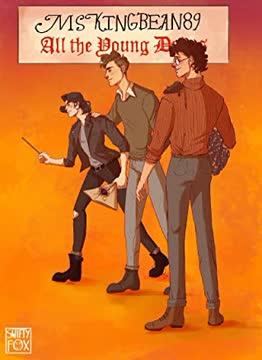
What writing style, narrative choices, and literary techniques does MsKingBean89 use?
- First-person limited POV: The story is told entirely from Remus Lupin's perspective, offering intimate access to his thoughts, feelings, and often unreliable interpretations of events, shaping the reader's understanding through his unique lens.
- Episodic structure: The narrative is broken into dated entries, often focusing on specific scenes or periods, creating a sense of lived experience and highlighting key moments of emotional or plot significance over a long timeline.
- Sensory detail and internal monologue: The author heavily relies on Remus's heightened senses (smell, hearing) and extensive internal monologue to convey his experiences, anxieties, and emotional states, immersing the reader in his subjective reality.
Hidden Details & Subtle Connections
What are some minor details that add significant meaning?
- Remus's reading struggles: Initially presented as a sign of being "thick" from his children's home background, Remus's difficulty with reading is later revealed to be a form of dyslexia, a subtle detail that highlights his hidden intelligence and the limitations imposed by his upbringing (Chapter 9, Chapter 10).
- The scent of magic: Remus's ability to smell magic, a subtle werewolf trait, is often mentioned in passing but becomes crucial for navigating the wizarding world, identifying individuals (like Dumbledore or Snape), and even locating secret passages or magical creatures (Chapter 1, Chapter 14, Chapter 100).
- Sirius's handwriting: Sirius's surprisingly neat, cursive handwriting, a product of his pureblood upbringing, contrasts sharply with Remus's struggle with writing and becomes a symbol of Sirius's hidden talents and the unexpected ways they connect, such as when Sirius uses it to write Remus's homework or magical notes (Chapter 10, Chapter 36).
What are some subtle foreshadowing and callbacks?
- The Whomping Willow's purpose: Introduced as a violent, recently planted tree, its true function as the guarded entrance to the Shrieking Shack, Remus's transformation location, is foreshadowed by its aggressive nature and the secrecy surrounding it, becoming a recurring symbol of Remus's hidden pain (Chapter 4).
- Sirius's family scars: Sirius showing Remus the thin, straight scars on his legs in their first year, casually mentioning they are from his parents, subtly foreshadows the severe physical abuse he suffers later, particularly the Lacero curse, which leaves similar marks (Chapter 9, Chapter 81).
- The 'Dark Mark' symbol: First seen as a tattoo on Bellatrix Black's arm, the skull and snake symbol is later revealed to be Voldemort's mark, foreshadowing the Black family's deep ties to the Death Eaters and the increasing danger they pose (Chapter 14, Chapter 82).
What are some unexpected character connections?
- Remus and Lily's shared struggles: Despite their initial awkwardness and Lily's friendship with Snape, Remus and Lily bond over being muggle-raised in the wizarding world, sharing experiences of feeling out of place and navigating prejudice, leading to a genuine friendship and academic partnership (Chapter 5, Chapter 65).
- Remus and Professor Ferox's shared background: Remus discovers that his Care of Magical Creatures professor, Leo Ferox, is also an orphan and muggle-raised, creating an unexpected connection and providing Remus with a rare adult figure who understands his background and encourages his potential (Chapter 68, Chapter 76).
- The Marauders and the McKinnons/MacDonalds: The initial rivalry or awkwardness between the Marauders and girls like Marlene McKinnon and Mary MacDonald evolves into genuine friendships, study partnerships, and even romantic entanglements, showing the interconnectedness of their lives beyond the core group (Chapter 65, Chapter 70, Chapter 71).
Who are the most significant supporting characters?
- Lily Evans: More than just James's love interest, Lily serves as a moral compass, a foil to the Marauders' recklessness, and a key figure in Remus's academic and social development, challenging his assumptions about friendship and prejudice (Chapter 5, Chapter 65, Chapter 91).
- Madam Pomfrey: The school nurse is a consistent source of care and medical expertise for Remus, understanding his condition and advocating for his safety and well-being, representing a rare figure of unconditional adult support in his life (Chapter 4, Chapter 9).
- Grant Chapman: Remus's muggle partner after the war, Grant provides a vital connection to the non-magical world and offers Remus a different kind of love and stability, helping him navigate grief and trauma outside of the wizarding context (Chapter 94, Chapter 95, Chapter 100).
Psychological, Emotional, & Relational Analysis
What are some unspoken motivations of the characters?
- Remus's need for acceptance: Beneath his angry exterior, Remus is driven by a deep longing for belonging and acceptance, stemming from his isolation at St Edmund's and his lycanthropy, which motivates his fierce loyalty to the Marauders and his efforts to prove his worth (Chapter 1, Chapter 9, Chapter 35).
- Sirius's rebellion against his family: Sirius's reckless behaviour, Gryffindor sorting, and embrace of muggle culture are deeply rooted in his defiance of the Black family's pureblood ideology and abusive practices, a silent scream against the expectations placed upon him (Chapter 3, Chapter 9, Chapter 81).
- Peter's desire for validation: Peter's constant need for approval, particularly from James and Sirius, and his eagerness to participate in their schemes, stems from insecurity and a fear of being left behind or seen as inferior, ultimately leading to his tragic choices (Chapter 3, Chapter 14, Chapter 90).
What psychological complexities do the characters exhibit?
- Remus's internal conflict: Remus grapples with the duality of his human and wolf identities, fearing his own capacity for violence and struggling with self-loathing and the internalisation of societal prejudice against werewolves (Chapter 4, Chapter 35, Chapter 91).
- Sirius's trauma response: Sirius's experiences of abuse and imprisonment manifest as emotional volatility, difficulty with intimacy, and a tendency towards self-destructive behaviour and lashing out, even at those he loves (Chapter 9, Chapter 81, Chapter 91).
- James's performative confidence: While genuinely brave and kind, James's outward arrogance and need for attention can be seen as a coping mechanism or a product of his privileged upbringing, masking deeper anxieties about living up to expectations (Chapter 3, Chapter 9, Chapter 70).
What are the major emotional turning points?
- The Marauders discovering Remus's secret: Instead of rejection, Remus finds acceptance and unwavering loyalty, fundamentally changing his perception of himself and the nature of friendship (Chapter 9).
- Sirius's imprisonment: This event shatters the Marauders, leaving Remus isolated and consumed by grief and a sense of betrayal, marking the end of his innocence and leading to years of emotional numbness and self-destruction (Chapter 91).
- Remus's encounter with the werewolf pack: This experience forces Remus to confront his identity, the complexities of the werewolf community, and his own capacity for both violence and connection, leading to a shift in his self-perception and purpose (Chapter 100, Chapter 101).
How do relationship dynamics evolve?
- Marauders' bond tested by secrets: The initial easy camaraderie deepens as they share secrets (Remus's lycanthropy, James's cloak, Sirius's family abuse), facing external threats and internal conflicts that forge an unbreakable loyalty (Chapter 9, Chapter 14, Chapter 81).
- Remus and Sirius's journey from friends to lovers: Their relationship is a slow burn, moving from hesitant friendship to deep emotional intimacy and eventually romance, complicated by secrecy, trauma, and external pressures, constantly redefining their boundaries and understanding of each other (Chapter 9, Chapter 86, Chapter 100).
- The impact of war on friendships: The escalating conflict and personal losses strain the Marauders' relationships, leading to periods of distance, mistrust, and conflict, highlighting the immense pressure placed upon their bonds (Chapter 82, Chapter 91, Chapter 100).
Interpretation & Debate
Which parts of the story remain ambiguous or open-ended?
- The full extent of Greyback's influence: While Remus learns about Greyback's philosophy and methods, the true depth of his power and the full scope of his plans for the werewolf community remain somewhat ambiguous, leaving the potential for future conflict (Chapter 101, Chapter 102).
- The future of the werewolf pack: The story ends with the pack divided and Remus having made contact with the 'insurgents', but their long-term fate and whether they can truly achieve peace or integration remain uncertain (Chapter 101, Chapter 102).
- Remus's long-term recovery: While Remus makes significant progress in healing from his trauma and addiction, the ending leaves open the question of whether he can fully escape the psychological scars of his past and the war (Chapter 94, Chapter 100, Chapter 102).
What are some debatable, controversial scenes or moments in All the Young Dudes?
- The Snape incident in fifth year: James and Sirius's public humiliation of Snape, particularly James's use of the 'Sectumsempra' curse, is a moment of extreme cruelty that sparks debate about the Marauders' morality and the nature of their rivalry with Snape (Chapter 90).
- Sirius's decision regarding the Secret Keeper: Sirius's choice to switch Secret Keepers with Peter, and the reasons behind it (whether it was a calculated risk, a moment of panic, or influenced by mistrust), is a central point of debate regarding his character and responsibility for the Potters' deaths (Chapter 91).
- Remus's actions within Greyback's pack: Remus's decision to infiltrate the pack, his use of manipulation and violence (like killing Gaius), and his internal struggle with the pack's ideology raise questions about the morality of his methods and the compromises made in wartime (Chapter 101, Chapter 102).
All the Young Dudes Ending Explained: How It Ends & What It Means
- The war ends, but losses remain: The story concludes in 1995, after Voldemort's defeat. However, the victory is bittersweet, marked by the deaths of James, Lily, Peter, and many others, leaving the survivors grappling with immense grief and trauma (Armistice).
- Sirius is freed and reunited with Remus: After twelve years in Azkaban, Sirius escapes and is reunited with Remus. The truth about Peter's betrayal is revealed, clearing Sirius's name. Their relationship is rekindled, but marked by the pain of their separation and shared trauma (Summer 1994, Early Summer 1995).
- A fragile future built on love and resilience: Remus and Sirius choose to face the future together, moving into Grimmauld Place, the Black family home, and planning to rebuild their lives and the Order. The ending signifies that while the past is full of pain and loss, love and connection offer the possibility of healing and hope, even in the face of an uncertain future (Summer 1995: Sirius, 'Til the End).
Download PDF
Download EPUB
.epub digital book format is ideal for reading ebooks on phones, tablets, and e-readers.








































