
Key Takeaways
A single early objection could have prevented years of devastation
“Just one phrase would have done the trick: Dude, this is really fucked up.”
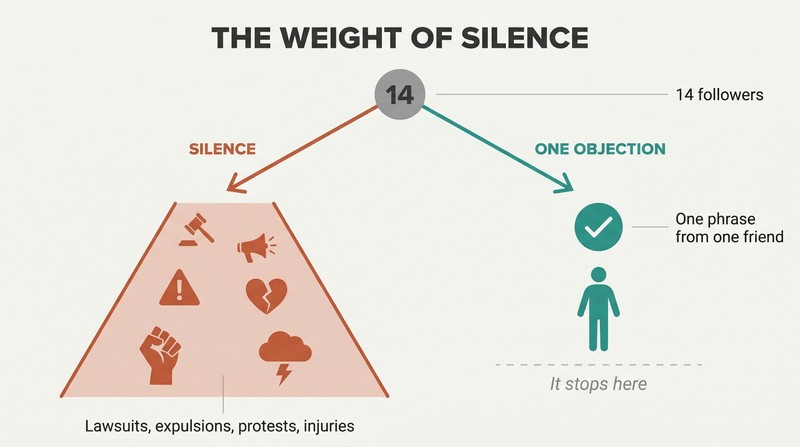
In 2017, a Korean American junior named Charles created a private Instagram account called @yungcavage at a grilled cheese restaurant, egged on by friends who promised to follow it. Over months, he posted images comparing Black classmates — some of them his close friends — to gorillas, drew nooses around their necks, and joked about the KKK. The account had just 14 followers.
The fallout consumed an entire community. Lawsuits, expulsions, a botched mediation, a 700-student protest, broken noses, vandalized cars, and suicidal teenagers on both sides followed. The one person who objected — a low-status boy named Wyatt — was routinely ignored. Charles admitted that if any high-ranking friend had simply said 'this is too far,' he would have stopped. Silence was the accelerant.
Ironic racism is hate's Trojan horse — extremists exploit it deliberately
“If you want to make the unthinkable thinkable, make it sound like a joke.”
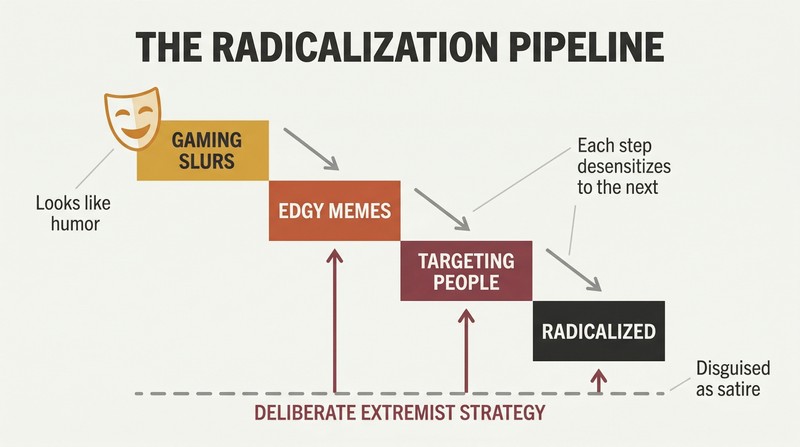
Charles's radicalization followed a predictable escalation: racial slurs in League of Legends matches, then Reddit's 'edgy' meme culture, then a private Instagram targeting real people he knew. Each exposure desensitized him to the next. By 2016, three-quarters of American youth ages 15 – 21 had encountered extremist content online, 85% of them accidentally.
Hate groups weaponize this pipeline. The neo-Nazi website The Daily Stormer published an internal style guide instructing writers to keep content ambiguous — sincere extremism disguised as ironic humor. Researchers found that most widely circulated racist memes originated on a tiny number of far-right forums before spreading to mainstream platforms. Poe's Law — the idea that online sincerity and satire are indistinguishable — is exactly what makes this recruitment strategy so effective.
A double-tap is not neutral — liking online hate is participation
“I recognized then: Yes, I did have a role in it. Being a follower of the account, liking, commenting, everything like that, that holds weight.”
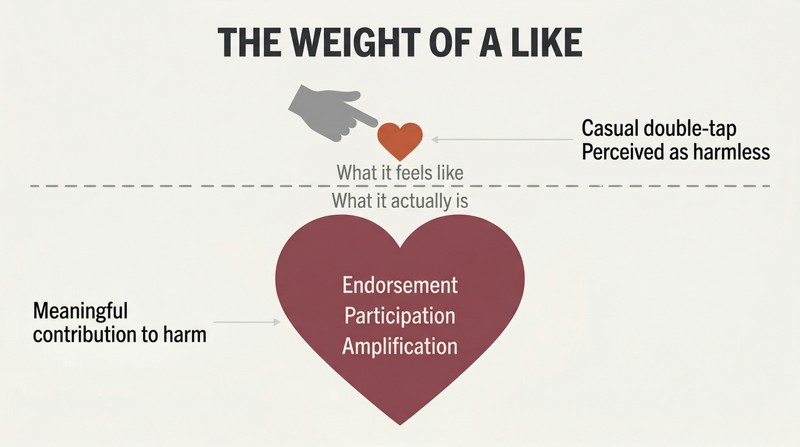
Eren was a 'default double-tapper' — scrolling and liking without processing what he endorsed. He followed over a thousand accounts and barely remembered @yungcavage. When confronted, he insisted he was peripheral: a sophomore who didn't know the juniors running the account. But Judge Donato ruled that anyone who 'liked' a harassing post 'meaningfully contributed to the disruptions.'
Research confirms bystanders face weaker pressure online. Researcher Sarah Jones identified five unwritten rules students use to justify inaction: only respond if you know the victim; only intervene if it seems truly harmful; follow your peer group's norms; wait for someone else to act first; and protect yourself from becoming the next target. In digital spaces where victims are invisible, these rules turn ordinary teens into silent accomplices.
In boy hierarchies, being funny outranks being moral
“In boy world, everything has to be funny or else your heterosexuality and your masculinity is questioned. Everything has to be funny or you're being a little bitch.”
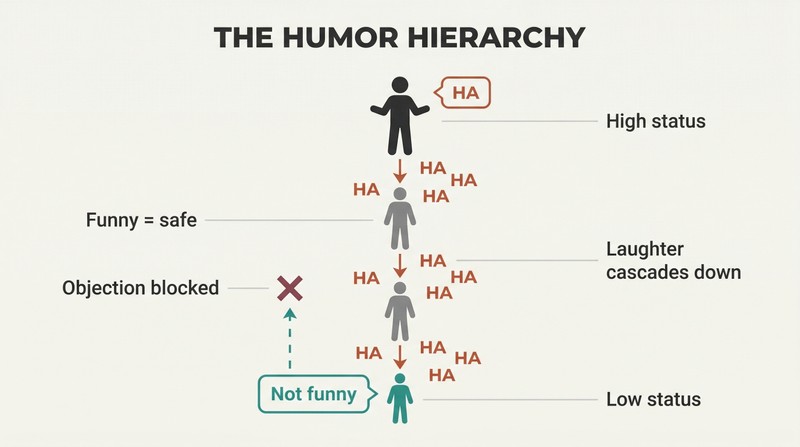
Being funny is untouchable social currency among teen boys, according to researcher Rosalind Wiseman. Boys who are competitively funny never face social exile. In Charles's friend group, status determined whose objections mattered. When low-ranking Wyatt wrote 'Hey not funny' and 'Fuck you' under a post comparing Andrea to a gorilla, nobody listened. Charles admits: 'We didn't view Wyatt as having much of a say.'
The hierarchy created a cascade. Charles pinpoints the moment racist jokes entered his circle: a boy used the N-word at Taco Bell, the high-status boys laughed, and Charles calculated — 'If this is what our group's humor is going to be, then I guess I'm okay with that.' Each boy who stayed silent gave the next one permission to laugh. Decency became the thing you'd get mocked for.
Every racist joke carries the weight of centuries it references
“A slur, a stereotype, a joke, an assumption is never just itself. It's also everything that came before it, centuries of wounds, cuts on top of cuts on top of cuts.”
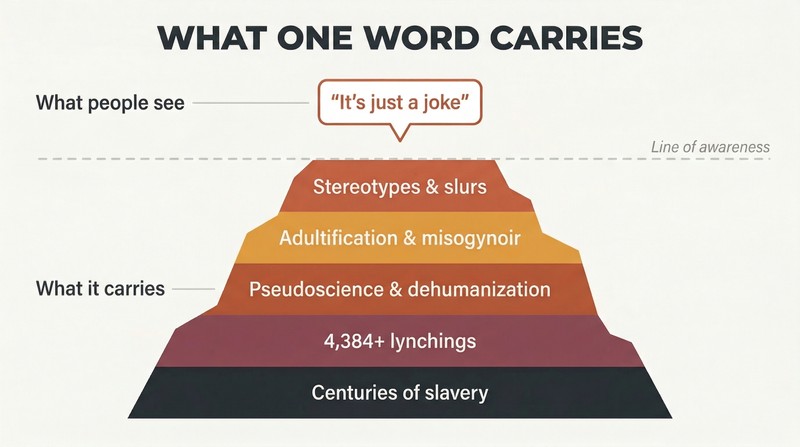
A noose is never just rope. Between 1887 and 1950, at least 4,384 Black Americans were lynched. The comparison of Black people to apes dates to 1600s European texts used to justify slavery. When Charles posted a photo of Andrea next to a gorilla, he deployed a weapon sharpened by centuries of use. Andrea's reaction: she couldn't even post a snow photo on Instagram without it being weaponized against her.
The book introduces misogynoir — scholar Moya Bailey's term for the specific intersection of anti-Black racism and misogyny facing Black women. A related phenomenon, adultification, means adults perceive Black girls as young as five as older and less innocent than white peers. Charles didn't know this history. But the weapon didn't need his understanding to cut.
Discrimination ages Black women's bodies at the cellular level
“When you are targeted for who you are, it doesn't just hurt your feelings. It hurts every cell in your body.”
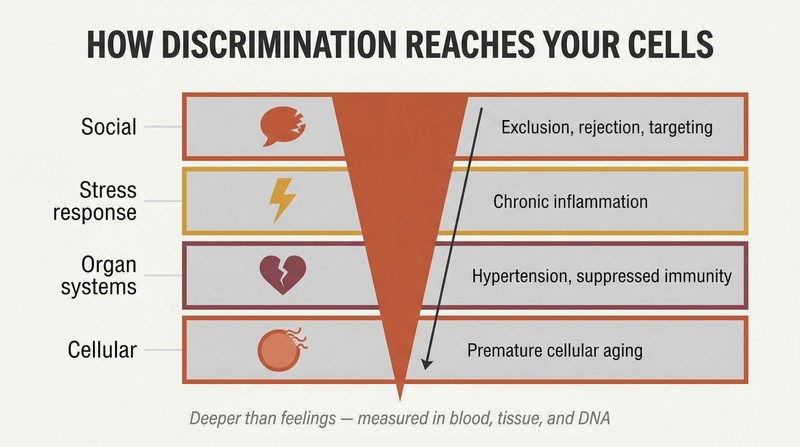
The physiological toll is measurable. People experiencing racial discrimination show higher blood pressure, shorter life spans, and premature cellular aging. Chronic inflammation from exclusion and rejection is linked to diabetes, cancer, and heart disease. Older Black women facing regular racism report nearly three times more cognitive difficulty than those who don't.
Stanford's Robert Sapolsky found parallel effects in low-status baboons: constant petty harassment from higher-ranking members produced hypertension, suppressed immunity, and diabetes-like symptoms. After the account's discovery, Albany's targeted students developed anxiety, panic attacks, depression, and disordered eating. One targeted student, Brutsri, drove to a remote lake multiple times with a replica pistol, planning suicide-by-cop. Another student who had followed the account stood in his family's bathroom holding a knife.
Zero-tolerance collapses every shade of guilt into one label
“Because everybody got the same punishment, students and teachers concluded that everyone had the same level of involvement.”
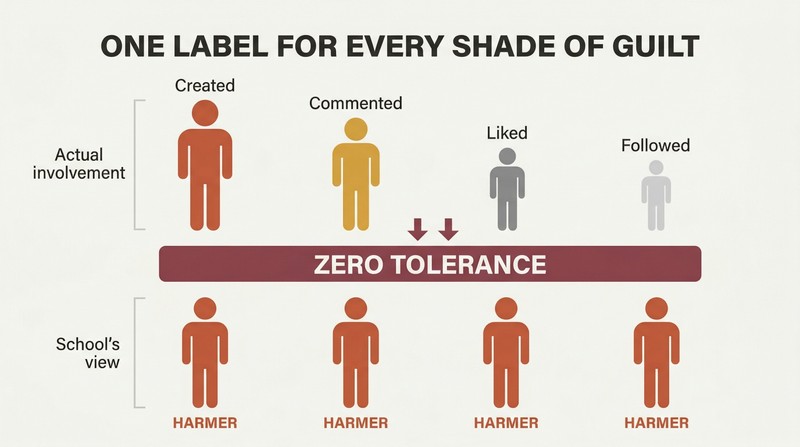
Albany's administration reached for a blunt instrument. Officials extended every follower to the maximum five-day suspension regardless of involvement — whether they'd liked, commented, or simply followed without ever interacting. All 13 followers were labeled 'Harmers,' a designation that appeared on whiteboards and in official documents, flattening the crucial distinction between creator and bystander.
Judge Donato eventually drew lines the school refused to. He ruled that students who 'liked' harassing posts could be disciplined, but mere followers who showed no approval had their First Amendment rights violated. By then, the community had already convicted all 13 as interchangeable co-conspirators. One student who never interacted with a single post faced the same social exile as the boy who drew nooses.
Public shaming entrenches bad behavior instead of reforming it
“It literally felt like we were in the medieval days and we're stoning someone.”
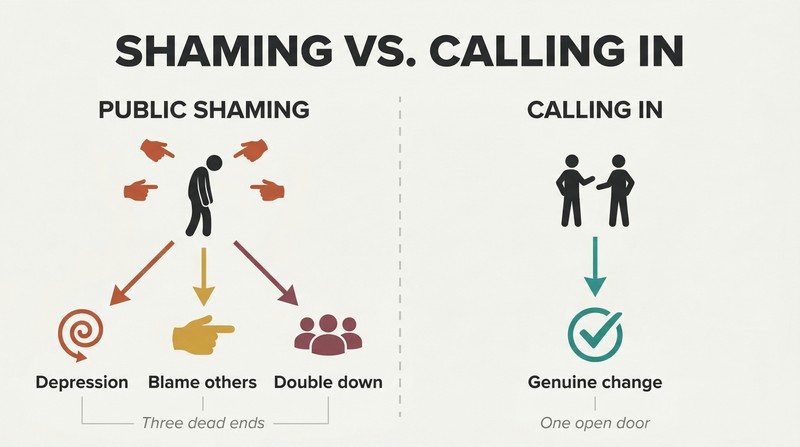
The March 30 sit-in was supposed to bring closure. Instead, a botched mediation and a false noose report ignited a 700-student protest. Account followers were paraded before the crowd. Students surrounded a family's minivan, rocking it and hurling trash through windows. One boy got his nose broken. Others were filmed and mocked across social media for days.
Criminologist John Braithwaite's research explains why this backfires. Public shaming gives people three options: accept the label and spiral into depression; shift blame to others; or find communities that celebrate the shamed behavior. In Albany, shaming drove some followers into deeper defensiveness, pushed multiple teenagers toward suicide, and convinced many they were irredeemable — precisely the condition least likely to produce genuine change. Professor Loretta Ross advocates 'calling in' instead: confronting harm privately with love.
Accountability means repairing harm, not matching pain for pain
“The main thing the racist kid learns about racism from expulsion is to be more discreet about their racism.”
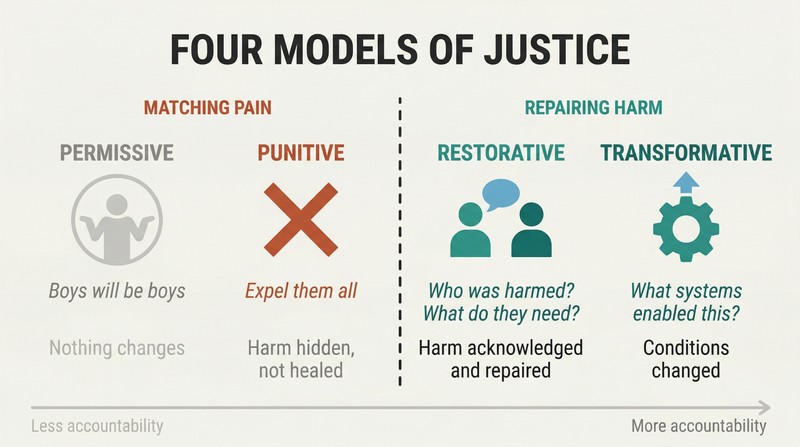
The book outlines four models of justice:
1. Punitive: eye for an eye — expel them all
2. Permissive: boys will be boys — let it go
3. Restorative: who was harmed, what do they need, whose obligation is it?
4. Transformative: what systemic conditions enabled this?
Albany defaulted to punitive and got stuck. Parents demanded expulsion. The school board feared appearing soft on racism. The SEEDS mediation — mislabeled 'restorative justice' — was its opposite: unprepared participants, no support structures, a mob forming outside. Real restorative justice requires weeks of preparation and skilled facilitation. Justice advocate Aishatu Yusuf defines genuine accountability as 'an understanding that a harm took place and that you are responsible for a piece of that harm' — a definition requiring conversation, not just punishment.
Transformation came from honest questions in living rooms, not courtrooms
“The biggest lesson I took away from this was the worst moments ended and I've had the best time.”
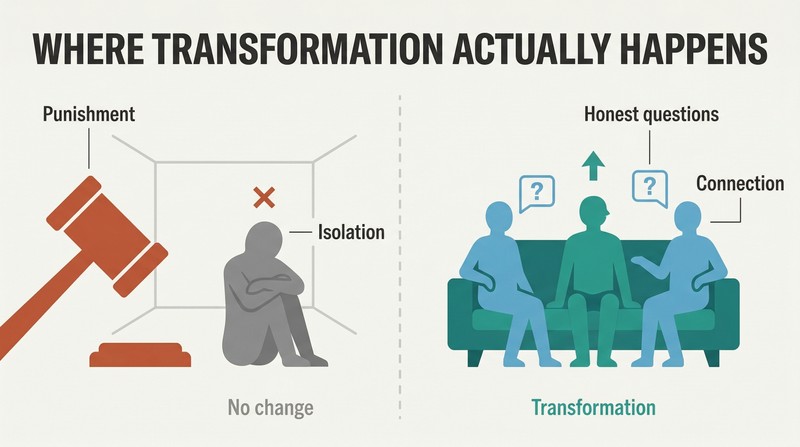
Charles didn't transform through expulsion. He spent months depressed and idle in his room. What changed him was moving to Florida, where his sister's teacher roommates accepted him while challenging him. One housemate played Kendrick Lamar and asked him to analyze lyrics about Black life. Another asked, 'Have you ever considered that maybe you seek attention in unhealthy places?' These questions, asked without judgment, cracked him open.
Similar patterns appeared across the story. Eren's growth came from relentless self-interrogation sparked by one commenter's words. Brutsri healed through activism and counseling, eventually joining the school board. Andrea found freedom through a lawsuit, travel to Guatemala, and a fifty-foot cliff jump into Lake Atitlán. In every case, healing required someone willing to see the whole person — not just the label.
Analysis
Accountable represents an evolution in how we narrate racial harm — one that refuses the villain-and-victim binary typically structuring such stories. Slater's methodology (hundreds of hours of interviews, legal documents, social media archives) produces something closer to Rashomon than polemic, which is precisely what makes the book's insights transferable rather than merely cautionary.
The book's most sophisticated argument is structural: the institutional architecture surrounding these teenagers — the school's discipline matrix, social media platforms monetizing their attention, a legal system thinking only in speech rights and tort claims — was built for a world that no longer exists. Albany's administrators had no framework for distinguishing between creating a racist meme and double-tapping on one. The Tinker test, designed for Vietnam-era armband protests, buckles under algorithmic amplification and the ambient anti-Blackness of internet culture.
What distinguishes Slater's approach is her willingness to trace harm in every direction without creating false equivalences. The targeted girls' trauma is documented with unflinching specificity — suicidal ideation, cellular-level health damage, years of PTSD symptoms. But so is the aftermath for followers: a boy with a knife in a bathtub, another planning suicide-by-cop, teenagers afraid to leave their houses for months. Slater never suggests these sufferings are equivalent. She suggests they are connected — products of a broken system that could identify wrongdoing but not facilitate repair.
The book's implicit challenge to restorative justice practitioners deserves attention. The Albany SEEDS mediation — often miscategorized as restorative justice — was its antithesis: unprepared participants, no support structures, a mob outside the door. Real restorative processes require weeks of preparation, voluntary participation, and skilled facilitation. Albany's failure was not a failure of restorative justice but of a community that grabbed the label without understanding the practice. The result is a book functioning simultaneously as investigative journalism, moral philosophy, and instruction manual for what not to do when hate erupts in a community that believes itself above it.
Review Summary
Accountable receives mostly positive reviews, praised for its nuanced exploration of a racist social media incident and its impact on a high school community. Readers appreciate Slater's balanced approach, presenting multiple perspectives and raising thought-provoking questions about accountability, justice, and societal issues. Many recommend it for students, educators, and parents. Some criticize its length and pacing, finding it occasionally repetitive or slow. Overall, reviewers commend the book's relevance, depth, and potential for fostering important discussions about racism, social media, and teen behavior.
People Also Read
Glossary
Misogynoir
Anti-Black-woman racism and misogynyTerm coined by scholar Moya Bailey describing the particular intersection of anti-Black racism and misogyny targeting Black women. Visible in dating apps (where Black women are stereotyped as less feminine or hypersexual), medical settings (where they're less likely to receive pain treatment), and schools (where they face harsher discipline). In the book, the @yungcavage posts exemplified misogynoir by mocking Black girls' hair and comparing them to animals.
Adultification
Perceiving Black girls as olderA documented phenomenon in which adults perceive Black girls as young as five as being older, less innocent, and less in need of comfort and protection than white girls of the same age. Research by Georgetown Law Center documented this bias. In Albany, adultification manifested as teachers and administrators being slower to recognize the account's targeted girls as vulnerable children in need of protection, while simultaneously expecting more emotional maturity from them.
Poe's Law
Online sincerity indistinguishable from satireThe principle that it is impossible to tell online whether someone is being genuinely extremist or satirically mocking extremism. Named informally after internet culture discussions. In the book, Poe's Law explains how hate groups exploit ambiguity—wrapping sincere racist ideology in layers of irony so that followers can always claim they were 'just joking.' Charles and his friends operated in exactly this ambiguous space.
The Tinker test
Standard for disciplining student speechLegal standard from the 1969 Supreme Court case Tinker v. Des Moines, which ruled that schools can discipline student speech only if it would foreseeably cause a 'substantial disruption' to school operations and the speech has a sufficient connection ('nexus') to the school. Judge Donato applied this test to determine which @yungcavage followers Albany High could legally punish, ruling that likers and commenters passed the test but passive followers did not.
Stereotype threat
Identity anxiety impairs performanceA phenomenon where anxiety about confirming a negative stereotype about one's identity group makes it harder to perform well on related tasks. In the book, Rina—a high-GPA junior class president planning to attend nursing school—began failing math after the account's discovery. The splinter of self-doubt she'd always carried about being perceived as less intelligent became a thorn, and sharing a classroom with account followers made concentration impossible.
Zone of Both
Where harmful jokes stay ambiguousThe author's term for the semi-lit psychological space where racist jokes are simultaneously meant and not meant, funny and not funny. In this zone, no one commits to feeling strongly about anything, which means no one has to confront actual harm. Charles's friend group operated here—their 'edgy humor' functioned as both genuine prejudice and plausible deniability simultaneously, providing safety through ambiguity.
Race realism
Pseudoscience ranking races by geneticsAlso called scientific racism or biological racism. The discredited claim that human races can be meaningfully ranked by intelligence or ability based on genetic differences. In the book, account follower Jon discovered these ideas online and spread them to friends, believing he'd accessed suppressed scientific truth. Over 140 prominent geneticists have signed statements that population genetics provides no support for such claims, and any two humans share 99.9% of their DNA.
Forbidden knowledge discourse
Framing rejected science as suppressedTerm coined by sociologist Dr. Reanne Frank for the rhetorical strategy used by proponents of discredited racial science. They portray themselves as brave truth-tellers whose ideas are rejected not because the science is flawed, but because the conclusions are too politically controversial to accept. This framing is especially effective with young people like Jon, who wanted to believe they'd accessed hidden truths unavailable to the mainstream.
Harmers
School's label for all followersThe label Albany Unified School District officials applied collectively to all 13 students who followed the @yungcavage account, regardless of their level of involvement. By grouping the account's creator, active commenters, casual likers, and uninvolved followers under one designation, the school eliminated any possibility of distinguishing degrees of culpability—and ensured that the community treated all 13 identically, from the boy who drew nooses to the girl who never interacted with a single post.
Calling in
Confronting harm privately with loveApproach advocated by Smith College professor Loretta J. Ross as an alternative to 'calling out' (public shaming). Calling in addresses wrongdoing through private conversation that presumes willingness on both sides to learn and repair harm. It targets the behavior rather than attacking the person's identity. Ross cautions that calling in isn't appropriate when people refuse accountability, and she supports 'punching up'—using public callouts against powerful figures whose positions insulate them from consequences.
FAQ
What's Accountable about?
- True Story of Racism: Accountable by Dashka Slater narrates the true story of a racist social media account created by teenagers at Albany High School and its profound impact on their lives and community.
- Focus on Consequences: It explores the consequences of the account's creation, including public shaming, legal battles, and the emotional toll on both perpetrators and victims.
- Themes of Racism and Accountability: The book delves into themes of racism, accountability, and the complexities of teenage behavior in the digital age, highlighting how social media can amplify harmful actions.
Why should I read Accountable?
- Relevant Social Issues: The book addresses pressing social issues such as racism, bullying, and the role of social media, making it highly relevant for today’s readers.
- Insightful Perspectives: It provides multiple perspectives from both victims and perpetrators, allowing readers to understand the complexities of human behavior and the consequences of actions.
- Educational Resource: Accountable serves as an educational resource for discussions about race, accountability, and the importance of empathy in a diverse society.
What are the key takeaways of Accountable?
- Understanding Accountability: The book emphasizes the importance of holding individuals accountable for their actions while recognizing their humanity and potential for change.
- Impact of Social Media: It illustrates how social media can be a double-edged sword, providing a platform for both connection and harm, and how quickly harmful content can spread.
- Complexity of Justice: The narrative explores different forms of justice—punitive, restorative, and transformative—and questions what true justice looks like in the context of racism and bullying.
What are the best quotes from Accountable and what do they mean?
- Accountability and Humanity: "How do we hold people accountable for wrongdoing and yet at the same time remain in touch with their humanity enough to believe in their capacity to be transformed?" This quote highlights the tension between accountability and compassion.
- Symbolism of Racism: "A noose is just a rope with a knot that can be tightened, but in America, it’s a rope that delivers a message." It underscores the historical and cultural significance of the noose as a symbol of racism and violence.
- Standing Against Injustice: "I will not stand for racism or sexism or homophobia." This declaration reflects the resolve of students to confront injustice and serves as a rallying cry for activism.
How does Accountable address the role of social media in shaping behavior?
- Amplification of Harm: The book illustrates how social media can amplify harmful behaviors and attitudes, allowing them to spread quickly and widely.
- Peer Pressure Dynamics: It explores how social media creates environments where peer pressure can lead to complicity in harmful actions.
- Impact on Identity: The narrative discusses how social media influences self-perception and identity among teenagers, complicating the understanding of accountability.
What methods of justice are discussed in Accountable?
- Punitive Justice: Focuses on punishment for wrongdoing, often without addressing underlying issues or promoting healing, critiqued for not leading to meaningful change.
- Restorative Justice: Emphasizes repairing harm through dialogue and understanding between affected parties, fostering empathy and connection.
- Transformative Justice: Looks beyond individual actions to address systemic issues, encouraging a broader examination of societal structures for collective change.
How does Accountable explore the concept of identity?
- Intersectionality: The book examines how race, gender, and social status intersect to shape individual experiences, highlighting challenges faced by students of color.
- Self-Perception: Characters grapple with their identities in the wake of events, questioning their worth and place in the community.
- Community and Belonging: Emphasizes the importance of community in shaping identity, showing how solidarity can foster resilience and belonging.
What role do parents play in Accountable?
- Influence on Behavior: The book posits that children learn behaviors, including racism, from their parents, highlighting the importance of parental guidance.
- Community Meetings: Describes how parents from both sides came together to discuss the incident, illustrating potential for dialogue and healing.
- Emotional Struggles: Parents grapple with their own emotions and the implications of their children’s actions, showcasing the broader impact on families.
How does Accountable address the concept of public shaming?
- Consequences of Shaming: Discusses how public shaming can lead to severe emotional distress, often resulting in long-term mental health issues.
- Lack of Control: Illustrates that once shaming is public, the original wrongdoer loses control over the narrative, with consequences spiraling beyond initial actions.
- Alternative Approaches: Advocates for a “calling in” approach, focusing on understanding and compassion rather than humiliation, suggesting more constructive outcomes.
How does Accountable depict the legal consequences faced by the teenagers?
- Lawsuits and Settlements: Details various lawsuits filed by both victims and perpetrators, illustrating the complex legal landscape surrounding free speech and accountability.
- Judicial Outcomes: Discusses outcomes of legal battles, including settlements and implications for students involved, highlighting the intersection of law and morality.
- Long-term Effects: Emphasizes that legal consequences extend beyond the courtroom, affecting lives and futures of teenagers involved.
What lessons does Accountable offer about empathy and understanding?
- Need for Compassion: Advocates for empathy as a crucial response to wrongdoing, suggesting understanding motivations can lead to healing.
- Building Bridges: Emphasizes importance of dialogue and connection in overcoming differences, encouraging seeking common ground.
- Personal Growth: Illustrates that personal growth often comes from facing uncomfortable truths and learning from mistakes, reinforcing capacity for change.
How does Accountable address the concept of restorative justice?
- Restorative Justice Principles: Introduces restorative justice as an alternative to punitive measures, focusing on healing and accountability.
- Community Involvement: Highlights role of community in restorative justice, emphasizing healing often requires collective effort and understanding.
- Long-term Impact: Suggests restorative justice can lead to more meaningful change and reconciliation, benefiting individuals and community.
Download PDF
Download EPUB
.epub digital book format is ideal for reading ebooks on phones, tablets, and e-readers.








































