Key Takeaways
1. The Constitution Forged a Powerful National State, Not Just Limited Government
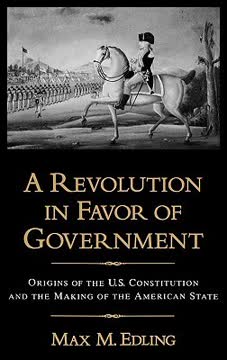
The major finding presented here is that the Federalist argument was not a proto-liberal call for minority rights and limited government but an argument about state formation, or state building.
Reinterpreting Federalism. This book fundamentally challenges the prevailing view that the U.S. Constitution was primarily designed to limit government and protect minority rights, as often attributed to James Madison. Instead, it argues that the Federalists' central objective was the creation of a strong, centralized national state, capable of acting decisively on the international stage. This "state-building" perspective reframes the entire debate over ratification.
European parallels. The Federalists envisioned an American state possessing powers akin to contemporary European "fiscal-military states," which were primarily organized for war, taxation, and debt management. They sought to equip the new government with the necessary tools to ensure national survival and prosperity in a competitive global environment, a stark contrast to the weak Confederation.
Beyond Madison. While Madison's contributions to The Federalist are invaluable, relying solely on his writings for understanding Federalism can be misleading. A broader examination of Federalist and Antifederalist discourse reveals that the core of the debate revolved around the scope and nature of national power, particularly in military and fiscal matters, rather than solely institutional checks and balances.
2. Antifederalists Feared a European-Style "Machtstaat" in America
As Bailyn has written, Antifederalists saw in the Constitution “the construction of what could properly be seen, and feared, as a Machtstaat, a central national power that involved armed force, the aggressive management of international relations, and, potentially at least, the regulation of vital aspects of everyday life by a government superior to and dominant over all other, lesser governments.”
Echoes of Country thought. Antifederalists drew heavily from the Anglo-American "Country" tradition, which viewed centralized power as inherently expansive and threatening to liberty. They saw the proposed Constitution as a blueprint for a powerful, potentially tyrannical state, reminiscent of the absolute monarchies of continental Europe or even the increasingly centralized British government they had just rebelled against.
Threats to liberty. Their fears were concrete and focused on specific powers granted to the new federal government. They worried about:
- The establishment of a standing army in peacetime.
- Unlimited federal taxation, especially direct taxes.
- The erosion of state sovereignty and local institutions.
- The potential for military enforcement of unpopular laws.
Preserving American exceptionalism. For Antifederalists, America's unique freedom stemmed from the absence of "big government" and its associated burdens. They believed the Federalists were betraying the Revolution's ideals by seeking to "Europeanize" America, thereby sacrificing liberty for national grandeur.
3. Confederation's Military Weakness Imperiled American Independence and Commerce
To the men who convened in Philadelphia and to the men and women who would later support the Constitution, Congress’s military weakness was one of the issues that appeared most critical to the future of the union.
Post-war vulnerability. After the War of Independence, the national government under the Articles of Confederation proved dangerously impotent. It lacked the capacity to defend the union's territorial integrity against European powers (Britain and Spain) or to protect its vital commercial interests. This weakness was a primary driver for constitutional reform.
Systemic failures:
- Requisitions: Congress relied on states for troops and funds, leading to inconsistent and insufficient contributions.
- Anti-army sentiment: A strong aversion to peacetime standing armies, rooted in colonial experience and Country ideology, prevented the formation of a professional national defense.
- Economic disadvantage: Without a unified commercial policy or military backing, the U.S. struggled against restrictive European trade policies, particularly Britain's Navigation Acts, which severely hampered American shipping and exports.
Geopolitical realities. Federalists recognized that in a world dominated by powerful "fiscal-military states," a weak and disunited America was vulnerable to exploitation and even partition. They argued that national respectability and economic prosperity were inextricably linked to military strength.
4. Federalists Demanded Unlimited Military Power for National Security
The powers requisite for attaining it, must be effectually confided to the federal councils.
Means to an end. Federalists argued that if the national government was responsible for the union's defense, it must possess the unlimited means to fulfill that duty. They rejected any constitutional restrictions on Congress's power to raise and support armies, viewing such limitations as dangerous and unrealistic in a hostile international environment.
Critique of the militia:
- Inefficiency: The militia, composed of citizen-soldiers, was deemed unreliable and ineffective against professional European armies, as demonstrated during the Revolution.
- Costly: Relying on short-term militia service was economically inefficient due to frequent rotations, loss of labor, and high bounties.
- Unsuitability: Militia were ill-suited for frontier defense or sustained campaigns, which required professional discipline and training.
Geopolitical necessity. The Federalists believed that national survival depended on the ability to deter foreign aggression and enforce treaties. This required a professional, standing army, however small, and the capacity for rapid, large-scale mobilization when necessary. They saw the European state system as a constant threat, where weakness invited attack.
5. Antifederalists Saw Standing Armies as a Direct Threat to Liberty and Property
If the Constitution was adopted and the Federalists realized their plan to raise a standing army, the people of America would soon find that the Constitution’s supporters would make use of it on the domestic—not international—scene.
Historical warnings. Antifederalists vehemently opposed the unlimited power to raise standing armies in peacetime, citing centuries of European history where such forces had been instruments of tyranny, used to suppress popular liberties and enforce arbitrary rule. They saw a direct link between a standing army and the establishment of despotism.
Domestic coercion:
- Tax enforcement: A primary fear was that a federal army would be used to compel the collection of oppressive taxes, overriding local resistance and popular will.
- Suppression of dissent: They believed the army would be deployed against citizens who dared to protest government actions, turning America into a "military government."
- Erosion of local control: The centralization of military power would undermine the state militias, traditionally seen as the "bulwark of freedom" and the ultimate check on federal overreach.
Betrayal of the Revolution. For Antifederalists, the creation of a standing army was a betrayal of the very principles for which Americans had fought against Britain. It represented a dangerous shift from a government based on consent and local control to one reliant on force and distant authority.
6. Federalists Advocated a "Light and Inconspicuous" Military Presence
The Federalist response to Antifederalist fears denied that the Constitution would create a government of force, depriving the people of their property by means of a military execution of unjust tax laws.
Limited scope, strategic deployment. While advocating for a professional army, Federalists assured that it would be small (around 3,000 men) and primarily deployed on the western frontier to manage Indian relations and deter European rivals. This strategic placement ensured minimal contact with the general populace, addressing fears of domestic military coercion.
No "government of force":
- Civilian enforcement: Federalists argued that ordinary law enforcement would rely on state magistrates and the cooperation of law-abiding citizens, not federal troops.
- Insurrection response: Military force would only be used in extraordinary circumstances, like large-scale insurrections or secession threats, and ideally, through nationalized state militias rather than regulars.
- Popular sovereignty: They maintained that the ultimate balance of power remained with the people and the states, making a federal military takeover impossible.
Division of labor. Federalists promoted a modern division of labor where professional soldiers handled defense, freeing citizens to pursue productive economic activities. This contrasted with the classical republican ideal of the citizen-soldier, which they deemed impractical and economically detrimental for a commercial republic.
7. Confederation's Fiscal Insolvency Undermined National Credit and Authority
By 1787 the insolvency of the national government was total. The problem had to be addressed—and the Constitution was by no means the only way to do so—or the Confederation was in danger of passing into oblivion.
Financial collapse. The Articles of Confederation rendered the national government financially bankrupt. It lacked independent taxing authority, relying instead on unreliable state requisitions, which consistently failed to meet federal expenses. This fiscal impotence was a critical weakness that jeopardized the union's very existence.
Failed funding mechanisms:
- Continental currency: Early reliance on fiat money led to hyperinflation and eventual worthlessness, destroying public trust.
- Loan certificates: Bonds issued to finance the war depreciated severely due to Congress's inability to guarantee interest payments, making future borrowing impossible.
- Foreign loans: Congress defaulted on loans from France and Spain, severely damaging America's international credit and reputation.
State-level resistance. States, facing their own financial burdens and popular resistance to heavy direct taxes (often leading to rebellions like Shays's), were unwilling or unable to consistently fund federal requisitions. This demonstrated the fundamental flaw of a national government dependent on state discretion for its revenue.
8. Unlimited Federal Taxation Was Essential for Restoring Public Credit
The precondition for the restoration of the credit of the national government was therefore that Congress was given “full command over the resources of the Union,” by being invested with an unlimited power over taxation.
Foundation of national power. Federalists insisted that Congress must have an unlimited and direct power to tax, rejecting any "suspended" taxing authority or reliance on state requisitions. This was not merely about covering current expenses, but about establishing a credible basis for national credit.
The logic of credit:
- Borrowing for war: In the "modern system of war," nations financed conflicts through large loans, not just current taxes.
- Security for lenders: Lenders (domestic and foreign) would only trust a government that could guarantee repayment, which required an assured and expansive revenue stream.
- Deterrence: A strong credit rating, backed by unlimited taxing power, would enable the U.S. to mobilize resources swiftly in a crisis, deterring potential adversaries.
Lessons from the Confederation. The Federalists argued that the Confederation's failure to secure revenue through requisitions had destroyed public credit, making it impossible to borrow and leaving the nation vulnerable. They saw unlimited taxing power as a non-negotiable prerequisite for national solvency and strength.
9. Antifederalists Feared Oppressive Taxes and the Demise of State Power
The State which gives up the power of taxation has nothing more to give.
Erosion of state sovereignty. Antifederalists viewed Congress's unlimited taxing power as a direct assault on state sovereignty and the vital role of state legislatures. They believed that federal taxes would inevitably monopolize all taxable objects, leaving states without revenue and reducing them to insignificant entities.
Mechanisms of oppression:
- Double taxation: Citizens would be burdened by both federal and state taxes, leading to widespread hardship.
- Unrepresentative taxation: A distant, numerically small Congress would lack the local knowledge to levy taxes fairly, leading to oppressive and arbitrary impositions.
- Fiscal bureaucracy: The introduction of federal tax collectors, independent of state control, was seen as an intrusive and potentially tyrannical extension of central power into private lives, reminiscent of the British excise system.
Loss of popular control. For Antifederalists, state legislatures were the only true popular assemblies, capable of reflecting local needs and providing a check on government overreach through their control of the purse. Stripping states of this power would remove the people's primary defense against arbitrary taxation and the eventual "consolidation" of power.
10. Federalists Promised a "Government for Free" Through Indirect Taxation
The great advantage of the impost was that the tax was “blended” with the price of the commodity taxed, which made the taxpayer “often not sensible of the payment.”
Minimizing burden and visibility. Federalists countered fears of oppressive taxation by promising a federal fiscal system that would be "light and inconspicuous." Their primary revenue source would be the impost (customs duties), which they argued was the least burdensome and most palatable form of taxation for the American people.
Advantages of the impost:
- "Unfelt" tax: Indirect taxes were "blended" into the price of goods, making consumers less aware they were paying a tax.
- Voluntary: Consumers could choose to avoid the tax by not purchasing luxury imported goods.
- Efficient collection: Collected at ports by a small, specialized federal service, minimizing intrusion into internal state affairs and daily life.
- Reduced overall burden: Federal assumption of national and state debts, funded by the impost, would allow states to drastically cut their own (often regressive) direct taxes, leading to a net reduction in the tax burden on most citizens.
Self-regulating system. Federalists argued that the impost contained an inherent check against excess: if duties became too high, consumption would fall, and smuggling would increase, forcing the government to lower rates. This, combined with the promise of a small, frontier-focused military, aimed to create a powerful national state that respected the deep-seated anti-statist sentiments of the American populace.