

Key Takeaways
Turn toward your pain, because it maps what you love most
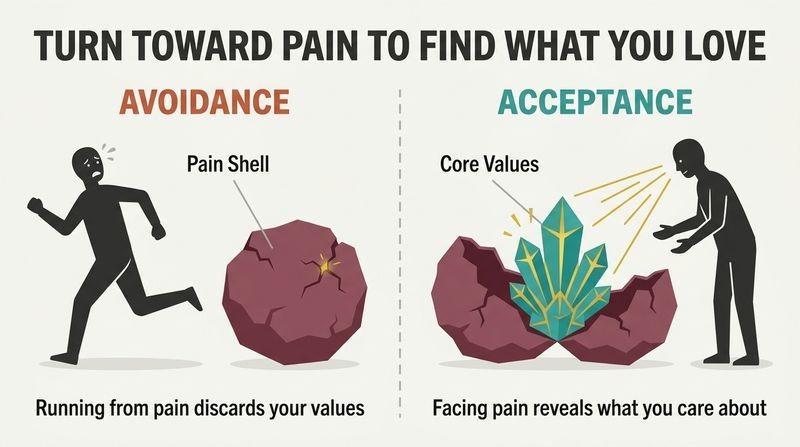
Steven Hayes, creator of Acceptance and Commitment Therapy (ACT), argues that our instinct to run from difficult thoughts and feelings backfires. His central concept is psychological flexibility: feeling and thinking openly, staying present, and moving toward what matters even while carrying pain.
The counterintuitive claim: you hurt where you care. A person crushed by depression yearns to feel fully alive. A socially anxious person yearns to connect. Hayes describes his own descent into panic disorder, where 80-90% of his waking hours were spent fighting anxiety, only to discover that fighting made it worse. Pain and purpose are two sides of the same coin. The way out is not elimination but a change in relationship to your inner experience.
This inverts the dominant Western therapeutic assumption that unpleasant feelings are problems to delete. It echoes Viktor Frankl's logotherapy and Buddhist non-attachment, but Hayes grounds it in over a thousand studies rather than philosophy alone. The framing resonates with modern affective neuroscience: suppression tends to amplify the very signals it targets. One caution worth noting is that turning toward pain requires a baseline of safety and support. For someone in acute crisis or ongoing danger, acceptance without stabilization can be premature, a nuance the approach handles through gradual, values-anchored exposure rather than flooding.
Your problem-solving mind is a dictator that poisons your inner life
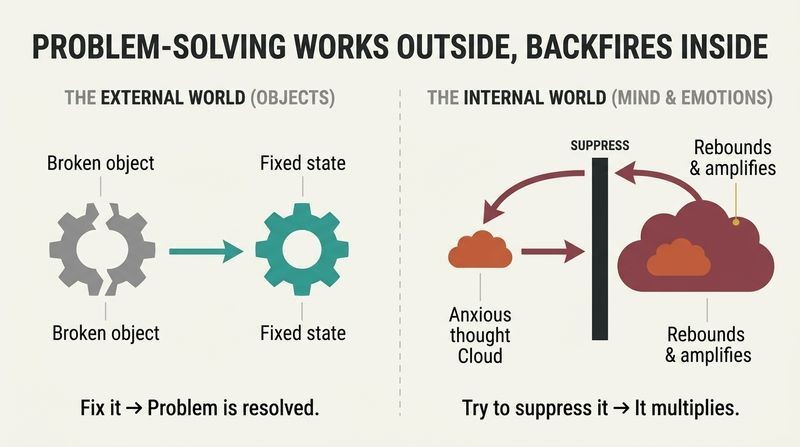
Hayes calls the relentless, judging voice in our heads the Dictator Within. It constantly offers 'solutions' to psychological pain that actually deepen suffering: get rid of it, figure it out, just fix it. This works brilliantly for external problems (call a friend to pick up your kid) but disastrously for internal ones.
The core error is treating life as a problem to be solved rather than a process to be lived. A memory is not a hot stove. To deliberately eliminate a thought, you must focus on it, which strengthens it. Trying to suppress anxiety breeds anxiety about anxiety. Hayes describes waking mid-night in full panic, proving how automatic this cycle becomes. The mind is good; the Dictator mode is what harms us.
The distinction between external and internal problem-solving is the book's sharpest practical insight. Evolutionary psychology supports it: the fight-or-flight machinery that saved our ancestors from predators misfires when aimed at thoughts, because you cannot flee your own nervous system. Daniel Wegner's ironic process theory demonstrated this experimentally with the white bear studies, where suppression instructions increased intrusive thoughts. Hayes extends this into a general theory of psychopathology. The 'Dictator' metaphor is vivid but risks anthropomorphizing cognition; the underlying mechanism is simply that language-based rules override direct experience, sometimes usefully, sometimes catastrophically.
Watch your thoughts instead of believing them, using defusion tricks
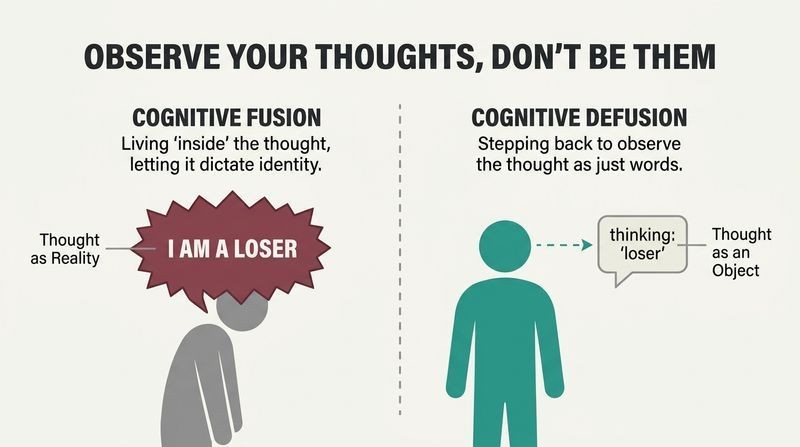
Cognitive fusion means buying into thoughts literally, letting them dictate behavior. Defusion is the skill of noticing thinking as an ongoing activity rather than truth. Hayes offers concrete techniques drawn largely from his clients.
One example: repeat a charged word rapidly for thirty seconds. A tattooed, gun-carrying client repeated 'loser' until it dissolved into mere sound, then wept about wanting to be a good father. Other methods: sing the thought to 'Happy Birthday,' name your mind (Hayes calls his George) and thank it politely, or write the thought on paper and carry it in your pocket. A tiny Irish lab study found that saying 'I cannot walk around this room' while walking boosted pain tolerance nearly 40%. Defusion prizes function over literal truth.
Defusion operationalizes what mindfulness traditions call metacognitive awareness, but Hayes strips it of spiritual scaffolding and tests it in randomized trials. The word-repetition exercise dates to Edward Titchener in 1916, revived a century later as clinical method. What is compelling is the shift from asking 'is this thought true?' (the traditional cognitive therapy question) to 'is this thought useful?' This reframe sidesteps endless internal debate. Skeptics might argue defusion risks dismissing thoughts that contain valid warnings. Hayes would counter that defusion is not suppression; you still hear the thought, you simply choose whether to act on it.
You are the awareness watching, not the story your ego tells
The Self pivot distinguishes the conceptualized self (your ego, your stories about who you are) from the transcendent, perspective-taking self (the observer behind your eyes that has been constant your whole life). Clinging to self-stories creates isolation, not belonging.
Hayes cites research that chasing self-esteem backfires: students who base worth on grades crash into depression after one bad mark. Genuine connection comes not from being special but from shared human consciousness. The most striking evidence involves autistic children like 'Sam,' who through perspective-taking training (learning 'if I were you and you were me') developed social awareness and waved goodbye to her mother for the first time. Perspective-taking relations of person, place, and time (I/you, here/there, now/then) build our very sense of self.
Hayes links a clinical intervention to a developmental theory of consciousness, which is ambitious. The claim that pursuing self-esteem is counterproductive aligns with Kristin Neff's self-compassion research, showing self-kindness outperforms self-esteem for resilience. The autism findings are provocative but come from small samples, so generalization deserves caution. The deeper philosophical move, that identity is a construction rather than a fixed essence, converges with both Buddhist anatta (no-self) and modern narrative psychology. What Hayes adds is a testable mechanism: deictic framing. The 'observer self' concept can feel abstract, but the practical payoff is real distance from harsh self-judgment.
Drop the rope in your tug-of-war with anxiety
Acceptance means receiving experience fully, as you would receive a gift, rather than fighting or fleeing it. A client gave Hayes the enduring metaphor: she felt locked in a tug-of-war with an anxiety monster over a bottomless pit. The solution was not to win but to drop the rope, freeing her hands for living.
Acceptance is not resignation or gritting your teeth. In a CO2 inhalation study, participants taught ACT methods had zero cases of feeling out of control, versus 42% for those using breathing relaxation. Crucially, acceptance is not about control: you open the valve fully in safe circumstances. Avoidance causes pain (like lifting a foot in quicksand sinks you deeper). Acceptance serves valued living, not mere endurance.
The quicksand and tug-of-war metaphors do heavy lifting because acceptance is genuinely hard to grasp intellectually. Hayes wisely insists acceptance is a means, not an end, distinguishing it from passive fatalism, a common misreading. The emotional-avoidance research connects to Todd Kashdan's finding that avoiders cannot sustain positive emotion either: numbing pain numbs joy. One tension: 'acceptance' as a word carries connotations of approval that Hayes must constantly disclaim. For people facing genuine injustice or abuse, the framing risks sounding like tolerate-your-oppression, which is why the book pairs acceptance tightly with committed action to change what can be changed.
Values are directions you travel, not goals you reach and finish
Hayes defines values as chosen qualities of being and doing (parenting lovingly, working honestly), expressed as verbs and adverbs. They are like heading west: you never arrive, you keep going. Goals are places you land; values are the compass.
This distinction matters because socially compliant goals (chasing approval, wealth, or 'shoulds') produce weak, resentful motivation. In a study, 132 college students who did fifteen minutes of values writing plus goal-setting raised their GPAs by roughly two-tenths of a point the next semester, while goal-setting alone did nothing. Hayes tells of a client who claimed not to care about family until, watching a family eat burgers nearby, he wept with longing. Pain is a flashlight: it reveals what you value by showing where you hurt.
The values-versus-goals distinction rescues motivation research from the hedonic treadmill problem, where achieved goals quickly lose their shine. It dovetails with Deci and Ryan's Self-Determination Theory: intrinsically chosen, autonomous values sustain effort far better than external pressures. The 'because I choose to' stance, where justification chains collapse after three 'whys,' cleverly exposes how much we outsource our motivation to social scripts. A fair challenge: values can themselves be internalized cultural conditioning masquerading as free choice. Hayes acknowledges choices are shaped by history but insists that owning them, rather than blaming heredity or society, is where agency and responsibility (response-ability) actually live.
Build change in tiny steps, choosing commit-slip-commit over commit-slip-quit
The Action pivot turns values into habits through small, repeated commitments rather than dramatic overhauls. Fixating on a perfect future state (quitting entirely, never relapsing) triggers procrastination and self-flagellation when you inevitably stumble.
Hayes recounts a heroin-addicted client who relapsed and declared himself a failure. His therapist asked simply: which of your values changed? None, the man admitted. The choice, then, was which pattern to strengthen: commit-slip-commit or commit-slip-quit. Practical tools include SMART goals, anchoring new habits to existing routines (grab an apple with your morning coffee), and practicing keeping small promises 'just because I choose to.' Hayes went a year without dessert not because it mattered but precisely because it did not, building trust that he could do what he said.
This is the behavioral engine beneath the mindful front-end, and it aligns closely with James Clear's habit-stacking and BJ Fogg's tiny-habits research: shrink the behavior until friction vanishes. The commit-slip-commit framing is therapeutically shrewd because relapse is the norm, not the exception, in behavior change, and self-blame predicts abandonment. Hayes reframes the lapse as data rather than verdict. The 'just because I choose to' commitments are a subtle inoculation against the mind turning values into another cudgel of obligation. The delayed-gratification thread nods to Mischel's marshmallow studies, though newer replications suggest socioeconomic context matters more than once believed.
Restructuring your negative thoughts is often futile, sometimes counterproductive
Hayes launched ACT partly by testing whether classic cognitive behavioral therapy's central premise held up. In eight studies, his team found it did not. In one, children afraid of the dark stayed longer not because affirmations changed their thinking, but because they believed the experimenter would know if they left. It was not what they knew, but who knew they knew.
He argues thoughts cannot be deleted (there is no unlearning, only new context-dependent learning, shown by Pavlovian extinction and rapid reacquisition). Trying to rearrange dense thought networks is like rearranging a spiderweb. Large studies now show CBT's benefits come mainly from behavioral components, and cognitive restructuring can even subtract from those effects. Positive affirmations make people with low self-worth feel worse.
This is Hayes's most confrontational claim, effectively critiquing the reigning gold standard of psychotherapy from inside the behavioral tradition. The affirmations finding (Wood et al., 2009) is genuinely counterintuitive and widely replicated. However, the picture is contested: CBT remains highly effective for many conditions, and its practitioners argue Hayes overstates the death of cognitive change. The honest synthesis, which the field has largely reached, is that changing your relationship to thoughts (defusion) and changing thought content (restructuring) are different tools with different evidence bases. Hayes deserves credit for insisting therapies explain why they work, not just that they work, raising the bar for the whole field.
Language itself, our greatest gift, manufactures our suffering
Hayes's underlying science is Relational Frame Theory (RFT): humans uniquely learn two-way relations between words and meanings. Say 'apple' and you salivate. This symbolic ability lets us solve problems, build technology, and imagine the future, but it also makes a frightening thought as real as a charging lion.
Chimps trained that a symbol means 'orange' cannot reverse it to pick an orange when shown the symbol; humans do this by twelve months. This two-way relating builds vast networks where any thought can trigger any other. Hayes summarizes: learn it in one, derive it in two, put it in networks, that change what you do. The dark side: we cannot stop relating, so a positive thought can trigger a painful one, and getting rid of a thought only weaves it deeper into the web.
RFT is the theoretical scaffolding that distinguishes ACT from generic mindfulness, giving it a basic-science pedigree most therapies lack. The claim that bidirectional symbolic relating is uniquely human and foundational to cognition is bold and has accumulated substantial experimental support, though it remains debated among linguists and comparative psychologists. The framing that our suffering is the price of our intelligence is philosophically elegant, echoing the biblical tree-of-knowledge motif in scientific dress. It also carries compassionate weight: your entangled mind is not a personal failing but the standard operating system of a symbolic species. This reframe alone reduces shame.
Notice invisible bias in yourself before demanding others fix prejudice
Hayes argues prejudice lives in everyone because our minds absorb cultural stereotypes whether we endorse them or not. He confesses that a childhood friend's racist slur ('it looks like rain' when a Black man approached) surfaced unbidden decades later when he looked at his own adopted African American daughter dressed for a dance.
His lab found all forms of prejudice reduce to authoritarian distancing, driven by three deficits: inability to take others' perspectives, inability to feel their pain, and unwillingness to stay open to that pain. Suppressing biased thoughts actually strengthens implicit bias. The alternative is a three-step practice: Own (notice your judgments without self-blame), Connect (feel the cost to others), Commit (take concrete action). Privilege is the hardest bias to see because it is invisible to those who hold it.
Hayes applies his acceptance framework to a domain where suppression is the default cultural strategy, and the science backs him: attempts to squash prejudiced thoughts often produce rebound effects, consistent with implicit-bias research. His personal vulnerability, admitting his own conditioned racism, models the 'Own' step and disarms defensiveness. The emphasis on invisible privilege converges with sociological work on structural advantage. A reasonable critique is that individual psychological flexibility, while necessary, is insufficient against systemic and institutional bias; changing minds does not automatically change housing policy or hiring algorithms. Hayes gestures at larger scales but the individual-level tools are where the evidence is strongest.
A whole community changed a sacred burial ritual to survive Ebola
Hayes closes with proof that psychological flexibility scales beyond individuals. During Sierra Leone's 2014 Ebola outbreak, kissing and washing the dead (culturally required to honor family and pass spirits onward) was spreading the virus, since Ebola surfaces on the skin of the deceased.
Rather than forcing compliance at gunpoint, locals trained in ACT and Elinor Ostrom's cooperation principles (a blend Hayes calls Prosocial) helped villagers invent a new ritual: washing, wrapping, kissing, and burying a section of banana tree trunk as a stand-in for the loved one. The Bo district achieved the lowest Ebola increase of eight heavily infected districts. A social worker named Hannah, herself a war-rape survivor, used values questions to help a terrified dying man choose love of family over fearful defiance.
This case study elevates ACT from personal therapy to public health intervention, a genuinely novel contribution. The banana-trunk solution is a masterclass in cultural humility: rather than dismissing the ritual as superstition, the intervention honored its meaning while altering its form, a lesson for any change effort meeting entrenched tradition. Hayes's analogy to Catholic transubstantiation preempts Western condescension effectively. Linking ACT to Ostrom's Nobel-winning commons-governance principles is intellectually rich, suggesting behavioral flexibility and institutional design reinforce each other. The evidence here is observational rather than controlled, so causal claims should be modest, but as a proof of concept for community-level flexibility, the story is compelling and hopeful.
Your body already knows the flexible response you keep overriding
Hayes insists you are not learning something foreign; you are recovering wisdom you already possess. In an exercise done with thousands worldwide, he asks people to physically pose their body at its worst with a painful issue (curled, clenched, hiding) then at its best (open, head up, arms free). Across the US, Canada, and Iran, results are identical: closed avoidance versus open acceptance.
He offers a second proof: recall your most empowering relationship, then answer six questions about it (were you accepted, present, seen, did what you care about matter). Each maps onto one flexibility skill. You already know what health looks like because you have felt it from someone who offered it. The skills are learnable through simple methods, and change can begin as fast as saying the word 'begin.'
Ending on the claim that flexibility is innate rather than imported is rhetorically and therapeutically smart: it reframes the entire program as remembering rather than acquiring, lowering the intimidation barrier. The cross-cultural posture data, while informal, gestures at something like embodied universals, resonating with research on universal emotional expression. The relationship exercise cleverly grounds abstract skills in lived experience everyone can access. A skeptic might note that 'you already know this' can undersell how much sustained practice genuine change requires, and Hayes elsewhere stresses that pivoting is fast but building the skill is slow, like a toddler learning to walk who falls seventeen times an hour.
Analysis
A Liberated Mind is the flagship trade book of Acceptance and Commitment Therapy, written by the psychologist who founded it. It is simultaneously a memoir (Hayes's own panic disorder and dark night on the carpet in 1981), a scientific manifesto (over a thousand studies, Relational Frame Theory), and a practical workbook. This triple identity is what makes it hard to summarize: the emotional narrative, the dense basic science of language and cognition, and the exercise-heavy how-to sections pull in different directions.
The book's intellectual contribution is a unified model of psychological suffering rooted in language itself. Where most self-help treats symptoms, Hayes locates the machinery: our uniquely human capacity for symbolic, bidirectional relating makes thoughts as vivid as reality, turning the mind into both problem-solver and torturer. His six pivots (defusion, self, acceptance, presence, values, action) are not arbitrary; he grounds them in evolutionary science, framing ACT as applied evolution across variation, selection, and retention.
What distinguishes ACT from the broader mindfulness wave is its insistence on asking why methods work, and its willingness to challenge cognitive behavioral therapy's core premise from within the behavioral tradition. Hayes's dismantling studies showing cognitive restructuring adds little are a genuine contribution to psychotherapy's self-understanding, even if his conclusions remain contested.
The book's limitations mirror its ambitions. The claims are sweeping ('more than any other single set of processes previously known to science'), the RFT science is presented more as settled than the field considers it, and many efficacy studies are small or from single labs. The relentless enthusiasm can feel evangelical. Yet the core insight is durable and increasingly mainstream: struggling against inner experience amplifies it, and a life is built not by feeling good but by feeling everything while moving toward what you value. Hayes's genius is packaging rigorous behavioral science in metaphors (dropping the rope, turning toward the dinosaur, the Dictator Within) that ordinary readers actually remember and use.
Review Summary
A Liberated Mind presents Acceptance and Commitment Therapy (ACT), focusing on psychological flexibility through six pivots: defusion, self, acceptance, presence, values, and action. Readers found the book helpful for anxiety and depression, praising its practical exercises and scientific backing. Some criticized its length and self-promotion, while others appreciated the personal anecdotes and broad applications. Many readers reported positive changes in their lives after applying ACT principles. The book is recommended for those seeking mental health improvement, though some suggest starting with simpler ACT introductions.
People Also Read








FAQ
What's A Liberated Mind about?
- Psychological Flexibility Focus: A Liberated Mind by Steven C. Hayes emphasizes the importance of psychological flexibility, which is the ability to adapt to changing circumstances and respond to thoughts and feelings in a way that aligns with one's values.
- Introduction to ACT: The book introduces Acceptance and Commitment Therapy (ACT), a therapeutic approach developed by Hayes that helps individuals accept their thoughts and feelings while committing to actions aligned with personal values.
- Six Key Pivots: Hayes outlines six key pivots—Defusion, Self, Acceptance, Presence, Values, and Action—that guide readers in living a more meaningful and fulfilling life.
Why should I read A Liberated Mind?
- Practical Tools for Life: The book provides practical tools and exercises that readers can apply to their daily lives to improve mental health and emotional well-being.
- Research-Backed Insights: Hayes draws on over thirty-five years of research in psychology, offering evidence-based insights into managing anxiety, depression, and other mental health challenges.
- Transformative Perspective: Reading this book can transform your perspective on pain and suffering, teaching you that embracing discomfort can lead to a richer, more meaningful life.
What are the key takeaways of A Liberated Mind?
- Psychological Flexibility is Essential: The ability to adapt and respond to life’s challenges with openness and acceptance is crucial for mental health.
- Embrace Pain for Growth: Hayes emphasizes that turning toward pain and discomfort, rather than avoiding it, can lead to personal growth and fulfillment.
- Six Pivots for Change: The book details six specific pivots—Defusion, Self, Acceptance, Presence, Values, and Action—that help individuals cultivate psychological flexibility.
What is the concept of "Defusion" in A Liberated Mind?
- Separating Thoughts from Self: Defusion involves creating distance between oneself and one’s thoughts, allowing individuals to see thoughts as mere words rather than truths that dictate behavior.
- Practical Techniques: Hayes suggests techniques such as repeating a word rapidly to diminish its emotional impact, helping individuals to detach from negative self-talk.
- Empowerment Through Perspective: By practicing defusion, individuals can empower themselves to choose actions that align with their values, rather than being controlled by their thoughts.
How does A Liberated Mind define "Acceptance"?
- Embracing Experiences: Acceptance is about fully embracing one’s thoughts and feelings, even the painful ones, rather than trying to avoid or suppress them.
- Learning from Pain: Hayes argues that acceptance allows individuals to learn from their experiences, turning pain into a source of wisdom and insight.
- Empowered Living: Acceptance is framed as a means to live a life that is rich and meaningful, despite the presence of discomfort.
What role does Presence play in A Liberated Mind?
- Living in the Now: Presence encourages individuals to focus on the current moment, reducing distractions from past regrets or future anxieties.
- Mindfulness Practices: The book outlines mindfulness techniques that help cultivate awareness of thoughts, feelings, and bodily sensations, promoting a deeper connection to the present.
- Enhancing Life Satisfaction: By being present, individuals can fully engage in their experiences, leading to a richer and more meaningful life.
What are the six pivots outlined in A Liberated Mind?
- Defusion: Learning to separate oneself from thoughts and see them as transient.
- Self: Developing a perspective-taking self that transcends the conceptualized self or ego.
- Acceptance: Embracing thoughts and feelings without judgment.
- Presence: Cultivating awareness of the present moment and what it offers.
- Values: Identifying and committing to personal values that guide actions.
- Action: Taking committed steps toward living in accordance with one’s values.
How can I apply the principles of A Liberated Mind in my daily life?
- Practice the Pivots: Start by integrating the six pivots into your daily routine, focusing on one at a time to build your psychological flexibility.
- Engage in Mindfulness: Use mindfulness techniques to stay present and aware of your thoughts and feelings, allowing you to respond rather than react.
- Set Values-Based Goals: Identify what truly matters to you and set small, achievable goals that align with those values, fostering a sense of purpose.
What are some effective exercises from A Liberated Mind?
- Word Repetition Exercise: This exercise involves repeating a word rapidly to diminish its emotional weight, helping to practice defusion.
- Values Writing Exercise: Reflect on what truly matters to you and write about how you can manifest those values in your daily actions.
- Mindfulness Practices: Engage in mindfulness exercises that focus on breathing and present awareness to cultivate acceptance and presence.
What are the best quotes from A Liberated Mind and what do they mean?
- “Life should be getting easier, but it’s not.”: This quote highlights the paradox of modern life, where despite advancements, many struggle with mental health and fulfillment.
- “Psychological flexibility is the ability to feel and think with openness.”: This emphasizes the core message of the book, which is about embracing thoughts and feelings to live a meaningful life.
- “You can’t get rid of something deliberately.”: This quote underscores the futility of trying to eliminate negative thoughts and feelings, advocating instead for acceptance and defusion.
How does A Liberated Mind address the "Dictator Within"?
- Inner Critic: The "Dictator Within" refers to the internal voice that judges and criticizes, often leading to psychological rigidity and avoidance.
- Awareness and Defusion: Hayes encourages readers to recognize this voice and practice defusion techniques to lessen its control over their actions.
- Empowerment Through Choice: By understanding the Dictator Within, individuals can reclaim their power and make choices that align with their values rather than being dictated by fear or self-judgment.
How does A Liberated Mind relate to mental health?
- Addressing Psychological Inflexibility: The book highlights how psychological inflexibility can contribute to mental health issues, such as anxiety and depression, and offers strategies to combat this.
- ACT as a Therapeutic Approach: Hayes presents ACT as an effective therapeutic model for various mental health conditions, emphasizing its focus on acceptance and values-based living.
- Promoting Resilience: By developing psychological flexibility, individuals can enhance their resilience and ability to cope with life's challenges, leading to improved mental health outcomes.
About the Author
Download PDF
Download EPUB
.epub digital book format is ideal for reading ebooks on phones, tablets, and e-readers.








































