
Key Takeaways
Knowing your limiting beliefs without tools to rewire them is purgatory
“Decades of psychological and emotional habits had worn deep grooves into the neural network wiring of my brain and nervous system.”
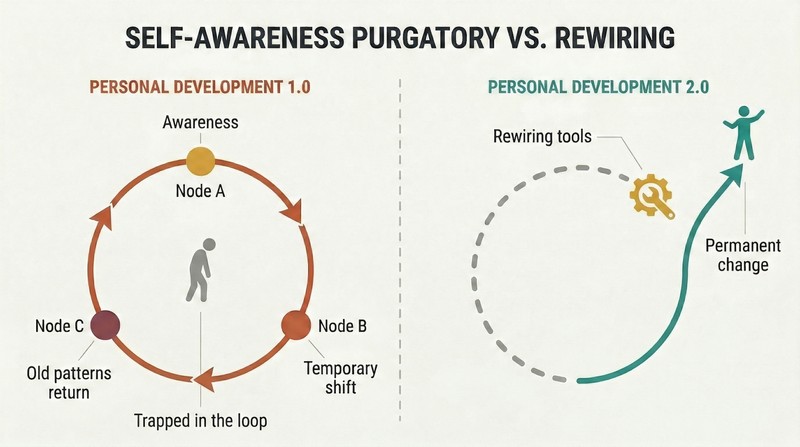
The self-help trap is real. David Bayer spent three years in sex addiction recovery, read dozens of foundational self-help books, traveled to an ashram in India, meditated in Tibet, and sat with Amazonian tribal leaders in a Sedona high school gym — spending over $100,000 and thousands of hours. Each experience produced a temporary shift before his old emotional patterns returned. He calls this self-awareness purgatory: you become acutely aware of your limiting beliefs but lack the tools to actually change them.
This is where most personal development stalls — what Bayer labels Personal Development 1.0. It builds intellectual understanding but doesn't rewire the brain. Personal Development 2.0 provides practical tools to permanently change neural pathways, not just recognize they exist.
Your beliefs are just childhood decisions — remake them anytime
“You can't outwit or outwork your beliefs. But you can change them.”
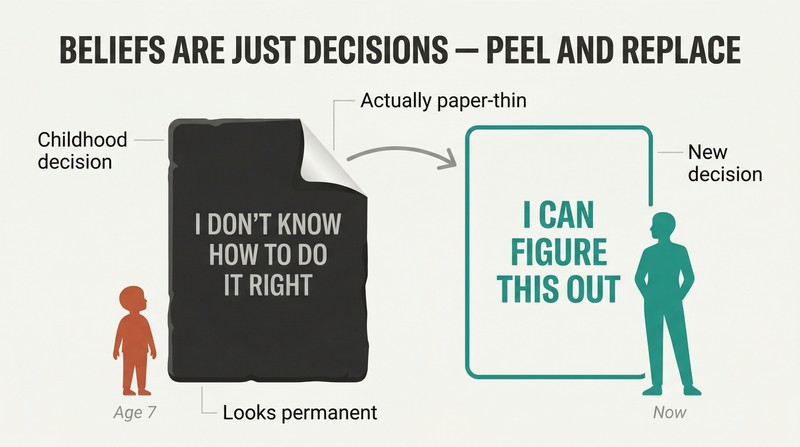
A seven-year-old's conclusion shaped decades. While building a school project in his parents' garage, young David moved some miniature buildings. His father gently put them back, explaining the "right" way. In that moment, David unconsciously decided: "I don't know how to do it right." That single decision drove self-sabotage in sales calls, relationships, and business for the next twenty-six years.
Bayer's core thesis: beliefs are decisions, and "decide" literally means to cut off all else. You didn't consciously choose these beliefs — they were instantaneous childhood meanings that kept reinforcing themselves through the Five Primary Drivers loop. But since they're decisions, not fixed truths, you have what Bayer calls a "response-ability" — the ability to simply make a new decision. No years of therapy required. Just recognize the old decision and choose its opposite.
Results always validate beliefs — a self-fulfilling loop you must interrupt
“Your brain is a goal-achieving machine, and the instructions it is operating against are the assumptions or beliefs you have about life.”
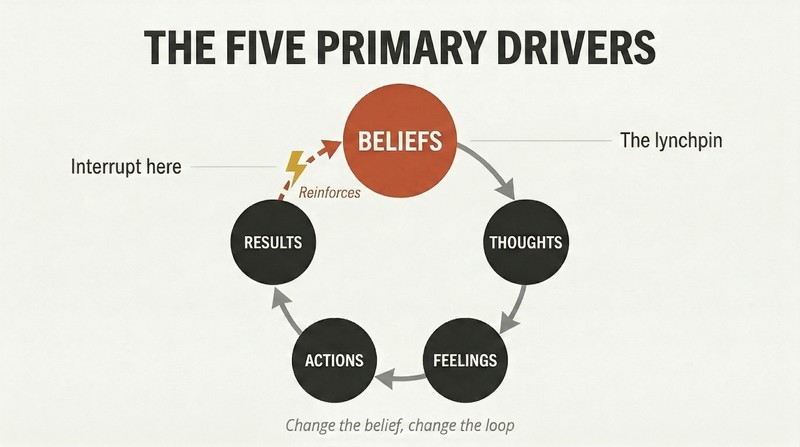
The Five Primary Drivers form a closed loop. Your beliefs dictate your thoughts. Thoughts produce feelings. Feelings drive actions. Actions determine results. And results reinforce the original belief. When the author believed "I don't know how to do it right," he avoided sales calls, drank coffee instead, produced zero sales, and concluded he was bad at sales — proving the belief true.
Bayer found that roughly 90% of people relive their parents' financial reality. Complete the sentence "When I was growing up, money was _ "and your answer likely describes your finances today. Client Jennifer saw her stalled business as "in a drought" — and it stayed that way until she reframed the stagnation as healthy reorganization. Within six months, revenue surged. The lynchpin isn't better strategy; it's changed beliefs.
Separate the brain's drama from the raw footage of what happened
“The quality of your life is equal to the quality of the story you tell yourself.”
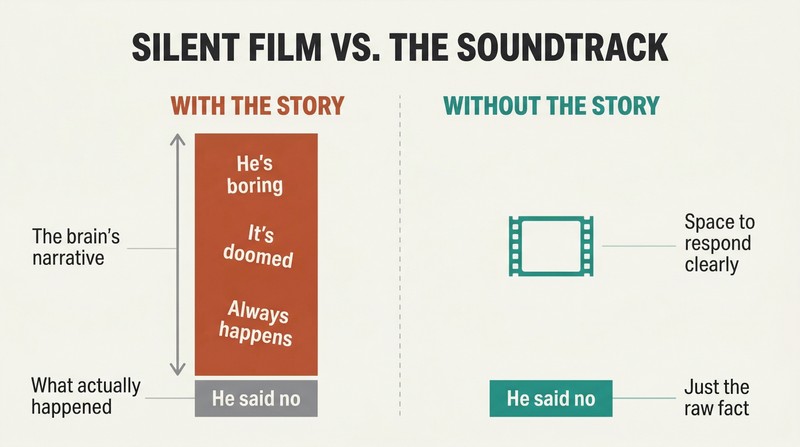
Your brain adds a soundtrack to silent film. Teenager Madison nearly dumped her boyfriend C.J. because he refused the ALS ice bucket challenge. Her brain spun a narrative: he's boring, this relationship is doomed. When she separated "what happened" (he said no to a challenge) from the story (she'd grow old bored with him), she realized she'd fabricated the entire crisis — and had done the same thing to her previous two boyfriends. The root: watching her parents' painful divorce made her hypercritical of partners.
The brain data-matches every new moment to past memories and applies old meanings at lightning speed. This served survival when saber-toothed tigers roamed. But it creates a groundhog-day existence where new relationships, new jobs, and new opportunities get experienced through the lens of old wounds.
Most people waste a third of waking life in primal fear mode
“We don't see squirrels worrying they're not going to find the next nut.”
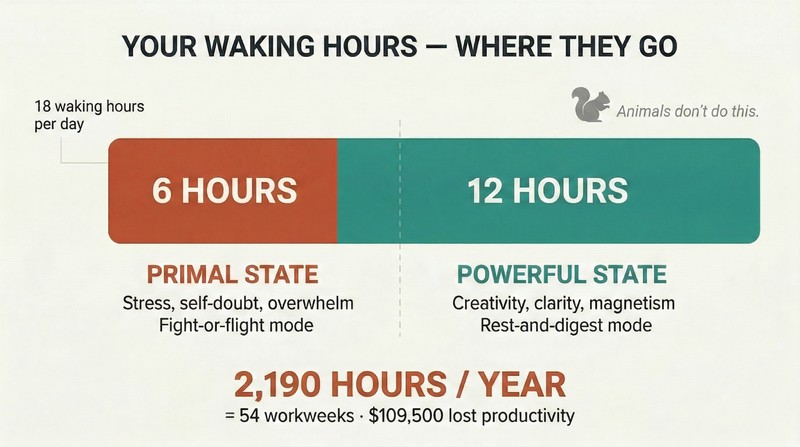
Surveys of tens of thousands reveal the average person spends six hours daily in what Bayer calls a Primal state — stress, overwhelm, comparison, indecision, self-doubt. That's 2,190 hours per year: the equivalent of 54 forty-hour workweeks. At just $50 per hour, that's $109,500 in lost productivity annually. All this suffering is uniquely human, manufactured by our meaning-making machinery.
Bayer's Two States of Being simplifies all emotions into two categories. Primal states (sympathetic nervous system, fight-or-flight) drain energy and intelligence. Powerful states (parasympathetic, rest-and-digest) generate creativity, clarity, and magnetism. All change — wealth, health, relationships — originates from Powerful states. You don't need to "do" more; you need to spend less time in Primal mode. The key: notice when you've shifted, then use the tools to shift back.
Treat every painful thought as a false alarm from your nervous system
“All suffering is caused by one thing and one thing only: unintelligent thinking.”
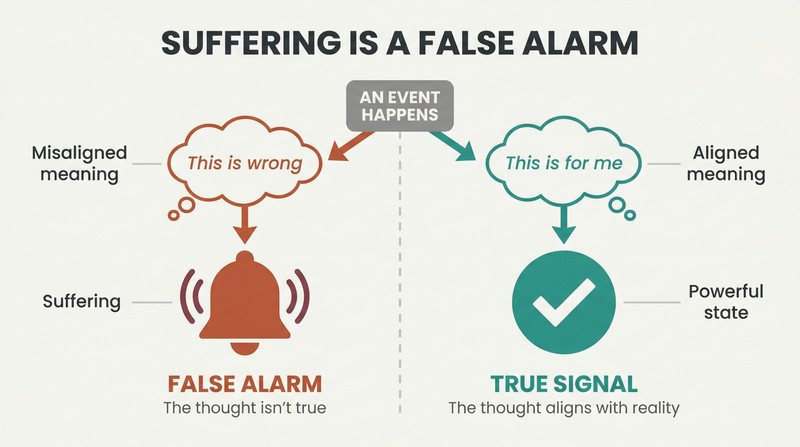
Your nervous system is an emotional lie detector. Autumn told herself "I married the wrong man" for fifteen years. When she recognized that thought always moved her into a Primal state, she applied Bayer's rule: if the thought causes suffering, it isn't true. The opposite — "I married the perfect man" — unlocked a flood of evidence. She'd invented the problem from an unexpected proposal and had never seen her husband clearly since.
Bayer calls misaligned thoughts "unintelligent thinking" — not as an insult, but as a technical description. When your thoughts align with reality, your nervous system produces Powerful states. When they misalign, you feel dissonance as suffering. The pain isn't caused by the experience itself (the bill, the diagnosis, the breakup) but by the meaning you assign to it. Two people can lose the same job and one crumbles while the other launches a business.
Find the opposite belief, then mine your own memories as proof
“Like planting a beautiful garden in a bed of weeds, the new plants soon become suffocated by the old terrain.”
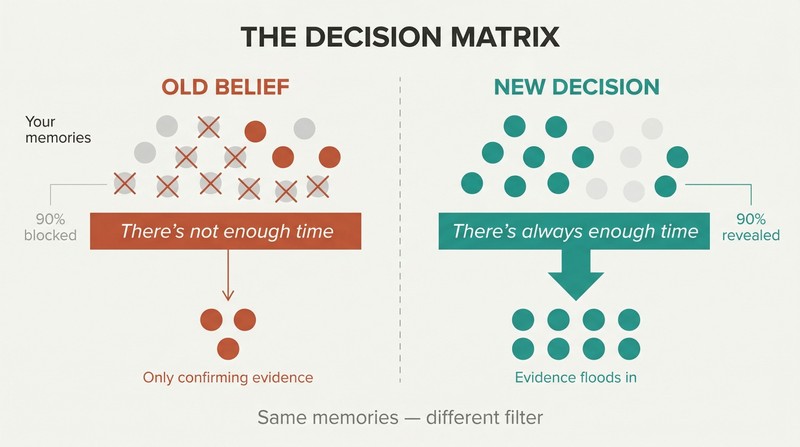
The Decision Matrix is a three-step tool:
1. Notice suffering and identify the limiting belief (e.g., "there's not enough time")
2. Make a new decision — the opposite ("there's always enough time for what matters")
3. Ask: What evidence do I have that this new decision is true?
Unlike affirmations that force-plant new beliefs without removing old ones, the Decision Matrix first proves the old belief was never true. Your brain's reticular activating system had been filtering out 90% of reality — the portion containing evidence for the new decision. As dormant memories resurface, you experience what Bayer calls a revelation: a permanent shift where the old belief becomes untenable. The author used one Decision Matrix on his "bully" pattern and within 90 days exited a toxic business partnership with a $500,000 payout.
Decide before you know the plan — your brain builds the bridge after
“The single most destructive assumption…is the false belief that before making a decision you must know 'the how.'
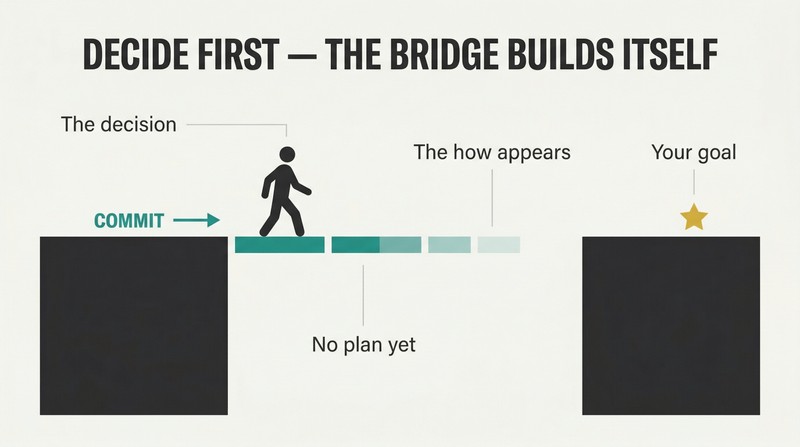
Your brain can't distinguish imagination from experience. A Harvard Medical School study found that pianists merely imagining playing piano activated the same brain regions as actually playing. When you decide and then imagine the outcome, your brain builds neural pathways toward that future — creating the thoughts, ideas, and perceptions that become your plan.
On Christmas Day 2012, the author decided — with no plan — to meet a beautiful Colombian woman and make her his wife. Weeks later he met Carol from Colombia at a restaurant in Sarasota. They married seven years later. In April 2014, he decided to earn an extra $60,000 outside his business by year's end. Through an unpredictable chain of events — a lunch introduction, a $20,000 investment, a buyout — he received exactly $60,000 on December 27. The decision came first; the how followed.
Successful thinkers follow a six-step sequence, not just positive vibes
“An overemphasis on 'the doing' vs. 'the being'…is the number one cause of professional and personal failure.”
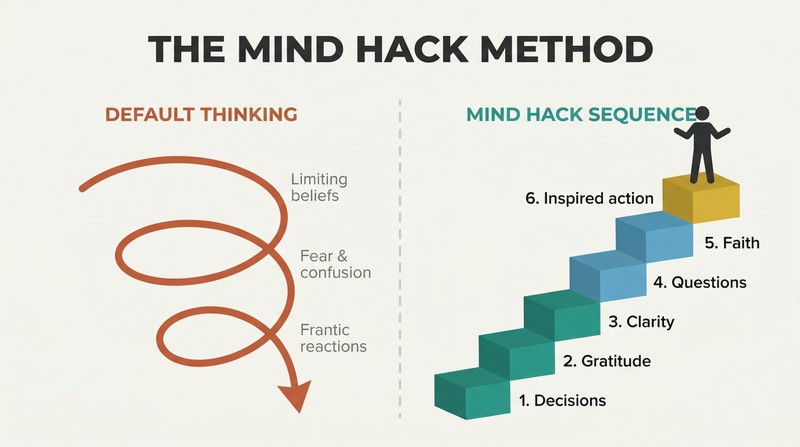
The Mind Hack Method replaces your brain's default. Most people run the Ordinary Model of Thinking: limiting beliefs → problems → confusion → disempowering questions → fear → frantic reactions. Successful people follow six steps:
1. Empowered decisions (unlock trapped energy)
2. Gratitude (redirect focus from problems to gifts)
3. Clarity (imagine the desired future in detail)
4. Empowering questions ("What are three metrics to ensure success?" not "What if this fails?")
5. Faith (recognize failure is always learning, redirection, reflection, or setup)
6. Inspired action (move from a Powerful state, not panic)
A CEO client was paralyzed asking "What if this acquisition is the wrong move?" Replacing that single question produced a clear action plan and one of the company's best-ever transactions.
Small belief shifts produce disproportionately massive life changes
“The resonance of an intelligent thought is far more powerful than an unintelligent one.”
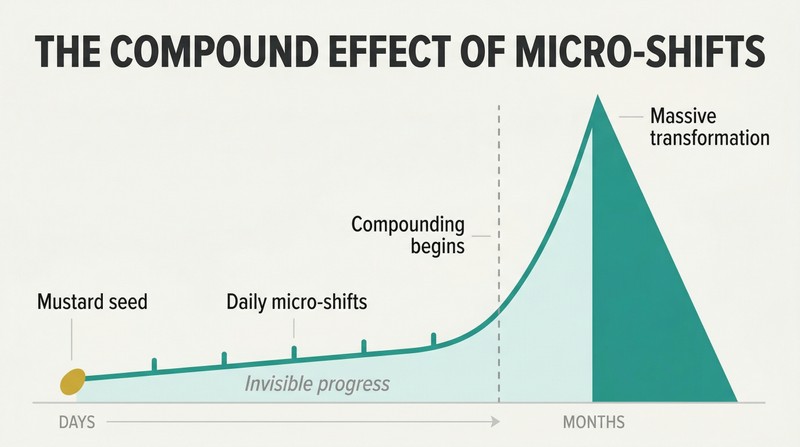
You don't need a perfect mindset. Bayer stresses that small, on-the-margin changes in thinking create sweeping external results. A tiny improvement in money consciousness compounds. Being slightly more open to ease transforms daily stress. The book quotes Matthew 17:20 — faith the size of a mustard seed can move mountains — as a description of how the system actually works: it doesn't require perfection, just consistent micro-shifts.
The practical application is the Mind Hack Morning Ritual: a 20-30 minute daily practice of four steps — journaling and working a Decision Matrix on current stress, listing 10-20 gratitudes, five minutes of future visualization, and five minutes of mindfulness meditation. The author did this daily for twelve months. Each session prunes old neural networks while building new ones, compounding over weeks into what others perceive as dramatic, overnight transformation.
Analysis
Bayer's contribution to the personal development genre is a diagnostic architecture — a flowchart for the confused seeker. Where most self-help books stop at 'change your beliefs,' Bayer provides a specific falsifiability criterion: if the thought causes suffering, it is by definition misaligned with reality. This is his most original move, retrofitting an empirical heuristic onto what has traditionally been purely aspirational territory.
The book's intellectual lineage is transparent — Buddhism's Four Noble Truths, Napoleon Hill's mental science, cognitive behavioral therapy's thought-record technique, and neuroplasticity research. Bayer's value-add is synthesis: he layers these into a single operating-system metaphor that resonates with entrepreneurs who think in terms of software bugs, algorithms, and system updates. The 'beliefs are decisions' reframe is the book's sharpest conceptual blade, transforming the amorphous challenge of 'changing your mindset' into the familiar act of making a choice.
However, the metaphysical claims in Part III — that consciousness is a unified field materially responsive to individual thought vibrations via quantum mechanics — outpace the neuroscience they rest upon. The observer effect operates at subatomic scales and has not been demonstrated at the level of life events. Readers should treat the vibrational-reality sections as motivational metaphor rather than settled physics.
The most practically valuable framework is the Two States of Being. By collapsing all emotional complexity into a binary — Powerful or Primal — Bayer gives overwhelmed people a usable real-time diagnostic. The six-hours-per-day statistic, while self-reported, reframes personal growth from a luxury into an economic necessity worth $109,500 annually — a shrewd pitch for his entrepreneurial audience.
The book's structural weakness is repetition; the same core argument restates across at least five overlapping frameworks. Yet for the target reader who has intellectually understood transformation for years without experiencing it, that repetition may function as precisely the kind of pattern-interrupt the author prescribes. The Decision Matrix alone — a deceptively simple three-step process — may justify the read for anyone trapped in self-awareness purgatory.
Review Summary
A Changed Mind receives overwhelmingly positive reviews, with readers praising its practical, tangible approach to personal development. Many describe it as life-changing, offering a clear framework for mindset shifts and immediate application. Reviewers appreciate the author's ability to explain complex concepts simply, making it accessible to a wide audience. The book is lauded for its unique perspective on self-help, combining psychology, spirituality, and quantum concepts. Readers report significant improvements in their thinking patterns and overall well-being after implementing the book's strategies.
Glossary
Inner Conflict
Gap between desire and beliefThe psychological incongruence that occurs when you want something but unconsciously believe you can't have it. For example, wanting financial abundance while believing money is hard to make. Bayer identifies Inner Conflicts as the sole barrier to achieving any desired outcome, and they are diagnosed by noticing the internal dialogue that explains why you don't yet have what you want.
Five Primary Drivers
Belief-to-result feedback loopA five-step cycle showing how beliefs shape reality: beliefs dictate thoughts, thoughts produce feelings, feelings drive actions, actions determine results, and results reinforce the original beliefs. This self-fulfilling prophecy explains why life circumstances tend to repeat. Bayer argues the only effective intervention point is at the belief level, not the action level.
Decision Matrix
Three-step belief replacement toolA mental technology for transforming limiting beliefs into empowered decisions. Step 1: Notice suffering and identify the limiting belief causing it. Step 2: Make a new decision (typically the opposite of the limiting belief). Step 3: Search your own memory for evidence that the new decision is true. Unlike affirmations, it works by proving the old belief was never accurate, triggering neural pruning.
Mind Hack Method
Six-step empowered thinking sequenceA structured thinking process that replaces the brain's default fear-based pattern (the Ordinary Model of Thinking). The six sequential steps are: empowered decisions, gratitude, clarity, empowering questions, faith, and inspired action. Each step builds energy and resourcefulness, contrasting with the Ordinary Model's downward spiral from limiting beliefs to fear and reactive behavior.
Two States of Being
Powerful vs. Primal emotional frameworkBayer's binary classification of all emotional states. Powerful states (joy, curiosity, calm, creativity) correlate with the parasympathetic nervous system and generate the energy needed for change. Primal states (stress, fear, anger, overwhelm) correlate with the sympathetic nervous system and drain resources. The average person spends approximately six hours daily in Primal states.
Primal State
Fear-driven sympathetic nervous activationAny emotional state that doesn't feel good—stress, anger, jealousy, overwhelm, depression, boredom. Primal states activate the sympathetic nervous system (fight, flight, or freeze) and represent what Bayer calls 'unintelligent thinking'—thoughts misaligned with reality. In Primal states, you lack the energy and clarity to solve problems or create change.
Powerful State
Resourceful parasympathetic nervous activationAny emotional state that feels good—joy, compassion, curiosity, creativity, peace, inspiration. Powerful states activate the parasympathetic nervous system (rest and digest) and indicate alignment with intelligent, accurate thinking. All meaningful change, goal achievement, and creative breakthroughs originate from Powerful states.
Echo Effect
Old patterns persisting after changeThe phenomenon where undesired experiences continue to appear temporarily after making a new decision, because those experiences were already 'in the pipeline' from previous habitual thoughts. Bayer warns against interpreting these echoes as evidence that the new decision failed, which he calls 'undeciding.' Holding firm through the echo period allows the new decision to take hold.
Self-awareness purgatory
Stuck knowing but not changingThe frustrating phase where someone has become acutely aware of their limiting beliefs through personal development work but lacks the tools to actually transform them. Bayer identifies this as the gap between Personal Development 1.0 (intellectual understanding) and Personal Development 2.0 (practical brain rewiring), and considers it where most seekers get permanently stuck.
Higher Power System
Consciousness-to-reality creation diagramBayer's visual framework showing how thoughts create vibrations transmitted into collective consciousness, which then manifests as life experiences. When you encounter those experiences, you have a 'one moment of transformation'—the opportunity to either reinforce old beliefs or make a new decision. The system is described as law-based, agnostic to desires, and responsive only to predominant thought vibrations.
Phenomenon
Operating at full awakened potentialThe fourth and highest of Bayer's four stages of consciousness (Asleep → Aware → Awake → Phenomenon). At this stage, energy previously consumed by fight-or-flight responses redirects into emergent qualities: heightened creativity, intuition, magnetism, health, and timing. Bayer describes it not as superhuman but as the natural state of someone no longer wasting energy on unintelligent thinking.
Mind Hack Morning Ritual
Daily 20-30 minute rewiring practiceA four-step morning routine designed to clear mental resistance and prime the brain for a Powerful state. Step 1: Journal stress and work a Decision Matrix on the strongest limiting beliefs (10-15 min). Step 2: List 10-20 things you're grateful for (5 min). Step 3: Visualize desired future scenes (5 min). Step 4: Mindfulness meditation focused on breath (5 min, building to 20 min).
FAQ
1. What is A Changed Mind: Go Beyond Self Awareness, Rewire Your Brain & Reengineer Your Reality by David Bayer about?
- Core focus on transformation: The book provides a step-by-step framework for personal transformation, teaching readers how to go beyond self-awareness to rewire their brains and reengineer their reality.
- Integration of science and spirituality: It combines neuroscience, psychology, and spiritual principles to help readers change limiting beliefs and create lasting change.
- Three-part structure: The content is organized into Becoming Aware, Rewiring the Brain, and Reengineering Your Reality, guiding readers from understanding inner conflict to manifesting a new reality.
- Personal journey: David Bayer shares his own story of overcoming addiction and despair, making the teachings relatable and credible.
2. Why should I read A Changed Mind by David Bayer?
- Authentic and relatable: Bayer’s personal journey from addiction to fulfillment adds credibility and relatability to his teachings.
- Practical transformation tools: The book offers actionable methods like the Decision Matrix and Mind Hack Method, moving beyond theory to real change.
- Breaks self-help frustration: It addresses the common problem of knowing what to change but not how, providing a clear, science-backed process for transformation.
- Empowerment and responsibility: Readers are encouraged to take radical responsibility for their thoughts, emotions, and actions, leading to greater joy and resilience.
3. What are the key takeaways from A Changed Mind by David Bayer?
- Beliefs shape reality: Your beliefs, often formed unconsciously, dictate your thoughts, feelings, actions, and results.
- Transformation is possible: By becoming aware of and changing limiting beliefs, you can rewire your brain and create a new reality.
- Practical methods: Tools like the Decision Matrix and Mind Hack Method provide a structured approach to lasting change.
- Suffering is optional: All suffering is caused by unintelligent thinking, and changing your interpretation of experiences can eliminate suffering.
4. What are the best quotes from A Changed Mind by David Bayer and what do they mean?
- "The problem is not the problem. The problem is what you think about the problem." This highlights that suffering comes from your interpretation, not the event itself.
- "Beliefs are decisions." This reframes beliefs as choices you can change, not fixed truths.
- "Mindset is the developed capacity to use your mind to change your brain." This emphasizes that mindset is an active skill, rooted in neuroscience, for personal transformation.
5. What is the "Inner Conflict" concept in A Changed Mind by David Bayer?
- Definition: Inner Conflict is the psychological tension between what you desire and the belief that you can’t have it, leading to stress and self-sabotage.
- Impact on life: This conflict drains creative energy and perpetuates negative emotions and behaviors, often resulting in self-fulfilling prophecies.
- Resolution approach: By identifying desires and the internal dialogue that blocks them, you can uncover and transform limiting beliefs, dissolving inner conflict.
6. How does David Bayer define beliefs and their role in shaping reality in A Changed Mind?
- Beliefs as unconscious decisions: Beliefs are decisions made, often in childhood, that become neural pathways shaping perception and behavior.
- Five Primary Drivers: Beliefs dictate thoughts, thoughts create feelings, feelings drive actions, actions produce results, and results reinforce beliefs, forming a self-perpetuating cycle.
- Beliefs dictate destiny: Changing beliefs changes your thoughts, feelings, and results, effectively rewriting your reality.
7. What is the neuroscience behind transformation in A Changed Mind by David Bayer?
- Brain plasticity: The brain is capable of rewiring itself through new experiences and thoughts, a process known as neuroplasticity.
- Memory and meaning: Experiences are stored with associated meanings, which influence future interpretations and behaviors.
- Mindset as brain change: Developing the skill to see your stories as just stories creates space to question and change beliefs, enabling brain rewiring.
8. What are the Two States of Being described in A Changed Mind by David Bayer?
- Powerful States: Positive emotions like joy, creativity, and peace, linked to the parasympathetic nervous system, enable optimal functioning and alignment with potential.
- Primal States: Negative emotions such as fear, anger, and stress, associated with the sympathetic nervous system, drain energy and cause suffering.
- Impact on perception: Your state determines how you interpret reality; shifting from primal to powerful states is key to transformation.
9. What is the "Power of Decision" in A Changed Mind by David Bayer and how does it work?
- Beliefs as decisions: Recognizing that beliefs are decisions empowers you to consciously choose new, empowering beliefs.
- Decision precedes how: You don’t need to know how to achieve your goals before deciding to pursue them; the act of deciding creates the mental framework for solutions.
- Threefold effect: New decisions replace old thoughts, shift perception to notice aligned opportunities, and attract synchronicities that support your goals.
10. What is the Decision Matrix method in A Changed Mind by David Bayer?
- Three-step process: Identify the limiting belief, make a new, opposite decision, and find evidence supporting the new belief.
- Emotional awareness: Negative emotions signal active limiting beliefs; tuning into these emotions helps pinpoint the beliefs to change.
- Sustainable transformation: The method rewires the brain by replacing old beliefs with new ones, leveraging the brain’s filtering system for lasting change.
11. What is the Mind Hack Method in A Changed Mind by David Bayer and how does it work?
- Contrast with ordinary thinking: The Mind Hack Method shifts you from fear-based, problem-focused thinking to empowered, solution-oriented thinking.
- Six principles: It includes empowered decisions, gratitude, clarity, strategic questions, faith, and action, each building on the last for transformation.
- Energy and results: Applying the method unlocks energy, creativity, and resourcefulness, enabling you to respond thoughtfully and create momentum toward your goals.
12. How does A Changed Mind by David Bayer address the law of attraction and why do some people struggle with it?
- Law of attraction explained: Your thoughts and emotions emit vibrations that attract matching experiences, operating as a consistent, law-based system.
- Common struggles: Unconscious limiting beliefs often contradict conscious desires, creating internal conflict that blocks manifestation.
- Integration and patience: Successful manifestation requires aligning beliefs and emotions with desires, maintaining faith, and consistently doing inner work to eliminate resistance.
Download PDF
Download EPUB
.epub digital book format is ideal for reading ebooks on phones, tablets, and e-readers.








































