Key Takeaways
1. Murder's Evolution: From Primitive Instinct to Existential Choice
Murder is an individual kind of phenomenon, and it changes as frequently as courting customs.
Changing patterns. Murder, far from being a static act, has evolved dramatically through history, reflecting shifts in society, psychology, and human freedom. Early civilizations, born from "jostling crowds" in fertile valleys, saw violence as a natural extension of animal instincts, a means of survival or protest against imposed order. The infamous Sawney Bean family, who lived as cannibals for decades, exemplify a reversion to primal savagism, driven by basic needs and a complete detachment from societal norms.
Brutality of early justice. This primitive violence was met with equally brutal, often public, punishments, reflecting a frightened society's desperate attempt to enforce order. Executions were common for minor offenses, and torture was a standard practice, as seen in the horrific execution of Damiens for attempting to assassinate Louis XV. Even children were hanged for petty theft, with judges believing such cruelty would deter others.
Beyond simple motives. As societies became more complex, so did the motives for murder. The Elizabethan era, while still marked by cruelty, introduced "domestic tragedies" where murder often stemmed from straightforward passions or economic gain. However, figures like Gilles de Rais, a wealthy nobleman who engaged in pedophilia and sadism, foreshadowed a later era where absolute power and wealth could unbalance an already excitable nature, leading to crimes that transcended simple motives.
2. The Age of Gin: Social Decay and Brutal Justice
Eight million gallons of gin a year were consumed in England at this time, the consumption in London alone being fourteen gallons per head.
Gin's devastating impact. The introduction of cheap gin in the late 17th century dramatically escalated crime rates and social decay in England, particularly in London's slums. This readily available, potent spirit fueled a century-long "crime wave," leading to widespread neglect and ill-treatment of children, and a surge in crimes of violence. Hogarth's "Gin Lane" vividly captured this era of squalor, drunkenness, and moral collapse.
Unfeeling society. Public executions, often attended by drunken, merrymaking crowds, became spectacles of entertainment, with little sympathy for the condemned. The custom of dissecting criminals' bodies or leaving them to rot on gibbets served as gruesome deterrents, reflecting a society where "pity was still a strange and valuable emotion." Even hangmen like Jack Ketch and John Thrift, despite their differing temperaments, were part of this brutal system.
Catherine Hayes' chilling case. The murder of John Hayes by his wife Catherine and her lovers exemplifies the era's blend of passion, avarice, and extreme brutality. Catherine's calculated dismemberment of her husband's body, her composure under pressure, and her eventual burning alive for petty treason, highlight the era's harsh penalties and the morbid fascination with such crimes, often driven by sexual undertones.
3. The Dawn of Scientific Detection: From Observation to Forensics
When the twenty-five-year-old Alphonse Bertillon became a clerk at the Sûreté in 1879, most of the old identification procedures were practically useless.
Limitations of early policing. For centuries, crime detection relied heavily on eyewitness accounts, confessions (often coerced), and the sheer memory of experienced detectives like Vidocq and Canler. As cities grew and criminal populations swelled, these methods became increasingly inadequate, leading to many unsolved cases and wrongful convictions. The gruesome preservation of Catherine Hayes' husband's head for identification underscores the primitive nature of early forensic efforts.
Bertillon's revolutionary system. Alphonse Bertillon, a meticulous and pedantic clerk, revolutionized criminal identification by introducing anthropometry, or "Bertillonage." His system involved taking precise measurements of criminals' bodies—height, reach, head circumference, limb lengths—based on the principle that no two individuals are exactly alike. Despite initial skepticism and resistance from superiors, Bertillon's method proved its value by identifying repeat offenders, laying the groundwork for modern forensic science.
The advent of fingerprints. Even as Bertillonage gained global recognition, a simpler, more accurate method emerged: fingerprinting. William Herschel in India and Henry Faulds in Scotland independently discovered the uniqueness of fingerprints. Sir Francis Galton and later Edward Richard Henry developed comprehensive classification systems, making fingerprints an irrefutable form of identification. The 1905 Stratton brothers case in Deptford, England, marked the first time a murder was solved and a conviction secured solely on fingerprint evidence, solidifying its place in criminal investigation.
4. The Rise of the Sexual Criminal: Fantasies and Mutilation
Unfortunately, the Germans have no corresponding term for what might be called ‘business-murder’, murder carried out in a purely practical spirit.
Beyond "business-murder." The 19th century saw the emergence of a new, more psychologically complex type of murder, moving beyond purely economic or passionate motives to "joy-murder" or lustmörd. Early examples from German history, like Nicklaus Stüller's brutal dismemberments and Kloss Renckhart's sadistic acts, hint at a deeper, often sexual, pathology. Andrew Bichel, the "Bavarian Ripper," exemplified the "furtive criminal" driven by secret sexual fascinations, often involving women's clothes.
The "criminal rats" of the slums. While some crimes remained economically driven, like those of Burke and Hare who murdered to sell bodies to medical schools, their brutality stemmed from the dehumanizing conditions of the slums. These "criminal rats" were not driven by complex psychological motives but by the harsh realities of survival, contrasting with the emerging pattern of murderers who killed for pleasure or perverse satisfaction.
Jack the Ripper's chilling legacy. The unknown killer of Whitechapel in 1888 became the ultimate symbol of the sexual psychopath. His meticulous mutilations, removal of internal organs, and the "obsessive tidiness" of his crime scenes pointed to a deeply disturbed individual driven by morbid fantasies. The Ripper's desire to eat parts of his victims and his taunting letters to the police revealed a killer who reveled in his acts, marking a terrifying shift in the nature of murder.
5. Murder as a Crime of Freedom and Boredom
The crime of Leopold and Loeb was not compulsive; it was a crime of freedom, a crime of boredom.
The intellectual criminal. The 19th century also witnessed the rise of the intellectual criminal, exemplified by Pierre-François Lacenaire, the "Manfred of the gutter." Driven by self-pity and a profound sense of alienation, Lacenaire saw his crimes as a "prolonged suicide" and a rebellion against a society he felt could never understand him. His calm acceptance of execution and his philosophical musings on his "tragic" situation foreshadowed later existentialist themes in crime.
Nietzschean "supermen." The Leopold and Loeb case in 1924 Chicago epitomized murder as a crime of freedom and boredom among the privileged. These wealthy, intelligent college boys, influenced by Nietzsche's philosophy of the superman, deliberately committed murder not out of compulsion or need, but to prove their intellectual superiority and to experience the ultimate transgression. Their detached, almost academic approach to killing highlighted a chilling new dimension of criminal motivation.
Beyond simple pathology. This type of crime challenges deterministic explanations, suggesting that even in the absence of poverty or clear psychological compulsion, individuals can choose to commit horrific acts. Dostoievsky's Raskolnikov and Stavrogin, characters who commit crimes to test their own moral boundaries or to escape spiritual stagnation, are literary precursors to these real-life cases, demonstrating that the human imagination can create crisis situations that lead to violence.
6. America's "Murder Castle": Urban Alienation and Psychopathic Power
It has to be recognised that, in his ghoulish way, Holmes was as much the exponent of the American dream as Henry Ford or Horatio Alger.
The dark side of ambition. H.H. Holmes, alias Herman Webster Mudgett, embodied the twisted ambition and urban alienation of late 19th-century America. His "murder castle" in Chicago, a labyrinth of trapdoors, secret rooms, and gas pipes, was a chilling manifestation of his psychopathic desire for control and voyeuristic pleasure. Holmes, a bungling swindler but a meticulous murderer, used his medical knowledge and charm to lure victims, primarily women, into his elaborate death trap.
Sexual underprivilege and control. Holmes's fascination with cadavers and his systematic disposal of bodies, often by selling skeletons to medical schools, revealed a deep-seated sexual pathology intertwined with a desire for power. In a society where sexual repression was rampant, Holmes's castle provided an outlet for his voyeuristic tendencies and his need to dominate women, whom he often violated before or after death. His actions, though monstrous, can be seen as a perverse response to the "civilisation neurosis" of rapidly expanding cities.
A chilling archetype. Holmes's ability to operate undetected for years, his multiple bigamous marriages, and his calculated insurance frauds, paint a picture of a man who saw himself as a "wolf preying on society." His case, like that of Theodore Durrant who committed sexual murders in a church, highlights how the desire to "remove those frustrating Victorian dresses" and assert control could explode into extreme violence, making him a disturbing archetype of the modern serial killer.
7. The Modern Loner: Sadism, Isolation, and Unfathomable Motives
Any man who had ever looked with interest at the legs of a woman in shorts can gain some insight into it.
The incomprehensible horror. The 20th century has seen an explosion of murders driven by perversions and fantasies, often committed by isolated individuals. Jesse Pomeroy, a disfigured teenager who mutilated and murdered dozens of children, represents an early, almost unexplainable case of pure sadism. His extreme ugliness and anti-social tendencies likely fueled a deep-seated hatred, leading to crimes that defied easy categorization.
Isolation and sexual obsession. Ed Gein, the Wisconsin necrophile, offers a chilling insight into the mind of a loner consumed by sexual obsession. Living alone after his domineering mother's death, Gein's graveyard excursions and the creation of "skin suits" and "noses" from human remains, though horrifying, become comprehensible through the lens of extreme isolation and a warped desire for companionship and control. His choice of elderly female victims, mirroring his mother, points to deep-seated psychological roots.
The itinerant predator. The vastness of America, with its lonely roads and transient populations, has facilitated the rise of itinerant sex offenders like Carl Folk and Mervyn Garvie. These individuals, often with histories of sexual assault and mental disturbance, prey on unsuspecting victims, their crimes driven by raw sexual hunger and sadistic impulses. The difficulty in tracking such individuals across state lines underscores the challenges of modern crime fighting in a large, mobile society.
8. Ideology and Corruption: The Moors Murders and De Sade's Influence
Brady soon convinced her that religion was a sign of weak mindedness.
The corruption of a normal mind. The Moors murder case, involving Ian Brady and Myra Hindley, stands as a chilling example of how a disturbed individual can corrupt a seemingly normal person through ideological manipulation. Brady, an intelligent but deeply resentful "outsider" fascinated by Hitler and de Sade, systematically indoctrinated Hindley, a religious and affectionate girl, into his nihilistic worldview, convincing her that society was decadent and its laws meaningless.
"Master and slave" dynamic. Their relationship, characterized by Brady's dominance and Hindley's masochistic tendencies, became a perverse "master and slave" dynamic. This allowed Brady to orchestrate the torture, sexual assault, and murder of children, with Hindley actively participating. The couple's chilling acts, including posing for photographs on their victims' graves, demonstrate a profound detachment from human empathy and a shared embrace of extreme sadism.
The de Sade argument. The case highlights the dangerous appeal of philosophical arguments that deny objective morality, such as de Sade's assertion that "society has made laws for the protection of the law-givers and the oppression of people stupid enough to accept them." This intellectual justification for depravity, coupled with Brady's manipulative personality, enabled the pair to commit unspeakable acts, raising profound questions about the nature of evil and human susceptibility to destructive ideologies.
9. The Randomness of Violence: Indifference and the Breakdown of Rules
What murders such as this indicate is that some of the basic rules of civilisation are being broken by people who—without really considering the question at length—suddenly say: ‘I don’t wish to be a part of your civilisation any more.’
Motiveless aggression. The 20th century has seen a disturbing rise in murders where the motive appears "wholly inadequate" or even random. Norman Smith, inspired by a television program, shot a stranger through her window out of sheer boredom. Klaus Gosmann, the "Mid-day murderer," meticulously planned his killings to coincide with church bells, viewing his victims as "inanimate. Ciphers," driven by a profound sense of alienation and a desire for power.
The tramp's rampage. Richard Speck's brutal murder of eight Chicago nurses, a culmination of a violent rampage fueled by drugs and alcohol, exemplifies the terrifying randomness of modern violence. His actions, seemingly triggered by a resemblance to his hated wife, were characterized by a chaotic indifference to human life, leaving a trail of death and a single survivor to identify him.
The Red Spider's calculated chaos. Lucian Staniak, Poland's "Red Spider," combined calculated planning with a dramatic flair, choosing national holidays for his sadistic sex murders. His initial motive of revenge for his family's death evolved into a compulsive pattern of rape and mutilation, demonstrating a complete breakdown of emotional values. These cases suggest a new era where individuals, feeling disconnected from societal norms, act out violent fantasies with chilling indifference.
10. The Enigma of Homosexual Murders
In recent years, there have been an increasing number of homosexual murders that conform to the ordinary pattern of sex-crime—ie committed for purpose of rape.
Beyond jealousy. While homosexual murders traditionally stemmed from jealousy or robbery, the late 20th century has witnessed a disturbing trend of such crimes conforming to the pattern of sadistic sex-crime. The case of Stephen Weinstein in Philadelphia, who systematically drugged, raped, and murdered college boys, reveals a calculated and prolonged pattern of predation, facilitated by his position and the complicity of younger helpers.
Hidden pathologies. The Ypsilanti case involving Ralph Nuss, a respected social and psychiatric worker, further illustrates this trend. Nuss, a man of great responsibility, harbored violent homosexual desires, leading to the strangulation and sexual assault of young men. His ability to maintain a facade of normalcy while committing such acts highlights the hidden pathologies that can exist within seemingly well-adjusted individuals.
Rampage and indifference. The Salt Lake City rampage of Myron Lance and Walter Kelbach, who murdered six victims in a spree of robbery and sexual assault, underscores the extreme indifference and contempt that can characterize these crimes. Their lack of remorse and their casual attitude towards human life reflect a profound alienation, where societal rules are utterly disregarded in a sudden explosion of violence.
11. The Enduring "Classic" Murder: Calculation and Concealment
And what is a ‘classic murder’? Perhaps the simplest definition is: the kind of murder that appeals to mystery writers, the kind of murder that might almost have been invented by a mystery writer.
The art of the perfect crime. Despite the rise of irrational and chaotic violence, the "classic" murder, characterized by careful planning, motive, and an attempt at concealment, continues to exist. These are the crimes that appeal to mystery writers, where the unraveling of clues and the psychological battle between killer and detective form the core narrative. Armand Rohart's murder of his wife, Jacqueline, in France, exemplifies this enduring pattern.
Flawed execution. Rohart, a wealthy and influential mayor, meticulously planned his wife's death to appear as an accidental drowning, motivated by jealousy and a desire to continue an affair. His use of ether, his feigned grief, and his attempt to use his wife's scratches as evidence of her struggle against the waves, all point to a calculated mind. However, forensic details, such as the absence of water in her lungs and the intact hair fixative, ultimately exposed his deception.
The human element of betrayal. The betrayal by his accomplice, Jacob Karbahay, who tape-recorded Rohart's murder proposals, further highlights the classic elements of intrigue and human fallibility. Rohart's case, like many before it, demonstrates that even the most cunning plans can be undone by unforeseen circumstances or the unexpected actions of others, proving that while motives and methods evolve, the fundamental human drama of murder remains.
Review Summary
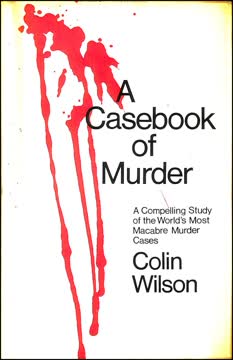
A Casebook of Murder holds an overall rating of 3.63 out of 5. One enthusiastic reader praised Wilson's theories on the evolution of murder through the centuries, particularly his insights on modern violence. Another critic found the book repetitive and lacking psychological depth, comparing it to bare-bones Wikipedia articles, and expressed regret over purchasing it. A third reader offered a brief four-star rating based on a reading experience from 1978. Opinions clearly vary on Wilson's analytical depth within the true crime genre.