

Key Takeaways
42% of HBS grads rushed into finance — the happiest ones didn't
“We were a class full of insecure overachievers, a term I heard again and again.”
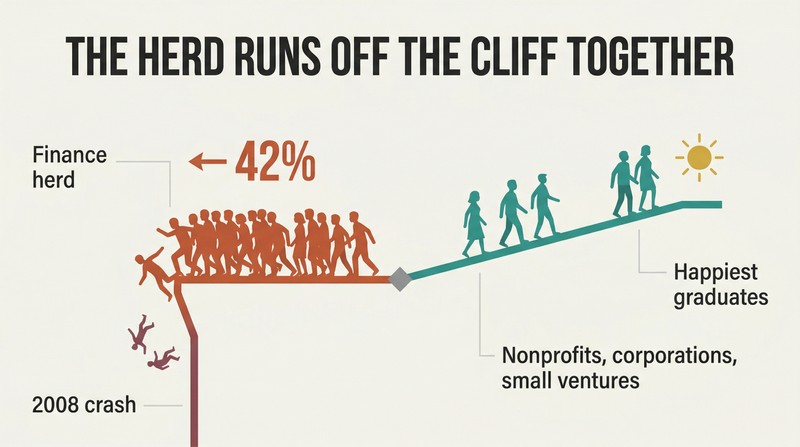
Philip Delves Broughton, a journalist with zero business background, enrolled at Harvard Business School in 2004 expecting a neutral period of study. Instead he found a pressure cooker where 895 students — chosen from 7,100 applicants — competed on a forced curve while stampeding toward summer internships. Ex-consultants warned that if you arrived married, you'd end up divorced. Ex-bankers described seeing their children only as sleeping outlines under blankets. Yet 42% of the class charged into financial services anyway.
The postscript reveals the punchline. Written after the 2008 crash, it shows the happiest graduates were those who'd joined old-fashioned corporations, nonprofits, or small ventures. Banking analyst Ray Soifer's indicator — which flags a market sell signal when 30%+ of HBS grads go into finance — was flashing red. The herd ran off the cliff together.
Train judgment like a muscle: practice with hundreds of messy, real cases
“The hope is that long after the minutiae of accounting or bond pricing have faded to a blur, you will be left with a distinctive way of thinking and making decisions.”
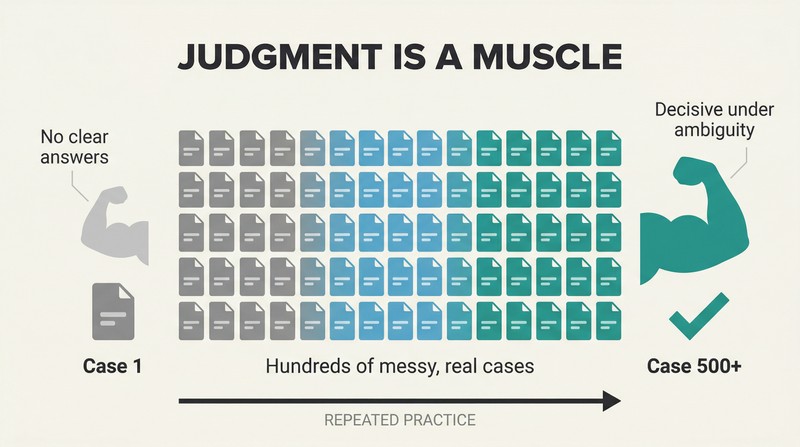
HBS teaches entirely through cases — real business situations, from a medieval baron's farming dispute to Dell's supply chain revolution. Students prepare each case for two or more hours, discuss it in study groups, then debate it in a ninety-person classroom. The professor begins with a cold call, selecting one student to introduce the case for up to fifteen minutes. Fifty percent of the final grade comes from class participation — what you say, not what you memorize.
There are no textbook answers. The very first accounting case had no clear solution. That was the point: to show the difficulty of divining truth from even simple situations. Over two years and hundreds of cases, this repeated immersion in ambiguous decisions builds what the school calls "learning by doing" — a muscle for acting under uncertainty that outlasts any formula.
Cash flow, not profit, determines if a growing company lives or dies
“Inventory, as we would learn again and again, is a dirty word in business, and the less you have of it, the better.”
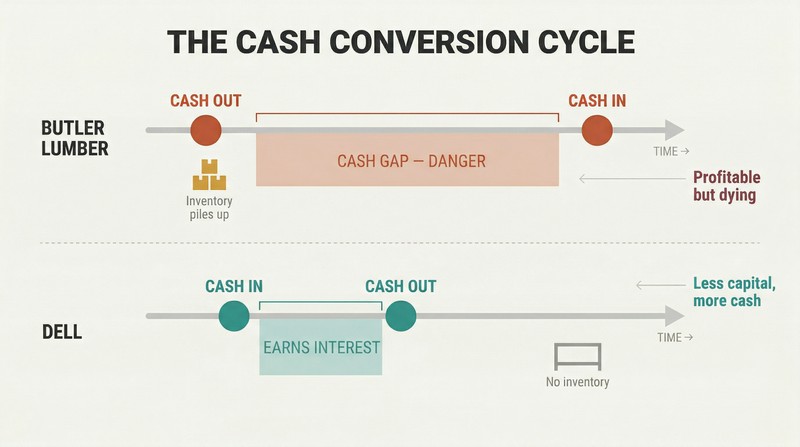
Butler Lumber was growing, profitable — and dying. The lumber company kept running out of cash because it bought wood from suppliers, stored it, and gave customers thirty days to pay. As it grew, its cash conversion cycle — the gap between paying suppliers and collecting from customers — widened dangerously. It needed ever more credit just to operate, missing supplier discounts along the way.
Dell mastered the opposite approach. Rather than building computers and hoping buyers appeared, Dell waited for orders and payment before manufacturing. It held almost no inventory. While competitors sank capital into unsold product, Dell earned interest on unspent cash. The lesson applied even to the author's own undergraduate days, when his cash conversion cycle of cashing checks at a pub spiraled him into debt with the bank.
Read financial statements like a shrink — character hides in the numbers
“Accounting, I found, was more impressionistic than I had ever imagined.”
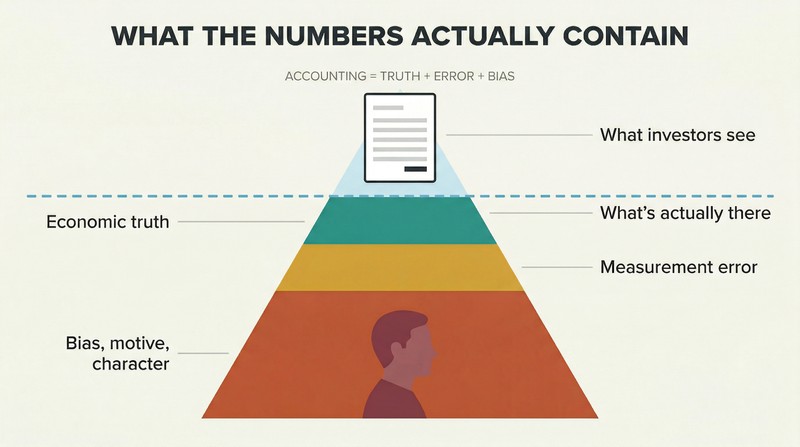
Professor Eddie Riedl taught a second mantra that framed the entire course: Accounting = Economic truth + Measurement error + Bias. In the Kansas City Zephyrs case, baseball team owners exploited depreciation rules to deflate profits and justify lower player salaries — numbers technically legal but economically misleading. The lesson: accounts are not truth. They are a story told through numbers, shaped by the teller's motives.
The most revealing example was Microsoft. Investors puzzled over why it hoarded massive cash reserves. Analysts proposed strategic explanations. But Bill Gates gave a simpler reason: he wanted to guarantee he could always pay a year's worth of salaries, even with zero revenue. The cash hoard wasn't a financial trick — it was a direct reflection of a founder's start-up anxiety and loyalty to his first employees.
Financial models serve politics, not truth — challenge the assumptions
“The only necessary tool in the chaos of finance… was not a computer or a set of formulae… but old-fashioned judgment, honed by experience.”
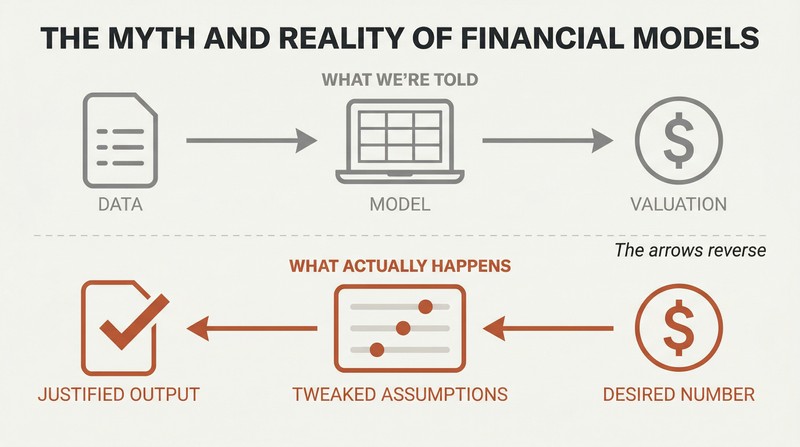
Broughton entered finance terrified of numbers, imagining it required pure mathematics. What he discovered was that every valuation model depends on assumptions about future revenue growth, costs, and discount rates — and these assumptions are debatable by anyone, regardless of technical expertise. Bankers in the class admitted their deal books were often recycled from one company to another with minor adjustments.
The real education came from a classmate, former investment banker Annette: if a client wanted a higher or lower valuation, bankers simply tweaked assumptions to reach the desired number. The more complex the model, the more levers to pull. Finance, the author concluded, was really about one thing — valuation — and valuation was really about judgment. Beta measures volatility; alpha measures genius. But both depend on assumptions no spreadsheet can validate.
Compete on tightly integrated systems, not individual brilliance
“Being very good at doing something was absolutely no guarantee of financial success.”
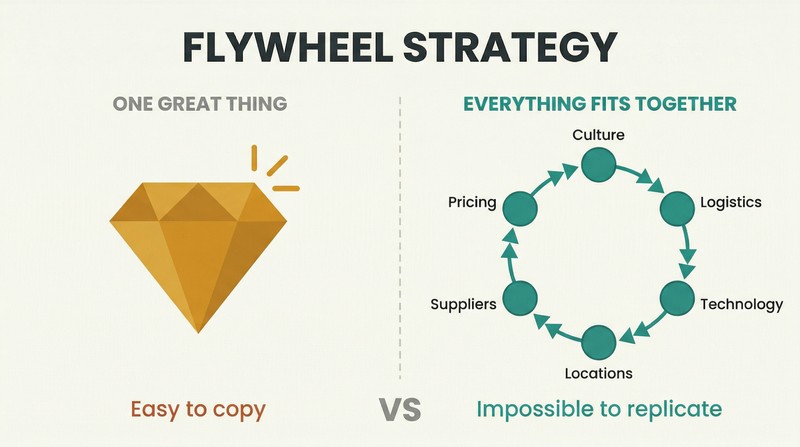
A beautifully run restaurant can be an economic disaster while grubby fast-food franchises mint money. Professor Felix Oberholzer-Gee taught that strategy begins with picking the right industry, analyzed through Porter's Five Forces: barriers to entry, supplier power, customer power, substitutes, and rivalry. Most major American companies return 10 – 15% on equity; the few exceeding 20% consistently share structural advantages.
But industry selection is just the start. Wal-Mart dominates not through low prices alone but through tight integration of frugal culture, rural locations, minimal advertising, ruthless logistics, supplier leverage, and top-notch technology. Each activity reinforces the others, creating a flywheel competitors cannot replicate. Apple's iPod ecosystem worked identically — device, iTunes, brand, and music catalog locked together. Strategy, as Broughton learned, isn't one brilliant move. It's how everything fits together.
Build processes so good every employee improves them daily
“Businesses needed to develop good processes in the ways baseball pitchers or golfers needed to develop muscle memory so they could perform the same physical action repeatedly.”
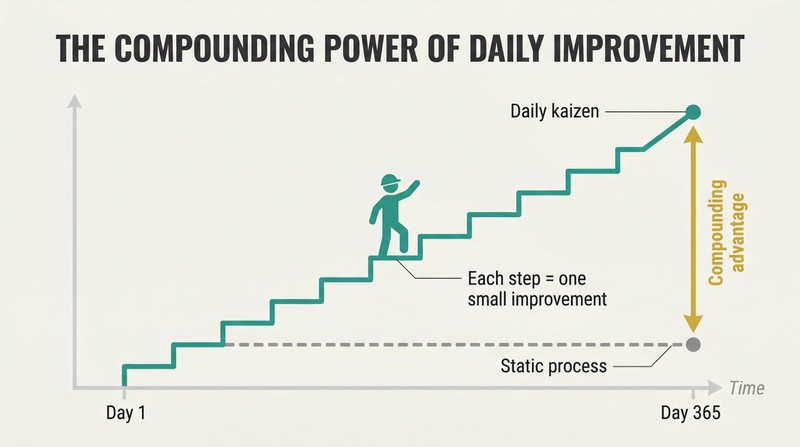
Toyota's production system was the most memorable operations case. Its philosophy rested on eliminating every form of waste through two principles. Jidoka meant making problems instantly visible: workers pulled an andon cord to halt the production line whenever they spotted a defect, with zero stigma. The team leader then applied the Five Whys to reach the root cause. Kaizen — "change for the better" — meant no process was ever finished; every employee sought constant, incremental improvement.
The power lay in compounding small gains. First observed in WWII aircraft factories, the learning curve effect showed that more production naturally led to faster and better output. Companies moving fastest up this curve built enduring advantages. Broughton's classmate Bo captured the spirit, vowing to apply Just-In-Time principles even to his grocery shopping.
Be a principal, not a service provider — that's where freedom lives
“I wanted control over my time, my financial resources, and my life…”
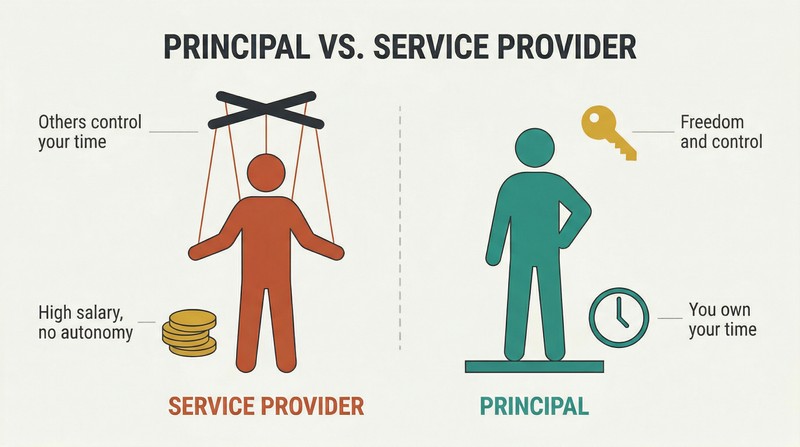
David Rubenstein, cofounder of the Carlyle Group, offered the sharpest career advice Broughton heard at HBS: be a principal or a decision maker, not a service provider. Principals — founders, investors, owners — capture the largest rewards and, crucially, control their time. Service providers — bankers, consultants, lawyers — run around for principals, surrendering schedules and autonomy for salaries.
This distinction haunted Broughton's job search. He watched classmates stampede toward consulting and banking — explicitly service-provider roles — because they offered high starting pay and prestige. Yet the entrepreneurs who visited campus radiated something different: independence, humor, self-knowledge. Rubenstein himself noted that with money came freedom, and with freedom came the opportunity to do more interesting things. Broughton ultimately chose to work for himself rather than surrender his time to a corporation.
Capital is never scarce; conviction and execution are
“The only firm decision one could make in embarking on this was the decision to be an entrepreneur.”
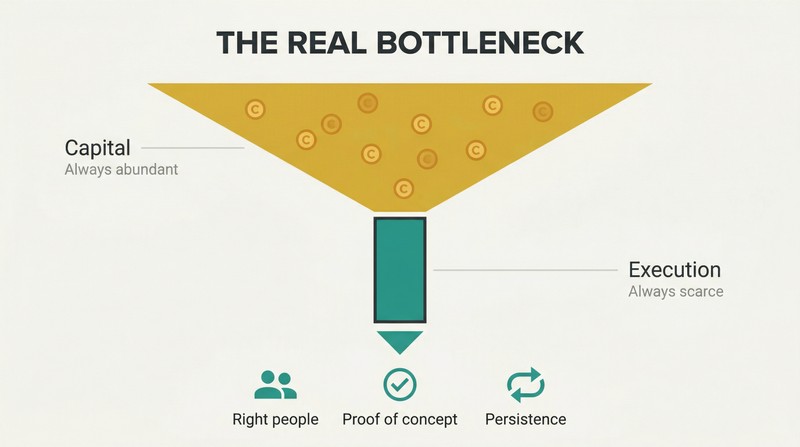
Entrepreneurship professor Joe Lassiter delivered the line that stuck with Broughton's classmates longest: in all of recorded history, the supply of capital has always overwhelmed the supply of opportunity. The real bottleneck is execution — finding the right people, proving the concept, persisting when customers are scarce. Broughton and classmate Bo experienced this firsthand, pitching a podcasting venture to Boston VCs who followed a predictable arc: excitement, drift, pointed questions they couldn't answer.
The venture failed, but the education didn't. Lassiter's deeper lesson was that entrepreneurship wasn't just a career — it was a way of living. He urged students to find a "world-class tribe," develop deep expertise in one area, and surround themselves with people who would speak frankly. The coolest thing in the world, he told them, was to be in love, be together, and see your kids grow up.
Every visiting CEO preached family first — then admitted failing at it
“The very ones who told us 'you have to get the balance right in your lives' often admitted… that they had not done so themselves.”
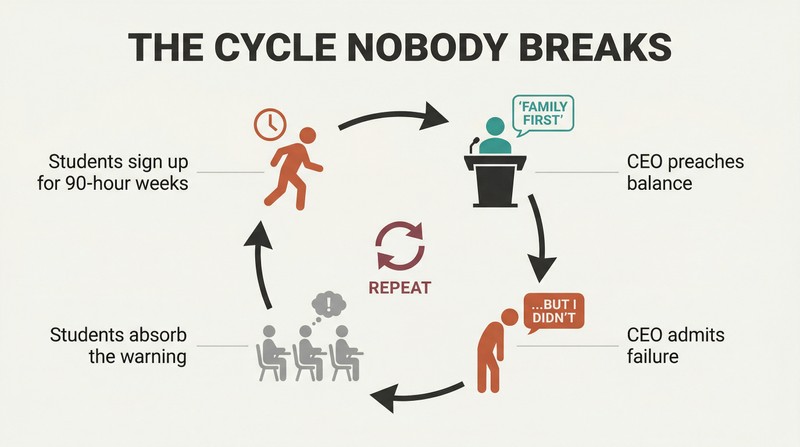
Meg Whitman told the class she'd given up trying to be the perfect wife, mother, and CEO, and admitted she probably wouldn't look back wishing she'd worked harder. A Goldman Sachs executive radiated "total defeat" describing his four ex-wives. A Morgan Stanley recruit described 127-hour work weeks, seeing his children only as sleeping silhouettes: "I've been watching my children grow longer."
The pattern was unmistakable. Professor Podolny pointed out that HBS never celebrated alumni who simply found happiness — who balanced family, career, and friendships. The school invited billionaires and Fortune 500 CEOs, the very people who confessed they'd failed at what mattered most. Students absorbed these cautionary tales, nodded gravely, then signed up for the same ninety-hour weeks. The inability to value the "priceless" was the MBA's blind spot.
Stop measuring your life against MBA peers — the curve devours happiness
“…even as I learned so much about business and myself, I had been beating myself up with comparisons to others.”
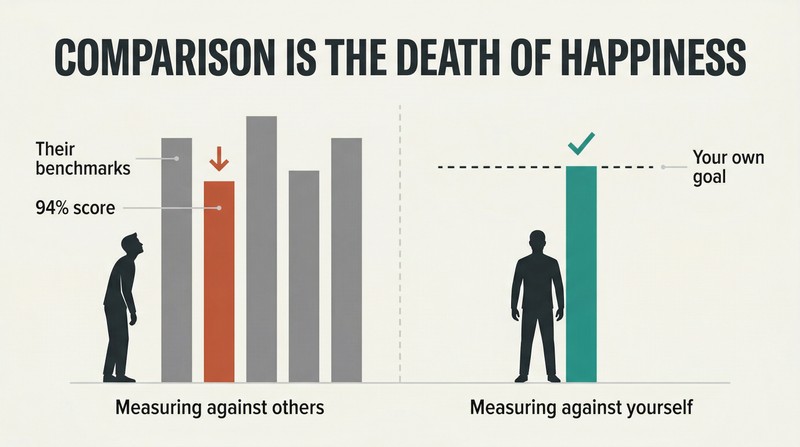
At graduation, student speaker P.J. Kim offered the insight that struck Broughton hardest: comparison is the death of happiness. Broughton had arrived as an accomplished foreign correspondent. Within weeks he was measuring himself against twenty-five-year-old bankers who built Excel models in their sleep. The forced curve intensified this — scoring 94% could place you at the bottom if everyone else scored 95%.
Broughton's friend Bob, a Stealth bomber pilot, helped him see clearly: the class of 2006 was not his peer group. Their average arrival age was twenty-seven; most wanted banking or consulting careers Broughton would hate. Treating them as his benchmark was self-destructive. The path forward was defining success on his own terms. Two years after graduating, Broughton was writing from a home office, raising two sons — exactly the life he'd described in a first-semester exercise.
Analysis
Broughton's memoir occupies a rare niche in business literature: simultaneously admiring elite education and devastating the culture it produces. Written by a journalist who never fully surrendered his outsider perspective, the book gains power from timing — published in 2008, just as the financial system his classmates enthusiastically joined was collapsing.
The book's most provocative argument is that HBS creates what it claims to prevent: groupthink. Despite student body diversity and emphasis on individual leadership, the school's incentive structure — forced curve grading, recruiting pressure, network conformity — funnels remarkably homogeneous career outcomes. The case method teaches students to consider multiple options, but recruiting season reduces those options to a handful of well-trodden paths. Forty-two percent of the class entering financial services wasn't market efficiency; it was herd behavior dressed in pinstripes.
This creates a tournament model where participants compete not just for jobs but for identity validation. Broughton's observation that students used financial terms like 'beta' and 'alpha' to describe everything from fish dishes to automobiles captures how thoroughly the MBA worldview colonizes consciousness. The MBA becomes less about learning business and more about securing membership in a self-reinforcing elite.
What gives the book endurance is its honest reckoning with privilege. Broughton never pretends he didn't benefit from HBS. He credits the school with teaching genuine competence — cash flow analysis, strategic thinking, decision-making under uncertainty. But he refuses to accept that this technical education justifies claims about 'educating leaders who make a difference in the world.' The gap between those claims and reality — between McNamara's statistics and the Vietnamese officer's sardonic reply, 'Ah, les statistiques' — is where the deepest insight lives.
The postscript transforms memoir into prophecy. Dean Light's refusal to accept specific blame for the 2008 crisis — 'we all failed' — perfectly illustrates the institutional narcissism Broughton documented. Two decades later, with MBAs running everything from hospitals to school systems, the questions he raised about the proper scope of business leadership remain unanswered and more urgent than ever.
Review Summary
What They Teach You at Harvard Business School offers an insider's perspective on the prestigious MBA program. Readers found it an engaging and illuminating account of the author's experiences, highlighting both the benefits and drawbacks of the HBS education. Many appreciated the author's candid observations about the intense pressure, competitive environment, and ethical dilemmas faced by students. While some readers felt the book was overly critical, others praised its honesty and thought-provoking insights into the world of elite business education and its impact on graduates' career choices and values.
People Also Read




Glossary
Case method
Teaching through real business situationsHBS's core teaching approach, adopted from the law school, in which students analyze written cases drawn from real business situations rather than hearing lectures. Students prepare each case independently, discuss in study groups, then debate in a 90-person classroom beginning with a professor's cold call on a selected student. No right answers exist; the goal is developing judgment under uncertainty.
Five Forces
Porter's industry profitability frameworkFramework developed by HBS professor Michael Porter identifying five structural factors that determine an industry's profitability: barriers to entry, supplier power, customer power, availability of substitutes, and intensity of rivalry. A sixth (complements) and seventh (government) force have been added since. Analyzing these forces reveals why some well-run businesses fail while poorly run ones in favorable industries thrive.
Cash conversion cycle
Time from payment to collectionThe period between when a company pays for its inputs and when it receives payment from customers. A shorter cycle means less cash tied up in operations. Dell achieved a negative cycle by collecting customer payment before paying suppliers, turning cash management into a competitive weapon. A growing company that ignores this metric can become insolvent despite rising profits.
Kaizen
Continuous incremental improvement philosophyA Japanese management philosophy meaning 'change for the better,' central to the Toyota Production System. Kaizen holds that no process is ever finished and every employee should seek constant, small improvements. Combined with jidoka (making problems instantly visible by stopping production lines) and Just-In-Time production (making only what is needed when needed), it eliminates waste and compounds quality advantages over time.
BATNA
Best walk-away alternative in negotiations'Best Alternative To a Negotiated Agreement'—a core concept from HBS's negotiations course. Knowing your BATNA prevents accepting a bad deal by clarifying options if negotiation fails or you walk away. The related concept ZOPA (Zone of Possible Agreement) defines the range of scenarios both parties could accept. Effective negotiators research both their own and their opponent's BATNA before sitting down at the table.
Forced curve
Competitive peer-based grading systemHBS's grading system ranking students against each other rather than against absolute standards. The top 15–25% receive a 1, the middle 65–75% a 2, and the bottom 20% a 3. Half the grade comes from class participation quality, half from exams. Even if all students perform brilliantly, someone must land at the bottom—creating persistent anxiety among high achievers unaccustomed to anything less than excellence.
Insecure overachievers
Anxious high-performers seeking validationA term repeatedly used at HBS to describe its student body: high-performing individuals who, despite extraordinary accomplishments, experience persistent anxiety about their status and choices. The combination of elite credentials and deep insecurity drives both the ambition and the conformism characterizing MBA culture—pushing students toward well-trodden career paths rather than the unconventional ones that visiting speakers consistently recommended.
FAQ
What's What They Teach You at Harvard Business School about?
- Personal Journey: The book chronicles Philip Delves Broughton's experiences as an MBA student at Harvard Business School (HBS), detailing the challenges and insights he gained.
- Education vs. Life Lessons: It explores the dual nature of education—how to make a living and how to live—highlighting moral and ethical dilemmas faced by future business leaders.
- Cultural Critique: Broughton critiques the culture at HBS, discussing the pressures of competition, the pursuit of wealth, and the impact of networking on personal and professional growth.
Why should I read What They Teach You at Harvard Business School?
- Unique Perspective: Broughton offers a fresh perspective as a journalist transitioning into business, making the book relatable for those unfamiliar with the corporate world.
- Critical Reflection: It encourages readers to reflect on their values and the ethical dimensions of business, challenging the notion that success is solely defined by financial gain.
- Engaging Storytelling: With a mix of humor and introspection, Broughton’s storytelling captivates readers, making complex business concepts accessible and engaging.
What are the key takeaways of What They Teach You at Harvard Business School?
- Importance of Networking: Networking is crucial for success in business, as many opportunities arise from connections made during and after HBS.
- Value of Self-Reflection: Broughton highlights the need for self-awareness and understanding one’s motivations, particularly in a high-pressure environment like HBS.
- Balancing Life and Work: The narrative stresses the importance of finding a balance between professional ambitions and personal fulfillment.
What are the best quotes from What They Teach You at Harvard Business School and what do they mean?
- “There are two types of education.”: This quote underscores the distinction between practical skills for making a living and broader life lessons that shape one’s character.
- “You’re the product.”: Reflects the idea that students at HBS are being shaped into future leaders who will influence the business world.
- “You probably won’t look back and wish that you’d worked harder.”: A reminder to prioritize personal relationships and well-being over relentless career pursuits.
How does Broughton describe the culture at HBS?
- Intense Competition: HBS is portrayed as a cauldron of ambition, where students feel immense pressure to secure prestigious job offers.
- Networking Focus: The culture heavily emphasizes networking, sometimes at the expense of genuine relationships.
- Diverse Backgrounds: The student body is diverse, yet many share a common drive for success and recognition.
What is the HBS case method, as described in What They Teach You at Harvard Business School?
- Real-Life Scenarios: Involves analyzing real business situations, allowing students to engage in discussions and debates about potential solutions.
- Critical Thinking Development: Encourages students to think critically and make decisions based on limited information.
- Collaborative Learning: Students learn from each other’s perspectives, fostering a collaborative environment.
What challenges did Broughton face during his time at HBS?
- Academic Pressure: The workload was overwhelming, especially in the early weeks, as Broughton struggled to keep up with the curriculum.
- Identity Crisis: Transitioning from journalism to business left him questioning his identity and purpose.
- Social Dynamics: He grappled with the social environment, feeling both connected and isolated among his ambitious peers.
What insights does Broughton provide about the business world?
- Ethical Dilemmas: Discusses the ethical challenges faced by business leaders, emphasizing the need for integrity in decision-making.
- Impact of MBAs: Argues that MBAs shape not only businesses but also society, influencing corporate culture and public policy.
- Value of Experience: Highlights the importance of real-world experience over theoretical knowledge.
What is the five-forces analysis mentioned in What They Teach You at Harvard Business School?
- Framework for Strategy: Developed by Michael Porter, it helps businesses understand competitive dynamics within their industry.
- Key Forces: Includes barriers to entry, supplier power, customer power, substitutes, and rivalry among competitors.
- Strategic Insight: Analyzing these forces allows businesses to craft strategies that enhance their competitive position.
How does Broughton view the relationship between business and government?
- Mutual Dependence: Business and government are interdependent, each playing a crucial role in shaping the economy and society.
- Critique of Business Dominance: Argues for a balanced approach that considers the needs of the community.
- Call for Responsibility: Advocates for business leaders to engage with government constructively.
What lessons does Broughton learn about entrepreneurship?
- Managing Risk: Entrepreneurship is about managing risks effectively to achieve success.
- Importance of Passion: Entrepreneurs need to be passionate about their ventures, driving persistence and innovation.
- Value of Community: Building a supportive network around entrepreneurial efforts is crucial.
How does Broughton’s experience at HBS shape his future career choices?
- Critical Reflection: Leads him to reevaluate his career aspirations, moving toward more meaningful work.
- Emphasis on Values: Reinforces the importance of aligning his career with personal values.
- Entrepreneurial Spirit: Embraces an entrepreneurial mindset, seeking opportunities that resonate with his life goals.

Download PDF
Download EPUB
.epub digital book format is ideal for reading ebooks on phones, tablets, and e-readers.








































