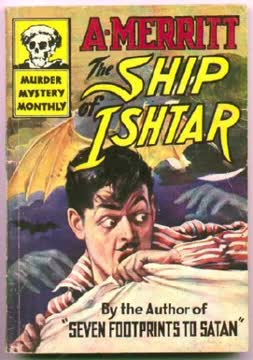
Plot Summary
The Summoning Stone's Secret
John Kenton, an American scholar and recent World War veteran, suffers a restless, hollow life until a mysterious Babylonian artifact arrives. The stone block, pulsing with inscrutable warnings and enigmatic fragrance, draws him into obsessive study. As the cuneiform inscriptions elude interpretation, ancient gods—Ishtar, Nergal, Nabu—seem to murmur just beyond meaning. A supernatural force compels Kenton toward the block, until he unleashes its secret: a miniature crystalline ship radiating unearthly light and fragrance. With ghostly bells and uncanny resonance, the block shatters time's divide—a cosmic summons awakening forgotten worlds, promising answers beyond sorrow but also demanding a price. Kenton is drawn, as if by fate, into a mystery threaded through with longing and danger, and a destiny bound by ancient powers.
The Ship Awakens
In a blur of mirages, mists, and swelling waves, Kenton witnesses the stone split, releasing the jeweled Ship of Ishtar. The ship is ablaze with impossible detail: doves of Ishtar, oarsmen in chains, decks of ivory and jet, shadowy manikins locked mid-motion. As the air floods with scents and silver fog, the miniature ship expands, its deck moving, the toys animating. Kenton's mind spirals between magic and madness—senses overwhelmed—until the ship "grows," the walls of his world shatter, and he is hurled from his room into another reality, plummeting through tempest and moonlit sea. He lands, blinking, upon the living deck: not a toy, but a vessel lost between divine conflict and eternal punishment, abandoned by time and ruled by gods' unresolved strife—his fate now bound to the Ship of Ishtar.
Crossing Worlds, Crossing Selves
Kenton wakes to the susurrus of waves and the perfume of ancient gods, on a vessel split between warring powers. He is neither seen nor heard by others, an invisible observer to a conflict between priestess Sharane of Ishtar, the sorcerer-priest Klaneth of Nergal, and their spectral followers. He witnesses a supernatural struggle: golden light thunders from Sharane's side, darkness billows from Klaneth's, as music and shadow battle along the deck's invisible barrier. Kenton is simultaneously a stranger, dreamer, and soul called to judgment. His war-born trauma is reflected in the radiant, enigmatic Sharane—her beauty as haunting as the violence of myth. The decks divide; time, reality, and yearning collapse into a vision of love, dread, and supernatural war, as Kenton slips again into oblivion—questioning life, sanity, and the truth of what he has become.
Doves and Serpents of Desire
Thrust back and forth between his own world and the ship, Kenton realizes his fate is chained to the miniature vessel in his room. On the ship, each movement in the "real" world echoes with supernatural consequence. The lines blur—his wounds persist, his desires intensify—while a seductive but desperate Sharane tests him, her affection mixing with doubt, self-assertion, and fear of her own temporal impossibility. Bound by Ishtar's love and vengeance, haunted by Klaneth's malice, Kenton finds himself both a pawn and player. Desires—sex, power, and love—are weapons and shields, doves and serpents, pulling all aboard into endless struggle. Kenton's yearning for Sharane and his terror of loss are deepened by the cruel puppetry of fate, its patterning written in the flesh and soul of everyone and everything on the ship.
The Silver Barrier Divides
The Ship of Ishtar is not merely a vessel, but a stage for unresolved cosmic conflict—an eternal battle between love and death, embodied by Sharane and Klaneth. A silvered, invisible barrier divides the ivory deck (Ishtar's) and the black deck (Nergal's)—a curse set by the gods: neither side may cross; all commerce, even touch, becomes a dramatic impossibility. The imprisoned souls—priests, slaves, and free women—circle in frustration and hope, their faith and hatred feeding the barrier's strength. Kenton, uniquely ungirded by oath to either god, can cross freely—a key, a threat, and a potential redeemer. Through this divide, love and rage, truth and illusion, phase on the razor's edge, as every struggle on deck is mirrored by supernatural tides with stakes beyond all mortal reason.
The Sin of Zarpanit
Through Sharane's trembling retelling, Kenton learns of the original wound: Zarpanit, Ishtar's high priestess, and Alusar, priest of Nergal, fell in passionate love. Their union, forbidden by cosmic law—love between the goddess of life and the god of death—exposed fault lines in the divine order. When the lovers are discovered, divine wrath follows: Ishtar and Nergal themselves descend into mortal flesh, their struggle erupting through their priests. Betrayal, punishment, and the double-edged mercy of gods trap Zarpanit, Alusar, Sharane, Klaneth, and their followers into ceaseless conflict aboard the ship—a battleground looping love, hate, and frustration, where only the conquering, sanctifying flame of mortal passion stands against condemnation from on high.
Judgment of the Immortal Court
Kenton is shown, through Sharane's memory, the immortal court's cold judgment: Zarpanit and Alusar stand before the veiled gods, accused yet proud. Their offense—to love past godly bounds—forces the gods themselves to debate the limits and obligations of their own creation. Nabu, the wise, tempers justice with understanding; Ishtar and Nergal each demand dominion. But even the gods, through their veils, sense the justice of mortal love. The sentence is paradoxical—a game with shifting rules: the lovers are doomed to eternal proximity but not union, forever struggling to meet and forever thwarted by their divine possessors. The gods, having created love's fire, find that not even they can wholly control or quench it. Their judgment births not closure but endless repetition, and the Ship-of-Ishtar is both theatre and prison for their unresolved divine failure.
The Flames Win Free
On the ship, love's passion—unquenchable and defiant—gradually overcomes divine barriers. Zarpanit and Alusar, driven by the compulsion to love and be loved, ultimately break through the separation inflicted by Ishtar and Nergal. The gods, possessing their mortal vessels, are outmaneuvered by the inextinguishable strength of the human heart: the forbidden lovers unite and die in each other's embrace, their flames merging and dissolving into freedom the gods can neither command nor contain. Their story becomes myth within myth, legacy and prophecy—an opening for Kenton and Sharane's own transgressive love, and a warning that even the greatest forces misjudge the resilience of desire. Yet the ship and its survivors are still bound; the battle's outward truce hides the possibility for endless recurrence.
The Battle of Powers
Kenton becomes the only one able to cross the forbidden barrier—a status that makes him both object of suspicion and target for manipulation. Klaneth and Sharane each try to bribe, threaten, or seduce him into acting as their agent of destruction against the other. Kenton must navigate the temptations and threats, outwit the high priest's treachery, withstand the catlike advances and rages of Sharane, and discover his own purpose on the ship. Fights erupt; alliances shift. Kenton is twice thrown from the ship and twice returns, each passage between worlds confirming the supernatural web knotted throughout his flesh and fate. Every action echoes across realities; he is battered, chained, wounded—his wounds healing or persisting as the ship crosses the mysterious boundaries of time and possibility.
Ship Between Suns and Shadows
Kenton, now blood-bound with the Norse slave Sigurd, is chained as a galley-rower, enduring toil, pain, and camaraderie. The ship moves not through physical seas, but between layered realities and metaphysical states—each port, storm, or islet a reflection of the ship's purgatorial essence. Sigurd's oaths of brotherhood, the harsh overseer Zachel's lash, the camaraderie of chained slaves, and Gigi the giant drummer's sly encouragement, draw Kenton into a sub-world of ancient myth transfigured as nightmare and philosophy. Plot and power shift with every transition between sleep and waking, reality and dream; the ever-present ship is the conduit—a metaphysical bridge—between mortal will and the designs of gods, between wrath and mercy, between punishment and redemption.
Dreams, Lovers, and Betrayal
On and off the ship, Kenton experiences visions and mirages, cycles of longing, heated encounters, and merciless tests. Sharane's affection manifests as tempestuous, seductive, and sometimes wounding—her desire to be loved, to be "alive and a woman," drives her to both embrace and strike Kenton. The two are rivals, lovers, and mirrors. Gigi and Zubran, former acolytes now bound by ancient trickery, forge bonds of friendship with Kenton, each supporting yet also testing his journey. Yet always, love and hatred are interlaced; each act of passion is shadowed by threat, each moment of tenderness by the near-certainty of loss or betrayal. As dreams and reality intermix, Kenton learns that on the Ship of Ishtar, each desire summons its own disaster—and fulfillment, if any, comes twinned with heartbreak.
Chains Broken, Paths Revealed
A perilous alliance with Gigi and Zubran leads to Kenton's escape from slavery, as Gigi breaks his chains and together they scheme to overthrow Klaneth. Each person—slave, priest, priestess, outcast—seeks escape, yet liberation is always circumscribed. The ship becomes a crucible where fate, divinity, and the inscrutable rules of magic meet the urgent reality of mortal need. Kenton's passage between worlds becomes less a curse and more a tool to outmaneuver his foes, as he learns to wield it and subtly shape his own path. He is reunited with his companions; friendship, trust, and love mark their ascent from slavery into rebellion, as the boundaries between pawn and player, mortal and immortal, begin to blur.
Emakhtila: City of Sorcerers
With Sharane captured and Klaneth triumphant in Emakhtila—an eerie Babylonian Babel, city of gods, gold, and cruelty—Kenton and his friends plot a desperate rescue. Disguises, stratagem, and ancient knowledge grant them passage through demon-haunted groves and labyrinthine city streets, where past and future, East and West, swirl in a fever dream. Guides and obstacles, allies and enemies, fall or rally with every step; the city is an extension of the ship's purgatory: everywhere, impossible beauty and casual violence. Kenton must balance his growing powers with the knowledge that here, all justice is arbitrary, and only the cunning, the loyal, and the brave stand a chance at breaking the cycle of judgment and vengeance.
The House of Bel Betrayed
Disguised, Kenton infiltrates the vast Temple of the Seven Zones—climbing through radiance and shadows, perilous stair upon stair, each station guarded by ancient magic and the memories of gods. He discovers that Sharane, her memory blotted, now serves as Priestess of the God Bel—her identity and love for Kenton buried under the weight of ritual and punishment. Through ritual, dance, and sacrifice, the city's human and divine politics play out. Layers of identity—Kenton, the Priest of Bel, the roles of gods—overlap and dissolve. Love, lust, denial, and truth blend in a fevered sequence, until only a desperate act—tearing away the god's mask—can break the spell and reawaken desire's true self.
God, Woman, and Priest Collide
In the storm-lashed Tower of Bel, Kenton and Sharane, briefly reunited, must confront not just Klaneth and his swarm, but the deeper consequence of their duality. The gods' drama—a contest between love embodying all tenderness and desire, and death manifest as fear and annihilation—plays out in flesh and blood. Betrayals compound: dancers, priests, and lovers stab and redeem one another. Kenton's courage, mercy, and violence interweave; the real battle is as much for Sharane's awakened heart as for survival. Sacrifice, both physical and spiritual, is demanded again and again—and one friend must offer his life in a final act of loyalty to buy the lovers' escape to the open sea.
The Black Priest Strikes
Klaneth's hatred, empowered by his dark god, triggers a final pursuit. The ship, freed but still haunted, flees into channels of churning rock and illusion, its human company harried on both sides by supernatural storms and implacable enemies. Pale powers shadow the decks; every survivor's strength and courage are demanded as the ship becomes the last redoubt against both divine wrath and infernal punishment. Even as the lovers embrace, grief and ruin stalk close, claiming friend after friend—the cost of resolution is dear, the price of love and memory yet higher. All mortal planning is set against the movement of powers beyond comprehension.
"Let the Strife End"
In a vision orchestrated by Nabu, Kenton witnesses the cosmic origins of the ship, the divine court, and the futility of godly anger. The gods—bringers of love, wisdom, war, and death—are shown to be as prisoners of unbearable ambivalence as the mortals they torment. The flames of mortal passion are the real source and measure of value in the universe: desire alone cannot be subdued by law, custom, or supernatural force. Confronted with this truth, Ishtar and Nergal call an end to their ceaseless, catastrophic strife. The ship is freed from its cycle of doom; the drama of gods, men, and women declared complete—its lessons, and its price, to echo forever through the worlds.
The Ship's Last Battle
As the shadow of damnation finally dissipates, mortal agency is restored. The last contest with Klaneth and his host ensues: in blood, courage, and the fellowship of those who chose love and loyalty over obedience, the doomed ship and its company face destiny. Kenton slays Klaneth but not before Sharane is mortally wounded defending him. Friends sacrifice themselves for one another; the web unravels. The Ship of Ishtar—now both symbol and reality—sinks beneath waves of time and legend. Kenton is returned, battered and bereft, to his "real" world, cradling the broken toy that was Sharane—his hand closing, then empty, but his heart awakened to new truths: that love is both power and loss, memory and longing, the spark that haunts and redeems all worlds.
Analysis
In The Ship of Ishtar, A. Merritt constructs an adventure-fantasy that is as much a meditation on trauma, desire, and the limitations of power (both human and divine) as it is a tale of love and supernatural struggle. The Ship is not simply a vehicle between worlds, but an existential purgatory where gods and mortals replay the consequences of forbidden love—its fire, its sacrifices, and the impossibility of closure. Each character is both archetype and individual, wrestling between the tragic obligations of role and the urgent compulsion to authenticity. The narrative's frame—modernity giving way to myth—allows for both satire and earnest engagement with the ancient problems of fate, agency, and the cost of memory. By placing a dislocated veteran at the story's center, Merritt both mirrors the postwar soul and raises the question: is heroism anything but longing transfigured by courage? The novel's refusal to grant easy resurrection or reward reinforces its chief theme: true love and agency are ever at risk, ever costly, and ever slipping from grasp, but remain the only eternal fire—stronger than the gods, death, and the world itself. Ultimately, the "strife ends" not when law prevails, but when mercy and the wisdom beyond all power acknowledge that desire is the only thing that must (and will) find its way.
Review Summary
Reviews of The Ship of Ishtar are generally positive, averaging 3.56 out of 5. Readers praise Merritt's vivid, poetic prose and imaginative world-building, set aboard a magical Babylonian vessel caught between warring gods Ishtar and Nergal. The novel is widely regarded as influential to the sword-and-sorcery genre. Common criticisms include dated gender dynamics, one-dimensional characters, and occasionally overwrought writing. Many consider it Merritt's finest work, noting its impact on later authors like Robert E. Howard, while acknowledging its pulp-era limitations.
People Also Read


Characters
John Kenton
Kenton is a war-scarred scholar, adrift and unsatisfied by modern life. His psychoanalytic core is defined by restlessness, longing, and a wounded masculinity, unable to integrate loss. The ship's enchantment draws from both his trauma and mythic yearning for meaning, love, and power. His journey is one of transformation: skepticism to acceptance, passivity to agency, pawn to hero. In Sharane, he rediscovers not only erotic fulfillment but an existential purpose; in his friendships with Gigi, Sigurd, and Zubran, he learns loyalty and sacrifice. Kenton is haunted by his ability to move between worlds, always a mediator across boundaries—of time, faith, gender, and selfhood. His development is ultimately a confrontation with the limits of desire, and the necessary acceptance of love's costs.
Sharane
Sharane embodies the eternal female: fierce, passionate, proud, and vulnerable, springtime vitality wreathed with autumnal wisdom. As Ishtar's priestess (and partial vessel), she is simultaneously susceptible to divine possession and driven by acutely human needs—love, affirmation, sexuality, and existential dread. Locked for centuries between goddess and woman, her psyche is shaped by the knowledge of temporal impossibility—equally afraid of being a ghost and a goddess, desperate for evidence of her own realness. Her relationship with Kenton is a cycle of desire, pride, submission, and self-assertion: she both needs to be conquered and insists on possessing her own narrative. Her development is a struggle to reconcile ancient punishment and new love—and ultimately, to choose defiant affirmation in place of curse.
Klaneth
Klaneth is the Black Priest of Nergal and the ship's primary antagonist, an incarnation of relentless, cold malice and unredeemed envy. Psychologically, he is driven by need for domination, proximity to power (both divine and otherwise), and a sexualized vendetta against Sharane and her kind. His monstrousness is both literal (sallow, animal, and cruel) and existential: unable to love, incapable of self-examination, he is the master of chains and the doer of betrayals. His alliances are functional, lacking loyalty or true companions. His repeated confrontations with Kenton and inability to subdue him mark Klaneth's ultimate limitation: evil can destroy but not comprehend, wound but not win hearts. His end is as he lived—alienated, blinded by hate, and finally destroyed by the very power of desire he sought to master.
Gigi
Gigi, the dwarf-limbed giant and beater of the serpent drum, is by turns comic, carnivalesque, melancholy, and pragmatic. His psychoanalytic essence is ambiguity: neither wholly good nor evil, neither hero nor buffoon. Trapped on the ship by trickery and fate, he offers Kenton the dual gifts of cleverness and loyalty—his self-deprecating narrative masks a hunger for acceptance and redemption. Gigi's development is subtle: he shifts from survivalist humor and guarded caution to risking everything for his comrades. His love for Satalu and affection for Kenton are soft spots beneath his irreverence. By story's end, he is the axis by which freedom (breaking chains) and meaning (commitment to something beyond himself) are realized.
Sigurd
Sigurd, the blond Viking rower, is a paragon of Norse virtue: strength, loyalty, courage in both battle and love. His psychoanalytic core is shaped by warrior-culture bonds and an existential readiness for death. His relationship with Kenton evolves from wary alliance to blood brotherhood, sealed by shared suffering and sacrifice. Sigurd anchors the "real" in the ship's metaphysics: he is flesh, sweat, song, and shield, the comfort of camaraderie, the willingness to risk all for a comrade's love. His arc moves from servitude through heroic agency to self-offering in love and battle, making him the archetypal friend—never center, always support.
Zubran (the Persian)
Originally weary and sardonic, Zubran is an intensely clever, jaded soldier-philosopher who joins with Kenton and Gigi in pragmatic, then passionate, resistance against Klaneth. His psychoanalysis reveals a man for whom the old world's truths have all grown stale, seeking meaning and excitement in new alliances, new dangers. He is the least sentimental of the group, but sacrifices himself with deliberate theatricality—a symbolic offering that gives the others freedom, echoing both resignation and affirmation. Zubran's arc is toward recognition of authentic feeling amid endless cycles of disappointment.
Ishtar
As goddess, Ishtar remains both present and absent—her influence constant, her intentions ambiguous. She is the source of sexuality, fierce wrath, and maternal protection. Within Sharane, she is both muse and tormentor. In psychoanalytic terms, she is the ruler of the unconscious—fertile, threatening, unreliable, and ultimately subject to rules set not by herself but by the desires of mortals. Her story is the struggle to accept limitations, acknowledge the true power of human longing, and admit her own fallibility.
Nergal
Nergal is rarely personified directly but his presence permeates the narrative wherever fear, division, or destruction are present. His psychological role is as Thanatos—the death drive, the impulse toward stillness, negation. In the story, he is both literal (as god of the underworld) and the spiritual driver for Klaneth and the cycle of judgment and violence. His inability to fully conquer or destroy marks the world's persistent return to life and meaning.
Satalu
Satalu, Sharane's chief handmaiden, is emblematic of loyalty and sacrificial love—less a developed character than a mirror for the fates of those around her. Her innocence, curiosity, and faith in Sharane and Kenton make her a comforting, necessary presence—her eventual capture and unknown fate underscoring the cost of divine and mortal struggles. She is the archetype of the lost, the not-quite-loved-enough, the collateral price of great quests.
Narada
Narada, dancer and erstwhile lover of the Priest of Bel, is the story's most poignant example of collateral pain and twisted longing. Her psychoanalytic arc is one of desperate erotic self-offering, humiliation, and the final violence of love betrayed. Her murder of the Priest of Bel is both an act of revenge and an existential cry against oblivion. In death, her soul is both condemned and sanctified, a lost cause whose sorrow haunts the story's conclusion.
Plot Devices
Dual Worlds and Permeable Realities
The narrative is structured by the literal and metaphysical permeability between Kenton's modern world and the mythic realm of the Ship of Ishtar. The ship itself, and the stone artifact, act as keys and bridges—objects both real and unreal, whose shifting status mirrors psychological passages (trauma, dreaming, desire) and the logic of fate. Each crossing is both a conquest and an escape, a fall and an ascent—a device that allows for constant self-questioning and plot reinvention.
The Eternal Return and Repetition
The struggle between Ishtar and Nergal is built on cyclical repetition—mirrored by the ship's endless voyage, the curse dividing black and ivory decks, and the mirrored punishments of Zarpanit and Alusar. The plot device of repetition not only enforces atmospheres of dread and longing, but sets up expectations always denied or subverted.
Magical Barriers and Oath-Binding
The invisible yet absolute barrier dividing the ship is both a magical and psychological boundary—a plot device that explores questions of agency, destiny, and exceptionalism (Kenton alone can cross). Oaths, magical vows, and relics (bracelets, swords, cymbal-drums) are woven into the structure, guaranteeing that escape must come from an accepted (magical) logic and internal consistency, not mere brute force.
Ritual, Dance, and Divine Judgment
The rituals, temple dances, and sacrifices that move the last third of the narrative act as both world-building and plot device—each performance is layered, concealing betrayal, seduction, and reawakening (Sharane's). The temple becomes a crystalline stage upon which love, law, and violence find their highest expression and greatest futility.
Narrative Framing and Foreshadowing
The story employs foreshadowing through letters, dreams, inscriptions, and spectral communication (Gigi's distant voice, Nabu's warnings). The plot is frequently suspended at moments of maximum stress to permit tragic anticipation and insights into cosmic design; each suspense serves to delay resolution and deepen emotional investment.
Symbolic Objects (Toy Ship, Sword, Bracelets)
Objects—especially the toy ship—bind the entire plot together. The ship's twin reality, the sword of Nabu, the bracelet of Sharane, become shifting emblems: of agency, longing, loyalty, betrayal, and the possibility to exit or re-enter mythic time. Their fates are always doubled; as one is broken or lost, so goes the hope of resolution.








































