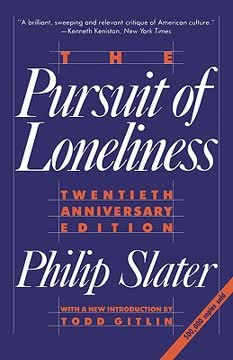
Key Takeaways
1. American Individualism Breeds Loneliness and Alienation
According to the American myth the individual is the end of society and individual expression is the index of political, social and economic vitality.
The individual's paradox. The American ideal of individualism, while celebrated as a cornerstone of freedom and vitality, paradoxically leads to profound loneliness and alienation. This cultural emphasis on self-reliance encourages people to minimize interdependence, seeking private solutions for every need, from housing to transportation. This relentless pursuit of autonomy, however, severs the very bonds that provide a comfortable sense of self and belonging.
Erosion of community. Historically, institutions like the extended family and stable local neighborhoods offered refuge from competitive pressures, providing spaces for trust and fraternity. These "oases" have steadily disappeared, leaving individuals to satisfy both their affiliative and invidious needs in the same, increasingly competitive, arenas. This erosion forces people into a precarious balance, intensifying the appeal of cooperative living while simultaneously making the longing for it more acute and suppressed.
Competitive encounters. As communication and shared spaces diminish, interactions with others become increasingly competitive and abrasive. People encounter fellow citizens not as collaborators, but as impediments—clogging highways, littering parks, or taking the last parking spot. This constant friction, born from a desire for privacy, ironically accelerates the very alienation it seeks to avoid, trapping Americans in a vicious cycle where the pursuit of individual distinction leads to monotonous uniformity.
2. Suppressed Desires Fuel Societal Rage
Those issues about which members of a given society seem to feel strongly all reveal a conflict, one side of which is strongly emphasized, the other side as strongly (but not quite successfully) suppressed.
Unmet human needs. American culture deeply frustrates three fundamental human desires: the wish for community, the need for direct engagement with problems, and the longing for healthy dependence. While individualism is overtly championed, these subordinate yearnings persist, creating internal conflict. When radical movements or alternative lifestyles personify these suppressed desires, they trigger an exaggerated panic and rage in the dominant culture, revealing the intensity of the internal struggle.
Fear as a bloated wish. Exaggerated fears of minorities or radical ideas often stem from a subconscious attraction to what they represent. Like the McCarthy era's fear of Communism, current anxieties about social movements are not primarily about physical danger, but about the unsettling possibility that these ideas might resonate with one's own secret doubts about the viability of the social system. This internal resonance must be stifled, often violently, because counterarguments are difficult to remember when a responsive chord is struck.
Cultural warping. Every culture attempts to warp human emotionality, permitting some reactions while suppressing others. In America, the emphasis on independence and competition means that desires for cooperation and shared responsibility are continually shouted down. This suppression, however, is never entirely successful, leading to a societal ambivalence where the very things most strongly denied—like the cooperative underside of competitive America—exert a powerful, seductive pull.
3. The "Toilet Assumption" Drives Superficial Problem-Solving
Our approach to social problems is to decrease their visibility: out of sight, out of mind.
Avoiding confrontation. American society exhibits a compulsive tendency to avoid confronting chronic social problems directly. Instead of extensive readjustments, the approach is to "wipe out" or "mop up" issues with short-term, often technological, solutions. This "toilet assumption" posits that unwanted difficulties will disappear if removed from immediate sight, leading to a cycle where problems are merely displaced, not resolved.
Consequences of invisibility. This avoidance mechanism has profound effects, from racial segregation to the institutionalization of the aged and mentally ill. By removing these problems from daily experience and consciousness, the general population loses the knowledge, skill, and motivation necessary to deal with them. When these discarded issues inevitably resurface—as riots or protests—society reacts with shock and disgust, calling for emergency measures to flush them away again.
Erosion of experience. Occupational specialization and modern conveniences, like the flush toilet, have censored our understanding of the world. We no longer confront the immediate realities of waste, poverty, or illness as past generations did. This creates a sterile, "chrome and porcelain vacuum" in our lives, leading to boredom and interpersonal insensitivity. Radical confrontations, though disruptive, offer a terrifying yet exciting break from this anesthetized existence, tapping into a latent hunger for genuine engagement.
4. Violence at a Distance: A Reflection of Societal Powerlessness
Our preference for violence at a distance is thus both an expression of and a revenge against this process.
Genocidal proclivities. America has a disturbing history of genocidal tendencies, from the extermination of Native Americans to the casual killing of Black Americans, and the use of atomic bombs. This attitude, particularly towards non-whites, extends to modern conflicts like Vietnam, where "rooting out the infrastructure" becomes a euphemism for indiscriminate killing, and the "body count" an end in itself. This "violence at a distance" is facilitated by technology, which insulates killers from the immediate consequences of their actions.
Impersonal injuries. Americans suffer mass impersonal injuries from mechanical forces against which they are powerless. Daily irritations—traffic jams, faulty technology, bureaucratic errors—are generated by vast, complex institutions where responsibility is diffuse. This powerlessness, coupled with the difficulty of locating the source of injury, leaves individuals feeling helpless and unable to express their rage directly.
Revenge on the remote. The preference for violence at a distance becomes both an expression of and revenge against this process of impersonal injury. Remote and unknown enemies, like those in Vietnam, become symbolic targets for the frustrations generated by an unresponsive technological environment. The very strangeness of the enemy amplifies hatred, allowing for the use of sadistic and genocidal instruments that would be unthinkable against a closer, more familiar foe.
5. Technology as an Authoritarian Master
We submit to an absolute ruler whose edicts and whims we never question.
Passive surrender. Americans, despite seeing themselves as masters of their environment, have passively surrendered to technological change. Society allows completely free rein to technological "progress" while opposing social change, effectively abdicating control over its social environment to a whimsical deity. This passive relationship means we constantly adapt to technology's disruptions rather than questioning its necessity or desirability.
The tyrannical father. Technology has inherited the cultural fantasy of the authoritarian father. While personal fathers may be benign, the technological environment acts as a fierce patriarch, demanding deference and absolute obedience. This ruthlessness, expressed in leveling landscapes and building massive infrastructure, indirectly afflicts children, perpetuating the myth of a punitive patriarch and a system of avoiding conflict through impersonal mechanisms.
Materialized fantasy. Technology is essentially materialized fantasy—the physical manifestation of previous generations' wishes. We are ruled by these past fantasies, which take time to unfold their social effects. This creates a situation where current generations are enslaved by the unconscious whims of their ancestors, perpetuating a cycle of technological dependence and a spurious sense of freedom.
6. The Intergenerational Chasm: Resentment and Unmet Expectations
The peculiarly exaggerated hostility that hippies tend to arouse suggests that the life they strive for is highly seductive to middle-aged Americans.
The Spockian challenge. Dr. Spock's influence reinforced child-centeredness, individualism, and feminine domesticity, implicitly challenging mothers to rear "perfect" children. This immense responsibility, coupled with the isolation and intellectual poverty of the housewife's role, creates a deep-seated resentment. Mothers, striving to meet this impossible ideal, often feel their sacrifices are unrewarded, leading to a free-floating anger directed towards youth who appear to live more pleasurably and authentically.
Vampiresque parenting. Parents, particularly in the middle class, often relate to their children in a "vampiresque" way, feeding on their accomplishments to sustain their own unfulfilled lives. This dynamic, satirized in "The Graduate," creates a profound guilt in children who must eventually break free to live their own lives. The elders' rage at youth's "bad form" or "dirty talk" masks their terror at having their own life choices challenged and their suppressed desires exposed.
Sexual desexualization. The older generation's denial of their own sexuality, particularly within the nuclear family, contributes to the generational chasm. While youth appear sexually liberated, their elders often undergo a stylistic desexualization, especially married middle-class women. This desexualization, necessary to defuse the overwhelming maternal input in child-rearing, creates a stark contrast with the overt sexuality of youth, fueling resentment and a sense of being "outgrown."
7. Pleasure Instrumentalized: The Scarcity of Satisfaction
The idea that pleasure could be an end in itself is so startling and so threatening to the structure of our society that the mere possibility is denied.
Artificial scarcity. American society, despite its affluence, operates on an artificial scarcity of gratification, particularly sexual pleasure. This scarcity is a cultural invention, more significant than fire, designed to harness human energy for continuous work. By attaching sexual interest to inaccessible or irrelevant objects—like cars or detergents—the impulse is manipulated, ensuring that desire remains unslaked and people continue striving for rewards that never truly satisfy.
The donkey and the carrot. To ensure a steady output of energy, society creates artificial scarcity, turning individuals into "donkeys" endlessly pursuing an inaccessible carrot. Romantic love, for instance, transmutes plentiful erotic desire into a scarce commodity by focusing it on a single, often unattainable, object. This "forced savings" of emotional energy, rooted in intensified parent-child relationships and the incest taboo, binds individuals to a lifelong pursuit of symbolic goals like fame, power, or wealth, which offer no true consummation.
Pleasure as a means. In this system, pleasure is only allowable as a means to an end that is itself a means, always yielding energy for the economy. Direct gratification is attacked, while symbolic stimulation is acceptable, creating a self-defeating cycle where the pursuit of "pure" experience (e.g., through drugs or pornography) only raises the stakes for further commercial exploitation. This instrumentalization of pleasure ensures that people remain angry and discontented, perpetuating a society that values productivity over human satisfaction.
8. Two Cultures Collide: Scarcity vs. Abundance
The new culture is based on the assumption that important human needs are easily satisfied and that the resources for doing so are plentiful.
Clash of worldviews. America is divided into two distinct cultures: the old, scarcity-oriented, technological culture and the amorphous, emerging counterculture. The old culture prioritizes property rights, technological requirements, competition, violence, and striving, assuming resources are limited. The new culture reverses these priorities, emphasizing personal rights, human needs, cooperation, sexuality, and gratification, based on the assumption of abundant resources.
Invidious values. The old culture's core flaw is its reliance on spurious, man-made scarcity, which now exists primarily to maintain the system itself. This leads to invidiousness becoming the foremost criterion of worth, where enjoyment is derived from denying pleasure to others. Advertising, for example, thrives on manufacturing illusions of scarcity, making people fight over products in a land of plenty, a parody of the old culture's competitive ethos.
Neotenous counterculture. The new culture, while a rejection of the old, also picks up latent themes from the American past, such as nostalgia for the Old West, communal living, and a simpler life. It embodies a "neotenous" quality, retaining childhood values like cooperation, spontaneity, and hedonism into adulthood. This re-emergence of suppressed values is deeply disturbing to old-culture adherents, who are both fascinated and repelled by what they had long stifled within themselves.
9. The Perilous Path of Social Change
Revolution does not occur when things get bad enough but when things get better - when small improvements generate rising aspirations and decrease tolerance for long-existing injustices.
Critique of gradualism. Revolutionaries often dismiss gradualism as mere conservative ingenuity, arguing that in a crisis, drastic action is necessary. However, all change contains an illusory element, with revolutionary moments often exaggerating their efficacy by ignoring the subtle, gradual shifts that precede and follow them. True change requires both radical and liberal pressures, as liberals soften the rigid status quo and radicals push the boundaries, creating rising expectations that make deeper transformation possible.
The activist-hippie dilemma. The new culture faces an internal split between militant activism and the hippie movement. Activists, focused on changing institutions, risk being corrupted by the old culture's utilitarian and power-oriented traits. Hippies, prioritizing inner experience and immediate gratification, risk being vulnerable and parasitic within a hostile external milieu. This dilemma highlights the challenge of achieving radical change without adopting the very values one seeks to overthrow.
Subverting the system. The old culture maintains control by defining legitimate pathways for change that subtly convert initial radical intent into conformity. The "politics of confrontation" offers a partial solution by operating in ambiguous spaces, challenging the system without fully playing by its rules. However, the ultimate goal is not just to dismantle old institutions but to redirect the motivational forces that created them, ensuring that new structures are rooted in different psychic foundations.
10. Reversing Priorities: From Means to Human Ends
We need to develop a human-value index - a criterion that assesses the ultimate worth of an invention or a system or a product in terms of its total impact on human life, in terms of ends rather than means.
Abandoning technological radicalism. To escape its self-destructive trajectory, America must reverse its pattern of technological radicalism and social conservatism. The current approach, where technological "progress" is blindly embraced and social change resisted, creates instability and misery. Instead, society must develop a "human-value index" to appraise systems and inventions based on their total impact on human life and satisfaction, rather than their internal metrics of wealth or innovation.
Defusing perverse incentives. The current economic system rewards self-aggrandizement and punishes altruism, creating a perverse incentive structure. Reforming this means shifting rewards to those who provide service and help others, rather than those who accumulate wealth. This could involve tax reforms that penalize the avaricious and subsidize the altruistic, or redirecting federal budgets from life-destroying activities to life-enhancing ones. The goal is to restore money to its rightful place as a medium of exchange, not an instrument of vanity.
De-intensifying parent-child bonds. Long-term motivational change requires reforming the psychic structures generated by family patterns, particularly de-intensifying the parent-child relationship. The current child-oriented, isolated nuclear family fosters "Oedipal" children, prone to narcissistic ambition. Breaking this cycle means establishing communities where children are socialized by many adults, parents have fulfilling lives beyond their children, and life is lived for the present, not vicariously through a future generation. This holistic approach is crucial for building a truly cooperative and communal world.
Review Summary
Most reviewers praise The Pursuit of Loneliness as remarkably prescient and still deeply relevant despite being written in 1970. Many highlight Slater's sharp critique of American individualism, consumerism, and the erosion of community as insights that feel just as applicable today. Readers appreciate his empathetic yet unflinching analysis, elegant prose, and ability to anticipate modern issues like technology-driven isolation. A few critics find the work dated, occasionally redundant, or ideologically flawed, but the overwhelming consensus celebrates it as essential, thought-provoking reading.