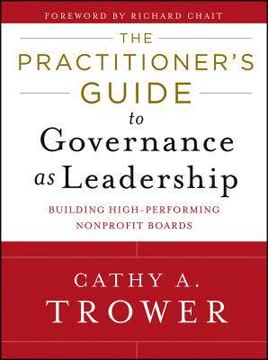
Key Takeaways
1. Embrace Governance as Leadership's Three Modes
The book emphasized that elevated purposes produce elevated performance.
Redefining governance. Traditional nonprofit governance often leaves board members feeling disengaged and underutilized, focusing on mundane tasks and ritualized meetings. The "Governance as Leadership" model reframes this by introducing three distinct, equally important modes of governance: fiduciary, strategic, and generative. This approach shifts the focus from merely doing work better to doing better work, elevating the board's purpose beyond basic compliance.
Three essential modes. Boards must operate adeptly in all three modes to add maximum value to their organizations.
- Fiduciary (Type I): Focuses on oversight, ensuring faithfulness to mission, accountability, and compliance with laws and regulations. It's about being a "night watchman" for tangible assets.
- Strategic (Type II): Concerns foresight, enabling boards and management to set priorities, chart the organization's course, and allocate resources. It's about aligning internal strengths with external opportunities.
- Generative (Type III): Involves insight and sensemaking, where the board acts as thoughtful leaders, bringing wisdom to critical issues before policies and strategies are formed. This mode is about framing problems and understanding organizational identity.
Beyond tasks. This model emphasizes mind-sets over mechanics and modes over tasks. Boards are encouraged to think in these three ways—as fiduciaries, strategists, and sensemakers—to provide oversight, foresight, and insight. This holistic approach aims for "consequential governance," where the board is a source of leadership, not just stewardship, leading to greater engagement and impact.
2. Unlock the Power of Generative Governance
Generative work means think first and think hard about what’s at issue and what’s at stake.
The neglected mode. While fiduciary and strategic modes are common, generative governance (Type III) is often the most neglected, yet potentially most consequential, type of work a board can do. It's the "genesis" of work, the thought process prior to acting, where boards collectively generate insight and understanding about ambiguous questions, problems, or opportunities. This involves deciding how the organization wishes to frame an issue, rather than just solving it.
Sensemaking before decisions. Generative thinking demands that boards make sense before they make decisions. It's about noticing cues and clues, choosing and using frames to interpret complex stimuli, and thinking retrospectively to establish a "dominant narrative" for the nonprofit. This process helps boards understand what problems need solving and what the preferred future looks like, rather than just how to get there.
Spotting opportunities. Generative opportunities are characterized by:
- Ambiguity: Multiple interpretations of what's happening.
- Saliency: High importance to many influential people.
- High stakes: Involves core values and organizational identity.
- Strife: High potential for confusion and conflict.
- Irreversibility: Decisions are difficult to revise.
Engaging in generative work early, when issues are still ambiguous, allows boards to influence the fundamental framing of challenges, preventing downstream "diagnosis momentum" and ensuring better, more aligned solutions.
3. Overcome Inherent Resistance to Transform Governance
Boards may know what to do, and do it reasonably well, but in the end they are derailed by the meaninglessness of what they do.
The cost of the status quo. Many boards underperform because their work feels meaningless, leading to disengagement and wasted time. Changing time-honored board traditions and culture is daunting due to a pervasive "status quo bias," where individuals prefer existing conditions and see change as a loss. This reluctance is often rooted in "Anxiety 1"—fear of change, difficulty in learning new practices, and the discomfort of challenging established norms.
CEO and board ambivalence. CEOs may feel vulnerable presenting questions instead of solutions, fearing it undermines their control or exposes uncertainty. Boards, accustomed to fiduciary discussions, may view generative conversations as "navel-gazing" or diversions from "real" work. This ambivalence can stem from:
- CEO perceptions: Boards seen as nuisances, ATMs, fiduciaries, or consultants, rather than thought leaders.
- Fear of conflict: Generative discussions might reveal schisms or unclarified values.
- Comfort zones: Board members prefer familiar fiduciary or strategic territory.
Strategies for getting started: To overcome this, leaders must create "Anxiety 2"—a greater anxiety about the cost of not changing. This can be achieved by:
- Surveying members: Gather data on board satisfaction and effectiveness.
- Building support: Position governance reform as an opportunity for engagement, fitness, and embodying core values, not a contest for control or a response to illness.
- Incremental experiments: Start with small, evaluated changes to build momentum.
- Calculating the cost: Quantify the risks of maintaining business as usual (e.g., erosion of competitive position, disengaged board).
4. Cultivate Critical Thinking and Combat Cognitive Biases
Good judgment is a “precarious balancing act” that requires “cognitive skills of the highest order”—the capacity to monitor one’s own thought processes for telltale signs of excessive closed- or open-mindedness and to strike a reflective equilibrium faithful to one’s conceptions of fair intellectual play.
Untapped potential. A significant portion of board members' intellectual capacity often remains untapped in meetings, which are typically designed for efficiency rather than critical thinking. This leads to passive listening and rubber-stamping, hindering consequential governance. Boards must foster metacognition—thinking about thinking—and apply "universal intellectual standards" like clarity, accuracy, and fairness to their deliberations.
Impediments to critical thinking. Human nature and cognitive biases frequently derail critical thought:
- Being wrong/certain: People resist admitting error, clinging to beliefs, and feeling certain even when incorrect (diagnosis momentum).
- Loss aversion: Preferring to avoid losses over acquiring gains, leading to irrational decisions.
- Delusions of rationality: Believing decisions are purely logical, ignoring emotional influences.
- Cognitive biases: Anchoring (first information sticks), framing (language shapes perception), confirmation bias (seeking confirming evidence), false consensus (assuming others agree), and bounded awareness (ignoring critical information).
Workarounds for better judgment. Boards can implement compensatory measures:
- Silent starts: Anonymously gather initial thoughts to avoid anchoring.
- Generative discussions: Explicitly frame issues to challenge assumptions.
- Predecisional accountability: Require members to justify decisions to an unknown audience.
- Decisive dialogue: Foster openness, candor, informality, and closure in discussions.
- "Getting on the balcony": Step back to observe patterns and test interpretations.
- Devil's advocates/inquisitors: Assign roles to challenge prevailing views and ask probing questions.
5. Build the Board as a High-Performing Team
No team is more vital to the organization’s success than the board, but at the same time, no other team faces so many unique obstacles to team performance.
Beyond a collection of individuals. For boards to truly fulfill their mission, they must evolve from mere "working groups" or "pseudo-teams" into high-performing teams. This means moving beyond individual influence to collective responsibility, shared purpose, and mutual accountability. Boards, as social systems, face unique challenges like infrequent interaction, members accustomed to leading, and complex authority lines.
Elements of an effective board team:
- Strategic composition: Beyond demographics and professional expertise, recruit members for diverse perspectives, critical thinking styles (e.g., foxes over hedgehogs), and a commitment to team play.
- Shared purpose: Develop a clear board mission statement and discuss legacy questions to align individual motivations with collective goals.
- Explicit norms: Codify behavioral expectations, including respect, trust, candor, and constructive dissent, to guide interactions. Examples include "Board Operating Agreements" or "Trustee Codes of Conduct."
- Effective orientation: Beyond factual information, onboard new members to the board's culture, norms, and how it operates in the three modes.
- Mutual accountability: Implement mechanisms like individual self-assessments and board team surveys to foster self- and peer-management, ensuring all members contribute meaningfully.
Skilled leadership. The CEO and board chair are crucial in building, energizing, and motivating the board as a team. This includes transparent chair selection processes and elevating the governance committee's role beyond just nominations to encompass broader board development and performance.
6. Forge a Governance-Friendly Culture of Inquiry
Make no mistake: it is the board’s culture—the shared values and beliefs that delineate acceptable behavior—that ultimately determines how effective the board can be.
Culture's profound impact. A board's culture, comprising visible artifacts, espoused values, and deeply ingrained underlying assumptions, dictates its effectiveness. Toxic cultures—like the "culture of maybe" (analysis paralysis), "culture of no" (blocking dissent), or "culture of yes" (superficial agreement)—can stifle critical thinking and prevent meaningful action. A "governance-as-leadership-friendly" culture, by contrast, is one of inquiry, where dialogue, candor, and dissent are valued.
Key cultural markers:
- Collective discernment and sensemaking: The board actively engages in problem-finding, framing issues, and learning from experience, rather than just solving problems presented by management. This involves working at the organization's internal and external boundaries to gather diverse cues and clues.
- Board-management collaboration: Lines between board and management blur in strategic and generative modes, fostering a true partnership where both parties work together on important issues, rather than being territorial.
- Diligence through productive engagement: Boards leverage multiple forms of capital (intellectual, reputational, political, social) beyond just financial. This requires collegiality (respectful challenge) over mere congeniality (passive agreement), encouraging dissent, and sanctioning renegade behaviors that undermine trust and productivity.
Driving culture change. Implementing Kotter's eight steps for change—establishing urgency, forming a powerful coalition, creating a vision, communicating it, empowering others, creating short-term wins, consolidating improvements, and making change stick—can help transform a board's culture. This ensures that new governance practices become embedded as "the way we do things around here."
7. Design Agendas for Impact, Not Just Efficiency
Agendas are artifacts of bureaucracy designed to control and organize discussions that might otherwise meander unproductively. Imperfect as they are, agendas are valued precisely for this reason. But leadership creates value by interrupting such routine.
Beyond routine. Traditional board agendas often prioritize routine business and reports, leading to passive listening and missed opportunities for deep engagement. To foster a "governance-as-leadership-friendly" culture, agendas must be intentionally designed to interrupt this routine and elicit critical thinking, dialogue, and debate on consequential issues.
Characteristics of effective agendas:
- Form follows function: Design the agenda based on desired outcomes and where board members can add the most value.
- Clear goals: Explicitly state what the board aims to achieve at each meeting.
- Consent agenda: Bundle routine, non-controversial items for quick approval, freeing up time for substantive discussions.
- Strategic prioritization: Place the most important strategic and generative topics early in the meeting, allocating significant time for them.
- Question-driven: Include open-ended questions for consideration, encouraging framing and sensemaking before decisions are required.
- Interaction over reports: Minimize lengthy presentations; send materials in advance with guiding questions for pre-reading.
- Summary and evaluation: Allocate time at the end to summarize discussions, define next steps, and evaluate the meeting's effectiveness.
Real-world application. Examples like Cabrini Green Legal Aid demonstrate how redesigning agendas—shifting from a series of updates to focused discussions on mission-critical questions—can dramatically increase board engagement and the quality of deliberations. This ensures that precious board time is spent on issues that truly matter to the organization's future.
8. Leverage Data with Organizational Dashboards
The very process of creating one, with the staff, allows the board to discern what matters, and is thus a very important collaborative learning experience.
Beyond financial metrics. While financial oversight is crucial, boards often need a broader view of organizational performance to govern effectively. Organizational dashboards provide "at-a-glance" insights into critical success factors, moving beyond mere data to actionable information. These dashboards should include key performance indicators (KPIs) that are easy to understand, relevant, strategic, quantitative, and up-to-date.
Benefits of dashboards:
- Focus and accountability: Keep the board's attention on what matters most, holding both management and the board accountable for institutional performance.
- Strategic dialogue: Indicators that are off-target provide fodder for rich board discussions, prompting deeper inquiry into underlying causes and potential solutions.
- Collaborative learning: The process of creating a dashboard, involving both staff and board, is a powerful sensemaking opportunity, revealing institutional priorities, values, and challenges.
- Informed decision-making: By tracking trends and comparing performance against benchmarks, boards can make more informed decisions, as seen in St. Paul's School's use of dashboards to manage endowment reliance and Baylor Health Care System's linking of CEO compensation to strategic KPIs.
Beyond the numbers. While dashboards emphasize quantitative measures, boards must also consider qualitative factors and the interplay between different metrics. The goal is not to reduce complex organizational realities to numbers, but to use data as a springboard for deeper understanding, critical thinking, and strategic action.
9. The CEO-Chair Partnership is Pivotal to Adaptive Governance
Most governance experts agree that the relationship between the board chair and the chief executive officer is critical to board effectiveness and important to organizational success.
The dynamic duo. Effective governance begins and ends with the CEO and board chair. This "dynamic duo" sets the tone, manages interactions, and clarifies norms, profoundly influencing the board's effectiveness. The CEO's perception of the board—as thought leaders to be engaged, rather than nuisances to be handled—is foundational. Similarly, the chair's leadership style, whether presiding or guiding, shapes the board's capacity for adaptive work.
Adaptive leadership in action. Both leaders must embrace adaptive leadership, focusing on clarifying values and enabling the organization to thrive through change, rather than just applying technical fixes.
- CEO's role: Invite the board into early, upstream challenges; emphasize sensemaking; highlight ambiguous issues; engage the board collectively; and deliberate rather than persuade. They must be willing to share generative work and be open to questions, not just provide answers.
- Chair's role: Act as the "conductor," setting the tone, enforcing norms, drawing out diverse views, guiding sensemaking, and seeking feedback. They must be a close confidante to the CEO and an intermediary between the board and management.
Nurturing the relationship. The CEO and chair must actively cultivate their relationship through regular, candid discussions about their partnership and organizational challenges. This mutual trust and understanding are essential for navigating difficult issues, modeling desired behaviors, and galvanizing the board towards higher performance. Without a strong, aligned partnership, efforts to transform governance are likely to falter.
10. Measure and Reflect for Continuous Board Improvement
The better the board understands governance, the better governed the organization will be.
Accountability through assessment. Sustaining governance excellence requires continuous measurement and reflection. Boards must hold themselves accountable for collective performance, moving beyond anecdotal evidence to systematic evaluation. This involves understanding what the board does well, where it falls short, and taking deliberate actions for improvement.
Methods for assessing board performance:
- Interviews: Conduct personal interviews with board and senior staff members to gather rich, nuanced data on board dynamics, culture, and key issues.
- Outsider observation: Engage an external consultant to observe meetings and provide objective feedback on processes, discourse quality, and cultural elements.
- Reflective practice: Encourage the board to regularly engage in retrospective sensemaking by:
- Examining past agendas for evidence of trimodal work.
- Discussing experiences after experimenting with new governance practices.
- Analyzing successful and unsuccessful past decisions to identify lessons learned.
- "Thinking forward" by considering what future success looks like and what might impede progress.
- Board self-assessment surveys: Utilize structured surveys to gauge performance across key dimensions like fiduciary, strategic, and generative responsibilities, organizational context, operations, meeting effectiveness, composition, and personal experience. These can also assess the "information gap"—what the board is versus should be informed about.
Actionable insights. The value of assessment lies not just in collecting data, but in the board's willingness to discuss findings, make sense of surprising or troubling results, and commit to actionable steps. This iterative process of measurement, reflection, and adaptation is crucial for embedding governance as leadership into the board's DNA.
11. Sustain Governance Excellence Through Vigilance and Coaching
You can be a really good organization without a great board but you won’t go to that greatness level without a great board.
The ongoing journey. Achieving governance excellence is not a one-time event but an ongoing journey requiring constant vigilance. Boards, like individuals striving for physical fitness, can easily backslide into old, comfortable habits. Sustaining governance as leadership demands persistent effort from the CEO, board chair, and a dedicated governance committee focused on continuous improvement.
Key elements for sustainability:
- Institutionalized practices: Embed new governance practices into board routines, bylaws, and orientation processes so they become second nature.
- Ongoing education: Provide continuous learning opportunities for board members on governance best practices, sector trends, and critical thinking skills.
- Proactive governance committee: Empower this committee to champion governance excellence, oversee assessments, ensure effective board composition, and support leadership development.
- External support: Consider engaging a "governance coach" to provide objective guidance, expertise, and accountability during the transition and beyond. A coach can help boards navigate challenges, name "elephants in the room," and reinforce new mindsets and behaviors.
The ultimate payoff. Investing in governance is an investment in the organization's future. A great board, characterized by engaged members, critical thinking, effective teamwork, and adaptive leadership, provides the courage, insight, wisdom, and resources necessary to elevate a nonprofit from good to truly great, ensuring its resilience and impact in an ever-changing world.