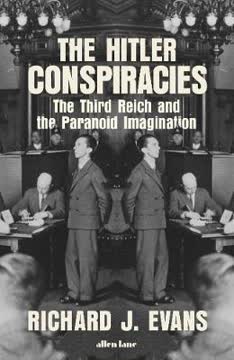
Punti chiave
1. Conspiracy Theories: An Enduring Human Phenomenon Fueled by Uncertainty
The idea that nothing happens by chance in history, that nothing is quite what it seems to be at first sight, that everything that occurs is the result of the secret machinations of malign groups of people manipulating everything from behind the scenes, is as old as history itself.
Ancient roots. Conspiracy theories, rooted in the belief that hidden forces orchestrate major events, are not new, but their prevalence has surged in the 21st century, amplified by the internet and social media. This phenomenon thrives on a declining trust in traditional information gatekeepers like journalists and publishers, and a growing acceptance of "alternative facts." Richard Hofstadter's "The Paranoid Style in American Politics" (1964) described this as a "heated exaggeration, suspiciousness, and conspiratorial fantasy," where enemies are seen as manufacturing history rather than being caught in its currents.
Personalized history. Conspiracy theories offer a distinctly personal interpretation of history, where decisive events are attributed to someone's will, not the vast, impersonal mechanism of history. This perspective often involves a surprising level of pedantry and pseudo-scholarship, as proponents heroically strive for "evidence" to prove the unbelievable. They provide a comforting, albeit false, sense of understanding in a complex world, reducing intricate processes like wars, revolutions, or economic crises to the actions of a single, tightly organized group.
Hitler's centrality. Adolf Hitler, in particular, has become a fixed reference point for evil in Western culture, making him a potent figure in countless conspiracy theories. His name frequently appears in online discussions, embodying an absolute standard of malevolence. This association lends a dramatic, good-versus-evil dynamic to narratives, attracting both those who genuinely believe in hidden forces and those who seek to bolster their own claims by linking them to such a notorious historical figure.
2. The Protocols of the Elders of Zion: A Forged Blueprint for Antisemitic Hatred
The document known generally as The Protocols of the Elders of Zion actually bears the heading ‘From the Reports of the “Wise Men of Zion” on the Meetings held at the First Zionist Congress held in Basel in 1897’ – ‘protocols’ here, essentially means ‘minutes’.
A fabricated text. The Protocols of the Elders of Zion, a notorious antisemitic forgery, purports to be the minutes of secret meetings where Jewish leaders plot global domination. This rambling, contradictory text, assembled around the turn of the 20th century, is a mishmash of French, German, and Russian sources, including extensive plagiarism from a French satire on Napoleon III. It falsely claims to reveal a systemic conspiracy by a universal Jewish organization to undermine society through divisive ideologies like liberalism, socialism, and anarchism, controlling the press and economy to achieve a Jewish dictatorship.
Limited direct influence on Hitler. Despite its widespread distribution and the claims of some historians, the Protocols' direct influence on Hitler's specific actions or detailed ideology was limited. Hitler's private library did not contain a copy, and he learned of its content indirectly, primarily through Henry Ford's antisemitic tract, "The International Jew." While he referenced it in "Mein Kampf," he did so only once, stating that its "inner truth" lay in its horrifying reliability in exposing the "nature and activity of the Jewish people," rather than its factual authenticity.
Racial instinct, not conscious plot. For Hitler and other Nazi leaders like Goebbels, the Protocols' significance was not as a literal blueprint for a conscious Jewish conspiracy, but as a confirmation of what they already "knew" about Jewish "racial instinct." They believed Jews were inherently subversive, acting by racially determined impulse rather than through an active, clandestine group of "Elders of Zion." This interpretation allowed them to dismiss the document's proven fraudulent nature, viewing it as a "pious falsehood" that revealed a "higher truth" about Jewish character, ultimately contributing to the atmosphere that enabled the Holocaust.
3. The "Stab-in-the-Back" Legend: A Myth of Internal Treachery for WWI Defeat
As an English general has very truly said, the German Army was “stabbed in the back”.
Blaming the home front. The "stab-in-the-back" legend emerged after Germany's defeat in World War I, claiming that the undefeated German army was betrayed by internal forces on the home front. This myth, popularized by figures like Field-Marshal Paul von Hindenburg, falsely attributed Germany's military collapse to civilian weakness, socialist agitation, and the November 1918 revolution, rather than the overwhelming Allied military superiority and the exhaustion of German resources. Hindenburg's testimony before a parliamentary committee, citing a misquoted English general, lent immense credibility to this narrative.
Political utility. The legend served as a potent propaganda weapon for the nationalist right, discrediting the democratic Weimar Republic and its founders, particularly the Social Democrats. It evolved from a general accusation of declining morale to a specific conspiracy theory alleging deliberate subversion by socialists, communists, and pacifists to cause Germany's defeat and usher in a revolution. This narrative ignored the fact that the armistice terms were already being negotiated before the revolution broke out, and that the army's morale had collapsed due to military failures.
Antisemitic variant. The most radical versions of the myth incorporated virulent antisemitism, portraying Jewish individuals as the "wire-pullers" behind socialist and revolutionary movements. This variant, propagated by ultra-nationalist groups, falsely accused Jews of being "war profiteers" and "shirkers," despite evidence from a suppressed wartime census showing high Jewish participation at the front. For figures like Hans Blüher, the "stab-in-the-back" was an "essential truth" rooted in the "Jewish spirit of defeatism," impervious to factual refutation, thus linking Germany's defeat directly to an imagined Jewish conspiracy.
4. The Reichstag Fire: A Lone Arsonist's Act Exploited for Dictatorship
God grant,’ he said, ‘that this be the work of the Communists. You are now witnessing the beginning of a great new epoch in German history, Herr Delmer. This fire is the beginning.’
A pivotal event. The burning of the Reichstag building on February 27, 1933, just weeks after Hitler became Chancellor, was a pivotal event that the Nazis immediately exploited. Hitler and Göring, arriving at the scene, quickly declared it a Communist plot, despite arresting only one individual, Marinus van der Lubbe, a Dutch anarcho-syndicalist. This alleged conspiracy provided the pretext for the Reichstag Fire Decree, which suspended civil liberties and paved the way for the Nazi dictatorship, allowing for the mass arrest and imprisonment of political opponents.
Competing narratives. The event spawned two diametrically opposed conspiracy theories:
- Nazi version: Communists set the fire as the first step in a coup. This was largely discredited even by the German Supreme Court, which found only van der Lubbe guilty.
- Communist version: The Nazis orchestrated a "false flag" operation to justify their crackdown. This theory, popularized by "The Brown Book of the Hitler Terror," alleged that Nazi stormtroopers entered through a secret tunnel, set multiple fires, and left van der Lubbe as a scapegoat.
Evidence for sole culpability. Extensive research, notably by Fritz Tobias and Hans Mommsen, has overwhelmingly supported the conclusion that van der Lubbe acted alone. Evidence includes:
- Van der Lubbe's consistent confession and detailed reconstruction of events.
- Lack of evidence for flammable liquids or multiple arsonists.
- Discrediting of "The Brown Book's" key sources, including forged documents and unreliable testimonies.
- Physical evidence disproving the use of a secret tunnel by multiple arsonists.
- Nazi leaders' genuine surprise and panic at the fire, as reported by eyewitnesses like Sefton Delmer.
Despite persistent attempts to revive the Nazi-plot theory, often through fabricated evidence and attacks on the integrity of dissenting historians, the historical consensus remains that van der Lubbe was the sole perpetrator.
5. Rudolf Hess's Flight: A Desperate Solo Mission, Not a Secret Peace Plot
‘Without a doubt this is the work of the Communists, Herr Chancellor,’ Göring said. ‘A number of Communist deputies were present here in the Reichstag twenty minutes before the fire broke out. We have succeeded in arresting one of the incendiaries.’
An unexpected journey. On May 10, 1941, Rudolf Hess, Hitler's deputy, flew a Messerschmitt Bf110E to Scotland, parachuting out near the estate of the Duke of Hamilton. Hess, increasingly marginalized in the Nazi hierarchy and obsessed with preventing a two-front war, believed he could negotiate a peace with Britain, fulfilling Hitler's earlier desire for a British alliance. He hoped to connect with a perceived "peace party" in British political circles, a notion based on a profound misunderstanding of British wartime resolve and Churchill's unassailable position.
Hitler's genuine surprise. All credible contemporary sources indicate that Hess's flight took Hitler completely by surprise, eliciting rage and despair rather than complicity. Hitler had previously banned Hess from flying due to safety concerns, and Hess's letter to Hitler, delivered after his departure, outlined his solo initiative. The idea of a secret pact of silence between them is pure speculation, lacking any supporting evidence. Furthermore, Hitler would have chosen a more skilled diplomat and a less risky method if he genuinely sought peace with Britain, especially with the invasion of the Soviet Union just weeks away.
Debunking conspiracy theories. Conspiracy theories surrounding Hess's flight, often claiming Hitler's prior knowledge or a British plot to lure him, are based on:
- Hearsay and speculation: Relying on unreliable accounts, misinterpretations of documents, or the absence of evidence.
- Forged documents: As seen with Martin Allen's fabricated evidence in the British National Archives.
- Exaggerated British Secret Service capabilities: Overestimating MI5's ability to orchestrate such a complex deception in 1941.
- The "peace party" fallacy: No evidence of a coherent group in Britain willing to overthrow Churchill or negotiate with Hess.
The overwhelming evidence points to Hess acting alone, driven by his own illusions and declining influence, making his mission a "fool's errand" with no strategic impact on the war.
6. Hitler's Death: Overwhelming Evidence Debunks Survival Myths
The earthly remains of Adolf Hitler,’ as Ian Kershaw concludes in his monumental biography of the Nazi leader, ‘it appears, were contained in a cigar-box.’
The official narrative. On May 1, 1945, German radio announced Hitler's death, claiming he died fighting Bolshevism. However, Soviet disinformation, driven by Stalin's political motives to portray Hitler as a coward and justify a harsh stance on Germany, initially fueled rumors that Hitler had escaped. This created a vacuum for speculation, leading to widespread sightings of the Nazi leader in various disguises and locations, from South America to a Tibetan monastery.
Comprehensive investigations. Despite initial confusion, multiple independent investigations have conclusively confirmed Hitler's suicide:
- Hugh Trevor-Roper's 1947 report: Based on extensive interviews with bunker survivors, it established the broad outline of Hitler's final days.
- Berchtesgaden court investigation (1950s): Declared Hitler officially dead after interviewing released Soviet captives, including his valet Heinz Linge.
- Soviet "Operation Myth" (1949, declassified 1990s): Independently corroborated Western findings, including Linge's and Hitler's adjutant Otto Günsche's testimonies.
Irrefutable evidence. The combined evidence paints a clear picture:
- Hitler consistently rejected escape, focusing on his place in history.
- He married Eva Braun, dictated his will, and tested cyanide on his dog.
- On April 30, 1945, he and Eva Braun committed suicide (he by gunshot, she by cyanide).
- Their bodies were doused in petrol and burned in the Reich Chancellery garden.
- Soviet troops recovered charred remains, and dental records confirmed Hitler's and Eva Braun's identities.
Persistent myths. Despite this overwhelming evidence, the myth of Hitler's survival, particularly his escape to Argentina, persists, fueled by:
- Sensationalist media and "alternative knowledge" communities.
- Forged documents and unreliable testimonies (e.g., "Gestapo Chief" by "Gregory Douglas").
- The psychological appeal of Hitler cheating death, portraying him as a "superman" who outwitted his enemies.
These survival myths, often intertwined with neo-Nazism and antisemitism, trivialize the Allied victory and the horrors of the Holocaust, serving as a dangerous form of historical revisionism.
7. The Self-Sealing Logic: How Conspiracy Theories Resist Disproof
Criticism, all the way up to their exposure as plagiarized and falsified, generally meets with the response that the critics are themselves part of the conspiracy, either Jewish or tools of the Jews.
Immunity to evidence. A defining characteristic of conspiracy theories is their self-sealing nature, making them impervious to factual refutation. When confronted with evidence that disproves their claims, proponents often dismiss critics as being part of the conspiracy, either as direct participants or as unwitting tools of the plotters. This tactic shifts the focus from the validity of the argument to the motives or character of the accuser, effectively creating an unchallengeable ideological cocoon.
"Higher truth" justification. Many conspiracy theorists, even when acknowledging that their "evidence" might be forged or factually incorrect, argue that it reveals a "higher truth" that transcends empirical verification. For instance, some proponents of the Protocols of the Elders of Zion admitted it was a forgery but insisted it captured the "essential truth" of Jewish subversion. This allows them to maintain their beliefs regardless of demonstrable falsehoods, prioritizing intuition or ideological conviction over verifiable facts.
Missing evidence and mysterious deaths. When direct evidence is lacking, conspiracy theories often resort to claims of suppressed or destroyed documents, or the mysterious deaths of key witnesses. This implies a deliberate cover-up by powerful elites to conceal the "real truth." For example:
- In the Reichstag Fire, alleged Nazi arsonists supposedly died in the "Night of the Long Knives" to ensure their silence.
- In Hess's flight, "missing papers" and "closed archives" are cited as proof of a hidden British plot.
- In Hitler's survival, the absence of his body or the "strange" deaths of those who might know the truth are used to fuel speculation.
This constant invocation of hidden or destroyed evidence reinforces the conspiracist's belief that they alone are privy to the "real truth," boosting their self-esteem and solidifying their worldview against external challenges.
8. The "Cui Bono" Fallacy: Assuming Guilt from Benefit
Conspiracy theories, as Michael Butter has remarked, always start at the end of an event. They begin by asking the question cui bono? – whom does the event benefit?
The core assumption. A fundamental logical fallacy underpinning many conspiracy theories is the "cui bono" argument: the assumption that whoever benefits from an event must have caused it. This simplistic reasoning allows proponents to bypass complex causal chains and attribute agency directly to perceived beneficiaries, often without any direct evidence of their involvement. This approach reduces intricate historical processes to a straightforward narrative of intentional manipulation.
Examples of "cui bono" in action:
- French Revolution: Benefited Jews, Freemasons, and Illuminati, therefore they must have orchestrated it.
- WWI German Defeat: Benefited German liberals, democrats, and socialists (who formed the Weimar Republic), therefore they "stabbed the army in the back."
- Reichstag Fire: Benefited Hitler and the Nazis (by enabling dictatorship), therefore they must have set the fire.
- Hess's Flight: If it had led to peace, it would have benefited Britain (by ending the war), therefore the British Secret Service must have lured him.
Ignoring complexity. This fallacy often leads to a reductionist view of history, where complex political, social, and economic factors are ignored in favor of a single, malevolent cause. It allows for the dismissal of inconvenient truths and the reinforcement of existing prejudices. For instance, instead of analyzing the economic and military realities of WWI, the "stab-in-the-back" myth simply blamed political opponents.
By starting with the outcome and working backward to identify a culprit, the "cui bono" fallacy provides a seemingly logical, yet often baseless, foundation for conspiratorial narratives, making them appealing to those seeking simple explanations for complex events.
9. The Allure of "Alternative Knowledge": Rejecting "Official" Truths
All of them, however, in one way or another, belong to communities of alternative knowledge.
Beyond mainstream narratives. Conspiracy theories thrive within "communities of alternative knowledge," where individuals share a common disdain for "official knowledge" disseminated by mainstream media, historians, and governments. These communities, ranging from organized groups to loose online networks, reinforce their collective identity and sense of worth by embracing narratives that challenge accepted facts, believing they alone have penetrated the "veil of secrecy."
Psychological and social drivers:
- Sense of empowerment: Believers feel privy to hidden truths, boosting their self-esteem and intellectual superiority over the "deceived masses."
- Simplification of complexity: Conspiracy theories offer clear-cut explanations for confusing events, reducing anxiety in an uncertain world.
- Moral clarity: They often present a world of absolute good versus evil, providing a comforting framework against life's moral ambiguities.
- Community and belonging: Sharing these beliefs fosters a sense of camaraderie and validation among like-minded individuals.
Interconnected narratives. Within these communities, belief in one conspiracy theory often correlates with belief in others. For example, proponents of Hitler's survival might also be:
- Ufologists: Believing in secret Nazi bases in Antarctica or on the moon.
- Occultists: Linking Nazism to supernatural powers or ancient mysteries.
- "Truthers": Questioning official accounts of events like 9/11 or JFK's assassination.
- Holocaust deniers: Rejecting the historical reality of the Holocaust.
This interconnectedness creates a dense web of pseudo-information, where each theory reinforces the others, making it difficult for adherents to break free from the conspiracist mindset.
10. The Dangerous Real-World Impact of Conspiracy Theories
Bogus history does harm. It offends war veterans and millions of victims of the Nazis. To suggest Hitler retired to some hideaway with the connivance of the western allies is insulting. It trivialises and negates the hard-won victory over the Nazis.
Eroding trust and inciting violence. While some conspiracy theories may seem harmless, their cumulative effect can be profoundly damaging. They erode public trust in institutions, experts, and objective truth, making rational discourse and informed decision-making difficult. Historically, they have directly incited violence, as seen with the Protocols of the Elders of Zion contributing to an atmosphere that led to pogroms and the Holocaust, or the "Pizzagate" hoax leading to an armed attack on a restaurant.
Historical revisionism and moral relativism. Conspiracy theories often serve as vehicles for historical revisionism, seeking to rehabilitate discredited figures or undermine established historical narratives. For example, the Hitler survival myth, by portraying him as a genius who cheated death, can inadvertently foster admiration for the Nazi leader. Similarly, suggesting that Allied leaders were complicit in his escape or that Churchill prolonged the war trivializes the sacrifices made to defeat Nazism and can be deeply offensive to victims and veterans.
Undermining truth itself. Perhaps most alarmingly, some conspiracy theories implicitly or explicitly suggest that whether their claims are factually true or not doesn't ultimately matter, as long as they convey a "higher truth." This radical skepticism casts doubt on the very idea of objective truth, making it challenging to organize society on rational principles. In an age of widespread misinformation, the painstaking work of historical research, which demands critical examination of evidence and a willingness to abandon preconceptions, becomes more crucial than ever to distinguish fact from dangerous fiction.
Sintesi delle recensioni
null